The Name Tag That Changed Everything
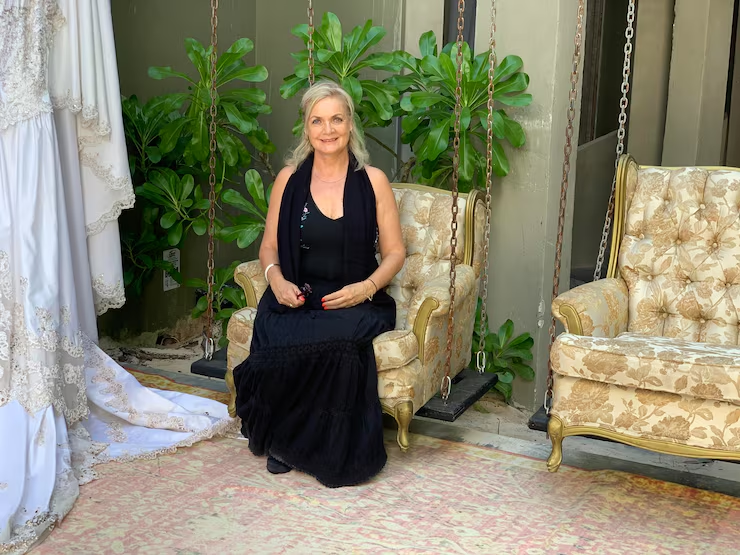
My name is Alice Edwards. I’m sixty-five years old, a widow living in a neat brick house on the edge of town—the same house where I brought my newborn son home forty years ago, the same house where I held my husband’s hand as he took his last breath three years ago.
Robert and I built our life together the old-fashioned way: slowly, carefully, with more attention to substance than appearance. He started with one hardware store and grew it into a chain of seven across three counties. I raised our son Richard, managed our home, and kept the books in the early years when every penny mattered. We weren’t flashy people. We drove sensible cars, took modest vacations, and believed that wealth was something you stewarded quietly, not something you flaunted.
When Robert died, he left me more than comfortable. The stores had been sold five years earlier, the investments were solid, and the house was paid off decades ago. My life became smaller after his death—quieter, simpler—but not empty. I had my garden, my book club, my volunteer work at the library. And I had Richard and his family: his wife Pamela, and their daughter Jennifer, my only grandchild.
Jennifer was getting married. Twenty-four years old, bright and beautiful, marrying a young man named Connor who seemed decent enough, if a bit colorless. The wedding had been in planning for eighteen months—a timeline that seemed excessive to me, but Pamela insisted everything had to be “perfect.”
“Perfect” apparently required a budget that made my eyes water.
The venue: Westbrook Hotel, the most expensive in the county, with crystal chandeliers and marble floors and a ballroom that seated three hundred. The dress: custom-designed, imported lace, a price tag I was asked not to share with “anyone who might judge.” The flowers: peonies and garden roses, out of season, flown in from somewhere warm. The cake: seven tiers of fondant artistry that cost more than my first car.
Every time a new invoice appeared, Pamela would call with that particular tone—bright, cheerful, apologetic only in the most superficial way.
“Alice, I hate to bother you, but the calligrapher needs a deposit for the place cards. It’s only thirty-five hundred. Can you put that on the card you gave us?”
“Alice, the photographer wants to secure the date with a down payment. Seventy-five hundred. Is that okay?”
“Alice, Jennifer just fell in love with these napkin rings—they’re vintage crystal, absolute treasures—but they’re eighteen dollars each and we need two hundred. You don’t mind, do you?”
I never said no. How could I? This was my granddaughter’s wedding, possibly my only grandchild’s only wedding. Robert and I had saved for exactly these kinds of moments—the milestones, the celebrations, the memories that outlast us.
But somewhere around invoice number forty, I began to feel less like a generous grandmother and more like a checkbook with a pulse.
Richard never called about the money. He’d text occasionally—”Thanks for covering the band, Mom. You’re the best”—but the actual requests always came through Pamela, as if my son had subcontracted his gratitude along with everything else.
Still, I told myself this was normal. Modern weddings were expensive. Young couples needed help. This was what grandparents did.
I told myself that right up until the morning of the wedding, when I stood in front of my bedroom mirror in the pale blue dress Robert had always loved and tried to remember why I’d agreed to pay for any of this.
The Church
The ceremony was at St. Andrew’s Episcopal, the church where Robert and I had been married forty-two years earlier. The same stained glass windows, the same oak pews, the same faint smell of furniture polish and ancient hymnals. For a moment, walking through those doors, I felt Robert beside me—not in a mystical way, but in the muscle memory of having walked this path together so many times before.
The church was beautiful. Pamela had achieved her “perfect” vision: white roses everywhere, candles glowing in tall glass hurricanes, ribbon marking the family pews. Jennifer looked radiant in her expensive dress, her face glowing with genuine happiness that made all the invoices seem almost worth it.
Richard walked her down the aisle, his chest puffed with that particular father-of-the-bride pride. I watched from the front pew, handkerchief ready, heart full despite everything. This was my granddaughter. This was family. This was love.
Connor stood at the altar looking nervous and young and earnest. The vows were traditional. Jennifer’s voice shook when she said “I do.” The organ swelled. They kissed to applause that echoed off the vaulted ceiling.
In that sanctuary, under soft light and sacred promises, I let myself believe this day was about something larger than money. I let myself feel generous instead of used.
That feeling lasted exactly until I reached the reception venue.
The Name Tag
The Westbrook Hotel ballroom was a masterpiece of Pamela’s planning: more white roses, more candles, tables draped in champagne-colored linens with centerpieces that probably cost more than most people’s rent. A string quartet played in the corner. Waiters circulated with champagne and tiny, expensive-looking hors d’oeuvres.
I’d been here once before, for a charity gala Robert had supported. The ticket price had been shocking then. Now I was paying for the entire event.
The check-in table stood near the entrance, staffed by two young women in black dresses. Guests lined up to receive their name tags and table assignments—elegant cards in calligraphy, each one personalized, each one costing eighteen dollars according to invoice number twenty-three.
I waited my turn, smiling at relatives I hadn’t seen in years, accepting compliments on my dress and congratulations on Jennifer’s beauty. When I reached the front, the young woman—blonde, twenty-something, professionally cheerful—rifled through the cards.
“Name, please?”
“Alice Edwards. Grandmother of the bride.”
“Oh, of course! Here you are, Mrs. Edwards.”
She handed me the card with a bright smile, already looking past me to the next guest.
I glanced down, expecting to see my name and “Grandmother of the bride” in that expensive calligraphy.
Instead, in elegant, swirling script, it read:
“The old lady who will pay for everything, my gal.”
The world went very, very quiet.
Not silent—the string quartet still played, conversations still hummed, champagne glasses still clinked—but all of it became distant, muffled, like I’d been plunged underwater.
I have lived sixty-five years. I’ve weathered recessions and my own mother’s death and the year Richard was thirteen and hated me for reasons he couldn’t articulate. I’ve sat through my husband’s cancer diagnosis and held his hand through treatments that left him hollowed out. I’ve chosen a casket and written a eulogy and stood at a graveside while they lowered the man I loved into the ground.
I know how to keep my face still. I know how to smile when I’m dying inside.
So I smiled at the young woman—who’d already moved on to the next guest and hadn’t noticed anything wrong—and said calmly, “I think there’s been a small mix-up with this card.”
She glanced at it, and her face went white. “Oh my God. Oh my God, Mrs. Edwards, I’m so sorry, I didn’t—someone must have—I’ll get you a new one right away—”
“That won’t be necessary,” I said quietly. I pinned the card to my chest, right above my heart, where everyone could see it. “This one is fine.”
“But—”
“Really. It’s fine.”
I walked into the ballroom under those crystal chandeliers I’d paid for, wearing the insult like a badge.
At first, I genuinely thought it must have been a mistake. A vendor with a dark sense of humor. A printing error. Something, anything, other than what it obviously was.
Then I heard them.
I was standing near the bar, waiting for the bartender to pour my white wine, when two women behind me started talking. I didn’t recognize them—friends of Pamela’s, probably, or Connor’s family.
“Did you see the grandmother’s name tag?” one of them said, voice dripping with amusement.
“I know! Pamela showed it to me earlier. She said they thought it would be hilarious.”
“Apparently, she’s been funding the whole wedding. Like, everything. Pamela called her their personal ATM.”
They laughed. Actually laughed.
I took my wine and walked away before they could see my face.
Personal ATM. Their personal ATM.
I found an empty chair near the edge of the ballroom and sat, wine untouched, name tag still pinned to my chest. Around me, the reception flowed on—guests found their tables, waiters served salads, the string quartet transitioned to something classical and forgettable.
And I thought about eighteen months of invoices. Eighteen months of “Can you cover this?” and “Just one more thing” and “You don’t mind, do you?” Eighteen months of being treated not like a grandmother, not like family, but like a funding source with unlimited capacity and no feelings.
“Mom!”
Richard appeared at my elbow, grinning, slightly flushed from champagne. “Come meet the Andersons. Dad used to golf with Bill. You remember them, right?”
I stood on autopilot, followed my son across the ballroom to where an older couple stood near the window.
“Bill, Sharon, this is my mother, Alice. Our walking bank account.”
He said it laughing. Casual. Like it was a charming joke we all shared.
Bill and Sharon Anderson looked horrified. Bill recovered first, extending his hand. “Mrs. Edwards, it’s lovely to see you again. Robert spoke so highly of you. I’m sorry for your loss.”
“Thank you,” I said automatically. I shook their hands, made small talk about the weather and Jennifer’s dress, and excused myself as quickly as politeness allowed.
Walking bank account.
I found the bathroom on the second floor, away from the reception, where the lighting was harsh and fluorescent and honest. I stood at the sink staring at my reflection—the pale blue dress, the silver hair I’d set so carefully that morning, the name tag pinned above my heart like a target.
“The old lady who will pay for everything.”
I’d paid for the dress I was wearing when I said goodbye to Robert. I’d paid for the flowers at his funeral. I’d paid for the reception afterward where Richard had gotten drunk and Pamela had complained about the catering.
I’d paid for my son’s college education and his first car and the down payment on his house when he was “between jobs.”
I’d paid and paid and paid, and somehow, along the way, I’d become not a person but a resource to be managed and mocked and exploited.
The door opened behind me. I turned, expecting another guest, and found Martin Reynolds instead.
Martin had been Robert’s attorney for twenty-five years—the one who’d drawn up our wills, handled the sale of the hardware stores, managed the trust funds and investments. He was in his seventies now, silver-haired and distinguished, still sharp as ever.
“Alice,” he said, clearly embarrassed. “I was looking for the men’s room and—” He stopped, his eyes landing on my name tag. His face changed. “What is that?”
“Apparently, a joke.”
“A joke.”
“Pamela’s idea, from what I understand. Something to make people laugh.”
Martin’s jaw tightened. “Robert would have been furious.”
“Robert isn’t here.”
“No. But his wishes are.”
He reached into his jacket pocket and withdrew an envelope—cream-colored, expensive paper, sealed with red wax. My name was written across the front in Robert’s handwriting.
“He asked me to give this to you,” Martin said quietly, “only if it ever became necessary. Only if—” He gestured at the name tag. “Only if something like this happened.”
My hands shook as I took it. “What is it?”
“A codicil to his will. Read it, Alice. And then decide what you want to do.”
He squeezed my shoulder and left me alone with my husband’s final words.
The Codicil
I locked myself in a bathroom stall—ridiculous, childish, but I needed privacy, needed a moment where no one could see my face—and opened the envelope.
Robert’s handwriting covered a single page, neat and precise as always. At the top, in formal legal language, it was labeled “Codicil to the Last Will and Testament of Robert James Edwards.”
Below that, in Robert’s voice:
Alice,
If Martin has given you this, it means something has gone wrong. It means our son, or someone in our family, has treated you in a way that would make me ashamed.
I’ve spent a lifetime building something to leave behind—not just money, but a legacy of decency, of respect, of treating people right. I always believed Richard understood that. But if you’re reading this, I was wrong.
So here’s what I’ve done:
This codicil adds one condition to the trust fund I established for Richard and Jennifer. Any descendant who publicly humiliates you, who treats you with disrespect, who makes you feel less than the extraordinary woman you are, will forfeit their claim to any inheritance from my estate.
Martin has full documentation of the trust terms. The decision to enforce this clause is yours alone. You can choose to ignore it. You can choose to forgive. That’s your right, and I’d never take it from you.
But Alice, my love, my partner, the woman who made every success I ever had possible—you also have the right to demand the respect you’ve earned. You have the right to say “enough.”
Don’t let them take advantage of your generous heart. Don’t let them mistake your kindness for weakness.
I love you. I’m sorry I’m not there to stand beside you. But I’m with you in this, at least.
Make them remember who you are.
Forever yours,
Robert
I read it three times, tears streaming down my face, smudging my carefully applied mascara.
Then I folded it carefully, put it back in the envelope, and tucked it into my purse.
I washed my face, reapplied lipstick, straightened my shoulders, and walked back into the reception with my head high and that insulting name tag still pinned to my chest.
Nothing about me had changed, really. Same dress, same silver hair, same grandmother who’d paid for every detail of this elaborate celebration.
But now I knew something they didn’t.
Now I was the woman holding the pen that could rewrite their futures with a single signature.
And as dinner was served and speeches began, I sat at my assigned table—number two, close to the front—and waited for the right moment.
The Toast
Dinner was salmon or chicken, elegantly plated, served by waiters who glided between tables like synchronized dancers. I ate mechanically, tasting nothing, smiling and nodding at tablemates who made awkward conversation around the enormous elephant pinned to my chest.
No one mentioned the name tag directly, but I saw them notice it. Saw their eyes widen, then slide away, embarrassed on my behalf. Saw them glance at Richard and Pamela’s table with new understanding.
After dessert—individual chocolate tortes with gold leaf, invoice number thirty-eight—the toasts began.
Connor’s father went first, telling stories about his son’s childhood that were meant to be charming but mostly revealed that Connor had been an unremarkable child who’d grown into an unremarkable man. Polite applause followed.
Richard stood next, microphone in hand, already emotional in that performative way some men get after expensive whiskey.
“My daughter,” he began, voice thick. “My beautiful Jennifer. I can’t believe she’s all grown up and married. It feels like yesterday I was teaching her to ride a bike, and now—” He paused for effect. “Now I’m watching her start her own family. I’m so proud. So grateful. And so thankful to everyone who made this day possible.”
He raised his glass. “To Jennifer and Connor!”
“To Jennifer and Connor!” the room echoed.
He sat down without mentioning me once. Without acknowledging that “everyone who made this day possible” was primarily his mother, the walking bank account in the pale blue dress.
Then the best man spoke, telling jokes about Connor’s college years that weren’t quite appropriate for a room full of grandparents and children. More polite applause.
Jennifer stood to thank everyone, her young face flushed with happiness and champagne. She thanked her parents for their love and support. She thanked Connor’s parents for welcoming her into their family. She thanked her bridesmaids for being beautiful and supportive. She thanked the vendors for making everything perfect.
She didn’t thank me either.
The DJ announced that anyone else who wanted to share a toast should feel free, and several people did—college friends, cousins, Connor’s sister. Each speech blurred into the next, a wall of sentiment that had nothing to do with me.
Then Martin Reynolds stood.
I hadn’t even realized he was here, hadn’t seen him at any of the tables during dinner. But there he was, walking to the microphone with the slow, deliberate pace of a man who’d spent decades in courtrooms and knew exactly how to command attention.
“For those who don’t know me,” he said, his voice carrying easily across the ballroom, “my name is Martin Reynolds. I was Robert Edwards’s attorney and friend for twenty-five years. Robert was the finest man I’ve ever known—honest, generous, principled. He built something remarkable, not just in business, but in life.”
He paused, letting the room settle into attention.
“Robert loved his family more than anything. He worked seventy-hour weeks so his son could have opportunities he never had. He saved and invested carefully so his granddaughter could pursue any dream she wanted. And he adored his wife, Alice, who stood beside him through every struggle and celebrated every success.”
Martin’s eyes found mine across the ballroom.
“Robert’s greatest fear,” he continued, “was that after he died, people might forget what he stood for. That his legacy might be reduced to a number in a bank account rather than a testament to character.”
The room had gone very quiet now.
“So Robert did something unusual. He added a codicil to his will—a special clause designed to protect the values he held most dear. That codicil states, quite simply, that any descendant who publicly humiliates Alice Edwards will forfeit any claim to their inheritance from his estate.”
You could have heard a pin drop.
“Now, I’m not here to make accusations,” Martin said calmly. “I’m simply here to read the terms of Robert’s will, as is my duty as executor. But I think it’s worth noting—worth everyone in this room noting—that Alice Edwards has funded this entire celebration. The venue, the flowers, the food, the band, every detail. She did it out of love. Out of generosity. Out of respect for family.”
He gestured toward me, toward the name tag still pinned to my chest.
“And this,” he said, his voice hardening, “is how she’s been thanked.”
Pamela had gone white. Richard looked confused, then panicked. Jennifer’s smile had frozen into something horrified.
“Alice,” Martin said directly to me, “Robert gave you the sole authority to enforce or waive this clause. The decision is yours. But whatever you decide, I want everyone in this room to understand something: this woman deserves better. This woman has earned respect, not mockery. And Robert knew that even if some people have forgotten.”
He set down the microphone and walked back to his seat in the complete silence that followed.
I stood slowly, my legs steadier than I’d expected. I walked to the microphone, aware of three hundred pairs of eyes watching me, and unclipped the name tag from my chest.
I held it up so everyone could see the calligraphy: “The old lady who will pay for everything, my gal.”
“I found this when I checked in today,” I said, my voice quiet but clear. “At first, I thought it was a mistake. A vendor’s error. Something accidental. Then I learned it was intentional. A joke. Something to make people laugh.”
I set the name tag on the podium.
“I’ve spent eighteen months paying for this wedding. I wrote checks without complaint because I loved my granddaughter and wanted her day to be perfect. I never asked for thanks. I never asked for recognition. I just wanted to be part of something beautiful. Part of family.”
My eyes found Richard’s across the ballroom.
“But somewhere along the way, I stopped being family. I became a resource. A walking bank account. The old lady who pays for everything. And that—” my voice caught, “—that breaks my heart more than any amount of money ever could.”
Jennifer was crying now, mascara running down her cheeks. Pamela had her hand over her mouth. Richard looked like he might be sick.
“My husband Robert knew this might happen,” I continued. “He knew that money can change people, can make them forget what really matters. So he built in protection—not for himself, but for me. A clause that says if you treat me with disrespect, with cruelty, you lose your inheritance.”
I paused, letting that sink in.
“I could enforce that clause right now. I could walk out of here and sign papers that would remove Richard and Jennifer from Robert’s trust fund. It would be legally binding and entirely justified.”
The silence was absolute.
“But I’m not going to do that. Not tonight.”
Relief flooded Richard’s face. Pamela grabbed his hand.
“Not tonight,” I repeated, “because Robert also taught me about grace. About giving people chances to make things right. About believing in the possibility of redemption.”
I looked at Jennifer, at her tear-stained face and trembling hands.
“So here’s what’s going to happen. You have thirty days. Thirty days to show me—through actions, not just words—that you remember who I am. That you remember what family means. That you understand I’m a person who deserves respect, not a checkbook to be mocked.”
I picked up the name tag and held it up one more time.
“If in thirty days you’ve proven that this was a terrible mistake that you truly regret, we’ll move forward as family. I’ll waive the clause. The inheritance stays intact. We’ll rebuild what was broken.”
I set down the name tag.
“But if you can’t show me that respect—if thirty days from now I’m still just ‘the old lady who pays for everything’—then I’ll enforce Robert’s wishes. And you’ll learn a very expensive lesson about treating people with dignity.”
I turned to leave, then stopped.
“Oh, and one more thing. The final invoice for this wedding comes to two hundred and forty-seven thousand dollars. I’ve paid two hundred and thirty thousand of that. The remaining seventeen thousand—that’s yours to figure out. Consider it your first test.”
I walked out of that ballroom with my head high, leaving behind three hundred shocked guests and a family that was finally, finally, seeing me as something more than a funding source.
The Thirty Days
The first week was radio silence. No calls, no texts, no emails. I wondered if they’d decided to call my bluff, if they thought I’d back down once the shock wore off.
I wouldn’t. I’d spent three years missing Robert, three years living in a house full of his absence. But reading his final words, understanding that he’d anticipated this and protected me—that gave me strength I didn’t know I still had.
On day eight, a letter arrived. Handwritten, from Jennifer.
Dear Grandma Alice,
I don’t know where to start except to say I’m sorry. I’m so, so sorry. The name tag was Mom’s idea—she thought it would be funny, would make you laugh, would be this inside joke we’d all share. I knew it was wrong the moment I saw it, but I didn’t say anything. I let it happen. I let you be humiliated at my wedding, and I’ll regret that for the rest of my life.
I never wanted you to feel used or unappreciated. I love you. You’ve always been there for me—at every birthday, every school play, every moment that mattered. And this is how I repaid you.
I know “I’m sorry” isn’t enough. I know I need to prove it. So Connor and I have decided we’re paying you back. We can’t do it all at once—we’re young and we don’t have two hundred thousand dollars. But we’re setting up a payment plan. Five hundred dollars a month. It’ll take years, but you’ll get every penny back.
Please give me a chance to make this right. Please don’t give up on me.
Love,
Jennifer
I read the letter three times, crying each time. It was a start. Not forgiveness yet, but a start.
On day twelve, Richard called. I let it go to voicemail twice before finally answering on his third attempt.
“Mom.” His voice was hoarse. “I’ve been trying to find the right words for almost two weeks, and I still don’t have them. What we did—what I allowed to happen—was unforgivable. You’ve given me everything my entire life, and I’ve taken it all for granted. I’ve treated you like an obligation instead of the person I love most in the world.”
“Why?” I asked quietly. “Why did it happen, Richard?”
“Because I’m a coward. Because Pamela’s world—her friends, her standards, her constant need for more—it swallowed me whole, and I forgot who I was. I forgot who you were. I let her turn you into a punchline because it was easier than standing up to her.”
“And now?”
“Now I’m standing up. I’ve told Pamela that either she calls you and apologizes sincerely, or I’m filing for separation. I’m not joking. I’m not bluffing. I’m done choosing her cruelty over your dignity.”
That surprised me. “Richard—”
“Dad would be ashamed of me,” he said, his voice breaking. “I knew it the second Martin stood up and read that codicil. Dad saw this coming, and he tried to protect you, and I—I proved him right. I proved I needed that protection because I’d failed you.”
“You didn’t fail me,” I said softly. “You disappointed me. There’s a difference. Failure is permanent. Disappointment can be repaired.”
“Can it? Can we repair this?”
“I don’t know yet. Ask me in eighteen more days.”
On day fifteen, Pamela called. The conversation lasted four minutes—three minutes of her making excuses about stress and wedding planning and how things got “out of hand,” and one minute of me telling her that excuses weren’t apologies and hanging up.
On day nineteen, Jennifer and Connor showed up at my door with the first check—five hundred dollars, made out carefully, handed to me with trembling hands.
“It’s not nearly enough,” Jennifer said. “It doesn’t come close to covering what we owe you. But it’s a start.”
I invited them in. We sat in the living room where Robert and I used to watch television, where I’d rocked Richard as a baby, where life had happened for forty years.
“Tell me about the name tag,” I said. “I need to understand how it happened.”
Jennifer looked at Connor, then back at me. “Mom suggested it about a week before the wedding. She was addressing the place cards and got frustrated about how expensive everything was. She said something like, ‘Your grandmother might as well have her contributions acknowledged,’ and it spiraled from there. By the time she showed me the finished card, I knew it was cruel, but I—” She stopped, ashamed. “I laughed. I actually laughed, Grandma. Because I’d gotten so used to thinking about you as the person who paid for things that I forgot to think about you as a person who has feelings.”
“And Connor? You went along with this?”
He nodded miserably. “I didn’t even know you’d paid for everything until the day before the wedding. Jennifer mentioned it casually, and I was shocked. But I didn’t say anything because I thought it was family business, not my place. That was wrong. I should have said something. I should have protected you.”
“You should have,” I agreed. “But you’re here now. That counts for something.”
We talked for an hour. Not about money—about family, about Robert, about the kind of marriage I hoped they’d build. When they left, I felt something shift. Not forgiveness yet, but the possibility of it.
On day twenty-three, Richard came by alone. Pamela had left him, he said. Moved out, gone to stay with her sister, filed separation papers.
“I’m sorry,” I said, and meant it.
“Don’t be. You were right. Dad was right. I chose poorly. I let her poison what mattered most. Maybe losing her will help me find myself again.”
We sat at the kitchen table—the same table where I’d served him a thousand meals, helped with a thousand homework assignments, listened to a thousand teenage dramas.
“I want to sell the house,” he said quietly. “The one you co-signed for. Downsize. Use the proceeds to pay you back everything you’ve spent on us over the years. It won’t be immediate, but you’ll get it all.”
“Richard—”
“Please, Mom. I need to do this. I need to prove I understand what I almost lost.”
On day thirty, I woke up to find my front porch covered in flowers. Not expensive arrangements from fancy florists, but simple bouquets—grocery store daisies, garden roses, wildflowers tied with ribbon. Dozens of them.
A note was taped to my door in Jennifer’s handwriting:
These are from everyone at the wedding who saw what happened and wanted you to know they stood with you. We collected them over the past month. Consider them proof that you were seen, you were valued, and you were loved—even when we failed to show it.
I stood on my porch in my bathrobe, surrounded by flowers, and cried for the first time since the wedding. Not from sadness anymore. From relief.
The Decision
That afternoon, I called Martin Reynolds.
“I’m ready to decide,” I told him.
“And?”
“I’m waiving the clause. The inheritance stands.”
He was quiet for a moment. “Are you certain?”
“I am. They’ve proven they understand what they did. They’ve started making amends. They’ve shown me respect—not perfectly, not completely, but enough to rebuild on.”
“Robert would be proud of you,” Martin said softly. “For standing up for yourself. And for showing grace when you could have shown power.”
“Robert would be proud of Richard too, I think. For finally remembering what matters.”
I hung up and called my son.
“Mom?” He answered on the first ring, voice anxious.
“It’s day thirty,” I said. “Time for my decision.”
“I understand. Whatever you decide, I’ll accept it. I’ll spend the rest of my life trying to make this right.”
“Richard, I’m waiving the clause. Your inheritance is secure. Jennifer’s is secure. The trust fund remains intact.”
Silence. Then a sound that might have been a sob.
“But,” I continued firmly, “things are going to be different going forward. I’m not a bank account. I’m not a resource to be managed. I’m your mother. And if you or Jennifer or anyone else ever treats me as less than that again, there won’t be a second chance. Do you understand?”
“Yes. God, yes. Thank you, Mom. Thank you.”
One Year Later
Jennifer’s daughter—my great-granddaughter—was born on a Tuesday in October. They named her Alice, after me and after Robert’s mother.
I was in the delivery room, holding Jennifer’s hand, when she came into the world. Connor cut the cord. Jennifer cried. And when they placed baby Alice in my arms, I looked down at her tiny, perfect face and thought about legacy.
Not the kind measured in bank accounts or trust funds. The kind measured in names passed down, in lessons learned, in families that break and heal and become stronger for it.
Richard and Pamela divorced. He sold the house and moved into a modest condo. He’s been paying me back faithfully—not because I demanded it, but because he needs to.
Jennifer and Connor make their monthly payments without fail. They visit every Sunday for dinner. They call me Grandma again, not “Alice” or “Mrs. Edwards” or anything else that creates distance.
And sometimes, when Jennifer bounces baby Alice on her knee, she’ll catch my eye and say, “I’m going to tell her about the name tag someday. When she’s old enough to understand. I’m going to tell her about the grandmother who loved us enough to demand better, who stood up for herself, who showed us that respect isn’t optional—it’s essential.”
“Will you tell her about the codicil too?” I ask.
“Absolutely. I’m going to tell her that Grandpa Robert loved you so much he built protection into his will. That he knew people could be thoughtless and cruel even when they don’t mean to be. That he wanted to make sure you’d always have the power to demand the dignity you deserved.”
“And what will you tell her about forgiveness?”
Jennifer smiles, this beautiful, hard-won smile that looks so much like Richard at his best. “I’ll tell her that real forgiveness isn’t pretending something didn’t happen. It’s acknowledging the hurt, demanding change, and then—if that change comes—choosing to rebuild. I’ll tell her that you taught us that.”
The brick house where Robert and I built our life is still mine. The garden still blooms every spring. The rooms still hold memories—some painful now, but most beautiful.
And on my mantle, in a simple frame, sits that terrible name tag:
“The old lady who will pay for everything, my gal.”
I kept it. Not as a reminder of pain, but as a reminder of strength. As proof that I stood up for myself when it mattered most. As evidence that love and boundaries aren’t enemies—they’re partners.
Robert would be proud, I think. Proud that I used the protection he gave me wisely. Proud that I demanded respect without destroying family. Proud that I showed our descendants what it means to be strong and graceful at the same time.
I’m sixty-six now. Baby Alice is six months old. Richard is rebuilding his life. Jennifer is becoming the kind of mother I always hoped she’d be.
And me? I’m still here, in this brick house on the edge of town, living on my own terms, loved by people who finally understand I’m more than a checkbook.
I’m Alice Edwards—Robert’s wife, Richard’s mother, Jennifer’s grandmother, baby Alice’s great-grandmother.
And I’m the woman who wore that insulting name tag with dignity, who read her husband’s final gift, who gave her family thirty days to remember who she was, and who chose grace without sacrificing self-respect.
That’s a legacy worth more than any trust fund.
That’s a legacy that will outlast us all.