The Porsche Test
The vintage 1973 Porsche 911 Carrera RS sat in the center of the driveway like a coiled predator, its Grand Prix White paint gleaming under the Sterling estate’s floodlights. To most, it was a masterpiece of German engineering—a collector’s piece worth half a million dollars. To Julian Vance, it was a trophy. It was the physical evidence that he had successfully scaled the walls of one of the wealthiest families in the country.
“It’s more than just a car, Julian,” I said, handing him the keys on his and Sophie’s one-month wedding anniversary. “It’s a symbol of heritage. Of speed. Of knowing when to push and when to hold back. Take care of it, and it will take care of you.”
Julian flashed that million-dollar smile—the one that had charmed my daughter Sophie into believing he was a man of substance. His teeth were professionally whitened, his jawline sharp, his hair styled with the kind of casual precision that required an hour in front of the mirror. Everything about him was calculated to project success he hadn’t earned.
“I won’t let you down, Thomas. She’s in good hands.”
I watched them drive off into the twilight. Sophie was laughing, her hair whipping in the wind, her hand resting on Julian’s shoulder with the trusting affection of a woman who believed she’d found her forever. Julian’s hands were tight on the leather-wrapped steering wheel, his eyes not on his wife, but on the long, winding road of his own ambition.
I didn’t trust him. I had never trusted him.
The Man I Was
I had built a multibillion-dollar shipping empire by reading the fine print in men’s souls. My father had taught me that lesson when I was twelve years old, watching him negotiate with dock workers who smiled to his face and stole from his warehouses at night. “Thomas,” he’d said, “a man’s character isn’t in his words. It’s in what he does when he thinks no one is watching.”
Julian Vance was a man made of footnotes—shallow, opportunistic, and entirely transactional. He had appeared in Sophie’s life eight months ago at a charity gala, introduced by a mutual acquaintance whose credentials I later discovered were fabricated. He worked in “venture capital,” a term so vague it could mean anything from legitimate investing to glorified gambling with other people’s money.
He had no family wealth. No pedigree. No accomplishments that couldn’t be explained by luck or the generosity of others. But he had charm, and charm—I had learned over decades—was the most dangerous asset a predator could possess.
The Porsche wasn’t just a gift. It was a test. It was a GPS-monitored, mechanically bugged litmus test for his character.
My head of security, Marcus Chen, had installed tracking devices in three separate locations within the vehicle. The GPS was standard, but we’d also embedded audio recording equipment in the dashboard and a secondary tracker in the chassis that would survive even if Julian discovered and disabled the primary system.
“You really think he’s going to fail?” my wife Eleanor had asked me the night before the presentation.
“I know he is,” I’d replied. “The only question is how spectacularly.”
Eleanor had been skeptical of Julian from the beginning. She was a federal judge before retiring to focus on our family foundation, and she had the instincts of someone who’d spent thirty years watching people lie under oath. “He looks at Sophie the way an appraiser looks at a painting,” she’d observed. “He’s calculating her value, not loving her soul.”
But Sophie was twenty-six, brilliant, and deeply in love with the idea of being in love. She had inherited her mother’s sharp mind and her father’s stubborn independence. When we’d expressed our concerns, she’d accused us of being controlling and elitist.
“Not everyone needs to come from old money to have value, Dad,” she’d said, her voice sharp with hurt. “You’re judging him because he’s not from your world.”
And perhaps she was right. Perhaps I was prejudiced. Perhaps Julian would prove me wrong.
But I was also a father. And I wasn’t going to leave my daughter’s future to chance.
The Failure
The failure happened exactly thirty-two days later.
It was 11:45 PM on a Tuesday. I was in my study, the blue light of the security monitors reflecting in my reading glasses, when my phone vibrated. A high-priority alert from the Porsche’s onboard system.
The car had stopped on the shoulder of Highway 101. Mile marker 40.
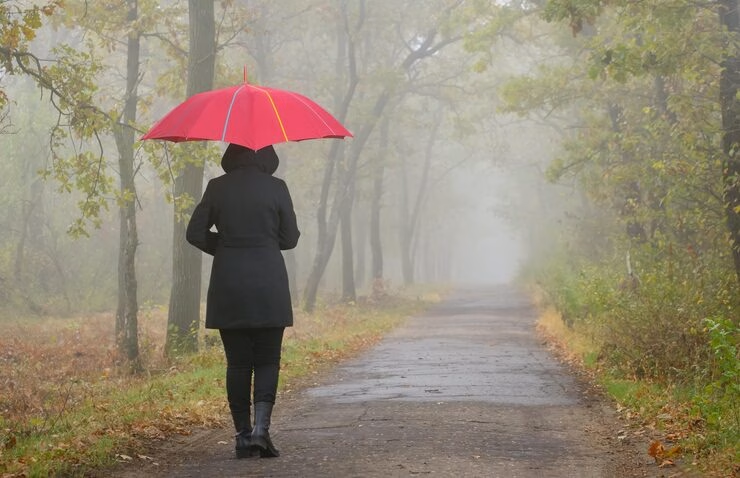
I pulled up the tracking interface on my tablet. The vehicle had been stationary for four minutes. The audio feed was active, but there was only the sound of rain and wind. No voices. No engine.
Then, at 11:49 PM, the car began moving again. Fast. The speed climbed to seventy, then eighty miles per hour.
My phone rang. It was Sophie. I could hear the rain and traffic in the background before she even spoke.
Her voice wasn’t just crying; it was shattered.
“Dad… he… he left me.”
The words hit me like a physical blow. I stood up so fast my chair rolled backward and crashed into the bookshelf.
“Where are you, Sophie?” I asked, my blood turning to liquid nitrogen.
“Mile marker 40. Highway 101. It’s raining and it’s dark and—” Her voice broke into sobs.
“What happened? Where is Julian?”
“He said the car was too small. He said he had to go pick up someone else. A woman, Dad. She was waiting for him at the gas station three miles back. He told me to get out. He told me to catch a taxi in the rain.”
I heard the sound of passing trucks, the hiss of tires on wet asphalt. My daughter was standing on the side of a highway in the middle of the night because her husband had abandoned her.
“He just… he drove away. He didn’t even wait to make sure I was safe. He just left me here.”
I didn’t waste time with words of comfort. Those would come later. “Stay exactly where you are. Don’t move from that spot. I’m sending Marcus by road and a helicopter to the clearing near the ridge. Lock yourself in the emergency call box if there is one. Do not accept rides from anyone.”
“There’s a call box about fifty feet ahead,” she said, her teeth chattering. “I’m so cold, Dad.”
“I know, sweetheart. I’m coming. Marcus will be there in twenty minutes. I’m calling the state police right now.”
“No police,” she said quickly. “Please. I don’t want this to be public. I just want to go home.”
“Sophie—”
“Please, Dad. Just come get me.”
I ended the call and immediately dialed Marcus. He answered on the first ring.
“I’m already on my way,” Marcus said. “I saw the alert. I’m fifteen minutes out.”
“She’s at mile marker 40. Alone. In the rain. I want you to find my daughter, and then I want you to find that son of a bitch and bring me every piece of evidence we have on him.”
“Understood.”
I hung up and dialed Eleanor. “Julian left Sophie on the side of Highway 101. I’m going to the hospital. Meet me there.”
“The hospital?” Eleanor’s voice went sharp. “Is she hurt?”
“I don’t know yet. But she’s been standing in the rain. She’s in shock. I’m not taking any chances.”
I grabbed my coat and headed for the garage. My hands were shaking—not with fear, but with a rage I hadn’t felt in forty years.
This was different. This was my daughter.
As I drove through the rain toward Sterling Memorial Hospital, I kept replaying Sophie’s words: He told me to get out. He just drove away.
The Porsche’s GPS showed Julian heading south, toward the coast. Toward money. Toward whatever life he thought he could build without the weight of a wife who actually knew his worth.
He had made a catastrophic mistake. He thought he was trading up—discarding Sophie for freedom and a sports car he believed was his.
He didn’t understand that the car was never his. The life was never his. And now, the future he’d been planning was about to be repossessed.
The Hospital
Marcus found Sophie twenty-two minutes later. She was huddled inside the emergency call box, soaking wet, shivering so violently she could barely hold her phone. He wrapped her in thermal blankets and carried her to his vehicle.
I met them at the emergency entrance of Sterling Memorial—a wing I had donated five years prior after Eleanor’s mother had received exceptional care there during her final illness.
Sophie stumbled out of the car and into my arms. She smelled of rain and exhaust fumes and fear. Her lips were blue. Her eyes were unfocused.
“I’m so stupid,” she whispered. “I’m so stupid, Dad. You were right about him.”
“You’re not stupid,” I said, holding her so tightly I was afraid I might hurt her. “You’re trusting. And he exploited that. That’s not your fault.”
Eleanor arrived moments later, her face pale but composed. She immediately took charge, speaking to the head nurse, ensuring Sophie was taken to a private room, away from the chaos of the main emergency department.
The doctor, a woman named Dr. Patricia Reeves whom I had known for a decade, stepped out from behind the curtain after the initial examination. Her expression was grim.
“Thomas. Eleanor. Sophie is stable. Mild hypothermia, but nothing life-threatening. We’ve warmed her up and she’s responding well. However—” She paused, glancing at Sophie through the window, then back at us. “—we’ve done the standard blood work. Under the circumstances, we have to be extremely careful with her medication going forward.”
“Why?” I asked.
Dr. Reeves lowered her voice. “Because Sophie is six weeks pregnant.”
The world went silent. The beeping of the monitors, the hushed voices of nurses, the hum of fluorescent lights—it all faded into a dull roar in my ears.
Julian hadn’t just abandoned my daughter on a dark highway to pick up a mistress in a car I had bought him.
He had abandoned his unborn child.
I looked at Eleanor. She wasn’t crying. Eleanor was a woman of ice and strategy, forged in courtrooms where emotion was a liability. She was slowly twisting her emerald wedding ring—a gesture she only made when she was calculating the total destruction of an enemy.
“Does Sophie know?” Eleanor asked quietly.
“Not yet,” Dr. Reeves said. “I wanted to speak with you first. Given the circumstances—the stress, the exposure—we need to monitor her very closely over the next few days. The first trimester is critical.”
I walked to the window and looked at my daughter. She was lying in the hospital bed, staring at the ceiling, one hand resting unconsciously on her stomach. She didn’t know yet that her body was protecting a secret.
“Tell her,” I said. “She deserves to know. But give us a moment with her first.”
Dr. Reeves nodded and slipped away.
Eleanor and I entered the room together. Sophie looked at us with red-rimmed eyes.
“I’m sorry,” she said immediately. “I’m sorry I didn’t listen. I’m sorry I defended him. I’m sorry I—”
“Stop,” Eleanor said gently, sitting on the edge of the bed. “You have nothing to apologize for. You loved someone who didn’t deserve it. That’s not a crime. That’s being human.”
“He left me on the side of the road,” Sophie whispered. “Like I was trash. Like I didn’t matter.”
“You matter,” I said, my voice rough. “You matter more than he will ever understand. And he’s going to learn that lesson very, very soon.”
Sophie looked at me with a flicker of fear. “Dad, don’t do anything crazy. I just want to forget he exists.”
“Oh, sweetheart,” Eleanor said, taking her hand. “Your father isn’t going to do anything crazy. He’s going to do something perfectly legal, perfectly calculated, and absolutely devastating.”
When Dr. Reeves told Sophie she was pregnant, my daughter’s face went through a dozen emotions in five seconds: shock, fear, disbelief, and then—surprisingly—a fierce, protective determination.
“Is the baby okay?” she asked immediately.
“Right now, yes,” Dr. Reeves said. “But we need to monitor you. The exposure to cold, the stress—it could have complications. We’re going to keep you here overnight for observation.”
Sophie’s hand moved to her stomach, this time consciously. “He doesn’t know,” she said quietly. “Julian doesn’t know.”
“And he doesn’t need to,” I said.
Sophie looked at me. “What are you going to do, Dad?”
I pulled a chair close to the bed and sat down. “I’m going to give your husband exactly what he wants. Freedom. The car. A chance to start over.”
“I don’t understand.”
“You will,” I said. “But right now, you need to rest. Let us handle Julian. You focus on taking care of yourself—and your baby.”
The Evidence
Eleanor stayed with her while I stepped out into the hallway. Marcus was waiting, tablet in hand.
“Report,” I said.
“Julian is currently at the Belmont Bay Resort. Presidential suite. He checked in two hours ago with a woman named Chloe Winters. Age twenty-three. Aspiring model. Instagram influencer. Fifteen thousand followers.”
“How did they meet?”
“DMs. She’s been commenting on his posts for three months. Lots of heart emojis. He’s been responding. The messages got progressively more intimate. They arranged to meet tonight.”
“And the Porsche?”
“Parked in valet. He posted a photo of it forty minutes ago. Caption: ‘New chapter. No limits.'”
I felt my jaw clench. “What else?”
“I pulled his financials. He’s been using the corporate credit card you gave him—the one attached to Sterling Holdings—to pay for dinners, hotels, gifts for Chloe. Over thirty thousand dollars in the last month alone.”
“Embezzlement,” I said softly.
“And fraud,” Marcus added. “He’s been selling proprietary information about Sterling Shipping routes to a competitor. Baltic Maritime. We have emails, wire transfers, everything.”
I took the tablet and scrolled through the evidence. It was all there. Julian wasn’t just a bad husband. He was a criminal.
“Beautiful,” I said. “Absolutely beautiful. He’s gift-wrapped his own destruction.”
“What do you want me to do?” Marcus asked.
I handed the tablet back. “For now? Nothing. Let him enjoy his night. Let him think he’s won. Tomorrow, we begin the lesson.”
The Bait
The first rule of war is to let your enemy believe he is winning.
For the next forty-eight hours, we kept the hospital quiet. No one called Julian. No one answered his texts—vague, gaslighting messages like: Hope you got home okay. I had a business emergency. Don’t be dramatic.
He was emboldened by our silence. He thought we were reeling, or perhaps that Sophie hadn’t told us the full story out of shame. He posted more photos: champagne on the beach, sunset drives in the Porsche, Chloe draped over the hood in a bikini with the caption Life’s too short for anchors.
Sophie saw the posts. I watched her face harden with each one.
“I want to help,” she said from her hospital bed. “Whatever you’re planning, I want to be part of it.”
“You need to rest,” Eleanor said.
“I’ll rest after he pays,” Sophie replied. “Tell me the plan.”
So I did.
On Thursday morning, Eleanor took the lead. She called Julian from her private line. I sat beside her in the hospital room, listening on speaker.
“Julian, darling,” Eleanor said, her voice honeyed and warm, perfectly masking the venom beneath.
“Eleanor! Hi,” Julian said, sounding slightly breathless. I could hear the roar of the Porsche’s engine in the background. “I was just about to call. Sophie and I had a little… misunderstanding the other night. I feel terrible.”
“Oh, don’t worry about that, dear. Young love always has its bumps,” Eleanor said. “I’m calling because Thomas and I have been talking. We realized that the Porsche was a bit of a selfish gift. It doesn’t provide for your future.”
Julian slowed the car down. I could hear his interest piquing. “Oh?”
“We’ve decided to transfer the deed of the North Hill estate into your name. It’s that forty-acre plot with the old winery up in the mountains. We want you and Sophie to have your own legacy. But we need to do the paperwork today because Thomas is flying to London tomorrow, and the lawyers need both signatures.”
There was a pause. I could almost hear the calculations in Julian’s mind. North Hill was worth fifteen million dollars. Prime real estate. Ocean views.
“Today?” Julian asked, trying to sound casual. “I… yes. Absolutely. Where do I go?”
“The estate itself,” Eleanor said. “The surveyor is there now. Bring the Porsche—the title for the car is tied to the land holding for tax reasons. We’ll sign everything over in one go. And Julian?”
“Yes, Eleanor?”
“Bring the car papers. We want this to be a clean transfer. No strings.”
“I’ll be there in an hour,” Julian said, his voice thick with excitement.
He didn’t even ask about Sophie. Not once.
Eleanor ended the call and looked at me. “He took the bait.”
“Of course he did,” I said. “He thinks he’s finally getting what he deserves.”
“He is,” Sophie said from the bed, her voice cold. “Just not the way he expects.”
North Hill
North Hill was the most isolated property we owned. It sat at the end of a six-mile private road that wound through dense forest and ended at a cliffside overlook with views of the Pacific Ocean. It was beautiful, desolate, and—most importantly—completely private.
The property had been in Eleanor’s family for three generations. Her grandfather had built the winery during Prohibition. The main house had burned down in the 1970s and never been rebuilt. All that remained were the stone foundations, the vineyards, and the roads.
It was the perfect place for a lesson in humility.
I watched Julian’s progress on the tablet in the back of my armored SUV. The GPS dot was moving fast, carving through the switchbacks with the confidence of someone who thought he owned the world.
Marcus was driving. Eleanor sat beside me, watching the same screen.
“He’s pushing it,” Marcus observed. “Seventy-five in a fifty zone.”
“He thinks he’s invincible,” Eleanor said.
Through the audio feed, we could hear Julian’s voice, loud and cocky over the sound of the engine.
“—telling you, Chloe, this is the big one. Fifteen million in property. I played it perfectly. Once the deed is in my name, I’ll refinance, pull out the equity, and we’re gone. Monaco. Dubai. Wherever you want.”
Chloe’s voice was high and breathy. “What about Sophie?”
Julian laughed. “What about her? She’ll get the divorce papers, and she’ll cry to daddy. Meanwhile, I’ll be on a yacht.”
“You’re so bad,” Chloe giggled.
“I’m practical,” Julian corrected. “I didn’t marry into one of the richest families in America to stay poor.”
Three miles from the summit, the road narrowed between a sheer rock face and a hundred-foot drop. Julian rounded a blind curve and slammed on the brakes.
A black Mercedes Sprinter van was parked sideways across the road, completely blocking both lanes.
Julian honked the horn. “What the hell?”
He waited. No one moved. No one appeared.
Julian opened his door, stepping out into the rain. His expensive suede loafers immediately soaked through.
“Hey!” Julian yelled. “Move the damn van!”
Behind him, a second black SUV—mine—slid silently into view, blocking his retreat.
Julian turned, his face shifting from anger to confusion to fear. He recognized the vehicle. He recognized the Sterling crest on the door.
Marcus and three other men stepped out of the van. They were tall, broad-shouldered, dressed in charcoal overcoats.
I stepped out of the SUV behind Julian, holding a black umbrella. Eleanor emerged beside me, equally composed.
“Thomas!” Julian said, his voice jumping an octave. “Eleanor! You scared me!”
I didn’t say anything. I just looked at the Porsche. Chloe was still inside, her face pressed against the window, her eyes wide.
“Get out of the car, Chloe,” Marcus said, opening the passenger door.
“What? No!” Julian protested. “Thomas, what is this?”
“There is no deed, Julian,” I said. My voice was low, carried by the wind and rain. “And there is no winery transfer. There is only mile marker 40.”
Julian froze. The color drained from his face.
“I… I can explain that,” he stammered. “Sophie was being hysterical—”
“Stop,” I said. The word silenced him instantly. “I’ve heard the recordings, Julian. I’ve heard you tell this girl how you were going to discard my daughter. I’ve heard you mock the gift I gave you.”
Marcus reached into the Porsche and pulled the keys from the ignition. He then reached into Julian’s jacket pocket and took his smartphone.
“Hey! That’s my phone!”
“Everything you are wearing, everything you are driving, and everything you think you own, belongs to me,” I said. “The clothes on your back were a gift from my wife. The watch on your wrist was a wedding present.”
Marcus dropped Julian’s phone into a puddle and crushed it under his boot. The screen shattered.
“The Porsche is being repossessed,” I continued. “The suite at the Belmont Bay—cancelled. Your bank accounts—frozen. As of five minutes ago, you have no job.”
Chloe scrambled out of the car. “Julian? What’s going on?”
Julian didn’t answer. He was staring at me, his world crumbling.
“You can’t do this,” he choked out. “I’m her husband! I have rights!”
“You have the right to remain silent,” Marcus quipped.
I looked at the long, dark road back down the mountain. Six miles to the main highway. No lights. No houses.
“It’s a long walk, Julian,” I said. “About the same distance Sophie had to walk before Marcus found her. Except she was alone, terrified, and pregnant.”
“Thomas! Please!” Julian lunged toward me, but the bodyguards blocked him.
I got into the back seat. Marcus climbed into the driver’s seat of the Porsche. The engine roared to life.
“Wait!” Chloe shrieked. “My purse!”
Marcus tossed a small plastic bag out the window. It contained her lipstick and a compact mirror. “That’s all that belongs to you.”
The Porsche roared away down the mountain. The Sprinter van followed.
I rolled down my window as my SUV began to move.
“One more thing, Julian,” I called out.
He was standing in the middle of the road, drenched, his suede jacket ruined.
“Don’t bother coming to the house. The locks were changed. And if you ever step foot on Sterling property again, I’ll send the District Attorney with a file on your embezzlement. Corporate fraud carries a seven-year minimum sentence.”
I rolled up the window.
The last thing I saw was Julian and Chloe standing in the rain, surrounded by nothing but consequences.
The Walk
The walk took them four hours.
By the time Julian and Chloe reached the main highway, the rain had turned into a freezing downpour. Julian’s suit was ruined. Chloe had lost a heel two miles back.
The recordings from the hidden microphones we’d placed along the route were a symphony of bickering and blame.
“You told me they were billionaires!” Chloe screamed.
“Shut up, Chloe! I’m trying to think!”
“Think about what? You’re nobody!”
A trucker took pity on Chloe at mile marker twelve. She climbed into the cab without looking back at Julian.
Julian finally hitched a ride in the back of a pickup truck. He arrived at the gates of the Sterling villa at 4:00 AM, soaked, shivering.
He approached the keypad and punched in the code.
BEEP. Red light. Access Denied.
He tried again. BEEP. Red light.
He grabbed the iron bars and shook them. “Sophie! SOPHIE! Let me in!”
A thermal printer whirred to life. A slip of yellow paper spat out.
NOTICE OF EVICTION
Property of Sterling Holdings LLC
Personal belongings relocated to Salvation Army
Julian collapsed against the bars.
“Sophie!” he howled. “Think of the baby!”
The front door opened.
But it wasn’t Sophie. It was me.
I walked down the steps slowly, stopping ten feet from the gate.
“You’re trespassing, Julian,” I said.
“Thomas… please,” he gasped. “Sophie… she loves me. We’re starting a family. You can’t separate a man from his child.”
I pulled a leather folder from my coat pocket. “You want to talk about the baby, Julian? Let’s talk.”
Julian pressed his forehead against the cold iron. “Is she okay? Is the baby okay?”
I let a long silence hang in the air.
“No, Julian,” I said finally, my voice a tomb. “They aren’t okay.”
Julian’s eyes went wide. “What… what does that mean?”
“The doctors did everything they could,” I said, letting my voice break. “But the stress… the hypothermia… the hours she spent wandering because her husband thought a mistress was more important…”
I let the sentence hang.
“The baby is gone, Julian.”
Julian’s hands slipped from the bars. He fell back onto the wet pavement.
“No… no, no, no.”
“You killed your child, Julian,” I said. “You traded your son or daughter for a car and a girl named Chloe.”
Julian began to sob.
“I have the divorce papers here,” I said, sliding a pen and the folder through the gap. “And a non-disclosure agreement. You sign these, you take this check for fifty thousand dollars, and you move to another state. You disappear.”
“Fifty thousand? That’s nothing!”
“This estate is worth nothing to a man in prison,” I snapped. “I have evidence of your credit card fraud. I have logs of you selling Sterling trade secrets. If you don’t sign right now, Marcus is calling the police.”
Julian looked at the pen. Then at the check. Then at the dark street.
His hand shook as he signed. The divorce papers. The NDA. He signed away his rights to a life he’d never deserved.
“The baby…” he whispered. “Was it a boy or a girl?”
I looked him dead in the eye.
“It doesn’t matter, Julian. You’ll never know.”
I took the folder. I watched him stand up, clutching the fifty-thousand-dollar check.
He turned and limped away into the darkness.
I watched until he was gone, swallowed by shadows.
Then I turned and walked back into the house.
I went upstairs, to the sun-drenched nursery Eleanor and I had begun to build.
Eleanor was there, sitting in a rocking chair. Sophie was asleep in the adjacent bedroom, her hand resting protectively over her stomach.
“Is it done?” Eleanor asked quietly.
“He’s gone,” I said. “He signed everything. He thinks he’s a child-killer. He’ll never come back.”
Eleanor nodded. “It was a necessary lie, Thomas. To protect them both.”
I sat on the edge of the rocking chair and looked at my daughter through the doorway. She didn’t know about the lie yet. We would tell her eventually—when she was stronger, when Julian was gone, when the divorce was final.
I walked to Sophie’s room and sat carefully on the edge of her bed. I reached out and placed my hand gently over hers, over the small life that was still very much alive.
Julian Vance thought he was a player in a high-stakes game.
He didn’t realize that when you play against a father protecting his child, the rules don’t exist.
The house always wins.
One Year Later
The California sun was warm on my back as I stood on the terrace of the Sterling vineyard.
Below, on the manicured lawn, Sophie sat on a white blanket under an oak tree. She looked radiant in a yellow sundress.
And in her arms was Leo.
He was six months old, with his mother’s bright green eyes and a laugh that sounded like pure joy. He was currently trying to eat a wooden toy car—a little red Porsche I had bought him as a joke.
“He’s getting fast, Dad!” Sophie called out. “You better watch out.”
“He’s a Sterling,” I said, walking down to join them. “He’ll be running the world by twelve.”
I sat down on the blanket, watching my grandson. He was healthy. He was safe.
Julian was a ghost now. My investigators reported he was living in a studio apartment outside Columbus, Ohio, working as a used car salesman. He was a heavy drinker, haunted by the “tragedy” he thought he’d caused, too terrified to search for Sophie online.
The lie had been our greatest investment.
“Dad?” Sophie asked. “Do you ever regret it? Giving him that car?”
I looked toward the garage, where the 1973 Porsche sat in climate-controlled perfection.
“No,” I said, reaching out to ruffle Leo’s soft hair. “That car was the best teacher I ever hired. It showed us exactly who Julian was before it was too late.”
“I used to think that car was a trophy,” Sophie said quietly. “But I realize now it was a test. And he failed spectacularly.”
“It was a shield,” Eleanor said, emerging with lemonade. “It protected you by revealing the truth.”
Leo grabbed my thumb with his tiny hand. He squeezed it, his eyes locked on mine.
“Does he know?” Sophie asked suddenly. “Julian. Does he know that Leo is alive?”
“No,” I said firmly. “And he never will. As far as Julian Vance is concerned, his child died because of his choices. And that weight will keep him a thousand miles away.”
Sophie nodded. “Good. Leo deserves better.”
“Leo has a father,” Eleanor said. “He has a grandfather who would move heaven and earth to protect him.”
I looked at my daughter. I looked at my grandson. I looked at the life we had built from the wreckage of Julian’s betrayal.
I had repossessed the car. I had repossessed the house. I had repossessed the future that Julian tried to steal.
And as Leo laughed, reaching for the sun, I knew that every decision—every calculated move, every necessary lie—had been worth it.
The debt was settled.
The test was complete.
And the Sterling family was whole again.