Grandma Asked When I’d Start a Family—I Had One, Just Didn’t Invite Her
At our Christmas lunch, Grandma said, “Your sister’s baby shower was just perfect. Now, when will you finally start a family?” I smiled and replied, “I did—just didn’t invite anyone who treats me like a failure.” The fork in her hand trembled.
I’m Sarah, thirty-five, and I work as a veterinarian in Portland, Oregon. I’ve always been the black sheep of my family. Not because I’m rebellious or anything, but because I chose a different path. While my sister Madison got married at twenty-four and immediately started popping out babies, I focused on my career. I spent eight years in school, did an internship at a specialty clinic, and built up my own practice. I love what I do, and I’m damn good at it.
My family, however, has never quite understood this choice. Every family gathering becomes an interrogation about my love life, my biological clock, and when I’m going to settle down and have a “real” family. It’s exhausting, but I’ve learned to deflect with humor and change the subject.
The Golden Child
Madison, my younger sister by three years, has always been the golden child. She married her high-school sweetheart Jake right after college and has three kids now: Emma, seven; Tyler, five; and baby Sophia, six months. Don’t get me wrong, I love my nieces and nephew. But Madison has this way of making everything about her and her perfect family life. She’s a stay-at-home mom, which is totally fine, but she acts like it makes her superior to everyone else—especially me.
Our parents, Linda and Robert, have always favored Madison. They helped with her wedding, gave her the down payment for her house, and basically worship the ground she walks on. Meanwhile, I paid my own way through vet school and bought my own place with zero help from them. When I graduated, they attended the ceremony—but left early to babysit Madison’s kids. When I opened my practice two years ago, they couldn’t make the ribbon cutting because it conflicted with Emma’s soccer game.
But the real villain in this story is my grandmother, Dorothy. She’s seventy-eight, sharp as a tack, and has never missed an opportunity to remind me that I’m disappointing the family by not having children. She’s been married three times, outlived two husbands, and has very strong opinions about what women should do with their lives. According to her, career success means nothing if you don’t have kids to show for it.
Every holiday, every birthday, every family gathering, Grandma Dorothy makes the same comments: “When are you going to find a nice man?” “You’re getting older, Sarah. Don’t wait too long or you’ll regret it.” “Madison is such a good mother. When will you follow her example?” I’ve tried being polite. I’ve tried changing the subject. I’ve tried explaining that some women find fulfillment in other ways. Nothing works. She just doubles down and gets more intrusive.
The Breaking Point
The breaking point came three months ago at Madison’s baby shower for Sophia. It was this elaborate affair. Madison had registered for hundreds of dollars’ worth of stuff, rented out a country club, and invited about fifty people. I showed up with a generous gift and tried to be supportive, but Grandma Dorothy cornered me within ten minutes of arriving.
“Sarah, honey, when are you going to have one of these parties for yourself?” she asked, gesturing around at all the decorations and gifts. “Madison looks so happy. Don’t you want to be happy, too?”
I explained—again—that I was happy with my life, that my career brought me joy, that I had fulfilling relationships with my friends and my pets, and that not everyone needs to have children to feel complete. Grandma Dorothy shook her head like I was a lost cause.
“That’s not real happiness, dear. That’s just keeping yourself busy. A woman isn’t complete without children. You’re going to wake up one day and realize you’ve wasted your whole life on animals when you could have had a real family.”
That stung. My work isn’t just a job. I save lives every day. I’ve helped families keep their beloved pets healthy. I’ve worked with rescue organizations and made a real difference in my community. To have her dismiss it as “keeping myself busy” was incredibly hurtful. But I bit my tongue, smiled politely, and walked away. I didn’t want to cause a scene at Madison’s party.
The comments didn’t stop there. Throughout the shower, various family members made little digs. My Aunt Susan asked if I was still “playing with animals” instead of having “real” babies. My cousin Jennifer wondered aloud if I was gay. (I’m not. But even if I were—so what?) My mom kept pushing me toward the single guys at the party, whispering about how nice they were. Meanwhile, Madison basked in all the attention, opening gift after gift and making little speeches about how blessed she felt. She kept shooting me pitying looks like I was some sad spinster who couldn’t possibly understand the joy of motherhood.
I left early, claiming I had an emergency at the clinic. That night, I went home and cried. Not because I wanted children and couldn’t have them, but because my own family made me feel like my life choices were worthless.
I called my best friend Jessica, who’s also child-free by choice, and she helped me process my feelings. “They’re projecting their own insecurities onto you,” she said. “Madison probably wonders sometimes what her life would have been like if she’d pursued a career. Your grandma comes from a generation where women didn’t have many options. They can’t understand that you chose differently because it threatens their worldview.”
Jessica was right, but it didn’t make the hurt go away.
The Distance
I decided I needed to take a break from family events for a while to protect my mental health. I skipped my dad’s birthday in July, claiming work conflicts. I missed Madison’s anniversary party in August, saying I was at a veterinary conference (which was true). I begged off a Labor Day barbecue, citing a “family emergency” with one of my patients.
Each time, I got guilt-tripping phone calls from my mom about how I was becoming distant and missing important family moments. Madison left passive-aggressive voicemails about how sad the kids were that Aunt Sarah wasn’t around. Grandma Dorothy sent a handwritten letter saying she was worried about me becoming a “bitter old maid.”
The truth was I was happier than I’d been in months. I spent my free time with friends who appreciated me. I threw myself into my work. And I started dating someone new—a fellow veterinarian named David who understood my passion for my career. David and I had been together for about four months by the time Christmas rolled around. He’s amazing: funny, intelligent, supportive of my goals, and he loves animals as much as I do. We’d been talking about moving in together after the New Year.
When my mom called to confirm I was coming to Christmas lunch, I almost said no. But something in her voice made me reconsider. She sounded genuinely sad that I’d been absent from so many gatherings, and despite everything, I do love my family. I decided to give them one more chance.
“I’ll be there,” I told her. “But I’m bringing David.”
There was a pause. “David? Who’s David?”
“My boyfriend. We’ve been together for four months.”
I could practically hear her brain working. “Oh. Oh, Sarah, that’s wonderful. I can’t wait to meet him. Maybe this means—well, maybe things are finally moving in the right direction for you.”
I should’ve known she’d interpret David’s presence as evidence that I was finally settling down and would soon be following Madison’s path to marriage and babies, but I let it slide. I was looking forward to having someone in my corner for once.
David was a little nervous about meeting my family, especially after I filled him in on their tendency to be judgmental. But he’s confident and charming, and I figured he could handle whatever they threw at us.
Christmas Lunch
The lunch was held at Madison and Jake’s house, like always. It’s this big colonial in the suburbs with a perfect lawn and a white picket fence—literally. Madison loves to play hostess, and she goes all out for holidays. The house was decorated like a Christmas magazine spread, with garlands everywhere, a twelve-foot tree, and enough twinkling lights to be seen from space.
David and I arrived right on time, bearing gifts and a bottle of expensive wine. I dressed carefully in a red cashmere sweater and black slacks—professional but festive. David looked handsome in a button-down and blazer. Madison greeted us at the door with her usual fake enthusiasm.
“Sarah, you look great—and you must be David.” She sized him up quickly and I could see her approving of his appearance. “Come in, come in. Everyone’s so excited to meet you.”
The house was full of the usual suspects: my parents, Grandma Dorothy, my Aunt Susan and Uncle Mike, cousin Jennifer and her husband Brian, plus Madison’s family. The kids immediately mobbed David, demanding to know if he had any pets and peppering him with questions about being a veterinarian. He handled it beautifully—crouching down to their level and telling them stories about some of the animals he treated. Even baby Sophia seemed charmed by him, reaching for his face with her chubby little hands.
“He’s great with kids,” my mom whispered to me, beaming. “Such a natural father.”
I internally rolled my eyes, but kept smiling.
Lunch was the usual elaborate affair—turkey, ham, all the sides, three kinds of pie. Madison had set the table with her fancy china and crystal glasses. Place cards directed everyone to their seats. I noticed David and I were seated at opposite ends of the table. Strategic separation, probably so they could interrogate us individually.
The meal started pleasantly enough. David charmed everyone with stories from the clinic, and my dad was particularly interested in hearing about the business side of running a veterinary practice. For about thirty minutes, I allowed myself to relax. Maybe this would be okay. Maybe they’d finally see me as successful and fulfilled.
Then Grandma Dorothy struck.
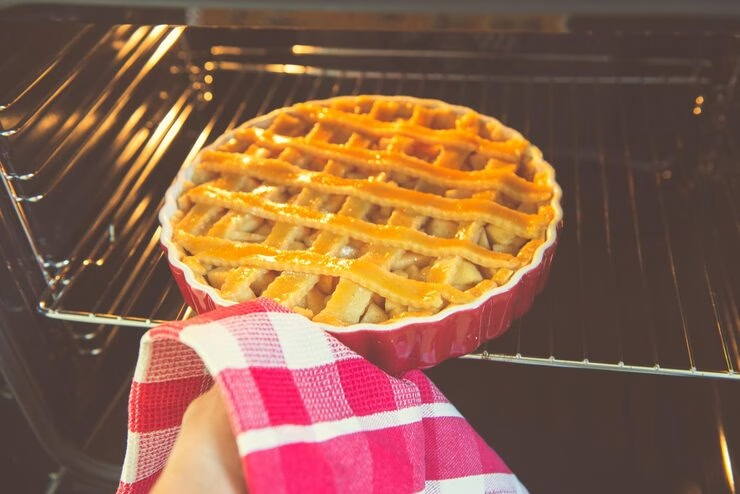
She’d been quiet during most of the meal, watching David and me with those sharp eyes of hers. As Madison served dessert—homemade apple pie with vanilla ice cream—Grandma set down her fork and looked directly at me.
“Sarah, dear, it’s so wonderful that you’ve finally found someone. David seems like a lovely young man.”
“Thank you, Grandma,” I said carefully.
“Your sister’s baby shower was just perfect. Such a beautiful celebration of new life.” She paused, her eyes glittering. “Now, when will you finally start a family?”
The table went quiet. Everyone was looking at me, waiting for my response. Madison had a small, satisfied smile on her face. My mother looked hopeful. David reached for my hand under the table, giving it a supportive squeeze.
I’d had enough. Three months of distance, four months of happiness with someone who actually valued me, and years of being made to feel less than—it all crystallized into perfect clarity.
I smiled slowly, deliberately.
“I did start a family, Grandma,” I said. “I just didn’t invite anyone who treats me like a failure.”
The fork in her hand trembled. Her face went pale, then flushed red.
“What… what are you talking about?”
“My chosen family,” I continued, my voice steady. “The people who respect my choices. Who celebrate my successes instead of treating them like consolation prizes for not having children. David is part of that family. So is Jessica, and my colleagues, and my rescue organization friends. People who see me as complete exactly as I am.”
My mother’s mouth opened and closed like a fish. Madison had gone perfectly still, her smirk wiped away. My father was staring at his plate.
“You can’t mean—” Grandma Dorothy started.
“I do mean it. For years, you’ve all made me feel like my life doesn’t matter because I chose career over kids. You’ve dismissed my education, my business, my happiness. You’ve compared me to Madison at every opportunity and found me lacking. You’ve pushed, prodded, and insulted me at every family gathering.”
“Sarah,” my mother said weakly. “That’s not—”
“It is fair, Mom. You left my graduation early to babysit. You missed my practice opening for a soccer game. You’ve never once asked me about my work with genuine interest—only as a prelude to asking when I’ll give it up for motherhood.”
I stood up, my legs surprisingly steady. David stood with me, his hand still holding mine.
“Madison, your baby shower was three months ago. You know why I haven’t been to family events since then? Because Grandma told me I was wasting my life. Because Aunt Susan asked if I was ‘playing with animals’ instead of having real babies. Because all of you made it clear that nothing I achieve will ever matter as much as pushing out children.”
Madison’s face had gone from white to red. “You’re being dramatic—”
“Am I? Tell me, Madison, when was the last time you asked about my work? When was the last time any of you celebrated something I accomplished? I opened a second clinic location in September. Did any of you know that? I was named Veterinarian of the Year by the Oregon Veterinary Medical Association in October. Did any of you congratulate me?”
Silence. Complete, damning silence.
“I sent everyone an email about both things,” I continued. “I got exactly two responses. One from Aunt Susan saying ‘that’s nice dear’ and one from Grandma Dorothy saying she hoped success in my career would help me attract a husband.”
Grandma Dorothy’s hand was shaking so badly now that she set down her fork. “I was trying to—”
“To what? Help? By telling me my life’s work is worthless? By implying I’m incomplete without children? Do you have any idea how hurtful that is?”
“You’re being selfish,” Madison said, finding her voice. “This is Christmas. You’re ruining it.”
“I’m ruining it?” I laughed, and it sounded bitter even to my own ears. “I showed up today hoping—stupidly hoping—that you’d all finally see me. That you’d meet David and realize I’m happy. That you’d ask about my life with genuine interest instead of judgment. But within thirty minutes, Grandma was already pushing about babies.”
“Well, you are getting older,” Grandma Dorothy said, her voice sharp now. “It’s a legitimate concern—”
“It’s none of your business,” I cut her off. “My reproductive choices are not your concern. My happiness is not contingent on following the path you think I should take. And I’m done—completely done—pretending that your approval matters more than my own self-respect.”
The Revelation
My father finally spoke. “Sarah, I think you’re overreacting—”
“Dad, you gave Madison $50,000 for her house down payment. You gave me a card that said ‘good luck’ when I bought my place. You paid for her entire wedding. You didn’t contribute a dime to mine when I was engaged five years ago—remember that? The engagement that ended because my fiancé wanted kids and I didn’t? You told me I was making the biggest mistake of my life by letting him go.”
My father looked stunned. “I… I thought we were being fair. Madison needed more help—”
“Because you assumed she needed it more. Because she was following the ‘right’ path. But you never asked if I needed help, Dad. You just assumed my choices meant I didn’t deserve it.”
“This is ridiculous,” Madison said, standing up. “You’re making everything about you when we’re just trying to have a nice family Christmas—”
“Everything is always about you, Madison,” I said, and her mouth snapped shut. “Every gathering revolves around your kids. Every conversation circles back to your perfect family. And you know what? That’s fine. I’m happy for you. But you’ve never—not once—shown interest in my life unless it was to pity me for not having what you have.”
“That’s not true,” she protested, but her voice lacked conviction.
“Really? Name one thing about my work. One thing I’ve told you about what I do.”
Madison opened her mouth, then closed it. She looked at Jake for help, but he just shrugged helplessly.
“You can’t, can you? Because you’ve never listened. None of you have.”
I looked around the table at my family. My mother was crying quietly. My father looked shocked and hurt. Grandma Dorothy’s face was still red with indignation. Aunt Susan and Uncle Mike were studiously examining their pie. Cousin Jennifer looked uncomfortable. The kids were confused, Emma’s eyes wide with concern.
“I love you all,” I said, and my voice broke slightly. “I do. But I can’t keep coming to these gatherings and letting you make me feel worthless. I can’t keep hoping you’ll suddenly see me as more than just a cautionary tale or a disappointment.”
“Where is this coming from?” my mother asked through her tears.
“It’s been coming for years, Mom. You just haven’t been listening.”
David cleared his throat. “Mrs. Peterson, Mr. Peterson, I need to say something.”
Everyone turned to look at him. He’d been so quiet through my speech that I think they’d almost forgotten he was there.
“Sarah is one of the most remarkable people I’ve ever met,” David said, his voice firm. “She runs two successful clinics. She’s saved countless animals. She volunteers with rescue organizations. She mentors young veterinarians. She’s built a life that matters—that makes a real difference in the world.”
He looked at Grandma Dorothy. “Mrs. Reynolds, you said Sarah was wasting her life on animals. I’ve seen her work. I’ve watched her stay up all night to save a dog hit by a car. I’ve seen her comfort a family whose cat was dying. I’ve seen her donate her services to people who couldn’t afford care. That’s not a waste. That’s a life of purpose and meaning.”
“But children—” Grandma started.
“Children are wonderful,” David agreed. “But they’re not the only way to live a meaningful life. And frankly, Sarah has more ‘family’ than most people I know—she just chose them instead of being born into them.”
“Thank you,” I said quietly to David. Then I looked at my family one more time. “I’m going to go now. David and I have plans with our actual family tonight—our friends who actually value us.”
“Sarah, wait,” my mother said, standing up. “Please don’t go like this. We can talk about this—”
“We’ve had years to talk about this, Mom. But you never wanted to hear it. Maybe now you will.”
I picked up my purse and David’s hand, and we walked toward the door. Behind us, I could hear Madison hissing at my mother, my father saying something about me being ungrateful, Grandma Dorothy demanding to know when children became so disrespectful.
But I didn’t stop. I didn’t look back. David and I walked out into the cold December air, and I felt lighter than I had in years.
The Aftermath
We sat in my car for a few minutes, the engine running to warm us up. My hands were shaking with adrenaline.
“That was…” David started.
“Awful? Terrible? The worst Christmas ever?”
“Brave,” he finished. “That was incredibly brave.”
I laughed, a slightly hysterical sound. “I just blew up my entire family Christmas.”
“They needed to hear it. All of it.” He reached over and took my hand. “I’m proud of you.”
We drove to Jessica’s house, where she was hosting a “Friendsgiving” style Christmas dinner for those of us without traditional family plans. When we arrived, the house was warm and full of laughter. There were about fifteen people there—other child-free friends, a few divorced folks, some people estranged from their families for various reasons, and a couple who’d driven from California to escape their own judgmental relatives.
Jessica took one look at my face and pulled me into a hug. “That bad?”
“I told them everything. Everything I’ve been holding in for years.”
“Good,” she said firmly. “It’s about damn time.”
We spent the evening eating, drinking, and laughing. Nobody asked me when I was having kids. Nobody compared me to anyone else. Nobody made me feel like my life was incomplete. We played games, exchanged small gifts, and watched Christmas movies. David fit right in, charming everyone with his dry sense of humor and veterinary stories.
Around midnight, my phone started buzzing. Texts from my mother, my father, Madison, even Aunt Susan. I turned it off without reading them.
“You okay?” David asked.
“I’m perfect,” I said. And I meant it.
The Fallout
The next day, Christmas Day, I finally checked my messages. There were dozens of them.
My mother: “Sarah, please call me. We need to talk about what happened. You really hurt your grandmother.”
My father: “This is childish. You owe everyone an apology.”
Madison: “You ruined Christmas. The kids are upset. Thanks a lot.”
Grandma Dorothy: “I never thought I’d see the day when my granddaughter would be so disrespectful. I raised you better than this.”
But there were other messages too. Aunt Susan: “Sarah, I want to apologize for some of the things I’ve said. You’re right—we haven’t been fair to you.”
My cousin Jennifer: “I’m sorry for my part in making you feel bad. I didn’t realize how much it was affecting you.”
And surprisingly, Jake: “Hey Sarah, I know this is weird coming from me, but I think you had a point yesterday. Madison and I need to do better at appreciating all the different ways people choose to live.”
I responded to Aunt Susan and Jennifer, accepting their apologies and suggesting we get coffee sometime to talk. I ignored the others. I wasn’t ready to deal with my parents or grandmother yet, and Madison’s message just made me angry all over again.
David stayed with me through Christmas Day. We cooked a simple meal together, watched movies, and went for a long walk in the park. It was quiet and peaceful—exactly what I needed.
The Reckoning
A week later, my mother called. I almost didn’t answer, but something made me pick up.
“Hi, Mom.”
“Sarah.” Her voice was strained. “Can we meet? Just you and me. I think we need to talk.”
We met at a coffee shop near my clinic. My mother looked tired, older somehow. She’d been crying—I could tell by the redness around her eyes.
“I’ve been thinking about everything you said,” she began. “And I talked to your father. And your grandmother.”
“And?”
“And you were right. About a lot of things.” She paused, struggling with the words. “I didn’t realize how much we’d been… dismissing you. Your accomplishments, your choices, your happiness. I thought we were just expressing concern. I thought we were helping.”
“You were judging, Mom. Constantly.”
“I know. I see that now.” She took a shaky breath. “Your grandmother is from a different generation. She doesn’t understand that women have more options now. And I… I think I was projecting my own insecurities onto you.”
That surprised me. “What do you mean?”
“I gave up my career when I had you and Madison. I was a paralegal, did you know that? I was good at it. But your father and I decided it made more sense for me to stay home. And I’ve wondered sometimes—especially watching you—what my life would have been like if I’d made different choices.”
I’d never known that. “Mom—”
“I’m not saying I regret having you girls. I don’t. But seeing you so successful, so independent, so happy with your choices… it made me uncomfortable. Because it reminded me of the path I didn’t take. And instead of celebrating you, I… I tried to make you feel like your choices were wrong. Because if your choices were right, then maybe mine were wrong.”
“Mom, your choices weren’t wrong. They were just different. That’s the whole point.”
She nodded, tears spilling over. “I know. I know that now. And I’m so sorry, Sarah. I’m sorry for every time I compared you to Madison. I’m sorry for missing your graduation and your opening. I’m sorry for not celebrating your achievements. I’m sorry for making you feel like you weren’t enough.”
I felt my own eyes filling with tears. “Thank you. That means a lot.”
“I want to do better. I want to be the mother you deserve. Can you give me another chance?”
I thought about it. About years of hurt and disappointment. About the damage that had been done. But also about the fact that she was here, trying, apologizing.
“I need some conditions,” I said.
“Anything.”
“No more comments about my biological clock. No more comparisons to Madison. No more suggestions that my life is incomplete. And you need to actually show interest in my work—real interest, not just polite questions before changing the subject.”
“Done. All of it.”
“And Mom? I need you to understand that David and I might never have kids. That might just not be our path. And if that’s something you can’t accept, then we can’t have a relationship.”
She swallowed hard. “I understand. And I accept that. Whatever makes you happy, Sarah. That’s all I should have wanted from the beginning.”
Moving Forward
It’s been three months since Christmas. My relationship with my mother is slowly rebuilding. She’s made genuine efforts—she came to tour my new clinic location and asked intelligent questions. She invited David and me over for dinner and didn’t mention children once. She even framed my Veterinarian of the Year certificate and hung it in her house.
My father has been slower to come around, but he’s trying. He sent me a card apologizing for the favoritism and enclosed a check—not to make up for the past, he said, but to acknowledge that I’d never been given the same support as Madison.
Madison and I aren’t speaking much. She sent a stiff email apologizing for “any hurt feelings” but defending her position that I’d been “unnecessarily harsh.” I responded that I’d be open to rebuilding our relationship when she was ready to genuinely apologize and see me as an equal. I’m not holding my breath.
Grandma Dorothy hasn’t spoken to me since Christmas. According to my mother, she’s “very hurt” by what I said and doesn’t understand why I “attacked” her. My mother suggested that Grandma is from a different time and I should cut her some slack, but I stood firm. Grandma Dorothy doesn’t get to insult me for years and then play the victim when I finally push back.
The relationship I didn’t expect to blossom was with Aunt Susan. We’ve had coffee several times, and she’s apologized profusely for her comments over the years. She admitted that she’d had an abortion in her twenties and had always felt guilty about it—seeing me confidently child-free made her uncomfortable because it challenged the narrative she’d built about that choice being her biggest regret. We’ve had some really deep conversations about women’s choices and societal expectations. She’s become an unexpected ally.
David and I moved in together in February. Our apartment is filled with plants, books, and a rescue dog named Murphy that we’re fostering (and probably going to fail at fostering and just adopt). We’re happy. We’re building a life together on our terms.
Last week, I got a call from Madison. She was crying.
“I’m sorry,” she said. “Really sorry. Not the fake apology from my email. A real one.”
“What changed?”
“Emma asked me yesterday why we never visit Aunt Sarah anymore. And when I tried to explain, I realized I couldn’t. I couldn’t explain why you don’t come to family events anymore without admitting that we drove you away. And then Emma asked what you do for work, and I… I couldn’t really answer. I realized I don’t know anything about your life. And that’s terrible, Sarah. I’m your sister and I don’t know anything about you.”
“No, you don’t.”
“I want to fix that. If you’ll let me.”
“Why now, Madison?”
There was a long pause. “Because Tyler asked me yesterday what I do. What my job is. And I told him I’m a mom, and he said ‘But what else?’ And I didn’t have an answer. And I realized that in making motherhood my whole identity, I’d lost sight of everything else. Including how to be a good sister.”
We talked for an hour. Really talked, for the first time in years. She asked about my work, and actually listened to the answers. She apologized for the comparisons, for the judgment, for making every gathering about her kids. She asked about David, about my plans, about my life.
“Can I come visit?” she asked at the end. “Just me, not the kids. I want to see your clinic. I want to understand your world.”
“I’d like that,” I said. And I meant it.
The New Normal
Madison visited last weekend. She toured both my clinic locations, watched me work, asked intelligent questions. She met Murphy and immediately fell in love with him. She had lunch with David and me and treated us like actual adults with interesting lives, not charity cases to be pitied.
At the end of the day, as she was leaving, she hugged me tight.
“I’m proud of you,” she said. “I should have said that years ago. You built something amazing, Sarah. And I’m sorry it took me this long to see it.”
“Thank you.”
“Can we do this again? Can I be part of your life—your real life, not just the family obligation version?”
“I’d like that.”
She pulled back and looked at me seriously. “I’m going to talk to Mom and Dad. About Grandma. About how they treated you. About all of it. You shouldn’t have had to blow up Christmas to get us to listen.”
“Probably not. But I’m glad I did.”
“Me too. Even though it was painful. Sometimes painful is necessary.”
I’m not naive enough to think everything is fixed. There’s still a lot of hurt to work through, a lot of trust to rebuild. Grandma Dorothy may never come around. Some family members may always see me as selfish or wrong. But I’ve learned something important: I don’t need their approval to be happy.
I have David. I have Jessica and my chosen family. I have my work, which brings me joy and purpose every single day. I have Murphy, who greets me like I’m the most important person in the world every time I come home. I have a life I built on my own terms.
And slowly, carefully, I’m rebuilding relationships with the family members who are willing to see me—really see me—and accept me as I am.
Last night, I got a text from my mother: “Dinner next week? I want to hear about the shelter outreach program you mentioned.”
No ulterior motive. No questions about babies. Just genuine interest in my life.
I texted back: “I’d love to. Can David come?”
“Of course. I’m making his favorite—I asked him last time what he liked.”
Small steps. But they’re forward steps.
I still don’t know if I’ll ever have a traditional relationship with my family. But I’ve stopped needing that. I’ve stopped trying to fit into their mold. I’ve stopped waiting for their approval.
I started a family—just not the one they expected. And that’s exactly how it should be.