The House That Was Mine Alone
My name is Charlotte Davis, and the first time I understood what privacy meant, I was twelve years old and my mother was reading my text messages aloud at the dinner table.
“Who’s Jake?” she asked, her voice bright with false curiosity, my phone glowing in her hand. “And why is he asking if you want to sit together at lunch?”
My father laughed, fork halfway to his mouth. “Our little Charlie’s got a boyfriend.”
I felt my face burn, my hands curling into fists under the table. “He’s not my boyfriend. And that’s my phone.”
“Nothing’s private in this family,” Mom said, still scrolling. “We don’t keep secrets.”
Except it wasn’t a secret. It was just mine. A small, ordinary conversation with a boy from social studies who thought I was funny. Something that belonged to me before they touched it, examined it, turned it into entertainment.
That was the first time I felt the walls closing in. It wouldn’t be the last.
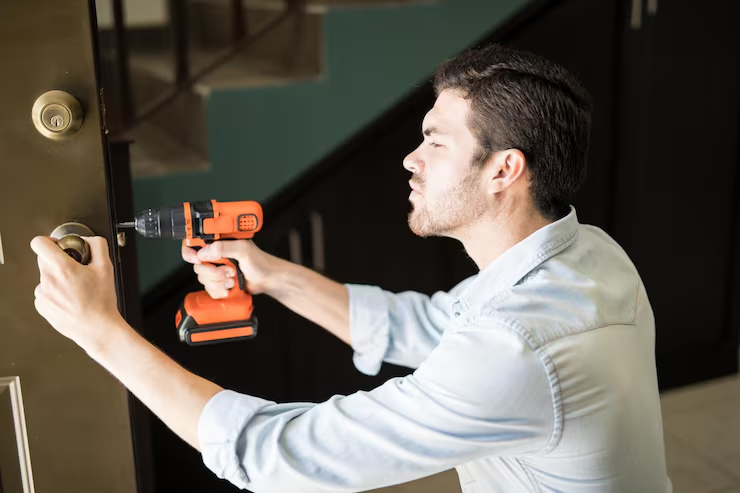
Twenty years later, I stood in the driveway of my new house—my house, the one I’d saved for and researched and purchased entirely on my own—and stared at the scratches around the front door lock.
Fresh metal shavings glinted on the welcome mat. An oily fingerprint smeared near the deadbolt where someone had steadied themselves while trying to gain entry.
My stomach didn’t drop with surprise. It hardened with recognition.
I knew exactly who had done this.
The locksmith’s white van sat crooked at the curb, engine still running. A young man in a company polo stood on my porch looking confused and uncomfortable while my parents flanked him like they had every right to be there.
My mother clutched her designer purse—the one she’d bought on credit and complained about for months afterward. My father scanned the quiet suburban street with the expression of a man who expected applause for solving a problem.
They hadn’t seen me yet. I was still half-hidden behind my car, parked one house down where I’d pulled over the moment I’d spotted the van.
Good.
I needed a minute to breathe, to center myself, to remember that I wasn’t the twelve-year-old girl whose privacy was a punchline at family dinners. I was thirty-two, a senior data analyst at a tech company, the owner of a three-bedroom house in a neighborhood I’d chosen specifically because it was forty minutes away from them.
Far enough to breathe. Close enough that they couldn’t claim I’d “abandoned the family.”
The irony wasn’t lost on me that even at thirty-two, I was still calculating distance in terms of their potential complaints.
I watched my father gesture impatiently at the locksmith, his body language aggressive in that particular way he had—not quite threatening, but insistent enough to make people uncomfortable. The locksmith was young, maybe twenty-five, probably just trying to make his quota for the day.
He had no idea he’d walked into a family drama that had been building for three decades.
My phone buzzed in my pocket. A text from my best friend, Maya.
How’s the new place? Settled in yet?
I stared at her message, then at my parents on the porch of my new house, and felt something cold and precise click into place in my chest.
Not yet, I typed back. But I’m about to be.
I stepped out from behind my car and walked toward them slowly, deliberately, my footsteps loud enough on the pavement that they couldn’t claim they hadn’t heard me coming.
My father turned first. His expression cycled through surprise, calculation, and finally settled on defensive indignation—the look he wore whenever he was caught doing something questionable and had already decided to make it my fault.
“Charlotte,” he said, as if I was the unexpected guest. “We’ve been trying to reach you.”
“I’ve been at work,” I said, keeping my voice level. “Where people generally are on a Tuesday afternoon.”
My mother turned, pressing her hand to her chest in that theatrical way she had. “We were worried. You haven’t been answering our calls.”
“I’ve been answering some of them,” I corrected. “The ones that weren’t the fourth call in two hours.”
The locksmith shifted his weight, clearly sensing the tension but not understanding its source. He was holding a key-cutting machine, probably pulled from his van when my parents had spun whatever story convinced him this was a legitimate service call.
“Ma’am,” he said, addressing me uncertainly. “These folks said they’re locked out of their daughter’s house and need—”
“This is my house,” I interrupted, pulling my keys from my pocket and holding them up. “I live here. Alone. And I have all my keys.”
The locksmith’s face went pale as the situation clarified itself. He looked at my parents with the expression of someone who’d just realized they’d been used.
“They told me it was an emergency,” he said. “That their daughter was out of town and they needed to check on something inside.”
“I’m not out of town,” I said. “I’m right here. And they don’t have permission to be on my property.”
My mother made a wounded sound. “Charlotte, don’t be dramatic. We’re family. We just wanted to make sure everything was okay with the house. You bought it so quickly, without even letting us see it first—”
“I’m thirty-two years old,” I said. “I don’t need permission to buy a house.”
“We’re not talking about permission,” my father cut in, his voice rising. “We’re talking about common sense. You bought a house in a neighborhood we’ve never seen, with people we don’t know, and you expect us not to worry?”
The locksmith cleared his throat. “I think I should probably go.”
“Good idea,” I said, not taking my eyes off my parents.
He was in his van and pulling away within thirty seconds, probably already planning how to tell this story to his coworkers.
My parents watched him leave, then turned back to me. Without the buffer of a third party, the air felt heavier, more dangerous.
“Where did you get a key to my house?” I asked quietly.
My mother’s expression flickered—guilt, quickly buried under offense. “We don’t have a key.”
“Then what were you planning to do once that locksmith opened my door? Walk inside a house you’ve never been invited to?”
“You’re our daughter,” my father said, as if that explained everything. As if those three words erased boundaries, autonomy, the basic right to privacy in my own home. “We have a right to make sure you’re safe.”
“You have a right to respect my wishes,” I countered. “And I never gave you permission to be here, let alone try to break in.”
“Break in,” my mother repeated, her voice dripping with disbelief. “Listen to yourself. We’re not criminals, Charlotte. We’re your parents. Parents who’ve sacrificed everything for you, who paid for your education, who—”
“Who read my text messages at dinner,” I said. “Who went through my room every time I left the house. Who called my college roommate when I didn’t answer the phone fast enough. Who showed up at my apartment unannounced so many times that my landlord asked if I needed help.”
The words came faster now, years of careful silence cracking open.
“You’re not worried about my safety,” I said. “You’re worried about not having access. About not knowing every detail of my life. About me having something that’s mine and only mine.”
My father’s jaw tightened. “We’re done talking about this on the street like trashy people. Give us a key, and we can discuss this inside like adults.”
“No.”
The word hung in the air between us, small and absolute.
“Excuse me?” my mother said.
“No,” I repeated. “You’re not getting a key. You’re not coming inside. This is my house, and you’re not welcome here right now.”
My father took a step toward me, his face reddening. “You can’t keep us out of your life forever, Charlotte. Sooner or later, you’re going to need us.”
“Maybe,” I said. “But not today.”
I walked past them to my front door, my hands steady as I unlocked both the deadbolt and the handle. The door opened smoothly—no damage, thank god—and I stepped inside without looking back.
“Charlotte!” my mother called, her voice breaking. “Don’t you dare close that door!”
I paused in the doorway, looking over my shoulder at the two people who’d raised me, who’d taught me that love and control were the same thing, who genuinely couldn’t understand why I would want a life they couldn’t monitor.
“I’m closing the door,” I said quietly. “And if you try to come back without permission, I’ll call the police.”
“You wouldn’t,” my father said, but his voice wavered with uncertainty.
“Test me.”
I closed the door softly, locked both locks, and stood with my forehead pressed against the cool wood, listening to the muffled sounds of their argument on the porch.
My mother’s voice, high and wounded: “How could she do this to us?”
My father’s voice, lower, angrier: “She’ll come around. She always does.”
But they were wrong this time.
I wasn’t coming around anymore.
The first week in my new house had been perfect before this. I’d unpacked boxes at my own pace, arranged furniture exactly how I wanted it, hung pictures that made me smile instead of ones that would pass my mother’s approval.
I’d painted the guest bedroom a deep teal that my mother would have hated—”too dark, too moody, what will people think?”—and I’d loved every brush stroke.
I’d learned which floorboards creaked, which windows stuck slightly, which corner of the kitchen got the best morning light. Small discoveries that felt like secrets between me and the house.
But underneath the joy of ownership had been a constant low-level anxiety that I’d tried to ignore.
I’d bought the house without telling my parents I was even looking.
After years of them “accidentally” finding my apartment listings, showing up at open houses I’d mentioned in passing, and offering unsolicited opinions on neighborhoods and floor plans, I’d learned to keep my search completely private.
I’d worked with a real estate agent I’d found through Maya, someone with no connection to my family or their social circle. I’d taken time off work for viewings without mentioning why. I’d kept every document, every conversation, every excited breakthrough to myself or shared only with Maya.
When I’d finally made an offer—on this house, with its wraparound porch and mature trees and the kind of quiet that felt like exhaling—I’d felt both elated and terrified.
Elated because I was doing something entirely my own.
Terrified because I knew the explosion that was coming.
I’d told them three days before closing. Not because I wanted their input, but because I knew if I waited until after, they’d find a way to make it worse.
We’d met at a coffee shop—neutral territory, public enough that they couldn’t make a scene but private enough for the conversation I knew we needed to have.
“I bought a house,” I’d said, sliding the folder across the table.
My mother had stared at it like I’d handed her a snake. “What do you mean you bought a house?”
“I found a place I love, made an offer, got approved for a mortgage. I close on Friday.”
My father had opened the folder slowly, his expression darkening as he scanned the paperwork. “You did this alone.”
“Yes.”
“Without asking for our opinion. Without letting us help you look. Without even—” He’d stopped, visibly trying to control his anger. “Why would you hide something this important?”
“I didn’t hide it,” I’d said carefully. “I kept it private. There’s a difference.”
“Not in a family,” my mother had said, her voice tight. “Family shares things. Family helps each other make big decisions.”
“I didn’t need help with this decision,” I’d said. “I’m thirty-two. I have a good job. I’ve been saving for years. This is something I wanted to do on my own.”
The silence that followed had been heavy with all the things they wanted to say but couldn’t in public.
Finally, my father had closed the folder and pushed it back across the table.
“I assume you’ll need help moving,” he’d said.
“I’ve hired movers.”
“Money for furniture?”
“I have furniture.”
“At least give us a key,” my mother had tried. “For emergencies. What if something happens and we need to reach you?”
That was when I should have said no clearly, firmly, the way I’d just done on my front porch.
Instead, I’d hedged. “Let me get settled first. We can talk about it later.”
Except “later” had never come because I’d avoided their calls, let their visits to my old apartment go unanswered, and generally tried to create space without explicitly drawing boundaries.
Because drawing boundaries with my parents had always felt like declaring war.
But apparently, they’d declared war anyway.
That night, I sat on my couch in my empty living room—still half-furnished, still smelling faintly of fresh paint—and called Maya.
“They tried to break into my house,” I said when she answered.
“Jesus. Are you okay?”
“I don’t know.” I pulled my knees up to my chest, suddenly exhausted. “They hired a locksmith. Told him I was out of town and they needed to get in.”
“That’s illegal.”
“I know.”
“Like, actually illegal. Not just rude or boundary-crossing. That’s attempted breaking and entering.”
I closed my eyes. “I know.”
“What did you do?”
“I sent them away. Told them they weren’t welcome.”
Maya was quiet for a moment. “How do you feel?”
“Terrified,” I admitted. “Relieved. Angry. Like I just jumped off a cliff and I’m still falling.”
“You didn’t jump,” Maya said gently. “You set a boundary they’ve been begging you to set for years. They’re just shocked you finally did it.”
“They’re going to make my life hell.”
“They were already making your life hell,” she pointed out. “At least now you have a door you can lock.”
After we hung up, I walked through my house slowly, checking every window, every door, making sure everything was secure.
In the back of the coat closet, I found what I was looking for—a small security camera I’d ordered online but hadn’t installed yet. It had seemed paranoid when I’d bought it, an overreaction to fears I couldn’t quite name.
Now it seemed like the bare minimum.
I spent the next hour mounting cameras at the front door, back door, and driveway. They weren’t professional quality, but they were WiFi-enabled and would send alerts to my phone if they detected motion.
The red recording lights blinked steadily once I’d finished setting them up, small eyes keeping watch while I slept.
It should have felt intrusive, having cameras pointed at my own house.
Instead, it felt like protection.
The calls started the next morning.
I was getting ready for work when my phone lit up with my mother’s name. I let it go to voicemail. She called again. Voicemail. Again. Voicemail.
After the sixth call in thirty minutes, I listened to the messages.
The first was apologetic: “Sweetie, I’m sorry if we overstepped yesterday. We just want to make sure you’re okay. Call me back when you get this.”
The second was confused: “I don’t understand why you’re ignoring us. Did we do something wrong? Please call me.”
The third was hurt: “I can’t believe you’re treating us this way after everything we’ve done for you. Your father is beside himself.”
By the sixth, she’d moved into anger: “This is ridiculous, Charlotte. You’re acting like a child. We’re your parents. You can’t just shut us out of your life because you bought a house.”
I deleted them all and turned my phone to Do Not Disturb before heading to work.
My job was usually a refuge—clean problems with data-driven solutions, coworkers who respected boundaries, a boss who communicated like an actual professional. But that day, I couldn’t focus. I kept checking my phone for notifications from the security cameras, half-expecting to see my parents on the front porch again.
Around 2:00 PM, I got a text from an unknown number.
Charlotte, this is your Aunt Jennifer. Your mother called me very upset. She says you’re refusing to talk to her and you threatened to call the police. What’s going on?
I stared at the message, anger building in my chest.
Of course they’d called my aunt. Of course they were spinning this as me being unreasonable, dramatic, cruel.
Of course they’d positioned themselves as the victims.
I typed out three different responses and deleted them all. Finally, I wrote:
Hi Aunt Jen. I’m fine. My parents and I are having a disagreement about boundaries. I appreciate your concern, but this is between us.
Her response came quickly: Boundaries are important, but so is family. Maybe if you just talked to them?
I tried. They hired a locksmith to break into my house.
Three dots appeared and disappeared several times. Then: Are you serious?
Yes.
Oh, Charlotte. That’s… I had no idea. Your mother made it sound like you just weren’t returning their calls.
I’m sure she did, I wrote. But that’s what happened.
What do you need from me?
I felt something loosen in my chest at the question. Not “How can I fix this?” or “Can’t you just apologize?” but “What do you need?”
Nothing right now, I wrote. But thank you for asking.
After that exchange, the texts from other family members started arriving. My cousin Brian. My uncle Mike. People I hadn’t spoken to in months, suddenly very concerned about the “rift” in our family.
I could see my parents’ strategy clearly—mobilize the extended family, make me look like the villain, apply pressure from every angle until I apologized and gave them what they wanted.
It had worked before. Countless times, over smaller infractions. I’d learned early that it was easier to apologize and comply than to weather the storm of family disappointment.
But something had changed in me between then and now.
Maybe it was signing my name on a mortgage and understanding what it meant to own something completely.
Maybe it was three decades of surveillance and control finally crystallizing into clarity.
Maybe I’d just reached my breaking point.
Whatever it was, I wasn’t apologizing this time.
The next escalation came on Thursday.
I got home from work to find my mother’s car in my driveway.
She was sitting in the driver’s seat, engine off, staring at my front door like she was trying to will it open through sheer force of determination.
I pulled in beside her and sat in my car for a moment, steadying my breathing.
This was my house. My property. I didn’t have to let her in. I didn’t have to explain myself.
But thirty-two years of conditioning whispered otherwise.
She’s your mother. She drove all the way here. The least you can do is talk to her. Don’t be difficult.
I got out of my car and walked to her window.
She rolled it down, her eyes red-rimmed and puffy. “Finally,” she said. “I’ve been waiting for an hour.”
“I was at work,” I said. “Like I am every weekday.”
“I needed to talk to you.”
“So you ambushed me at my house.”
“It’s not an ambush,” she said, her voice breaking. “You won’t return my calls. You won’t answer my texts. What else am I supposed to do?”
“Respect that I need space.”
“Space,” she repeated, like the word was foreign. “From your own mother?”
“Yes.”
She stared at me, tears spilling over. “I don’t understand what I did wrong.”
I could have let it go. Could have softened, explained again, tried to make her understand in a way that wouldn’t hurt her feelings.
But I was tired.
Tired of protecting her from the consequences of her own actions. Tired of managing her emotions while mine went ignored. Tired of being responsible for her pain when she’d never taken responsibility for mine.
“You hired a locksmith to break into my house,” I said flatly. “You lied to him. You tried to violate my privacy in my own home.”
“We were worried—”
“No,” I interrupted. “You were controlling. There’s a difference.”
She flinched like I’d slapped her. “That’s not fair.”
“None of this is fair, Mom. It wasn’t fair when you read my diary when I was twelve. It wasn’t fair when you went through my phone at dinner. It wasn’t fair when you showed up at my college unannounced to ‘check on me.’ It wasn’t fair when you called my first boyfriend’s mother to ‘get to know her’ before I’d even introduced you.”
“I’m your mother,” she said desperately. “That’s what mothers do.”
“No,” I said quietly. “That’s what controlling parents do. And I’m done with it.”
I walked past her car to my front door, unlocked it, and stepped inside without inviting her in.
Through the window, I watched her sit in her car for another ten minutes before finally starting the engine and driving away.
My hands were shaking so badly I had to sit down on the floor of my entryway and press my palms against the cool tile until they steadied.
On Friday morning, I called the non-emergency police line.
The dispatcher was professional and patient as I explained the situation—the attempted break-in, my parents’ refusal to respect boundaries, the escalating behavior.
“Have they threatened you?” she asked.
“Not directly. But they showed up at my house uninvited after I told them not to come.”
“And you’re the homeowner? This is your property?”
“Yes.”
“All right. I’m going to have an officer come by to take a report. That way, if they escalate further, you’ll have documentation.”
Officer Williams arrived an hour later. He was in his forties, with kind eyes and the patient demeanor of someone who’d probably handled a thousand family disputes.
I showed him the security footage from Tuesday—my parents on the porch with the locksmith, my father gesturing angrily, my mother clutching her purse.
“And you never gave them a key?” he asked.
“Never.”
“Did you give them permission to be on your property?”
“No.”
He made notes on a small pad. “What would you like to happen here, Ms. Davis?”
“I want documentation,” I said. “In case I need to file for a restraining order later.”
His eyebrows rose slightly. “You think it’ll come to that?”
“I hope not,” I said honestly. “But I also never thought they’d try to hire someone to break into my house.”
He nodded slowly. “All right. I’ll file this report. If they show up again, call us immediately. Don’t try to handle it yourself.”
After he left, I felt simultaneously relieved and sick.
I’d just filed a police report against my own parents.
The girl who used to rearrange her room to avoid their disapproval had just involved law enforcement.
Maya called that afternoon. “You did the right thing,” she said when I told her.
“Did I? Or did I just make everything a thousand times worse?”
“They made it worse,” she corrected. “You’re just protecting yourself. There’s a difference.”
That weekend, I didn’t leave my house. I ordered groceries online, caught up on work, and tried not to obsess over every car that drove down my street.
On Sunday evening, my doorbell rang.
I checked the security camera first—a habit I’d developed in less than a week—and saw my father standing on my porch, alone this time, holding a manila folder.
I didn’t open the door.
“Charlotte,” he called through the wood. “I know you’re in there. Your car’s in the driveway.”
I stayed silent.
“I’m not here to fight,” he said. “I just want to talk. Please.”
Still silent.
“I have documents you need to see. About the house.”
That made me pause. Documents?
Against my better judgment, I opened the door but stayed in the threshold, blocking entry.
“What documents?”
He held up the folder. “Can I come in?”
“No.”
His jaw clenched. “Charlotte—”
“Whatever you need to show me, you can show me from there.”
He stared at me for a long moment, then opened the folder and pulled out several sheets of paper. “Do you remember when you were twenty-two and we refinanced the house?”
My stomach dropped. “Vaguely.”
“We had you sign some paperwork. For the refinance.”
“I remember. And I had my name removed when I found out you’d listed me as a co-borrower without telling me.”
“About that,” he said slowly. “Turns out there was a second set of documents. Different loan. The bank found them when we were getting ready to sell.”
“Sell?” I repeated. “You’re selling the house?”
“We’re downsizing. Not important. What’s important is that your name is still on these documents. Which means technically, you’re part owner.”
The world tilted slightly. “That’s not possible. I never agreed to—”
“You signed them,” he said, tapping the papers. “Right here. Your signature.”
I stared at the photocopied signature, my stomach churning. The handwriting looked like mine. The date was from when I was in college, exhausted from finals, signing anything they put in front of me because I trusted them.
“This is why we need access to your finances,” he continued. “To sort this out. The bank says the sale can’t go through until we clear up the title issue. We need you to sign some new papers, work with our lawyer—”
“No.”
He blinked. “What?”
“I’m not signing anything until I have my own lawyer look at this.”
“Don’t be ridiculous. We’re family—”
“Family doesn’t forge documents,” I said. “Family doesn’t trick their daughter into signing away her rights. Family doesn’t hire locksmiths to break into houses.”
“We didn’t forge anything!” His voice rose. “You signed these yourself! You just don’t remember because you never paid attention—”
“Get off my porch.”
“Charlotte—”
“Get off my porch, or I’m calling the police.”
He stared at me, papers clutched in his hand, and for the first time, I saw something like uncertainty cross his face.
“You’ve changed,” he said quietly. “This isn’t who you are.”
“No,” I said. “This is exactly who I am. You just never let me be it before.”
I closed the door while he was still trying to formulate a response.
Monday morning, I called out sick from work and spent the day researching real estate attorneys.
I found one—Sharon Martinez, who specialized in title disputes and property law—and made an appointment for that afternoon.
Her office was downtown, filled with law books and that particular smell of old paper and strong coffee that all professional offices seemed to have.
I showed her the photocopied documents my father had brought. “I don’t remember signing these,” I said. “Or if I did, I didn’t understand what they were.”
She studied them carefully, her expression neutral. “How old were you when these were allegedly signed?”
“Twenty-two. I was in college.”
“Living with your parents?”
“No, but financially dependent on them.”
She made notes. “And you’ve never received any correspondence about this loan? Tax documents, statements, nothing?”
“Nothing. I didn’t even know it existed until last night.”
Sharon leaned back in her chair. “Ms. Davis, I’m going to be honest with you. If these signatures are genuine, even if you didn’t understand what you were signing, that’s going to be difficult to challenge. However—” she held up a hand when I started to protest “—if you can prove you were coerced, or that material information was withheld, we might have grounds to contest.”
“What does that look like?”
“Documentation. Emails, texts, anything that shows your parents pressured you or deliberately kept you in the dark about financial arrangements. Do you have anything like that?”
I thought about years of deleted text messages, voicemails I’d never saved, conversations that had happened only in person specifically so there’d be no record.
“Not much,” I admitted. “They were always careful.”
Sharon nodded, unsurprised. “That’s common in these situations. Family financial abuse often leaves minimal paper trail because the victims trust the abusers.” She paused. “Did you file a police report about the attempted break-in?”
“Yes. Last week.”
“Good. That establishes a pattern of boundary violation. We can use that.” She pulled out a legal pad. “Here’s what I recommend: We send your parents a letter formally requesting all documentation related to any financial arrangements with your name on them. We state clearly that you don’t recall authorizing anything and you’re investigating potential fraud. We cc their attorney if they have one.”
“Fraud,” I repeated. The word felt huge and terrible.
“If they forged your signature, yes. If they tricked you into signing without explaining what the documents were, possibly. If you signed with full knowledge and consent, then we’re looking at extricating you from an agreement you made as a legal adult.” She looked at me seriously. “This is going to get messy, Ms. Davis. Are you prepared for that?”
I thought about my house—my actual, real house that was 100% mine. My haven. My first adult space that no one else had touched.
“Yes,” I said. “I’m prepared.”
The letter went out on Wednesday.
By Thursday afternoon, I had seventeen missed calls from my parents and a voicemail from my father that I’d probably never forget.
“You want to play lawyer?” his voice said, tight with rage. “Fine. We’ll play lawyer. But don’t come crying to us when you realize how much this is going to cost you. We tried to handle this as family. You’re the one making it ugly.”
I saved the voicemail and forwarded it to Sharon.
Her response was immediate: Perfect. This helps us.
My mother’s approach was different. She enlisted my grandmother—her mother—who called me on Friday morning.
“Charlotte, honey,” Grandma Rose said, her voice gentle. “Your mother is beside herself. She says you’ve accused them of fraud?”
“I’ve asked for documentation,” I corrected. “Of financial agreements I allegedly signed but don’t remember.”
“But why lawyers? Why make this legal? Can’t you just sit down and talk like family?”
“I tried that, Grandma. Multiple times. They don’t hear me unless there’s a legal letterhead involved.”
She sighed, a long sound full of disappointment. “When did you become so hard?”
The question stung more than I wanted to admit.
“I’m not hard,” I said quietly. “I’m just finally soft enough to know when something hurts.”
After we hung up, I sat in my living room and cried for the first time since this all started. Not sad tears. Angry ones. Grieving ones.
I was grieving the parents I’d wished I had. The ones who would have celebrated my first house instead of trying to break into it. The ones who would have respected my boundaries instead of trampling them.
I was grieving the version of myself who’d kept trying to earn their approval, thinking if I was just patient enough, compliant enough, understanding enough, they’d eventually see me.
That version of me had died the moment I’d closed my front door with them on the other side.
Three weeks later, Sharon called with news.
“We got the documents,” she said. “And Charlotte, you’re not going to like this.”
My stomach clenched. “How bad?”
“The signatures look genuine. But there are some irregularities in the notarization that we might be able to challenge. More importantly, I found something interesting in the loan terms.”
“What?”
“The loan was structured as a home equity line of credit, with your parents’ house as collateral. But the actual funds? They never went toward the house. They went to a business investment your father made. It failed. He used your signature to secure a loan he knew he couldn’t pay back.”
I closed my eyes. “So he committed fraud.”
“Arguably, yes. If we can prove you didn’t understand what you were signing, and that he misrepresented the purpose of the loan. The good news is that the statute of limitations might work in your favor here. The bad news is that proving intent is difficult.”
“What do you recommend?”
“We can file a complaint with the state attorney general’s office and see if they want to investigate. We can also demand the title be cleared through the courts. But Charlotte—” her voice gentled “—this is going to take months. Maybe years. And it’s going to cost you, both financially and emotionally.”
“Is there any way to just… walk away?”
“You could disclaim any interest in their property, essentially saying you don’t want to be involved. But that doesn’t address the fact that your signature was used without your informed consent.”
I sat with that for a moment. My parents had used me. Had put my name on documents that could have destroyed my credit, that could have left me liable for their debts.
And they’d done it while I was young and trusting and desperately trying to make them proud.
“File the complaint,” I said. “Clear the title. Do whatever it takes.”
“I will,” Sharon said. “But you should know—your parents will likely retaliate. This is going to get worse before it gets better.”
“It’s already worse.”
“Fair point.”
The retaliation came in waves.
First, my mother started posting vague, martyrish updates on social media about “ungrateful children” and “family betrayal.” I blocked her, but screenshots made their way to me through concerned cousins.
Then my father called my boss.
My boss—a woman named Patricia who I’d worked with for four years and who I respected immensely—called me into her office on a Tuesday afternoon.
“I need to talk to you about a strange call I got yesterday,” she said carefully.
My heart sank. “My father?”
“He said he was concerned about your mental health. That you’d been acting erratically, making false accusations against your family, and he was worried it might be affecting your work performance.”
I felt sick. “What did you tell him?”
“I told him that discussing employees with family members without the employee’s consent would be a massive HIPAA violation if we were in healthcare, and since we’re not, it’s just inappropriate and I was ending the call.” She looked at me seriously. “Charlotte, is everything okay?”
I could have minimized it. Could have said “family stuff” and left it vague.
Instead, I told her the truth.
All of it. The attempted break-in. The forged documents. The police report. The legal battle I was now in the middle of.
When I finished, Patricia was quiet for a long moment.
“How long has this been going on?” she finally asked.
“My whole life, in different ways. But the acute crisis started when I will,” Sharon said, her voice steady and professional. “I’ll have the paperwork ready for you to sign by tomorrow.”
The weeks that followed were a blur of legal notices and silence. After my father’s last voicemail, the calls stopped. No more “check-ins,” no more Aunt Jennifer relaying messages, no more midnight texts. It was as if, by involving the law, I had finally spoken a language they understood—not the language of love or family, but the language of consequences.
It took six months of mediation and several grueling meetings in sterile conference rooms. My father sat across from me, looking older and smaller than I remembered. He didn’t look like the man who had laughed at my privacy being invaded at twelve. He looked like a man who had gambled with things that weren’t his and lost.
To avoid a full fraud investigation that could have led to criminal charges, they agreed to a settlement. My name was scrubbed from their property titles and the loan was restructured solely in their names. In exchange, I signed a non-disclosure agreement regarding the specifics of the financial dispute.
They had to sell their house to cover the debt. They moved into a smaller condo three towns over. I didn’t help them pack.
Reclaiming the Sanctuary
The day the final papers were signed, I came home and sat on my wraparound porch. It was autumn now, and the mature trees I’d loved when I first saw the place were dropping gold and crimson leaves onto the grass.
I looked at the front door. The scratches from the locksmith’s tools were still there, faint but visible. I hadn’t sanded them down yet. I realized then that I didn’t want to. They were a reminder of the day I didn’t cave.
I went inside and walked through my rooms.
-
The teal guest room was finished, a deep, moody sanctuary where I read on Sunday mornings.
-
The kitchen was messy with the remnants of a dinner I’d cooked just for myself, using the spices my mother always said were “too much.”
-
The air was silent. There was no one wondering where I was, no one checking my phone, no one waiting for me to be someone I wasn’t.
My phone buzzed on the counter. I didn’t flinch. I didn’t feel that cold spike of dread in my stomach.
It was Maya. Pizza and a movie tonight? Your place?
I started to type Yes, but then I paused. I looked at the sunlight hitting the hardwood floors and the way the shadows stretched across the living room. I felt the weight of the key in my pocket—the only copy that existed outside of my own hands.
Not tonight, I typed back. I just want to be home.
I put the phone on the table, face down. I walked to the front door and turned the deadbolt. The click was loud and final in the quiet house.
I leaned my back against the wood, closed my eyes, and took a breath. The air tasted like cedar and old books and a future I had built with my own hands.
For the first time in thirty-two years, I wasn’t a daughter, a data point, or a secret to be shared. I was just Charlotte.
And the house was finally mine alone.
Understanding the Boundaries
What Charlotte experienced is a transition from Enmeshment to Autonomy. In many families, boundaries are seen as a threat to “closeness,” but healthy relationships actually require them to flourish.