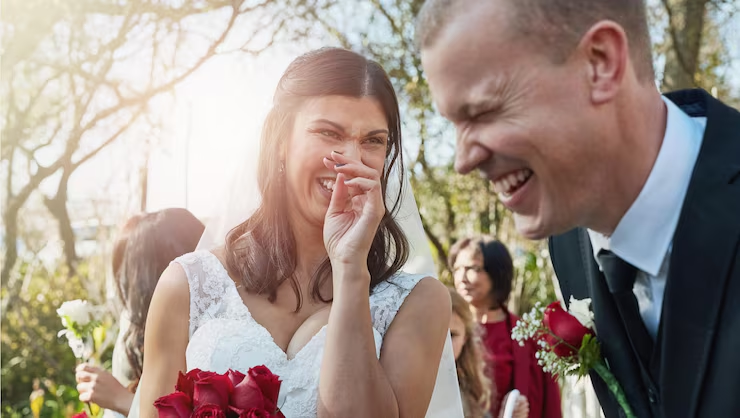
The Recording I Played at My Wedding
They say the happiest day of a woman’s life is draped in lace and scented with lilies, a carefully choreographed performance of eternal devotion staged under the watchful eyes of everyone she has ever known. For three years, I believed I was rehearsing for that singular, blissful climax. I believed that Ethan Miller was the anchor to my drifting ship, the one man who looked past the staggering portfolio of Carter International Realty and saw only me—Elena, the girl who preferred charcoal sketches to balance sheets.
I was a fool. But fortunately, I am a fool who learns quickly when the stakes are my life.
One hour before the wedding, the air in the bridal suite at The Grand Essex was thick with the scent of expensive hairspray and the nervous energy of my bridesmaids. I needed air. I needed a moment of silence to reconcile the woman I was with the wife I was about to become. I slipped away, the heavy train of my gown whispering against the marble floors of the quiet hallway outside the ballroom.
I stopped near the alcove of the executive lounge, the door slightly ajar. I expected to hear the clinking of glasses or perhaps a stray waiter. Instead, I heard a voice that made my blood turn to liquid nitrogen.
“I don’t care about her, Ma,” Ethan whispered, his tone devoid of the warmth he usually reserved for me. It was sharp, transactional, and utterly chilling. “I just want the access. I want the money.”
I froze. The world seemed to tilt on its axis. My hand hovered over the door handle, my knuckles turning as white as my dress. Then came the response, low and purring with a satisfaction that made my skin crawl. It was Linda Miller, my soon-to-be mother-in-law.
“You’re doing exactly what we discussed,” Linda murmured. “Once that ring is on her finger, every asset the Carters have spent forty years building becomes part of the Miller legacy. Just keep her emotional, Ethan. She’s fragile. She’s easy to navigate when she thinks she’s loved.”
Fragile.
The word sparked a fire in the pit of my stomach that began to consume the frost.
The Woman I Was
My family had built an empire from the red clay of the earth, stone by stone, contract by contract. My grandfather started with a single apartment building in Queens. My father turned that into a portfolio spanning three states. And I had spent my twenties in boardrooms, outmaneuvering men twice my age who underestimated me because I wore Chanel and spoke softly.
Yet Ethan had convinced me that my ambition was merely a “cute” hobby.
He’d done it so subtly I hadn’t even noticed I was being erased. When I talked about expanding into sustainable architecture, he’d smile and say, “That’s adorable, but maybe focus on the core business first.” When I mentioned wanting to chair the next investor meeting, he’d squeeze my hand and suggest I “take a break” from the stress.
He had diminished me so effectively that I’d started to believe him.
Standing in that hallway, listening to him reduce me to a transaction, I realized something that should have been obvious from the beginning: Ethan Miller had never loved me. He’d loved what I represented. Access. Money. Power.
My hands began to tremble, not with the flutter of bridal nerves, but with the rhythmic vibration of a predator finding its mark.
I didn’t burst through the door. I didn’t scream.
I turned, retreated into the shadows, and walked toward the restroom. I locked the door, leaned against the cold porcelain sink, and stared at the stranger in the mirror.
The woman looking back at me was draped in ivory silk and pearls, but her eyes were no longer those of a bride. They were the eyes of a CEO.
I realized then that I wasn’t just Elena Carter; I was the primary shareholder of my own destiny.
And it was time for a hostile takeover.
The Plan
The transition from heartbreak to cold, calculated execution took exactly four minutes.
I pulled my phone from the hidden pocket of my gown—a small detail I had insisted on for my sketches, which now served a much darker purpose. I didn’t call Ethan. I didn’t call my father.
I opened my voice recording app. The one I used to capture design ideas and meeting notes. The one that had been running, unbeknownst to me, for the past fifteen minutes while I stood outside that lounge.
I played it back, my hands shaking.
The audio was perfect. Crystal clear. Damning.
I sent a single, encrypted message to Michael Harris, the lead counsel for the Carter estate and a man who had warned me three months ago that Ethan’s background check had “unusual gaps.”
Activate the ironclad prenup clause. The one involving moral turpitude and bad faith. Be at the altar in thirty minutes. Bring the heavy hitters.
Michael’s reply was instantaneous: Understood. I’m already in the lobby. Elena, are you okay?
I stared at the screen, a solitary tear escaping and charting a path through my foundation. I wiped it away with a brutal swipe of my thumb.
I’ve never been better, Michael. I’m finally awake.
I walked out of that restroom and back into the bridal suite. My bridesmaids fluttered around me, oblivious to the carnage I was preparing. I smiled. I laughed. I let them touch up my lipstick.
I was a master of the long game, and the Miller family was about to find out that a Carter never loses a negotiation.
The Ceremony
The music began to swell—the opening chords of a cello concerto that I had once thought was romantic. Now, it sounded like a funeral dirge.
My father, Julian Carter, appeared at the door, his eyes shimmering with a pride that nearly broke my resolve. He took my hand, his grip firm and grounding.
“You look like your mother,” he whispered. “She would be so proud of the woman you’ve become.”
“I’m doing this for her, Dad,” I said, and for the first time that day, it wasn’t a lie. I was doing this for every woman who had ever been told her value was a bargaining chip for a man’s greed.
As the double doors to the ballroom swung open, the scent of five thousand white roses hit me like a physical blow. The room was a sea of New York’s elite—investors, politicians, socialites—all gathered to witness the merger of the year.
And there stood Ethan Miller at the altar, looking every bit the dashing prince in his midnight-blue tuxedo. He looked at me with a smile that was so convincing, so perfectly practiced, that I almost admired his sociopathy.
Almost.
I walked down the aisle with a steady pace, each step a hammer blow against the floorboards. Ethan reached out to take my hand as I ascended the stairs. His palm was warm. Mine was as cold as a tombstone.
The officiant began the ceremony. The words flowed over me like water off a slate roof. Ethan’s vows were a masterpiece of fiction, a poetic tribute to a love he didn’t feel for a woman he didn’t know. He spoke of “building a future” and “sharing a soul,” while I felt the weight of my phone in the hidden pocket of my dress.
Then, the moment arrived. The air in the room seemed to vanish.
“Elena Carter,” the officiant said, his voice resonant in the hushed ballroom. “Do you take this man to be your lawfully wedded husband?”
The silence stretched. Five seconds. Ten.
I saw Ethan’s smile falter just a fraction. I saw Linda Miller leaning forward in the front row, her eyes narrowed with a sudden, sharp intuition.
I didn’t say “I do.”
I smiled softly, an expression that didn’t reach my eyes, and turned toward the audience.
“Before I answer that,” I said, my voice clear and steady, “I think there is a piece of information that our guests—and our investors—deserve to hear.”
A murmur, like the sound of a distant tide, rippled through the pews.
Ethan’s hand tightened on mine, his grip bordering on painful.
“Elena,” he hissed, his voice a frantic whisper. “What are you doing? This isn’t the time.”
“Oh, Ethan,” I replied, stepping back and pulling my hand from his as if he were covered in ash. “This is the only time.”
The Revelation
I turned to the crowd, my gaze finding my father’s confused face, then shifting to the predatory mask of Linda Miller. She was already on her feet, her instinct for self-preservation kicking in.
“My dear, you’re clearly overwhelmed,” Linda snapped, her voice projecting with the authority of a woman who was used to silencing boardrooms. “The stress of the day has clearly affected your judgment. Ethan, take her back to the suite.”
I ignored her. I reached into the hidden pocket of my gown and pulled out my smartphone. I connected it to the ballroom’s sound system—the one I’d had my assistant configure that morning under the guise of “testing the microphone for my vows.”
I tapped the screen once.
The sound system of the ballroom, designed to carry the dulcet tones of a string quartet, suddenly exploded with the raw, clear audio I had captured an hour ago.
“I don’t care about her, Ma. I just want the access. I want the money.”
The ballroom went glacial.
I watched the color drain from Ethan’s face in real-time, replaced by a grey, sickly pallor. It was the look of a man watching his life’s work—his grandest deception—incinerate in front of a thousand witnesses.
“Once that ring is on her finger, every asset the Carters have spent forty years building becomes part of the Miller legacy. Just keep her emotional, Ethan. She’s fragile. She’s easy to navigate when she thinks she’s loved.”
The recording ended.
The silence that followed was heavier than the audio. It was the sound of a reputation dying.
My father stood up, his jaw tight, his eyes burning with a cold, aristocratic rage that made even the bravest men in the room flinch.
“Ethan,” my father said, his voice a low, dangerous rumble. “I think you should leave. Now.”
“Wait!” Linda cried out, her voice rising to a frantic pitch. “This is a misunderstanding! That audio could be anything! It’s a fabrication! Elena is trying to embarrass my son because she’s unstable!”
On cue, the side doors of the ballroom opened. Michael Harris walked down the aisle, his briefcase in hand, flanked by two men in dark suits who didn’t look like wedding guests. They looked like the kind of men who served subpoenas and conducted forensic audits.
“As legal counsel for the Carter family,” Michael announced, his voice slicing through Linda’s hysterics, “I am here to clarify the situation. Ms. Carter has exercised the ‘Bad Faith’ clause of the pre-marital agreement signed three months ago. Given the evidence of premeditated financial fraud and emotional manipulation, the Miller family’s access to any and all Carter holdings is hereby terminated. Effective immediately.”
The Collapse
Linda clutched her chest, a theatrical gesture intended to elicit sympathy. She began to gasp, her breath hitching in a display of dramatic distress.
“You… you planned this? You orchestrated this public humiliation?”
I looked down at her from the altar, the train of my dress pooled around me like a fallen cloud.
“No, Linda,” I said, my voice devoid of emotion. “You planned to use me as a stepping stone. You planned to treat my family’s legacy like a scavenged carcass. I simply planned to survive you.”
Ethan fell to his knees on the velvet-covered steps of the altar. The “prince” had been reduced to a beggar in sixty seconds. He reached for the hem of my gown, his eyes brimming with tears that I now knew were just another tool in his arsenal.
“Elena, please,” he choked out. “I was scared. I didn’t mean it like that. I do love you. We can move past this. Don’t do this to us. Think of everything we’ve built.”
“We built nothing, Ethan,” I replied, stepping back so his fingers brushed only the air. “You built a trap. I built a future. And the two are no longer compatible.”
I turned to the officiant, who was frozen in place, his book still open to the page on ‘Eternal Love.’
“The ceremony is over,” I told him.
Then I looked at the crowd. My friends, my business rivals, the people who would go on to tell this story for decades. I didn’t feel embarrassed. I didn’t feel like a victim. I felt like the most powerful person in the room.
“I apologize for the disruption,” I said to the guests. “But the Carters don’t host celebrations for lies. Please, enjoy the reception. The food is paid for, the champagne is vintage, and the bride is officially celebrating her independence.”
Security moved in. Linda Miller’s dramatic gasps turned into vitriolic screams as she was escorted out, her pearls rattling against her neck as she fought the guards.
Ethan followed her, head bowed, his midnight-blue tuxedo now looking like the uniform of a defeated soldier.
I watched them go, and as the doors closed behind them, I felt a weight lift from my shoulders that I hadn’t even realized I was carrying.
My father walked up to the altar and pulled me into his arms.
“I’m proud of you,” he whispered. “Your mother would be too.”
The Aftermath
I walked out of that ballroom as a woman who had just averted a catastrophe. I walked out as a woman who had traded an ivory shroud for a suit of armor.
That night, I didn’t sit in a honeymoon suite in Paris. I sat on the balcony of my penthouse overlooking Central Park, a glass of sparkling water in my hand and the quiet hum of the city beneath me. I had unzipped the dress myself, the silk now draped over a chair like a discarded skin.
The next morning, the headlines were as brutal as I expected.
The Carter Coup. The Altar Audit. Elena Carter: Heiress or Executioner?
I ignored the tabloids. I ignored the frantic voicemails from Ethan—excuses wrapped in apologies, layered with the desperate logic of a man who had lost his meal ticket.
Within forty-eight hours, Michael Harris informed me that the Millers had vacated their apartment. Ethan had moved back in with Linda, his “future” now a landscape of debt and disgraced social standing.
Linda’s “chest-clutching” incident hadn’t earned her the sympathy she craved. In the circles we moved in, there is no greater sin than being caught. She was a pariah, a cautionary tale whispered over gin and tonics at the St. Regis.
But I didn’t cancel my honeymoon.
Two weeks later, I arrived in Lake Como, Italy.
I spent my days walking through the cobblestone streets of Bellagio, sketching the way the sunlight hit the water, eating gelato with no one to impress and no one to diminish my appetite. For the first time in years, I wasn’t an investment. I wasn’t a “fragile” girl to be navigated.
I was just Elena.
Rebuilding
I threw myself back into work when I returned. I restructured the real estate holdings, expanded our reach into sustainable architecture, and began a foundation for young women in business.
I wasn’t bitter. I wasn’t angry. I was liberated.
The foundation became my passion project. We funded scholarships for women in STEM fields, provided mentorship programs, and created a network of support for female entrepreneurs. I named it after my mother—The Catherine Carter Foundation.
Every time I spoke at an event, someone would ask about “the wedding that wasn’t.”
I had a standard response prepared.
“I didn’t lose a husband that day,” I would say. “I gained a life. I said something much more sacred than ‘I do.’ I said ‘I am.’ And that is a vow I will never break.”
Because love that requires your silence is not love. It’s a hostage situation. And a marriage built on the sand of greed will always succumb to the tide of the truth.
Months later, a reporter from a business magazine asked me if I regretted the public nature of the breakup.
I looked her in the eye and smiled.
“Not for a second,” I said. “If I’d handled it privately, the Millers would have spun the narrative. They would have painted me as the unstable heiress who couldn’t handle commitment. By making it public, by showing everyone exactly who they were, I protected not just myself but every other woman they might have tried to deceive.”
The article ran with the headline: Elena Carter: The Woman Who Turned Her Wedding Into a Boardroom.
I framed it and hung it in my office.
Six Months Later
I had walked into that ballroom as a bride. I walked out as a queen.
Six months passed. The story faded from the front pages, replaced by newer scandals and fresher gossip. But it never quite disappeared. It became part of my legend—the woman who exposed her own wedding as a fraud.
I learned to live with it. More than that, I learned to own it.
I started receiving letters from women across the country. Some were facing similar situations—fiancés who seemed too interested in their money, partners who diminished their accomplishments, families who treated them as assets rather than people.
I responded to every single one. I connected them with lawyers, therapists, financial advisors. I built a quiet network of support for women who needed help extricating themselves from toxic relationships.
And then, one day, I ran into someone I hadn’t expected to see.
I was at a charity gala—one of those black-tie affairs where Manhattan’s elite gathered to write checks and feel good about themselves. I was there representing the foundation, networking with potential donors.
That’s when I saw her.
Linda Miller.
She was thinner than I remembered, her face harder, her eyes carrying a bitterness that seemed to have settled into her bones. She was with a man I didn’t recognize—older, distinguished, clearly wealthy.
Our eyes met across the room.
For a moment, I thought she might make a scene. But she didn’t. She just stared at me with an expression I couldn’t quite read—part hatred, part something else. Respect, maybe. Or fear.
I nodded once, a small acknowledgment, and turned away.
I didn’t need her apology. I didn’t need closure. I’d already moved on.
One Year Later
I recently ran into Michael Harris at a gallery opening. He looked at me, really looked at me, and smiled.
“You’ve changed, Elena,” he said. “You move differently.”
“I move with my own weight now, Michael,” I replied. “No one else’s expectations are riding on my shoulders.”
I’d started seeing someone new—a man named David who built bridges, both literally and figuratively. He was a structural engineer with his own firm, his own success, his own identity.
When I told him about my ambitions for the company, he didn’t call them “cute.” He asked for a seat at the table so he could learn from me.
When I told him about the wedding, about Ethan, about everything that had happened, he listened without judgment.
“That must have taken incredible courage,” he said.
“It took survival instinct,” I corrected. “Courage came later, when I decided to build something new instead of hiding from what happened.”
We took things slowly. No rushing toward marriage, no pressure to perform. Just two people getting to know each other honestly, without pretense or manipulation.
It felt revolutionary.
The Letter
Sometimes, late at night, I think about the girl I was, smoothing the ivory fabric of her dress in a quiet hallway. I want to tell her that the race in her heart wasn’t fear—it was the engine of her own survival starting up.
I didn’t get my happy ending that day. I got something better. I got my beginning.
One evening, about eighteen months after the wedding that wasn’t, I received a letter.
It was handwritten, on cheap stationery, postmarked from Connecticut.
I almost threw it away, assuming it was another tabloid request or legal matter. But something made me open it.
Dear Elena,
You don’t know me, but I was at your wedding. I was a plus-one, someone’s cousin, barely worth noticing in that crowd of important people.
I want to thank you.
Three months after your wedding, my boyfriend proposed. He was charming, attentive, everything I thought I wanted. But after what I saw you do, I started paying attention differently. I started asking questions.
I found out he’d been lying about his job, his finances, his entire life. He wasn’t interested in me—he was interested in my trust fund.
Because of you, I didn’t marry him. Because of you, I walked away before it was too late.
You probably saved my life, or at least my future. I wanted you to know that what you did mattered. Not just for you, but for all of us who were watching.
Thank you for being brave enough to say no.
Sincerely, A grateful stranger
I read the letter three times, tears streaming down my face.
This was why it had been worth it. Not the headlines, not the scandal, not the satisfaction of exposing Ethan and Linda.
It was worth it because somewhere out there, women were paying attention. Women were learning that they didn’t have to accept being diminished, manipulated, or used.
They were learning to say no.
Two Years Later
I’m thirty-two now. Carter International Realty has expanded into six states. The Catherine Carter Foundation has funded over two hundred scholarships and helped launch fifty women-owned businesses.
David and I got engaged last month. It was quiet, private, just the two of us on a beach in Maine. No grand gestures, no audience, no performance.
When he asked me to marry him, he said something I’ll never forget.
“I don’t want access to your money or your company or your connections. I just want access to you. To your mind, your heart, your dreams. That’s all I’ve ever wanted.”
I said yes.
We’re planning a small ceremony. Immediate family only. No five thousand roses, no crystal chandeliers, no five hundred witnesses.
Just us, and the people who actually love us.
My father asked me if I was nervous.
“Not even a little,” I told him. “Because this time, I know the difference between a man who loves me and a man who loves what I can give him.”
“Your mother would be so proud,” he said, his eyes glistening.
“I know, Dad. I am too.”
The Legacy
Sometimes people ask me if I’m afraid of being hurt again. If the experience with Ethan made me cynical about love.
The answer is no.
What happened with Ethan didn’t make me cynical. It made me careful. It made me wise. It made me strong.
I learned that love isn’t about grand gestures or perfect moments or fairy-tale endings. It’s about honesty, respect, and partnership. It’s about being seen for who you really are and valued for exactly that.
I learned that my worth isn’t measured by whether someone wants to marry me, but by whether I want to marry myself—whether I can look in the mirror and respect the person looking back.
And I learned that sometimes the bravest thing you can do is walk away from something everyone else thinks you should want.
The recording I played at my wedding became a turning point—not just for me, but for every woman who heard it and recognized herself in my story.
I didn’t plan to become a symbol. I just planned to survive.
But survival, I’ve learned, is its own kind of revolution.
Epilogue
Last week, I was cleaning out old files when I found the ivory dress, still hanging in the back of my closet. I’d kept it, though I’m not sure why.
I pulled it out and looked at it—this beautiful, expensive thing that represented everything I’d almost lost.
I thought about donating it, but that didn’t feel right.
Instead, I had it altered. The train was removed, the bodice simplified, the whole thing transformed into something I could actually wear.
I wore it to a foundation gala last month. When people asked about it, I told them the truth.
“It’s my wedding dress,” I said. “From the wedding I didn’t have.”
Some people looked uncomfortable. Others smiled.
But one woman—a young entrepreneur I’d been mentoring—looked at me with tears in her eyes.
“You took something that was supposed to trap you,” she said, “and turned it into something beautiful that you actually chose. That’s the most inspiring thing I’ve ever seen.”
That’s when I realized: the dress was never the problem. The expectations were.
And when you strip away the expectations, when you remove the performance and the pressure and the need to please everyone else, what you’re left with is the truth of who you are.
I’m Elena Carter.
I’m a CEO, an architect, a philanthropist, a daughter, a fiancée, and a survivor.
I’m the woman who played a recording at her own wedding and walked away from everything everyone else thought she should want.
And I’ve never been happier.
Because sometimes, the best way to say “I do” is to first learn how to say “I won’t.”
And that—that is a lesson worth learning, even if it costs you everything.
Especially if it costs you everything.
Because in the end, what you lose is only what was never really yours to begin with.
And what you gain is yourself.
That, I’ve learned, is priceless.