The Man in Worn Boots
My daughter thinks I live on canned soup and tomatoes from my garden.
To her, I’m just her dad in a drafty little cabin outside Chicago, the old guy in worn-out boots who used to drive trucks and now stretches a modest pension. She has no idea that the company logo on half the trailers on the interstate still sends a very quiet fortune to my account every month.
I kept it that way on purpose. Money changes people. I wanted to know my daughter loved me, not the size of my balance.
Then she married Brody.
He’s the type who scans your shoes before he looks at your face. When he invited me to meet his parents at one of the most expensive restaurants in Chicago, I already knew it wasn’t about family. It was about showing off.
So I dressed exactly how he expected me to.
Old denim jacket with a frayed collar. Clean but scarred work boots. The kind of outfit that makes a hostess look you up and down and ask if you’re “here for a delivery.”
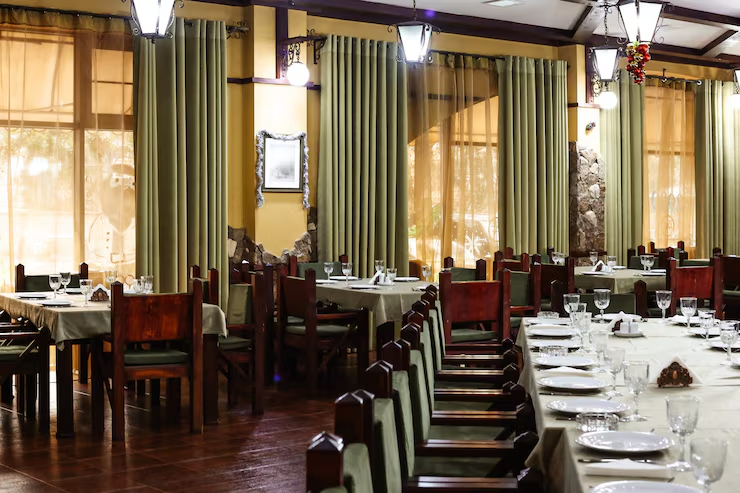
I walked through those heavy glass doors, and I could feel the room go quiet. Men in polished suits. Women in diamonds. Soft lighting, thick tablecloths, that faint smell of truffle and money in the air.
My daughter, Harper, sat near the window twisting her napkin into knots. When she saw me, her eyes lit up with relief and embarrassment at the same time.
“Dad’s here,” she said.
Brody didn’t stand up. He didn’t smile. He finally looked up from his phone, dragged his eyes down my jacket and boots, and let out a loud groan.
“You wore that?” he said. “This is a five-star place, Bernard, not a roadside diner.”
I held out my hand anyway.
“Good evening, Brody.”
He looked at it like it was dirty, then picked up his water glass and took a long, bored sip. My hand hung there in the air until I pretended to adjust my jacket instead.
His parents arrived like they were walking onto a stage.
Richard in a too-shiny suit and oversized gold watch. Meredith in fur, rings stacked on every finger. They didn’t shake my hand either. She actually wiped the chair next to me with a silk cloth before sitting down on the edge, angled away from me like I was a bad smell.
The Performance Begins
Dinner was two hours of them talking down to me and slowly breaking my daughter into pieces.
“So, Bernard,” Richard began, swirling his wine like he was judging a vintage he’d never afford on his own, “Harper tells us you worked in… transportation?”
“Drove trucks for thirty years,” I said simply.
“How… rustic,” Meredith added, pronouncing the word like it meant something contagious. “I suppose someone has to do that sort of work.”
Harper’s shoulders tensed. I gave her a small smile, the kind that said I’m fine, sweetheart.
But she wasn’t fine.
They spent the next hour dissecting every choice she’d made. Her job as a school counselor was “underambitious.” Her car was “embarrassing.” Her apartment before meeting Brody was “practically a slum.”
“We’ve been trying to elevate her,” Meredith explained to me, like Harper wasn’t sitting right there. “But it’s difficult when someone comes from… limited circumstances.”
Brody nodded along, cutting his steak with precise, aggressive movements. “She’s learning. Slowly.”
Harper stared at her plate, cheeks burning red.
I wanted to flip the table.
Instead, I took a bite of my bread and played the part they expected. The simple man. The burden. The embarrassment they could use to make themselves feel superior.
“This bread is real nice,” I said, my accent thickening just a touch. “Don’t get stuff like this at home.”
Richard snorted. Meredith covered her mouth with her napkin, but I saw the smile.
They ordered bottle after bottle of wine I could tell they didn’t understand. They ordered appetizers they barely touched. They sent back dishes for imaginary problems just to watch the staff scramble.
And through it all, Harper shrank smaller and smaller in her seat.
When dessert arrived—a seventy-dollar plate of chocolate something with gold leaf—Brody leaned back in his chair and surveyed the table like a king.
“This is what success looks like, Bernard,” he said. “This is what Harper married into. I hope you appreciate what I’ve done for your daughter.”
“I’m sure you do your best,” I said quietly.
His eyes narrowed, but before he could respond, the waiter appeared with the leather folder.
The check.
The Moment of Truth
Richard patted his pockets with theatrical confusion. “Oh no. I must have left my wallet in the car. How silly of me.”
Meredith gasped like it was a Greek tragedy. “Mine too! It ruins the line of my dress, you understand.”
Brody grabbed the folder with a confident flourish, like this was his moment to shine. He opened it, and I watched the color drain from his face.
Twelve hundred dollars.
He recovered quickly, pulling out a sleek black card and handing it to the waiter with forced casualness.
“No problem. I’ve got this.”
The waiter returned two minutes later, voice soft but clear enough for nearby tables to hear.
“I’m sorry, sir. The card was declined.”
Brody’s jaw clenched. “Try it again. Sometimes there are security holds.”
The waiter nodded politely and disappeared. When he returned, his expression told the story before his words did.
“I’m afraid it didn’t go through again, sir.”
Brody fumbled for another card. Same result.
Richard suddenly became very interested in the ceiling. Meredith studied her rings like she’d never seen them before.
Then Brody turned to Harper, and his voice went cold.
“Give me your card.”
She looked up, eyes wide. “I don’t have it. You told me to leave it at home so I wouldn’t ‘overspend’ while we were out.”
“Are you serious?” His voice rose. “You can’t do one simple thing right? You bring nothing to this table. Nothing. I carry this entire family and you can’t even help with the simplest—”
“Brody—” Harper whispered, her voice breaking.
“No,” he snapped. “Every single day I have to make up for your inadequacy. Your family’s poverty. Your lack of ambition. And now this?”
The restaurant had gone quiet. People were staring. Harper looked like she wanted to disappear into the floor.
That’s when I reached into my pocket.
Not for the phone that could pay this bill a thousand times over.
For a little canvas pouch I’d prepared specifically for this moment.
The Breaking Point
I loosened the drawstring and gently spilled its contents onto the pristine white tablecloth: crumpled one-dollar bills, a few fives, some quarters and dimes. The kind of money you keep in your truck for tolls and coffee.
“I can help,” I said, letting my voice shake just a little. “I was saving this for groceries this week, but… family is family, right?”
I started smoothing the bills with my calloused hands, counting slowly.
“One… two… three…”
Meredith gasped—not in sympathy, in horror.
She pulled out her phone, angled it at me, and hit record.
“Everyone needs to see what we deal with,” she whispered to Brody, loud enough for me to hear. “Look at him. Counting pocket change in a place like this. This is what your wife’s people bring to the table.”
I kept counting, hands deliberately unsteady.
“Four dollars… four twenty-five…”
Around us, I could feel the weight of stares. Some pitying. Some disgusted. Some just curious about the spectacle.
Harper reached for my hand. “Dad, please, you don’t have to—”
“It’s okay, sweetheart,” I said. “I want to help.”
Brody stared at that little pile of worn bills and scattered change like it was a mirror showing him something he couldn’t stand to see.
He snapped.
“Stop it!” he shouted, sweeping his arm across the table.
Bills flew through the air. Coins scattered and rolled across the marble floor, making tiny ringing sounds in the silence. A quarter spun on its edge before falling flat near a woman’s designer heel.
The entire restaurant froze.
“I don’t want your pocket money,” Brody snarled, standing so fast his chair scraped loudly against the floor. “You’re not helping. You’re embarrassing us. You are an embarrassment.”
He grabbed Harper by the arm—hard enough that she winced—and pulled her up from her seat.
“We’re leaving. Now.”
“Brody, the bill—” she started.
“I said we’re leaving!”
The manager rushed over, professional but firm. “Sir, I’m afraid you can’t leave without—”
“Send it to me,” Brody snapped, pulling Harper toward the door.
Richard suddenly stood up. “I’ll just… check on the car situation.”
Meredith gathered her fur and followed without a word, stepping over my scattered money like it was trash on the sidewalk.
Harper looked back at me, tears streaming down her face, mouthing I’m sorry as Brody dragged her toward the exit.
The manager turned to me, caught between protocol and compassion. “Sir, I’m very sorry, but someone needs to—”
“I know,” I said quietly.
The other diners had returned to pretending they weren’t watching, but their sideways glances said everything. Some looked at me with pity. Others with contempt. A few with that particular discomfort people feel when they witness someone else’s humiliation and don’t know where to look.
I sat there alone at that table under the chandeliers, surrounded by my scattered dollar bills and everyone’s judgment.
Then I reached into the inside pocket of my old denim jacket and pulled out a different phone.
Not the cheap prepaid flip phone Harper thinks I use.
The heavy, encrypted smartphone I haven’t touched since I stepped away from my company five years ago.
I unlocked it with my thumbprint and dialed a number I still knew by heart.
The Real Man Emerges
“Fairbanks,” a crisp voice answered on the first ring.
“It’s Bernard,” I said, letting every trace of the tired old-man act drop right there between the wine glasses and the linen napkins. “I need you to run a full background check on the Miller family—Brody, Richard, and Meredith. Employment, credit, assets, debts, everything. I want it by morning.”
There was a pause. “Mr. Garrett? Sir, I thought you were—”
“I was. I’m not anymore. Also, unfreeze my primary accounts. All of them.”
I glanced at the door where they’d disappeared with my daughter.
“And Tom? Book the conference room. I’m coming back.”
I ended the call and looked up to find the manager standing there, clearly having heard at least part of that conversation. His expression had shifted from apologetic to carefully neutral.
I pulled out a different card from my wallet. Not the platinum one—that would have been too obvious. The black one. The one without a credit limit.
“For the table,” I said. “And add twenty percent for your staff. They handled that situation with remarkable professionalism.”
He took the card, glanced at the name, and his eyes widened slightly. “Mr. Garrett. Of Garrett Freight Solutions?”
“That’s right.”
“I… I didn’t realize. I’m terribly sorry for—”
“You have nothing to apologize for,” I said. “They do.”
While he processed the payment, I bent down and started collecting my dollar bills and scattered change. Not because I needed them, but because my daughter had watched them fall, and I wanted her to know that the man who counted those bills was the same man who loved her. Money doesn’t change that.
A waiter appeared and tried to help, but I waved him off gently.
“I’ve got it. Thank you.”
The manager returned with my card and receipt. “Mr. Garrett, if there’s anything we can do—”
“Actually, there is.” I looked around the elegant dining room, at the tables full of people who’d watched my humiliation and done nothing. “Who owns this restaurant?”
“The Belmont Group, sir. They own several properties in Chicago.”
“Get me the owner’s contact information. I’d like to discuss a potential acquisition.”
His eyebrows rose. “You want to… buy the restaurant?”
“Among other things.” I stood up, pocketing my salvaged money. “I’ll be in touch.”
I walked out of that restaurant the same way I’d walked in—in my worn boots and frayed jacket. But the people who’d pitied me or laughed at me now watched with a different kind of confusion as the valet brought around not some beat-up truck, but a Tesla I kept registered under a shell company for exactly these kinds of situations.
I drove to Harper’s apartment.
The Real Conversation
I knew she’d be there. Brody would have brought her home and left immediately—men like him can’t stand to face the consequences of their cruelty.
I knocked. Waited.
The door opened a crack, and Harper’s tear-stained face appeared. When she saw me, she burst into fresh sobs.
“Dad, I’m so sorry. I’m so, so sorry. The way they treated you, the things they said—”
I stepped inside and pulled her into a hug, the way I had when she was little and the world felt too big.
“You have nothing to apologize for, sweetheart.”
“But the money, the bill, the way Brody—” She pulled back, wiping her eyes. “I’ll pay you back. However long it takes, I’ll pay you back every—”
“Harper.” I guided her to the couch. “Sit down. We need to talk.”
She sat, still crying, still apologizing.
I took a breath. Five years of careful secrecy, gone in one sentence.
“The bill is paid. In full. With a generous tip.”
She blinked. “What? How did you—did you borrow—”
“I didn’t borrow anything.” I pulled out my phone—the real one—and opened my banking app. I turned the screen toward her.
She stared at the numbers. Her mouth opened. Closed. Opened again.
“That’s… that’s not… Dad, whose phone is this?”
“Mine.”
“But the account name says Garrett Freight—” Her eyes went wide. “Garrett Freight Solutions. That’s the company on all the trucks. You said you used to drive for them.”
“I did. I started as a driver when I was nineteen. Worked my way up to dispatcher, then regional manager, then operations director. By the time I was forty, I owned the company.” I took the phone back. “When your mother died, I stepped back. Made it look like retirement. But I still own seventy percent of the shares.”
Harper looked like I’d just told her the sky was purple.
“You’re… you’re rich?”
“I’m comfortable.”
“Comfortable? Dad, that account has—” She couldn’t even say the number.
“Eight point three million,” I said quietly. “That’s just the primary account. There are others.”
She stood up, paced to the window, then back. “Why didn’t you tell me?”
“Because I needed to know you loved me for who I am, not what I have. And I needed to know that the people in your life valued you, not your access to money.”
“So you’ve been pretending to be poor? For years?”
“Not pretending. Living simply. There’s a difference.” I stood up and put my hands on her shoulders. “I drive an old truck because I like it. I live in that cabin because it’s peaceful. I wear these boots because they’re comfortable. The money doesn’t define who I am.”
She was crying again, but different tears this time.
“Brody,” she whispered. “He said such terrible things to you. He called you an embarrassment. He—” Her voice broke. “He treats me the same way, Dad. Every single day.”
“I know.”
“His parents aren’t wealthy either,” she said, the words tumbling out. “They’re drowning in debt. Richard got fired six months ago. Meredith shoplifts jewelry and returns it for store credit. Everything they showed you tonight was a performance. And Brody…” She sank back onto the couch. “Brody’s company is failing. He’s been lying about promotions. He screams at me when the credit cards don’t work. He blames me for his failures.”
I sat down beside her. “Why didn’t you tell me?”
“Because I was ashamed. Because I thought… I thought I could fix it. I thought if I was good enough, quiet enough, helpful enough, he’d go back to being the man I thought I married.” She looked at me with broken eyes. “But that man never existed, did he?”
“No, sweetheart. He didn’t.”
We sat in silence for a moment. Then Harper said something that made my heart break and swell at the same time.
“What do I do?”
“What do you want to do?”
She took a shaky breath. “I want to leave him. I want my life back. But I don’t have anywhere to go. I gave up my apartment when we got married. I don’t have savings because he controls all the money. I—”
“You have me,” I said firmly. “You have always had me. And now…” I pulled out a business card I’d picked up from the car. “You have this.”
She took the card. “Morrison & Associates. Family Law.”
“Best divorce attorney in Chicago. I’ve already sent a retainer. She’s expecting your call.”
Harper stared at the card, then at me. “You planned this.”
“I suspected tonight would go badly. I didn’t know it would go this badly, but…” I shrugged. “I came prepared.”
“Dad.” She started crying again. “I don’t know what to say.”
“Say you’ll let me help. Really help. No more pretending you’re okay when you’re not. No more protecting me from the truth.”
She nodded, and I held her while she cried—for the marriage she was ending, for the man who’d hurt her, for the time she’d lost trying to make something broken look whole.
The Morning After
By morning, three things had happened.
First, Tom Fairbanks had sent me a comprehensive report on the Miller family. Richard had been fired for embezzlement. Meredith had three outstanding warrants for retail fraud. Brody’s company was two months from bankruptcy, and he’d been taking money from Harper’s account to cover his losses.
Second, Harper had moved into my cabin. We’d driven to her apartment at dawn while Brody was out, packed everything that mattered, and left her keys on the counter with the wedding ring.
Third, I’d received a very angry phone call.
“You can’t do this!” Brody screamed through the phone. “She’s my wife! You can’t just take her!”
“She’s my daughter,” I said calmly. “And she’s not property. She left on her own.”
“Because you poisoned her against me! You and your pathetic poverty act—”
“About that,” I interrupted. “I’ve been thinking about your company. What was it called? Miller Brand Solutions?”
He went quiet.
“I did some research. You’re sixty days from insolvency. Your three biggest clients are about to pull their contracts. You’ve got one Hail Mary option—that Midwest manufacturing account you’ve been chasing.”
“How do you know about—”
“Because they’re considering two firms. Yours and mine.”
Another silence.
“You don’t have a firm,” he said, but his voice had lost its certainty.
“Garrett Freight Solutions,” I said. “We also own Garrett Consulting, which happens to specialize in exactly what your potential client needs. I spoke to them this morning. Very friendly people. They were very interested to hear about your… situation.”
“You bastard.”
“Here’s what’s going to happen, Brody. You’re going to sign the divorce papers when they arrive. You’re not going to contest anything. You’re not going to make this difficult for Harper in any way. And if you’re very, very polite about it, I might decide not to bury your company completely.”
“You can’t—”
“I already did. That manufacturing contract? They’re signing with us next week. Your three major clients? I made some calls. Turns out when you have enough connections, information travels fast. They know about your financial situation now. They’re jumping ship.”
His breathing came hard and fast through the phone.
“You’re going to destroy me,” he said.
“No,” I corrected. “You destroyed yourself. I’m just making sure you don’t take my daughter down with you.”
I hung up.
Harper was in the kitchen making coffee, her face lighter than I’d seen it in months.
“Was that him?” she asked.
“It was.”
“Is he going to fight the divorce?”
“No,” I said. “He’s going to sign everything.”
She handed me a mug of coffee and looked out the window at the woods surrounding my cabin. “This is really your life? The cabin, the quiet, the simple routine?”
“It really is.”
“But you could have anything. Mansions, vacation homes, private jets—”
“I could,” I agreed. “But I don’t need those things. I need peace. I need my daughter to be safe and happy. I need to wake up and know that the people in my life are there because they want to be, not because of what I can give them.”
She nodded slowly. “That’s why you hid the money.”
“That’s why I hid the money.”
“What happens now?” she asked.
“Now? You heal. You figure out who you are without someone telling you you’re not good enough. You go back to your counseling work, or don’t, or try something completely different. You live here as long as you want.” I sipped my coffee. “And when you’re ready, you decide what kind of life you want to build.”
“And you?”
I smiled. “I’m going to buy a restaurant.”
Six Months Later
The acquisition went through in three weeks. I didn’t just buy that one restaurant—I bought the whole Belmont Group. Twelve high-end establishments across Chicago.
I kept the staff. Raised their wages. Improved their benefits.
But I made one significant change to that particular restaurant where I’d been humiliated: I turned it into a community dining program two nights a week. Anyone could come. Anyone could eat. No judgment. No dress code. Pay what you can afford, and if you can’t afford anything, the meal is free.
The first night we opened the community program, I worked the door myself.
In my worn boots and old denim jacket.
A grandmother came in with three dollars in coins, apologizing that it wasn’t enough for a full meal.
I smiled and showed her to the best table in the house.
“Ma’am,” I said gently, “this is more than enough. Welcome.”
Harper worked beside me that night, seating guests, taking orders, clearing tables. She glowed with purpose in a way she never had with Brody.
She’d filed the divorce papers. Started therapy. Enrolled in a program to become a licensed clinical social worker. She was building a life that was hers.
As for Brody? His company folded. Richard and Meredith moved out of state to escape their creditors. I heard through mutual acquaintances that Brody had to take a job at a competitor’s firm—in their entry-level program.
I didn’t gloat. I didn’t follow up. I simply let them fade into the past where they belonged.
Late that night, after the last community diner had left with a full stomach and a to-go container, Harper and I sat at a corner table with cups of coffee.
“You know what’s funny?” she said.
“What’s that?”
“Brody spent our whole marriage trying to prove he was successful. Trying to look rich. Trying to impress people.” She gestured around the elegant dining room, now empty except for us. “And you, the man who actually has everything, spent years pretending you didn’t.”
“Different values,” I said simply.
“He wanted people to think he was important. You just wanted to be loved.”
I reached across the table and squeezed her hand. “And I am. That’s all that matters.”
She smiled—the real smile I hadn’t seen since before the wedding.
“I love you, Dad.”
“I love you too, sweetheart.”
We sat there in comfortable silence, father and daughter, surrounded by the restaurant where I’d once scattered dollar bills on the floor to prove a point.
That point was simple: A man’s worth isn’t measured by his bank account or the brand of his shoes. It’s measured by how he treats people when he has nothing to gain from them.
I could have revealed myself that night at the table. Could have pulled out my black card immediately and watched them scramble to apologize.
But that wouldn’t have shown Harper the truth about who they really were.
Sometimes the greatest gift you can give someone you love is clarity. And sometimes, that clarity comes from letting cruel people reveal themselves completely before you step in to end their power over you.
My daughter learned that lesson the hard way.
But she learned it.
And now she’s free.
As for me? I’m still the guy in the worn boots and the frayed denim jacket. I still live in my cabin outside Chicago. I still drive my old truck.
The only difference is that now, twice a week, I open my doors to people who need to know that their worth isn’t determined by what’s in their pockets.
Because I remember what it was like to sit at that table, counting crumpled dollar bills while people laughed.
The difference is, I was never really poor.
But they were.
Poor in spirit. Poor in character. Poor in the things that actually matter.
And no amount of money could ever fix that.