Twenty Years of Silence
For twenty years I called children who never picked up.
I left birthday messages that went straight into the void. I sent holiday packages from my tiny New Jersey apartment and took photos of every single one, just so I could remind myself, “You did your part, you’re still their mom.”
They never answered. Not once.
Not a text. Not an email. Not even a one-line “Got it, thanks.”
I watched them grow up through the internet like I was some stranger: Jennifer in designer dresses at charity galas, Christopher in sharp suits at corporate events, posing in glossy American suburbs with big trees and spotless driveways. My name never appeared in any caption.
I didn’t exist in their world.
But I never stopped acting like I did.
Then one Wednesday, everything changed.
I opened my mailbox and there it was: thick ivory card, gold letters, my daughter’s name shining on the front.
“Mrs. Jennifer Stone invites you to her 45th birthday celebration…”
My hands shook so hard I had to sit down. After twenty years of silence, my daughter was inviting me into her home. No handwritten note, no “I miss you,” just a formal card. But after two decades of nothing, that little piece of paper felt like a heartbeat.
The Preparation
I spent three days getting ready like it was the most important night of my life.
I bought a wine-colored dress that cost a quarter of my monthly check from the small boutique downtown where the owner, Rosa, knew my situation. She’d watched me come in over the years, looking at dresses I couldn’t afford for events I was never invited to.
“This is the one, Margaret,” she said, holding up the burgundy silk. “This is your moment.”
I took the pearl necklace my own mother gave me forty years ago out of its box. The clasp was tarnished but the pearls still gleamed. I polished them carefully, remembering how Mama had worn them to every important occasion in her life.
I chose a special gift for Jennifer—a silver picture frame engraved with her initials, something that said, “I still see you as my girl.” Inside, I placed a photo from her childhood: Jennifer at seven, missing her front teeth, laughing on a swing set I’d saved three months to buy.
Saturday night arrived like a storm I’d been watching approach for decades.
The taxi rolled through rows of perfect lawns and American flags on porches until it stopped in front of a mansion glowing with warm light. Music floated out to the street. Laughter. Clinking glasses. The kind of world I’d worked myself to the bone so my children could reach.
My driver, an older man with kind eyes, looked at me in the rearview mirror.
“Big party?”
“My daughter’s birthday,” I said, and my voice cracked on the word “daughter.”
“She’s lucky to have you,” he said.
I paid him and watched his taillights disappear down the street, suddenly feeling very alone.
A housekeeper opened the door before I could ring.
“Party’s in the back, ma’am.”
No greeting. No warmth. Just instructions.
I walked through a house that could have fit my entire apartment three times over. Marble floors. Crystal chandeliers. Family photos on the walls—but none of me. I searched for my face in every frame as I passed. Nothing. It was like I’d been erased from their history.
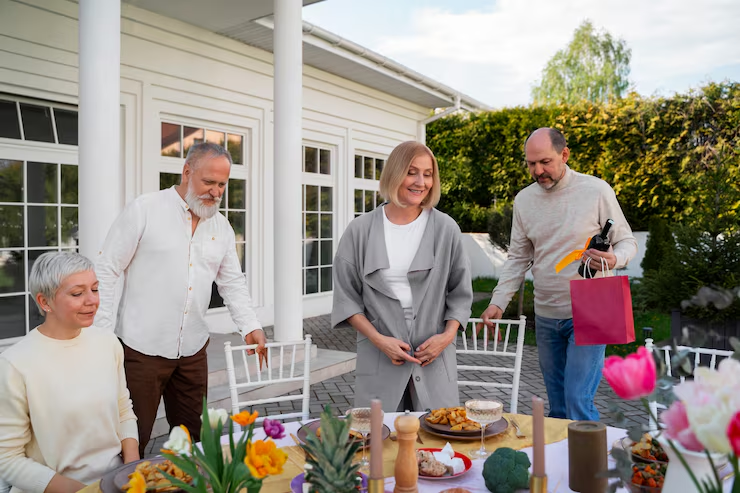
The garden looked like a magazine spread. White tablecloths, flowers everywhere, a live jazz band tucked under twinkling lights strung between trees. People in elegant clothes holding champagne flutes, talking like they’d never had to count a single dollar in their lives.
I spotted Jennifer in the middle of it all. Perfect hair swept into an elegant updo. Perfect dress that probably cost more than my rent. Perfect smile plastered across her face as she laughed at something a man in an expensive suit was saying.
She saw me, and for half a second something real flashed in her eyes—surprise, maybe even fear. Then the social smile slid into place like a mask.
“Mom, you made it,” she said, kissing the air near my cheek. Not my cheek. The air beside it.
She turned to her friends. “This is my mother, Margaret.”
The way she said “mother” sounded more like “unexpected guest” or “distant acquaintance.”
A woman in diamonds looked me up and down. “How lovely. I didn’t realize you had family nearby, Jennifer.”
“She lives in New Jersey,” Jennifer said, as if that explained my twenty-year absence from her life.
No one asked me a single question. No one asked where I’d come from, how I’d been, what I did, if I’d met the grandkids whose faces I’d only seen online. They smiled politely and turned back to their conversations about vacation homes and private schools and stock portfolios.
Jennifer drifted away to greet other guests, and I ended up at a small table in the corner, holding a glass of champagne I didn’t really want, watching my daughter’s life unfold in front of me like a movie I wasn’t part of.
The Reunion That Wasn’t
That’s where I saw him—Christopher.
My son. My boy who used to crawl into my bed after his dad died, shaking and crying, begging me not to leave him too. The child who’d held my hand at the funeral and whispered, “We’re a team now, right Mom?”
Now he walked into the garden in a suit that probably cost more than my entire wardrobe, surrounded by laughing men who clapped him on the back like he was the most important person in the room.
Our eyes met.
For just a second, I saw the little boy underneath the expensive clothes. The one who’d needed me. The one who’d loved me.
Then he looked right through me, like I was part of the furniture, and turned to say something that made his friends burst into laughter.
I thought my heart couldn’t break any further.
I was wrong.
I sat at that small table for over an hour. Waiters came by with trays of food I couldn’t taste. People brushed past me without acknowledgment. I watched my daughter float through her party, her life, her perfect world that had no space for the woman who’d given up everything to build it.
I remembered the years after their father died. David had been the breadwinner, the stability, the safety net. When he was gone, I was left with two small children, a mountain of debt, and a bachelor’s degree that hadn’t aged well in the job market.
I worked three jobs. Morning shift at the hospital cafeteria. Afternoons cleaning houses. Evenings doing data entry from our cramped apartment while Jennifer and Christopher did homework at the kitchen table.
I wore the same coat for eight winters. I cut my own hair. I ate the leftovers my children didn’t finish because groceries were expensive and growing kids needed to eat first.
But they went to good schools. They had new clothes for the first day of class. They went on field trips and joined clubs and never had to feel poor, even though we were drowning in bills I paid in the dark after they’d gone to bed.
When Jennifer got into college, I took out loans I’m still paying off. When Christopher needed a car to get to his internship, I sold my mother’s china set—the only thing of value I owned.
I gave them everything.
And they gave me twenty years of silence.
A little later, Jennifer’s husband—a man I’d never met, whose wedding I’d never been invited to—took the microphone on a small stage in the center of the garden.
He thanked everyone for coming. He wrapped an arm around my daughter and talked about how much they’d built together, how blessed their life was, how grateful they were for the community of friends who’d supported them.
People clapped on cue, raising their glasses.
Then his tone changed, became more excited.
“Tonight,” he said, “we also want to share something special with all of you. We’ve found a beautiful piece of land on the coast. We’re planning a beach house for the whole family, a place for the Stone family to gather for generations to come.”
Everyone applauded like they’d just announced a movie deal.
Christopher joined them on stage, smiling like a man closing another big business win. He shook his brother-in-law’s hand with the easy confidence of someone who’d never struggled for anything.
And then Jennifer did something that made my stomach drop.
She started scanning the crowd.
Her eyes locked onto mine. Her smile widened, but it didn’t reach her eyes.
“Mom,” she called, pointing straight at me in front of fifty strangers, “why don’t you come up here with us?”
The Question
Every head turned.
Every pair of eyes followed me as I walked to that stage in my carefully chosen dress, clutching my purse with her gift inside. My legs felt weak. My heart hammered so hard I thought everyone could hear it.
Jennifer slipped an arm around my shoulders so gently it almost felt real. Almost felt like love.
“Everyone,” she said brightly, her voice carrying across the garden, “this is my mother. After so many years, she’s finally here with us. And we want her to be part of this… family project.”
The crowd murmured approvingly. How touching. How sweet. The prodigal mother returned.
That’s when my son stepped forward, took the microphone, and asked the one question that made twenty years of silence snap into perfect, painful focus:
“Mom, how much did you keep from selling your house?”
The whole garden went quiet.
The band kept playing softly, some jazz standard about love and moonlight.
Fifty people stared at me, waiting to see if I would hand over my second chance at a life… just to finally be allowed back into theirs.
I looked at Christopher. At Jennifer. At their perfectly groomed spouses standing beside them with expectant smiles.
“My house?” I repeated slowly.
Jennifer’s grip on my shoulder tightened slightly. “Christopher mentioned you sold the house last year. We just want to make sure you’re being smart with the money, Mom. We thought it would be wonderful if you could invest in the beach house with us. A family investment. Finally, something we can all share together.”
My mouth went dry.
The house.
Six months ago, I’d finally managed to scrape together a down payment on a small house in a quiet neighborhood. Nothing fancy. Two bedrooms, a tiny yard, but it was mine. After twenty years of renting that cramped apartment, eating ramen so my kids could have better, working myself to exhaustion, I’d finally bought something that belonged to me.
I hadn’t sold it. I’d bought it.
But someone had told them otherwise.
I looked at my son. “Who told you I sold a house?”
He shifted uncomfortably. “I… I saw a real estate transaction under your name. I have connections who run background checks for the firm. I was just… keeping tabs.”
“Keeping tabs,” I echoed. “You were keeping tabs on me, but you couldn’t return a single phone call in twenty years?”
Jennifer’s smile flickered. “Mom, let’s not make this awkward—”
“Awkward?” The word came out sharper than I intended. “You invite me here after two decades of silence, put me on stage in front of strangers, and ask me for money, and I’m the one making this awkward?”
People started whispering. Christopher’s face reddened.
“We’re not asking for a handout,” he said defensively. “We’re offering you an opportunity to be part of something. To finally be included in this family.”
That word. Included.
Like I was the one who’d walked away. Like I was the one who’d stopped answering calls.
“I didn’t sell a house,” I said quietly. “I bought one.”
Jennifer blinked. “What?”
“I bought a house. Six months ago. A small house that I saved for twenty years to afford. It’s the first thing I’ve ever owned that’s truly mine.”
The silence that followed was deafening.
Christopher’s mouth opened and closed. “But the transaction said—”
“Your background check was incomplete,” I said. “You saw the real estate transaction and assumed I was finally worth something. That after years of being too poor to matter, I might finally have something you could use.”
Jennifer’s arm dropped from my shoulder. “That’s not fair.”
“Fair?” I looked at my daughter—this stranger wearing my daughter’s face. “I worked three jobs to put you through college. I sold my mother’s china to buy your brother a car. I wore the same winter coat for eight years so you could have new clothes for school. And the moment you graduated, the moment you didn’t need me anymore, you both vanished.”
“You’re exaggerating—” Christopher started.
“Twenty years,” I cut him off. “Twenty years of phone calls you never returned. Twenty years of birthday cards you never acknowledged. Twenty years of watching you both live these beautiful lives online while I didn’t even warrant a mention. And now, now that you think I have money, suddenly I get an invitation?”
The guests had gone completely silent. Even the band had stopped playing.
Jennifer’s perfect composure cracked. “You don’t understand the pressure we were under. Building careers, starting families, maintaining our social position—”
“Your social position?” I stared at her. “Is that what I was? An embarrassment? The poor mother who cleaned houses and worked in a cafeteria? The one who didn’t fit into your perfect American dream?”
“You’re being dramatic,” Christopher said, but his voice lacked conviction.
I reached into my purse and pulled out the silver frame I’d brought for Jennifer. I held it up so everyone could see the photo inside—seven-year-old Jennifer on that swing set, laughing with her missing front teeth.
“I brought you this,” I said to my daughter. “It’s engraved with your initials. I thought… I thought maybe you’d want to remember when you were happy. When we were happy. When I was your mom and not just a potential investor.”
Jennifer stared at the frame like it was a ghost.
I set it down on the stage and turned to walk away.
“Mom, wait—” Jennifer’s voice cracked.
I stopped but didn’t turn around.
“We’re sorry,” she whispered.
“No, you’re not,” I said. “You’re embarrassed. There’s a difference.”
I walked through that garden, past all those shocked faces, through that beautiful house with its photos that erased me, and out into the night.
The Aftermath
The taxi driver who picked me up took one look at my face and didn’t ask any questions. He just drove.
When I got home—to my small, precious house that I’d bought with money I’d earned and saved—I took off the wine-colored dress, put away my mother’s pearls, and made myself a cup of tea.
I sat in my kitchen, in my house, and I cried.
Not because they’d hurt me. They’d been hurting me for twenty years.
I cried because I’d finally seen the truth clearly: My children hadn’t forgotten about me. They’d chosen to forget about me. And the moment they thought I had something they wanted, they’d chosen to remember.
My phone buzzed. Jennifer.
“Mom, please call me. Let’s talk about this like adults.”
I deleted the message.
Christopher called twice. I didn’t answer.
Over the next week, they both tried repeatedly to reach me. The messages shifted from apologetic to annoyed to indignant.
“You humiliated us in front of our friends.”
“You’re being unreasonable.”
“We were trying to include you.”
Include me. As if twenty years of exclusion could be erased by one party invitation motivated by money.
I blocked their numbers.
Three Months Later
Three months after the party, I was in my garden planting tomatoes when my neighbor, Mrs. Chen, called over the fence.
“Margaret! Someone’s here to see you.”
I wiped the dirt from my hands and walked around to the front of my house.
A young woman stood on my porch, maybe twenty-five, with Jennifer’s eyes and Christopher’s dark hair.
My heart stopped.
“Grandma Margaret?” she said hesitantly.
I’d never met my granddaughter in person. I’d seen her grow up through Jennifer’s Facebook photos—carefully curated images of a perfect life—but we’d never spoken.
“Emma?” I whispered.
She nodded, tears already streaming down her face. “I found your address in Mom’s desk. I… I had to come. I had to meet you.”
We stood there staring at each other for a long moment. Then she stepped forward and hugged me, and I wrapped my arms around this stranger who was my blood, this young woman I’d been aching to know for twenty-five years.
We sat on my porch drinking lemonade while she told me her story.
“I always knew something was wrong,” Emma said. “Mom and Uncle Christopher never talked about their childhood. No stories, no photos, nothing before college. And sometimes I’d hear them on the phone arguing about you, about money, about the past.”
“What did they say?”
“That you didn’t understand their world. That you were… difficult.” She looked down at her glass. “But last month I found something. Old letters you’d written to Mom. Birthday cards, Christmas cards, letters about your life. All of them unopened. Dozens of them, spanning twenty years.”
My chest tightened.
“They kept them?”
“In a box in the storage room. Like evidence. Like proof of something.” Emma’s voice shook. “I read every single one, Grandma. I read about how you worked multiple jobs to support them. How you sold your mother’s things to help Uncle Christopher. How you went without so they could have more. And then I read the later letters, the ones where you begged them to just tell you if you’d done something wrong, begged them to let you be part of their lives.”
She was crying now, and so was I.
“After that party, after what happened on stage, I confronted Mom. We had the worst fight of my life. She tried to justify it, said they were protecting me from ‘instability,’ from your ‘lifestyle.’ But I could see through it. They were ashamed of where they came from. Ashamed of you.”
“Emma—”
“I told her I was ashamed of her,” Emma said fiercely. “I told her I’d rather have a grandmother who worked three jobs and loved unconditionally than parents who value appearances over people. And then I left.”
“You left?”
“I moved out. Got my own apartment. I’m paying my own way through grad school now, no help from them.” She smiled through her tears. “I figured if you could do it alone, so could I.”
We talked for hours. She asked about my life, my work, my house. She wanted to know everything—not the sanitized version her parents might have told her, but the truth. The struggles and the victories. The lonely years and the small joys.
When she finally left, she hugged me again at the door.
“Can I come back?” she asked. “Can I… can I know you?”
“Emma, you can come back anytime,” I said. “You’re always welcome here.”
As I watched her walk to her car, my phone buzzed. I’d unblocked Jennifer’s number weeks ago, though I hadn’t responded to any of her messages.
This one was different.
“Emma told me she found you. Mom, please. We need to talk.”
I looked at the message for a long time. Part of me wanted to delete it, to maintain the boundary I’d finally drawn. But another part—the part that had spent twenty years hoping—wondered if it was finally time.
I typed back: “I’m listening.”
Six Months Later
Rebuilding took time.
Jennifer and Christopher didn’t transform overnight into the children I’d once known. There were awkward dinners where old resentments surfaced. There were therapy sessions—family therapy that Emma insisted we all attend. There were hard conversations about shame, about class, about the ways they’d internalized the idea that their past was something to escape rather than honor.
“I thought if I cut ties with who I was, I could become who I wanted to be,” Jennifer admitted during one session, her voice small. “I thought you represented everything I was running from. Poverty. Struggle. Instability.”
“But I never represented those things,” I said quietly. “I represented love. I represented sacrifice. And you ran from that too.”
She nodded, crying. “I know. I know that now.”
Christopher was harder. He’d built his entire identity on being a self-made man, and admitting that his mother had made him required demolishing that story.
“Every time someone at the firm asked about my family, I said my parents were deceased,” he confessed. “It was easier than explaining you. Easier than admitting I came from nothing.”
“You didn’t come from nothing,” I said firmly. “You came from love. That’s not nothing.”
The beach house plan had fallen apart after the party. Their friends had distanced themselves, uncomfortable with the public confrontation. Jennifer and Christopher’s spouses had insisted on family therapy before any reconciliation.
And slowly, painfully, we found a new way forward.
It wasn’t the relationship I’d dreamed of during those twenty years of silence. We didn’t become the picture-perfect family. But we became real.
Emma became my anchor. She visited every Sunday. We cooked together, gardened together, talked about everything and nothing. She brought her boyfriend to meet me, and later, when they got engaged, she asked me to help plan the wedding.
“I want you in the front row,” she said. “Where you should have been at Mom’s wedding. Where you should have been all along.”
On the day of Emma’s wedding, I sat in that front row wearing a new dress—one I’d bought without checking the price tag because I could finally afford to. Jennifer sat beside me, her hand finding mine during the ceremony.
“I’m sorry,” she whispered as Emma walked down the aisle. “I’m sorry for all the years. I’m sorry I let shame make me cruel.”
I squeezed her hand. “I forgive you. But I won’t forget. And I won’t let it happen again.”
“I wouldn’t expect you to,” she said.
Christopher gave a toast at the reception. Midway through, he did something unexpected—he turned to me.
“To Margaret,” he said, his voice thick with emotion. “The strongest person I know. The woman who gave us everything and asked for nothing in return. Mom, I’m sorry it took me so long to see it. To see you. I love you.”
The room erupted in applause, but all I heard was those three words: I love you.
After two decades of silence, they finally sounded real.
Now
That was two years ago.
I’m sixty-eight now. I still live in my small house with my small garden. I still work part-time at the hospital cafeteria, not because I have to, but because I like the routine and the people.
But now, my refrigerator is covered with photos. Real ones. Me with Emma and her husband. Me with Jennifer’s youngest son, teaching him to plant tomatoes. Me with Christopher and his daughter at her soccer game.
I’m not erased anymore.
Last month, Jennifer called and asked if I wanted to have lunch. Not a family obligation. Just us.
We sat in a small café, and she told me about her life—not the Instagram version, but the real one. The struggles in her marriage. The pressure she feels to maintain appearances. The therapy she’s still in.
“Sometimes I wonder who I would have been if I hadn’t spent twenty years running,” she said.
“You’d be who you are now,” I told her. “Just with more time.”
She smiled sadly. “Do you forgive us? Really?”
I thought about that question. About forgiveness and what it means.
“I forgive you for being human,” I said finally. “For making mistakes. For being ashamed when you shouldn’t have been. But I don’t forgive the cruelty. I don’t forgive the years of silence or the party where you tried to use me. Those things changed me. They taught me that I deserve better than scraps of love given only when it’s convenient.”
Jennifer nodded, crying quietly. “You do deserve better. You always did.”
“But I’m here now,” I added. “I’m here because I choose to be, not because I need to be. That’s the difference. I don’t need you to be whole. I want you in my life, but I’m whole without you. And I’ll never let myself forget that again.”
She reached across the table and took my hand. “Thank you for not giving up on us completely.”
“I didn’t do it for you,” I said honestly. “I did it for me. And for Emma. And for the possibility that maybe, just maybe, we could build something real from the ruins.”
We’re building it now. Slowly. Carefully. With clear boundaries and honest conversations and the understanding that family isn’t just blood—it’s choice.
My children chose to forget me for twenty years.
And now, every single day, they have to choose to remember.
Some days they choose well. Some days they slip back into old patterns.
But I’m no longer waiting by the phone, hoping to be chosen.
I’m living my life. And they’re welcome to be part of it, on my terms, in my small house with my small garden and my big, hard-won peace.
Because that party taught me something crucial: The people who only value you when they think you have something to give them don’t actually value you at all.
And the moment I stopped trying to earn their love was the moment I finally became free.
I look at that silver picture frame sometimes—the one I left on the stage that night. Jennifer sent it back to me months later with a note: “I’m sorry I forgot this version of us.”
I keep it on my mantel now, next to new photos. The little girl on the swing is still there, frozen in time, laughing with her missing teeth.
But next to her is another photo: me and Emma, planting tomatoes, both of us covered in dirt and grinning.
One image of what was lost.
One image of what was found.
And in the space between them, twenty years of silence that taught me the most important lesson of my life:
You cannot pour from an empty cup. And you cannot love people who refuse to see you.
I spent two decades trying to be enough for children who’d decided I wasn’t.
Now I know the truth: I was always enough.
They just weren’t ready to see it.