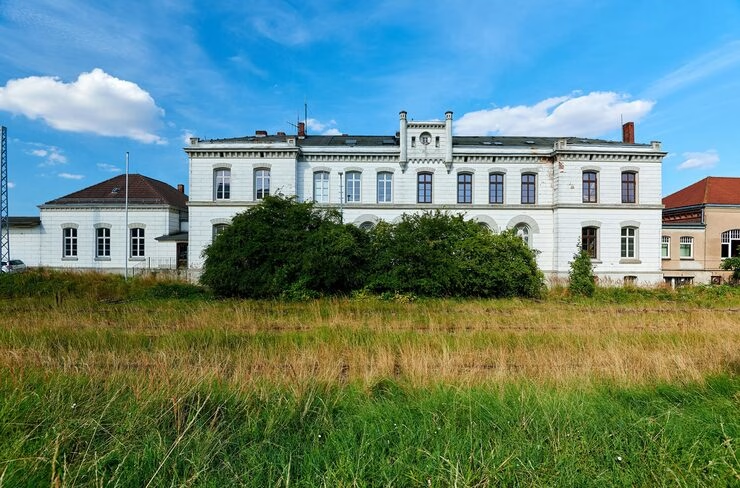
The House That Wasn’t Theirs
I bought the house quietly.
Six bedrooms. Wraparound porch. Tall windows that filled the rooms with light and the faint smell of fresh paint. For six peaceful weeks, I thought it was the smartest decision I’d made in my sixty-three years.
Then one afternoon, I stood behind my own front door and heard my daughter-in-law giving a tour.
“This is the master suite,” Rebecca said brightly. “It’ll be ours. My mom can have the room next door.”
Ours.
My mom.
If you’ve never heard someone assign rooms in a house you paid for, it changes the way you breathe.
I didn’t interrupt. I didn’t knock. I placed my hand on the brass doorknob and counted to five.
I listened to the click of her heels, the whisper of a tape measure sliding out, my son Kevin’s soft laugh—the one he uses when he agrees without thinking.
Three Months Earlier
Three months earlier, I was Margaret Stevens, newly widowed in a small American town where church bells still ring on Sundays and the hardware store cuts keys while you wait. After Henry’s funeral, everyone told me the same thing.
“Keep busy.”
“Don’t be alone.”
Kevin and Rebecca called daily.
“Sell the old place, Mom,” Kevin said. “Find something new. Something to look forward to.”
So I did.
I found a Victorian that felt like a second chance. Oak trees. Warm floors. A kitchen big enough for three generations—if we were kind to one another. I bought it quietly. Insurance money. A trust. Contractors who still call me ma’am.
I planned a surprise. Keys in my hand. A smile. “Welcome home.”
That was the plan.
The Discovery
Before I moved in, I saw Rebecca on the front path, sunglasses on, smiling into her phone.
“My new place,” she said. “Our plan.”
I watched from my car as she pointed to the windows I chose, the fixtures I approved, the porch where I imagined sitting with coffee.
Kevin arrived with a folder. They unlocked the door like they belonged there. Crossed the threshold like the house had been waiting for them.
Inside, Rebecca narrated the future.
Curtains here. A crib someday. The master—theirs. The smaller room—perfect for Mom.
Not me. Never me.
Her mom. Patricia. The woman who had made it clear at every family gathering that her daughter deserved better than Kevin’s modest salary, better than his family’s humble background.
I stood frozen in my car, keys digging into my palm, watching my son and his wife claim a future I had purchased.
That night, I sat with the deed under my palm and finally understood how easily love gets confused with ownership—especially when people say, “This is what’s best for everyone.”
The Confrontation Builds
At dawn, I drove back.
Porch light still on. Street quiet, the way American neighborhoods are before school buses arrive. Through the glass, I saw Rebecca again—this time with her parents.
She gestured up the staircase like a professional guide.
“Master suite here. Mom next door.”
Patricia—Rebecca’s mother—stood with her arms crossed, nodding approvingly. Her father examined the crown molding like he was assessing an investment property.
“And Margaret?” Patricia asked.
Rebecca’s laugh was light, dismissive. “Oh, she’ll probably stay in her old house. Or we can find her a nice little condo nearby. Something manageable.”
Something manageable. Like I was a problem to be solved rather than the woman who had made this entire scenario possible.
Kevin said nothing. He stood by the window, hands in his pockets, nodding occasionally like a supporting actor in someone else’s play.
That’s when two things became very clear.
First: I had trusted the wrong people.
Second: they were about to learn who actually holds the keys.
I didn’t announce myself. I stood where the house could hear everything.
Rebecca reached for the doorknob again—still talking, still confident.
It didn’t turn.
Once. Then again.
Her voice faltered. Her smile shifted. Color drained from her face.
I stepped back and counted to three.
The Reckoning
I walked around to the front entrance, my real keys—the only keys that actually opened this door—jingling in my hand. I pushed open the door and stepped inside.
“Good morning,” I said calmly.
Four heads snapped toward me. Kevin’s face went pale. Rebecca’s expression cycled rapidly through confusion, recognition, and something that looked uncomfortably like guilt.
“Mom?” Kevin managed. “What are you doing here?”
“I own this house,” I said simply. “What are you doing here?”
Silence settled over the entryway like dust.
Patricia recovered first, her smile professional and cold. “Margaret, we were just looking at the property. Rebecca mentioned you were considering buying it, and we wanted to see if it would work for the family.”
“I wasn’t considering buying it,” I said. “I bought it. Six weeks ago. Cash purchase. The deed is in my name.”
Rebecca’s mouth opened and closed. “But Kevin said—”
“What did Kevin say?” I turned to my son.
Kevin looked at his shoes. “I told her you were looking at properties. That you might need help deciding. That we could all live together, like you wanted.”
“Like I wanted?” I repeated slowly. “Kevin, when did I say I wanted to live with you and Rebecca?”
“You said you didn’t want to be alone,” he protested weakly.
“Not being alone and living under your roof are very different things.” I set my purse down on the console table—my console table, in my house. “Who told you that you could come here? How did you get a key?”
Rebecca finally found her voice. “The realtor gave us access. We’ve been working with her on finding a property for our family. She said this one was available for showings.”
“Which realtor?”
“Sandra Morrison.”
I knew Sandra Morrison. I had specifically told her that the sale was confidential and that no one—no one—was to have access without my written permission.
“Sandra gave you access without my authorization,” I said. “That’s a violation of our agreement. But more importantly, you’ve been in my house, planning your lives in my rooms, without ever asking if that was something I wanted.”
Patricia stepped forward, her expression hardening. “Now Margaret, let’s not be dramatic. Kevin is your son. Family takes care of each other. Surely you didn’t buy this big house just for yourself.”
“That’s exactly what I did.”
The words landed like stones in still water.
“This house is mine. I bought it with money Henry and I saved for forty years. I bought it because I wanted space, light, and peace. I bought it because I wanted a fresh start after losing my husband.”
“But we thought—” Rebecca began.
“You thought wrong.” I looked at each of them in turn. “You assumed that because I’m a widow, because I’m your mother, because I have resources, that I would simply hand over my life, my choices, and my home to accommodate your plans.”
Kevin finally looked up. “Mom, we were trying to help. Rebecca’s apartment is small, and we’re thinking about starting a family—”
“Then buy your own house,” I said. “With your own money. Make your own decisions. Build your own life.”
“We can’t afford something like this,” Rebecca said, her voice rising. “Not in this neighborhood. Not with these schools.”
“Then you save, you sacrifice, you work for it. The way Henry and I did. The way every generation before you has done.”
Patricia’s expression turned icy. “That’s a very selfish attitude, Margaret. Family should support family. If you have the means—”
“I worked forty-two years as a nurse,” I interrupted, my voice still calm but carrying an edge now. “I worked nights, weekends, holidays. I missed birthdays and anniversaries. Henry worked construction until his hands were permanently scarred. We saved every spare dollar. We didn’t take vacations. We didn’t buy new cars. We built something slowly, carefully, together.”
I walked further into the house, and they followed like uncertain children.
“This house represents fifty years of sacrifice. It represents every shift I worked while exhausted, every meal Henry and I ate at home instead of in restaurants, every luxury we denied ourselves. And now, three months after I buried him, you want me to hand it over so you can have the life you want without doing the work.”
“That’s not fair,” Rebecca said, tears forming in her eyes.
“You’re right,” I agreed. “It’s not fair. It’s not fair that Henry died at sixty-seven before he could enjoy this with me. It’s not fair that I spent my entire adult life caring for other people and now, finally, when I make a decision for myself, I’m called selfish.”
The Truth Comes Out
Kevin stepped forward, hands raised like he was approaching a spooked horse. “Mom, please. We didn’t mean to upset you. We just thought… Rebecca’s been talking to her mom about how much we need more space, and when I mentioned you were looking at houses, Rebecca assumed—”
“Rebecca assumed she could have mine,” I finished. “Without asking. Without discussing. Without considering that I might have my own plans.”
“We were going to ask you,” Kevin insisted. “We just wanted to see it first, to make sure it would work—”
“For who?” I asked sharply. “Work for who, Kevin? Because from what I heard, the master suite was going to Rebecca and you. Patricia was getting the room next door. I was either being relocated to a condo or allowed to stay in my old house—in other words, graciously permitted to keep the life I already had while you took the life I was building.”
Rebecca wiped her eyes. “It wasn’t like that. I just thought… you’re alone now, and we’re young, and we need space for a family. I thought it made sense—”
“For you,” I said. “It made sense for you.”
Patricia stepped closer to her daughter, protective and indignant. “Margaret, I think you’re being unreasonable. Families blend their resources. That’s what families do. Rebecca was simply trying to find a practical solution that benefited everyone.”
“Benefited everyone?” I looked at Patricia directly. “How was I benefiting? By funding your daughter’s lifestyle? By giving up the home I chose? By moving aside so Rebecca could have what she wanted?”
“You’re twisting this,” Patricia said coldly. “Making it sound malicious when it was simply practical planning.”
“Then let me make my own plans perfectly clear,” I said. “This house is mine. The deed has my name on it. Every decision about this property—who enters it, who lives in it, who even visits it—is mine to make. And right now, I’m asking all of you to leave.”
Kevin’s face crumpled. “Mom, please. Don’t do this. We can talk—”
“We just did,” I said. “And I learned everything I needed to know. You’ve been planning my life without including me in the discussion. You’ve been in my house without my permission. You’ve been making assumptions about my generosity without ever asking what I wanted.”
“Fine,” Rebecca said suddenly, her tears evaporating into anger. “Keep your house. We’ll find our own place.”
“I hope you do,” I said sincerely. “I hope you find a home you love, that you work for, that you build together. Because that’s how you appreciate things—when you earn them.”
Rebecca grabbed her purse and stormed toward the door. Patricia followed, pausing only to give me a look of pure disdain.
“You’ll regret this, Margaret. Family doesn’t forget.”
“Neither do I,” I replied.
Kevin lingered, torn between his wife and his mother. “Mom, I’m sorry. I should have talked to you first. I should have—”
“Yes, you should have,” I agreed. “But you didn’t. And now we all understand where we stand.”
He nodded slowly, painfully, and followed his wife out.
The door closed. The house fell silent except for the ticking of the grandfather clock in the hallway—another purchase I’d made without anyone’s input or approval.
I walked through each room slowly, letting the silence settle, letting the space become mine again.
The Aftermath
For three days, my phone rang constantly. Kevin called seventeen times. Rebecca sent texts that started apologetic and gradually became accusatory. Patricia left a voicemail calling me bitter and selfish.
I didn’t respond to any of them.
On the fourth day, I met with Sandra Morrison in her office.
“Mrs. Stevens,” she said nervously, “I can explain—”
“You gave my son access to my house without my authorization,” I said calmly. “That’s a breach of our agreement. I want it in writing that you will never represent me again, and I want an apology letter acknowledging what you did.”
Sandra’s face went red. “Rebecca said she was your daughter-in-law, that you’d asked her to check on the property—”
“And you believed her without calling me to confirm. That’s negligence.”
Sandra stammered through an apology. I got my letter. I left her office and never looked back.
The following week, I moved into the house fully. I hired movers, unpacked boxes, arranged furniture exactly how I wanted it. I hung Henry’s favorite painting in the living room. I set up the guest bedroom—not for Patricia, not for Rebecca, but for my sister who lived in Oregon and had always wanted to visit.
I planted flowers in the front garden. I bought new curtains. I sat on the wraparound porch every morning with my coffee, watching the neighborhood wake up.
And I was happy.
Three Months Later
Three months later, Kevin called. Not with demands or explanations, but with a simple request.
“Mom, can we talk? In person?”
I hesitated. Then agreed.
He came alone. That was the first good sign.
We sat on the porch—my porch—with coffee between us.
“I’m sorry,” he said. “I owe you a real apology. Not the kind I gave you when I was trying to smooth things over, but an actual apology. I was wrong.”
I waited.
“Rebecca and I have been in counseling,” he continued. “We’ve been talking about boundaries, about expectations, about how we’ve been living our lives based on what other people want instead of what we actually need.”
“That’s good,” I said quietly.
“We found an apartment,” Kevin said. “It’s small. It’s not in the best neighborhood. But it’s ours. We’re paying for it ourselves, and it feels different. It feels real.”
“I’m proud of you,” I said. And I meant it.
“Rebecca wanted me to apologize for her too. She’s embarrassed. She realizes now how it looked, what she did. Her mother has very strong opinions about how things should be, and Rebecca’s spent her whole life trying to meet those expectations.”
“I understand that,” I said. “But understanding doesn’t mean accepting behavior that hurts me.”
“I know.” Kevin looked down at his coffee. “Can we start over? Not with the house, not with expectations. Just… as mother and son?”
I thought about it. About forgiveness, about boundaries, about second chances earned through genuine change.
“Yes,” I said. “But on one condition.”
“Anything.”
“You never assume you know what’s best for me again. If you have an idea, if you have a concern, if you want something—you ask. You talk to me like I’m a person capable of making my own decisions. Not a problem to be managed.”
“Deal,” Kevin said. He extended his hand. We shook on it.
One Year Later
One year later, the house was exactly what I’d hoped it would be. A sanctuary. A fresh start. A place where I could breathe.
Kevin and Rebecca visited occasionally, always calling first, always asking if it was a good time. They brought food sometimes, helped with yard work, sat on the porch and talked about their lives.
Rebecca apologized in person eventually, six months after the incident. It was awkward and tearful, but genuine. She’d started therapy separately from the marriage counseling, working through her relationship with her mother and her own sense of worth.
“I thought if I had a big house, if I had nice things, if I looked successful, I would finally be enough,” she admitted. “And I was willing to take shortcuts to get there.”
“And now?” I asked.
“Now I’m trying to build something real. It’s harder. But it feels better.”
Patricia never apologized. We saw each other twice at family events. She was coldly polite. I was calmly indifferent. Kevin and Rebecca learned to manage her expectations rather than surrender to them.
My sister did visit from Oregon. She stayed in the guest room—the one that was supposed to be Patricia’s—and we spent two weeks drinking coffee on the porch, walking through the neighborhood, and laughing about all the years we’d missed while raising our families.
On what would have been Henry’s sixty-eighth birthday, I sat in the garden with a glass of wine and thought about everything we’d built together. The life. The savings. The choices.
“I did good, Henry,” I said quietly to the evening air. “I chose me. Finally.”
The house didn’t answer, but the wind through the oak trees sounded gentle, approving.
And in that moment, sitting in my home that I’d bought with my money and protected with my boundaries, I understood something fundamental: love without respect isn’t love at all. It’s obligation. It’s transaction. It’s people taking what they want and calling it family.
Real love asks first. Real love respects boundaries. Real love celebrates your choices even when they’re inconvenient.
I finished my wine and walked back inside, locking the door behind me—my door, my lock, my choice.
And it felt exactly right.