The Airport Where I Stopped Waiting
“Please… We Were Wrong. Come Back!”
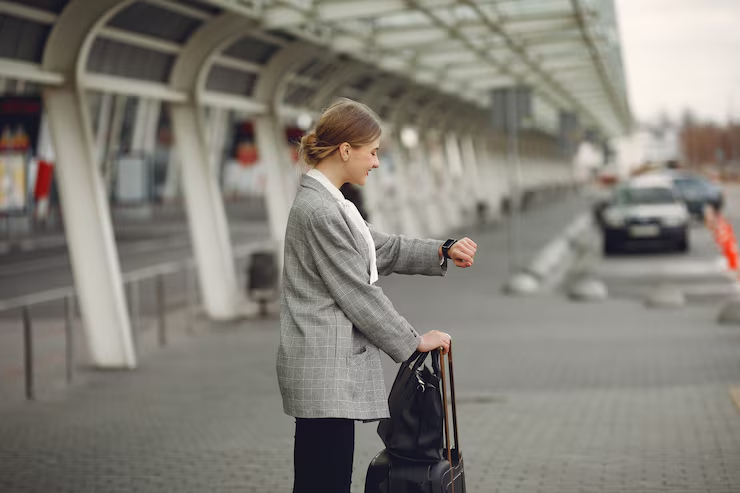
The pickup curb at JFK has a very specific kind of cold—wind off the roadway, headlights sliding past, families reuniting in quick hugs before disappearing into warm cars.
I was eighteen, standing there with a suitcase, my phone hovering at ten percent, and a hope I didn’t want to admit out loud.
I called my mom once. Then again. Then again.
Twelve calls in a row.
Each one rang… and dropped. Like I was a wrong number. Like I didn’t belong to anyone.
Around me, other kids were being pulled into back seats with “How was your semester?” and “You must be starving.” I kept checking the curb like my family would appear at the last second if I waited hard enough.
They didn’t.
An hour later, my phone buzzed—not a call, just a text.
“You want attention?” my mom wrote. “Please take a rideshare home.”
I stared at the screen so long my eyes blurred. My throat tightened. I turned my face away from the traffic and let a few tears fall quietly, the way you do when you’re trying not to give the world a show.
A rideshare pulled up. I climbed into the back seat with my suitcase and my pride and the last bit of battery I had left.
The driver glanced at me in the mirror. “You good, miss?”
I swallowed. “Yeah. Just… long day.”
But inside, something had already changed. Not loud. Not dramatic. Just a clean decision settling into place.
If I was so easy to ignore, then I was going to stop performing for people who only noticed me when it was convenient. I wasn’t going to keep asking to be included. I wasn’t going to keep shrinking to fit their story.
Three years later, I woke up to my phone buzzing like it might slide off the nightstand—message after message stacked on my screen.
Please. We were wrong. Come back. Just talk to me.
Thirty-seven messages from the same woman who once left me at an airport and sent a text that still stung.
And the strangest part?
It wasn’t satisfying the way you imagine a “comeback” would feel.
It was quiet.
Like standing on the other side of a line you finally drew—and realizing they were still on the other side, calling across a distance you’d built on purpose.
Before the Airport
My name is Elena Rivas. I’m the oldest of three children, born to parents who wanted perfection but settled for control when perfection proved exhausting.
My brother Mateo was the golden child—athletic, charming, effortlessly good at everything that looked impressive from the outside. My sister Lucia was the baby, coddled and forgiven for the same things I’d been punished for years earlier.
And I was the responsible one. The one who didn’t need reminders. The one who handled things quietly so nobody had to worry.
When I was ten, my mom forgot to pick me up from dance practice. I waited on the curb for two hours until the instructor drove me home. When we pulled up, my mom looked confused, like she’d forgotten I existed for the afternoon.
“Oh, Elena,” she said, hand to her chest. “I’m so sorry, honey. Mateo had a game and it ran late.”
No hug. No real apology. Just an explanation that made me feel like I should’ve known better than to expect her.
When I was fourteen, I won a regional writing competition. I came home with the certificate, smiling, ready to share the news. My dad glanced at it, nodded, and said, “That’s great, mija. Can you help your brother with his college essay later?”
Mateo’s essay. Not mine. His.
I learned early that my accomplishments were footnotes in someone else’s story.
By the time I got into college—a good college, the kind my parents had pushed Mateo toward but never thought I’d reach—I thought things might shift. I thought they’d be proud. I thought they’d see me differently.
Instead, my mom said, “It’s far, though. And expensive. Are you sure you wouldn’t be happier closer to home?”
Translation: We don’t want to deal with the logistics of you being gone.
I went anyway. I packed my things, I got on a plane, and I started my first semester at a school where nobody knew me as “Mateo’s sister” or “the quiet one.”
For the first time in my life, I was just Elena.
And I loved it.
The First Semester
College was everything I’d hoped it would be. I made friends—real friends, the kind who actually asked how I was doing and waited for an answer. I joined the campus literary magazine. I took classes that challenged me, professors who remembered my name, late-night conversations in the dorm lounge that made me feel seen in a way I’d never experienced at home.
I called my parents every week. Sunday evenings, like clockwork.
Most of the time, my mom answered with a distracted “Hi, honey, how’s school?” and then pivoted immediately to something happening with Mateo or Lucia. My dad rarely got on the phone at all.
I tried not to let it bother me. I told myself they were busy, that they cared in their own way, that I was being too sensitive.
But the truth was already forming in the back of my mind, small and sharp: They didn’t miss me. They missed the things I used to do for them.
When finals ended in December, I booked my flight home. I texted my mom the details two weeks in advance.
Flight lands December 18, 4:30 PM. JFK. Can someone pick me up?
She responded with a thumbs-up emoji.
That was it. No “Can’t wait to see you” or “We missed you.” Just a thumbs-up.
I told myself it was fine. I told myself I was reading too much into it.
But when I landed at JFK and stood at that curb, watching family after family reunite while my phone rang into silence, I knew.
I wasn’t a priority. I never had been.
The Rideshare Home
The driver who picked me up was a woman in her fifties with kind eyes and a rosary hanging from the mirror. She didn’t ask questions, just drove, and I was grateful for the silence.
When we pulled up to my house forty-five minutes later, the lights were on. My dad’s car was in the driveway. Mateo’s car too.
They were home. They’d been home the whole time.
I paid the driver, thanked her quietly, and dragged my suitcase up the front walk. The door was unlocked. I stepped inside.
The house smelled like dinner—roasted chicken, the kind my mom only made for special occasions. I heard laughter coming from the dining room.
I walked in.
My whole family was sitting around the table. My mom, my dad, Mateo, Lucia. Plates full, wine glasses out, a cake in the center with “Welcome Home Mateo” written in blue icing.
Mateo had come home from his school two days earlier. They’d thrown him a party.
They all looked up when I walked in. My mom’s face went pale.
“Elena,” she said, her voice thin. “You’re here.”
“Yeah,” I said, my voice flat. “I’m here.”
Nobody moved. Nobody got up. Nobody apologized.
My dad cleared his throat. “We thought your flight was tomorrow.”
“It wasn’t,” I said.
Lucia looked down at her plate. Mateo shifted uncomfortably.
My mom stood up, smoothing her hands on her jeans. “Well, you’re here now. Sit down, I’ll get you a plate.”
“I’m not hungry,” I said.
I turned and walked upstairs to my room. I closed the door. I sat on the edge of my bed and I stared at the wall.
The tears didn’t come this time. Just a cold, clear certainty settling into my chest.
I wasn’t going to do this anymore.
The Shift
That night, I didn’t come down for dinner. I didn’t go down for dessert. I stayed in my room, unpacking my suitcase, reorganizing my things.
My mom knocked once. “Elena? Are you okay?”
“I’m fine,” I said through the door.
She didn’t push. She never did.
The next morning, I woke up early and made myself breakfast. I ate alone at the kitchen table, then I went back upstairs.
When Lucia knocked and asked if I wanted to go to the mall, I said no.
When my dad asked if I could help Mateo move some furniture, I said I had plans.
When my mom asked if I was upset, I said I was tired.
I wasn’t rude. I wasn’t dramatic. I just… stopped trying.
I stopped asking to be included. I stopped volunteering to help. I stopped making myself convenient.
For the rest of winter break, I was polite and distant. I came to family dinners when called, but I didn’t linger. I answered questions, but I didn’t offer stories. I was there, but I wasn’t present.
And the strangest thing happened: nobody noticed.
Or if they did, they didn’t care enough to ask why.
When I flew back to school in January, nobody drove me to the airport. I took a rideshare again.
My mom texted: Safe travels!
I didn’t respond.
The Next Two Years
I went back to school and I built a life that had nothing to do with them.
I worked two part-time jobs to cover my expenses so I wouldn’t have to ask for money. I spent holidays with friends whose families welcomed me with warmth I’d forgotten existed. I dated someone who actually listened when I talked. I wrote articles for the magazine that got picked up by bigger publications.
I became someone I was proud of.
My family still called occasionally. My mom, mostly, with updates I didn’t ask for.
Mateo got engaged!
Lucia made the dean’s list!
Your dad says hi!
I responded politely. Short texts. Surface-level engagement.
They never asked about my life. Not really. Not in a way that required them to actually listen.
By my senior year, I’d stopped going home for breaks altogether. Thanksgiving, I stayed on campus. Christmas, I went to my friend Sophie’s house in Vermont. Spring break, I took a trip to visit another friend in California.
My mom noticed that time.
You’re not coming home for spring break?
I have plans, I wrote back.
With who?
Friends.
We’d love to see you.
I stared at that message for a long time. We’d love to see you. Would they? Or would they love the idea of me being there, filling a seat at the table, making them look like a complete family?
Maybe next time, I replied.
I graduated in May. My parents didn’t come to the ceremony.
“It’s such a long trip,” my mom said when I told her the date. “And your dad has a work thing. But we’re so proud of you, honey.”
I didn’t argue. I didn’t guilt-trip them. I just said okay.
Sophie’s parents came instead. They cheered when I walked across the stage. They took me to dinner afterward. They treated me like I mattered.
And I realized something: Family isn’t about blood. It’s about who shows up.
Mine hadn’t shown up in years.
The Messages
I moved to Boston after graduation. I got a job at a nonprofit, a small apartment in a neighborhood I loved, a routine that felt like mine.
I changed my number and didn’t tell my parents.
Not out of spite. Just… I wanted a clean start. I wanted to stop waiting for them to care.
For six months, I heard nothing. And it was peaceful.
Then, one morning in November, I woke up to my phone buzzing. Not my current number—my old one, the one I’d forwarded to a Google Voice account I barely checked.
Thirty-seven messages. All from my mom.
I scrolled through them slowly, my coffee going cold in my hand.
Elena, please call me back.
We need to talk.
Your dad is in the hospital.
Where are you?
Why aren’t you answering?
Mateo’s wedding is in two weeks. You need to be here.
People are asking about you.
Please. We were wrong. Come back.
We miss you.
Just talk to me.
I read them all. Every desperate, pleading line.
And I felt… nothing.
No anger. No satisfaction. No vindication.
Just a quiet distance, like reading about someone else’s family.
I set the phone down and finished my coffee.
The Call
A week later, my mom called from a different number. I answered without thinking, still half-asleep.
“Elena?” Her voice cracked. “Oh my God, Elena. You answered.”
I sat up, rubbing my eyes. “What do you want, Mom?”
“I—” She started crying. “I’ve been trying to reach you for weeks. Where have you been?”
“I moved,” I said.
“You moved? Where? Why didn’t you tell us?”
“I did,” I lied. It was easier than explaining.
“Your brother is getting married,” she said, her voice trembling. “He wants you there. We all do.”
“That’s nice,” I said.
“Elena, please. We messed up. I know we did. But you’re still our daughter. You’re still part of this family.”
I looked out my window at the street below, people walking dogs, living their lives.
“Am I?” I asked quietly.
“What?”
“Am I part of this family? Because for most of my life, it hasn’t felt that way.”
She was quiet.
“You left me at the airport,” I continued, my voice steady. “After twelve calls. And when you finally texted, you made it sound like I was being dramatic for wanting you to pick me up.”
“I was overwhelmed that day—”
“You were home,” I interrupted. “You were all home. Having dinner. Celebrating Mateo.”
“We thought—”
“You didn’t think about me at all,” I said. “And that was the problem. You never did.”
She was crying now, full sobs. “Please, Elena. Please don’t do this. We love you.”
“Maybe you do,” I said. “But love without effort is just a word. And I’m tired of words.”
“So you’re just… what? Cutting us off?”
“No,” I said. “You cut me off a long time ago. I just finally stopped trying to reconnect the line.”
I hung up.
My hands were shaking, but my breathing was steady.
I didn’t feel cruel. I felt clear.
The Wedding
Mateo called two days before the wedding. I almost didn’t answer, but curiosity won.
“Elena,” he said. “It’s me.”
“I know.”
“Are you coming?” His voice was smaller than I’d ever heard it.
“No.”
“Why not?”
I sighed. “Because you didn’t ask me to be in the wedding party. Because you didn’t call when I graduated. Because for three years, nobody in this family has asked how I’m doing. Not really.”
“I’m sorry,” he said. “I should have… I should have been better.”
“Yeah,” I said. “You should have.”
“Can I… can I still fix this?”
“I don’t know, Mateo. Can you?”
He was quiet for a long time. Then: “What do you want me to do?”
“I want you to try,” I said. “Not just now, when it’s convenient. Not just when you need me to show up and make the family look complete. I want you to actually try. And if you can’t do that, then honestly, it’s better if we just… don’t.”
“I hear you,” he said. “I do. But Elena, we’re family.”
“Then act like it,” I said.
And I hung up again.
Three Months Later
I didn’t go to the wedding. I sent a card with a generic congratulations message and no return address.
Christmas came and went. I spent it with Sophie’s family again, eating too much pie and playing board games by the fire.
In January, I got a letter. Actual mail, handwritten, addressed to my Boston apartment.
It was from Lucia.
Dear Elena,
I don’t know if you’ll read this. I wouldn’t blame you if you didn’t.
But I wanted you to know that I get it now. I didn’t before. I thought you were being dramatic, pulling away from us. I thought you were the problem.
But I’m in college now. I’m the oldest one left at home. And I’m starting to see what you saw.
Mom and Dad don’t ask about me either. They don’t come to my things. They don’t care unless it’s convenient.
And I realized you weren’t being difficult. You were protecting yourself.
I’m sorry I didn’t defend you. I’m sorry I didn’t see it sooner.
I don’t expect you to forgive me. But I wanted you to know that I understand now.
If you ever want to talk, I’m here.
Love, Lucia
I read the letter three times. Then I folded it carefully and put it in my desk drawer.
A week later, I called her.
“Lucia?”
“Elena?” She sounded shocked. “You called.”
“Yeah,” I said. “I got your letter.”
“And?”
“And… I appreciate it. I really do.”
We talked for an hour. Really talked. About college, about our parents, about the ways we’d both felt invisible.
“I don’t know how to fix it,” she said finally. “With them, I mean.”
“You can’t,” I said. “But you can protect yourself. You can decide what you deserve and stop accepting less.”
“Is that what you did?”
“Yeah,” I said. “It was hard. But it was necessary.”
“Do you think you’ll ever come back?” she asked. “Like, to see us?”
I thought about it. “Maybe. Someday. If things change. But I’m not holding my breath.”
“That’s fair,” she said.
We stayed in touch after that. Texts, occasional calls. She visited me in Boston once, and it was strange but good to see her outside the context of our family’s dysfunction.
We were building something new. Something honest.
Two Years Later
I’m twenty-four now. I live in a city where nobody knows my history, surrounded by people who chose me and who I chose back.
My parents still try sometimes. My mom sends cards on my birthday. My dad leaves voicemails I don’t return.
Mateo reached out last month. He asked if we could talk, really talk. I said maybe someday, but not yet.
I don’t hate them. I don’t wish them harm. But I also don’t owe them access to a life they didn’t help me build.
Sometimes I think about that airport curb. About eighteen-year-old Elena standing there in the cold, waiting for people who weren’t coming.
And I want to go back and tell her: It gets better. Not because they change. But because you do.
You learn that you can’t make people love you the way you need. You can’t force them to show up. You can’t shrink yourself into a shape that finally makes them care.
All you can do is walk away and build a life that doesn’t require their approval.
The hardest part isn’t leaving. It’s accepting that they might never understand why you had to.
But your peace is worth more than their comfort. Your dignity is worth more than their convenience.
And the people who truly love you won’t make you beg for scraps of their attention.
I learned that at JFK, standing alone while the world moved around me.
And three years later, when my phone buzzed with thirty-seven desperate messages, I learned something else:
Sometimes the best revenge isn’t making them regret losing you.
It’s building a life so full they can’t fit into it anymore.
I’m Elena Rivas. I’m twenty-four years old. And I don’t wait at airports for people who won’t come.
I drive myself now. And I always arrive right on time.