You’ll Eat After Everyone
It wasn’t the words themselves—it was the tone. Calm. Efficient. Managerial. “You’ll eat after everyone.”
No malice. No raised voice. Just the sterile detachment of someone used to being in charge, telling the woman who raised her when she’s allowed to eat in her own home. That was how my daughter—my Caroline—spoke to me last night in her grand dining room in Connecticut, the one with the white candles, the oak table, and the smell of rosemary and wine drifting through the air.
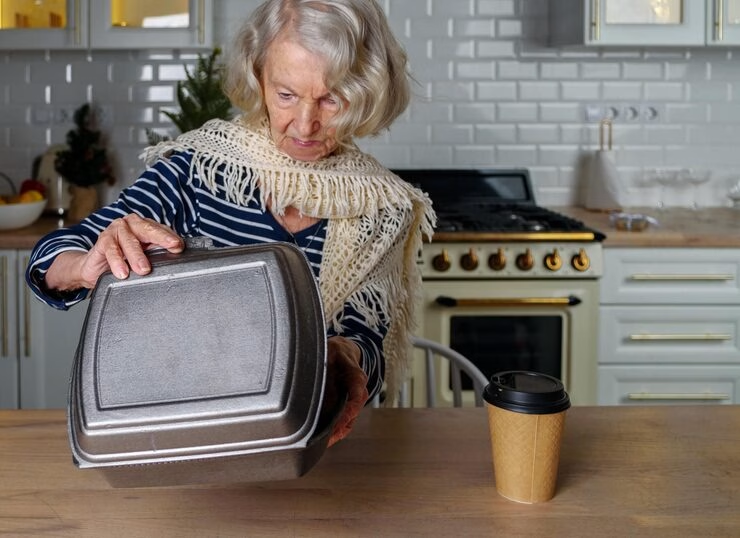
I had woken before sunrise to cook that roast. Cider, sage, sea salt, patience. Eight hours of care poured into a single meal—my small way of contributing, of feeling useful. And yet when the guests sat down—her husband, their friends from the golf club, even the neighbors she barely knows—there was no seat left for me. Just her voice, crisp and polite, assigning me a place outside my own family’s circle.
Something inside me shifted—not loudly, not angrily, but with the clean, silent break of something that had been cracking for years. I looked at the roast, glistening and perfect, and felt my fingers tighten around the pan. The laughter from the table washed over me—thin, bright, rehearsed—while a part of me went very still.
She didn’t notice when I stood. No one did. They were too busy passing the wine.
I carried the roast—my roast—through the hallway, past the family portraits I’d been edited out of, past the foyer that used to hold my piano but now displayed only her curated taste. When I stepped outside, the air was cold enough to sting, and for the first time in months, I felt fully awake.
My name is Eleanor Vance, and I suppose you could say I finally took something back.
The Year Before
You see, a year ago, Caroline convinced me to sell my house and move in “for my own good.” Bills, lawn care, loneliness—she had a reason for everything. I told myself she was right, that it was time to let her lead. But somewhere between the errands, the small corrections, and the patronizing smiles, I stopped being a mother and became a project.
That sentence—You’ll eat after everyone—wasn’t new. It was just the first time I really heard it.
My husband Thomas had died two years earlier. Heart attack at sixty-seven, sudden and absolute. The grief had been a fog I walked through for months, but I’d been managing. The house was paid off. My pension covered expenses. I had my garden, my book club, my Tuesday morning walks with Margaret from next door.
But Caroline saw vulnerability where I saw adjustment. She saw incompetence where I saw learning. She saw an opportunity to take control.
“Mom, you can’t keep up that big house alone,” she’d said, sitting in my kitchen with her leather portfolio and her concerned expression. “The property taxes are outrageous. The roof needs replacing. And what if something happens to you? You’re seventy-two. It’s not safe.”
Each point was technically true, but none were insurmountable. I’d already gotten quotes on the roof. The property taxes were manageable. And I’d lived in that house for forty years—I knew every creaking board, every temperamental faucet, every morning the sun hit the kitchen just right.
But Caroline was persistent. She wore me down with statistics about elderly falls, articles about aging in place, and the unspoken implication that resisting her help was foolish pride.
“We have plenty of room,” she’d said. “The guest suite is basically its own apartment. You’d have privacy but also security. Family nearby. Doesn’t that sound better than rattling around in that old house alone?”
When I finally agreed, I told myself I was being practical. Reasonable. Making it easier on everyone.
I should have known better.
The Guest Suite
The “guest suite” in Caroline’s house was lovely in the way a hotel room is lovely—impersonal, coordinated, and utterly without soul. Beige walls. Cream carpet. Furniture from a catalog. A small kitchenette with a mini-fridge and a microwave, though Caroline made it clear I was expected to take my meals with the family.
“It’ll be so nice having you here,” she’d said that first week, helping me unpack. “Though Mom, you really don’t need all these… things.”
She said “things” the way someone might say “trash.” She was looking at my collection of vintage teacups, the ones I’d been gathering since I was twenty. Thomas had bought me the first one on our honeymoon in England.
“They’re just taking up space,” Caroline continued. “Why don’t we donate some? You’re starting fresh. You don’t need to carry all this old stuff into your new life.”
I kept the teacups. But over the following months, other things disappeared—books Caroline decided I’d never read again, clothes she deemed “dated,” photographs she said were “cluttering” the shelves. Each loss was presented as helpful decluttering, freeing me from burdens, making my life simpler.
What she was really doing was erasing me.
The Small Erosions
The changes were gradual. First, Caroline took over my banking, insisting it would be “easier” if she managed my accounts online. Then she started scheduling my doctor’s appointments without asking, accompanying me to each one and dominating the conversations with the physician.
“Mom sometimes forgets to mention her symptoms,” she’d say, as if I weren’t sitting right there. “Last week she had a dizzy spell she didn’t tell anyone about.”
I’d had no dizzy spell. I’d simply stood up too quickly from the couch.
My car keys disappeared next. Caroline claimed she was having the car serviced, but days turned into weeks. When I asked about it, she sighed with that particular brand of patience reserved for difficult children.
“Mom, your reflexes aren’t what they used to be. Dr. Patterson said seniors your age should be cautious about driving. We’re just trying to keep you safe.”
Dr. Patterson had said no such thing. But Caroline controlled the narrative.
My old friends started appearing less frequently. Margaret called a few times, but Caroline always seemed to answer, explaining I was resting or not feeling well, promising I’d call back. I never got the messages.
When I confronted her, she looked genuinely hurt. “I’m protecting your energy, Mom. You get so tired after visitors. I’m just trying to help you rest.”
But I wasn’t tired. I was being isolated.
The Dinner Parties
Caroline hosted dinner parties monthly—elaborate affairs designed to showcase her perfect life to her perfect friends. She’d always volunteered me to help with the cooking, presenting it as giving me purpose, keeping me engaged.
“Mom loves cooking,” she’d tell her guests. “It makes her feel useful.”
What Caroline loved was having free labor that came with the bonus of looking generous. I’d spend days preparing food for people who barely acknowledged my existence. During dinner, I’d serve, clear plates, refresh drinks—always moving, never sitting.
At first, I ate afterward in the kitchen, telling myself it was practical. Someone needed to clean up, and this way the food didn’t sit out getting cold.
But last night was different. Last night, Caroline said it out loud, gave voice to the unspoken rule I’d been following for months.
“You’ll eat after everyone.”
Not a question. Not a request. A directive.
I was standing there holding the roast I’d spent eight hours preparing, and my daughter was telling me I wasn’t worthy of sitting at a table in what she called “our home” but was really hers.
The Breaking Point
I don’t remember the sound of the door closing behind me. I remember the smell of apples and smoke, the way the roast’s juices shimmered under the porch light, and the quiet certainty blooming in my chest.
Three blocks away stood a house with chipped blue shutters and a grandfather clock that hadn’t ticked since I left. My house.
I hadn’t sold it. Despite Caroline’s pressure, despite the realtor she’d contacted, despite the staging company she’d hired, I’d never signed the final papers. Something in me had resisted, some stubborn core that knew I might need a way back.
I’d rented it out instead, to a young couple who were understanding when I showed up at 9 PM on a Saturday night, roast pan in hand, asking if they’d be willing to break their lease.
“We were actually thinking about buying,” the husband said, looking at his wife. “If you’re interested in selling.”
“I am,” I said. “But not tonight. Tonight I just need my house back.”
They were gone by morning, apologetic and efficient. By noon, I was alone in my kitchen, eating leftover roast at my own table, remembering who I used to be.
The Phone Calls
Caroline called seventeen times that first night. I didn’t answer. The voicemails progressed from concerned to irritated to angry to something that almost sounded like fear.
“Mom, where are you? Everyone’s worried. Just call me back so I know you’re safe.”
“This is ridiculous. You can’t just leave in the middle of a dinner party. You’re embarrassing me.”
“Fine. If you want to be childish, be childish. But at least let me know where you are.”
“Mom, I’m sorry if I upset you. Can we please talk about this like adults?”
That last one almost worked. Almost. But then I remembered the tone—You’ll eat after everyone—and I deleted the message.
She showed up the next morning. I watched through the window as she got out of her BMW, perfectly composed in her cashmere coat, her expression a careful mixture of concern and exasperation.
I didn’t answer the door.
“Mom! I know you’re in there. Your car is in the driveway. Please, let’s talk about this.”
I sat in my kitchen, drinking tea from one of the vintage cups she’d tried to make me donate, and waited.
She knocked for ten minutes before leaving. She came back that afternoon. Then the next day. Then she called the police for a wellness check.
The officer was kind but bemused. “Ma’am, your daughter is very worried about you.”
“My daughter is worried about control,” I corrected. “I’m seventy-two, not senile. I’m in my own home, which I own, living my own life. Is there a law against that?”
“No, ma’am. But maybe you could just give her a call? Let her know you’re alright?”
“I’ll think about it.”
I didn’t call.
Reclaiming My Life
The first week was harder than I expected. Not because I missed Caroline’s house—I didn’t—but because I’d forgotten how to be alone without being lonely. I’d forgotten how to fill my days with purpose I chose rather than tasks assigned to me.
I started small. I called Margaret, who screamed with joy when she heard my voice.
“Eleanor! Where have you been? I’ve called dozens of times!”
“I know. I’m sorry. It’s… complicated. Can we meet for coffee?”
We met the next day, and I told her everything. She listened without interrupting, her expression growing darker with each detail.
“That’s elder abuse,” she said flatly when I finished. “Caroline was isolating you, controlling your finances, restricting your movement. That’s textbook abuse.”
“She thought she was helping—”
“She thought she was in charge,” Margaret corrected. “There’s a difference.”
I thought about that for a long time.
The Lawyer
Margaret’s nephew was a lawyer specializing in elder law. He agreed to meet with me on short notice and listened carefully to my story.
“Do you have access to your accounts?” he asked.
“I think so. Caroline set up online banking, but they’re still in my name.”
“Check. Today. And if anything seems wrong, we act immediately.”
I went home and logged into my bank account for the first time in months. What I found made my hands shake.
Caroline had been transferring money—small amounts at first, then larger ones. Two thousand here. Five thousand there. Over the year I’d lived with her, nearly forty thousand dollars had moved from my accounts to hers.
The lawyer’s face was grim when I showed him the statements. “This is financial exploitation. We can report this, press charges—”
“No,” I said. “Not yet. I want to talk to her first.”
“Mrs. Vance, I strongly advise—”
“I’m still her mother,” I said. “Before this becomes legal, it needs to be personal.”
The Confrontation
I invited Caroline to lunch. Neutral territory—a small cafe downtown where we used to meet before everything changed. She arrived looking perfectly composed, though I noticed the tension around her eyes.
“Mom, I’m so glad you agreed to meet. I’ve been so worried—”
“I know about the money,” I said.
She went very still. “What?”
“The transfers. Forty thousand dollars over twelve months. That’s theft, Caroline. From your own mother.”
“I was managing your accounts! You asked me to!”
“I asked you to help me with online banking. I didn’t ask you to steal from me.”
“It wasn’t stealing.” Her voice had that edge to it now, the careful control slipping. “Do you have any idea how much it cost to have you living with us? Food, utilities, the guest suite renovation—”
“You invited me to live with you. You insisted it was for my own good.”
“Because it was! You couldn’t handle that big house alone!”
“I was handling it fine until you convinced me I couldn’t. That was the first manipulation, Caroline. Everything else followed.”
She looked at me like I was speaking a foreign language. In a way, I suppose I was. For months, I’d been speaking the language of submission, of gratitude, of knowing my place. This language—the language of boundaries and self-respect—was new to both of us.
“I don’t understand what’s happened to you,” she said finally. “You’ve changed.”
“No,” I said quietly. “I’m just remembering who I was before you started deciding who I should be.”
The Reckoning
Over the next month, I rebuilt my life with Margaret’s help. I reconnected with friends Caroline had gatekept. I joined a new book club. I started painting again, something I hadn’t done since Thomas died.
The lawyer helped me secure my accounts and change all my passwords. Caroline had no access anymore, and the transfer history was documented in case we needed it later.
She came by the house twice more, each time more desperate.
“Mom, please. Can’t we move past this? You’re my mother. I love you.”
“Do you? Or did you love having control over someone who couldn’t say no?”
“That’s not fair.”
“Neither was telling me when I could eat.”
That stopped her. She stood on my porch, the same porch where she’d played as a child, and I saw the exact moment she realized I wasn’t coming back.
“You’re really going to do this? Choose… what? Loneliness? Pride? Over family?”
“I’m choosing dignity,” I said. “And I’m hoping someday you’ll understand the difference.”
Six Months Later
Caroline and I speak now, though not often. Brief phone calls every few weeks, careful conversations that avoid the subjects that would make us both too angry or too sad. She hasn’t apologized—I don’t think she’s capable of seeing what she did as wrong—but she’s stopped trying to control me.
Last week, she asked if I’d come to dinner. Not to cook. Not to serve. Just to sit at the table as a guest.
I said I’d think about it.
I’m still thinking.
The Lesson
Margaret asked me once what I learned from that year in Caroline’s house.
“That love without respect is just another kind of prison,” I said. “And that the people who claim to be helping you are sometimes the ones you most need to escape.”
She nodded. “And the roast? Do you ever regret taking it?”
I laughed. “That roast was the best decision I ever made. I’d spent eight hours making something beautiful, and I was damned if I was going to let it go to people who saw me as a servant.”
“So what did you do with it?”
“Ate it for a week,” I said. “Every meal. With my good china and my vintage teacups and nobody telling me to wait my turn.”
“Sounds perfect.”
“It was.”
The Real Victory
The real victory wasn’t taking the roast. It wasn’t moving out or securing my accounts or even establishing boundaries with Caroline.
The real victory was the morning I woke up in my own house, made my own breakfast, and realized I’d stopped living my life on someone else’s schedule.
I tend my garden now without someone suggesting I’m overdoing it. I read books Caroline would consider trashy. I eat dinner whenever I’m hungry, not when someone decides it’s appropriate.
Last week, I hosted my own dinner party. Just Margaret and a few other friends, nothing fancy. I cooked a simple pasta dish, and we sat around my dining room table drinking wine and laughing until midnight.
At one point, Margaret raised her glass. “To Eleanor,” she said. “The only woman I know brave enough to steal her own roast.”
Everyone laughed, but I corrected her gently.
“I didn’t steal it,” I said. “I took back what was mine.”
The Phone Call
This morning, Caroline called. I almost didn’t answer—our last conversation had ended awkwardly, with her trying to explain away the money transfers as “budgeting help” and me refusing to accept the revisionism.
But something made me pick up.
“Mom?” Her voice was different. Smaller. “Can I come over?”
“Why?”
“Because I think I owe you an actual apology. Not the kind where I explain why I was right. The kind where I admit I was wrong.”
I was silent for a long moment. “Okay.”
She came an hour later. We sat in my living room—the room she’d once suggested I convert to a “more practical” space—and she cried.
“I thought I was taking care of you,” she said. “But really, I was taking you over. And I didn’t see it because it felt like… like I was finally in charge of something. My marriage was falling apart, my job was suffocating me, and here was this one thing I could control.”
“I’m not a thing, Caroline.”
“I know. God, I know that now. But I’d spent so long watching you be this… competent, capable person, and then Dad died and you seemed lost, and I thought, finally, something I can fix.”
“I wasn’t broken.”
“No. You were grieving. And I turned your grief into my project.”
It wasn’t a perfect apology. But it was honest.
“I can’t promise we’ll go back to how we were,” I said. “I’m not sure I want to.”
“I know. I just… I want you to know I see it now. What I did. And I’m sorry.”
We sat together in the quiet for a while, and I thought about what forgiveness actually means. It doesn’t mean forgetting. It doesn’t mean pretending the harm never happened.
It means deciding that the relationship is worth more than the grudge.
“Okay,” I said finally. “We can start from here.”
The Ending
I’m still in my house with the blue shutters. My garden is thriving. My book club meets every Wednesday. I’ve sold three paintings to a local gallery.
Caroline and I have dinner once a month—sometimes at my house, sometimes at hers, never with the unspoken hierarchy that poisoned everything before.
Last week, she helped me bake bread. We worked side by side in my kitchen, and at one point she asked, “Do you remember teaching me to braid bread dough when I was little?”
“Of course.”
“I’d forgotten that. How patient you were. How you’d let me try over and over even when my braids looked terrible.”
“They weren’t terrible. They were yours.”
She looked at me with something that might have been understanding. “I should have remembered that patience when you needed it from me.”
“Maybe,” I said. “But you’re learning it now.”
We ate the bread together at my dining room table, just the two of us, and for the first time in years, I felt like I had my daughter back.
Not the controlling, managing, efficiency-obsessed version who’d taken over my life.
The real one. The one who remembered being loved enough to try, and fail, and try again.
Epilogue
People ask me sometimes about that night—the night I took the roast and walked out into the cold.
They want to know if I was scared. If I knew where I was going. If I had a plan.
The truth is simpler than that.
I was seventy-two years old, standing in a house where I wasn’t allowed to sit at the table, holding a roast I’d made with eight hours of care, and I realized I had a choice.
I could stay and accept the role I’d been assigned—the diminished, grateful, unobtrusive mother who knew her place.
Or I could pick up the roast and walk out the door.
So I did.
And in doing so, I didn’t just take back a meal.
I took back myself.