The Photo
Our daughter didn’t invite us to her engagement party—we pressed our suits anyway, set the gift down, and watched her caption thank a “second family.” By dawn the DMs arrived with explanations and “just one more favor,” but we didn’t argue or post. We closed the Bank of Mom & Dad, changed the locks at the lake house—and let her new family handle the bill.
We learned from a photo—her in a silk dress, champagne lifted, captioned “Family is everything.” Once, that word meant us. Now it meant someone else: Gavin’s parents, his cousins, a circle of practiced smiles that made sure we weren’t in the frame.
It wasn’t a misunderstanding. It was choreography—lighting, table settings, and a caption arranged to say, you’re no longer required here.
The next morning, the navy dress I’d pressed was still hanging by the mirror. The dry-cleaning tag brushed my wrist as I took it down. I didn’t cry. I folded the dress back into its plastic and sat beside the gift we’d wrapped—a vintage cookbook she’d annotated with pencil hearts when she was little. On the title page she once wrote in looping letters: For when I grow up. Apparently, she had.
Robert came in with coffee, glasses sliding down his nose. “You saw it?” he asked.
I nodded.
He didn’t ask which it. He said, “Then we’re done giving people reasons to forget us.”
That sentence stayed with me all day. We were never the dramatic parents—we were the responsible ones. We showed up, fixed, wired, patched, paid. Every check carried hope. Every “thank you” carried distance. You don’t clock the subtraction right away; you just wake up one day and realize your child thanks other people for the values you taught her.
The Spreadsheet
By evening, I stopped scrolling her photos and opened the laptop. A spreadsheet blinked to life—rows, dates, transfers: tuition, rent, deposits. Robert sat beside me in quiet as I entered each line. It wasn’t about money. It was about memory. Every entry was a story she no longer kept.
We didn’t post. We didn’t argue. We didn’t write a long, aching note to the internet about ungrateful kids. We counted. Counting creates clarity. Clarity—eventually—turns into peace.
Emily’s College (2018-2022): $127,000
Apartment deposits (2022-2025): $18,500
Car down payment: $8,000
Monthly car insurance: $4,200 total
Credit card “emergencies”: $23,600
Study abroad semester: $15,000
Graduate school deposit (non-refundable): $5,000
Wedding dress shopping trip to NYC: $2,800
Lake house summers (estimated value): Priceless
The number at the bottom made me blink: $204,100.
Two hundred and four thousand dollars. Not counting the immeasurable—the late-night phone calls, the care packages during finals, the dropped everything when she needed us.
Robert leaned over my shoulder and whistled low. “We could have retired early.”
“We still can,” I said quietly.
The Call
Three nights later, her name lit my screen. No “Hi, Mom.” Just: “Did you pay the card? It’s been declined.”
For a beat, I heard the small voice from years ago—the child who called after bad dreams. But this voice wasn’t afraid of monsters. It was afraid of overdraft fees.
“Emily,” I said evenly, “didn’t I warn you this might happen?”
A sharp exhale. “Mom, please. I’m at the register.”
That’s when it landed: she hadn’t only left us out of a party—she’d left us out of her priorities.
I looked at Robert. He didn’t speak. He closed the laptop and gave a single, quiet nod—the kind that changes the next chapter.
“Emily, the card is paid. But it’s the last time.”
“What?”
“The card. The rent supplements. The ‘just this once’ transfers. They’re done.”
Silence. Then, incredulously: “You’re cutting me off? Now? Right before the wedding?”
“No. We’re stepping back. There’s a difference.”
“This is insane! I have expenses! The wedding alone—”
“Is being paid for by your ‘second family,’ according to your Instagram.”
Another silence, this one sharper. “You’re really going to throw that in my face? It was just a caption, Mom. You’re being dramatic.”
“Dramatic would be showing up to a party I wasn’t invited to. We stayed home.”
“I told Gavin’s mom you probably wouldn’t come anyway! You guys are always so busy with your own stuff!”
The accusation hung in the air, absurd and stinging. We were busy with our own stuff? We who had rearranged our lives for twenty-six years around her needs?
“Emily, you didn’t invite us. Not a text. Not a call. We learned about your engagement party from Instagram.”
“I just… I figured you’d understand. Gavin’s family planned it. It was their thing.”
“And you couldn’t add two seats?”
“It was complicated!”
“No,” I said, my voice steady. “It was a choice. And we’re making ours. From now on, you handle your own bills. Your own emergencies. Your own life.”
“You can’t be serious.”
“I’ve never been more serious.”
I hung up.
Robert squeezed my hand. We sat in the quiet for a long time.
The Messages
The messages started within the hour.
Emily: Mom, I’m sorry. I didn’t mean it like that.
Emily: Can we talk? Please?
Emily: The venue needs a deposit by Friday. Can you help just this once?
Emily: Gavin’s parents said they’d cover catering but they can’t do everything.
Emily: Are you really going to ruin my wedding over this?
I read each one. I didn’t respond.
The next morning, a different message appeared:
Gavin: Hi Mrs. Patterson. Emily’s really upset. I know there was a misunderstanding about the party. She feels terrible. Is there any way we could talk?
I showed it to Robert. He raised an eyebrow. “Feels terrible enough to apologize properly? Or just terrible enough to need money?”
“Guess we’ll find out.”
I wrote back: Gavin, we’d be happy to talk. Let us know when Emily is ready to have an actual conversation, not just ask for favors.
No response.
Three days passed. Then a week.
The Lake House
The lake house had been our refuge for twenty years. A small A-frame in the Adirondacks, two hours north, where we spent summers teaching Emily to swim, to fish, to appreciate silence.
She’d brought friends up every summer through college. Last year, she’d brought Gavin. They’d stayed for two weeks, using it as their personal vacation rental while we stayed home and worked.
We hadn’t been up there in months.
“Let’s go this weekend,” Robert said one morning over breakfast.
“Just us?”
“Just us.”
We packed light and drove up Friday afternoon. The house was exactly as we’d left it—slightly dusty, smelling of pine and old books. We spent Saturday cleaning, repairing a loose deck board, restocking the pantry.
Sunday morning, we changed the locks.
It wasn’t vindictive. It was practical. The lake house was ours—our investment, our retreat, our peace. Emily had treated it like a free hotel. That arrangement was over.
We left the old keys on the kitchen counter with a note:
Emily—The lake house will no longer be available for visits without explicit invitation from us. We hope you understand. Love, Mom and Dad.
We mailed her the note with a photo of the new locks.
The Wedding Invitation
Two weeks later, a cream-colored envelope arrived in the mail.
Mr. and Mrs. Robert Patterson
are cordially invited to the wedding of
Emily Christine Patterson
and
Gavin Michael Whitmore
Robert held it up to the light as if checking for authenticity. “Well. At least we made the wedding.”
“Generous of her.”
“Should we RSVP?”
I thought about it. The petty part of me wanted to decline, to let her panic about empty seats and whispers. But the mother part—the part that still remembered her as a baby, as a child, as someone I loved despite everything—couldn’t quite do it.
“We’ll go,” I said. “But we’re not paying for a damn thing.”
The RSVP card went back with two checkmarks under “accepts with pleasure” and nothing else.
No offer to help with costs. No excited phone call about dress shopping or flowers. Just two checkmarks.
The Venue Crisis
Three weeks before the wedding, my phone rang at 9 PM. Emily’s name flashed.
I almost didn’t answer.
“Mom?” Her voice was thick with tears. “The venue fell through.”
I waited.
“They double-booked. Our date is gone. We’re scrambling to find another place but everywhere wants deposits we don’t have ready and Gavin’s parents already paid for so much and I don’t know what to do—”
“Emily,” I interrupted gently. “Why are you calling me?”
“Because you’re my mother!”
“I am. But I’m not your bank.”
“I’m not asking for money! I’m just… I’m scared, Mom. Everything’s falling apart.”
For the first time in weeks, she sounded like my daughter again. Not entitled. Not distant. Just scared.
“Have you looked at outdoor venues?” I asked. “Parks? Vineyards?”
“Everything’s booked.”
“What about the lake house?”
Silence.
“The lake house?”
“It’s yours if you want it. No charge. But Emily—you have to ask me properly. Not because you need something. Because you want us there.”
More silence. Then, quietly: “I want you there, Mom. I want you there because you’re my mother and I’ve been an idiot and I’m sorry.”
I closed my eyes. “Say that again.”
“I’m sorry. I’m so sorry. I got caught up in… I don’t know. Gavin’s family is so impressive and they were offering so much and I just… I wanted to be part of something that felt big and important and I forgot that you and Dad are the reason I can even do any of this.”
“Keep going.”
“I shouldn’t have excluded you from the engagement party. I should have made sure you had seats. I should have thanked you in that caption. I should have been grateful instead of entitled. And I’m sorry.”
The spreadsheet flashed in my mind—all those numbers, all those sacrifices. But underneath it was something older: her first steps, her first day of school, her first heartbreak.
“Okay,” I said.
“Okay?”
“Okay, you can use the lake house. But Emily—things are different now. We’re not the Bank of Mom and Dad anymore. We’re your parents. There’s a difference.”
“I know. I understand.”
“Do you?”
“I’m learning.”
The Wedding
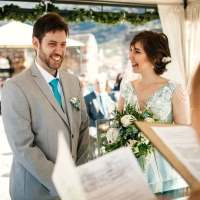
The lake house wedding was small—thirty people instead of two hundred. We set up chairs on the dock. Emily wore a simple dress, not the designer gown from the NYC shopping trip. Gavin’s parents helped with decorations. Our friends brought food.
It was imperfect and beautiful.
When Emily walked down the makeshift aisle on Robert’s arm, I saw her as she was—not the Instagram influencer thanking her “second family,” but our daughter. Flawed, learning, trying.
During the reception, she pulled me aside.
“Thank you,” she said. “For this. For still being here.”
“We’re always here, Emily. We’re just not here to be used.”
She nodded. “I get that now. And Mom? I saw the spreadsheet.”
I blinked. “What?”
“Dad left it open on the laptop last month when I stopped by. I saw the numbers. All of it. I had no idea…”
“It wasn’t about the money—”
“I know. But it showed me what I’d been taking for granted. You and Dad sacrificed so much and I acted like it was nothing. Like you were just… supposed to do it.”
“We wanted to help you. We still do. But we needed you to see us as more than an ATM.”
“I do now. I promise.”
We hugged, and for the first time in months, it felt real.
Six Months Later
Emily and Gavin rented a modest apartment in the city. They split bills. She took a second job to pay down her credit card. When she called, it was to talk—not to ask for money.
She visited the lake house twice over the summer, calling ahead, bringing groceries, helping with repairs.
“This place is even better than I remembered,” she said one evening, sitting on the dock with her feet in the water.
“It’s the same place,” Robert said.
“I know. I’m just seeing it differently.”
We had dinner together once a month. Slowly, carefully, we rebuilt what had broken—not the transactional relationship of parent-as-bank, but something healthier. Something real.
The Lesson
One Sunday afternoon, Emily showed up with a wrapped box.
“What’s this?” I asked.
“Just open it.”
Inside was the vintage cookbook—the one we’d wrapped for her engagement party and never delivered.
“You kept it?” I whispered.
“I never threw anything away, Mom. I was just too proud to admit I needed it. Look at the inscription.”
I opened the cover. Her childhood handwriting stared back at me: For when I grow up.
Below it, in fresh ink, she’d added: I’m still growing. Thank you for not giving up on me. Love, Emily.
I looked up at her, tears blurring my vision.
“I’m sorry it took so long,” she said. “I’m sorry I had to lose access to the bank before I learned to value the people.”
“You didn’t lose us,” Robert said quietly. “You just found us again.”
She hugged us both, and in that moment, the spreadsheet didn’t matter. The money didn’t matter. What mattered was this: our daughter was learning, growing, becoming someone we could be proud of—not because of what we gave her, but because of who she chose to be.
The Boundaries
We never reopened the Bank of Mom & Dad. The lake house remained ours, shared on our terms. Emily’s emergencies became her responsibility. And slowly, she stopped having so many emergencies.
She learned to budget. To save. To say no to things she couldn’t afford. To value what she had instead of always reaching for more.
It wasn’t easy. There were setbacks. There were moments when we almost caved, almost wrote the check, almost slipped back into old patterns.
But we held the line. Because love isn’t about giving everything. It’s about teaching someone to stand on their own.
And eventually, Emily did.
The Ending
Two years after the lake house wedding, Emily called on a Tuesday evening.
“Mom? You busy?”
“Never too busy for you. What’s up?”
“I wanted to tell you something. I got the promotion.”
“Emily! That’s wonderful!”
“Yeah. And the first thing I did was call my financial advisor and set up an education fund.”
“An education fund?”
“For when Gavin and I have kids someday. So they’ll have what I had—college paid for, opportunities, chances. But Mom?”
“Yeah?”
“I’m also setting up boundaries. Because I don’t want to raise kids who take me for granted the way I took you for granted. I want to raise kids who understand the value of sacrifice and gratitude and showing up.”
My throat tightened. “You’re going to be an amazing mother.”
“I learned from the best. Even when I wasn’t paying attention.”
After we hung up, I sat in the quiet of our living room—the same room where we’d opened that laptop and counted the cost of love. The spreadsheet was long deleted. The numbers didn’t matter anymore.
What mattered was this: we had loved our daughter enough to let her fall. And when she was ready, we loved her enough to help her stand back up.
Not by giving her everything.
By teaching her she could do it herself.
And that, in the end, was the greatest gift we could ever give.