The Ghost in the Freezer
“Don’t touch that food, my husband’s family is about to arrive!”
My daughter’s voice rang out from the kitchen doorway. My son-in-law immediately added, “If my wife has already arranged it that way, then we should just follow her plan.” I froze for a moment. The house was mine, the food in the fridge was mine, everything there was mine. I calmly smiled and nodded. That night, when she opened the freezer, she suddenly let out a startled scream and ran around the room. In all my life, I had never done anything like this before.
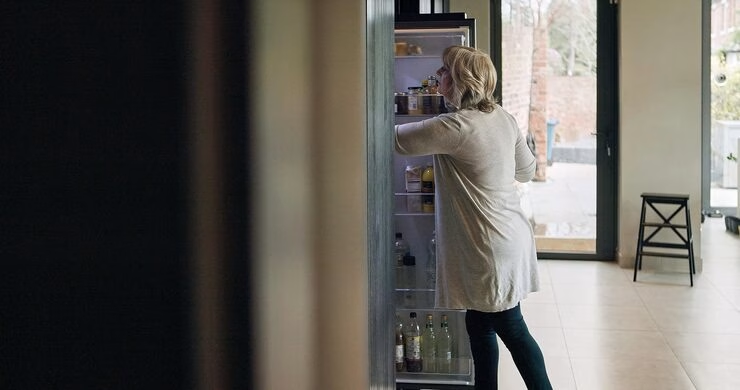
My daughter’s voice shot across the kitchen of our little house outside Seattle, Washington, sharp enough to make me pause with the fridge door still open. For a moment I thought she was joking, the way she used to when she was a teenager rolling her eyes at everything, but the look on her face told me this wasn’t a joke and I wasn’t part of the “family” she was trying so hard to impress.
On the top shelf were the steaks I’d bought at Safeway with my own debit card, the salad ingredients I’d carried home on my aching knees, the cheesecake I’d spent the afternoon baking in this very American kitchen I helped pay for. My Social Security check had barely hit my account when I went out in the rain to stock “our” fridge, because that’s what mothers do, even at sixty-nine.
From the doorway my son-in-law added, in that calm corporate tone he brought home from the office, “If my wife has already arranged it that way, then we should just follow her plan.” As if I were an employee who’d touched the wrong tray in the break room, not the woman whose name used to be on a deed, whose hands had cooked every holiday meal since before he was born. The strange part was, he didn’t even look angry. He looked… satisfied.
For a few seconds I couldn’t move. The house was mine, the food in the fridge was mine, the down payment on this tidy little slice of American suburbia had come from the sale of my old home in Texas. I left my friends, my church, my memories, and crossed state lines for her so she “wouldn’t worry” about me living alone, and now here I was, being told not to touch my own groceries because her in-laws from California might not approve.
I could have reminded her who signed the wire transfer at the bank downtown, who handed over fifty thousand dollars so she and her husband could smile in front of this gray two-story like a picture in a mortgage brochure. I could have told her about the nights I went without new shoes so she could have prom dresses and plane tickets and another “last chance” semester of college. Instead, I did something that scared her more than if I had shouted.
I smiled. I closed the fridge softly, like it wasn’t a big deal at all, wiped my hands on my apron, and said, “Of course, dear. I’ll stay out of your way.” Then I went upstairs to the small guest room they called “Mom’s room,” the one that still smelled faintly of cardboard boxes and bubble wrap from the day I moved in with everything I had left of my life.
The Invisible Woman
My name is Margaret Chen. I was born in San Francisco in 1955 to parents who’d immigrated from Taiwan in the early fifties. I grew up speaking both English and Mandarin, straddling two worlds the way so many first-generation Americans do—never quite Chinese enough for my grandmother, never quite American enough for my classmates.
I married young. Richard was a good man, a postal worker with steady hands and a quiet smile. We had one daughter, Jessica, and we raised her in a modest brick house in Austin, Texas, where Richard had taken a transfer for better pay. We lived simply but well. We saved money. We took Jessica to the library every Saturday. We taught her to work hard, to be grateful, to honor her family.
Richard died of cancer when Jessica was twenty-three. It was quick and brutal—six months from diagnosis to funeral. I was fifty-seven years old, suddenly alone in a house that felt too big and too quiet.
Jessica had moved to Seattle by then, working in tech, making more money than her father and I had ever dreamed of. She called every week. She sent flowers on my birthday. She worried about me living alone.
“Mom, you should move here,” she said during one of our Sunday calls. “There’s so much to do in Seattle. You’d love it. And I could see you more often.”
I hesitated. I had friends in Austin. I had my church community. I had the small garden Richard had planted before he got sick.
“Jessica, I don’t know. This is my home.”
“But you’re alone there, Mom. What if something happens? What if you fall and no one finds you for days?”
The worry in her voice was genuine. I could hear it. And I thought, isn’t this what mothers are supposed to do? Follow their children, support them, make their lives easier?
So I sold the brick house on Maple and 3rd. The one Richard and I had bought with a thirty-year mortgage we’d paid off early. The one with the good bones and the fig tree in the backyard. I packed up forty years of memories into boxes and hired movers.
Jessica and her husband, David, had just bought a house in a suburb outside Seattle. A nice house, they said. Plenty of room. They needed help with the down payment—just twenty percent to avoid PMI, Jessica explained, using terms I barely understood.
“Mom, if you help us now, you’ll always have a place with us. We’ll take care of you. You won’t have to worry about anything.”
I transferred fifty thousand dollars. Half of what I’d made selling my house. The other half I kept for emergencies, for my future, for whatever remained of my independence.
The house was nice. Gray siding, white trim, a two-car garage. The neighborhood was quiet, full of young families and manicured lawns. Jessica and David gave me the guest room upstairs—a small room with beige walls and a window that looked out at the neighbor’s fence.
“This is your room, Mom,” Jessica said brightly. “You can decorate it however you want.”
But it never felt like mine. It felt like a place I was borrowing, a temporary arrangement that had somehow become permanent.
The first few months were fine. I cooked dinner most nights. I did laundry. I kept the house clean while they worked their long tech-industry hours. I told myself this was helpful, that I was contributing, that this was what family did.
But slowly, things changed.
Jessica started correcting the way I folded towels. David mentioned that my cooking was “a bit heavy” for their diet. They bought a robot vacuum and suggested I didn’t need to vacuum anymore—as if that had been my hobby rather than my contribution.
When their friends came over, Jessica introduced me as “my mom who’s staying with us for a while,” as if I were visiting rather than living in a house I’d helped buy.
I started spending more time in my room. I started feeling like a guest who’d overstayed her welcome.
The Dinner Party
The day of the dinner party, I woke up early as usual. I made coffee, read the news on my tablet, and planned to go grocery shopping. Jessica had mentioned her in-laws were coming for dinner—David’s parents from California, visiting for the weekend.
“Just a casual dinner, Mom,” she’d said. “Nothing fancy.”
But I knew better. I’d seen the way Jessica acted around David’s mother, Christine—all nervous energy and forced laughter, desperate to prove she was sophisticated and capable.
I went to Safeway and bought good steaks, fresh vegetables, ingredients for the chocolate cheesecake Jessica had loved as a child. I spent my own money, my Social Security check that had just deposited. I wanted to help. I wanted to contribute to this dinner, to be part of it.
When I got home, my knees aching from the walk, I unpacked everything and started arranging it in the fridge. That’s when Jessica appeared in the doorway, her face tight with stress.
“Don’t touch that food, my husband’s family is about to arrive!”
I looked up, confused. “I just bought this. I thought I’d help with dinner.”
“Mom, I already have everything planned. I don’t need you to—” She stopped, took a breath, softened her voice in that patronizing way people do when they’re trying to stay calm. “I appreciate it, but I have a specific menu. This will just confuse things.”
David appeared behind her, drawn by the tension in her voice. He looked at the steaks in my hands, at Jessica’s face, and said smoothly, “If my wife has already arranged it that way, then we should just follow her plan.”
The words were polite, but the message was clear: Stay in your lane. This isn’t your house. These aren’t your decisions to make.
I stood there, holding the packages of meat I’d bought with my own money, in the kitchen of the house I’d helped purchase, and felt something inside me go cold and quiet.
“Of course,” I said, my voice pleasant and empty. “I’ll stay out of your way.”
I put the groceries on the counter and walked upstairs to my room. I didn’t slam the door. I didn’t cry. I just sat on the edge of the bed and felt the weight of my invisibility settle over me like a shroud.
The Dinner I Wasn’t Invited To
From upstairs, I heard the doorbell chime at six o’clock sharp. I heard the burst of greetings, the exclamations of “It’s so good to see you!” and “The house looks wonderful!”
I heard Christine’s voice, warm and commanding, complimenting the décor, asking about the neighborhood, treating Jessica’s home like a museum she was touring.
No one called for me. No one knocked on my door.
I waited, thinking maybe Jessica would come get me, would say “Mom, come down and meet everyone.” But the minutes stretched into an hour, and the sounds of dinner—the clink of silverware, the laughter, the conversation—drifted up the stairs without me.
I understood then. This wasn’t an oversight. This was intentional.
Jessica didn’t want me at that dinner. She didn’t want her mother-in-law to see her as someone who still needed her mother, who still had family obligations, who wasn’t a completely independent adult. I was an embarrassment. A reminder of dependence. A complication in the perfect narrative she was trying to present.
I listened to them talk about interest rates and property values and vacation plans to Hawaii. I heard David’s father tell a long story about golfing in Palm Springs. I heard Christine compliment the meal—”Jessica, this is absolutely delicious, you’re such a talented cook!”
My cheesecake sat untouched in the fridge downstairs. My steaks were probably shoved to the back, forgotten.
Around nine o’clock, I heard the goodbyes, the promises to visit again soon, the car doors closing, the house returning to its normal quiet.
I waited another hour before going downstairs.
The kitchen was a disaster. Dishes piled in the sink, wine glasses on the counter, food scraps scattered across the cutting board. The dining room table still had plates and napkins and empty bottles.
I opened the fridge. The shelves were half-empty. They’d eaten well—finished the expensive wine, the appetizers, the main course. Not a single plate had been set aside for me. Not even a portion of leftovers labeled with my name.
I looked at my cheesecake, still in its glass dish, untouched and unmentioned.
That’s when I understood: I wasn’t family anymore. I was staff. Worse than staff—I was invisible staff, not even worthy of acknowledgment.
I stood in that kitchen, in the yellow light from the stove hood, and felt something shift inside me. Something that had been bending and bending finally snapped.
If they wanted to treat me like I didn’t exist, fine. But I wasn’t going to disappear quietly.
The Plan
I spent the next day thinking. Planning. I wasn’t angry—anger is hot and loud and temporary. What I felt was cold and clear and permanent.
I thought about everything I’d sacrificed. The house in Texas. The friends I’d left behind. The independence I’d given up to make my daughter’s life easier. The fifty thousand dollars I’d handed over without hesitation because she said she needed it.
And what had I gotten in return? A small room. A sense of obligation. The feeling that I was a burden rather than a blessing.
I thought about Richard, about what he would say if he could see me now. He’d always been protective of me, always made sure I knew I was valued. “Margaret,” he’d say, “don’t let anyone make you feel small.”
I’d let myself become small. I’d shrunk myself to fit into their lives, and they’d accepted my smallness without question, without gratitude, without even noticing.
It was time to remind them I was still here.
I waited until late afternoon, when Jessica was at work and David was in his home office on a conference call. I went to the garage and looked through the boxes I’d never fully unpacked—the things I’d brought from Texas that didn’t have a place in this house.
I found what I was looking for: Richard’s old Halloween decorations from the year we’d gone overboard trying to scare the neighborhood kids. He’d been so proud of his setup—motion sensors, fake cobwebs, a recorded soundtrack of creepy sounds.
And the centerpiece: a realistic skeleton he’d bought from a medical supply store. Life-sized, articulated, disturbingly accurate.
I carried it inside, waited for David’s office door to close again, and took it to the kitchen. I opened the freezer—the big chest freezer in the garage that Jessica used for bulk items and meal prep.
I positioned the skeleton inside, arranged it so that when someone opened the lid, they’d be face-to-face with a frozen corpse, its hollow eyes staring up, its jaw hanging open, its bony hand reaching toward the light.
Then I covered it with a thin layer of frozen vegetables and closed the lid.
I went back to my room and waited.
The Scream
Around ten o’clock that night, I heard Jessica go to the garage. She’d mentioned earlier that week she needed to grab some frozen chicken for meal prep.
I heard the garage door open. I heard her footsteps. I heard the freezer lid creak.
And then I heard the scream.
It wasn’t a startled yelp or a surprised gasp. It was a full-throated, primal scream of pure terror that echoed through the house and probably woke up the neighbors.
I heard her running—literally running—back into the house, shouting for David.
“There’s a body! There’s a body in the freezer! Oh my God, David, there’s a dead body!”
I heard David’s heavy footsteps rushing downstairs, heard him saying “What? What are you talking about?”
I heard them both go to the garage, heard the freezer open again, heard Jessica’s panicked breathing and David’s confused silence.
“It’s… it’s a skeleton,” David said slowly. “It’s not real, Jess. It’s a Halloween decoration or something.”
“What the hell is it doing in our freezer?!” Jessica’s voice was shrill with residual fear and rising anger.
I waited exactly three minutes. Then I came downstairs in my bathrobe, my hair in curlers, looking like I’d just woken up.
“What’s all the noise about?” I asked innocently. “Is everything okay?”
Jessica whirled on me, her face flushed. “Mom! Did you put a skeleton in the freezer?”
I blinked at her. “Oh, that. Yes, I found it in one of my boxes. Your father’s old Halloween decoration. I thought you might want to use it next October, so I put it in storage.”
“In the freezer?!”
“Well, I didn’t have anywhere else to put it. My room is quite small, as you know. And you did say the freezer had extra space.”
David was staring at me with an expression I couldn’t quite read. Suspicion? Amusement? Concern?
“Mom, you scared me half to death!” Jessica said. “I thought someone had been murdered and hidden in our garage!”
“I’m sorry, dear. I didn’t think about how it might look. I was just trying to be helpful and put things away.”
The words were apologetic, but my tone wasn’t. And Jessica heard it. She looked at me—really looked at me—for the first time in months.
“You did this on purpose,” she said slowly.
I met her eyes. “Did what on purpose? Put away a family heirloom? Try to contribute to this household? Try to exist in a space I helped create?”
“That’s not—”
“Because I have to say, Jessica, I wasn’t sure I was even allowed to touch the freezer. Given that I’m apparently not allowed to touch the food in the fridge or contribute to family dinners or exist outside my designated room.”
The garage went quiet.
David cleared his throat. “I think maybe we should all talk about this inside.”
“There’s nothing to talk about,” Jessica said, but her voice had lost its edge. She looked shaken, and not just from the skeleton.
“I think there’s a lot to talk about,” I said quietly. “But it’s late. I’ll let you two discuss it.”
I turned and walked back into the house, leaving them standing in the garage with Richard’s skeleton between them.
The Conversation
The next morning, Jessica knocked on my door. It was Saturday, and she wasn’t at work for once. She looked tired, like she hadn’t slept.
“Mom? Can we talk?”
I was sitting in the chair by the window, drinking tea and reading. I’d been awake for hours, calm and clear-headed in a way I hadn’t felt in months.
“Of course. Come in.”
She sat on the edge of the bed, picked at a thread on the comforter, and took a long breath.
“I’m sorry,” she said. “About the dinner. About the fridge. About… everything.”
I waited. I’d learned that silence is more powerful than words sometimes.
“I didn’t realize I was making you feel unwelcome in your own home,” she continued. “Or, I guess I did realize it, but I convinced myself it was for good reasons. That I was just trying to establish boundaries or whatever the therapy podcasts call it.”
“Why did you exclude me from dinner with David’s parents?” I asked.
She flinched. “Because… because Christine is so judgmental. Because she’s always making comments about David’s last girlfriend, about how independent she was, how successful. And I didn’t want her to see me as someone who still needs their mother around. I wanted to seem… capable. Adult.”
“And having me at dinner would make you seem incapable?”
“In her eyes? Maybe. I don’t know. I just felt like I had to present this perfect image of having everything together—the house, the career, the marriage, everything.”
“So you made me disappear.”
She nodded, tears forming. “I made you disappear. And I didn’t even save you any food. I didn’t even think about you sitting upstairs alone while we were having dinner.”
“No, you didn’t.”
“That’s horrible. I’m horrible.”
“You’re not horrible, Jessica. But you’ve forgotten something important.”
She looked up at me, waiting.
“You’ve forgotten where you came from. You’ve forgotten who helped you get here. You’ve forgotten that family isn’t something you hide when it’s inconvenient—it’s something you honor, especially when it’s difficult.”
“I know,” she whispered.
“Do you? Because that fifty thousand dollars I gave you for this house? That was half of everything I had. That was my security, my future, my independence. I gave it to you because you asked, because you said you needed it, because that’s what mothers do. And you’ve treated me like an unwanted roommate ever since I moved in.”
The tears were streaming down her face now. “I didn’t mean to—”
“I know you didn’t mean to. But intention doesn’t erase impact. I left my entire life in Texas for you. My friends, my church, my home. And you’ve made me feel like I’m an imposition here, like I’m something to be managed rather than someone to be loved.”
“What can I do?” she asked. “How do I fix this?”
I thought about that question. I thought about Richard, about the house in Austin, about the life I’d given up.
“First, you need to understand that I’m not asking for your permission to exist in this house. I helped buy it. I live here. I’m not hiding in my room anymore because you’re embarrassed by me.”
She nodded.
“Second, if you want me to contribute to this household—and I do want to contribute—then you need to let me. Let me cook. Let me help. Let me be part of this family instead of an obligation you’re managing.”
“Okay. Yes.”
“And third, you need to decide if you actually want me living here. Because if this arrangement isn’t working for you, if I’m truly an inconvenience, then we need to have an honest conversation about that.”
“No!” Jessica said quickly. “No, Mom, I want you here. I really do. I just… I got caught up in trying to be someone I’m not, and I forgot to appreciate who I actually am. Which includes being your daughter.”
We sat in silence for a moment. Outside, a lawnmower started up in a neighbor’s yard. Life continuing, mundane and normal.
“What’s the deal with the skeleton, really?” Jessica asked, almost smiling through her tears.
I allowed myself a small smile. “That was me reminding you I’m still here. Still capable of surprises. Still someone you should probably pay attention to.”
“It worked. David and I were up half the night talking about how we’ve been treating you. He feels terrible too.”
“David’s a good man. He just takes his cues from you.”
“I know. Which means I need to set better cues.”
She reached over and took my hand. Her hand was warm and strong, like her father’s had been.
“Can we start over?” she asked. “Can we figure out how to actually live together as family instead of… whatever this has been?”
I squeezed her hand. “We can try. But Jessica, if we’re going to make this work, you need to stop being ashamed of needing people. Needing help doesn’t make you weak. It makes you human.”
“I know. Or I’m learning. It’s hard, Mom. Everything I see online, everyone I work with—they all seem so independent and successful and like they have everything figured out.”
“They don’t. They’re just better at hiding their struggles. Don’t compare your reality to other people’s performances.”
She laughed, a watery sound. “When did you get so wise?”
“I’ve always been this wise. You just stopped listening.”
Six Months Later
Six months after the skeleton incident—which became a running joke in our house—things were different.
Not perfect. Not a Hallmark movie. But different in real, meaningful ways.
Jessica and David sat down with me and worked out an actual arrangement. I paid rent—not much, but enough that I felt like a contributing member of the household rather than a charity case. In exchange, I had real space, real autonomy, real respect.
We converted the basement into a proper apartment for me—a bedroom, a small sitting area, and a kitchenette. Jessica fought with David about the cost, but I contributed from my savings, and we made it work. It was mine. Actually mine.
I started cooking again, but now Jessica cooked with me. We made her father’s recipes together on Sunday afternoons. She asked questions about his life, about our marriage, about the family history she’d never bothered to learn.
David’s parents came for Thanksgiving. This time, I was at the table. Christine made a comment about multigenerational living being “very traditional,” and Jessica surprised me by responding firmly: “It’s not traditional. It’s practical and it’s family. Mom is part of this household, not a guest.”
Christine blinked, taken aback, but she nodded. And later, she actually asked me about my life, about Texas, about Richard. It wasn’t warm, but it was respectful.
I joined a community center in Seattle. Made friends. Started taking a watercolor painting class. Reclaimed parts of my life that had nothing to do with being Jessica’s mother.
Jessica and I had hard conversations sometimes. About expectations, about boundaries, about the difference between helping and hovering. About how I couldn’t fix all her problems, and she couldn’t ignore all my needs.
But we had those conversations. We didn’t avoid them or pretend everything was fine.
One evening, Jessica came down to my apartment and sat on my small couch.
“I told Christine about the skeleton,” she said.
I looked up from my painting. “You did? Why?”
“Because she was going on about how family should always maintain proper appearances, and I just… I told her the truth. That I’d treated you terribly, that you’d put a skeleton in our freezer to get my attention, and that it was the wake-up call I needed.”
“What did she say?”
Jessica grinned. “She was scandalized. But also, I think, a little impressed. She said you sounded ‘formidable.'”
“I am formidable,” I said. “I’m just usually polite about it.”
“I’m glad you stopped being polite that night, Mom. I needed someone to shake me out of the person I was becoming.”
“You were always a good person, Jessica. You just forgot for a while.”
“I forgot a lot of things. I forgot that being successful doesn’t mean being independent to the point of isolation. I forgot that needing people isn’t weakness. I forgot that you’re not just my mother—you’re a whole person with your own life and your own value.”
I set down my paintbrush. “And now you remember?”
“Now I remember. And I’m trying to do better every day.”
She stood up to leave, then paused at the door.
“Dad would be proud of you. The skeleton thing, I mean. That was exactly his kind of move.”
I smiled. “He would have loved it. He always said I was too nice for my own good.”
“You’re not too nice. You’re exactly nice enough. Until someone crosses a line. Then you’re exactly formidable enough.”
After she left, I sat in my small apartment—my space—and thought about Richard, about Texas, about the journey that had brought me here.
I thought about the woman I’d been when I arrived in Seattle: smaller, quieter, diminished by my own willingness to accommodate.
And I thought about the woman I’d become: someone who’d planted a skeleton in a freezer and refused to disappear.
Epilogue
A year after the skeleton incident, Jessica gave birth to my first grandchild—a daughter they named Margaret, after me.
When I held her in the hospital, Jessica said, “I want her to grow up knowing her grandmother. Really knowing you, not just seeing you at holidays.”
“She will,” I promised.
“And Mom? I want her to grow up seeing that women can be soft and strong at the same time. That needing people doesn’t make you weak. That family is complicated and messy and worth fighting for.”
“You’ll teach her that,” I said. “You’ve learned it yourself.”
“I learned it from a skeleton in a freezer.”
We both laughed, and baby Margaret made a small sound, like she was laughing too.
Later, when everyone had gone home and I was alone in my apartment, I looked at the photo Jessica had texted me—three generations, all named Margaret. Me holding my granddaughter, Jessica beside us, all of us smiling.
I thought about the women who’d come before me, who’d crossed oceans and continents and made sacrifices I couldn’t imagine. I thought about the woman I’d been—diminished and invisible, treated like a ghost in my own home.
And I thought about the woman I’d become—someone who knew her worth, who demanded respect, who wouldn’t disappear even when it was convenient.
The skeleton was still in the garage, tucked in a box marked “Holiday Decorations.” Jessica insisted on keeping it.
“It’s a reminder,” she’d said. “That sometimes the people you love need to scare you a little to get your attention.”
I’d learned something too: that sometimes you have to become a ghost to remind people you’re alive. That silence can be louder than screaming. That the most powerful thing you can do is refuse to disappear.
In nearly seventy years of life, I’d never done anything like what I did that night—never been dramatic, never been vengeful, never demanded attention in such an unconventional way.
But I’d do it again in a heartbeat.
Because I’d learned that being polite and accommodating and small doesn’t earn you respect. It earns you invisibility.
And I was done being invisible.
I was Margaret Chen. I was a widow, a mother, a grandmother. I was someone who’d crossed state lines and given up everything for family. I was someone who’d been pushed aside and forgotten.
But I was also someone who’d put a skeleton in a freezer and changed everything.
And that, I decided, was exactly formidable enough.
The Ghost in the Freezer
“Don’t touch that food, my husband’s family is about to arrive!”
My daughter’s voice rang out from the kitchen doorway. My son-in-law immediately added, “If my wife has already arranged it that way, then we should just follow her plan.” I froze for a moment. The house was mine, the food in the fridge was mine, everything there was mine. I calmly smiled and nodded. That night, when she opened the freezer, she suddenly let out a startled scream and ran around the room. In all my life, I had never done anything like this before.
My daughter’s voice shot across the kitchen of our little house outside Seattle, Washington, sharp enough to make me pause with the fridge door still open. For a moment I thought she was joking, the way she used to when she was a teenager rolling her eyes at everything, but the look on her face told me this wasn’t a joke and I wasn’t part of the “family” she was trying so hard to impress.
On the top shelf were the steaks I’d bought at Safeway with my own debit card, the salad ingredients I’d carried home on my aching knees, the cheesecake I’d spent the afternoon baking in this very American kitchen I helped pay for. My Social Security check had barely hit my account when I went out in the rain to stock “our” fridge, because that’s what mothers do, even at sixty-nine.
From the doorway my son-in-law added, in that calm corporate tone he brought home from the office, “If my wife has already arranged it that way, then we should just follow her plan.” As if I were an employee who’d touched the wrong tray in the break room, not the woman whose name used to be on a deed, whose hands had cooked every holiday meal since before he was born. The strange part was, he didn’t even look angry. He looked… satisfied.
For a few seconds I couldn’t move. The house was mine, the food in the fridge was mine, the down payment on this tidy little slice of American suburbia had come from the sale of my old home in Texas. I left my friends, my church, my memories, and crossed state lines for her so she “wouldn’t worry” about me living alone, and now here I was, being told not to touch my own groceries because her in-laws from California might not approve.
I could have reminded her who signed the wire transfer at the bank downtown, who handed over fifty thousand dollars so she and her husband could smile in front of this gray two-story like a picture in a mortgage brochure. I could have told her about the nights I went without new shoes so she could have prom dresses and plane tickets and another “last chance” semester of college. Instead, I did something that scared her more than if I had shouted.
I smiled. I closed the fridge softly, like it wasn’t a big deal at all, wiped my hands on my apron, and said, “Of course, dear. I’ll stay out of your way.” Then I went upstairs to the small guest room they called “Mom’s room,” the one that still smelled faintly of cardboard boxes and bubble wrap from the day I moved in with everything I had left of my life.
The Invisible Woman
My name is Margaret Chen. I was born in San Francisco in 1955 to parents who’d immigrated from Taiwan in the early fifties. I grew up speaking both English and Mandarin, straddling two worlds the way so many first-generation Americans do—never quite Chinese enough for my grandmother, never quite American enough for my classmates.
I married young. Richard was a good man, a postal worker with steady hands and a quiet smile. We had one daughter, Jessica, and we raised her in a modest brick house in Austin, Texas, where Richard had taken a transfer for better pay. We lived simply but well. We saved money. We took Jessica to the library every Saturday. We taught her to work hard, to be grateful, to honor her family.
Richard died of cancer when Jessica was twenty-three. It was quick and brutal—six months from diagnosis to funeral. I was fifty-seven years old, suddenly alone in a house that felt too big and too quiet.
Jessica had moved to Seattle by then, working in tech, making more money than her father and I had ever dreamed of. She called every week. She sent flowers on my birthday. She worried about me living alone.
“Mom, you should move here,” she said during one of our Sunday calls. “There’s so much to do in Seattle. You’d love it. And I could see you more often.”
I hesitated. I had friends in Austin. I had my church community. I had the small garden Richard had planted before he got sick.
“Jessica, I don’t know. This is my home.”
“But you’re alone there, Mom. What if something happens? What if you fall and no one finds you for days?”
The worry in her voice was genuine. I could hear it. And I thought, isn’t this what mothers are supposed to do? Follow their children, support them, make their lives easier?
So I sold the brick house on Maple and 3rd. The one Richard and I had bought with a thirty-year mortgage we’d paid off early. The one with the good bones and the fig tree in the backyard. I packed up forty years of memories into boxes and hired movers.
Jessica and her husband, David, had just bought a house in a suburb outside Seattle. A nice house, they said. Plenty of room. They needed help with the down payment—just twenty percent to avoid PMI, Jessica explained, using terms I barely understood.
“Mom, if you help us now, you’ll always have a place with us. We’ll take care of you. You won’t have to worry about anything.”
I transferred fifty thousand dollars. Half of what I’d made selling my house. The other half I kept for emergencies, for my future, for whatever remained of my independence.
The house was nice. Gray siding, white trim, a two-car garage. The neighborhood was quiet, full of young families and manicured lawns. Jessica and David gave me the guest room upstairs—a small room with beige walls and a window that looked out at the neighbor’s fence.
“This is your room, Mom,” Jessica said brightly. “You can decorate it however you want.”
But it never felt like mine. It felt like a place I was borrowing, a temporary arrangement that had somehow become permanent.
The first few months were fine. I cooked dinner most nights. I did laundry. I kept the house clean while they worked their long tech-industry hours. I told myself this was helpful, that I was contributing, that this was what family did.
But slowly, things changed.
Jessica started correcting the way I folded towels. David mentioned that my cooking was “a bit heavy” for their diet. They bought a robot vacuum and suggested I didn’t need to vacuum anymore—as if that had been my hobby rather than my contribution.
When their friends came over, Jessica introduced me as “my mom who’s staying with us for a while,” as if I were visiting rather than living in a house I’d helped buy.
I started spending more time in my room. I started feeling like a guest who’d overstayed her welcome.
The Dinner Party
The day of the dinner party, I woke up early as usual. I made coffee, read the news on my tablet, and planned to go grocery shopping. Jessica had mentioned her in-laws were coming for dinner—David’s parents from California, visiting for the weekend.
“Just a casual dinner, Mom,” she’d said. “Nothing fancy.”
But I knew better. I’d seen the way Jessica acted around David’s mother, Christine—all nervous energy and forced laughter, desperate to prove she was sophisticated and capable.
I went to Safeway and bought good steaks, fresh vegetables, ingredients for the chocolate cheesecake Jessica had loved as a child. I spent my own money, my Social Security check that had just deposited. I wanted to help. I wanted to contribute to this dinner, to be part of it.
When I got home, my knees aching from the walk, I unpacked everything and started arranging it in the fridge. That’s when Jessica appeared in the doorway, her face tight with stress.
“Don’t touch that food, my husband’s family is about to arrive!”
I looked up, confused. “I just bought this. I thought I’d help with dinner.”
“Mom, I already have everything planned. I don’t need you to—” She stopped, took a breath, softened her voice in that patronizing way people do when they’re trying to stay calm. “I appreciate it, but I have a specific menu. This will just confuse things.”
David appeared behind her, drawn by the tension in her voice. He looked at the steaks in my hands, at Jessica’s face, and said smoothly, “If my wife has already arranged it that way, then we should just follow her plan.”
The words were polite, but the message was clear: Stay in your lane. This isn’t your house. These aren’t your decisions to make.
I stood there, holding the packages of meat I’d bought with my own money, in the kitchen of the house I’d helped purchase, and felt something inside me go cold and quiet.
“Of course,” I said, my voice pleasant and empty. “I’ll stay out of your way.”
I put the groceries on the counter and walked upstairs to my room. I didn’t slam the door. I didn’t cry. I just sat on the edge of the bed and felt the weight of my invisibility settle over me like a shroud.
The Dinner I Wasn’t Invited To
From upstairs, I heard the doorbell chime at six o’clock sharp. I heard the burst of greetings, the exclamations of “It’s so good to see you!” and “The house looks wonderful!”
I heard Christine’s voice, warm and commanding, complimenting the décor, asking about the neighborhood, treating Jessica’s home like a museum she was touring.
No one called for me. No one knocked on my door.
I waited, thinking maybe Jessica would come get me, would say “Mom, come down and meet everyone.” But the minutes stretched into an hour, and the sounds of dinner—the clink of silverware, the laughter, the conversation—drifted up the stairs without me.
I understood then. This wasn’t an oversight. This was intentional.
Jessica didn’t want me at that dinner. She didn’t want her mother-in-law to see her as someone who still needed her mother, who still had family obligations, who wasn’t a completely independent adult. I was an embarrassment. A reminder of dependence. A complication in the perfect narrative she was trying to present.
I listened to them talk about interest rates and property values and vacation plans to Hawaii. I heard David’s father tell a long story about golfing in Palm Springs. I heard Christine compliment the meal—”Jessica, this is absolutely delicious, you’re such a talented cook!”
My cheesecake sat untouched in the fridge downstairs. My steaks were probably shoved to the back, forgotten.
Around nine o’clock, I heard the goodbyes, the promises to visit again soon, the car doors closing, the house returning to its normal quiet.
I waited another hour before going downstairs.
The kitchen was a disaster. Dishes piled in the sink, wine glasses on the counter, food scraps scattered across the cutting board. The dining room table still had plates and napkins and empty bottles.
I opened the fridge. The shelves were half-empty. They’d eaten well—finished the expensive wine, the appetizers, the main course. Not a single plate had been set aside for me. Not even a portion of leftovers labeled with my name.
I looked at my cheesecake, still in its glass dish, untouched and unmentioned.
That’s when I understood: I wasn’t family anymore. I was staff. Worse than staff—I was invisible staff, not even worthy of acknowledgment.
I stood in that kitchen, in the yellow light from the stove hood, and felt something shift inside me. Something that had been bending and bending finally snapped.
If they wanted to treat me like I didn’t exist, fine. But I wasn’t going to disappear quietly.
The Plan
I spent the next day thinking. Planning. I wasn’t angry—anger is hot and loud and temporary. What I felt was cold and clear and permanent.
I thought about everything I’d sacrificed. The house in Texas. The friends I’d left behind. The independence I’d given up to make my daughter’s life easier. The fifty thousand dollars I’d handed over without hesitation because she said she needed it.
And what had I gotten in return? A small room. A sense of obligation. The feeling that I was a burden rather than a blessing.
I thought about Richard, about what he would say if he could see me now. He’d always been protective of me, always made sure I knew I was valued. “Margaret,” he’d say, “don’t let anyone make you feel small.”
I’d let myself become small. I’d shrunk myself to fit into their lives, and they’d accepted my smallness without question, without gratitude, without even noticing.
It was time to remind them I was still here.
I waited until late afternoon, when Jessica was at work and David was in his home office on a conference call. I went to the garage and looked through the boxes I’d never fully unpacked—the things I’d brought from Texas that didn’t have a place in this house.
I found what I was looking for: Richard’s old Halloween decorations from the year we’d gone overboard trying to scare the neighborhood kids. He’d been so proud of his setup—motion sensors, fake cobwebs, a recorded soundtrack of creepy sounds.
And the centerpiece: a realistic skeleton he’d bought from a medical supply store. Life-sized, articulated, disturbingly accurate.
I carried it inside, waited for David’s office door to close again, and took it to the kitchen. I opened the freezer—the big chest freezer in the garage that Jessica used for bulk items and meal prep.
I positioned the skeleton inside, arranged it so that when someone opened the lid, they’d be face-to-face with a frozen corpse, its hollow eyes staring up, its jaw hanging open, its bony hand reaching toward the light.
Then I covered it with a thin layer of frozen vegetables and closed the lid.
I went back to my room and waited.
The Scream
Around ten o’clock that night, I heard Jessica go to the garage. She’d mentioned earlier that week she needed to grab some frozen chicken for meal prep.
I heard the garage door open. I heard her footsteps. I heard the freezer lid creak.
And then I heard the scream.
It wasn’t a startled yelp or a surprised gasp. It was a full-throated, primal scream of pure terror that echoed through the house and probably woke up the neighbors.
I heard her running—literally running—back into the house, shouting for David.
“There’s a body! There’s a body in the freezer! Oh my God, David, there’s a dead body!”
I heard David’s heavy footsteps rushing downstairs, heard him saying “What? What are you talking about?”
I heard them both go to the garage, heard the freezer open again, heard Jessica’s panicked breathing and David’s confused silence.
“It’s… it’s a skeleton,” David said slowly. “It’s not real, Jess. It’s a Halloween decoration or something.”
“What the hell is it doing in our freezer?!” Jessica’s voice was shrill with residual fear and rising anger.
I waited exactly three minutes. Then I came downstairs in my bathrobe, my hair in curlers, looking like I’d just woken up.
“What’s all the noise about?” I asked innocently. “Is everything okay?”
Jessica whirled on me, her face flushed. “Mom! Did you put a skeleton in the freezer?”
I blinked at her. “Oh, that. Yes, I found it in one of my boxes. Your father’s old Halloween decoration. I thought you might want to use it next October, so I put it in storage.”
“In the freezer?!”
“Well, I didn’t have anywhere else to put it. My room is quite small, as you know. And you did say the freezer had extra space.”
David was staring at me with an expression I couldn’t quite read. Suspicion? Amusement? Concern?
“Mom, you scared me half to death!” Jessica said. “I thought someone had been murdered and hidden in our garage!”
“I’m sorry, dear. I didn’t think about how it might look. I was just trying to be helpful and put things away.”
The words were apologetic, but my tone wasn’t. And Jessica heard it. She looked at me—really looked at me—for the first time in months.
“You did this on purpose,” she said slowly.
I met her eyes. “Did what on purpose? Put away a family heirloom? Try to contribute to this household? Try to exist in a space I helped create?”
“That’s not—”
“Because I have to say, Jessica, I wasn’t sure I was even allowed to touch the freezer. Given that I’m apparently not allowed to touch the food in the fridge or contribute to family dinners or exist outside my designated room.”
The garage went quiet.
David cleared his throat. “I think maybe we should all talk about this inside.”
“There’s nothing to talk about,” Jessica said, but her voice had lost its edge. She looked shaken, and not just from the skeleton.
“I think there’s a lot to talk about,” I said quietly. “But it’s late. I’ll let you two discuss it.”
I turned and walked back into the house, leaving them standing in the garage with Richard’s skeleton between them.
The Conversation
The next morning, Jessica knocked on my door. It was Saturday, and she wasn’t at work for once. She looked tired, like she hadn’t slept.
“Mom? Can we talk?”
I was sitting in the chair by the window, drinking tea and reading. I’d been awake for hours, calm and clear-headed in a way I hadn’t felt in months.
“Of course. Come in.”
She sat on the edge of the bed, picked at a thread on the comforter, and took a long breath.
“I’m sorry,” she said. “About the dinner. About the fridge. About… everything.”
I waited. I’d learned that silence is more powerful than words sometimes.
“I didn’t realize I was making you feel unwelcome in your own home,” she continued. “Or, I guess I did realize it, but I convinced myself it was for good reasons. That I was just trying to establish boundaries or whatever the therapy podcasts call it.”
“Why did you exclude me from dinner with David’s parents?” I asked.
She flinched. “Because… because Christine is so judgmental. Because she’s always making comments about David’s last girlfriend, about how independent she was, how successful. And I didn’t want her to see me as someone who still needs their mother around. I wanted to seem… capable. Adult.”
“And having me at dinner would make you seem incapable?”
“In her eyes? Maybe. I don’t know. I just felt like I had to present this perfect image of having everything together—the house, the career, the marriage, everything.”
“So you made me disappear.”
She nodded, tears forming. “I made you disappear. And I didn’t even save you any food. I didn’t even think about you sitting upstairs alone while we were having dinner.”
“No, you didn’t.”
“That’s horrible. I’m horrible.”
“You’re not horrible, Jessica. But you’ve forgotten something important.”
She looked up at me, waiting.
“You’ve forgotten where you came from. You’ve forgotten who helped you get here. You’ve forgotten that family isn’t something you hide when it’s inconvenient—it’s something you honor, especially when it’s difficult.”
“I know,” she whispered.
“Do you? Because that fifty thousand dollars I gave you for this house? That was half of everything I had. That was my security, my future, my independence. I gave it to you because you asked, because you said you needed it, because that’s what mothers do. And you’ve treated me like an unwanted roommate ever since I moved in.”
The tears were streaming down her face now. “I didn’t mean to—”
“I know you didn’t mean to. But intention doesn’t erase impact. I left my entire life in Texas for you. My friends, my church, my home. And you’ve made me feel like I’m an imposition here, like I’m something to be managed rather than someone to be loved.”
“What can I do?” she asked. “How do I fix this?”
I thought about that question. I thought about Richard, about the house in Austin, about the life I’d given up.
“First, you need to understand that I’m not asking for your permission to exist in this house. I helped buy it. I live here. I’m not hiding in my room anymore because you’re embarrassed by me.”
She nodded.
“Second, if you want me to contribute to this household—and I do want to contribute—then you need to let me. Let me cook. Let me help. Let me be part of this family instead of an obligation you’re managing.”
“Okay. Yes.”
“And third, you need to decide if you actually want me living here. Because if this arrangement isn’t working for you, if I’m truly an inconvenience, then we need to have an honest conversation about that.”
“No!” Jessica said quickly. “No, Mom, I want you here. I really do. I just… I got caught up in trying to be someone I’m not, and I forgot to appreciate who I actually am. Which includes being your daughter.”
We sat in silence for a moment. Outside, a lawnmower started up in a neighbor’s yard. Life continuing, mundane and normal.
“What’s the deal with the skeleton, really?” Jessica asked, almost smiling through her tears.
I allowed myself a small smile. “That was me reminding you I’m still here. Still capable of surprises. Still someone you should probably pay attention to.”
“It worked. David and I were up half the night talking about how we’ve been treating you. He feels terrible too.”
“David’s a good man. He just takes his cues from you.”
“I know. Which means I need to set better cues.”
She reached over and took my hand. Her hand was warm and strong, like her father’s had been.
“Can we start over?” she asked. “Can we figure out how to actually live together as family instead of… whatever this has been?”
I squeezed her hand. “We can try. But Jessica, if we’re going to make this work, you need to stop being ashamed of needing people. Needing help doesn’t make you weak. It makes you human.”
“I know. Or I’m learning. It’s hard, Mom. Everything I see online, everyone I work with—they all seem so independent and successful and like they have everything figured out.”
“They don’t. They’re just better at hiding their struggles. Don’t compare your reality to other people’s performances.”
She laughed, a watery sound. “When did you get so wise?”
“I’ve always been this wise. You just stopped listening.”
Six Months Later
Six months after the skeleton incident—which became a running joke in our house—things were different.
Not perfect. Not a Hallmark movie. But different in real, meaningful ways.
Jessica and David sat down with me and worked out an actual arrangement. I paid rent—not much, but enough that I felt like a contributing member of the household rather than a charity case. In exchange, I had real space, real autonomy, real respect.
We converted the basement into a proper apartment for me—a bedroom, a small sitting area, and a kitchenette. Jessica fought with David about the cost, but I contributed from my savings, and we made it work. It was mine. Actually mine.
I started cooking again, but now Jessica cooked with me. We made her father’s recipes together on Sunday afternoons. She asked questions about his life, about our marriage, about the family history she’d never bothered to learn.
David’s parents came for Thanksgiving. This time, I was at the table. Christine made a comment about multigenerational living being “very traditional,” and Jessica surprised me by responding firmly: “It’s not traditional. It’s practical and it’s family. Mom is part of this household, not a guest.”
Christine blinked, taken aback, but she nodded. And later, she actually asked me about my life, about Texas, about Richard. It wasn’t warm, but it was respectful.
I joined a community center in Seattle. Made friends. Started taking a watercolor painting class. Reclaimed parts of my life that had nothing to do with being Jessica’s mother.
Jessica and I had hard conversations sometimes. About expectations, about boundaries, about the difference between helping and hovering. About how I couldn’t fix all her problems, and she couldn’t ignore all my needs.
But we had those conversations. We didn’t avoid them or pretend everything was fine.
One evening, Jessica came down to my apartment and sat on my small couch.
“I told Christine about the skeleton,” she said.
I looked up from my painting. “You did? Why?”
“Because she was going on about how family should always maintain proper appearances, and I just… I told her the truth. That I’d treated you terribly, that you’d put a skeleton in our freezer to get my attention, and that it was the wake-up call I needed.”
“What did she say?”
Jessica grinned. “She was scandalized. But also, I think, a little impressed. She said you sounded ‘formidable.'”
“I am formidable,” I said. “I’m just usually polite about it.”
“I’m glad you stopped being polite that night, Mom. I needed someone to shake me out of the person I was becoming.”
“You were always a good person, Jessica. You just forgot for a while.”
“I forgot a lot of things. I forgot that being successful doesn’t mean being independent to the point of isolation. I forgot that needing people isn’t weakness. I forgot that you’re not just my mother—you’re a whole person with your own life and your own value.”
I set down my paintbrush. “And now you remember?”
“Now I remember. And I’m trying to do better every day.”
She stood up to leave, then paused at the door.
“Dad would be proud of you. The skeleton thing, I mean. That was exactly his kind of move.”
I smiled. “He would have loved it. He always said I was too nice for my own good.”
“You’re not too nice. You’re exactly nice enough. Until someone crosses a line. Then you’re exactly formidable enough.”
After she left, I sat in my small apartment—my space—and thought about Richard, about Texas, about the journey that had brought me here.
I thought about the woman I’d been when I arrived in Seattle: smaller, quieter, diminished by my own willingness to accommodate.
And I thought about the woman I’d become: someone who’d planted a skeleton in a freezer and refused to disappear.
Epilogue
A year after the skeleton incident, Jessica gave birth to my first grandchild—a daughter they named Margaret, after me.
When I held her in the hospital, Jessica said, “I want her to grow up knowing her grandmother. Really knowing you, not just seeing you at holidays.”
“She will,” I promised.
“And Mom? I want her to grow up seeing that women can be soft and strong at the same time. That needing people doesn’t make you weak. That family is complicated and messy and worth fighting for.”
“You’ll teach her that,” I said. “You’ve learned it yourself.”
“I learned it from a skeleton in a freezer.”
We both laughed, and baby Margaret made a small sound, like she was laughing too.
Later, when everyone had gone home and I was alone in my apartment, I looked at the photo Jessica had texted me—three generations, all named Margaret. Me holding my granddaughter, Jessica beside us, all of us smiling.
I thought about the women who’d come before me, who’d crossed oceans and continents and made sacrifices I couldn’t imagine. I thought about the woman I’d been—diminished and invisible, treated like a ghost in my own home.
And I thought about the woman I’d become—someone who knew her worth, who demanded respect, who wouldn’t disappear even when it was convenient.
The skeleton was still in the garage, tucked in a box marked “Holiday Decorations.” Jessica insisted on keeping it.
“It’s a reminder,” she’d said. “That sometimes the people you love need to scare you a little to get your attention.”
I’d learned something too: that sometimes you have to become a ghost to remind people you’re alive. That silence can be louder than screaming. That the most powerful thing you can do is refuse to disappear.
In nearly seventy years of life, I’d never done anything like what I did that night—never been dramatic, never been vengeful, never demanded attention in such an unconventional way.
But I’d do it again in a heartbeat.
Because I’d learned that being polite and accommodating and small doesn’t earn you respect. It earns you invisibility.
And I was done being invisible.
I was Margaret Chen. I was a widow, a mother, a grandmother. I was someone who’d crossed state lines and given up everything for family. I was someone who’d been pushed aside and forgotten.
But I was also someone who’d put a skeleton in a freezer and changed everything.
And that, I decided, was exactly formidable enough.