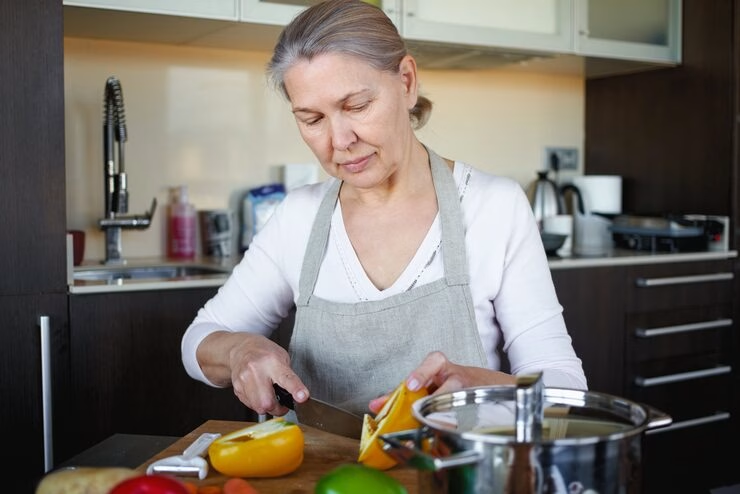
The Soup That Changed Everything
While I was stirring a pot of soup for the whole family, my daughter-in-law came closer and said, “Who told you to cook like that?”
My son kept his eyes glued to the TV, pretending he didn’t see anything.
A few minutes later, a loud noise came from the kitchen.
And from that very moment, everything in this house began to be rearranged.
Ten minutes earlier, it looked like any ordinary evening in our small apartment just outside Los Angeles. An NFL game recap was blasting from the flat-screen, the American flag magnet on the fridge caught the light, and I was doing what I’d done my whole life in this country—standing by the stove, cooking for people who no longer really looked at me.
Dawn never needed to raise her voice to cut me down. “The coffee’s weak.” “The eggs are overcooked.” “Don’t you know how people do things here, Helen?” Every comment sounded like advice, but it felt like a verdict. And Robert… he just sat there, thumb on the remote, eyes on the screen, pretending he heard nothing.
I am seventy-one years old. Six months ago, I buried my husband Henry and locked the front door of the little house where we’d spent fifty years together. That house had a porch swing, a tiny backyard, and a kitchen where we danced on Sundays. When Robert said, “You shouldn’t be alone at your age, Mom. Move in with us,” I believed him. I sold furniture, packed my life into a few suitcases, and moved into his modern building, thinking I was going to a safe place.
Instead, I walked straight into a role I hadn’t agreed to: live-in help with no paycheck and no respect.
The Breaking Point
That night, as I stirred the vegetable soup Robert had loved as a boy, Dawn walked into the kitchen in her silk robe, heels tapping on the polished floor. She bent over the pot with a disgusted look.
“This looks terrible. Who told you to cook like that?”
I opened my mouth to explain, but before a single word came out, the volume of the TV in the living room went up. The roar of the crowd on screen drowned out my voice. Robert didn’t even turn his head.
In that moment, it wasn’t just the soup that went wrong. Something inside me slipped. All the early mornings, the quiet cleaning, the careful tiptoeing so I wouldn’t “get in the way”—they all came crashing down at once.
My hand jerked. The wooden spoon clattered against the pot. And then, without fully deciding to do it, I swept my arm across the counter. Plates, bowls, the ceramic salt shaker Henry had given me for our anniversary—everything crashed to the floor in a spectacular explosion of sound.
Metal, ceramic, shards of glass on white tiles… and me, standing in the middle of it all, breathing hard, hands still shaking.
Dawn shrieked and jumped back. “What the hell is wrong with you?”
“Mom, what did you do?” Robert whispered from the doorway, staring at me like he didn’t recognize the woman in front of him.
He thought the mess on the floor was the problem. He had no idea that night was only the beginning.
I looked at my son—my only child, the boy I had raised while Henry worked two jobs, the boy I had read bedtime stories to and cheered for at baseball games—and I saw a stranger. A man who could watch his wife belittle his mother and do absolutely nothing.
“I’m leaving,” I said quietly.
“Mom, calm down,” Robert said, finally muting the TV. “Just clean this up and we’ll forget about it.”
“No. I’m leaving. Tonight.”
Dawn crossed her arms. “You’re overreacting. I was just trying to help you improve.”
“Help me?” I laughed, a sharp, bitter sound. “You’ve been ‘helping me’ for six months. I’m done being helped.”
I walked past them both, went to the guest room—my room—and started packing.
The First Night Alone
Twenty minutes later, I stood on the sidewalk outside their building with two suitcases, my purse, and three hundred dollars in cash. Robert had followed me down, protesting weakly, but he didn’t try very hard to stop me.
“Mom, where are you even going to go?”
“Anywhere but here.”
“This is crazy. You’re being dramatic. Just come back upstairs.”
I looked at him one last time. “Your father would be ashamed of you.”
His face went pale, but he said nothing. I walked away.
I found a motel two miles down the highway—one of those places with hourly rates and flickering neon signs. The clerk barely looked at me as I paid for three nights in cash. The room smelled like cigarette smoke and industrial cleaner, but it had a bed and a door that locked.
I sat on the edge of the mattress and tried not to cry.
What had I done? I was seventy-one years old with no job, limited savings, and nowhere to go. I had left the only family I had over a pot of soup.
But even as panic crept in, I knew I couldn’t go back. Not to Dawn’s insults. Not to Robert’s cowardice. Not to the invisible life I’d been living.
I opened my suitcase to find clean clothes for tomorrow and my fingers touched something unexpected: an envelope, yellowed with age, tucked between two sweaters.
Henry’s handwriting on the front: For Helen. Open if you need it.
My hands trembled as I tore it open.
Henry’s Letter
Inside was a handwritten letter and a folded document. I recognized Henry’s careful script immediately.
My dearest Helen,
If you’re reading this, I’m gone, and you’re in trouble. I’m sorry I can’t be there to help, but maybe I still can.
You remember the storage unit I rented when we downsized fifteen years ago? The one on Maple Street? I never told you what was in it because I didn’t want you to worry about it. But it’s yours now.
Inside, you’ll find some things from the old days—the furniture we couldn’t bear to sell, some of your mother’s china, and a few other items that might be worth something.
But more importantly, Helen, you’ll find the deed to the cabin.
My breath caught. The cabin?
Yes, that cabin. The one my father left me in Big Bear. I know we only went there a handful of times before the kids came along, and I know it’s probably falling apart by now. But it’s paid off. It’s ours. It’s yours.
The key is in the storage unit, along with the title documents. Everything is in your name now.
If you’re reading this, it means you need a place to go. So go there, Helen. Fix it up if you can. Sell it if you must. But don’t let anyone make you feel like you have nothing.
You’ve always been stronger than you knew.
All my love, always, Henry
I read the letter three times, tears streaming down my face. Henry had left me a way out. Even from beyond the grave, he was still taking care of me.
The folded document was the deed to a property in Big Bear Lake, California. A two-bedroom cabin on half an acre, fully paid, transferred to my name six months before Henry died.
He had known. Somehow, he had known I would need this.
The Storage Unit
The next morning, I took a taxi to the storage unit on Maple Street. The facility manager looked skeptical when I showed up with my key, but the lock turned smoothly.
Inside was exactly what Henry had described: our old furniture wrapped in plastic, boxes of family photos, my mother’s china service still packed in newspaper. And in the back corner, a metal filing cabinet.
I opened the top drawer and found everything: keys to the cabin, maintenance records, tax documents showing the property was paid in full, even a folder with photos of the place from thirty years ago.
The cabin looked small and rustic in the pictures—wood siding, a stone chimney, surrounded by pine trees. It had been Henry’s father’s hunting retreat, a place we’d visited maybe five times in our entire marriage. I remembered it as charming but basic: no dishwasher, temperamental plumbing, wood-burning stove.
But it was mine. And it was somewhere to go.
I also found a lockbox. Inside was fifteen thousand dollars in cash—Henry’s “emergency fund” that I had never known existed.
“You sneaky old man,” I whispered, smiling through my tears. “You really did think of everything.”
I spent the rest of the day organizing. I rented a truck, loaded the furniture and boxes I wanted to keep, and drove to a secure storage facility closer to Big Bear. Then I checked out of the motel and pointed the truck toward the mountains.
The Cabin
Big Bear Lake is about two hours from Los Angeles, nestled in the San Bernardino Mountains. As I drove higher into the elevation, the air got cooler and the pine trees grew thicker. I felt like I was driving into a different world.
Finding the cabin took some effort—the address led me down a dirt road that hadn’t been maintained in years. But when I finally pulled up to the property, my heart lifted.
It was still standing.
The cabin looked exactly like the photos, just older and more weathered. The wood siding was gray with age, the windows were filmed with dirt, and the porch sagged slightly. But the structure was solid, the roof looked intact, and the chimney stood straight.
I unlocked the front door and stepped inside.
The air was stale and dusty, but the interior was surprisingly intact. The furniture we’d left behind—a threadbare sofa, a wooden dining table, an old iron bed frame—was still there, covered in dust but usable. The kitchen had ancient appliances but running water. The bathroom worked, though the hot water heater would need replacing.
It was perfect.
Not because it was comfortable or modern, but because it was mine. No Dawn to criticize. No Robert to ignore me. Just me and four walls and the sound of wind through pine trees.
I spent the first night on the old sofa, wrapped in a blanket from my suitcase, listening to the cabin settle around me. I was exhausted, terrified, and completely alone.
But I was also free.
Building a Life
The next few weeks were the hardest and most satisfying of my life.
I cleaned the cabin from top to bottom, scrubbing years of neglect from every surface. I brought in the furniture from storage—the good couch, the dining chairs, my mother’s china cabinet. I replaced the hot water heater, fixed the leaking sink, and patched holes in the walls.
I worked slowly, taking breaks when my back ached or my hands cramped. But every day, the cabin looked a little more like a home.
The neighbors were friendly. An older couple named Frank and Marie lived down the road. When they saw me struggling with a broken porch step, Frank came over with his toolbox.
“You’re Henry’s wife,” he said. It wasn’t a question.
“You knew Henry?”
“Knew his father. Good man. Henry came up here sometimes when he needed to think. Helped me fix my roof a few years back.”
Marie brought me fresh bread and jam. “It’s good to see someone living here again. Place has been empty too long.”
Slowly, I met more people. The woman who ran the hardware store in town. The couple who owned the small grocery. The retired teacher who led a book club at the library.
They welcomed me without questions or judgment. They didn’t care that I was seventy-one and living alone in a cabin. They just accepted me as one of them.
Robert’s Calls
Robert called three weeks after I left. I almost didn’t answer.
“Mom, where are you? We’ve been worried sick.”
“Have you?”
“Of course! You just disappeared. We didn’t know if something happened to you.”
“I’m fine. I’m at the cabin.”
“What cabin?”
“The one your grandfather left to your father. The one in Big Bear.”
There was a long pause. “I didn’t know Dad had a cabin.”
“There are a lot of things you don’t know, Robert.”
“Mom, this is ridiculous. Come home. Dawn feels terrible about what happened.”
“Does she? Or are you just tired of doing your own cooking and cleaning?”
“That’s not fair.”
“Neither is how you both treated me for six months.”
“We gave you a place to live!”
“You gave me a guest room and a list of chores. That’s not a home, Robert. That’s servitude.”
He was quiet for a moment. When he spoke again, his voice was harder. “Fine. If you want to be stubborn, that’s your choice. But don’t expect us to bail you out when you can’t take care of yourself anymore.”
“I don’t expect anything from you anymore. That’s the point.”
I hung up.
He called back twice more over the next month. Each time, I let it go to voicemail. Each message was the same: vague apologies mixed with frustration that I was “being difficult.”
He never once asked if I was okay. He never offered to visit. He just wanted me to come back and resume my role as the silent, obedient mother who cooked and cleaned and stayed out of the way.
I deleted the messages and kept working on the cabin.
The Unexpected Visitor
Three months after I moved to Big Bear, someone knocked on my door early one Saturday morning.
I opened it to find a young woman, maybe twenty-five, holding a backpack and looking exhausted.
“Are you Helen?” she asked.
“Yes. Who are you?”
“My name is Sarah. I’m… I’m Robert’s daughter. Your granddaughter.”
I stared at her, speechless. Robert had a daughter?
“Can I come in?” she asked quietly. “I’ve been driving all night.”
I stepped aside and let her in. She collapsed onto my couch, looking like she might cry.
“I didn’t know Robert had a daughter,” I said carefully.
“He doesn’t talk about me much. I’m from his first marriage, before Dawn. My mom raised me in Oregon. Robert and I… we’re not close.”
“Why are you here?”
“Because I heard what happened. My mom stayed in touch with some of Robert’s old friends. They told her about you leaving. I wanted to make sure you were okay.”
I sat down across from her, studying her face. She had Robert’s eyes but a softer expression, more open.
“I’m fine,” I said. “Better than fine, actually.”
“Good. I’m glad.” She hesitated, then added, “Robert was always kind of… like that. Even when I was a kid. He’d get embarrassed if my mom didn’t dress right or talk right around his friends. He wanted everyone to think he had this perfect life.”
“He married Dawn to get that perfect life.”
“Yeah. And now he has someone else to judge.” Sarah looked around the cabin. “This place is nice. Cozy.”
“It’s home.”
“Can I stay for a few days? I promise I won’t be in the way. I just… I needed to get away from everything for a bit.”
I looked at this young woman—my granddaughter, whom I’d never met, whom Robert had never mentioned—and made a decision.
“You can stay as long as you need to.”
Two Years Later
Sarah stayed for three weeks that first visit. Then she came back for Thanksgiving. Then Christmas. Then she started visiting every few months, bringing friends, helping me with repairs, treating the cabin like a second home.
Through Sarah, I learned about the granddaughter I’d never known. She was studying social work in Portland. She volunteered at a homeless shelter. She was kind, thoughtful, and nothing like her father.
“He wasn’t always like this,” she told me one night over hot chocolate. “When I was little, before he met Dawn, he was different. Warmer. But somewhere along the way, he started caring more about what people thought than about actual people.”
“I know,” I said. “I watched it happen.”
Frank and Marie became like family. Marie taught me to make sourdough bread. Frank helped me build a small greenhouse for vegetables. Their grown children visited sometimes and treated me like an aunt.
The book club ladies adopted me. We met every Wednesday afternoon, drinking tea and arguing about novels.
I got a part-time job at the hardware store, mostly for something to do and people to talk to. The owner, Tom, was a widower in his seventies who appreciated that I actually knew the difference between a Phillips head and a flathead screwdriver.
“Your husband taught you well,” he said approvingly.
“My husband taught me that knowing how to fix things yourself is worth more than money,” I replied.
The cabin became exactly what I needed: a place that was entirely mine, filled with people who chose to be there rather than people who tolerated me.
Robert called twice in those two years. Once to tell me Dawn was pregnant and they were having a baby. Once to ask if I was planning to leave him anything in my will.
I didn’t attend the baby shower. I didn’t visit when the baby was born. And I told him my will was none of his business.
“You’re really going to hold a grudge forever?” he asked, sounding annoyed rather than hurt.
“It’s not a grudge, Robert. It’s a boundary. There’s a difference.”
“Whatever, Mom. When you’re ready to act like family again, you know where to find us.”
But he never asked where to find me. He never drove up to Big Bear to see how I was living. He never apologized for standing by while his wife belittled me.
He just expected me to eventually give in and come back.
He was still waiting.
The Letter
On what would have been Henry’s 75th birthday, I sat at the cabin’s small desk and wrote a letter. Not to Robert—I had nothing left to say to him. But to Sarah, and to Henry, and maybe to myself.
Dear Henry,
I found your letter. I found the cabin. I found the life you wanted me to have if I ever needed it.
You were right about everything. I needed a place to go. I needed to remember I was stronger than I knew.
The cabin is beautiful now. I’ve fixed it up, made it comfortable, filled it with people who actually care about me. Sarah comes to visit. The neighbors have become friends. I’m happier here than I’ve been in years.
Robert never understood what you and I had. He saw you as someone who worked hard and provided, but he never saw the man who danced with me in the kitchen or left me secret letters or made sure I’d be okay even after you were gone.
He became the kind of man who values appearances over people. I don’t know when that happened, or if I could have stopped it. But I know I can’t fix it now.
So I’m doing what you’d want me to do: I’m living. I’m happy. I’m free.
Thank you for giving me one last gift. Thank you for loving me enough to plan for the day I might need to save myself.
I miss you every day. But I’m okay. Better than okay.
All my love, always, Helen
I folded the letter and put it in the drawer with Henry’s original note. Then I made myself a cup of tea and sat on the porch, watching the sun set through the pine trees.
Somewhere down the mountain, Robert was living his perfect life with his perfect wife in their perfect apartment, probably wondering when his difficult mother would finally come to her senses.
But up here, in a cabin held together by repairs and memories and stubbornness, a seventy-three-year-old woman was living the life she’d built from broken dishes and found courage.
And she had never been happier.
The soup had been terrible. But everything that came after it was exactly right.