No One Wanted To Buy The Savage Black Horse
Cheyenne, Wyoming. Wind that forgets how to stop. An auction yard humming like a tired radio.
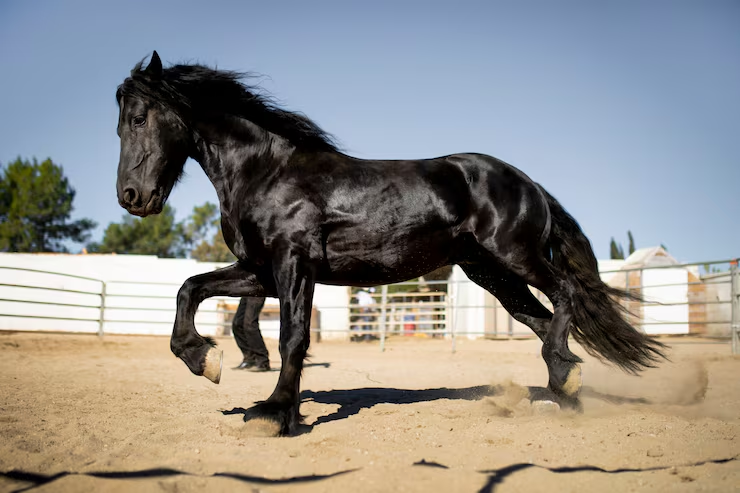
In the center pen, a coal-black Shire stallion stood too big for his own shadow—muscle stacked on bone, eyes that didn’t blink first. The rails around him were higher than the others, cross-braced and scuffed where something heavy had tested every screw. People watched the way they watch a fire: close enough to feel it, far enough to run.
Bids started strong and fell like bad weather. A thousand. Eight. Six. Four. Boots shuffled. Coffee cooled. The clipboard notes were short and unkind, and the math everyone understood ended in the same place it always does when a horse won’t be handled.
Then a man at the edge of the shade lifted his hand.
Not the loud kind. A veteran whose limp wasn’t a secret and whose jacket had outlived a few hard years. He didn’t square his shoulders like a hero in a movie. He didn’t promise anything. He just looked at the stallion the way a person looks at a locked door and tries to learn the hinges.
The gavel fell. The air changed.
What came after didn’t arrive with a rope or a crowd. It arrived with mornings that smelled like sage and iron, with a fence line and a pair of eyes that kept choosing the far corner. The horse tested bolts. The wind tested patience. The town tested its favorite conclusion: some things are too broken to be worth the time.
Days stacked into something that looked a lot like a choice.
From a distance, it wouldn’t have seemed like much. No speeches. No tricks. Just a man showing up, setting a bucket down, and letting silence carry part of the conversation. If you blinked, you’d miss the first change. Most people did. They were busy deciding how the story ends.
The veteran stepped to the rail. The stallion turned his head just enough to see him with both eyes. The wind dropped for half a second, like even Wyoming wanted to hear.
The stallion’s ears flicked once. The man opened his mouth and said…
“Ghost.”
The Name
The word hung in the cold morning air, not quite a question, not quite a statement. Just an offering.
The stallion’s ear twitched again. His massive head turned slightly, one dark eye fixed on the man who’d just spent four hundred dollars on what the auctioneer had called “a liability with legs.”
James Crawford—Jim to anyone who’d known him before Kandahar, nothing at all to most people now—stood with his weight on his good leg and watched the horse watch him back. The auction yard was emptying out, trailers rattling away down gravel roads, but Jim wasn’t in a hurry. Hurrying was for people who had somewhere to be.
“Ghost,” he said again, softer this time. “Because that’s what you are, isn’t it? Something everyone can see but nobody wants to get close to.”
The stallion snorted, a sound like contempt.
Jim understood contempt. He’d lived with it for three years—in the eyes of the VA nurse who sighed when he missed appointments, in the tone of his ex-wife’s lawyer, in the mirror every morning when he tried to remember who he used to be.
“Yeah,” Jim said. “I get it.”
The Transport
Getting Ghost from the auction yard to Jim’s rented property fifteen miles outside Cheyenne took four hours, three broken rails, and two men swearing they’d never trailer another horse as long as they lived.
“You’re insane,” said Dale, the auction yard manager, after Ghost kicked a dent in the trailer wall that looked like abstract art. “That horse is going to kill you.”
“Maybe,” Jim said.
“I’m serious. He nearly took out Bobby’s knee last week. Went for the stock manager before that. Nobody can get near him.”
“Then why’d you keep him?”
Dale looked uncomfortable. “Owner died. Heart attack in the barn. Horse found him three days later. Been different ever since.”
Jim went quiet. He looked at Ghost, who was standing in the far corner of the trailer, sides heaving, eyes wild.
“How long ago?”
“Six months. We tried everything. Trainers, vets, even one of those horse whisperer types from Laramie. Nothing. He just… he’s done with people.”
“Six months,” Jim repeated. He thought about his own timeline—eighteen months since the IED, fourteen since the discharge, eight since Sarah took the kids and left. Time measured in befores and afters.
“I’ll take him from here,” Jim said.
He drove the trailer home alone, taking the back roads slow, talking the whole way even though he knew Ghost couldn’t hear him through the metal.
“It’s alright,” he said. “I’m not gonna hurt you. We’re just going somewhere quiet. Somewhere you can figure things out.”
The trailer rocked once, hard, like Ghost was testing the walls.
Jim kept talking.
The Property
The place Jim rented wasn’t much—twenty acres of scrub grass and sage, a barn that leaned optimistic, a house that kept the rain out on good days. The fences needed work. Everything needed work. But it was far enough from town that nobody bothered him, and the quiet was thick enough to breathe.
He backed the trailer up to the largest paddock, reinforced with extra rails he’d spent the last week installing. Then he opened the door and stepped back.
Ghost didn’t charge out. He stood in the dark interior of the trailer for a long moment, then stepped down slowly, each hoof deliberate, like he was testing the ground for traps.
When all four feet were on dirt, he raised his head and looked around. His neck was thick with muscle, his mane tangled and long. In the clear Wyoming light, he looked less like a horse and more like something out of an old story—the kind that ends badly.
“This is it,” Jim said from outside the fence. “Not much, but it’s yours if you want it.”
Ghost walked to the far corner and stood with his back to the barn, watching Jim with one eye.
Jim sat down on an overturned bucket and opened a thermos of coffee. “I’m gonna be here every day,” he said. “Morning and evening. I’m not gonna chase you or rope you or make you do anything. But I’m gonna be here.”
Ghost’s ear flicked.
Jim took that as progress.
The Routine
The first week was just showing up.
Jim came out every morning at six, before the sun burned the cold off the air. He’d sit on his bucket outside the paddock, drink his coffee, and talk. About nothing. About everything. About the weather, the news, the way the light hit the mountains.
Ghost stayed in his corner and pretended Jim didn’t exist.
The second week, Jim started bringing a second bucket. He’d fill it with grain and set it inside the fence, then return to his spot outside. Ghost wouldn’t touch it while Jim was there, but by evening, the bucket was always empty.
The third week, Jim moved his bucket inside the fence.
That was the morning Ghost charged.
He came fast, a thousand pounds of muscle and fury, head low, hooves throwing dirt. Jim didn’t run—couldn’t run, not with the bad leg. He just stood up, raised his hands, and said, “No.”
One word. Firm. Not angry. Just… no.
Ghost stopped three feet away, breathing hard, eyes wild.
They stood like that for a long time. Jim’s heart was hammering, but he kept his hands steady, his voice calm.
“I’m not here to hurt you,” he said. “I’m just here.”
Ghost tossed his head and wheeled away, returning to his corner.
Jim sat back down, hands shaking, and finished his coffee.
Progress.
The Breakthrough
It happened on a Tuesday morning in October, six weeks after Jim brought Ghost home.
Jim was sitting on his bucket, talking about nothing—something about a book he’d been reading, something about the VA appointment he’d missed again—when Ghost walked over.
Not charging. Not threatening. Just… walking.
He stopped five feet away, head high, nostrils flared.
Jim went quiet. He didn’t move. Didn’t reach out. Just sat there, letting Ghost make the choice.
Ghost took one step closer. Then another.
Then he lowered his massive head and sniffed Jim’s shoulder.
His breath was warm and smelled like grass. Jim felt something crack open in his chest—something that had been locked tight since Kandahar, since the hospital, since Sarah’s lawyer’s office.
“Hey, Ghost,” he whispered.
Ghost didn’t pull away.
They stood like that until the sun crested the mountains and the world turned gold.
The Town
News travels fast in small Wyoming towns, especially when it involves something people have opinions about.
“I heard Jim Crawford bought that killer horse,” said Denise at the feed store.
“Damn fool,” said Tom at the diner. “That horse is gonna put him in the ground.”
“Someone should check on him,” said Pastor Mike at the church council meeting. “Make sure he’s alright.”
Nobody checked on him.
But they watched. People drove by Jim’s property a little slower than necessary, craning their necks to see if the crazy veteran was still alive. They saw him in the paddock with Ghost, sometimes sitting, sometimes standing, always talking.
“He’s lost it,” they said.
“Probably PTSD,” they said.
“Shame,” they said.
Jim didn’t hear any of it. He was too busy listening to a horse.
The Touch
It took another three weeks before Ghost let Jim touch him.
Jim didn’t push. He’d learned patience in the desert—the kind that keeps you alive when everything’s trying to kill you. He just showed up, talked, existed in the same space.
One morning, Ghost walked over and stood close enough that Jim could feel the heat coming off his body. Jim slowly, slowly, raised his hand.
Ghost’s ear pinned back.
Jim froze.
They stayed like that—Jim’s hand suspended in the air, Ghost deciding whether to trust or bolt—until finally, Ghost took one step forward.
Jim’s palm touched his neck.
The stallion’s skin was warm, the hair coarse. Jim could feel the muscle underneath, the tension, the power. But Ghost didn’t move. Didn’t pull away.
“Good boy,” Jim whispered. “Good boy, Ghost.”
For the first time in six months, Ghost closed his eyes.
The Storm
The blizzard hit in early November, fast and mean the way Wyoming storms do.
Jim had prepared—extra hay in the barn, water buckets filled, the paddock gate secured. But when the wind started screaming and the snow came sideways, he knew Ghost would panic.
He’d seen it before, in other horses—the way storms triggered something primal, sent them running into fences, hurting themselves in their fear.
Jim pulled on his coat and limped out into the white.
He found Ghost in the middle of the paddock, standing rigid, sides heaving. The wind had torn a section of tarp loose from the barn, and it was snapping like gunfire.
Ghost’s ears were flat. His eyes were rolling.
Jim knew that look. He’d seen it in the mirror.
“Ghost!” he shouted over the wind. “Ghost, come here!”
The stallion didn’t move.
Jim stepped closer, into the paddock, snow already accumulating on his shoulders. “It’s just noise,” he said. “It’s just wind. It can’t hurt you.”
Ghost pawed the ground, once, twice.
“I know,” Jim said, closer now. “I know it’s loud. I know it sounds like the world’s ending. But it’s not. It’s just a storm.”
He reached Ghost’s side and put his hand on the stallion’s neck. Ghost’s muscles were like stone.
“Breathe,” Jim said. “Just breathe with me.”
He stood there, hand on Ghost’s neck, counting his own breaths aloud until the stallion’s sides stopped heaving quite so hard. Until Ghost’s ear swiveled toward him instead of pinning back.
They stood together in the storm until it passed.
The Healing
Winter settled in hard. Jim and Ghost fell into a rhythm—mornings in the paddock, evenings in the barn. Jim started doing the PT exercises the VA kept nagging him about, the ones that hurt but helped. Ghost started letting Jim groom him, brush out the tangles in his mane, pick his hooves.
They were both learning to trust again.
One morning, Jim brought a saddle blanket.
Ghost tensed but didn’t bolt.
“Just trying something,” Jim said. “You don’t like it, I’ll take it off.”
He laid the blanket across Ghost’s back. The stallion shifted but held still.
“Good boy.”
The next day, Jim brought the saddle.
It took two weeks before Ghost would tolerate the weight of it. Another week before Jim could tighten the girth without Ghost sidestepping. Jim didn’t rush. Rushing was how you broke things.
By December, Jim was sitting in the saddle while Ghost stood still.
By January, they were walking around the paddock.
By February, they were ready for the outside world.
The Ride
The first time Jim rode Ghost beyond the property line, half of Cheyenne seemed to materialize on their porches to watch.
“Suicide,” someone muttered.
“Someone call the sheriff,” someone else said.
But Jim just touched his heels to Ghost’s sides, and the big stallion moved forward—smooth, steady, powerful.
They rode down the dirt road toward town, past the feed store and the diner and the church. People stared. Some waved. Most just watched, trying to reconcile the savage black horse from the auction with this calm, steady animal carrying a quiet veteran down Main Street.
Jim didn’t explain. He just rode.
Ghost’s ears were forward, his gait even. He didn’t shy at cars or dogs or the flapping banner outside the hardware store. He just walked, like he’d been doing this all his life.
When they reached the park at the edge of town, Jim dismounted and led Ghost to the water trough. A kid approached, maybe eight years old, eyes wide.
“Mister? Is that the mean horse?”
“His name’s Ghost,” Jim said. “And he’s not mean. He was just scared.”
“Can I pet him?”
Jim looked at Ghost, who was watching the kid with curiosity, not aggression.
“Gentle,” Jim said. “Move slow.”
The kid reached up and touched Ghost’s nose. The stallion lowered his head and breathed softly against the small hand.
The kid grinned. “He’s nice.”
“Yeah,” Jim said. “He is.”
The Offer
Spring came late that year, but when it arrived, it brought Tom Hendricks with it.
Tom owned the largest ranch in the county—three thousand acres, two hundred head of cattle, and a reputation for knowing horses. He pulled up to Jim’s property in a truck that cost more than Jim’s annual disability check and got out slowly, like he was approaching something dangerous.
“Jim Crawford?”
“That’s me.”
“I heard about your horse. The one from the auction.”
“Ghost.”
“Right. Ghost.” Tom looked at the stallion, who was grazing peacefully in the paddock. “I was at that auction. Saw what he was like. Saw what you paid for him.”
“Okay.”
“I want to buy him.”
Jim went still. “He’s not for sale.”
“I’ll give you ten thousand.”
“No.”
“Fifteen.”
“He’s not for sale,” Jim repeated.
Tom studied him. “You know what you’ve got there, don’t you? That horse could sire champions. With the right training, the right program—”
“He’s already got the right program.”
“Look, I respect what you did. Taking him on, calming him down. But you’re living on disability and doing odd jobs. I’m offering you real money.”
Jim met his eyes. “And I’m telling you no. Ghost isn’t a commodity. He’s not a project. He’s a partner. You can’t buy that.”
Tom was quiet for a long moment. Then he nodded. “Alright. But if you change your mind—”
“I won’t.”
After Tom left, Jim walked out to the paddock. Ghost lifted his head and walked over, pushing his nose against Jim’s chest.
“We’re good, buddy,” Jim said. “Nobody’s selling anybody.”
Ghost snorted, like he’d never doubted it.
The Fair
The county fair in August was the biggest event of the year—rodeos, livestock shows, carnival rides that smelled like funnel cake and diesel.
Jim hadn’t planned on going. Crowds weren’t his thing. But Pastor Mike stopped by one evening and asked if Jim would consider bringing Ghost to the fair’s exhibition barn.
“People need to see him,” Mike said. “Need to see what’s possible.”
“He’s not a circus act.”
“No. He’s proof that broken things can heal.”
Jim thought about that. About the man he’d been eighteen months ago—angry, isolated, convinced he was beyond fixing. About the horse that everyone had written off as dangerous.
“Alright,” he said. “We’ll come.”
The day of the fair, Jim rode Ghost into town. They entered the exhibition barn to stares and whispers, but Ghost walked calmly, unbothered by the noise and the crowd.
A line formed—people wanting to meet the “savage black horse” that had been gentled by the quiet veteran. Kids touched his nose. Adults asked questions. Jim answered simply, honestly.
“How’d you do it?”
“Patience.”
“What’s the secret?”
“There isn’t one. You just show up.”
By the end of the day, Jim was exhausted. But as he led Ghost back to the trailer, a woman stopped him.
“Mr. Crawford?”
He turned. She was maybe sixty, with kind eyes and a purple ribbon pinned to her jacket—a fair judge.
“I just wanted to say thank you. My son came home from Iraq last year. He’s been… struggling. But watching you with Ghost today, seeing what’s possible… I think it helped him. So thank you.”
Jim’s throat tightened. “Tell your son it gets better. Slowly. But it does.”
She nodded, eyes bright, and walked away.
Ghost nudged Jim’s shoulder.
“Yeah,” Jim said quietly. “We did good today, buddy.”
One Year Later
A year after Jim bought Ghost at the auction, they stood together in the same paddock where it all began.
Ghost wasn’t the same horse. His coat gleamed. His mane was neat. His eyes were calm. He walked over to Jim without hesitation, lowered his head for scratches, and stood patiently while Jim checked his hooves.
Jim wasn’t the same man either. He’d started going to his VA appointments. He’d reconnected with his kids—video calls at first, then visits. He’d even started training other “problem” horses, the ones nobody wanted, the ones everyone said were too far gone.
He had a waiting list.
“You know what I figured out?” Jim said, running his hand down Ghost’s neck. “Nobody’s really broken. Some of us just need more time. More patience. More space to heal.”
Ghost leaned into him, a thousand pounds of trust.
“Thanks for teaching me that,” Jim said.
The wind picked up, carrying the smell of sage and coming snow. Jim climbed into the saddle, and Ghost moved forward smoothly, carrying them both toward whatever came next.
Behind them, the auction yard was holding another sale. Another horse that nobody wanted was waiting in a pen, eyes wild, future uncertain.
But somewhere in Cheyenne, a veteran was watching. And thinking about buckets. And names. And time.
Because some things are worth saving.
And some people are worth the wait.