The Safe Behind the Wall
I lost everything in the divorce—the custody of my children, the mansion I’d called home for ten years, the furniture I’d carefully selected, the life I’d built. All I had left was my mother’s old country house, the Victorian farmhouse Richard had always dismissed as a pointless project not worth visiting. Standing in that courtroom watching Judge Morrison sign the papers awarding Richard full custody, I felt my entire world collapse into nothing.
“Mrs. Hartwell, given your lack of employment history and current financial situation, the court finds it in the children’s best interest to remain with their father.”
Emma’s face flashed in my mind—my eight-year-old daughter who still needed me to braid her hair every morning. Tyler, my six-year-old son who had nightmares only I could calm. My attorney touched my arm, silencing my protest. The decision was final.
Ten years. I’d given Richard everything while he built his construction empire. I’d managed our household, raised our children, organized his business dinners, convinced myself I was building something alongside him. The prenup I’d signed at twenty-four had come back to haunt me like a ghost I’d forgotten existed. Richard’s lawyer had painted me as an unemployable housewife who contributed nothing except spending his money. Never mind my economics degree. Never mind that I’d sacrificed my promising career at a financial planning firm to support his ambitions.
Walking out of that courthouse felt like walking through a cemetery. Everything I’d been was buried in that room. Richard was already loading the children into his BMW when I reached the parking lot. Emma pressed her face against the window, tears streaming down her cheeks. Tyler didn’t even look at me. I mouthed “I love you” to Emma through the glass, but Richard pulled away before she could respond.
The Country House
Standing alone in that parking lot, clutching the keys to my Honda—the only thing Richard couldn’t take because it was in my name from before marriage—I realized I had exactly one place to go. The old country house my mother had left me three years ago. I’d never even spent a night there.
The drive took two hours through winding mountain roads. When I finally pulled into the overgrown driveway, my heart sank. The Victorian farmhouse looked worse than I remembered—paint peeling, shutters hanging crooked, weeds growing through the porch boards. But it was mine. Richard’s name was nowhere on the deed.
Inside smelled like dust and memories. Mom’s furniture remained covered in white sheets like ghosts. The electricity barely worked. The water ran brown for several minutes before clearing. I stood in what used to be Mom’s kitchen, overwhelmed by the magnitude of starting over at thirty-four with nothing but a broken-down house and twelve hundred dollars in my checking account.
That first night, I cried myself to sleep on Mom’s old couch, wrapped in a quilt she’d made before I was born. But when morning came, something had shifted inside me. The silence—no Richard criticizing, no kids fighting, no schedule demanding constant attention—let me think clearly for the first time in years. I had two choices: collapse under the weight of everything I’d lost, or figure out how to build something new.
I chose to fight, though I had no idea how much my mother had already prepared me for this battle.
The Beginning
I started making the house livable—coaxing the ancient furnace to life, learning basic plumbing from YouTube videos, wielding cleaning supplies from the dollar store like weapons against years of neglect. Three days in, my neighbor Mrs. Henderson appeared with a casserole and memories of my mother.
“She was proud of you,” Mrs. Henderson said over tuna noodle casserole. “Always talking about your college degree, how smart you were with numbers. She never liked that boy you married. Said he was the type to take credit for other people’s sunshine.”
The accuracy stung. How had Mom seen in minutes what I’d missed for years?
That afternoon, I explored job opportunities in town. The results were depressing—most positions required recent experience I didn’t have. But the bank manager, Patricia Walsh, looked intrigued when I explained my economics background. We spent twenty minutes discussing market analysis and investment principles, and I surprised myself by remembering more than I’d expected.
“I’ll give you a trial period,” Patricia finally said. “Three days a week, fifteen dollars an hour, helping with basic accounts and loans.”
It was a far cry from Richard’s six-figure income, but it felt like winning the lottery.
The Discovery
Three days into cleaning the house, I noticed something strange—a section of siding that looked different from the rest, newer somehow though still weathered. Armed with a crowbar from Mom’s garden shed, I carefully pried at the edges. The wood came away easily, revealing not a window but a small door.
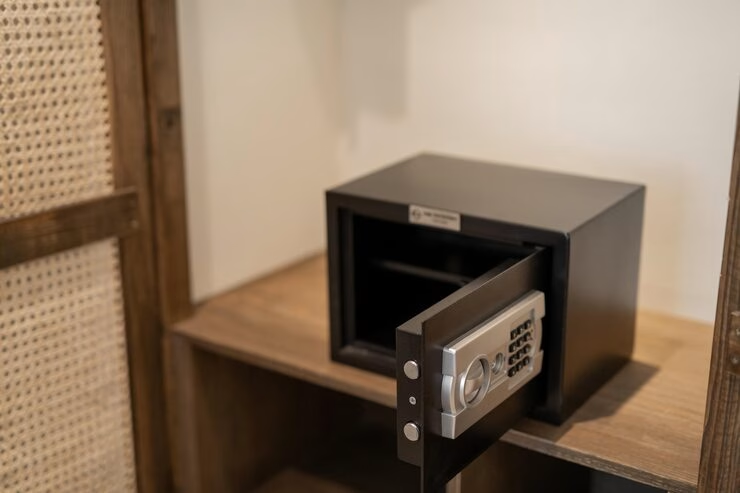
Behind it was a hidden compartment built into the wall. My hands trembled as I shined my flashlight inside and found a metal box about the size of a shoebox—a small safe with a combination lock.
I tried Mom’s birthday. Nothing. My birthday. Nothing. Then I remembered something from childhood—Mom always said our family’s lucky number was the date she and Dad married, the twenty-third. With shaking fingers, I entered 0-8-2-3.
The safe clicked open.
Inside was an envelope with my name in Mom’s careful handwriting. Below it were documents I couldn’t immediately identify and what looked like jewelry boxes. But the envelope drew my attention. It felt thick, substantial.
I opened it carefully and unfolded several pages. The first line made my hands shake: “My dearest Miranda, if you’re reading this, then you found your way home and discovered what I’ve been saving for you all these years.”
The Letter
Mom’s letter explained everything I’d never known about my parents. They hadn’t been just librarians and teachers—they’d been brilliant with investments. Dad had started small, using his teacher’s salary to buy stocks everyone else overlooked. Mom had helped him research and analyze, gradually building a portfolio that grew beyond their wildest dreams.
But they’d lived simply, deliberately, wanting me to understand the value of hard work and education rather than grow up entitled. They’d watched me fall in love with Richard and seen how he tried to control me. When I gave up my career to serve his ambitions, Mom knew she needed a different plan.
“If something happened to us, if you ever found yourself alone and powerless, you would need resources he couldn’t touch or even know about,” she’d written.
I looked at the documents beneath the letter—stock certificates, bond records, bank account information. The numbers were staggering. Mom had left me assets worth well over two million dollars. Beneath the financial documents were jewelry boxes containing pieces I’d never seen her wear—diamonds, pearls, an expensive watch—and beneath those, an insurance policy with my name as beneficiary.
The payout: $3.7 million.
The last item was a key attached to a business card for a bank forty minutes away. “Safety deposit box 247. Everything else is there.”
I spent the rest of the evening reviewing every document, trying to understand what Mom had built. She’d been methodical, careful, incredibly smart about hiding assets while staying completely legal. Every investment was documented, every transaction recorded.
Around midnight, I found myself laughing through tears at the sheer audacity. While Richard had been congratulating himself on his business empire, my supposedly simple mother had been quietly assembling an empire of her own—to make sure I would never be trapped or powerless.
At the bottom of the letter, Mom had written: “Miranda, you have the knowledge to manage these assets, grow them, and build the life you deserve. Your father always said you had his mind for numbers and my patience for long-term planning. It’s time to prove him right.”
The Safety Deposit Box
The next morning, I drove to the county bank with the key. The safety deposit box contained additional stock certificates, real estate deeds for properties I’d never known existed, and detailed instructions for converting assets into working capital. Mom owned four rental properties, a small office building in town, and had mineral rights on over three hundred acres. The rental income alone would support a comfortable lifestyle.
She’d been quietly collecting wealth for thirty years while everyone thought she was just getting by on a teacher’s pension.
Sitting in the bank’s private room, surrounded by evidence of my mother’s secret financial genius, I felt something shift inside me. The helpless woman who’d left that courthouse was gone. In her place was someone with resources, knowledge, and real power.
Richard had no idea what was coming.
The Strategy
I spent the next three days reviewing every document, every investment. My first priority was establishing immediate financial stability. I contacted the investment firm managing Mom’s accounts and met with Thomas Parker, who treated me with the respect that comes with having a substantial portfolio.
“Your mother was remarkable,” Thomas said. “She had an intuitive understanding of market patterns that most professionals lack.”
Within a week, I had access to liquid funds. I paid off the tiny mortgage on the country house, upgraded the electrical and plumbing, made it truly livable. More importantly, I established new bank accounts Richard’s lawyers could never access or discover.
But money was only part of the equation. I needed professional credentials that would impress a family court judge. My old supervisor from the financial planning firm was sympathetic when I called, connecting me with a certification program I could complete online in six months.
The children remained my biggest challenge. Richard allowed supervised weekly visits monitored by a court-appointed observer. Emma seemed confused and angry. Tyler was withdrawn but still climbed into my lap the moment he saw me.
“Daddy says you can’t take care of us anymore,” Emma said during our third visit. “He says you don’t have a job or a house.”
I chose my words carefully, knowing everything would be reported to Richard’s lawyers. “I have a house now, sweetheart—where Grandma used to live. And I’m starting a job helping people with their money, like I studied in college.”
Richard’s strategy was working—keeping me isolated while he built his case that I was unfit.
That evening, I called my old college roommate Sarah, now a successful attorney. After I explained my situation, she gave me crucial advice.
“Courts are reluctant to change custody quickly, but they will reconsider if you demonstrate significant improvement in circumstances. Document everything—income, housing, career development. And don’t let his lawyers know about your assets until you’re ready to reveal them.”
I would rebuild my professional reputation, establish myself as competent, and only then reveal my full resources. Let Richard think he’d left me powerless while I quietly assembled everything I needed.
The Transformation
Three months into my new life, Patricia offered me expanded responsibilities at the bank. My success with customers—helping a young couple understand their first home loan, explaining debt-to-income ratios in plain English—had impressed several larger account holders.
“Would you be interested in taking on more responsibility?” Patricia asked. The promotion came with substantial salary increase and flexible scheduling for my certification studies.
But the real surprise came when I reviewed my first-quarter investment returns. Following Mom’s strategies and applying my own analysis, I’d grown my portfolio by twelve percent in three months. I wasn’t just managing inherited wealth—I was actively building it.
Richard had always told me I didn’t understand business, that I was too emotional for financial decisions. Watching the numbers prove him wrong felt profound.
Six months after discovering Mom’s letter, I was unrecognizable. The certification program was nearly complete, and I’d begun taking independent clients. Word spread about the new financial adviser who actually listened and explained complex concepts clearly.
I purchased the office building Mom had secretly owned and renovated the ground floor into my own financial planning practice. The project connected me with local business owners who saw me as an up-and-coming professional rather than Richard’s discarded ex-wife.
My supervised visits with the children had evolved into longer, less formal meetings. The court observer noted that both children seemed happy and secure during our time together. Emma asked questions about my new house and job. Tyler made plans for “when Mommy has her own home again.”
Richard seemed increasingly frustrated by my transformation. His attempts to intimidate me fell flat against my newfound confidence.
The Custody Hearing
The custody modification hearing was scheduled for a Tuesday morning in November, exactly one year after Richard had destroyed my life in the same courthouse. This time, I walked through those doors wearing a tailored navy suit I’d purchased with my own money, carrying a briefcase full of documentation that told a very different story.
Sarah met me in the hallway, looking confident. “Remember, stay calm no matter what his lawyers try. Your transformation speaks for itself.”
Richard sat across the courtroom with his legal team, looking every bit the successful businessman. But something was different about his demeanor—the smug confidence replaced by wariness, like a man who suspected the game had changed but didn’t understand the new rules.
Judge Morrison—the same judge who’d awarded Richard custody—reviewed our case files. “Mrs. Hartwell, I see you’ve requested a modification based on substantial changes in circumstances. Present your evidence.”
Sarah methodically presented my case: employment history showing consistent advancement, client testimonials, documentation of completed certification, my growing independent practice, bank statements proving stable income, photos and inspection reports of my renovated home with separate bedrooms for each child.
But the real bombshell came when Sarah presented my investment portfolio statements.
“Your honor, Mrs. Hartwell has not only achieved financial stability, she has demonstrated exceptional financial acumen. Her investment returns are in the top percentile of professional money managers.”
I watched Richard’s face as the numbers were read. His expression shifted from confusion to shock to something approaching panic. He’d spent a year believing I was struggling on my bank salary. The reality devastated his narrative.
His attorney, Marcus Webb, requested a recess. Through the conference room’s glass door, I could see Richard gesticulating frantically while his lawyers tried to calm him.
When they returned, Webb’s strategy was predictably desperate. “Your honor, we question the source of these alleged assets. Where did this money come from?”
Sarah presented Mom’s death certificate, inheritance documentation, and proof that every asset had been legally transferred and properly reported. “Mrs. Hartwell inherited these assets from her late mother. Every transaction has been documented and verified.”
The most powerful testimony came from Ruth, the court-appointed supervisor. “Over the past year, I’ve observed significant positive changes in both children during their time with their mother. Mrs. Hartwell has demonstrated patience, emotional stability, and genuine engagement. The children consistently express happiness about their visits and excitement about spending time at their mother’s house.”
Two weeks later, Judge Morrison called us back to chambers.
“I’ve reviewed all evidence,” Judge Morrison began, “and I’m prepared to modify the custody arrangement. Mrs. Hartwell, you’ve demonstrated remarkable personal and professional growth. Your financial stability, career development, and housing situation clearly meet the court’s standards for primary custody.”
The relief was overwhelming. After a year of supervised visits and legal battles, I was getting my children back.
The Confrontation
Richard wouldn’t give up easily. The following week, Patricia called me about someone investigating my financial background. The harassment was beginning.
But I needed a different strategy. I remembered something Mom had written about protecting yourself through community connections. I’d learned enough about Richard’s business during our marriage to know his vulnerabilities. His construction company’s success came partly through relationships with city officials that involved arrangements skating close to ethical violations.
I scheduled a meeting with Richard at a neutral location. He arrived looking confident, probably expecting another opportunity to intimidate me. I opened my briefcase and removed copies of donation records, PAC reports, and contract awards.
“Richard, I’ve been reviewing our old tax returns. I found some interesting patterns in your charitable giving.”
His expression shifted as he realized what I’d discovered and how damaging it could be if made public.
“What do you want?” he asked, his voice tight with anger.
“I want you to stop harassing my clients and employees. I want you to cease all attempts to investigate or undermine my business. And I want you to accept that our custody arrangement is final and non-negotiable. In return, these documents remain private.”
The silence stretched. Richard was realizing the powerless ex-wife he’d dismissed had become someone capable of destroying everything he’d built.
“You’ve changed, Miranda,” he said finally, his voice carrying respect and resentment.
“Yes, I have. I’ve learned to value myself and protect what matters, including my children and my business.”
He stood to leave, then paused. “I actually preferred you when you were weak and dependent.”
“I know you did, Richard. That was always the problem.”
The New Life
The children’s transition to living with me full-time went smoothly. Emma threw herself into decorating her room and making friends. Tyler gradually came out of his shell. The real test came six weeks in when Tyler had a nightmare and called for me instead of his father.
“I dreamed that Daddy took us away again and we couldn’t find you,” he whispered as I held him.
“That’s not going to happen, sweetheart. This is our home, and nobody can take you away from me anymore.”
My business continued flourishing. Word of mouth brought new clients weekly. I’d hired two part-time assistants. The office building housed not just my practice but a small accounting firm and legal aid clinic serving our rural community.
The most satisfying recognition came from Emma’s teacher. “Emma talks about you with such pride. She tells everyone her mom helps people with their money and owns her own business.”
Hearing that my professional success contributed to my daughter’s self-esteem felt like the ultimate validation. I’d spent years believing Richard’s narrative that career ambition and good mothering were incompatible. Emma’s pride proved how wrong that assumption had been.
One Year Later
One year after the custody modification, I stood in my expanded office building’s conference room, looking at a view that never failed to inspire me. The business had grown—twelve employees, offices in three towns, a client base including the most successful individuals and businesses in our region.
But the real measure wasn’t in financial statements. It was in the sound of Emma practicing violin in the next room while Tyler worked on homework at the desk I’d set up in my office.
Richard had faded into the background, maintaining scheduled visitation but no longer attempting to control our arrangements. The children saw their father regularly and maintained a relationship with him, but they’d grown secure knowing their primary home was with me.
That evening at dinner, Tyler asked a question revealing how completely our lives had transformed. “Mom, why did Daddy used to say you couldn’t work? You’re really good at your job.”
The innocent question from my eight-year-old captured the absurdity of everything I’d once accepted as truth.
“Some people believe that taking care of a family means you can’t do other important work too,” I explained. “But I’ve learned that being good at one thing often makes you better at other things. Taking care of you and Emma taught me skills I use in my business every day.”
After the children went to bed, I sat in Mom’s old chair—now positioned in my home office—and reread the letter that had changed everything. Her words about trusting my education, understanding my worth, and building something true to myself had proven prophetic.
But the most profound truth was one I’d discovered for myself: real security didn’t come from money or professional success, though both were valuable. Real security came from knowing I could create value, solve problems, and build relationships based on mutual respect rather than dependency or control.
The Legacy
As I turned off the lights and headed upstairs to check on my sleeping children, I felt nothing but gratitude for the journey that had brought me home to myself.
The safe behind the wall hadn’t just contained my mother’s inheritance. It had contained the truth she’d always known and waited patiently for me to discover: that I had everything I needed to build the life I deserved.
The money was just a tool. My real power came from understanding my own worth and refusing to let anyone diminish it.
Mom had seen it. Mrs. Henderson had seen it. Patricia had seen it from our first conversation. The only person who hadn’t seen it was me—trapped in a narrative that defined my worth through someone else’s achievements and approval.
But narratives can be rewritten. Lives can be rebuilt. Sometimes losing everything is what it takes to discover what you’re actually capable of creating.
In my case, losing the life I thought I wanted led me to build the life I was meant to live.
And that was a legacy worth far more than any inheritance.