The Black Dress
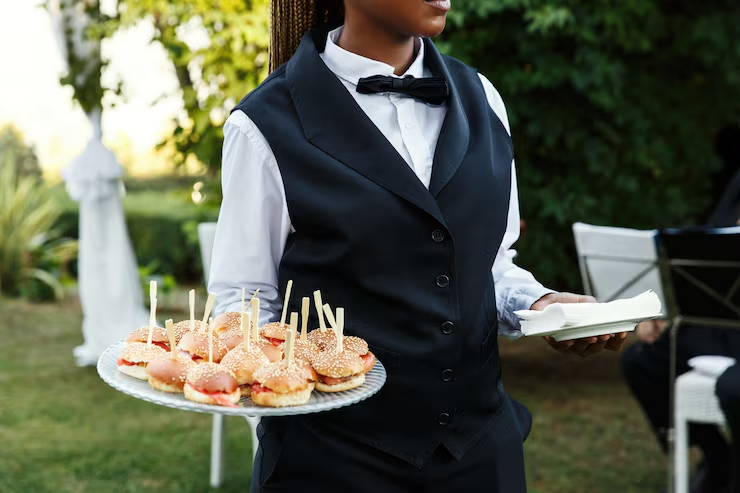
At my sister’s wedding, my dad pointed at my black dress in front of 287 guests and joked, “At least you’re dressed for serving drinks.” Everyone laughed. He told his business partners I worked at “some motel in Nevada,” sat me with the catering staff, and suggested I “help out” so I wouldn’t “feel out of place.” So I did. I picked up a champagne bottle, walked table to table, poured their glasses like I was part of the team… in a venue I quietly bought four months earlier. An hour later, the general manager stopped the music, grabbed the mic, and said, “The owner needs to address something.” My dad smirked and asked, “Who?”
He stopped smiling when I walked in.
My name is Sierra Stanton, and I’m thirty-two. Last June, I was humiliated in front of almost three hundred people at my own sister’s wedding—sat in the back with the staff, mocked for “choosing to serve people” for a living. What my father didn’t know was that the “some motel in Nevada” job he’d been sneering about for eight years had turned into a hospitality group with seven properties and eight-figure annual revenue… and that the crown jewel he’d been bragging about for months, The Grand View Estate, now belonged to my company.
The red flags started long before the wedding. The invitation that arrived nearly a month after everyone else’s, with a note on Dad’s personal stationery: Don’t wear anything flashy. This wedding isn’t about you. Don’t embarrass Vanessa. The phone call where my sister told me Dad had “already arranged the seating” and put me at table fourteen. The way he always condensed my entire life into a single sentence: “Sierra works in hospitality somewhere in Nevada,” said in the same tone most people reserve for “she failed out of college.”
What he also never mentioned? When Mom died, her life insurance paid out $120,000—$60,000 for Vanessa, $60,000 for me. Vanessa got hers at twenty-one and used it as a condo down payment. When I asked about mine, he said, “You’ll just waste it,” and “kept it safe” until I “proved I knew how to manage money.” I left town at twenty-two with $2,400, one Honda Civic, and a letter from my mother that said, You don’t need anyone’s permission to become who you’re meant to be. But sometimes you’ll need to show them.
So when he had me moved to the staff table “because it’s more appropriate” and made his big speech about legacy—raising a glass “to the daughter who will carry on the Stanton name” and tossing in a jab “to my other daughter, who’s always welcome to pour the drinks”—I let him. I let him go all the way. I poured, I smiled, I listened to his friends repeat his version of my life right to my face: dropout, no ambition, such a shame.
And then, when the venue manager stopped the music and said, “The owner needs to address something that happened tonight,” I watched my father’s confidence evaporate in slow motion. He demanded to know who the owner was. The manager pointed toward the doors. And I stepped out of the shadows in the same black dress he’d mocked, no champagne tray in my hands this time—just the truth.
Before the Wedding
To understand how we got here, you have to understand where I came from.
My father, Richard Stanton, built a commercial real estate empire in Colorado. Strip malls, office parks, the kind of developments that made money quietly and reliably. He was respected, well-connected, and convinced that success looked exactly like him: a corner office, a country club membership, and children who followed the script.
Vanessa followed the script. Finance degree from Boulder, engagement to a corporate attorney, Junior League membership, the works. She was Dad’s pride.
I was Dad’s disappointment.
My mother, Claire, had been different. She’d worked as a hotel concierge before marrying Dad, loved people, loved service, loved making someone’s day better with a good recommendation or a warm smile. She used to tell me, “Hospitality isn’t servitude, Sierra. It’s artistry. You’re creating experiences people remember forever.”
She died when I was fourteen. Breast cancer, eighteen months from diagnosis to funeral. Dad remarried within two years—a woman named Patricia who wore pearls and hosted charity luncheons and never once asked me how I was doing.
By the time I graduated high school, the house felt like a museum I wasn’t allowed to touch. Vanessa was away at college. Dad and Patricia attended galas. I spent most of my time working at a local hotel as a front desk clerk, saving money, dreaming of anywhere else.
I enrolled in community college because Dad insisted, but my heart wasn’t in it. I wanted to work, to learn the business from the ground up, to build something with my hands instead of theory from a textbook. When I dropped out after a year to take a full-time position at a boutique hotel in Denver, Dad stopped speaking to me for three months.
“You’re throwing your life away,” he’d said when he finally called. “Working the front desk at a hotel? Claire would be ashamed.”
That was the line that broke something in me. My mother, who’d loved hospitality, who’d taught me that service was noble—he was using her memory as a weapon.
“Don’t you ever speak for her,” I’d said, my voice shaking. “You don’t get to tell me what she would think.”
“Then prove me wrong,” he’d snapped. “Show me this isn’t a waste.”
I hung up. And I decided I would.
The Escape
At twenty-two, I asked about my inheritance. Mom’s life insurance. The money she’d left specifically for me and Vanessa to build our futures.
Dad had given Vanessa hers two years earlier. But when I asked for mine, he’d looked at me over his reading glasses and said, “You’re not ready.”
“What do you mean I’m not ready? It’s my money.”
“And I’m the executor. The policy allows me discretion over distribution if I believe the beneficiary is incapable of managing it responsibly. You dropped out of school, Sierra. You’re working an entry-level job with no prospects. I’m not handing you sixty thousand dollars so you can blow it on… whatever it is you think you’re doing.”
I’d stared at him, rage and disbelief warring in my chest. “That’s not your decision.”
“Actually, it is. And when you’ve proven you can hold down a real job, we’ll revisit this conversation.”
I should have fought him. Should have hired a lawyer, contested it, demanded what was legally mine. But I was twenty-two, exhausted, and surrounded by people who agreed with him—Patricia, Vanessa, even some of Mom’s old friends who’d say things like, “Your father just wants what’s best for you.”
So I left.
I packed my car, drove to Las Vegas, and started over with $2,400 and a letter my mother had written me before she died. I kept it folded in my wallet:
Sierra, my darling girl—
If you’re reading this, I’m gone. I’m so sorry I won’t be there to see you grow into the woman I know you’ll become. But I also know you’ll be extraordinary.
Don’t let anyone tell you who you’re supposed to be. Not your father, not your sister, not anyone. You have a gift for making people feel seen. Use it. Build something beautiful. And remember: you don’t need anyone’s permission to become who you’re meant to be.
But sometimes, you’ll need to show them.
I love you forever, Mom
Building From Nothing
Las Vegas in 2014 was a city still recovering from the recession. Hotels were struggling. Small properties were being sold off cheap. And I, a twenty-two-year-old with a resume that said “front desk clerk,” walked into the smallest, most rundown motel I could find and asked for a job.
The Desert Rose Inn had twelve rooms, peeling paint, and a manager who was three months behind on payroll. I offered to work for free for a month if he’d teach me everything—bookkeeping, maintenance, vendor relations, the whole operation.
“You’re either crazy or desperate,” he’d said.
“Both,” I’d replied.
He hired me.
I worked sixteen-hour days. I learned how to fix toilets, negotiate with linen suppliers, sweet-talk inspectors, and upsell guests on upgrades they didn’t know they wanted. I learned that hospitality wasn’t just about clean sheets—it was about anticipation, about reading people, about creating a feeling.
After six months, the owner—an elderly man named Frank who’d bought the place as a retirement project and quickly learned he hated it—offered to sell it to me for $150,000.
“I don’t have $150,000,” I’d said.
“Then find it,” he’d said. “You’re the only person who’s ever cared about this place. I’ll hold it for you for six months.”
I worked three jobs. I saved every penny. I pitched to small investors—mostly older women who reminded me of my mother and liked my grit. I cobbled together $40,000 for a down payment, got a small business loan for the rest, and at twenty-three, I became the owner of the Desert Rose Inn.
My father called it “a shack in the desert.”
I called it the beginning.
The Build
Over the next eight years, I built an empire one property at a time.
I renovated the Desert Rose until it had a 4.8-star rating on every travel site. I reinvested every dollar of profit into improvements, marketing, and training staff who actually gave a damn. Within two years, I’d paid off the loan and turned a profit.
I used that profit to buy a second property—a slightly bigger motel that was in foreclosure. Then a third. Then a boutique hotel in Reno that I turned into a destination for couples’ weekends.
By the time I was thirty, I owned six properties under the name Stanton Hospitality Group. Last year, I acquired a seventh—a sprawling estate venue in Northern California that I rebranded as The Grand View Estate, a luxury event space for weddings, corporate retreats, and high-end gatherings.
My father knew none of this. To him, I was still the girl who “worked at some motel in Nevada.” He never asked for details. Never visited. Never once said, “Tell me about your life.”
Vanessa knew a little more—we’d stayed in touch sporadically over the years, mostly through texts on birthdays and holidays. But even she didn’t know the full scope. It was easier to let them think I was small. It hurt less than trying to prove myself and being dismissed.
But when Vanessa got engaged last year and started planning her wedding, something shifted.
The Invitation
The invitation arrived six weeks after everyone else’s. I knew because I’d seen Vanessa’s Instagram posts—photos of beautifully calligraphed envelopes, excited captions about “spreading the love.”
Mine came with a note on Dad’s personal stationery:
Sierra,
Vanessa’s wedding will be a significant event. Many important people will be attending. Please dress appropriately—nothing flashy. This day is about Vanessa and Jonathan, not you. We trust you’ll conduct yourself with the dignity the occasion deserves.
—Dad
I read it three times, each time feeling the same sick twist in my stomach. Not We’re so excited you’re coming. Not It wouldn’t be the same without you. Just a preemptive scolding, as if I were a child who needed to be reminded how to behave.
I called Vanessa.
“Hey!” she answered, bright and distracted. “Did you get the invitation?”
“I did. A little late, but I got it.”
“Oh, yeah, sorry about that. Dad was handling the guest list and I think yours got lost in the shuffle.”
“Right. And the note?”
A pause. “What note?”
“The one Dad included. Telling me not to embarrass you.”
A longer pause. “Sierra, he’s just… he’s stressed. This wedding is a big deal for him. You know how he is.”
“Yeah,” I said quietly. “I know how he is.”
“Look, just come. Wear something nice. It’ll be fine.”
“Where am I sitting?”
“Um… I think Dad said table fourteen?”
Table fourteen. In a wedding with twelve tables reserved for family and close friends, I’d been placed at fourteen. With the overflow. With people who barely knew the bride and groom.
“Got it,” I said. “I’ll be there.”
After I hung up, I pulled up the venue information Vanessa had sent months earlier. The Grand View Estate. Northern California. Stunning views, world-class service, exclusive availability.
I opened my laptop and pulled up my company files.
The Grand View Estate. Acquired four months ago. Fully owned and operated by Stanton Hospitality Group.
Owned by me.
I sat back in my chair, staring at the screen, and started to laugh.
The Day Of
I flew into San Francisco the morning of the wedding. I’d offered to come earlier, to help with setup, but Vanessa had said, “Dad’s got it all handled. Just show up day-of.”
So I did.
I wore a simple black dress—elegant, understated, appropriate for an evening wedding. I’d agonized over it for weeks, knowing that whatever I wore would be scrutinized, criticized, used as evidence of something.
When I arrived at The Grand View Estate, I parked in the guest lot and walked toward the entrance. The grounds were stunning—rolling hills, manicured gardens, a stone terrace overlooking the valley. My team had done incredible work preparing for this event, and I felt a surge of pride seeing it all come together.
Inside, the coordinator greeted me with a clipboard. “Name?”
“Sierra Stanton.”
She scanned the list. “Oh! You’re at table fourteen. That’s toward the back, near the—”
“Near the catering station,” I finished. “I know.”
She looked uncomfortable. “I’m sorry, I didn’t—”
“It’s fine,” I said, smiling. “Not your fault.”
I found my table. It was tucked in a corner, partially obscured by a decorative screen. The other seats were empty—apparently, I was early.
I sat down and waited.
Guests began to arrive. I watched my father work the room, shaking hands, introducing people, playing the role of proud father of the bride. He wore a custom suit, a Rolex, the confidence of a man who’d spent his whole life being right.
He saw me once, from across the room. His eyes flicked over my dress, and I saw his mouth tighten. Then he turned back to his conversation, dismissing me without a word.
Vanessa looked beautiful. Her dress was stunning, her makeup perfect. She glowed in the way brides are supposed to glow. I felt a pang of something—not quite jealousy, but a sadness that we’d grown so far apart that I was a footnote in her big day.
The ceremony was lovely. I stood in the back, behind all the seated guests, because there hadn’t been a seat saved for me in the family section. I watched my father walk Vanessa down the aisle, watched him dab at his eyes with a handkerchief, watched him sit in the front row next to Patricia while I stood alone in the shadows.
After the ceremony, the reception began.
That’s when everything started to unravel.
The Toast
Dinner was served. I sat at table fourteen with two of the catering staff on their break and three distant cousins who asked polite questions about what I did for a living.
“I work in hospitality,” I said.
“Oh, that’s nice. Where?”
“Nevada, mostly.”
“Like Vegas?”
“And Reno. A few other places.”
They nodded, already losing interest, and turned their attention to the speeches beginning at the front of the room.
My father stood up, microphone in hand, his voice booming with practiced ease.
“Ladies and gentlemen, thank you for being here tonight to celebrate my daughter Vanessa and her wonderful husband, Jonathan. As a father, there’s no greater joy than seeing your child find happiness and build a life of meaning and purpose.”
He went on, talking about Vanessa’s accomplishments, her career, her bright future. He talked about legacy, about the Stanton name, about how proud he was.
And then, as he was wrapping up, he added with a smile: “And of course, we can’t forget my other daughter, Sierra, who’s here tonight. She’s always welcome to pour the drinks.”
The room erupted in laughter.
I felt three hundred pairs of eyes turn toward me. Some pitying. Some amused. Some confused.
My father raised his glass. “To family.”
“To family,” the room echoed.
I didn’t raise my glass. I sat very still, feeling the heat rise in my face, feeling the old familiar shame try to take root.
And then I stood up.
I walked to the bar, picked up a champagne bottle, and started pouring.
Pouring
Table by table, I moved through the room with a champagne bottle in hand, filling glasses, smiling, playing the role my father had assigned me.
“Thank you, dear.”
“How thoughtful.”
“Isn’t that the sister? The one who works at a motel?”
I heard every whisper. Every laugh. Every pitying look.
At one table, a business associate of my father’s—a man I vaguely remembered from childhood—said, “Sierra, right? Your dad tells me you’re out in Vegas. Hospitality work?”
“That’s right,” I said, pouring his glass.
“Good for you,” he said in a tone that meant the opposite. “Honest work. Not everyone’s cut out for the business world.”
“True,” I agreed, moving to the next glass.
At another table, Patricia leaned over and whispered loudly to a friend, “Richard tried so hard with that one. But you can’t force ambition.”
I smiled and kept pouring.
My father watched me from the head table, a satisfied smirk on his face. He’d made his point. Put me in my place. Reminded everyone what I was: the disappointing daughter, the one who’d squandered her potential, the one who poured drinks while her sister built a life.
I made it through the entire room. Every table. Every glass.
And then I returned the bottle to the bar, nodded to the staff, and slipped out through the side door into the venue manager’s office.
The Manager
Alex Torres had been running The Grand View Estate for three years before I acquired it. He was efficient, professional, and loyal—exactly the kind of person I wanted representing my properties. When I bought the venue, I kept him on with a raise and a promise that I’d never interfere with his operations unless absolutely necessary.
Tonight was absolutely necessary.
“Are you sure you want to do this?” Alex asked when I found him in his office, reviewing the evening’s schedule.
“Positive,” I said.
“It’s going to cause a scene.”
“Good.”
He studied me for a moment, then nodded. “Your call, boss.”
Twenty minutes later, the music stopped mid-song.
Alex stepped onto the small stage where the DJ had been set up, a microphone in his hand.
“Ladies and gentlemen, I apologize for the interruption. There’s a matter that needs to be addressed. The owner of The Grand View Estate needs to speak with you regarding something that occurred tonight.”
The room went silent. Confused murmurs rippled through the crowd.
My father stood up, frowning. “What’s this about? Who’s the owner?”
Alex gestured toward the main doors. “She’ll be right out.”
I stepped out of the shadows at the back of the room and began walking toward the stage.
Every eye turned toward me.
My father’s confusion shifted to irritation. “Sierra, what are you—”
I reached the stage. Alex handed me the microphone. I looked out at the crowd—287 people, all watching, all waiting.
I found my father’s face in the crowd. He looked angry now, embarrassed that his disappointing daughter was making a scene at his other daughter’s perfect wedding.
“Hi,” I said, my voice steady. “For those of you who don’t know me, I’m Sierra Stanton. Vanessa’s sister. The one who pours drinks.”
Nervous laughter scattered through the room.
“I want to thank you all for being here tonight to celebrate Vanessa and Jonathan. This venue is truly special, and I’m glad they chose it for their big day.” I paused. “I’m especially glad because I own it.”
The room went dead silent.
“Four months ago, my company—Stanton Hospitality Group—acquired The Grand View Estate. It’s the seventh property in our portfolio, which spans Nevada and California and generates eight figures in annual revenue. So when my father suggested I help pour drinks tonight so I wouldn’t ‘feel out of place,’ I thought, why not? I’m very familiar with how things work here.”
My father’s face had gone pale.
“I’ve spent the last ten years building a business from nothing. I started with $2,400 and a twelve-room motel that most people would have called a teardown. I worked three jobs, slept four hours a night, and learned every aspect of this industry from the ground up. Not because I had to, but because I loved it. Because my mother taught me that service isn’t something to be ashamed of—it’s something to be proud of.”
My voice caught slightly on mother, but I pushed through.
“What I didn’t know, until very recently, was that my father has been keeping my inheritance from me for the last decade. Sixty thousand dollars that my mother left specifically for me, that he decided I wasn’t ‘responsible’ enough to have. Money that could have changed my life when I was twenty-two and sleeping in my car between shifts.”
Gasps rippled through the crowd.
“But here’s the thing—I didn’t need it. I built my company without it. Without him. Without his approval or his support or his belief that I was capable of anything.”
I looked directly at my father now.
“You’ve spent years telling people I work at ‘some motel in Nevada.’ You’ve introduced me as the daughter who didn’t live up to her potential. You put me at table fourteen tonight, with the catering staff, because you thought that’s where I belonged.”
His mouth opened, but no sound came out.
“But I don’t belong at table fourteen, Dad. I belong at the owner’s table. Because this venue? This business? This empire you didn’t think I was capable of building? It’s mine. And it’s worth more than anything you’ve ever given me—including your approval.”
The room was so quiet I could hear someone’s phone buzz three tables away.
“So thank you,” I continued, my voice softer now, “for underestimating me. For dismissing me. For making me feel small enough that I had to leave and prove to myself that I wasn’t. Because if you’d believed in me, I might have stayed. And I never would have become who I am now.”
I handed the microphone back to Alex and stepped off the stage.
The room erupted.
The Aftermath
Some people clapped. Some people sat in stunned silence. Some people immediately pulled out their phones.
I walked past my father without looking at him, past Patricia’s scandalized expression, past the guests who were whispering and pointing.
Vanessa caught my arm as I reached the door.
“Sierra—”
“I’m sorry,” I said. “I didn’t want to ruin your wedding. But I couldn’t sit there anymore and let him—”
“I know,” she said quietly. Her eyes were red. “I’m so sorry. I didn’t know about the money. I didn’t know he—”
“It’s okay.”
“It’s not okay.” She looked back toward the head table, where our father was standing now, arguing with Alex, demanding something, his face purple with rage. “He’s been lying to both of us.”
“Yeah,” I said. “He has.”
She hugged me, tight and sudden. “I’m proud of you,” she whispered. “Mom would be too.”
I hugged her back, feeling something break open in my chest. “Thanks, Nessa.”
When I finally left, I walked past my father in the lobby. He grabbed my arm.
“You’ve humiliated me,” he hissed. “In front of everyone. At your sister’s wedding.”
“No,” I said, pulling my arm free. “I told the truth. There’s a difference.”
“You’re selfish. Ungrateful. After everything I’ve—”
“You’ve done nothing,” I said, my voice calm. “You kept my inheritance. You dismissed my work. You’ve spent a decade making me feel worthless. But I’m not worthless, Dad. I’m successful. And I did it without you.”
“You—”
“And if you ever want a relationship with me, you’re going to have to earn it. Not with money. Not with apologies. With actual change. With actually seeing me.”
I walked out into the night air, my hands shaking, my heart pounding.
My phone buzzed. A text from Alex: You good?
I smiled. Yeah. I’m good.
Six Months Later
My father never apologized. Not directly. But three weeks after the wedding, he transferred $60,000 into my account with a note that said simply, Your inheritance. I should have given this to you years ago.
I donated it to a scholarship fund for women in hospitality.
Vanessa and I talk now. Really talk. She’s asked me about my business, visited one of my properties, apologized for all the years she didn’t stand up for me.
“I was so focused on making Dad happy,” she’d said over coffee in Reno. “I didn’t realize how much he was hurting you.”
“You were trying to survive too,” I’d told her. “We both were.”
She’s thinking about leaving her finance job. Thinking about doing something that makes her happy instead of something that makes Dad proud. I told her I’d support her either way.
As for me? Stanton Hospitality Group is thriving. We’re opening an eighth property next year. I’ve been featured in industry magazines, invited to speak at conferences, approached by investors who see what I’ve built and want to be part of it.
Sometimes, late at night, I think about that moment on the stage. About the look on my father’s face when he realized who I’d become. About the sound of my own voice, steady and sure, telling my truth in front of everyone who’d ever doubted me.
I think about my mother’s letter: Sometimes you’ll need to show them.
And I smile.
Because I showed them.
And more importantly, I showed myself.
I am Sierra Stanton. I own seven properties, employ over 200 people, and built an empire from $2,400 and a dream. I am my mother’s daughter. And I am enough.
I always was.