The Distance Between Kansas and Here
During Thanksgiving dinner, my husband looked at me and said, “You can’t do anything.” The whole family burst out laughing. The next morning, I left everything, drove more than 6,000 miles, bought an old cabin in the middle of the forest and started a new life. A few years later, on the day I opened the doors to my “empire,” my husband appeared.
In our small dining room just outside Wichita, Kansas, with an NFL game buzzing from the living room and the smell of turkey and pumpkin pie drifting through the house, I kept passing the dishes and topping up glasses like nothing had happened, while something inside me finally went perfectly still.
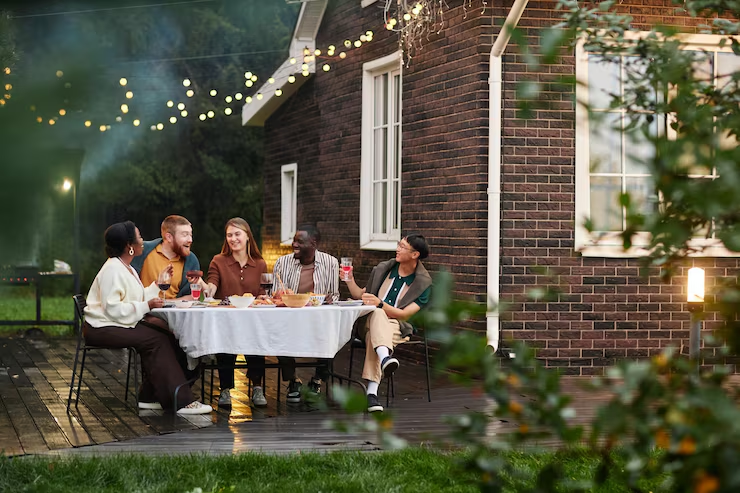
From the outside, it looked like a picture-perfect American Thanksgiving in the Midwest.
Long table, good china, a golden roasted turkey in the middle, everyone talking over one another about promotions, mortgages, and whose kids had made which honor roll.
On the inside, all I could hear was his voice in my head, growing sharper every time he repeated it for a laugh: “You can’t do anything.”
The comment came during dessert. My sister-in-law had been talking about starting a catering business. Someone asked what I thought about entrepreneurship. Before I could answer, Rick—my husband of fourteen years—leaned back in his chair, fork in hand, and delivered the line that would become my liberation.
“Claire? Start a business?” He laughed, looking around the table for validation. “She can’t do anything. She can barely manage the PTA bake sale without calling me three times.”
They laughed. His mother laughed. His brother laughed. Even my own sister smiled uncomfortably into her wine glass.
I didn’t defend myself. I didn’t cry. I just stood up, cleared my plate, and walked into the kitchen. I scraped turkey bones into the trash, loaded the dishwasher with mechanical precision, and felt something ancient and tired finally release its grip on my throat.
When the plates were scraped and the dishwasher started its slow, familiar hum, I opened my laptop at the same kitchen island where I’d iced cupcakes and packed school lunches for years in Sedgwick County.
Instead of hunting for Black Friday deals, I typed “Wichita, Kansas to Anchorage, Alaska” into Google Maps and watched a bright blue line slice straight up through the center of the United States toward the edge of the map.
Sixty-eight hours of driving. Four thousand three hundred miles. A route that would take me through seven states and two Canadian provinces.
I clicked “Directions” and started taking notes.
The Morning After
By sunrise, my suitcase was in the trunk of my aging Toyota, my wedding ring was sleeping in the bathroom drawer, and our split-level house in suburban Kansas was shrinking in the rearview mirror.
I didn’t leave a note. I sent a single text message at 6:47 AM: I’m leaving. Don’t look for me. Papers will be mailed.
I turned off my phone before he could respond.
I followed the gray ribbon of I-135 and I-70, crossed into Colorado, then through Wyoming and Montana, sleeping in forgettable motels off American interstates where the ice machine rattled all night.
I drank gas-station coffee in South Dakota, watched huge, empty skies open over Montana. Each mile felt like shedding a layer of skin I didn’t know I’d been wearing.
I thought about the fourteen years. The slow erosion. How “I love you” became “What did you do all day?” How my opinions at dinner parties were met with Rick’s hand on my shoulder and a gentle, condescending, “Claire doesn’t really follow politics.”
How I’d learned to make myself smaller and quieter until I wasn’t sure there was anything left of me worth finding.
Somewhere along the Alaska Highway, with snowbanks higher than my car and semi-trucks thundering past, it hit me: I’d already done something he was sure I never would.
I’d left.
The highway turned white. The trees became dense walls of spruce. The temperature dropped twenty degrees. I crossed into Yukon Territory, then into Alaska itself, and felt like I was driving off the edge of the known world.
Which, in a way, I was.
Talkeetna
Weeks later, I was signing papers in a cramped real estate office in Anchorage, Alaska.
The property was two hours north, near a lake outside the little town of Talkeetna, where the post office still knew everyone by name.
An old log cabin half-buried in snow, a gravel road, a broken dock, and a silence so deep it felt like I’d stepped off the edge of my old life while technically never leaving the country.
The realtor—a woman named Diane with silver hair and weathered hands—looked at me skeptically when I said I wanted to buy it outright.
“It’s been empty for three years,” she warned. “Roof might need work. Well definitely needs work. And you’re from Kansas?”
“Not anymore,” I said.
She studied me for a long moment, then slid the papers across the desk. “Alright then. Welcome to Alaska.”
The first months were nothing glamorous.
I learned to shovel real Alaska snow—the heavy, wet kind that makes your back scream. I learned to keep pipes from freezing when the weather app stopped at minus signs, and to fall asleep without the background noise of Kansas suburbs and distant freight trains.
I painted walls, scrubbed floors, hauled secondhand furniture up from Anchorage, and hunched over the old kitchen table sketching a rough plan for a tiny wilderness lodge no one back in Kansas would have believed I could run.
The silence was the hardest part. Not the work, not the cold, not the isolation. The silence. Because in the silence, I had to hear my own thoughts. I had to face the woman who had allowed herself to shrink for fourteen years.
I had to decide who I wanted to become.
I started small. I fixed the porch. I replaced the windows. I cleared the land down to the lake and rebuilt the dock with my own hands, watching YouTube videos on my phone and making a hundred mistakes before getting it right.
A local guide named Tom—a grizzled man in his sixties who’d lived in Alaska his whole life—stopped by one afternoon and watched me hammering.
“You’re doing it wrong,” he said.
“I know,” I replied. “But I’m doing it.”
He smiled. “Fair enough. Need help?”
Tom became my first friend in Alaska. He taught me about the land, about the wildlife, about how to survive winters that felt like they’d never end. And when I told him my half-formed dream about turning the cabin into a lodge, he didn’t laugh.
“I know some folks in tourism,” he said. “Might could partner with you. Bring in fishing groups, photographers. You got something here.”
Building Something Real
A local guide agreed to partner with me.
We started simple. Tom brought in a group of fishermen. I cooked them breakfast, packed their lunches, and listened to their stories around the fire at night. They paid. They left reviews. They told their friends.
Then a couple from Seattle flew into Ted Stevens Anchorage International Airport, rented a car, followed my shaky emailed directions, and stood in my doorway saying, “We saw your photos online and had to come all the way up here.”
The woman squeezed my hand and asked, “You did all this yourself?” and for the first time in my life, I said “Yes” without apologizing for it.
Word spread. I invested every dollar back into the property. I added two guest cabins. I installed a proper heating system. I built a deck overlooking the lake where guests could watch the northern lights dance across the sky.
I learned to manage bookings, handle finances, negotiate with suppliers. I learned that I was good at this—not just competent, but genuinely skilled. I had a vision, and I knew how to execute it.
The “old cabin in the woods” became a small lodge with real bookings, a website, repeat guests from all over the U.S., and a calendar so full I had to color-code it.
I hired staff. Two young women from Anchorage who wanted to escape the city. A chef who’d worked in Seattle and retired to Alaska for the peace. Tom’s grandson to help with maintenance and guide services.
I created jobs. I created something from nothing.
Three years after leaving Kansas, I stood on my deck watching the sunset paint the lake gold and pink, and I realized I was happy. Not the performative happiness I’d worn like a mask in Wichita. Real happiness. The kind that comes from building a life you’re proud of.
I hadn’t spoken to Rick since the day I left. The divorce papers were filed, processed, and finalized through lawyers. He didn’t contest anything. My sister told me he’d been “humiliated” by my departure, that he told everyone I’d had a breakdown.
I didn’t care. He was part of a story I’d finished writing.
Or so I thought.
The Day He Arrived
The day I planned to officially expand—adding a fourth cabin and launching a partnership with a regional tourism board—dawned clear and cold.
I’d invited local business owners, the mayor of Talkeetna, some journalists from Anchorage. It was a celebration. Proof that I’d built something lasting.
That afternoon, as the water turned to glass and the birch trees stood bare against a pale Alaska sky, I heard tires crunch on the gravel drive.
A rental SUV with Anchorage plates rolled to a stop in front of the lodge I had designed, paid for, and kept alive with both hands and too many late nights to count.
The door opened, and he stepped out.
Same eyes, same way of straightening his collar like he was about to walk into a meeting in downtown Wichita, only smaller now against the wide Alaskan landscape I called home.
For a long moment, we just stared at each other: the man from my old Kansas life and the woman he’d once told, in front of everyone, “You can’t do anything.”
Rick looked older. Grayer. There was something diminished about him that had nothing to do with the landscape. He glanced around—at the main lodge, at the guest cabins, at the lake, at the sign by the road that read “Birchwood Lodge: Wilderness Hospitality by Claire Morrison.”
I’d taken back my maiden name.
He took off his gloves, glanced up at the building I had designed, paid for, and kept running with my own two hands, and finally spoke.
“Claire.”
I didn’t move from the deck. I crossed my arms and waited.
“I… I didn’t know where you were for two years,” he said, walking closer. “Your sister wouldn’t tell me. The lawyers wouldn’t tell me. You just vanished.”
“I left,” I corrected. “There’s a difference.”
He stopped at the bottom of the deck stairs. “I came to apologize.”
The words hung in the air. Behind me, I could hear my staff setting up for the reception. I could hear laughter, the clink of glasses, the sound of a life I’d built without him.
“Apologize,” I repeated flatly.
“What I said at Thanksgiving… it was cruel. I was…” He ran a hand through his hair, a gesture I’d once found endearing. Now it just looked like performance. “I was wrong, Claire. I didn’t see you. I didn’t appreciate what I had.”
“What you had,” I said. “Interesting choice of words.”
He climbed the first two steps. “I know I can’t undo it. But when I saw the article—”
“Article?”
“About this place. About you. It was in the Anchorage paper. Someone shared it in a Kansas business group online. Everyone was talking about it. The woman who left Kansas and built a wilderness empire in Alaska.” He gestured at the lodge. “I didn’t believe it was you at first. But then I saw the photo.”
So that’s why he’d come. Not because he’d spent three years reflecting on his behavior. Not because he’d genuinely changed. Because I’d become notable enough to embarrass him back home.
“Why are you here, Rick?”
He took a breath. “I want another chance.”
I laughed. I couldn’t help it. The absurdity of it—him standing in Alaska, on my property, asking for another chance after telling me I couldn’t do anything.
“Another chance,” I repeated. “To what? To remind me I’m incompetent? To make me small again?”
“No. I’ve changed, Claire. The divorce, it… it woke me up. I’ve been in therapy. I realized how much I took you for granted. How much I—”
“Diminished me. Dismissed me. Made me believe I was less than I am.”
He flinched. “Yes.”
I looked at him—really looked at him. At the man who’d shared my bed for fourteen years. Who’d promised to cherish me. Who’d instead slowly convinced me that my thoughts, my dreams, my capabilities were all just amusing delusions.
“Do you know what I learned up here?” I asked quietly. “I learned that I’m capable of anything. I learned that the only thing holding me back was believing your version of me instead of discovering my own.”
“I know. And I’m sorry. I’m so sorry.”
“I’m sure you are,” I said. “But your apology doesn’t change anything. It doesn’t erase fourteen years. It doesn’t rebuild trust. And it certainly doesn’t earn you a place in the life I’ve built.”
Tom appeared in the doorway behind me. “Claire? Folks are starting to arrive.”
I didn’t take my eyes off Rick. “I’ll be right there.”
Rick’s face tightened with something—not quite anger, but close. “So that’s it? You’re just going to turn me away?”
“You turned me away every day for fourteen years,” I said. “You turned me into a punchline at Thanksgiving dinner. You made me believe I was nothing. And now you’re upset because I left and proved you wrong?”
“Claire, please—”
“I’m not the same woman you married,” I continued, my voice steady. “I’m not the woman who sat quietly while you diminished her. I’m not the woman who needed your permission to exist. That woman died somewhere on the Alaska Highway. And I’m not bringing her back. Not for you. Not for anyone.”
He stood there, speechless, his face cycling through emotions I no longer had the energy to decode.
“You should go,” I said. “You have a long drive back to Anchorage. I have guests to welcome.”
“Claire—”
“Goodbye, Rick.”
I turned and walked into the lodge. I didn’t watch him leave. I didn’t need to.
The Celebration
The reception was beautiful. The mayor gave a speech about economic development and the importance of small businesses in rural Alaska. A journalist from the Anchorage Daily News interviewed me about the journey from Kansas to here.
“What made you decide to come to Alaska?” she asked.
I thought about lying. About giving some sanitized version about always loving nature, about seeking adventure. But I’d spent enough years performing for other people’s comfort.
“I was told I couldn’t do anything,” I said simply. “So I left and did everything.”
She smiled. “That’s a good story.”
“It’s a true story,” I corrected. “Which makes it better.”
That night, after the guests had gone and my staff had cleaned up, I sat alone on the deck with a cup of tea and watched the stars emerge. They were impossibly bright up here, undimmed by city lights or Kansas humidity.
My phone buzzed. A text from an unknown number.
I’m sorry. I truly am. You built something incredible. I hope you find happiness. -R
I deleted it without responding.
Because this wasn’t about him anymore. Maybe it never had been. It was about a woman who was told she was nothing and decided to become everything. It was about reclaiming the parts of myself I’d given away in the name of keeping peace.
It was about learning that sometimes the best revenge isn’t revenge at all—it’s living so well that the people who doubted you become irrelevant to your story.
Epilogue: Five Years Later
Five years after that Thanksgiving dinner, Birchwood Lodge has expanded to eight cabins, a full-service restaurant, and partnerships with wildlife tour operators across Alaska.
We’ve been featured in travel magazines. We’ve hosted photographers, writers, families, honeymooners, and solo travelers from six continents. Last month, a woman from Kansas arrived. She was recently divorced. She stood on the deck overlooking the lake and cried.
“I didn’t think I could do this,” she told me. “Leave. Start over. Everyone said I was crazy.”
I handed her a cup of coffee and smiled. “Crazy is staying somewhere that makes you small. Leaving is the sanest thing you can do.”
She looked at me with wonder. “How did you know you’d be okay?”
“I didn’t,” I admitted. “But I knew I wouldn’t be okay if I stayed. And that was enough.”
She stayed for a week. When she left, she hugged me tight and whispered, “Thank you for showing me it’s possible.”
I think about that a lot. About how the hardest thing I ever did—leaving—became the thing that gave other women permission to leave too.
Rick never contacted me again after that text. I heard through the grapevine that he remarried. Someone from his office. I felt nothing when I heard the news. Not anger, not satisfaction, not even curiosity. Just nothing.
He was a chapter in a book I’d finished reading.
These days, I wake up to the sound of loons on the lake. I drink my coffee watching moose wander through the property. I greet guests, manage staff, plan expansions, and fall asleep exhausted and satisfied.
I’ve dated. Nothing serious, but that’s by choice. I’m learning to trust again, slowly. Learning that not everyone will make me small. But I’m also learning that I don’t need anyone to make me whole. I already am.
Last week, I got a message through the lodge’s website. It was from Rick’s mother.
Dear Claire, I want you to know that I think about what happened at that Thanksgiving dinner often. I laughed along with everyone else, and I’ve regretted it every day since. You deserved better. From all of us, but especially from my son. I’m proud of what you’ve built. I hope one day you can forgive me. -Margaret
I sat with that message for a long time. The old me would have rushed to forgive, to smooth things over, to make everyone comfortable. But I’ve learned that forgiveness isn’t about making other people feel better about their mistakes. It’s about releasing the hold those mistakes have on you.
I wrote back: Margaret, I appreciate your message. I don’t carry anger toward you or anyone else from that time. I’ve moved on, and I hope you have too. I wish you well. -Claire
I didn’t offer forgiveness. I didn’t need to. I simply acknowledged the past and released it.
Because here’s what I’ve learned in the five years since I drove away from Kansas: You can’t build a new life while dragging the old one behind you. You have to let go. You have to forgive yourself for staying too long. You have to accept that some people will never understand your choices, and that’s okay.
Your life doesn’t require anyone’s approval but your own.
I look at the empire I’ve built—and yes, it is an empire, even if it’s made of log cabins and gravel roads instead of steel and glass—and I feel something I never felt in fourteen years of marriage.
Pride.
Not the hollow pride of performance, but the deep, bone-level satisfaction of knowing I built this with my own hands. I proved the doubters wrong. Most importantly, I proved myself right.
That Thanksgiving dinner broke something in me. But it also freed something. It freed the woman I was always supposed to be, the one who’d been buried under years of “You can’t.”
Turns out, I can.
I can leave. I can drive 4,300 miles into the unknown. I can buy land. I can build buildings. I can run a business. I can create jobs. I can inspire others. I can stand on my own deck, overlooking my own lake, in my own life, and feel completely, utterly at peace.
And if that’s not doing something, I don’t know what is.
The distance between Kansas and here isn’t measured in miles. It’s measured in courage. In the willingness to walk away from what’s killing you, even when you don’t know what’s on the other side. In the decision to bet on yourself when everyone else has counted you out.
It’s measured in the moment you realize that the person who doubted you most wasn’t your husband or your in-laws or your old friends back in Wichita.
It was you.
And the moment you stop doubting yourself, the whole world opens up.
I’m standing in mine. And I’m never going back.