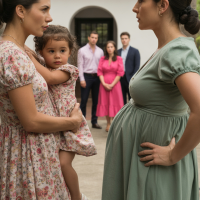
The Ultimatum
“You either babysit your nieces every single day, or you start paying the full rent. One thousand seven hundred and fifty dollars a month. Your choice, Haley.”
My mom stood in the kitchen doorway with her arms crossed, blocking my path to the front door like I was some kind of prisoner trying to escape. My dad sat at the kitchen table behind her, nodding along as if everything she said was perfectly reasonable.
My older sister Britney lounged on the couch in the living room, scrolling through her phone while her two daughters—three and five—ran screaming through the house, knocking over everything in their path.
I clutched my backpack straps, already running late for my evening shift at the coffee shop.
“Mom, I have work. I have classes. I have a life. I cannot watch Britney’s kids every single day while she does nothing.”
“Britney is going through a hard time,” my dad chimed in, his voice carrying that familiar tone of disappointment he reserved exclusively for me. “She needs family support right now.”
A “hard time.” That was the phrase they’d been using for the past six years to excuse every irresponsible decision my sister made. She had her first daughter, Madison, when she was twenty-two, after a whirlwind romance with a guy named Tyler, who disappeared three months into the pregnancy. Then came Jaden, born to a different father named Curtis, who stuck around just long enough to miss the birth before vanishing to pursue his dream of becoming a professional poker player in Las Vegas.
My name is Haley, and I’m twenty-four years old. I live in Omaha, Nebraska, in a cramped two-story house with my parents, my sister, and her two children. I’m a full-time college student pursuing my degree in accounting, and I work part-time at a local coffee shop to cover my tuition, books, and whatever scraps of independence I can scrape together.
For the past three years, I’ve been treated like the family’s unpaid nanny, housekeeper, and emotional punching bag.
The Pattern
The situation had started gradually, the way these things always do. When Madison was born, I was eighteen and still living at home to save money for college. My parents asked me to help out “occasionally,” just here and there, while Britney adjusted to motherhood. I agreed, because that’s what families do.
But occasional help turned into daily expectations. Daily expectations turned into mandatory obligations, and mandatory obligations turned into the prison I found myself trapped in that evening.
“I already contribute to this household,” I said, struggling to keep my voice steady. “I buy my own groceries. I pay for my car insurance. I clean the entire house every weekend because nobody else will lift a finger.”
“That is not enough anymore,” my mom replied coldly. “Things have changed around here. Your father’s hours got cut at the plant and we are struggling financially. If you want to continue living here, you need to step up and do your part.”
Step up. Another phrase they loved to weaponize against me.
Britney had never “stepped up” a single day in her life, yet somehow I was always the one falling short of their expectations.
I looked past my mom toward my sister in the living room. Britney didn’t even glance up from her phone. She was twenty-eight years old, had never held a job for longer than two months, and spent her days watching reality television while her children destroyed the house around her. My parents had been paying for everything she needed since the day she dropped out of community college. Yet they had the audacity to demand more from me.
“What about Britney?” I asked, feeling the frustration rising in my chest. “Why does she not get a job and pay rent? Why does she not watch her own children instead of expecting me to do it?”
The silence that followed was deafening. My mom’s expression hardened into something resembling disgust. My dad shook his head slowly, as if I had just said something unforgivable.
“Britney is a single mother,” my mom said, each word dripping with condescension. “She has enough on her plate dealing with two young children. You, on the other hand, have no real responsibilities. You go to school. You work a few hours at some coffee place. That is nothing compared to what she deals with every single day.”
I felt the familiar burn of injustice rising in my chest. Nothing compared to what she deals with. As if attending college full-time while working twenty-five hours a week and maintaining a decent GPA was somehow less demanding than lying on a couch all day while someone else raised your children.
“I have a midterm exam next week,” I said quietly. “If I fail this class, I lose my scholarship and everything I’ve worked for.”
“Then study while you babysit,” my mom snapped. “Other people manage to do both. You are not special, Haley.”
I wanted to scream at them. I wanted to tell her that I had been managing for years while receiving no credit, no appreciation, and no support from anyone in this family. But I had learned long ago that arguing with my parents about Britney was pointless. In their eyes, she could do no wrong, and I could never do anything right.
As I pushed past my mom and walked out the front door into the cold evening air, I heard my dad mutter something under his breath. Something about ungrateful children and disrespect.
I climbed into my old Honda Civic with the cracked windshield and rusted bumper, started the engine, and sat there for a long moment trying to remember how to breathe normally.
That night, as I made lattes and cleaned espresso machines at the coffee shop, I couldn’t shake the feeling that something fundamental had shifted in my relationship with my family. My parents were no longer asking for help. They were issuing ultimatums. And somewhere deep in my gut, I knew with absolute certainty that this was only the beginning of something worse.
The History
The truth is, I had been the family’s invisible support system since I was sixteen years old.
That was the year my grandmother on my mom’s side passed away unexpectedly, leaving behind a small inheritance that my parents immediately used to help Britney buy a car. Not me—Britney. Because she needed transportation to get to her community college classes, the ones she would drop out of six months later without any consequences.
I remember standing in the kitchen when my dad announced the decision. I had just gotten my learner’s permit and was saving every penny from my part-time job bagging groceries to eventually buy my own vehicle. The inheritance would have covered at least a decent down payment on something reliable.
But that money vanished into a shiny red sedan that Britney totaled within eight months because she was texting while driving. My parents paid for her next car, too. And the one after that.
When I graduated high school with honors and a partial scholarship to the University of Nebraska at Omaha, my parents threw a small party in the backyard. When Britney had graduated three years earlier with barely passing grades and no plans for the future, they’d rented out a banquet hall at a local restaurant and invited fifty people.
The disparity wasn’t lost on me, but I had learned to swallow my disappointment. It was simply how things worked in our family.
The babysitting started in earnest when Madison was six months old. Britney claimed she needed to “get out of the house” for her mental health, so my parents volunteered my services without asking me first.
I would come home from classes to find the baby in a playpen, my sister nowhere to be found, and a note on the refrigerator saying she would be back by dinner. She rarely was. Sometimes she wouldn’t return until past midnight.
My parents never questioned where Britney went. They never asked why she needed eight hours of “mental health time” while her infant daughter screamed for attention. They simply expected me to handle it without complaint.
By the time Jaden was born two years later, I had become the de facto primary caregiver for both children. My entire schedule revolved around their needs, not my own.
I missed study groups because Madison had a doctor’s appointment that Britney forgot about. I turned down extra shifts at work because Jaden was sick. I lost friendships because I could never go out, could never commit to plans, could never be anything other than available.
My friend group from high school had dwindled to nothing. The few people who still reached out eventually stopped when I canceled on them for the tenth time. The loneliness was crushing, but I told myself it was temporary. Once I graduated and got a real job, I could move out and start my own life.
I just had to survive until then.
The Breaking Point
The warning signs that things were about to get worse started appearing about three months before that confrontation in the kitchen.
My dad’s manufacturing company announced layoffs, and while he kept his job initially, his hours were reduced. My mom, who worked part-time as a receptionist at a dental office, picked up extra shifts, but it wasn’t enough to cover the gap.
Instead of asking Britney to contribute financially, my parents started making pointed comments about my situation. How much did I make at the coffee shop? How much was I spending on “frivolous things” like textbooks? Did I really need a gym membership when I could just run outside?
The gym membership comment stung particularly hard because I didn’t have a gym membership. I had never been able to afford one.
They were inventing expenses to justify demanding more from me while completely ignoring the actual drain on the family finances—Britney’s lifestyle. Her constant online shopping. Her subscription boxes for makeup. Her weekly trips to get her nails done while I watched her children without compensation.
But I kept my mouth shut and tried to stay focused. One more year of school. One more year of keeping my head down. Then I would be free.
That was the lie I told myself to keep going.
The night of the ultimatum, I came home from my shift around 11:30, exhausted. The house was dark except for the flickering television in the living room, where Britney had fallen asleep on the couch, surrounded by empty chip bags and soda cans. Madison and Jaden were supposed to be in bed hours ago, but I could hear them giggling upstairs, clearly still awake.
I walked past my sleeping sister without waking her, climbed the creaky stairs, and found both children jumping on the bed. Jaden was only three—young enough that being awake this late would throw off her entire schedule for days. Madison at five knew better but didn’t care.
“Girls, it is way past your bedtime,” I said, trying to keep my voice gentle despite my exhaustion.
“Mommy said we could stay up late tonight,” Madison replied defiantly.
“Mommy is asleep downstairs. Come on, let’s get you both tucked in.”
It took me forty-five minutes to calm them down, read them stories, and finally get them to sleep.
By the time I made it to my own bedroom, I was running on fumes. I had a paper due in two days that I hadn’t started, a shift at work the next morning starting at six, and an impossible choice hanging over my head.
I sat on the edge of my bed and stared at the wall. The paint was peeling where water damage from a leak my parents never fixed had left its mark. My furniture was the same furniture I’d had since middle school. My closet was barely big enough to hold my clothes, most of which I’d bought secondhand.
This was my life. This was what I had accepted for years because I believed it was the only option.
But that night, something shifted inside me.
Maybe it was the exhaustion finally reaching its peak. Maybe it was the unfairness of being asked to choose between my future and my freedom. Maybe it was simply the accumulation of a thousand small indignities finally reaching a breaking point.
I pulled out my phone and opened my banking app. I had been saving money in a separate account that my parents didn’t know about. It wasn’t much—a few thousand scraped together over years—but it was something.
I began searching for apartments near my university.
The Escape
Three weeks passed after the ultimatum, and the atmosphere in the house grew more poisonous by the day. My parents had given me a deadline, and it was approaching like a storm.
They had doubled down on their expectations, treating me with open contempt whenever I failed to meet their increasingly unreasonable demands.
The schedule they imposed was brutal and deliberately impossible. I was expected to watch Madison and Jaden from seven in the morning until noon, then again from four in the afternoon until eight at night, without exception. That left me a four-hour window to attend all my classes, work my shifts, study for exams, and somehow maintain my sanity.
It was mathematically impossible, and they knew it.
I tried to negotiate. I offered to pay three hundred dollars a month instead of the full $1,750. I offered to babysit on specific days. I offered to help find Britney a job so she could contribute.
Every suggestion was rejected.
“You are being ridiculous,” my mom said. “Do you think landlords negotiate with tenants in the real world? This is the real world, Haley. Grow up.”
The irony of her lecturing me about the “real world” while her twenty-eight-year-old daughter contributed nothing wasn’t lost on me. But I bit my tongue and continued planning my escape.
Finding an apartment on my budget was challenging. Most places required first and last month’s rent plus a security deposit, which would wipe out almost everything I’d saved. But after days of searching, I found a listing for a shared student apartment near campus.
A girl named Whitney was looking for a roommate to split a two-bedroom unit. The rent was six hundred dollars a month plus utilities, and she was flexible about the move-in date.
I messaged Whitney immediately and arranged to see the apartment the next afternoon. I told my parents I had a group project meeting at school.
The apartment was small but clean. Whitney was a graduate student in the biology department—quiet and studious, exactly the kind of roommate I needed. We talked for over an hour about expectations, schedules, and boundaries.
She didn’t care if I studied late at night. She didn’t expect me to clean up after her or raise her children. She simply wanted someone reliable to split the rent with.
I signed a lease that same day with hands that shook slightly. Move-in date was scheduled for the first of the following month, just five days away.
Walking back to my car after signing the paperwork, I felt a complicated mix of emotions. Relief. Fear. Guilt. Excitement. I had never done anything this significant without my parents’ knowledge or approval.
But I also knew deep in my bones that this was the right choice.
The Revelation
I drove home and found my sister exactly where I’d left her—on the couch, watching television while her daughters tore apart the house unsupervised. My parents were both at work.
“Can you grab Jaden?” Britney asked without looking up. “She’s been asking for a snack for like twenty minutes, and I am in the middle of something important.”
I looked at the television. She was watching a reality show about wealthy people buying vacation homes. That was the “important” something.
“Where are the snacks?” I asked, my voice flat.
“I don’t know. Kitchen somewhere. Mom usually handles all that.”
I walked into the kitchen and found the pantry nearly empty. No crackers, no fruit snacks, no applesauce pouches. Just a half-eaten bag of stale pretzels and some canned goods.
I grabbed the pretzels and brought them to Jaden, who immediately started crying because she wanted Goldfish crackers, not pretzels.
“Britney, there is nothing for the kids to eat,” I said.
“So go to the store and buy something,” she said.
“I do not have money for groceries. I buy my own food separately. Remember?”
My sister finally looked at me, her expression pure annoyance.
“Then ask Mom for her card when she gets home. I don’t know what you want me to do about it. Figure it out. You’re the responsible one around here.”
You’re the responsible one.
It was supposed to be a compliment, but it had always been used as a weapon. Being “responsible” meant being taken advantage of. Being responsible meant having no boundaries that anyone respected. Being responsible meant sacrificing my own needs so irresponsible people never had to face consequences.
I did not go to the store. I made peanut butter sandwiches with the last of the bread and gave them to the girls, then retreated to my room.
My sister complained to my parents when they got home, and I received another lecture about being unhelpful and selfish. But for the first time in years, their words didn’t penetrate my armor.
I had a plan. I had a way out. All I had to do was survive five more days.
The Midnight Departure
The night before my scheduled move, I began packing in secret after everyone had gone to sleep. I waited until the house was completely quiet, then carefully filled boxes and bags with my belongings—clothes, books, my laptop, the small collection of things that were truly mine.
I worked silently, methodically, moving with the precision of someone who had been planning this moment for weeks. Every creak of the floorboards made my heart race. Every distant sound made me freeze.
By two in the morning, everything I owned was packed and ready. I had arranged with Whitney to pick up my things the following afternoon while my parents were at work. I would leave the house keys on my dresser and walk out one final time.
But as I stood in my empty room, surveying the stripped-down furniture and bare walls, I realized I couldn’t wait until afternoon. The weight of another day in this house was more than I could bear.
The thought of one more breakfast filled with passive-aggressive comments. One more hour of watching my sister do nothing while I was expected to do everything. One more moment of being treated like the family’s least important member while simultaneously being expected to hold everything together.
I looked at the clock on my phone. 2:14 in the morning.
I pulled out my phone and texted Whitney.
I know this is crazy, but is there any way I could come tonight instead of tomorrow?
Her response came within minutes.
Sure. I’ll leave the door unlocked for you. Just let yourself in quietly.
My heart pounded as I made the decision. I loaded my car in three silent trips, each one feeling like an eternity. The house remained dark and quiet. Nobody stirred.
At 2:47 in the morning, I placed my house key on the kitchen counter next to a note I had written earlier.
The note was brief: I am moving out. Please do not contact me for a while. I need space to figure things out.
I didn’t apologize. I didn’t explain. I didn’t beg for understanding.
I simply walked out the front door, climbed into my car, and drove away into the darkness.
The streets of Omaha were empty at that hour, illuminated only by streetlights. I drove toward my new apartment with the windows cracked open, letting the cold night air wash over me. I was shaking uncontrollably, though whether from fear or exhilaration, I couldn’t tell.
What I didn’t know, as I pulled into the parking lot of my new building and began unloading my belongings, was that my departure would set off a chain of events that would expose truths my parents had been hiding for years. That my absence would force them to confront the consequences of their choices. That the comfortable arrangement they had built on my labor was about to come crashing down.
I thought I was simply leaving a toxic situation. I had no idea I was also lighting a match that would burn down the facade they had carefully constructed.
The Calls
The first indication that something had gone wrong came at 7:23 in the morning, roughly five hours after I left. My phone exploded with notifications that woke me from a restless sleep.
Missed calls from my mom. Missed calls from my dad. Text messages from both of them, escalating in tone from confused to angry to threatening.
Where are you?
Haley, answer your phone right now. This is not funny.
The girls woke up crying and Britney can’t find you anywhere. If you don’t call back in ten minutes, I’m reporting you as a missing person.
I stared at my phone from the comfort of my new bed in my new room in my new apartment that smelled like fresh paint and possibility and freedom. Whitney had gone back to sleep after helping me unload my car, and I was alone with my thoughts and the chaos unfolding remotely through my screen.
Part of me wanted to respond immediately. Part of me felt guilty for the panic I was causing. But a larger part, the part that had been silenced for years, felt something else entirely.
Relief.
Pure, overwhelming relief.
I turned my phone on silent and went back to sleep.
When I woke up around noon, I had accumulated forty-seven missed calls and over a hundred text messages from various family members.
My sister had joined the barrage, her messages alternating between accusations and demands.
You left me with the kids and no warning. How am I supposed to handle them alone? This is so typical of you, always thinking about yourself first.
The audacity of that line almost made me laugh. Britney, who had thought about nothing but herself for as long as I could remember, was accusing me of selfishness.
I scrolled through the messages without responding, piecing together what had happened.
My mom had discovered my note around six in the morning. She had immediately tried to call me, then woken up my dad in a panic, then barged into Britney’s room to announce that I had apparently abandoned them all.
Britney’s first concern, according to the messages, was who would watch the girls while she went to her nail appointment that afternoon. Not where I had gone. Not whether I was safe. Just who would cover her scheduled self-care time.
My dad’s messages were more measured, but no less manipulative.
Haley, whatever is going on, we can talk about it like reasonable adults. Running away doesn’t solve anything. Come home and we’ll work this out together as a family.
As if they had ever treated me like an adult. As if their ultimatum and demands had been the actions of reasonable people.
I finally responded to my mom at two in the afternoon after I had showered, eaten, and started to feel human again.
I am safe. I moved out. Please respect my request for space.
Her response was immediate and volcanic.
Space? You want space after everything we’ve done for you? You ungrateful little traitor. You have destroyed this family with your selfishness. I hope you’re happy with yourself.
I read her words three times, waiting for them to hurt like they always had, waiting for the familiar sting of maternal disapproval. But it didn’t come.
All I felt was a strange emptiness, like the place where her opinion used to matter had been hollowed out and sealed over.
I blocked her number. Then I blocked my dad’s number. Then I blocked Britney’s number.
The silence that followed was the most peaceful thing I had experienced in years.
But my family’s problems were only beginning.
The Landlord
What I didn’t know, as I settled into my new life and focused on catching up with my schoolwork, was that my departure had exposed a fundamental instability in the household finances.
Two days after I left, I received a call from an unknown number. I almost didn’t answer, but something made me pick up.
“Is this Haley?”
The voice was male, professional, and unfamiliar.
“Who’s asking?”
“My name is Gerald, and I’m calling from Oakwood Property Management. I’m the landlord for the property at 723 Maple Street.”
My parents’ house. My former address.
“I’m not sure why you’re calling me,” I said carefully. “I don’t live there anymore.”
“I’m aware. Your mother informed me of your departure when I called about the overdue rent. However, your name is still on the lease as a co-tenant, so I needed to reach out to you directly.”
My blood ran cold.
“I’m sorry, what? My name is on the lease?”
“Yes. You were added as a co-tenant approximately three years ago. Your mother said it was to help build your credit. But that also means you are jointly responsible for any outstanding debts or damages.”
I sank onto my bed, my mind racing. Three years ago, my parents had asked me to sign some paperwork for what they claimed was a utility account in my name. I had been nineteen, trusting, and too overwhelmed to read the fine print.
I had signed where they pointed. They had put me on their lease without telling me the truth.
“How much is overdue?” I asked, my voice barely above a whisper.
“Three months of rent, plus some significant damage to the property. All told, we’re looking at approximately six thousand dollars.”
Six thousand dollars.
That was more than double what I had saved. That was my entire financial cushion gone in an instant.
“I need to think about this,” I said. “Can I call you back?”
“Of course. But understand that if this is not resolved within thirty days, we will be forced to begin eviction proceedings, and that will affect everyone on the lease—including you.”
I hung up and sat in stunned silence.
My parents had not only exploited me for years; they had also set me up to take the fall for their financial failures without my knowledge or consent. Even after leaving, I was still caught in their web.
The Fight Back
I spent the next forty-eight hours in barely controlled panic. I researched tenant law in Nebraska. I called the university’s free legal clinic and scheduled an appointment. I combed through all my financial records trying to understand how this had happened.
What I discovered was both infuriating and illuminating.
My parents had been struggling financially for much longer than they’d admitted. My dad’s hours had been cut multiple times over the past two years. My mom had actually lost her dental receptionist job six months ago and had been hiding it from everyone, including my dad, by claiming to “pick up extra shifts” that didn’t exist. She spent her days at the library or the mall, pretending to work while the bills piled up.
The rent had been overdue since before they issued me the ultimatum. The $1,750 they demanded wasn’t about teaching me responsibility. It was about covering their own shortfall without having to admit they were failing.
And the damage to the property? That was entirely Britney’s doing. Her children had destroyed the carpet, drawn on walls with permanent markers, and broken a window that had been poorly patched with tape. Damage my parents had hidden from the landlord for months.
“Eventually” had finally arrived, and they had planned to make me pay for it all.
The legal clinic appointment confirmed what I’d feared. As a co-tenant, I was legally responsible for the lease, regardless of whether I had knowingly agreed. My signature was on the document.
However, the law student who reviewed my case suggested a possible avenue.
“If you can prove that your signature was obtained through misrepresentation, you might be able to argue that the contract is voidable,” she explained. “Did your parents tell you specifically what you were signing?”
“They said it was for a utility account to help build my credit.”
“Do you have any evidence of that? Texts, emails, anything?”
I thought back. I hadn’t been as diligent then, but I remembered something. My mom had sent me a text message asking me to sign what she called “the electric bill paperwork.”
I had kept that phone and backed it up to my computer. The message might still be there.
That night, I spent hours searching through old backups until I finally found it. The text was dated November three years ago: Hi, honey. Can you come sign the electric bill paperwork when you get home? It’ll help build your credit. Love, Mom.
Electric bill paperwork. Not lease. Not rental agreement. A deliberate misrepresentation.
I took screenshots and emailed them to the law student immediately. She responded within hours, her tone notably more optimistic.
“This helps significantly. It establishes that you were misled about the nature of the document. We can use this to argue that your consent was not informed.”
For the first time since the landlord’s call, I felt genuine hope.
But there was still the matter of my family and what this revelation meant going forward.
They had not just taken advantage of me. They had actively deceived me, placed me in legal jeopardy, and were now trying to make me responsible for their debts. Whatever guilt I had felt about leaving evaporated completely.
Whatever lingering connection I had maintained to the idea that “family” meant unconditional support dissolved entirely.
These people were not my family in any meaningful sense. They were strangers who had used my trust against me. And I was done being their victim.
The Resolution
Armed with evidence and legal guidance, I began constructing a plan.
The first step was establishing documentation of everything. I saved every text message, every voicemail, every piece of evidence that showed my parents’ pattern of deception.
The second step was protecting myself financially. I opened new bank accounts that my parents had no access to. I changed my mailing address and made sure all my important documents were sent directly to my new apartment. I informed my employer of my new contact information.
The third step was the hardest: confronting the truth about what my family had done and deciding how to respond.
Part of me wanted revenge. I wanted to expose their lies publicly, ruin their reputations, make them suffer the way they had made me suffer. I fantasized about calling their employers, their friends, their extended family.
But another part of me recognized that revenge would only keep me tied to them emotionally. Every action I took against them would be a reaction to their behavior, which meant they would still be controlling my life.
True freedom meant letting go entirely—not holding on through hatred.
I decided on a middle path. I would pursue justice within the legal system and protect my interests, but I would not actively seek to destroy them. I would simply let the consequences of their own actions unfold naturally.
It didn’t take long for those consequences to begin.
The landlord, Gerald, was surprisingly understanding when I presented my evidence and explained my situation. He had been a landlord for decades and had seen his share of family disputes. After reviewing the text message and consulting with his own attorney, he agreed to remove my name from the lease retroactively.
“Your parents should have been honest with you from the start,” he said during our phone call. “Putting someone’s name on a legal document without their full understanding is fraud. I’m not going to hold you responsible for their choices.”
The relief I felt was overwhelming. Six thousand dollars I would not owe. An eviction that would not appear on my record. A fresh start that remained unblemished.
But for my parents, the situation was about to get much worse.
With my name removed from the lease, they were now solely responsible for the overdue rent and property damage. Gerald gave them thirty days to pay in full or face eviction proceedings. He was no longer willing to extend patience.
The calls started again, this time from unknown numbers that my family had borrowed to bypass my blocks. Voicemails filled with anger, desperation, and blame.
“This is your fault,” my mom screamed. “You ruined everything. You were supposed to help us, and instead you abandoned us when we needed you most. I hope you know you are going straight to hell for what you have done.”
“Haley, please,” my dad said in another message. “We can work this out. Just come home and help us figure this out. We need you.”
Britney’s messages were the most revealing.
“The landlord came by and said we have to pay like six thousand dollars or get kicked out. This is insane. You need to fix this. These are my kids, Haley. Do you want my kids to be homeless?”
Her kids. The kids she had never properly cared for. Now she was using them as emotional leverage.
I did not respond to any of the messages.
Two weeks later, I received word through a mutual family friend that my parents had been served with official eviction papers. They had failed to pay, failed to address the damage, and failed to negotiate any settlement. The eviction process had officially begun.
The same friend also shared some other developments. My mom’s lies about her employment had finally been discovered. My dad found a credit card statement for purchases made during hours she claimed to be working—purchases that placed her at a mall across town.
The confrontation that followed had been explosive. They were now sleeping in separate rooms and barely speaking.
Britney, faced with the prospect of actual homelessness for her children, had been forced to contact the fathers of her kids. Tyler, Madison’s father, had resurfaced after five years and agreed to take partial custody. Curtis, Jaden’s father, had returned from Las Vegas—broke but willing to step up.
For the first time in their lives, my sister’s children were going to have relationships with their fathers. Not because Britney had facilitated it, but because she had no other choice.
The irony was not lost on me. My departure had forced my family to do what they should have done years ago—take responsibility for their own lives.
One Year Later
The eviction was finalized six weeks after I left. My parents and sister moved into a small apartment on the outskirts of town, a cramped two-bedroom unit they could barely afford, even with my dad working overtime and Britney finally getting a job at a grocery store.
I learned this through social media, where distant relatives posted supportive messages about the family’s “difficult transition.” Nobody mentioned me. Nobody acknowledged that I had been pushed out, exploited, and deceived.
In the family narrative, I was simply the ungrateful daughter who had abandoned them.
I was okay with that. Their narrative was not my concern anymore.
As for me, I thrived.
Without the constant demands of babysitting and household management, I had time to focus on my studies. My grades improved dramatically. I picked up additional shifts at the coffee shop and started building a genuine savings account.
I made friends for the first time in years—people who valued my company rather than my usefulness. Whitney became one of those friends. We stayed up late talking about our dreams and fears. She told me about her research in marine biology. I told her about my past, about my family, about the years of exploitation.
“You survived something really hard,” she said one night as we sat on our tiny balcony watching the sunset. “Not everyone would have had the courage to leave.”
“I didn’t feel courageous,” I admitted. “I felt terrified. I still feel terrified sometimes.”
“That’s what courage is,” Whitney replied. “Being scared and doing it anyway.”
Three months after my midnight departure, I received an unexpected visitor. I was walking back from class when I saw a familiar figure sitting on the steps of my apartment building.
It was my mom.
She looked older than I remembered. More tired. The lines around her eyes had deepened. She stood up when she saw me approaching, her expression uncertain.
“Haley,” she said. “Can we talk?”
Every instinct told me to walk away, to protect the peace I had built, to refuse any further engagement. But curiosity got the better of me.
“Five minutes,” I said. “Then you leave.”
We sat on a bench near the building, maintaining careful distance. My mom folded her hands in her lap and stared at the ground.
“I’m not here to ask you to come back,” she said finally. “I know you won’t. And I know why.”
I waited, saying nothing.
“Gerald told me what he found out about the lease. About how we misled you.”
She paused, struggling with the words.
“I didn’t… I didn’t think of it as fraud at the time. I thought I was helping you build credit.”
“You thought it would be good for you,” I corrected. “You thought that if something went wrong, I would be on the hook. You used me as a safety net without telling me.”
She didn’t deny it.
“I’ve made a lot of mistakes,” she said quietly. “With you, with Britney, with your father. I thought I was holding the family together, but I was just holding on to control.”
It was the closest thing to an apology I had ever received from her. And yet, it was not enough.
“I needed you to be my mother,” I said, my voice cracking despite my efforts to stay calm. “I needed you to protect me, not exploit me. I needed you to see that Britney was taking advantage of everyone. I needed you to be fair.”
“I know.”
“But you weren’t. You chose her. Every single time, you chose her, and you expected me to just accept it—to keep giving until there was nothing left.”
My mom looked up, tears streaming down her face.
“I am sorry, Haley. I am so sorry.”
It was the first time she had ever said those words to me genuinely.
I let them sit in the air for a long moment.
“I believe you,” I finally said. “But sorry doesn’t erase what happened. Sorry doesn’t give me back the years I lost. Sorry doesn’t rebuild trust that you systematically destroyed.”
“I know it doesn’t. I’m not asking for forgiveness. I’m just asking for a chance. A chance to show you that I can be different.”
I considered her request. The anger I had carried for so long had begun to fade, replaced by something more complicated—grief, maybe, or acceptance.
“I’m not ready for that,” I said honestly. “Maybe someday. But not now.”
My mom nodded, accepting my answer without argument.
“Can I at least have a way to reach you in case of emergencies?”
I gave her my email address. Not my phone number. Not my address. Just email. It was more than she deserved, but it was what I could offer.
She thanked me and left.
I sat on that bench for a long time after she was gone, processing what had just happened.
My mom had apologized, had admitted her mistakes, had asked for a second chance. Six months ago, I would have given it to her instantly. I would have rushed to forgive, to reconcile, to return to the familiar patterns.
But I was not that person anymore.
I had learned that some relationships could not be repaired, that some damage was too deep for apologies to reach. That choosing yourself was not selfish but necessary.
My family would have to rebuild without me, and I would have to build a new life without them.
Both paths led forward. Both required courage.
I chose mine.
One year passed from the night I slipped out of my parents’ house. One year of growth, healing, and transformation I never could have imagined.
I graduated from the University of Nebraska at Omaha with a degree in accounting and a job offer from a regional firm specializing in nonprofit financial management. The salary was modest but steady—enough to afford my own apartment and start building a real future.
Whitney had moved to California for a research position, but we stayed in touch. She had become the sister I never really had.
My actual family remained on the periphery. My mom sent occasional emails—updates about Britney’s job and the children’s progress, questions about my well-being that I answered briefly and neutrally. The relationship was distant but civil. It was the best I could offer.
Britney had surprised everyone. Forced to take responsibility for her children without me as a safety net, she had stepped up in ways nobody expected. She was still far from perfect, but she was present. She had enrolled Madison in kindergarten and was working with Curtis to establish a stable co-parenting arrangement for Jaden.
That was the most unexpected outcome of my departure.
Without me serving as the default caregiver, their actual parents had been forced to engage. Madison now spent weekends with Tyler, who had gotten sober and was rebuilding his life. Jaden was developing a relationship with Curtis.
My leaving had not destroyed the family. It had simply forced them to function without their crutch.
I thought about that often—how my sacrifice had not helped anyone in the end. How my presence had enabled dysfunction rather than curing it. How sometimes the most loving thing you can do is let people face the consequences of their choices.
The anger I had carried had faded into something softer. Not forgiveness exactly, but acceptance. I could not change what had happened. I could only choose how to move forward.
On the anniversary of my midnight departure, I took myself out to dinner at a nice restaurant downtown. I sat alone at a table by the window, watching the city lights reflect off the glass, and allowed myself to feel proud.
I had escaped a situation that many people never find the courage to leave. I had built a life on my own terms. I had learned to value myself enough to demand better.
It had not been easy. There were nights when the loneliness felt overwhelming. There were moments when I questioned whether I had done the right thing. There were times when the guilt crept back.
But sitting in that restaurant, independent and whole, I knew the truth.
They had never needed me. They had used me.
And when I stopped allowing it, they found other ways to survive.
The difference between need and use is the difference between love and exploitation. My family had exploited me for years under the guise of love, and I had accepted it because I didn’t know any better.
Now I knew better.
And I would never go back.