The Bill I Couldn’t Pay
My son Marcus called on a Wednesday afternoon with a voice I hadn’t heard in years—warm, excited, like he actually remembered I existed.
“Mom, I want to do something special for you. Vanessa and I want to show our appreciation for everything you’ve done.”
I gripped the phone, my arthritis making my fingers ache. Sixty-four years old, a lifetime of cleaning offices and scrubbing floors to put that boy through college, and this was the first time he’d ever said those words.
“We’ve booked a weekend at the Grandmont Hotel. Five stars, Mom. Your own suite, spa access, gourmet dining. It’s our gift to you. You deserve it.”
I closed my eyes, tears streaming down my face before I could stop them. After all those years—the double shifts, the ruined knees, the nights I’d eaten crackers for dinner so he could have real food—maybe my son finally saw me. Finally valued what I’d sacrificed.
God, I was naive.
Friday morning, Marcus and Vanessa picked me up in a gleaming black car. She wore a cream-colored dress that probably cost more than my monthly rent. He had designer sunglasses and that practiced smile he used in his real estate videos.
But I didn’t see the manipulation then. I only saw my successful son, finally proud enough to be seen with his mother.
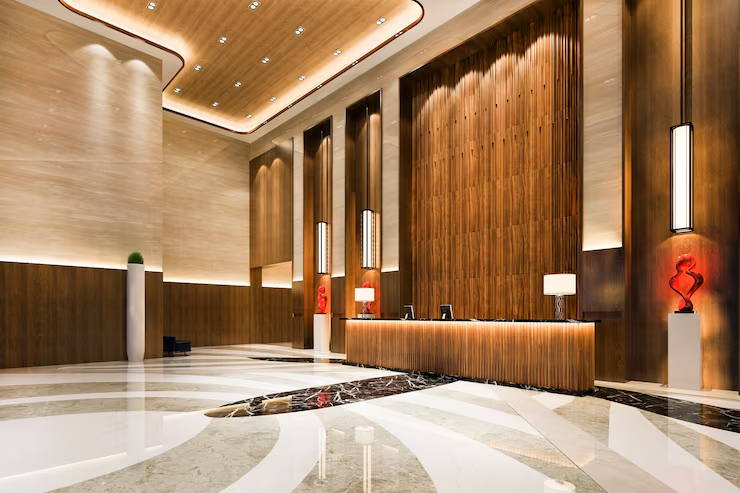
The Grandmont was magnificent—all marble columns and crystal chandeliers, floors so polished you could see your reflection. The smell of jasmine and expensive wood hung in the air. I felt small in my discount-store dress and worn shoes, but Marcus took my arm.
“Relax, Mom. You belong here as much as anyone.”
Vanessa smiled beside him. “Christine, you’re going to love the suite. Garden view, jacuzzi, everything.”
Her voice was honey-sweet poison, but I didn’t know it then.
The suite was larger than my entire apartment. A king bed with clouds-white linens. Floor-to-ceiling windows overlooking a garden bursting with roses. A bathroom with pearl tiles and towels so soft they made me want to cry.
I sat on the bed and touched the sheets with trembling hands. This was real. My son loved me.
The weekend was a dream. Breakfasts with exotic fruits I’d never tasted. Lunches where waiters treated me like royalty. Marcus ordered wine. Vanessa laughed her crystalline laugh. And I felt, for the first time in decades, like I mattered.
Saturday night we dined on the terrace overlooking the city lights. Marcus raised his glass.
“To you, Mom. For everything you sacrificed.”
Vanessa applauded. I cried. We toasted.
I didn’t know I was swallowing my own destruction.
Sunday morning, Marcus told me to meet them in the lobby at eleven for checkout.
“Don’t worry about anything, Mom. We’ve got it handled.”
I came down right on time with my small suitcase and full heart. They were already there, talking to the blonde receptionist.
I approached, smiling. Marcus saw me, hugged me tight, and whispered:
“Thanks for covering the stay, Mom. It was unforgettable.”
Then he pressed a paper into my hands and walked away.
The bill. $8,750.
I watched them stroll through the lobby like tourists in a park. Marcus with his hands in his pockets, Vanessa with her designer bag swinging from her shoulder. Both laughing softly, whispering to each other.
They passed through the glass doors, climbed into that gleaming black car, and disappeared into Chicago traffic.
Just like that.
As if I weren’t his mother. As if the weekend hadn’t happened. As if he didn’t know I made $900 a month cleaning office buildings at night.
My legs stopped working. The paper shook so violently in my hands the numbers blurred.
$8,750.
More than nine months of my life, working until my back screamed and my knees gave out.
And my son knew it. He knew exactly how much I earned, how much I had, how much I didn’t have.
He knew I couldn’t pay this. He’d counted on it.
The blonde receptionist cleared her throat. “Ma’am? Will that be cash or card?”
Her voice was professional but her eyes held pity. She was witnessing my humiliation in real time.
I opened my mouth but no sound came—just a choked gasp like I’d been kicked in the stomach.
Around me, life continued. A young couple laughed by the fountain. A businessman barked into his phone. A family dragged luggage toward the elevator.
Everyone living their normal lives while mine collapsed in pieces.
Heat flooded my face. Pure shame running through me like fire.
“I… I don’t have it.”
The words came out broken, barely audible.
“Ma’am, if there’s an issue, I can call the manager—”
“Issue.” Such a small word for the abyss I’d just fallen into.
Tears started falling without permission. Thick, hot, loaded with rage and shame.
The receptionist grew nervous. “Ma’am, please. We’ll figure this out.”
But her voice was hollow. There was no solution.
Suddenly, I heard slow footsteps dragging across marble. An elderly woman emerged from behind the desk—maybe eighty, with pure white hair in a tight bun, deep wrinkles, and honey-colored eyes that studied me with strange intensity.
She wore the hotel uniform, but hers looked older, like she’d worn the same fabric for decades.
She approached, her steps small but firm. The blonde receptionist looked surprised.
“Margaret, you don’t need to—”
The elderly woman raised a wrinkled hand, silencing her. She stopped in front of me, so close I could smell her lavender perfume.
She studied my face like she was searching for something specific.
“You’re Mr. Thompson’s daughter.”
Her voice was raspy but firm. The question hit me like a punch.
Thompson. My father. No one had said that name in front of me in thirty years.
He’d died when I was thirty-four, leaving me alone with a young son and no inheritance—just vague memories of a distant man who worked constantly and spoke little.
“Yes,” I whispered. “I’m his daughter.”
Margaret closed her eyes briefly, holding back some huge emotion. When she opened them, a single tear rolled down her wrinkled cheek.
“I worked for your father for thirty-two years. From the time I was twenty-five until the day he died.”
The lobby seemed to freeze.
“Your father was… complicated. Difficult. But he told me something before he passed.” She reached into her uniform pocket and pulled out a yellowed envelope, folded and worn by time.
My name was written on it in shaky handwriting: Christine.
“He said, ‘One day my daughter will come here. She’ll be alone. Lost. When you see her, give her this. It’s the only thing I can give her now.'”
She held out the envelope with trembling hands.
“He arranged for me to work here thirty years ago. Told me to wait. That someday you’d arrive.”
Her voice broke. “After thirty-two years, I can finally keep my promise.”
I took the envelope with numb fingers. It was heavy—something solid inside, more than paper.
I opened it slowly. Inside was a folded letter and an old, rusted key. The key had a number engraved: 447. A small leather tag hung from it with a handwritten address.
I unfolded the letter. My father’s slanted writing.
Christine, if you’re reading this, it means you’ve discovered nothing in our family was what it seemed. Forgive me for the secrets. This key opens a storage unit at the address Margaret will give you. Inside you’ll find the truth about who I really was. And who you are. Go alone. Trust only yourself. Your father, William Thompson.
I read it three times, but the words made no sense.
Secrets. Truth. Who I really was.
My father had been a quiet accountant who left early and came home late. When he died, I’d expected some small inheritance. Instead, there were only debts I’d paid by selling our few remaining possessions.
Now, thirty years later, a rusted key and a letter saying everything had been a lie.
I looked up at Margaret. “What’s in that storage unit?”
My voice came out louder than expected, cutting through the thick silence.
Margaret shook her head. “I don’t know. Your father never told me. He only asked me to give this to you when I saw you lost and alone.”
She paused. “And here you are.”
I looked at the leather tag. The address was written in faded ink: Industrial Avenue 447, Unit 12, east side.
I knew that area. Abandoned warehouses and broken streets where nobody went after dark.
“Ma’am?”
The blonde receptionist’s voice pulled me back to reality—and the hotel bill I couldn’t pay.
Margaret turned to her with unexpected authority. “I’ll handle Mrs. Thompson’s bill. Put it on my account. I’ll pay in installments from my salary.”
The receptionist started to protest, but Margaret silenced her with a look.
“Your father saved my life more times than I can count. This is the least I can do for his daughter.”
I couldn’t speak. This stranger who’d kept a secret for three decades was paying my debt—a debt my own son had created to destroy me.
“I can’t accept—”
Margaret took my hands in hers, wrinkled and cold. “Yes, you can. But first, go to that address. Open that unit. Find out why your son did what he did.”
Her words froze my blood. “What do you mean?”
Margaret squeezed my hands with surprising strength. “Your son was here six months ago. He asked for me specifically. Said he was researching his grandfather’s life for a family project.”
She paused. “I told him I’d worked for Mr. Thompson, that I knew him well. He asked too many questions about properties, money, inheritances. I told him your father had assets, things left unresolved. I didn’t give details, but it was enough.”
Her expression darkened. “I saw his eyes light up. Pure greed. I knew I’d made a mistake.”
My world tilted. Marcus had been here. Had talked to Margaret. Had investigated my father.
Six months ago.
Six months of planning this—planning to bring me here, humiliate me, leave me with nothing.
“I need to go to that storage unit.”
The words came out firm, loaded with determination I didn’t know I had.
Margaret nodded. “Go now. Before he gets there first. Because if Marcus finds out where it is, he won’t leave you anything.”
I left the Grandmont in a daze, the key clenched in my fist until the metal cut my skin.
I took a bus toward the east side. The trip lasted over an hour, the city transforming from clean modern buildings to old structures with graffiti and broken windows.
When I reached my stop, the sun was setting, painting the sky violent orange and purple.
Industrial Avenue 447 was exactly as I remembered from decades ago—an endless row of rusted metal warehouses with corroded doors and massive padlocks. Weeds grew through cracked pavement. Trash accumulated in corners.
I walked slowly, counting numbers on doors. Unit 8. Unit 9. Unit 10.
My heart hammered so hard I felt it in my throat.
Finally—Unit 12. A dark gray metal door taller than me, with a huge padlock that looked untouched for decades.
I took out the key with trembling hands. It took three tries to get it in the lock. When it finally slid in, the metal screeched. I turned it slowly.
The padlock opened with a dry click that echoed in silence.
I pushed the door. It ground open, screaming like it was in pain.
Cold, damp air rushed out, bringing smells of mildew, rusted metal, and something old—something that had been waiting thirty years to be discovered.
I looked inside. Total darkness. Only shadows dancing in gloom.
I pulled out my phone, turned on the flashlight, and took my first step toward the truth my father had buried.
What I saw inside would change everything I thought I knew about my life.
My phone’s flashlight cut through darkness in a trembling beam. The warehouse smelled of decades of abandonment, of silence accumulated between cold metal walls.
The space was huge—maybe seventy feet long, forty feet wide. Rusted shelves lined the walls, filled with cardboard boxes rotted by moisture. Some had collapsed, spilling contents onto the floor—yellowed papers, destroyed folders, blurry photographs.
In the center sat an old wooden table covered in dust so thick it looked like gray velvet.
And on that table, perfectly centered as if someone had placed it yesterday, was a large manila envelope. Intact. Dust-free.
As if time hadn’t touched it.
I approached slowly, heart hammering. This didn’t make sense. Everything else was destroyed by decades, but that envelope looked new.
Someone had been here recently.
I picked it up with trembling hands. It was heavy, full of more than paper.
I opened it carefully and poured its contents onto the table.
Documents. Dozens of them.
Property deeds. Birth certificates. Death certificates. Old black-and-white photographs. And a brown leather notebook with dog-eared corners.
I held the phone between my teeth to free my hands and started sorting through them.
The first deed was for a house downtown. Address: Monroe Street 428, registered to William Thompson—my father. Date: 1978.
I’d never seen that address. Never knew my father owned property beyond the modest house where I grew up.
I checked the next document. Another property. And another. And another.
Six houses total, all in expensive areas, all registered during the 1970s and 1980s.
How was this possible?
My father worked as an accountant at a small firm. He earned enough to support us, but there were never luxuries. No vacations. No new cars. No expensive clothes.
My mother sewed our dresses from scraps. I wore shoes until the soles fell off.
And my father owned six properties.
My hands trembled holding these papers that rewrote my entire family history.
I picked up a birth certificate. The name stopped my heart.
Daniel Thompson Harris. Date of birth: March 22, 1967. Father: William Thompson. Mother: Rebecca Harris.
I read it three times, but the words didn’t change.
My father had another child. A son born seven years before me. A brother I never knew existed.
I searched frantically. Found another certificate.
Jennifer Thompson Cole. Born 1973. Father: William Thompson. Mother: Patricia Cole.
Another daughter. Three years younger than me.
My breathing became ragged. My father had other families—maybe two, maybe more. While I grew up believing we were his only world, he had other children, other women, other parallel lives that never intersected with mine.
The photographs confirmed everything.
My father, young, maybe thirty, arm around a dark-haired woman with a wide smile. She held a baby. Behind them, a large house with a garden.
Another photo: my father with a different woman, blonde, in front of a shiny car.
Another: him alone, standing before an office building in a suit and tie.
He wasn’t just an accountant. He was someone else entirely.
I opened the leather notebook with shaking hands. Pages filled with my father’s slanted writing. Records. Meticulous notes of income and expenses.
January 1978: Rental income, $4,100. Payment to Rebecca, $600. Payment to Susan —my mother— $500. Savings for new property, $3,000.
Page after page, year after year. A cold, calculated record of how he divided money among his different families.
I sank onto the concrete floor, notebook pressed against my chest.
Everything I believed about my father was a lie.
He wasn’t a humble man working hard to support us. He was a real estate investor who’d accumulated properties, maintained multiple families in ignorance.
And my mother never knew. Never suspected the money he gave her was a fraction of what he actually had.
But this still didn’t explain Marcus. How had he discovered this? Why was abandoning me at that hotel part of his plan?
I searched through documents until I found a recent one—a letter dated eight months ago, in handwriting I didn’t recognize.
Dear Marcus Thompson, in response to your investigation into William Thompson’s estate, I confirm the mentioned properties remain registered to the deceased. However, there is a sealed will deposited with this office that cannot be opened until all legitimate heirs are located and notified. Recognized heirs to date are Daniel Thompson Harris and Jennifer Thompson Cole. Sincerely, County Probate Office.
There it was.
Marcus had investigated his grandfather. Discovered the properties, the will, the other heirs.
And he’d decided this fortune was his.
But to claim it, he needed me—the other legitimate daughter—to disappear or be so destroyed I couldn’t fight legally.
That’s why the hotel. The humiliation. Leaving me broke.
He wanted to break me emotionally, ruin me financially, so when the will opened, I wouldn’t have strength or resources to claim anything.
A metallic sound pulled me from my thoughts. Footsteps outside.
Someone was approaching the warehouse.
I jumped up, stuffed the most important documents in my purse, and killed the flashlight.
Darkness swallowed me whole.
The footsteps grew closer. Slow. Heavy. Intentional.
They stopped right outside the door.
“I knew you’d come here, Mom.”
Marcus’s voice cut through silence like a knife. Icy. Without a trace of the fake warmth he’d used all weekend.
I turned on my phone and pointed light toward the door.
He stood silhouetted against the orange sunset sky. No designer sunglasses. No perfect smile.
His face was hard. Eyes shining with something dark I’d never seen before.
“Margaret told you, didn’t she? Stupid old woman couldn’t keep her mouth shut.”
He stepped inside. I backed away instinctively.
“I spent six months researching your father. Six months discovering the saintly grandfather I never knew was actually a con artist who accumulated a fortune while keeping us in poverty. And now that fortune belongs to me.”
“He had other children, Marcus.” My voice sounded firmer than expected. “There’s a will. Other heirs. It’s not just yours.”
He laughed—dry, humorless. “Those heirs don’t know you exist. And if you don’t exist legally, you can’t claim anything. That’s why I needed to destroy you first. Leave you broke, without resources, without dignity. So when the will opens, you’ll be too broken to fight.”
Vanessa appeared behind him, arms crossed, wearing that cold expression I now understood was her true face.
“The hotel was my idea,” she said with poisonous pride. “Emotional and financial blow at the same time. Elegant, don’t you think?”
They laughed together. The sound turned my stomach.
My son and his wife had planned this like a game. Like I wasn’t human. Like my pain was entertainment.
“I won’t let you have it.”
The words came before I could think them.
Marcus took a step toward me, expression menacing. “You don’t have a choice, Mom. You’re already ruined. Already left with nothing. And when I’m done with you, you won’t even have a place to live.”
Then, from darkness at the back of the warehouse, a deep masculine voice cut the air like thunder.
“She’s not alone.”
We all froze.
The voice came from shadows in the back. Deep. Firm. Loaded with authority.
I turned my phone toward it.
A man’s figure emerged slowly from darkness.
Tall, broad-shouldered, maybe sixty. Close-cropped gray hair, deep wrinkles around his eyes, square jaw strangely familiar.
He wore simple clothes—jeans and a dark green flannel—but his posture commanded respect.
He stopped about ten feet away, arms crossed. His eyes swept over Marcus with contempt before settling on me with an expression I couldn’t decipher.
Pain. Recognition.
“Who the hell are you?” Marcus stepped forward, trying to regain control, but his voice sounded less certain.
The man didn’t answer immediately. Just stared at me, studying like he was seeing a ghost.
“I’m Daniel,” he finally said, voice husky. “Daniel Thompson. Your brother.”
The world stopped.
The words floated in thick air like dense smoke.
Brother.
The birth certificate I’d seen minutes earlier came to life.
The son my father had seven years before me with another woman. The heir Marcus mentioned.
He was here. Had been waiting in shadows this whole time.
“It can’t be,” I whispered, though deep down I knew it was true.
Daniel stepped into the light. I could see him better now.
He had the same eyes as my father—dark brown with that penetrating gaze I remembered from childhood. Same nose shape. Same jawline.
Like seeing my father alive again, thirty years later.
Tears blurred my vision without permission.
Daniel pulled a folded paper from his shirt pocket and held it out.
“Four months ago, I received a notice from probate. They told me my father died thirty years ago and left a will. That I was one of the heirs.”
He paused. “I didn’t know anything about this. My mother never spoke about William Thompson. I never knew my father. I grew up believing he’d abandoned me before I was born.”
I took the paper with trembling hands. Same letter I’d seen in the documents.
“I started investigating,” Daniel continued, voice loaded with contained emotion. “Discovered I had sisters—you, Christine, and another, Jennifer, who died twelve years ago in a car accident.”
His voice broke. “I discovered our father was a man who maintained parallel lives. That he lied to all of us. That he built a fortune behind our mothers’ backs while they worked themselves to death.”
I could see raw pain in his eyes. The same pain I felt.
We were children of the same deception. Victims of the same man who’d given us life but denied us truth.
“When I discovered this warehouse existed, I came to investigate. Found all the documents. The properties. The accounts. The letters.” He turned to Marcus with a look that could freeze hell.
“And I discovered your son had been snooping. That he’d bribed probate employees to get private information. That he’d contacted Margaret for details about the properties. I understood he was planning something.”
Daniel walked slowly toward Marcus, who backed away instinctively. Vanessa pressed closer to the wall, previous arrogance evaporating.
“What I didn’t expect was for you to be so cruel,” Daniel continued, voice sharp. “That you’d humiliate your own mother in public. Leave her broke, without dignity, just to break her emotionally.”
He stopped in front of Marcus, much taller, more imposing.
“You’re worse than our father. He at least had decency to keep his lies secret. You use them as weapons against the woman who gave you life.”
Marcus tried to regain his defiant posture, but his voice trembled. “That fortune is mine. I’m his grandson. I have more right than you—a bastard who never knew the old man.”
Daniel didn’t move, but tension in his jaw became visible.
“Legally, we’re equal heirs. Christine, me, and you through your mother. But here’s the difference: I didn’t come to steal. I came to know the truth and make sure no one else suffered for William Thompson’s secrets.”
He turned to me, expression softening. “Christine, I know this is overwhelming. I know your world just collapsed. But you need to know something else.”
He pulled another document from his shirt pocket. This one older, yellowed, with official seals.
“Our father’s will was very specific. He divided properties equally among his legitimate children. But he added a clause: if any heir attempts to dispossess another through deceit or fraud, they automatically lose their share.”
The words fell like bombs.
I looked at Marcus and saw his face pale.
“Your son planned to destroy you to take your share,” Daniel said implacably. “He paid private investigators. Bribed employees. Conspired to leave you financially and emotionally ruined. Everything’s documented. I made sure to collect every piece of evidence over the past four months.”
He pulled out his phone and scrolled through photographs—emails between Marcus and a private investigator, bank transfers to corrupt probate employees, text messages between him and Vanessa planning every detail of the hotel weekend.
Everything was there. Every step of their cruel plan captured in digital evidence that would destroy them legally.
“According to the will’s clause, Marcus loses all rights to the inheritance. And you, Vanessa…” He looked at my daughter-in-law with absolute coldness. “As an accomplice, you won’t see a cent either.”
Vanessa let out a choked cry. “This is a setup. You can’t prove it.”
Daniel smiled without humor. “I can. And I will. I’ve already delivered copies to the probate office. The hearing is in three weeks. By then, you two won’t just lose the inheritance—you’ll face charges for fraud, elder abuse, and conspiracy.”
Marcus exploded. “You’re a meddling bastard! This isn’t your problem! She’s my mother, not yours!”
He took a threatening step toward Daniel, but Daniel didn’t flinch.
“Exactly. She’s your mother—the woman who raised you, who sacrificed everything, who gave you all she had. And you repaid her with betrayal. That makes you something worse than a thief. It makes you a monster.”
The silence that followed was so dense it felt physical.
Marcus trembled with impotent rage. Vanessa cried against the wall, her mask completely destroyed.
And I stood there trying to process that in a single afternoon, I’d lost my son—but gained a brother.
That my father was a liar, but he’d had the foresight to protect us from the grave.
That everything I thought I knew about my family was false.
Daniel approached and put a large, rough hand on my shoulder.
“I know it hurts. Believe me. I went through the same thing four months ago. Discovering your whole life was built on lies is like dying and being reborn.”
His voice became softer. “But there’s something you need to understand. Our father was a terrible man, but we don’t have to be. We can choose what to do with what he left us.”
“I don’t want that fortune.”
The words came out before I could think them.
Daniel nodded slowly, as if he’d expected exactly that answer.
“Me neither. At least not all of it. That’s why I have a proposal. But first, we need to finish this.”
He turned to Marcus one last time.
“You have two options. Leave here now. Stay away from your mother forever. And maybe I won’t press criminal charges. Or try to fight this legally, and I’ll make sure you spend the next few years in prison.”
Marcus looked at me with pure hatred. No trace of the son I’d loved—only a cruel stranger who’d used my love as a weapon.
“This isn’t over,” he spat.
He grabbed Vanessa’s arm and they left the warehouse, footsteps echoing against metal until they faded.
Then, for the first time all afternoon, Daniel and I were alone.
The silence that remained was different. Not oppressive. Strange, loaded with unanswered questions and half-discovered truths.
Daniel stood looking at me with curiosity and caution, like I was a wounded animal that might flee.
“How did you know I’d be here today?”
My voice sounded hoarse, worn by emotion.
Daniel shrugged, leaning against one of the rusted shelves.
“I didn’t know for sure. But I knew your son’s plan. Knew he’d bring you to the hotel, abandon you. Assumed Margaret would keep her promise. So I’ve been coming here every afternoon for three weeks, waiting. Today was the day.”
Three weeks. This stranger who shared my blood had spent three weeks waiting in an abandoned warehouse to protect me from danger I didn’t even know existed.
“Why?” The question came out barely a whisper. “Why do you care what happens to me? You don’t know me.”
Daniel looked away toward shadows. For a moment I thought he wouldn’t answer.
“Because I spent fifty-seven years believing I was alone,” he finally said, voice loaded with old, deep sadness. “My mother died when I was twenty-two. I never had siblings. Never had family beyond her.”
He paused. “When I discovered I had sisters—that there were people in the world I shared blood with—I felt something I’d never felt before. Hope. The possibility of not being alone.”
He turned to me, eyes shining with contained tears. “Jennifer’s already gone. Only you and I were left. And I wasn’t going to let your son rob you before we could meet.”
The tears I’d been holding finally poured out. I cried for my lost son, for my lying father, for my mother who died without knowing truth.
For all the years Daniel and I had lived apart, ignorant of each other.
I cried until there were no more tears.
And Daniel walked over and hugged me. Didn’t say anything. Didn’t try to comfort me with empty words.
Just held me while I fell apart. His embrace firm and warm, smelling of simple soap and honesty.
In that embrace from a stranger who was my brother, I felt something I hadn’t felt in decades: security.
The feeling that someone was on my side unconditionally, without hidden agendas, without betrayals waiting in shadows.
When I finally calmed, Daniel let go and pulled a clean handkerchief from his pocket.
I took it and wiped my face, ashamed I’d broken down like that.
“Don’t apologize,” he said before I could speak. “You have the right to cry. The right to feel everything you’re feeling. I cried for months when I discovered the truth about our father.”
He pulled out the leather notebook I’d dropped. Opened it to a marked page.
“Look at this. Proof of who William Thompson really was.”
I brought my phone closer. An entry dated 1983.
Rebecca threatened to tell everything if I don’t increase support. Gave her $700 to shut her up. Susan suspects something. Must be more careful. Properties generating excellent income. Can buy seventh house soon.
Entry after entry, each colder than the last. My father didn’t write about love or regret. He wrote about money, control, manipulation.
How to keep his women separate. How to ensure none of his children knew each other. How to maximize profits while giving us bare minimum to survive.
A meticulous record of a double, triple life maintained with accountant’s precision and con artist’s coldness.
“He was a monster,” I said, words burning my throat.
Daniel closed the notebook slowly. “He was human. A selfish, cowardly, cruel human. But human nonetheless.”
He sat on the concrete floor, leaning against the wall, and motioned for me to sit beside him.
I did, too tired to keep standing.
“You know what the saddest thing is?” Daniel continued. “With all his money and properties and secrets, he died alone in a hospital. None of his women were there. None of his children. Only Margaret, the employee he paid to keep his lies.”
I remembered Margaret’s words. Daniel nodded.
“She was the only loyal person he had. And it wasn’t even for love. It was for misguided duty and thirty-two years of salary.”
We sat in silence. The warehouse was cold, humidity seeping through cracks.
But there was something comforting about sharing that desolate space with someone who understood exactly what I was feeling.
“You said you had a proposal,” I finally broke the silence.
Daniel straightened and looked me in the eyes.
“The six properties our father left are worth approximately $900,000 total. According to the will, we’re each entitled to $450,000.”
He paused, choosing words carefully. “My proposal is this: we sell the properties. Take that money and use it to do something our father never did—something good.”
“Like what?”
Daniel smiled for the first time. That smile transformed his face completely.
“Margaret needs money for retirement. She’s worked her whole life and barely has enough to survive. We give her $60,000. It’s the least we can do for the woman who kept our father’s secrets but ultimately helped us find each other.”
I nodded slowly. That made sense. It was fair.
“The rest we divide, but not to spend on ourselves. We use it to help other people. Create a fund for single mothers who work cleaning jobs like our mothers did. Women raising children alone, breaking their backs to give them education. We give them scholarships. Opportunities. We do something meaningful with that dirty money.”
His eyes shone with intensity. “We turn the legacy of a liar into hope for people who really need it.”
Tears returned, but different this time. Not of pain, but something like peace.
“Our father used that money to control and hurt,” I said slowly. “We’ll use it to free and heal.”
Daniel extended his hand. “Do you agree?”
I took his hand—rough and strong—and shook it firmly. “I agree.”
Three months later, the Susan and Rebecca Foundation officially opened.
Named after our mothers. The women who’d worked themselves to death while our father accumulated wealth.
We sold the six properties for $920,000. Gave $60,000 to Margaret, who cried for an hour when we handed her the check.
The rest we divided—a portion for each of us to secure our futures, and the largest part for the foundation.
In the first year, we granted forty full scholarships to children of domestic workers. Helped seventy-five mothers with emergency rent. Financed six small businesses for women wanting to stop cleaning other people’s houses.
I never spoke to Marcus again.
I heard through others that he and Vanessa divorced six months after the hearing. That he moved to another state. Works in sales, doesn’t make much.
Part of me still hurts when I think of him. He’s my son. That love doesn’t completely erase.
But I learned that loving someone doesn’t mean allowing them to destroy you.
Sometimes the hardest love is the one exercised from a distance.
Daniel became my real family.
We have dinner every Sunday. Celebrate birthdays. Work together at the foundation, interviewing families, handing out scholarships, watching our father’s dirty money finally do some good.
One day, while reviewing applications in my small apartment, Daniel told me something I’ll never forget.
“Our father taught us how not to live,” he said. “He showed us the wrong path so clearly we had no choice but to choose the opposite. In that sense, he gave us a gift. The certainty of what kind of people we didn’t want to be.”
He was right.
I didn’t want to be like my father, building empires on lies.
I didn’t want to be like my son, destroying others for greed.
I wanted to be like my mother. Like Daniel’s mother. Women who worked until they broke to give their children something better.
Today, two years after that afternoon at the Grandmont where my world collapsed, I look back and see the path clearly.
The pain was while our father accumulated his secret hoard.
The foundation didn’t just provide money; it provided a way out. We bought a small office building downtown—ironically, one I used to clean—and turned it into a sanctuary. We offered legal aid, childcare, and emergency grants for women who were one “unpayable bill” away from disaster.
The Final Reckoning
As for Marcus and Vanessa, the “fraud and dispossession” clause in my father’s will was as cold and precise as his accounting had been.
-
The Inheritance: Because of the evidence Daniel collected—the emails, the bribes, and the calculated plan to bankrupt me—Marcus was legally barred from receiving a single cent of the Thompson estate.
-
The Downfall: His real estate business, built on a facade of wealth and “success,” crumbled when the probate documents went public. His clients didn’t want a man who would leave his own mother in a hotel lobby to handle his dirty work.
-
The Silence: He reached out once, six months later, asking for a loan. I didn’t even read the full email. I just hit delete. I had a new family now, one built on the truth.
A Different Kind of Wealth
Margaret retired a week after the properties were sold. She moved into a small, sunny apartment near the lake, funded entirely by our father’s estate. For the first time in thirty-two years, she didn’t have to wear a uniform.
Daniel and I spent a lot of time together. We were strangers at first, navigating the wreckage of a shared father we both hated, but we grew into a friendship that felt like the sibling bond I’d missed for sixty years. We found our other half-sister’s children—Jennifer’s kids—and made sure they were taken care of, too.
The Full Circle
One rainy Tuesday evening, I walked into the foundation office. A young woman was sitting in the waiting area, her hands trembling as she held a bill she couldn’t pay. She looked exhausted, her knees probably aching, her spirit nearly broken.
I walked over to her, sat down, and took her hand. It felt rough, just like mine.
“Don’t worry,” I told her, and for the first time in my life, I meant it. “We’ve got it handled.”
I looked up and saw my father’s slanted signature on an old framed document in the hallway. He had spent his life building walls to keep people apart. We had used his bricks to build a bridge.
The bill was finally paid—not just the one from the Grandmont, but the one for the lifetime of secrets that had kept us in the dark. I was Christine Thompson, and for the first time in my sixty-four years, I was exactly who I was meant to be.