The Funeral
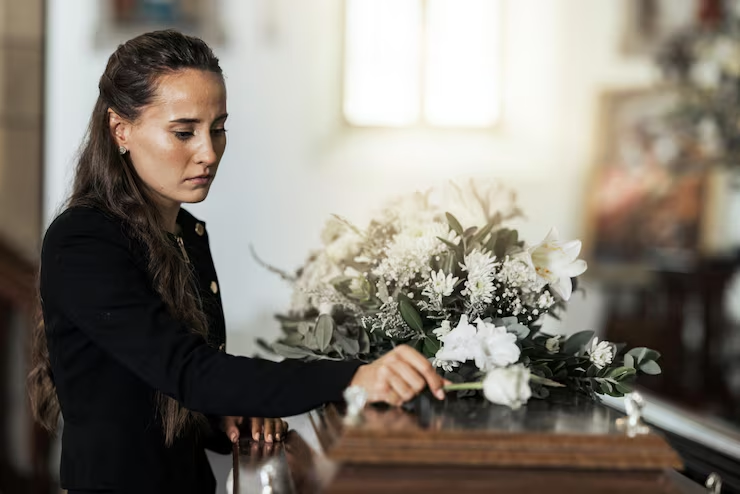
The air inside St. Michael’s Church in Portland, Oregon felt heavier than grief itself—thick with perfume, polished shoes, and the kind of fake sympathy people wear like a designer coat. Snow was melting on the steps outside, but inside, everything was frozen.
He walked in like a king returning to his throne. My brother—suit sharp, smile sharper. And on his arm was her. The same woman who once swore forever with her hand in mine, then vanished into his penthouse like I’d been a practice run.
Seven years later, she still had that look. The one that says I chose money over love and I’d do it again.
She brushed past me, close enough that her perfume hit like a slap.
And then she whispered the words that made the whole world go silent in my chest:
“So… I guess I won, right? You’re still poor.”
For a second I thought I’d snap—I thought I’d choke on rage, on shame, on every night I rebuilt myself from the ground up. But I didn’t.
I smiled.
I looked her dead in the eye and said calmly, “Yeah… well, meet my wife.”
And that’s when her face changed.
Because the woman standing next to me wasn’t someone she expected—not someone anyone expected. She didn’t wear diamonds. She didn’t need them. She stood like truth itself. Like consequence. Like the kind of woman who doesn’t compete because she already won by existing.
And right there, in the middle of my father’s funeral, I watched my ex realize something terrifying:
She didn’t win.
She just traded love for an illusion, and the bill had finally arrived.
Seven Years Earlier
My name is Nathan Cole. Seven years ago, I was twenty-eight years old, working as a middle school music teacher in Portland, making thirty-eight thousand dollars a year. I lived in a modest apartment, drove a twelve-year-old Honda Civic, and I was the happiest I’d ever been.
Because I was engaged to Sarah Winters.
Sarah was everything. Smart, funny, beautiful in the way that made you forget to breathe. She was a nurse at Oregon Health & Science University, and we’d met at a coffee shop where I was grading papers and she was studying for her boards.
We dated for two years. I proposed in the same coffee shop where we met, with a ring I’d saved for six months to buy. It wasn’t expensive—maybe two thousand dollars—but she cried when I put it on her finger.
“It’s perfect,” she whispered. “You’re perfect.”
We set a date. June fifteenth. A small wedding at a vineyard outside the city. Nothing extravagant—just family, close friends, and the promise of a life built together on love instead of money.
My brother was supposed to be my best man.
His name is Marcus Cole. He’s four years older than me, and he’s everything I’m not. Tall, confident, successful. He graduated from Stanford with an MBA and went straight into private equity. By the time he was thirty, he was a partner at a firm managing hundreds of millions of dollars.
My father adored him. My mother bragged about him at every family gathering. I was proud of him too, even though I knew I could never compete.
But I didn’t need to compete. I had Sarah.
Three months before the wedding, Marcus came to Portland for a visit. He’d been living in New York, but his firm was opening an office on the West Coast and he was overseeing the transition.
“I’ll be around more,” he told me over beers at a downtown bar. “Which means I can actually help with the wedding. Let me throw you guys a bachelor party. Let me do something.”
I was grateful. Marcus had always been generous, and I wanted my brother to be part of our celebration.
That was my first mistake.
The second mistake was introducing him to Sarah.
The Shift
It started small. Too small to notice at first.
Marcus started showing up at our apartment unannounced. “I was in the neighborhood,” he’d say, holding a bottle of wine or a box of pastries from some expensive bakery. Sarah would laugh and invite him in, and the three of us would sit around talking about wedding plans, work, life.
He was charming. Attentive. He asked Sarah about her nursing shifts, about her family, about her dreams. He listened in a way that made people feel seen.
I didn’t think anything of it. He was my brother. She was my fiancée. What could possibly go wrong?
Then the gifts started.
A spa package for Sarah because “she works so hard and deserves to relax.” Tickets to a concert she’d mentioned wanting to see. A designer handbag “just because.”
“Marcus, this is too much,” I told him one night after he’d sent her a gift basket worth at least three hundred dollars.
“Relax, Nate,” he said, clapping me on the shoulder. “She’s going to be my sister-in-law. I’m allowed to spoil her.”
Sarah loved it. She posted photos of the gifts on social media with captions like #BlessedWithTheBestFutureInLaws and #SpoiledByMyFutureBIL.
I told myself it was harmless. I told myself I was being paranoid.
But then Sarah started comparing.
“Marcus took me to lunch at this amazing restaurant downtown,” she mentioned one evening. “You should see the view from the top floor. It’s incredible.”
“That’s nice,” I said, trying to focus on the essays I was grading.
“He drives a Tesla, you know. The Model S. It’s so smooth. So quiet.”
I looked up. “Sarah, are you okay?”
“What? Yeah, I’m fine. I’m just saying, it’s a nice car.”
A week later, she asked me when I was planning to get a new car.
“I don’t know,” I said. “The Civic still runs fine.”
“But don’t you want something nicer? Something more… professional?”
“I’m a teacher, Sarah. I don’t need a professional car.”
She sighed. “I’m just saying, Marcus has his life together. He’s successful. He’s—”
“He’s not me,” I interrupted. “Is that what you’re trying to say?”
“No, of course not,” she said quickly. But the look in her eyes told me everything.
The Breakup
It happened three weeks before the wedding.
I came home early from school one day—there was a teacher planning session that got cancelled—and I found them on my couch.
They weren’t kissing. They weren’t touching. But they were sitting too close. Talking too quietly. And when I walked in, they both jumped like I’d caught them stealing.
“Nate,” Sarah said, standing up quickly. “You’re home early.”
“Yeah,” I said slowly, looking between them. “What’s going on?”
“Nothing,” Marcus said smoothly. “Just keeping Sarah company. She said you were going to be late.”
I looked at Sarah. “You told him I’d be late?”
She didn’t answer.
That night, after Marcus left, I confronted her.
“Sarah, what’s happening here?”
“Nothing’s happening,” she said defensively. “Marcus and I are just friends.”
“Friends don’t look at each other the way you two were looking at each other.”
“You’re being paranoid, Nate.”
“Am I?” I asked. “Because it feels like you’re pulling away from me. It feels like you’re comparing me to my brother and deciding I’m not good enough.”
She was quiet for a long time. Then she said, “Maybe I am.”
My stomach dropped. “What?”
“Maybe I am comparing you,” she said, her voice rising. “Maybe I’m realizing that I don’t want to spend my life struggling. Maybe I don’t want to live in a cramped apartment and worry about money and drive a piece of junk car.”
“We’re not struggling,” I said. “We’re building a life. Together.”
“You’re building a life,” she corrected. “I’m just along for the ride.”
“That’s not fair.”
“Isn’t it?” she asked. “Marcus has everything, Nate. Success. Money. Ambition. And you… you’re content with mediocrity.”
The words hit like a punch to the gut.
“So that’s it?” I asked quietly. “You want him instead of me?”
She didn’t answer.
Two days later, she gave me back the ring.
“I’m sorry,” she said, tears streaming down her face. “I can’t marry you.”
“Why?”
“Because I deserve more.”
She moved out that night. Marcus helped her pack.
The Aftermath
The wedding was cancelled. The deposits were lost. My family was humiliated. My friends didn’t know what to say.
And three months later, Sarah and Marcus got engaged.
My parents didn’t know how to handle it. My mother cried. My father said, “These things happen, Nathan. You’ll find someone else.”
But Marcus? Marcus didn’t apologize. He didn’t explain. He just moved Sarah to New York, bought her a penthouse apartment, and married her in a ceremony that cost more than I’d make in five years.
I stopped talking to him. I stopped going to family gatherings. I threw myself into my work and tried to forget.
But the anger never went away. The humiliation never faded.
For seven years, I carried it like a stone in my chest.
And then my father died.
The Return
My father’s funeral was held on a cold January morning. The church was packed with people who’d known him—business associates, old friends, family members I hadn’t seen in years.
I stood near the front, next to the woman who had saved me.
Her name is Dr. Elena Vasquez. She’s a trauma surgeon at OHSU. We met four years ago when I brought a student to the emergency room after a playground accident. She was the attending physician, calm and competent and brilliant.
We started talking. Then dating. Then building a life that had nothing to do with money or status or competition.
Elena didn’t care that I was a teacher. She didn’t care that I drove an old car. She loved me for who I was, not what I could provide.
We got married two years ago in a quiet ceremony at the courthouse. No fanfare. No expensive reception. Just us and two witnesses and the promise to build something real.
Elena is the kind of woman who doesn’t need to prove anything to anyone. She’s confident in her own skin, secure in her own success, and completely unbothered by people like Marcus and Sarah.
Which is why, when they walked into the church that morning, she just squeezed my hand and whispered, “You okay?”
“Yeah,” I said. “I’m okay.”
But I wasn’t. Not really. Because seeing Sarah after seven years brought everything back—the betrayal, the humiliation, the nights I spent wondering if I was ever good enough.
They sat in the second row, right behind my mother. Marcus wore a suit that probably cost five thousand dollars. Sarah wore a black dress and pearls, her hair perfect, her makeup flawless.
She looked like success. Like victory.
And when the service ended and people began mingling in the lobby, she made her way over to me.
The Confrontation
“Nathan,” she said, her voice dripping with false sympathy. “I’m so sorry about your father.”
“Thank you,” I said evenly.
She looked at Elena, then back at me. “And who’s this?”
“This is my wife, Elena,” I said.
Sarah’s smile tightened. “Your wife. How… nice.”
Elena extended her hand. “Nice to meet you.”
Sarah shook it briefly, then turned her attention back to me. Marcus was standing a few feet away, talking to someone, but I could see him watching us out of the corner of his eye.
“So,” Sarah said, lowering her voice. “How have you been, Nate? Still teaching?”
“Yeah,” I said. “Still teaching.”
She nodded, her smile turning smug. “That’s… good. Everyone needs teachers, right?”
“Right.”
She leaned in closer, and that’s when I smelled it—the same perfume she used to wear when we were together. It felt like a weapon.
“So… I guess I won, right?” she whispered. “You’re still poor.”
The words hung in the air between us. I could feel Elena stiffen beside me, but I didn’t need her to defend me.
Because for the first time in seven years, I wasn’t angry anymore.
I was just… done.
I smiled.
“Yeah,” I said calmly. “Well, meet my wife.”
Sarah blinked, confused. “I just did.”
“No,” I said. “I mean really meet her. Elena, tell Sarah what you do.”
Elena looked at me, then at Sarah. “I’m a trauma surgeon at OHSU.”
Sarah’s smile faltered slightly. “Oh. That’s… impressive.”
“Thanks,” Elena said. “I also teach at the medical school. And I’m on the board of directors for the hospital’s charitable foundation.”
Sarah’s face was starting to change now, the smugness draining away as she realized Elena wasn’t some struggling teacher’s wife—she was someone with real success, real accomplishments.
But I wasn’t done.
“And Sarah,” I said, “since we’re catching up, let me tell you something else. That apartment you and Marcus live in? The penthouse in Manhattan?”
Her eyes narrowed. “What about it?”
“My father bought it for him. As a wedding gift.”
Her face went pale.
“And the Tesla he drives? That was a bonus from his firm—after they nearly fired him last year for underperforming.”
Marcus had stopped talking now. He was staring at me, his face turning red.
“And that private equity firm he works for?” I continued. “They’re under federal investigation for fraud. Has he mentioned that?”
The lobby went quiet. People were starting to stare.
“Nate—” Marcus started.
“No,” I said, turning to face him. “You don’t get to talk. Not after what you did.”
“What I did?” he asked, his voice rising. “I fell in love. That’s what I did.”
“You stole my fiancée,” I said flatly. “Three weeks before our wedding. And you didn’t have the decency to apologize.”
“She chose me,” Marcus said. “That’s not my fault.”
“You’re right,” I said. “She did choose you. She chose money over love. And you know what? I hope it was worth it.”
I turned back to Sarah. Her face was ashen now, tears starting to form in her eyes.
“Because here’s the truth, Sarah,” I said quietly. “You didn’t win. You traded a life with someone who loved you for a life with someone who had money. And now you’re married to a man who’s about to lose everything.”
“That’s not true,” she whispered.
“Isn’t it?” I asked. “Ask him about the SEC investigation. Ask him why he’s been taking so many trips to DC. Ask him how long he thinks he can keep this up before it all comes crashing down.”
Marcus was silent now, his jaw clenched, his hands balled into fists.
“And you know what the worst part is?” I continued. “You could have had a simple, honest life. You could have had someone who loved you for who you were, not what you could provide. But you chose this. You chose appearances over substance. And now you’re stuck with a man who can’t even look his own brother in the eye.”
I turned to Elena. “We should go.”
She nodded, and we started walking toward the door.
Behind us, I heard Sarah’s voice, small and broken: “Nathan, wait—”
But I didn’t stop.
Because I was done waiting for apologies that would never come.
Three Months Later
The news broke in March.
Marcus’s firm was indicted on multiple counts of securities fraud. The partners were arrested. Assets were frozen. The company collapsed.
Marcus lost everything. The penthouse. The cars. The lifestyle Sarah had chosen him for.
They moved back to Portland, into a small apartment not unlike the one Sarah and I had shared seven years ago. Marcus took a job at a local bank, making a fraction of what he used to make.
Sarah got a job at a different hospital—not OHSU, where Elena worked, but a smaller facility on the outskirts of town.
I heard through my mother that they were struggling. That Sarah was miserable. That Marcus blamed her for pushing him to maintain a lifestyle he couldn’t afford.
My mother called me one evening, her voice hesitant.
“Nathan,” she said. “I know you don’t want to hear this, but… Marcus is in trouble. Real trouble. He’s talking about bankruptcy. He’s—”
“Mom,” I interrupted gently. “I’m sorry he’s struggling. I really am. But I can’t help him.”
“I’m not asking you to help him financially,” she said. “I’m asking you to forgive him.”
I was quiet for a long time.
“I don’t know if I can,” I admitted.
“He’s your brother.”
“He was my brother,” I corrected. “Before he betrayed me.”
“People make mistakes, Nathan.”
“And people live with the consequences of those mistakes,” I said. “That’s not cruel. That’s just life.”
She sighed. “You’ve become hard.”
“No,” I said. “I’ve become honest.”
One Year Later
A year after the funeral, Elena and I were sitting on our back porch, watching the sun set over the city. We’d just finished dinner—nothing fancy, just pasta and salad—and we were talking about our day.
“I saw Sarah today,” Elena mentioned casually.
I looked at her. “Where?”
“At the hospital. She was dropping off paperwork for a transfer request.”
“She’s leaving Portland?”
“Apparently. She and Marcus are moving to Seattle. Fresh start, I guess.”
I nodded slowly. “Good for them.”
Elena studied my face. “You really mean that, don’t you?”
“Yeah,” I said. “I do.”
“No anger? No resentment?”
“I’ve been carrying that around for seven years,” I said. “It’s exhausting. And you know what? They’re not worth it.”
She smiled and leaned against me. “You’re a good man, Nathan Cole.”
“I married a good woman,” I replied.
We sat in comfortable silence for a while, watching the light fade from the sky.
“You know what’s funny?” I said eventually.
“What?”
“She thought she won. She thought choosing money over love was the smart play. But she ended up with neither.”
“And you ended up with both,” Elena said.
I laughed. “I didn’t end up with money.”
“You have enough,” she said. “And you have love. Real love. The kind that doesn’t disappear when things get hard.”
She was right. I had enough. Enough money to pay my bills and save a little. Enough friends to fill my life with laughter. Enough purpose to get up every morning excited about my work.
And I had Elena. Which was more than enough.
Epilogue: Five Years Later
It’s been five years since my father’s funeral. Five years since I saw Sarah whisper those words in the church lobby.
I guess I won, right? You’re still poor.
I’m thirty-eight now. Still teaching. Still driving an old car, though I upgraded to a newer used Honda a few years back. Still living in Portland.
Elena and I have a daughter now. Her name is Grace, and she’s two years old. She has her mother’s dark eyes and my messy hair, and she’s the light of our lives.
We don’t have a big house. We don’t have expensive cars. We don’t take extravagant vacations.
But we have Sunday mornings making pancakes. We have bedtime stories and neighborhood walks. We have the kind of life that’s built on love instead of appearances.
And we have each other.
I heard through my mother that Marcus and Sarah are still together. Still struggling. Still trying to rebuild what they lost.
I hope they figure it out. I really do. Not for my sake, but for theirs.
Because holding onto bitterness doesn’t hurt the people who wronged you—it only hurts you.
And I’m done hurting.
Last week, I ran into Sarah at a grocery store. It was the first time I’d seen her in five years. She was pushing a cart full of generic brands and store-brand cereal, looking tired but somehow… softer.
She saw me and froze.
“Nathan,” she said.
“Hey, Sarah.”
We stood there awkwardly for a moment, the fluorescent lights humming overhead.
“How are you?” she asked finally.
“I’m good,” I said. “Really good. You?”
She nodded slowly. “We’re… managing. It’s been hard, but we’re figuring it out.”
“I’m glad,” I said, and I meant it.
“I heard you have a daughter,” she said quietly.
“Yeah. Grace. She’s two.”
“That’s wonderful.” She looked like she wanted to say more, but couldn’t find the words.
So I said them for her.
“Sarah, I forgive you.”
She looked up, tears in her eyes. “What?”
“For what happened. For all of it. I forgive you.”
“Why?” she whispered.
“Because I’m happy,” I said simply. “And holding onto anger was keeping me from being fully happy. So I’m letting it go.”
She nodded, wiping her eyes. “Thank you.”
“Take care of yourself, Sarah.”
“You too, Nathan.”
I walked away, pushing my cart toward the checkout, feeling lighter than I had in years.
Because forgiveness isn’t about saying what someone did was okay. It’s about releasing yourself from the burden of carrying their mistakes.
And I was finally free.
That night, I told Elena about running into Sarah. She listened quietly, then asked, “How do you feel?”
“Honestly?” I said. “I feel relieved. Like I can finally close that chapter.”
“Good,” she said, kissing my forehead. “Because this chapter—our chapter—is pretty great.”
She was right.
This chapter was pretty great.
And it had nothing to do with money or status or winning some imaginary competition.
It had everything to do with love. Real, honest, unglamorous love.
The kind that shows up on Tuesday mornings. The kind that stays when things get hard. The kind that builds a life instead of just a lifestyle.
Sarah thought she won when she chose Marcus over me.
But she didn’t win anything. She just traded one kind of struggle for another.
And me?
I didn’t lose anything.
I gained everything.
Because the woman standing next to me at my father’s funeral wasn’t there to compete with Sarah or prove a point.
She was there because she loved me.
And that, more than anything else, is what winning actually looks like.