The Guest
“For your sister.” He didn’t lower his voice. He didn’t soften it. He said it like a verdict—like my bank account was a family emergency fund he could tap whenever Madison detonated another phase of her life.
The first warning came at 2:03 a.m.
A utility alert lit up my phone: Power scheduled for disconnection in 48 hours — Oak Street.
The house. The family house. The one my parents live in. The one my twenty-four-year-old sister drifts in and out of whenever her newest reinvention collapses.
I stared at the screen, nauseous.
Three weeks earlier, I’d wired my mom a thousand dollars “for bills.” The electricity should’ve been covered. It wasn’t. And I already knew where the money went, even before anyone admitted it.
So I paid the balance. Again.
Because I’m always the one who does.
Oak Street isn’t just a building. It’s a three-generation Victorian—ornate trim, real wood, history in every corner. Five years ago, my dad leveraged it for a “sure thing” business deal. The deal collapsed. The bank didn’t hesitate. The foreclosure clock started ticking.
My mom cried.
Madison panicked about her lifestyle.
My dad sat in silence like denial could stop paperwork.
I emptied my savings. Took out a brutal loan in my own name. Bought the house back at auction.
When I handed my father the truth—that the deed was now mine—he didn’t thank me.
He just said, “At least it stays in the family.”
Apparently, that meant I paid… and he decided.
The Barbecue
Then came the barbecue.
Late August. Thick air. Overgrown grass. Madison sobbing beside a brand-new white BMW she “couldn’t sell because it’s part of her brand.”
“I owe thirty thousand,” she cried, mascara running down her face in perfect theatrical rivers.
My dad turned to me like gravity itself required my compliance.
“Logan—”
“No,” I said.
One word. Calm. Finished.
The silence afterward wasn’t awkward—it was coordinated. Like everyone silently agreed I’d broken an unspoken rule.
“Logan, she’s your sister,” my mom said softly, her voice carrying that specific tone of maternal guilt she’d perfected over three decades.
“She’s twenty-four,” I replied. “I’m not a bank.”
“But you have the money,” Madison said, her voice shifting from tears to accusation in a heartbeat. “You make six figures. You don’t even have kids. What else are you spending it on?”
I looked at her—really looked at her. The designer sunglasses pushed up on her head. The manicured nails. The BMW with the custom leather seats that she’d bought three months after quitting her last job because her boss “didn’t respect her vision.”
“I’m spending it on not going into debt to fund your Instagram aesthetic,” I said evenly.
My father’s jaw tightened. “That’s enough. Family helps family.”
“I bought this house,” I reminded him. “That’s helping family. This is enabling Madison.”
“You’re being selfish,” Madison spat.
I stood up, grabbed my keys, and left. Behind me, I heard my mother’s voice: “Logan, please…”
But I kept walking.
The Call
Two weeks later, my cousin Jenna called.
“Why is there a dumpster in the driveway?” she asked, confusion thick in her voice. “And a moving truck?”
My stomach dropped. “What are you talking about?”
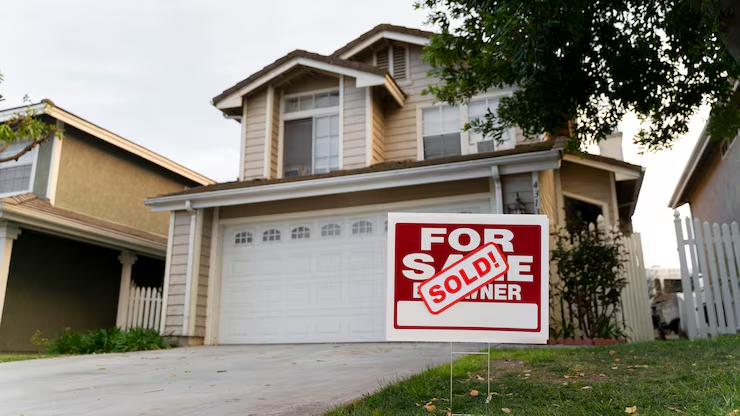
“At Oak Street. I was driving by and saw people loading furniture. There’s a ‘Sold’ sign on the door.”
I hung up and drove to Oak Street with my pulse in my ears, my hands gripping the steering wheel so hard my knuckles went white.
When I pulled up, the scene was worse than I’d imagined.
Two men were carrying my grandfather’s hand-carved sideboard—the one he’d made by hand in 1957, the one my grandmother had polished every Sunday for forty years—into an unmarked truck.
On the front door, slapped over the brass knocker like a death certificate, was a red sticker:
SOLD — PRIVATE SALE
My father stepped outside in his best suit, the navy one he wore to weddings and funerals, smiling like it was a victory parade.
“I fixed everything,” he announced, spreading his arms wide. “I sold the house.”
My mouth went dry. The world seemed to tilt sideways.
“You can’t,” I managed. “You don’t own—”
He cut me off, leaning closer, voice rising just enough for the movers to hear, establishing his authority in front of witnesses.
“I need cash,” he snapped. “Madison is drowning. The car payment, the credit cards, the rent on that ridiculous apartment—she’s twenty-four and she’s already ruined. I’m doing this for your sister. Someone has to save her, and apparently you’ve decided it won’t be you.”
I didn’t yell.
I didn’t argue.
I pulled out my phone and called Marcus Chen, my real estate attorney. The one who’d handled the auction purchase. The one who’d filed all the paperwork five years ago.
He answered on the second ring. “Logan?”
“Marcus, I need you to explain something to me,” I said, my voice dangerously calm. “If I own a property—full deed, clear title, my name only—can someone else sell it without my permission?”
There was a pause. “No. That’s fraud. That’s a felony. Why? What’s happening?”
“Someone just sold my house.”
“I’ll be there in twenty minutes. Don’t sign anything. Don’t let anyone remove anything else. And call the police.”
I hung up and looked at my father.
He’d gone pale. The confidence was draining from his face like water from a cracked glass.
“You’re bluffing,” he said, but his voice wavered.
“Am I?” I pulled up my email, found the deed, and turned the screen toward him. “This is the deed to 412 Oak Street. See that name right there? Logan Michael Carter. Not David Carter. Not ‘the Carter family.’ Just me.”
“But I live here,” he said, and now the panic was creeping in. “This is my house. I’ve lived here for thirty years.”
“You live here as my guest,” I corrected. “A guest I’ve never charged rent. A guest whose utilities I’ve paid. A guest who apparently thinks hospitality means ownership.”
My mother appeared in the doorway, her face crumpling when she saw my expression.
“Logan, please,” she started. “We didn’t mean—”
“Who did you sell it to?” I asked, cutting her off.
My father’s jaw clenched. “A nice family. Cash buyer. They’re paying four hundred fifty thousand.”
“Four hundred fifty?” I laughed, but it was a hollow, bitter sound. “The property’s worth six hundred minimum. You undersold my house by at least a hundred fifty thousand dollars.”
“It was a fast sale,” he defended. “We needed the money now.”
“You needed the money,” I corrected. “For Madison’s BMW. For her credit cards. For whatever crisis she’s manufactured this week.”
“She’s family!” my father shouted.
“So am I!” I shouted back, finally losing control. “I’m the one who saved this house! I’m the one who’s been paying your bills! I’m the one who actually showed up when everything fell apart! But somehow, I’m the one who doesn’t count!”
The Police
Marcus arrived first, pulling up in his Tesla with a leather briefcase and an expression that meant business. He took one look at the moving truck and shook his head.
“Nobody moves another item,” he called out to the movers. “This sale is fraudulent.”
One of the movers, a beefy guy in a stained tank top, stepped forward. “Look, man, we got paid to move—”
“By someone who doesn’t own the property,” Marcus interrupted smoothly. “So unless you want to be accessories to theft and fraud, I suggest you stop.”
The movers looked at each other, then at my father, then back at Marcus. They set down the box they were holding.
Five minutes later, a police cruiser rolled up.
Officer Patterson stepped out—a woman in her forties with tired eyes and no patience for nonsense. I knew her vaguely from high school; she’d been two years behind me.
“Someone want to tell me what’s going on?” she asked.
Marcus handed her a folder. “The property at this address is owned by Logan Carter. His father, David Carter, attempted to sell it without his knowledge or consent. That’s fraud and theft. We need the sale stopped and charges filed.”
Officer Patterson flipped through the documents—the deed, the property tax records, everything with my name on it. Then she looked at my father.
“Mr. Carter, is this your property?”
“It’s the family home,” he said stubbornly. “I’ve lived here for—”
“That’s not what I asked. Is this property deeded in your name?”
Silence.
“Sir, I need an answer.”
“No,” he finally admitted. “It’s in Logan’s name. But he’s my son. He wouldn’t—”
“He would,” I interjected. “And I am. Officer, I want to press charges for attempted fraud. And I want him evicted.”
My mother gasped. “Logan, no. Please.”
“You tried to sell my house,” I said, my voice shaking now, all the years of being the backup plan, the safety net, the one who didn’t matter finally erupting. “You forged documents. You took bids. You accepted an offer. You hired movers. All without asking me. Without even telling me.”
“Because you would have said no!” my father exploded. “You always say no when it comes to Madison!”
“Because Madison is an adult who needs to face consequences!” I shouted back. “She’s not a child! She’s not disabled! She’s not incapable! She’s just spoiled! And every time you bail her out, you make it worse!”
Officer Patterson held up a hand. “Everyone calm down. Mr. Carter—David Carter—I need you to come with me to the station. We need to sort this out officially.”
“I’m not going anywhere,” my father said.
“Sir, you can come voluntarily or I can arrest you for attempted fraud and theft. Your choice.”
The color drained completely from his face.
My mother started crying. “David, just go. We’ll fix this. We’ll explain—”
“There’s nothing to explain,” I said flatly. “He tried to steal my house. There’s no explaining that away.”
The Buyers
As my father was being led to the patrol car, another car pulled up—a Honda Odyssey with a “Baby on Board” sticker. A couple in their thirties got out, looking confused.
“Is this 412 Oak Street?” the man asked. “We’re the Johnsons. We’re supposed to be closing today.”
Marcus stepped forward. “I’m sorry to inform you, but the sale is invalid. The person who sold you this property doesn’t own it.”
The woman’s face fell. “What? But we put down earnest money. Fifty thousand dollars. We gave up our apartment. Our furniture is in storage. We were supposed to move in today.”
I felt a twist of sympathy. They were innocent in this. Victims of my father’s desperation and stupidity.
“I’m truly sorry,” I said. “But my father committed fraud. He doesn’t own this house. I do. And I never agreed to sell it.”
“But we have a contract,” the husband said, pulling out papers. “Signed by David Carter, owner.”
“David Carter is not the owner,” Marcus explained patiently. “Logan Carter is the owner. The deed is in his name. Your contract is void. However, you should be able to recover your earnest money from the escrow account. If not, you’ll have legal recourse against David Carter personally.”
The wife started crying. “We’ve been saving for three years. We have two kids. This was supposed to be our forever home.”
I closed my eyes, feeling the weight of their disappointment even though none of this was my fault.
“I’m sorry,” I said again. “But I can’t fix this for you. My father created this situation, not me.”
They left, devastated, and I felt like garbage even though I’d done nothing wrong.
The Sister
An hour later, Madison showed up.
She stormed out of her BMW, still in her yoga pants and designer hoodie, her face flushed with fury.
“What the hell did you do?” she screamed. “Dad’s at the police station! Mom’s hysterical! You’re destroying this family!”
“I’m destroying it?” I asked incredulously. “Madison, Dad tried to sell my house without telling me. To pay your debts. How is that my fault?”
“You could have just helped me!” she cried. “Thirty thousand dollars is nothing to you!”
“It’s a year’s worth of careful saving,” I said. “It’s security. It’s stability. And most importantly, it’s mine. Not yours.”
“I’m your sister!”
“And I’m not your ATM!” I shouted. “I’ve given you money before, Madison. Remember? I paid off your car three years ago. You promised you’d never ask again. Then you bought a new car you can’t afford. I paid for your apartment deposit two years ago. You swore you’d get a job and make it work. You got fired for showing up late and then quit the next two jobs because they ‘didn’t align with your energy.’ I gave you five thousand dollars last Christmas. You spent it on a trip to Bali.”
“I needed that trip! I was burned out!”
“From what? You don’t work!”
She slapped me.
The sound cracked across the lawn like a gunshot. My face stung. Officer Patterson, who was still there finishing paperwork, stepped forward immediately.
“Ma’am, that’s assault. I can arrest you right now.”
Madison burst into tears. “He’s ruining everything! Dad was just trying to help me! Logan has all this money and he won’t share it!”
“I earned it,” I said quietly, my cheek still burning. “I work sixty-hour weeks. I didn’t buy a BMW on credit. I don’t take vacations I can’t afford. I make choices, Madison. You make excuses.”
“You’re cruel,” she spat.
“No,” I said. “I’m tired. And I’m done.”
The Fallout
My father was charged with attempted fraud. The DA offered him a plea deal: probation, restitution to the Johnsons for their earnest money and moving expenses, and a permanent restraining order preventing him from making any decisions regarding my property.
He took the deal. He had no choice.
My mother begged me to drop the eviction notice.
“Where will we go?” she cried. “We have no savings. Your father can’t get a loan now with the criminal charges. Please, Logan. We’re your parents.”
I looked at her—really looked at her. At the woman who’d stood by silently every time Madison got bailed out. Who’d never once said, “Maybe Logan deserves consideration too.” Who’d watched my father try to steal my house and said nothing until it affected her.
“You can stay,” I said finally. “But things are changing.”
I drew up a formal lease. Market rate rent: twenty-five hundred a month. They’d pay utilities. They’d maintain the property. And Madison was not allowed to live there—not even temporarily.
“We can’t afford twenty-five hundred a month,” my mother protested.
“Then Dad needs to get a job,” I said. “He’s sixty-two, not dead. And you can work too. I’ve been carrying this family for five years. It’s time you carried yourselves.”
“You’re punishing us,” she said.
“No,” I replied. “I’m establishing boundaries. Something I should have done years ago.”
Madison’s Response
Madison, predictably, lost her mind.
She called me seventeen times in one day. When I finally answered, she screamed for ten minutes straight about how I was selfish, cruel, vindictive, and destroying the family.
“You have the money!” she kept repeating. “You could help and you’re choosing not to!”
“You’re right,” I said calmly. “I’m choosing not to. Because help implies temporary assistance toward improvement. What you want is permanent funding for irresponsibility. Those aren’t the same thing.”
“I hate you,” she said.
“That’s fine,” I replied. “But you still owe thirty thousand dollars, and I’m not paying it.”
She hung up on me.
Two weeks later, her BMW was repossessed. She called, crying, begging me to get it back.
“No,” I said.
“But how will I get to work?”
“You don’t have a job.”
“I’m looking!”
“Then you’ll have plenty of time to take the bus.”
She hung up again.
Six Months Later
It’s been six months since the day my father tried to sell my house.
Six months since I stopped being the family safety net.
My father got a job at Home Depot. Part-time, but it’s something. My mother started cleaning houses three days a week. They make their rent—barely—but they make it.
Madison moved in with her latest boyfriend. He makes decent money and apparently enjoys funding her lifestyle. I give it six months.
I’ve started sleeping better. The constant anxiety about when the next crisis will hit, when the next phone call will come demanding money, when the next guilt trip will arrive—it’s gone.
I went on a vacation. A real one. Two weeks in Iceland. I hiked glaciers and saw the Northern Lights and didn’t check my phone for four days straight.
My cousin Jenna asked me if I felt guilty.
“Sometimes,” I admitted. “But then I remember that Dad tried to sell my house without telling me. That Madison slapped me for not funding her lifestyle. That Mom stood by silently while they both treated me like an ATM with legs. And the guilt fades pretty quick.”
“Do you think they’ve learned anything?” she asked.
I laughed. “Dad’s learned that fraud has consequences. Madison’s learned that if she cries loud enough, someone else will probably cave. Mom’s learned that she actually can work. I don’t know if those are the lessons they needed, but they’re the ones they got.”
“And what did you learn?”
I thought about it. “I learned that you can’t save people from themselves. I learned that being family doesn’t mean being a victim. And I learned that the word ‘no’ is a complete sentence.”
The Final Call
Last week, Madison called again.
I almost didn’t answer. But curiosity got the better of me.
“What?” I asked.
“I wanted to say I’m sorry,” she said.
I waited. There’s always a but.
“I’m sorry,” she repeated. “I treated you like a bank. I used you. I took advantage of your kindness. And I was wrong.”
Still waiting for the but.
“That’s it,” she said. “No ask. No favor. I just… I wanted you to know I’m sorry. And I’m trying to do better.”
“Are you?” I asked.
“My boyfriend kicked me out,” she admitted. “Turns out he wasn’t as okay with my spending as he pretended. So I’m back at Mom and Dad’s. Sleeping on the couch. Dad’s making me pay three hundred a month in rent. And Mom has me helping with her cleaning business.”
“Good,” I said.
“It sucks,” she said, but there was something different in her voice. “But also… I’m getting it. I think. What you were trying to tell me. That actions have consequences. That I can’t just expect other people to fix my messes.”
“That’s progress,” I acknowledged.
“I got a job,” she said. “Hostess at a restaurant. It’s not glamorous. But it’s steady. And I’m thinking about going back to school. Maybe for business management.”
“That’s good, Madi,” I said, using the childhood nickname I hadn’t used in years.
“Can I ask you something?” she said.
“You can ask.”
“Do you think you’ll ever forgive me? Not now, but eventually?”
I considered it. “I don’t know. But I think there’s a difference between forgiveness and trust. I might forgive you someday. But trust? That’ll take years. If it happens at all.”
“That’s fair,” she said quietly. “Logan?”
“Yeah?”
“Thank you. For not giving in. I know it doesn’t feel like it, but… hitting rock bottom was the best thing that ever happened to me.”
We hung up.
I don’t know if Madison’s changed for real or if this is just another phase. I don’t know if my parents have actually learned anything or if they’re just behaving because they have to.
But I know this: I’m not responsible for fixing them. I’m not required to set myself on fire to keep them warm. And I’m not the bad guy for having boundaries.
The house on Oak Street still stands. The Victorian with three generations of history.
But now it has one very clear rule: I own it. Everyone else is just a guest.
And guests who don’t respect the host? They don’t get invited back.
My name is Logan Carter. I’m thirty-two years old. I bought my family’s house when they lost it, and my father tried to sell it without my permission to bail out my sister.
I said no. I pressed charges. I drew boundaries.
And for the first time in my life, I’m not the one paying for everyone else’s choices.
If this story sounds familiar—if you’re the responsible one, the backup plan, the emergency fund—remember this: You don’t owe people your financial ruin. You don’t owe them your mental health. And you don’t owe them access to assets you earned.
Family doesn’t mean servitude. It means mutual respect.
And anyone who can’t give you that?
They’re just guests in your life. And you’re allowed to change the locks.