The Brake Line
It was nearly midnight when I stepped into the garage, the door rolling up with its familiar metallic rattle. I had a bag of fried chicken tucked under my arm—still warm, still smelling like salt and grease and the small promise of a quiet night after a long shift.
That promise lasted about two seconds.
From the far end of the garage, I heard my stepson’s voice. Not raised. Not tense. Calm. Casual. The way someone sounds when they’re discussing something already settled, already done.
“Yeah,” he said softly into his phone. “It’s done.”
I froze mid-step, one hand still on the door handle.
“There’s no way the brakes hold the way they’re supposed to,” he continued, his tone matter-of-fact. “Not tomorrow.”
The bag of chicken crinkled in my grip. I didn’t move. Through the half-open side door that led from the garage into the house, I could see the blue glow of his phone screen washing over his face. He leaned against the workbench like he was killing time, like this was just another Thursday night conversation.
Then he added, almost lazily, “It’ll handle itself.”
My pulse started to pound so hard I could feel it in my ears, in my throat. I waited—desperate, silently begging—for the conversation to turn. For whoever was on the other end to shut it down. For him to laugh and say he was joking. For something that sounded like hesitation or second thoughts or basic human decency.
Instead, a voice came through the speaker. A woman’s voice.
My wife’s voice.
Calm. Measured. Clinical.
“You’re certain?” she asked.
“Yeah,” he replied without missing a beat. “He won’t make it far.”
There was a pause. The kind of pause where your brain scrambles to rewrite reality, to find some explanation that isn’t the obvious one. The kind of pause where you hope desperately that you misunderstood.
Then my wife exhaled—slow, relieved, satisfied.
“Okay,” she said. “Just be careful. Tomorrow.”
That was the moment it clicked.
This wasn’t a joke.
This wasn’t teenage stupidity.
This was deliberate.
And I was the problem they were trying to solve.
The Man They Thought I Was
My name is David Brennan. I’m forty-seven years old. I work as a logistics coordinator for a shipping company, which means I spend my days tracking containers, negotiating delivery schedules, and solving problems that most people don’t even know exist.
It’s not glamorous. It’s not exciting. But it pays well, and it’s steady.
I married Rebecca three years ago. She came with a seventeen-year-old son named Tyler—a quiet kid who spent most of his time in his room, gaming or scrolling through his phone. I didn’t try to be his father. He had a father. I just tried to be… present. Respectful. Someone he could count on if he needed it.
Rebecca was different from my first wife. Organized. Controlled. She had spreadsheets for grocery shopping and color-coded calendars for appointments. At first, I found it charming—a sign that she had her life together.
But over time, the organization started to feel less like efficiency and more like calculation.
She asked questions about my insurance policy. About my retirement accounts. About what would happen to the house if something happened to me.
“Just planning ahead,” she’d say with a smile. “Being responsible.”
I didn’t think much of it. People plan. People prepare. That’s what adults do.
But now, standing in my garage with a bag of cold chicken and my stepson’s words echoing in my ears, those conversations took on a different weight.
He won’t make it far.
I stepped backward, quietly, carefully. I eased the garage door back down without letting it slam. I walked to my car—not the truck, the sedan I used for errands—and I got in.
My hands were shaking so badly I could barely get the key in the ignition.
I sat there for a moment, engine idling, trying to process what I had just heard. Trying to find some alternate explanation that didn’t end with my wife and stepson planning my death.
But there wasn’t one.
I pulled out of the driveway and drove three blocks before I pulled over and made the first call.
The Tow
The dispatcher at Morton’s Towing sounded bored, like this was just another breakdown on just another Thursday night.
“What’s the vehicle?” she asked.
“2019 Ford F-150,” I said, my voice steadier than I expected. “Black. License plate Delta-Foxtrot-Seven-Two-Four-Nine.”
“And the issue?”
“The brakes,” I said. “They’re not safe.”
“Can you drive it?”
“No,” I said firmly. “It’s not safe to drive.”
There was a pause. I could hear her typing.
“Okay, we can have someone there in twenty to thirty minutes. Where are we taking it?”
I gave her an address—a mechanic shop across town that I trusted, run by a guy named Paul who had worked on my vehicles for years. I also gave her explicit instructions: the truck was not to be driven under any circumstances. Flatbed only. And I wanted photos of everything before it was moved.
“No problem,” she said. “We’ll take care of it.”
I hung up and sat in the dark, staring at the dashboard clock. Twelve-seventeen AM.
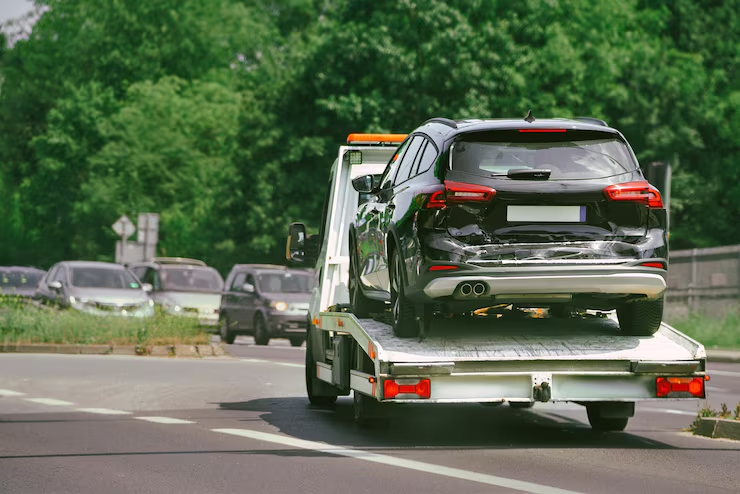
Twenty minutes later, my phone buzzed. A text from the tow driver with a photo: my truck on the flatbed, secured with chains, ready to go.
I saved the photo. Then I made the second call.
The Father
Tyler’s biological father is named Marcus Webb. He’s a cop—a detective with the county sheriff’s department. He and Rebecca divorced when Tyler was eight, and from what I understood, the split was ugly. Custody battles. Accusations. Lawyers.
Rebecca got primary custody. Marcus got every other weekend and alternating holidays.
I’d met him a handful of times—stiff, awkward exchanges when he picked Tyler up or dropped him off. He was polite but cold, the way people are when they’re being professional instead of friendly.
I didn’t have his number saved in my phone. I had to look it up in the paperwork from when we refinanced the house, where Rebecca had listed him as Tyler’s emergency contact.
The phone rang twice before he picked up.
“Webb,” he said, his voice rough with sleep.
“Detective Webb, this is David Brennan. Rebecca’s husband.”
There was a pause. I could hear him shifting, sitting up.
“What’s wrong?” he asked, suddenly alert. “Is Tyler okay?”
“Tyler’s fine,” I said. “Physically. But I need to talk to you about something he did tonight.”
“What did he do?”
“He tampered with my truck,” I said. “The brakes. I overheard him telling Rebecca that I wouldn’t make it far if I drove it tomorrow.”
Silence.
“Are you serious?” Marcus asked, his voice low and dangerous.
“I’m dead serious,” I said. “I had the truck towed to Paul’s Auto on Seventh Street. I’m having it examined first thing in the morning. But I thought you should know. And I thought… given your line of work… you might want to be there when they look at it.”
Another pause. Longer this time.
“I’ll be there,” he said. “What time?”
“Eight AM.”
“I’ll be there at seven-thirty,” he said. Then, quieter: “Is Rebecca involved?”
“Yes,” I said. “She was on the phone with him. She knew.”
He exhaled slowly. “Jesus Christ.”
“Yeah.”
“David,” he said, and for the first time, his voice softened. “You did the right thing calling me. Don’t go back to that house tonight. You hear me? Don’t go back.”
“I wasn’t planning on it,” I said.
“Good. I’ll see you in the morning.”
He hung up.
I sat in my car for another ten minutes, staring at the phone, wondering if I had just set something in motion that couldn’t be stopped.
Then I drove to a hotel and checked in under a fake name.
The Messages
I didn’t sleep. I lay on top of the scratchy hotel comforter, fully clothed, staring at the ceiling while my phone buzzed relentlessly on the nightstand.
The first message came at 12:47 AM.
Where are you?
Then, five minutes later:
Why is the truck gone?
Then:
Did you move it?
Then:
David, answer me.
I didn’t respond. I just watched the messages pile up, each one sharper than the last, panic bleeding through the carefully constructed calm.
At 1:23 AM, Tyler started texting.
Hey, where’d the truck go?
Dad?
You home?
I didn’t answer him either.
At 2:15 AM, Rebecca called. I let it go to voicemail. She called again at 2:18. Again at 2:22.
Finally, at 2:30, she left a message.
“David, I don’t know what’s going on, but you’re scaring me. Please call me back. Please. Just let me know you’re okay.”
Her voice sounded worried. Concerned. The voice of a wife who just wanted to know her husband was safe.
It was a good performance.
I deleted the voicemail and turned off my phone.
The Garage
Paul’s Auto opened at seven AM. I arrived at seven-fifteen, clutching a cup of gas station coffee that tasted like burnt rubber.
Paul was already there, a stocky man in his fifties with grease-stained hands and a perpetually skeptical expression. He looked at me as I walked in.
“David,” he said. “Got your truck in the back. You said something about the brakes?”
“Yeah,” I said. “I need you to check them. Thoroughly.”
“What’s going on?”
“Just check them,” I said. “Please.”
He studied me for a moment, then nodded. “Alright. Give me an hour.”
“I’ll wait,” I said.
At 7:35, a black sedan pulled into the lot. Marcus Webb stepped out, dressed in jeans and a leather jacket, his badge clipped to his belt. He looked tired, but his eyes were sharp.
“David,” he said, shaking my hand.
“Thanks for coming,” I said.
“Where’s the truck?”
“In the bay. Paul’s looking at it now.”
Marcus nodded. “Let’s go.”
We walked into the garage together. Paul was already under the truck, a work light in one hand, muttering to himself.
“Paul,” I called. “This is Detective Webb. He’s going to observe.”
Paul slid out from under the truck and looked at Marcus. His expression shifted—recognition, maybe caution.
“Detective,” he said.
“Paul,” Marcus replied. “What are we looking at?”
Paul wiped his hands on a rag. “Well, I’m not done yet, but I can tell you this much: someone’s been messing with the brake lines.”
My stomach dropped.
“Show me,” Marcus said.
Paul slid back under the truck, and Marcus crouched down next to him. I stood there, frozen, listening to them talk in low voices about fluid leaks and cut lines and pressure failures.
After ten minutes, they both slid out.
Paul looked at me, his face grim. “David, if you had driven this truck today, you’d have been fine for the first few miles. But the moment you hit the brakes hard—say, at a stoplight or on the highway—the line would’ve blown. No brakes. No way to stop.”
“Jesus,” I whispered.
Marcus pulled out his phone and started taking photos. “Paul, I need you to document everything. Every cut, every mark, every tool impression. Can you do that?”
“Yeah,” Paul said quietly. “I can do that.”
Marcus turned to me. “David, I need you to walk me through exactly what you heard last night.”
So I did. I told him about coming home. About hearing Tyler’s voice. About the phone call with Rebecca. About the exact words they used.
It’s done. He won’t make it far. Just be careful tomorrow.
Marcus’s jaw tightened with every sentence.
When I finished, he was silent for a long moment.
Then he said, “I’m going to need you to come down to the station and make a formal statement. And I’m going to need to talk to Tyler. And Rebecca.”
“Are you arresting them?” I asked.
“Not yet,” he said. “But I will. Attempted murder, conspiracy, tampering with a vehicle… yeah. They’re going down.”
He looked at me, and for the first time, I saw something that might have been sympathy.
“I’m sorry,” he said. “I know this isn’t easy.”
“It’s not,” I agreed. “But it’s better than being dead.”
The Station
The interview room at the sheriff’s station was exactly what you’d expect: gray walls, a metal table, a camera in the corner. Marcus sat across from me with a recorder between us.
“For the record,” he said, “this is Detective Marcus Webb interviewing David Brennan regarding an incident that occurred on the night of November fourteenth. David, you’re here voluntarily, correct?”
“Correct,” I said.
“And you understand that this conversation is being recorded?”
“I do.”
“Good. Tell me what happened.”
So I told him. Again. Every detail. Every word. Every inflection.
When I finished, he leaned back in his chair.
“David, I need to ask you something,” he said. “And I need you to be honest. Is there any chance you misheard? Any chance this was a misunderstanding?”
“No,” I said firmly. “I know what I heard.”
He nodded slowly. “Okay. Then here’s what’s going to happen. I’m going to bring Tyler in for questioning. And depending on what he says, I’m going to arrest him. And Rebecca.”
“What do I do?” I asked.
“You stay away from them,” he said. “You don’t go back to that house. You don’t answer their calls. You let me handle this.”
“Okay,” I said.
He stood up. “Thank you for coming forward. A lot of people wouldn’t have.”
“A lot of people don’t overhear their own murder being planned,” I said.
He didn’t smile. “No. They don’t.”
The Arrest
Tyler was arrested three hours later. Marcus picked him up at the house while he was still in his pajamas, eating cereal in front of the TV.
Rebecca called me seventeen times while it was happening. I didn’t answer.
When Marcus brought Tyler into the interrogation room, he tried to play it cool. Shrugged. Acted confused. Said he didn’t know what they were talking about.
Then Marcus showed him the photos of the brake lines.
Tyler’s face went white.
“That’s not… I didn’t…” he stammered.
“We have the tools you used,” Marcus said calmly. “We found them in your toolbox in the garage. Your prints are all over them.”
Tyler’s mouth opened and closed like a fish.
“We also pulled your phone records,” Marcus continued. “The call you made to your mother at eleven forty-three PM lasted eight minutes. You want to tell me what you talked about?”
Tyler started crying.
“I didn’t want to do it,” he sobbed. “She made me. She said we’d lose everything if he didn’t… if he didn’t…”
“If he didn’t die,” Marcus finished coldly.
Tyler nodded, tears streaming down his face.
“Where’s Mom?” he asked. “I want my mom.”
“Your mom’s in the next room,” Marcus said. “She’s being questioned too.”
And she was.
Rebecca didn’t cry. She didn’t break down. She sat in her chair, perfectly composed, and denied everything.
“This is absurd,” she said calmly. “David is clearly having some kind of breakdown. He’s been acting paranoid for weeks. This is all in his head.”
But then they played her the recording.
Tyler had been wearing a wire when they arrested him. And before he broke down, he had called his mother—one last time—and she had said enough to bury herself.
Did you clean up the tools?
Did he see anything?
Tyler, you have to stay calm. We stick to the story.
When they played it back for her, Rebecca’s face didn’t change. But her hands started to shake.
“I want a lawyer,” she said.
“Smart choice,” Marcus replied.
The Trial
The trial took eight months.
Tyler pleaded guilty to attempted murder and tampering. He got twelve years, eligible for parole in eight.
Rebecca fought. She hired expensive lawyers. She claimed coercion, mental illness, misunderstanding. She painted me as a controlling husband who had driven her to desperation.
But the evidence didn’t lie.
The brake lines. The tools. The phone records. The recording.
The jury deliberated for four hours.
Guilty on all counts.
She got twenty years. No parole.
When they led her out of the courtroom, she looked at me. Not with anger. Not with regret.
With nothing.
Like I was already dead to her.
Epilogue
It’s been two years now.
I live in a different house, in a different part of town. I changed my phone number. I started seeing a therapist. I still work in logistics, but I took a transfer to a different office.
Some nights, I still wake up in a cold sweat, hearing Tyler’s voice in the garage.
It’s done. He won’t make it far.
But most nights, I sleep fine.
Because I’m alive.
And the people who tried to kill me aren’t free anymore.
Marcus and I stay in touch. We grab coffee sometimes. He apologized once for not seeing the signs sooner—for not realizing what kind of person Rebecca was.
I told him it wasn’t his fault. None of us saw it.
Because the scariest monsters don’t look like monsters.
They look like family.
They sound calm. Reasonable. Organized.
And they plan your death the way most people plan a vacation—with spreadsheets and careful timing and the quiet confidence that they’ll get away with it.
But sometimes, you come home early.
Sometimes, you hear the truth.
And sometimes, you’re smart enough to walk away before the brakes fail.
I got lucky.
A lot of people don’t.
If you’re reading this and something feels wrong—if the person you love is asking strange questions about your insurance, your schedule, your vehicle—trust your gut.
Because the loudest warning sign isn’t always a shout.
Sometimes it’s a whisper in a garage at midnight.
And if you hear it, don’t confront them.
Don’t give them a chance to fix their mistake.
Just walk away.
And call someone who can help.
Because your life is worth more than their plan.