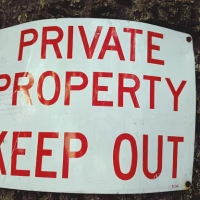
The House He Thought He Sold
My son called me in the evening: “I’m getting married tomorrow. Your car and house are sold. I’ll call you back.”
I was in the patient room at this point and replied, “Okay, but you left out one thing.”
He replied, “What do you mean?”
I laughed out loud because the house he SOLD ACTUALLY…
The Call
He called while I was still in a patient gown: “I’m getting married tomorrow—and the house is sold.”
The patient room smelled like clean linen and weak coffee from the hallway cart. Rain traced slow lines down the window, blurring the parking lot lights into soft halos. A nurse with a little flag pin on her badge had just finished checking my chart and said, “Try to rest, Ms. Hadley. You’ve had a long week.”
I nodded like I could.
My phone rang again—unknown number first, then my son’s name. Gar. My only child. The one I used to meet at the front door with dinner still warm and homework already spread out on the table.
I answered anyway.
“Mom,” he said, breathless, like he was calling from somewhere loud. “I’m getting married tomorrow. And… just so you know, your car and the house are sold. We already handled it. I have to go.”
For a second, I thought I’d misheard him.
My fingers tightened around the blanket.
“Gar… what?”
He didn’t slow down.
“It’s taken care of. Tabitha said it’s better this way. We don’t have time for a long conversation.”
I stared at the pale patient bracelet on my wrist, the one that kept catching the light when I moved.
“Okay,” I said quietly, surprising myself with how steady my voice sounded. “But you left out one thing.”
There was a sharp pause on the line.
Then his tone changed—less rushed, more suspicious.
“What do you mean?” he asked.
I looked at the rain, at the soft reflection of my own face in the glass. The woman who’d spent decades being polite. Being agreeable. Being grateful for whatever was offered.
And then I laughed—once, out loud.
Because the house he said he sold… the house he was so sure was his to move around like a chess piece… actually belonged to someone else entirely.
“Mom?” Gar’s voice sharpened. “What’s going on?”
I took a slow breath, the kind the respiratory therapist had taught me earlier that week.
“The house you sold,” I said calmly, “isn’t mine anymore.”
Silence.
“What are you talking about?” he asked.
“I transferred the deed three months ago,” I said. “To a trust. You don’t own it, Gar. And neither do I—not on paper, anyway.”
The line went dead quiet except for background noise—voices, music, the muffled sound of celebration happening somewhere far away from this hospital room.
“You’re lying,” he said finally.
“I’m not,” I replied. “Check the county records if you want. The house is in an irrevocable trust. You can’t sell it. Neither can Tabitha.”
Another pause.
Then his voice came back—tight, furious.
“Why the hell would you do that?”
I closed my eyes.
“Because I saw this coming,” I said.
Three Months Earlier
My name is Diane Hadley.
I’m sixty-one years old, and for most of my life, I thought being a good mother meant saying yes.
Yes to helping with rent when Gar lost his job.
Yes to co-signing the car loan he swore he’d pay back.
Yes to letting him move back home at thirty-two because “things were tough right now.”
Yes to keeping quiet when he brought Tabitha into my house without asking, and she rearranged my kitchen like it was hers.
Yes to pretending I didn’t notice when money started disappearing from my wallet.
Yes to smiling when Gar told me he needed to be added to my bank account “just in case something happened.”
I said yes because I loved him.
Because he was my son.
Because his father died when Gar was twelve, and I thought maybe if I gave him enough, it would make up for what he’d lost.
But three months ago, something shifted.
I was sitting in my kitchen—the kitchen I’d owned for thirty years, the one with the chipped tile I kept meaning to replace and the window that looked out over the backyard where Gar used to play—when I overheard a phone call.
Gar was in the living room, talking to Tabitha.
He didn’t know I was home.
I’d come back early from my doctor’s appointment because the traffic was lighter than expected.
“She’s not going to last much longer,” Gar was saying, his voice low. “The doctor said her lungs are getting worse. Six months, maybe a year.”
My breath caught.
I pressed my back against the kitchen wall, listening.
“So we just wait?” Tabitha’s voice came through the speakerphone, sharp and impatient. “That’s the plan? We wait for her to die?”
“What else can we do?” Gar asked. “The house is in her name. The car, the bank account—everything’s hers. We can’t touch it until…”
He trailed off.
“Until she’s gone,” Tabitha finished.
I heard Gar sigh.
“Yeah.”
“Well, we need to speed this up,” Tabitha said. “I’m not waiting a year. We need that house sold so we can buy something decent. I’m not living in your mother’s old place with her floral wallpaper and her stupid ceramic roosters.”
Gar laughed.
He actually laughed.
“I know,” he said. “Trust me, I know.”
I stood there in my own kitchen, holding my breath, listening to my son and his fiancée discuss my death like it was a minor inconvenience delaying their real estate plans.
That’s when I made the call.
The Lawyer
Her name was Margaret Chen, and she’d been recommended by a friend from my book club—a woman whose daughter had tried to drain her accounts during a health scare.
“You need someone who understands elder law,” my friend had said. “Margaret’s tough. She won’t let anyone take advantage of you.”
I met Margaret in her office downtown the following week.
She was younger than I expected—maybe forty—with sharp eyes and a no-nonsense handshake.
“Tell me what’s happening,” she said.
I told her everything.
The overheard conversation.
The joint bank account Gar had insisted on.
The way he’d been asking questions about my will, about the house, about “what would happen if something happened.”
Margaret listened without interrupting, taking notes on a yellow legal pad.
When I finished, she set down her pen.
“Do you want to protect your assets?” she asked.
“Yes.”
“Even from your son?”
I hesitated.
Then nodded.
“Yes.”
Margaret leaned forward.
“Here’s what I recommend,” she said. “We create an irrevocable trust. You transfer ownership of the house and any other significant assets into the trust. You can still live in the house—you’ll have what’s called a ‘life estate’—but legally, you won’t own it anymore.”
“So Gar can’t sell it,” I said.
“Exactly. He won’t have any claim to it. When you pass, the house will go to whoever you name as beneficiary in the trust—a charity, a friend, anyone you choose. But while you’re alive, it’s protected.”
“What about the bank account?” I asked.
“Remove him as a joint holder immediately,” Margaret said. “Open a new account in your name only. Transfer your funds. Don’t tell him until it’s done.”
I felt a strange mixture of relief and guilt.
“Is this… cruel?” I asked.
Margaret’s expression softened.
“Diane, your son was planning to sell your house while you’re still alive,” she said gently. “That’s not love. That’s exploitation. Protecting yourself isn’t cruel—it’s necessary.”
I signed the papers that afternoon.
The Transfer
The hardest part was doing it without Gar knowing.
I transferred the deed to the trust on a Tuesday morning while Gar was at work and Tabitha was at a hair appointment.
Margaret handled everything.
The trust was named “The Hadley Family Trust,” and the sole beneficiary—after my death—was a local hospice charity that had cared for my late husband.
I kept my life estate, which meant I could live in the house until I died.
But I didn’t own it anymore.
And neither did Gar.
The bank account was harder.
Gar had access to the joint account, and I knew if I suddenly withdrew everything, he’d notice immediately.
So I did it slowly.
$500 here.
$1,000 there.
Small transfers to a new account at a different bank—one Gar didn’t know about.
It took six weeks to move everything.
By the time I was done, the joint account had just enough to cover the monthly bills.
Everything else was safe.
And Gar had no idea.
The Diagnosis
Two months after I set up the trust, my doctor gave me the news.
“Your lungs are deteriorating faster than we’d hoped,” Dr. Patel said, her face serious. “The COPD is progressing. We need to talk about hospice care.”
I sat in her office, staring at the anatomical posters on the wall, and felt strangely calm.
I’d known this was coming.
I’d been a smoker for thirty years before I quit.
The damage was done.
“How long?” I asked.
“It’s hard to say,” Dr. Patel said. “Could be six months. Could be a year. It depends on how your body responds to treatment.”
I nodded.
“Thank you for being honest,” I said.
That night, I didn’t tell Gar.
I didn’t tell anyone.
I just sat in my living room—the one with the floral wallpaper and the ceramic roosters—and thought about what I wanted my final months to look like.
I didn’t want them to be spent fighting with my son.
I didn’t want them to be spent watching him circle me like a vulture, waiting for me to die so he could cash in.
I wanted peace.
And for the first time in years, I felt like I might actually get it.
The Collapse
Three weeks ago, I collapsed in my kitchen.
One moment I was making tea.
The next, I was on the floor, gasping for air, my chest tight and burning.
Gar found me.
He called 911.
The paramedics came and took me to the hospital.
I spent a week in the ICU, hooked up to machines that breathed for me.
Gar visited once.
He stood in the doorway, looking uncomfortable, and asked if I needed anything.
“I’m okay,” I said, my voice hoarse from the ventilator tube.
He nodded and left.
Tabitha didn’t come at all.
When I was moved to a regular room, the nurses were kind.
They brought me extra blankets.
They made sure I had water.
They asked if I had family coming to visit.
“My son’s busy,” I said.
They smiled politely, but I saw the pity in their eyes.
That’s when Gar called.
The Confrontation
“You can’t do this,” Gar said, his voice rising. “That house is supposed to be mine. You promised.”
I was still in the hospital bed, phone pressed to my ear, rain still falling outside.
“I never promised you the house, Gar,” I said calmly.
“You said I’d inherit everything!”
“And you will,” I said. “Whatever’s left. But the house isn’t mine to give anymore.”
“This is insane,” he said. “You’re trying to punish me.”
“I’m protecting myself,” I said.
“From what? From your own son?”
“Yes,” I said simply.
The word hung in the air.
Gar made a strangled sound.
“Tabitha was right,” he said. “You’ve always been selfish. You’ve always put yourself first.”
I almost laughed.
“Gar, I spent thirty years putting you first,” I said. “I worked two jobs to pay for your college. I co-signed loans I couldn’t afford. I let you move back home when you were thirty-two. I said yes to everything you ever asked for.”
“And now you’re taking it all back,” he said bitterly.
“No,” I said. “I’m just making sure you don’t take more than you’ve already taken.”
Silence.
“Tabitha’s going to lose her mind,” he said finally.
“Then maybe you should’ve married someone who loved you for more than my house,” I said.
He hung up.
The Wedding
I didn’t hear from Gar for three days.
Then, on a rainy Thursday evening, I got a text:
We’re getting married tomorrow. Small ceremony. Just us and Tabitha’s family. Thought you should know.
No invitation.
No address.
No time.
Just: Thought you should know.
I stared at the message for a long time.
Then I typed back:
Congratulations. I hope you’re happy.
I meant it.
Not in a bitter way.
In a tired, final way.
I hoped he was happy.
I hoped Tabitha made him happy.
I hoped they built a life together that didn’t require waiting for someone to die.
But I knew—deep in my bones—that they wouldn’t.
Because happiness built on greed never lasts.
The Lawyer’s Call
Two days after the wedding, Margaret Chen called me.
“Diane, I wanted to give you a heads-up,” she said. “Your son contacted my office.”
“About the trust?” I asked.
“Yes. He wanted to know if there was any way to dissolve it. I told him no—it’s irrevocable. He threatened to sue.”
I closed my eyes.
“Can he?”
“He can try,” Margaret said. “But he won’t win. The trust is legally sound. You were of sound mind when you created it. There’s no basis for a challenge.”
“What will he do?” I asked.
“Probably nothing,” Margaret said. “Once he realizes it’ll cost him more in legal fees than he’d ever recover, he’ll back off.”
“Thank you,” I said.
“Diane,” Margaret said gently, “I know this is hard. But you did the right thing.”
I wasn’t sure I believed her.
But I wanted to.
The Discharge
I was discharged from the hospital the following week.
The doctor gave me a list of instructions—oxygen at night, no stairs, medications three times a day.
“Do you have someone at home to help you?” the nurse asked.
“I’ll manage,” I said.
She looked at me for a long moment, then nodded.
I took a taxi back to the house—the one Gar thought he’d sold, the one that was no longer mine on paper but would be my home until I died.
I unlocked the door and stepped inside.
The floral wallpaper was still there.
The ceramic roosters were still on the shelf.
The kitchen still smelled faintly of the tea I’d been making before I collapsed.
It was mine.
Not legally.
But in every way that mattered.
I sat down in my favorite chair and looked around the room.
Quiet.
Empty.
But mine.
Three Months Later
Gar called again three months later.
I almost didn’t answer.
But something made me pick up.
“Mom,” he said.
His voice was different—quieter, flatter.
“Hi, Gar,” I said.
“Tabitha left,” he said.
I didn’t say anything.
“She said I lied to her,” he continued. “About the house. About the money. She said I promised her a life I couldn’t deliver.”
“I’m sorry,” I said.
And I was.
Not for Tabitha leaving.
But for Gar—for the fact that he’d built his life on a foundation of things that were never his.
“I don’t know what to do,” he said.
“You start over,” I said simply. “You figure out who you are without counting other people’s money.”
He was quiet for a long time.
“Can I come see you?” he asked.
I looked around my living room—the floral wallpaper, the ceramic roosters, the life I’d protected.
“Yes,” I said. “You can come see me.”
“Okay,” he said. “I’ll come this weekend.”
“Okay,” I said.
He hung up.
I sat there in the quiet, holding the phone.
I didn’t know if we could rebuild.
I didn’t know if Gar would ever really understand what he’d done.
But I knew one thing for certain:
The house was mine.
My peace was mine.
And no one—not even my son—could take that away from me.
The Visit
Gar came that weekend.
He looked thinner.
Tired.
He stood on the porch like he wasn’t sure he was allowed to come in.
“Hi, Mom,” he said.
“Hi, Gar,” I said, stepping aside. “Come in.”
We sat in the living room—the one with the wallpaper he used to make fun of.
He looked around like he was seeing it for the first time.
“I’m sorry,” he said finally.
“For what?” I asked.
“For all of it,” he said. “For treating you like… like you were just a thing to inherit. For listening to Tabitha. For not visiting you in the hospital.”
I nodded slowly.
“Thank you for saying that,” I said.
“Do you forgive me?” he asked.
I looked at my son—the boy I’d raised, the man who’d hurt me, the stranger who was asking for a second chance.
“I’m working on it,” I said honestly.
He nodded.
“That’s fair,” he said.
We sat in silence for a while.
Then Gar asked, “Can I ask you something?”
“Go ahead.”
“Why did you laugh?” he asked. “On the phone, when I told you I sold the house. You laughed. Why?”
I smiled.
“Because for the first time in a long time,” I said, “I wasn’t the one being played.”
Gar looked down at his hands.
“I deserved that,” he said.
“Yes,” I said. “You did.”
Six Months Later
I’m still here.
Still in the house with the floral wallpaper and the ceramic roosters.
Still breathing—slowly, carefully, with oxygen at night and medications that keep the pain at bay.
Gar visits once a month.
We don’t talk about the trust.
We don’t talk about Tabitha.
We just talk—about the weather, about his new job, about the past when things were simpler.
It’s not perfect.
But it’s something.
And I’ve learned that something is enough.
The house is still in the trust.
When I die, it’ll go to the hospice charity.
Gar knows this now.
He doesn’t fight it anymore.
“I just want you to be okay, Mom,” he said last time he visited.
“I am okay,” I said.
And I meant it.
Because I learned something important in that hospital room, in that moment when Gar told me he’d sold my house:
I learned that the only person responsible for protecting me was me.
I learned that love doesn’t mean saying yes to everything.
I learned that sometimes, the kindest thing you can do for yourself is to say no.
And I learned that a house is just a house.
But peace?
Peace is priceless.
The End
I don’t know how much time I have left.
The doctors don’t make promises.
My lungs are tired.
My body is tired.
But my mind is clear.
And when I look around this house—this home—I don’t see floral wallpaper and ceramic roosters.
I see a life I fought to protect.
I see a boundary I finally learned to draw.
I see a woman who spent sixty-one years saying yes to everyone else.
And who finally, at the very end, learned to say yes to herself.
That’s worth more than any house.
More than any inheritance.
More than anything Gar or Tabitha ever wanted from me.
It’s worth everything.
And when my time comes—when I take my last breath in this house that’s mine but not mine, protected but not possessed—I’ll go knowing I did one thing right:
I didn’t let them take it from me.
Not the house.
Not my peace.
Not my dignity.
I kept what mattered.
And I let go of everything else.
That’s enough.
That’s more than enough.
That’s everything.