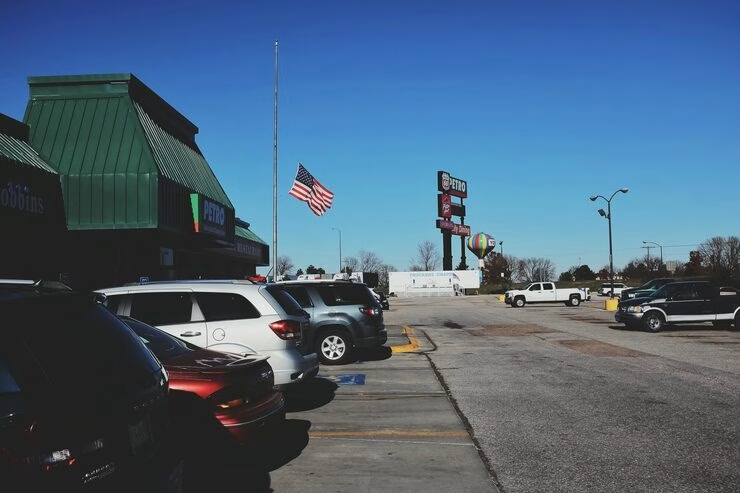
The Empty Parking Space
I walked out into the cool Columbus morning and saw only an empty parking space. Twelve hours earlier, my shiny new Honda Accord had been sitting there under the sodium lights of my apartment complex, its silver paint catching the glow like something out of a dealership commercial. Now there was nothing but bare concrete and a faint pair of tire marks where someone had backed out—fast.
My chest tightened so hard it hurt.
I called my mother with shaking hands.
“You did what?” I heard my own voice crack through the phone, too loud in the quiet parking lot. My heart was beating so hard I could feel it in my throat.
My mother laughed on the other end of the line—that light, dismissive chuckle she always used when she decided I was being dramatic.
“Relax, Jasmine,” she said. “We gave your spare key to Felicity. She needed a reliable car, and yours was just sitting there in the parking lot.”
I stared at the empty space like the car might somehow reappear if I just looked hard enough.
“Mom, that car is in my name,” I said slowly. “I’ve been making payments on it for three months. You can’t just give someone my keys without asking me first.”
“She’s your sister,” my mother said, as if that explained everything. “Family helps family. You know Felicity has been going through a hard time since the divorce. She needed transportation to get to her new job, and you have that nice new car just sitting there.”
I closed my eyes for a second and tried to breathe.
Felicity. Of course it was Felicity.
My older sister, who had managed to wreck four cars in the past five years alone. My sister who had totaled our dad’s pickup running a red light because she was changing the radio station. Who had wrapped her ex-husband’s sedan around a telephone pole after a party, swearing she was “fine to drive” after drinking. Who had driven her own leased compact into a ditch because she was texting and forgot the road curved. Who had rear-ended an empty school bus because she was applying mascara at a stoplight.
“Mom, Felicity has destroyed every car she’s ever touched,” I said. “She has the worst driving record of anyone I know.”
“That’s not fair,” my mother snapped. “Those were accidents. Anyone can have an accident.”
“Four accidents in five years isn’t bad luck,” I said. “It’s a pattern. It’s negligence. And now you’ve given her my car without even telling me.”
My mother’s voice hardened, taking on that edge I knew too well.
“You’ve always been jealous of your sister,” she said. “Ever since you were children, you could never stand to see her have anything nice. You always had to compete with her.”
I almost laughed at the absurdity of that.
Me, jealous of Felicity.
I was the one who had worked two jobs through college while she dropped out after one semester to pursue a modeling career that never turned into anything but Instagram posts. I had saved for years to afford the down payment on this car while she burned through three marriages and twice as many credit cards. I had built my life carefully, brick by brick, while she demolished everything in her path and expected someone else to clean up the rubble.
“Mom,” I said, my voice flat now, “I need you to listen to me very carefully. Where did Felicity take my car?”
“I don’t know exactly,” she said. “Probably to work. She said something about a new position at a salon in Worthington. You should be happy for her, Jasmine. She’s finally getting her life together.”
“When did she take it?” I asked.
“Last night around eleven,” my mother said, like she was telling me what she’d watched on TV. “Your father met her at your apartment complex and gave her the spare key. We thought you’d be asleep and we didn’t want to wake you. We were trying to be considerate.”
They had come to my apartment in the middle of the night—my home, my front door, my parking lot—and handed over my property without even knocking to ask permission.
The betrayal of it settled into my bones like ice water, spreading through my whole body until I felt numb.
“Mom,” I said quietly, “I’m going to give you a minute to understand what you’ve done. You and Dad came to my home, gave away my car without my permission, and didn’t even tell me until I called in a panic because I thought it had been stolen.”
“It wasn’t stolen, Jasmine,” she said sharply. “It’s with family. That’s completely different.”
“It was taken without my consent,” I said. “That is the definition of stolen.”
My mother scoffed, and I could picture her rolling her eyes in their little ranch house just outside Dayton, coffee mug in hand, morning news humming in the background.
“You’re being ridiculous and dramatic as usual,” she said. “Your sister will bring it back when she’s done with it. A week, maybe two at most.”
“When she’s done with it?” I repeated. “It’s not a library book, Mom. It’s a twenty-eight-thousand-dollar vehicle that I’m still paying off. I have car payments. I have insurance. I need that car to get to work.”
“Money, money, money,” she said, disgust curling around the words. “That’s all you ever think about, Jasmine. Family comes before money. Family comes before everything.”
Something inside me shifted.
For twenty-nine years I had been carefully stacking bricks to build a wall between myself and the reality of who my family really was. Standing in that empty parking space, with Columbus morning traffic rushing past on East Broad and the cold October air biting my cheeks, I felt the first crack open in that wall.
“All right,” I said quietly. “Just give me a minute.”
I hung up before she could answer.
Breaking Point
My name is Jasmine, and I’m twenty-nine years old. I work as an operations manager at Crestwell Electric, a midsized electrical supply company on the east side of Columbus, Ohio—concrete warehouses, forklifts beeping in reverse, pallets of cable and fixtures stacked to the ceiling. I’ve lived in this city my whole life, watched the skyline add new glass towers and stadium lights while I tried to grow myself into someone my family might finally respect.
I stood in that empty parking spot a moment longer, staring at my phone.
Then I opened my contacts, scrolled past my mother’s name, past my father’s, past Felicity’s, and stopped on the number I never thought I’d actually dial.
I called the police.
The officer who arrived was a woman about my age with kind eyes and a no-nonsense demeanor that immediately put me at ease. Her patrol SUV pulled into the lot, Columbus Police Department decals catching the pale fall sunlight. Her name was Officer Bradley, and she listened to my story with the patience of someone who’d heard variations of it a hundred times but still gave each case her full attention.
“So let me make sure I understand the situation,” she said, pen poised over her notepad. “Your parents came to your apartment complex last night, gave your spare key to your sister, and she drove away in your vehicle without your knowledge or consent.”
“That’s correct,” I said.
“And you’re the sole owner of this vehicle?” she asked. “Your name is on the title and registration, not anyone else’s?”
“Yes. I bought it three months ago from a dealership in Dublin,” I said. “I have all the paperwork inside my apartment.”
She nodded and made a note.
“And you didn’t give anyone permission to take your car,” she continued. “Not your parents, not your sister, not anyone.”
“No,” I said. “I didn’t even know it was gone until I walked outside this morning to go to work. I thought it had been stolen by a stranger. I never imagined my own family would do something like this.”
She wrote something else, then looked up at me with a serious expression.
“I have to ask you this directly, and I need you to think carefully before you answer,” she said. “Are you certain you want to file a report? Once this is in the system, it’s in the system. Your sister will be flagged for vehicle theft, and that’s not something that can be easily undone.”
I thought about my mother’s voice on the phone. That little condescending laugh.
I thought about all the times I’d covered for Felicity, made excuses, cleaned up her messes because that’s what “good sisters” did. I thought about the car payments I would still owe even if Felicity crashed this vehicle like she’d crashed all the others. I thought about years of being treated like the backup plan while Felicity was the star.
“I’m certain,” I said.
Officer Bradley’s expression was professional but not unkind.
“All right,” she said. “I’m going to start filling out the official report. This will take a few minutes.”
As she worked, my phone buzzed with an incoming call from my father. I let it go to voicemail. Then another call from my mother. Voicemail again. Then a text message from Felicity herself—the first direct communication I’d had from her in months.
Heard you’re freaking out about the car. Chill out. I’m just borrowing it for the week. I’ll bring it back Sunday. Stop being so dramatic.
I showed the text to Officer Bradley. She raised an eyebrow.
“She texted you admitting she has the car,” the officer said. “Apparently she thinks this is just a misunderstanding.”
“She thinks I’m overreacting,” I said.
“Well,” Officer Bradley replied, lifting her phone to take a photo of my screen, “this will make things easier from an evidentiary standpoint. I’m going to enter this into the system now. Your vehicle will be flagged as stolen, and any officer who runs the plates will be alerted immediately. If your sister is driving it, she’ll be stopped.”
Part of me expected to feel guilty. Part of me expected the familiar wave of anxiety that always came when I did anything that might upset my family—that sick churn in my stomach that had controlled my decisions for as long as I could remember.
Instead, I felt something else.
Relief. A strange, almost weightless relief, like setting down a heavy bag I hadn’t realized I’d been carrying.
My phone rang again. This time it was Felicity calling directly.
After a moment of hesitation, I answered.
“Jasmine, what is wrong with you?” she snapped. My sister’s voice was sharp with annoyance, the same tone she used whenever anyone dared to inconvenience her. “Mom said you’re acting crazy about the car. It’s just a car. I needed it for work. You weren’t using it in the middle of the night.”
“You took my car without asking me, Felicity,” I said. “You didn’t call. You didn’t text. You just took it.”
“I did ask,” she shot back. “I asked Mom and Dad, and they said it would be fine. They said you’d understand because you’re always so understanding about everything.”
“They don’t own my car,” I said. “They can’t give permission for something that isn’t theirs to give.”
“God, you’re so uptight,” she said. “This is exactly why nobody likes you, you know that? You’re always obsessed with rules and fairness and making sure everything is exactly right. Meanwhile, I’m actually trying to get my life together, and you can’t even let me borrow a stupid car for one week.”
Officer Bradley watched me, her expression carefully neutral. I realized she could probably hear every word.
“Felicity, where are you right now?” I asked.
“None of your business,” she snapped. “I’ll bring the car back when I’m ready and not a minute before.”
“That car is currently registered as stolen with the Columbus Police Department,” I said. “If you’re driving it and you get pulled over for any reason, you’ll be arrested on the spot.”
There was a pause.
Then she laughed. It sounded disturbingly like our mother’s dismissive chuckle.
“You’re bluffing,” she said. “You would never actually call the cops on your own sister. You don’t have the guts.”
“I already did,” I said. “The officer is standing right next to me as we speak.”
Silence.
I could almost hear the gears turning in her head as she tried to decide whether I was lying.
“You’re lying,” she said finally.
“I’m not,” I replied.
Another pause. When she spoke again, her voice had changed, sharpening into something uglier.
“You are unbelievable, Jasmine,” she said. “You’ve always been jealous of me, and now you’re trying to ruin my life because I finally have a chance at something good. You can’t stand to see me succeed.”
“I’m trying to get my car back,” I said. “That’s all I want.”
“This isn’t about the car and you know it,” she snapped. “This is about you wanting to control everything. You can’t stand that Mom and Dad love me more than you. You’ve always resented that.”
The words landed with a familiar sting, aimed straight at old wounds that had never healed properly. But something was different now. Something had shifted when I stepped into that empty parking space and realized my family had violated my boundaries so casually, so completely.
“Felicity,” I said, “I don’t care if Mom and Dad love you more. I stopped caring about that years ago. I care that you stole my car.”
“I didn’t steal it,” she snapped. “They gave me the key. That’s not stealing.”
“A key they had no right to give,” I said. “Look, I don’t want to argue about semantics. Just bring the car back to my apartment and we can sort this out without police involvement.”
“No,” she said. “I need it for work. You can take the bus or get a ride or something. Figure it out.”
I closed my eyes and took a slow breath.
“All right, then,” I said. “I’ll see you when the police find you.”
I hung up before she could answer.
Officer Bradley closed her notepad.
“She’s not going to bring it back voluntarily, is she?” she asked.
“No,” I said. “She thinks I’m bluffing. She thinks I’ll back down like I always do.”
“We’ll put out a bulletin with the make, model, color, and plate number,” she said. “Any patrol unit that spots it will pull it over. Columbus is a big city, but there are only so many places to hide a car.”
I nodded. I felt strangely calm now that the decision had been made.
“What happens when you find her?” I asked.
“Depends on the circumstances,” she said. “If she’s driving, she’ll be pulled over and detained. If the vehicle is parked, we’ll impound it and notify you. Either way, she’ll have to answer for taking your property without permission.”
The Wreckage
The call came four hours later.
I was sitting at my desk at Crestwell Electric, trying to focus on inventory reports while my phone sat silent beside my keyboard. From my window I could see the gray ribbon of I-70 in the distance, trucks rolling past in an endless line, everyone else’s life moving forward while mine felt stuck.
My coworker, Denise, had noticed something was wrong the second I walked in that morning. She’d handed me a coffee from the drive-thru down the street.
“You look like someone ran over your dog,” she’d said. “What happened?”
“Family drama,” I’d said. “I don’t want to talk about it yet.”
She’d nodded and squeezed my shoulder before going back to her desk. Denise understood boundaries in a way my family never had.
When my phone finally rang and I saw Officer Bradley’s number, I stood up so fast I knocked over my coffee. Lukewarm liquid spread across my paperwork in a messy brown stain.
“This is Jasmine,” I said, wiping frantically at the mess with a stack of paper towels.
“Jasmine, it’s Officer Bradley,” she said. “We found your vehicle.”
“Where is it?” I asked. “Is Felicity with it?”
There was a pause long enough that my stomach dropped before she spoke.
“The car is at an impound lot on the west side,” she said. “It was abandoned in a no-parking zone about three hours ago. Looks like your sister ditched it when she realized we were actively looking for it.”
“What condition is it in?” I asked.
Another pause. Longer this time.
“You should probably come see it yourself,” she said. “I can meet you there in about an hour if that works for your schedule.”
I told my supervisor I had a family emergency—which was technically true—and borrowed Denise’s car to drive across town. The impound lot sat off a busy stretch of West Broad Street, surrounded by chain-link fence topped with barbed wire, rows of damaged vehicles packed together under an overcast Ohio sky.
Officer Bradley was already there when I arrived, standing next to what had once been my pristine three-month-old Honda Accord.
The front bumper was dented and scraped like someone had rear-ended another vehicle at low speed and kept going. The driver’s side mirror was cracked, hanging at an awkward angle. Long scratches ran down the passenger door, deep and deliberate, like someone had keyed the car out of spite. A crack spiderwebbed across the rear window, running diagonally from corner to corner.
“What happened?” I heard myself ask, my voice distant in my own ears.
“Hard to say without more investigation,” she said. “The bumper damage is consistent with a minor collision. The scratches could be vandalism or a tight parking situation. As for the window, your guess is as good as mine.”
I walked slowly around the car, cataloging every scrape, every dent, every sign of my sister’s carelessness branded permanently into the metal.
When I’d driven this car off the lot, it had been perfect. I’d washed it every weekend. I’d vacuumed the interior, kept a lavender air freshener hanging from the mirror, treated it like something precious because it represented years of saving and sacrifice. Now it looked like something pulled from a demolition derby.
“We found fast-food wrappers all over the interior,” Officer Bradley said. “And there’s some kind of stain on the back seat I’d strongly recommend having professionally cleaned. Could be motor oil, could be something else. Either way, it’s not great.”
My phone rang. My mother’s name flashed across the screen.
I answered.
“Jasmine,” she said immediately, voice tight, “Felicity just called me crying hysterically. She said the police are after her because you filed some kind of report. Please tell me this is all a big misunderstanding.”
“It’s not a misunderstanding, Mom,” I said. “She stole my car.”
“‘Stole’ is a very strong word,” my mother said, her tone shifting into that controlled anger she used when she was trying not to explode. “She borrowed it. There’s a difference.”
“She took it without my permission,” I said. “She drove it for less than twenty-four hours and already damaged it severely. I’m standing in an impound lot on the west side right now looking at the wreck she made of my brand-new car. The bumper is dented. The mirror is cracked. The rear window has a huge crack in it. And the interior looks like a garbage dump.”
“Damaged it?” my mother repeated. “What do you mean, damaged? Felicity didn’t mention anything about damage.”
“Of course she didn’t,” I said. “When has Felicity ever taken responsibility for anything? She probably didn’t even notice she hit something. She was probably on her phone or putting on makeup or doing any of the hundred things she does instead of watching the road.”
My mother went quiet. I could hear her breathing on the other end.
When she spoke again, her voice had switched into full manipulation mode.
“Well, even if there was some minor damage, it was probably an accident,” she said. “You know Felicity has always had bad luck with cars. That doesn’t mean she deserves to be treated like a criminal by her own sister.”
“Bad luck?” I repeated. “She’s destroyed four vehicles in five years. That’s not luck, Mom. That’s a pattern of reckless behavior that you and Dad have enabled every single time by paying her legal fees and buying her new cars and making excuses for her.”
“We did what any good parents would do,” she said. “We supported our daughter when she was struggling.”
“And what about me?” I asked. “What about when I was struggling? When I was working two jobs to pay for college while Felicity dropped out and you paid for her apartment? When I was saving every penny for years to buy this car while you bought Felicity three different vehicles that she wrecked? When did you ever support me the way you support her?”
The words came out before I could stop them—years of resentment finally finding a voice.
“You never needed help, Jasmine,” she said. “You were always so capable, so independent. Felicity needed more support because she struggled more. That’s just the reality of having children with different needs.”
“Different needs or different standards?” I asked. “Because from where I’m standing, it looks like you held me to a higher standard my entire life while letting Felicity get away with anything.”
“That’s not true,” she said quickly. “And you know it.”
“It is absolutely true,” I said. “And the proof is that you thought it was perfectly acceptable to give away my car in the middle of the night without even asking me. You would never have done that to Felicity.”
Officer Bradley pretended to examine the damage while I unloaded years of family dysfunction into the phone. I appreciated her pretending not to listen.
“Jasmine, I think you’re overreacting because you’re upset,” my mother said finally. “Why don’t you take some time to calm down, and then we can talk about this like reasonable adults?”
“I am perfectly calm, Mom,” I said. “I’ve never been calmer in my life. And here’s what’s going to happen: Felicity is going to face consequences for stealing my car. Real consequences, from the legal system. Because clearly our family is incapable of holding her accountable for anything.”
“You can’t be serious,” she whispered. “You’re going to let the police arrest your own sister over a car?”
“She stole my property and destroyed it,” I said. “Those are her choices, not mine. I’m just responding appropriately.”
“This will tear the family apart,” she cried. “Is that what you want?”
I looked at my damaged car, at the dents and scratches and cracks that represented everything wrong with the way my family had always treated me, and realized something important.
The family had already been broken for years. I’d just been the only one pretending otherwise.
“What I want,” I said, “is for my sister to face the consequences of her actions. Something you and Dad should have enforced years ago. Maybe if you had, we wouldn’t be in this situation.”
My mother gasped like I’d slapped her.
“How dare you speak to me that way after everything we’ve done for you,” she said.
“What exactly have you done for me, Mom?” I asked. “Paid for my college? No, I did that myself. Helped me buy my car? No, I saved for years on my own. Supported me emotionally? No, you were too busy cleaning up Felicity’s messes to notice I even existed. The only thing you’ve ever consistently done for me is criticize me for not being more understanding of my sister’s ‘problems.'”
Silence stretched between us.
“I think you need to take some time and reflect on what you’re doing to this family,” she said quietly.
“I think you need to do the same,” I replied.
I hung up and blocked her number before she could call back.
“That sounded like a difficult conversation,” Officer Bradley said gently.
“You have no idea,” I said.
“Actually,” she said, “I might have some idea. These situations are more common than you’d think—family members taking property without permission, assuming forgiveness will be automatic. It rarely ends well.”
She had shown me more respect in one morning than my family had in twenty-nine years.
“How do I proceed with pressing charges?” I asked.
Justice
The insurance adjuster arrived two days later, a middle-aged man named Gerald with a clipboard and a sympathetic expression that suggested he’d seen this kind of thing before. I’d already retrieved the car from the impound lot and paid the fees myself—another bill I couldn’t afford but didn’t have the luxury to ignore.
“So this was a theft by a family member?” Gerald asked, walking slowly around the car in the parking lot of my apartment complex.
“My sister,” I said. “She took the spare key from my parents and drove off with it in the middle of the night without my knowledge or consent.”
“And you filed a police report documenting the theft?” he asked.
“Yes,” I said. “I have the case number right here.”
I handed him the paperwork Officer Bradley had given me.
Gerald nodded and crouched by the bumper.
“This dent is pretty significant,” he said, running his fingers along the damaged area. “Looks like she hit something at a decent speed and kept driving. The paint transfer suggests another vehicle—probably a darker color.”
“She didn’t mention hitting anything when she talked to my mother,” I said. “But then again, she probably didn’t even notice.”
“That happens more often than you’d think,” he said.
He moved to the passenger side, examining the long scratches.
“These look deliberate,” he said. “See how they’re all the same depth and angle? Someone keyed this car.”
“Keyed it?” I repeated. “Why would someone key my car?”
He shrugged.
“Hard to say,” he said. “Could’ve been vandalism wherever she left it parked. Could’ve been someone with a grudge against your sister. Could’ve been your sister herself, for all we know.”
I stared at the scratches, a sick feeling turning in my stomach. The idea that Felicity might have deliberately damaged my car on top of everything else was almost too much to process.
Gerald walked to the back and studied the cracked rear window.
“This is interesting,” he said. “See how the crack radiates from this point? Something hit it from the inside, not the outside.”
“From the inside?” I asked.
“That’s what the pattern suggests,” he said. “Could’ve been an accident—someone tossing a bag and hitting it harder than intended—or could’ve been intentional. Either way, it’ll need to be replaced.”
He spent another twenty minutes documenting everything, taking photos and notes. When he finished, he turned to me with something almost like optimism.
“Here’s the good news,” he said. “Your comprehensive coverage should handle most of this. Given that you have a police report documenting the theft, we can process this as a stolen vehicle recovery claim.”
“What does that mean exactly?” I asked.
“It means we’ll cover the repairs minus your deductible,” he said. “Given the extent of the damage, you might even qualify for a total loss payout if the repair costs exceed a certain percentage of the vehicle’s current value.”
“A total loss?” I asked. “You mean you’d pay me for the whole car?”
“Potentially,” he said. “I’ll have to run the numbers and consult with our assessment team, but this is a fairly new vehicle with significant damage to multiple systems. It’s definitely possible.”
For the first time since I’d found the empty parking space, hope flickered.
“How long will that take?” I asked.
“I should have an answer within a week,” he said. “In the meantime, document any additional damage you find and keep copies of all your communications with the police.”
After Gerald left, I sat in the driver’s seat of my battered car and tried to process everything that had happened in the past forty-eight hours.
My phone buzzed with a voicemail notification. Against my better judgment, I listened.
Felicity’s voice filled my ear, slurred and angry, like she’d been drinking.
“So you actually did it?” she said. “You actually called the cops on your own sister. I hope you’re happy now. Mom and Dad are devastated. They can’t believe you would do this to the family. And for what? A stupid car. You always cared more about things than people, Jasmine. That’s why you’re going to end up alone, you know that? Nobody wants to be with someone as cold as you.”
I saved the voicemail. Officer Bradley had told me to document everything, and this felt exactly like the kind of thing that should be documented.
There was another message, this one from my father. His voice was quieter than my mother’s, more disappointed than angry, which somehow felt worse.
“Jasmine, this is your father,” he began. “Your mother told me about your conversation. I understand you’re upset about the car, but I think you’re overreacting. Felicity made a mistake, but she’s still your sister. Family forgives family. That’s how it’s always worked in this family. I think you should drop the charges and apologize to your mother for the things you said. She’s very hurt, and she didn’t deserve to be spoken to that way.”
I deleted that one.
If my father wanted to pretend that enabling Felicity’s behavior for decades counted as loyalty, that was his choice. I was done participating.
The third message was from an unknown number. When I played it, I heard Felicity’s voice again, but different this time—laughing, almost gleeful.
“Hey, Jasmine, guess what?” she said. “I found another car to use. One of my friends is letting me borrow hers, so you can have your precious Honda back. What’s left of it, anyway. Hope you enjoy driving around in a car nobody wants, just like you. Have a great life, sister.”
She hung up, still laughing.
I sat in my damaged car, surrounded by the evidence of my sister’s recklessness and my family’s betrayal, and realized something else.
I had spent my entire life trying to earn the love and respect of people who were incapable of giving it. I had worked hard, played by the rules, been the responsible one, the dependable one, the one who always cleaned up the messes and made excuses and kept the peace.
And what had it gotten me?
A stolen car, a pile of bills, and a family that blamed me for their own choices.
Something in me hardened that day—not in a bitter way, but in a protective way, like a callus forming over a wound rubbed raw for too long.
The next morning, I called Officer Bradley.
“I want to proceed with pressing charges,” I said. “Whatever the maximum is for what she did, I want to pursue it fully.”
The Courtroom
The court date came three months later, on a cold November morning that matched my mood. The Franklin County Courthouse downtown was a big stone building with metal detectors at the entrance and the state flag snapping in the wind.
I hadn’t spoken to anyone in my family since blocking their numbers. I hadn’t responded to letters or messages sent through relatives. I’d built a wall around my life and only let in the people who had earned their way inside.
“You don’t have to attend the hearing,” Detective Hernandez had told me over the phone the week before. “You’ve already given your statement, and the evidence speaks for itself. But you have the right to be there if you want to see how it plays out.”
I wanted to see.
I needed to see.
The courtroom slowly filled with lawyers, defendants, and spectators. My parents arrived about ten minutes before Felicity’s case was called. My mother wore a black dress like she was attending a funeral. My father wore a suit I’d never seen before.
They saw me almost immediately.
My mother’s face flashed through a series of expressions—surprise that I was there, hope that I might be coming back to them, anger when she registered my closed expression, and finally resignation when I didn’t acknowledge her at all.
She started toward me, but my father put a hand on her arm and shook his head. They sat on the opposite side of the gallery, as far from me as they could be while still being in the same room.
Felicity was led in by a bailiff, wearing an orange jumpsuit, her hair pulled back in a messy ponytail. She looked smaller than I remembered, like the last few months had taken something out of her.
She didn’t look at me.
The judge was a woman in her sixties with steel-gray hair and a no-nonsense expression that suggested she’d heard every excuse in the book.
She read the list of charges aloud in a clear, steady voice: unauthorized use of a motor vehicle, failure to appear on three separate traffic citations, driving with a suspended license, destruction of property valued at over a thousand dollars.
“How does the defendant plead?” the judge asked.
Felicity’s lawyer, an overworked-looking public defender, leaned over and whispered in her ear. Felicity glanced at our parents. For a split second, her gaze flicked toward me.
“Guilty, Your Honor,” she said quietly.
The sentencing phase took about twenty minutes.
The judge reviewed Felicity’s driving record in detail, noting each incident, each second chance. She listened to the public defender argue for leniency, citing Felicity’s recent divorce, her difficult circumstances, her willingness to plead guilty.
Then she looked directly at my sister.
“Ms. Harper,” she said, her voice firm but not cruel, “I have reviewed your file extensively, and what I see is a consistent pattern of disregard—for the law, for other people’s property, and for the consequences of your actions. You have been given multiple opportunities to correct your behavior. You have been offered reduced sentences and chances to make things right. You have squandered every one of those opportunities.
“At some point, this court has to send a message that this kind of behavior will not be tolerated.”
My mother made a small strangled sound.
“I am sentencing you to ninety days in county jail,” the judge continued, “with sixty days suspended pending successful completion of probation. You will serve thirty days beginning immediately. You will then be on supervised probation for two years. Your driver’s license is revoked indefinitely. You may petition for reinstatement after five years if you have demonstrated sustained compliance with all court requirements.
“You are ordered to pay restitution to the victim in the amount of three thousand dollars, and you are prohibited from contacting the victim in any way, directly or indirectly. Do you understand these terms?”
“Yes, Your Honor,” Felicity said, her voice barely audible.
“Additionally,” the judge said, “any violation of these probation terms will result in the immediate imposition of the suspended sentence, plus any new charges that may apply. This is your last chance, Ms. Harper. I strongly suggest you take it seriously.”
The bailiff led Felicity away. She didn’t look at me. She didn’t look at our parents. She kept her head down and walked through the side door like someone who had finally discovered that the rules really did apply to her.
In that moment, I felt something I hadn’t expected.
Not satisfaction, exactly, though there was some of that. Not pure vindication, though that flickered too.
Mostly, I felt relief.
Deep, bone-level relief, the kind that comes when a weight you’ve carried for so long you forget it’s there is finally lifted.
My parents found me in the hallway outside the courtroom a few minutes later.
I’d been expecting a fight, a guilt trip, a last-ditch manipulation.
What I got instead was bewilderment.
“Jasmine,” my father said quietly. “How did we get here? How did things go so wrong?”
I looked at him. Really looked at him.
This was the man who had snuck into my apartment complex in the middle of the night to hand over my spare key. The man who had watched Felicity’s wrecks and arrests and court dates and always reached for his wallet instead of the word ‘no.’ The man who had expected me to be fine with it all.
“You got here,” I said, “by treating me like I didn’t matter and treating Felicity like she could do no wrong. You got here by never holding anyone accountable for anything. You got here by deciding that my boundaries were less important than keeping the peace.”
My mother opened her mouth, then closed it when my father put his hand on her arm.
“I think,” he said slowly, “that we made a lot of mistakes. I don’t know how to fix them.”
“I don’t know either,” I said honestly. “And right now, I’m not sure I want to try. Maybe someday. But not today.”
I walked away before either of them could answer.
New Beginning
My new car was waiting in the parking garage—a silver Toyota Camry I’d bought with the insurance payout from a dealership near Polaris. No one in my family had ever sat in it or touched it or held a key to it.
I got in, started the engine, and drove out of downtown, past the courthouse and the Statehouse and the familiar brick streets of the Short North, without looking back.
The weeks that followed were a quiet kind of transformation.
Without my family’s constant drama draining me, I found myself with time and energy I hadn’t known I was missing. I joined a gym near my apartment and actually went three times a week. I reconnected with friends I’d drifted from, people who lived in other parts of Columbus I’d always been “too busy” to visit.
I started living my life for myself—maybe for the first time ever.
“You seem different,” Denise said one afternoon in the break room. “Lighter, somehow. Like you finally put something down.”
“That’s exactly what happened,” I said. “I stopped carrying weight that wasn’t mine.”
She nodded like she understood. Maybe she did. Everyone has something they’ve been carrying for too long.
The restitution check from Felicity arrived about two months after the trial—a money order for three thousand dollars that must have cost her everything she’d managed to save.
I deposited it into my savings account without ceremony. Money that would go toward my future instead of someone else’s chaos.
A year passed.
According to cousins who still talked to both sides, Felicity completed her thirty days in jail and moved into a small apartment with a roommate. She worked a fast-food job, relying on buses and rides from friends.
My parents, humbled by watching their golden child face real consequences for the first time, finally stopped trying to rescue her. Maybe they couldn’t afford it anymore. Maybe they’d finally learned. I didn’t know and didn’t really care.
I was promoted at Crestwell Electric. I moved into a nicer apartment on the north side of Columbus, with a view of the skyline and a little balcony where I could drink coffee on Sunday mornings and watch the city wake up. I started dating a man named Thomas, who worked in healthcare administration.
He was kind and patient and thoughtful—all the things my family had never been.
When I told him the whole story about Felicity and the car and the court dates, he didn’t tell me I’d overreacted. He didn’t tell me I should forgive and forget.
He just listened.
“It sounds like you finally chose yourself,” he said when I finished. “That’s one of the hardest things a person can do.”
In the end, the consequences caught up with everyone who needed them.
Felicity struggled through probation, working low-wage jobs, learning how to live without a car in a city that wasn’t built for pedestrians. My parents faded into the background of my life, sending birthday cards and holiday texts that I acknowledged politely but didn’t invite in deeper.
The family I’d grown up in was gone, but I wasn’t mourning it.
I was relieved to finally be free of it.
On a quiet Sunday morning in my new apartment, I stood by the window with a mug of coffee, watching the Columbus skyline glow under a clear Midwestern sky. The sounds of the city drifted up—distant sirens, a motorcycle on the freeway, kids playing in the courtyard below.
For the first time, I understood what this whole ordeal had really been about.
It was never just about a car.
It was about respect and boundaries and the question of whether I was going to keep letting people treat me like my needs didn’t matter.
For twenty-nine years, I’d been the responsible one, the dependable one, the one who absorbed the chaos and made everything okay for everyone else.
And what had it gotten me?
An empty parking space and a family that blamed me for noticing I’d been robbed.
Not anymore.
Now I had a life that was mine, built on my own terms, protected by boundaries I was no longer afraid to enforce. The car had been the catalyst, the last straw that snapped a pattern I should’ve broken years earlier.
I would never be grateful for what Felicity did.
But I could acknowledge that her theft had given me something valuable in return: clarity.
The clarity to walk away from people who had never really deserved my loyalty in the first place.
As I watched the morning light spill across the city I’d always called home, I realized the real victory was already complete.
Not because Felicity had suffered, though she had.
Not because my parents might finally be sorry, though they might be.
But because I had stopped waiting for permission to put myself first—and I had simply done it.
That was the only victory that ever really mattered.