The Christmas Night That Changed Everything
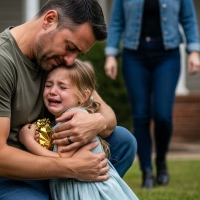
I used to think the coldest thing I’d ever feel was a Portland winter. I was wrong. The coldest thing is being shoved out of your own home on Christmas night by your own father.
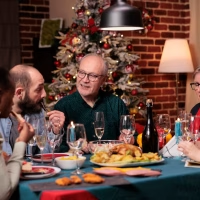
My name is Harper Carter, and last Christmas, everything I thought I knew about family shattered in a single moment. It happened at the dining table—crystal glasses gleaming under chandelier light, gold-trimmed plates reflecting candles, guests pretending we were the perfect Carter family. My father had orchestrated the evening like a Broadway production, every detail calculated to impress his business associates and their perfectly coiffed wives.
Then Grandpa George’s trembling hand dropped a small piece of turkey onto the silk tablecloth.
The room went silent. Every conversation died mid-sentence. My father’s chair scraped back so violently the Christmas music seemed to stop.
“That’s it,” he snarled, his face contorted with rage that seemed completely disproportionate to a dropped piece of meat. “If you can’t keep that useless old man under control, Harper, get out. Both of you.”
Before I could process what was happening, he grabbed Grandpa’s wheelchair and shoved it violently toward the front door. I stumbled after them, reaching for Grandpa, but my father’s hand clamped around my arm like a vice. He dragged me across the marble foyer, threw open the door, and literally pushed us both into the freezing December night.
The door slammed behind us with such finality that I heard the lock click into place.
I thought we’d lost everything. I didn’t know Grandpa had a secret worth $2.3 billion.
The Coldest Night
I didn’t feel the cold at first. Shock has a way of numbing everything. Snow drifted silently into Grandpa George’s lap as he clutched the thin blanket across his paralyzed legs. His breathing turned quick and shallow, the way it always did when he was scared but trying not to show it for my sake.
“Harper, are you all right?” he whispered, his voice barely audible over the wind.
I wasn’t. But I nodded anyway, wrapping my arms around myself as reality began to sink in. Behind us, through the frosted windows of the mansion, laughter continued as if nothing had happened. As if a disabled man in a wheelchair and his granddaughter hadn’t just been thrown out like garbage on Christmas night.
I pounded on the heavy oak door, my fists making hollow sounds that went unanswered. “Dad, open the door! Grandpa could freeze out here!”
Inside, I heard the clinking of glasses, the murmur of resumed conversation. Someone asked, “What’s happening?”
Then my father’s voice, cold and sharp enough to cut through the door: “Nothing important. Just taking the trash out.”
Trash. He meant us.
My throat tightened, but I forced myself to stay steady for Grandpa’s sake. I couldn’t fall apart, not when he needed me.
“Come on,” I said, kneeling beside his chair, my knees sinking into the snow. “I’ll take you home.”
He reached out with a shaking hand and rested it on my shoulder. Even through my coat, I could feel how cold his fingers were.
“I’m so sorry, Harper,” he whispered, his voice breaking. “I never wanted you to see this side of him.”
But I had. I saw everything—his humiliation, my father’s cruelty, the guests who averted their eyes and pretended not to notice. As I pushed his wheelchair down the icy driveway, snow crunching under my boots and my breath forming clouds in the frigid air, one thought sank deep into my chest: this wasn’t my family anymore. Not after tonight.
I had no idea that losing them was the first step toward discovering a truth that would change everything.
The Reality of Survival
The moment we reached my tiny apartment on Hawthorne Street, the heater greeted us with its usual pathetic performance—two weak clicks, a grinding sound, then silence.
I rushed to wheel Grandpa inside, immediately rubbing his ice-cold hands between mine. “Sit tight, Grandpa. I’ll get the kettle going.”
He nodded, attempting a smile that didn’t reach his eyes. “I’ve survived worse than this, Harper.”
But his lips were turning blue, and I could see him shivering despite the blanket.
The apartment was embarrassingly small. Peeling paint curled from the walls, the couch sagged in the middle like a broken spine, and the kitchenette had a flickering bulb that made everything look even more depressing.
I caught Grandpa scanning the room slowly, taking in every detail. He wasn’t judging—that wasn’t his way—but I could see the hurt in his eyes.
“Harper,” he said softly, his voice weighted with guilt. “I shouldn’t be here. I’m nothing but a burden to you. You should put me in a nursing home and—”
“No.” The word came out sharper than I intended.
I knelt in front of him, gripping his frail hands tightly. “You’re not going anywhere. You’re staying with me, Grandpa. I won’t hear another word about it.”
His eyes glistened with unshed tears, and for a moment, neither of us could speak.
That night, I heated up leftovers from my shift at the diner—half a roasted chicken and some mashed potatoes I’d packed because I’d had a feeling we might need them. I fed him slowly, watching his hands tremble as he tried and failed to lift the fork on his own.
“Harper, you’re working too much,” he observed quietly.
“I’m fine, Grandpa. Really.”
That was a lie, and we both knew it. I worked morning shifts at the diner, slinging eggs and coffee to truckers and early risers, then stocked shelves at the supermarket until well past midnight. My legs ached constantly. My hands were cracked and bleeding from hot dishwater and cheap industrial soap, and sleep came in thin, unsatisfying scraps between alarm clocks.
But what choice did I have? Rent, medication, food—everything had doubled the moment Grandpa moved in after my father decided he was too much trouble to keep around.
At two in the morning, after washing the last dish and folding the last of Grandpa’s laundry, I collapsed onto the small cot I’d set up beside his wheelchair.
Grandpa reached down, his hand shaking with the effort, and brushed a loose strand of hair from my face.
“You shouldn’t have to sacrifice your entire life for me,” he whispered.
I swallowed the lump in my throat. “I’m not sacrificing anything. You’re my only real family, Grandpa.”
A single tear rolled down his wrinkled cheek.
I thought this was the lowest point of our lives. I had no idea we were standing at the edge of a much bigger truth.
The Drive That Changed Everything
It was a rare Sunday morning when I wasn’t rushing to one job or another. I was washing dishes when Grandpa cleared his throat in that particular way that meant he had something important to say.
“Harper,” he said, his voice oddly steady, “can you drive me somewhere today?”
I froze, hands still in the soapy water. He hadn’t asked to go anywhere in weeks.
“Where do you need to go?”
“You’ll see when we get there.”
He sounded different—calm, serious, resolute. It made something flutter nervously in my chest.
I helped him into the passenger seat of my ancient Honda, carefully buckled the blanket around his legs, then wrestled his wheelchair into the trunk. When I started the engine, he pointed straight ahead.
“Go left at the light. Just keep driving.”
No address, no explanation, no hint of our destination.
We drove past all the familiar streets of Portland. Past the diner where I served coffee. Past the supermarket where I stocked shelves. Past the clinic where I picked up Grandpa’s medications.
Then the scenery began to change. The houses grew larger. The sidewalks became pristine. The cars in driveways were sleek and expensive.
“Grandpa, where are we going?” I asked, confusion growing.
He didn’t answer directly. He just gently laid his hand on top of mine on the steering wheel.
“Trust me, Harper. Please.”
Finally, we reached an iron gate that looked like it belonged to a historic estate. It was tall, black, intricately carved. I slowed the car, certain we’d taken a wrong turn.
“Grandpa, this is someone’s mansion. We can’t just—”
Before I could finish, the massive gates swung open automatically. Two security guards in crisp uniforms stepped out, straightened to attention, and bowed to my grandfather.
My jaw dropped. “What the hell?”
One guard approached the car window. “Welcome home, Mr. Carter. We received word you might be returning today. It’s an honor, sir.”
Welcome home. Mr. Carter. Honor.
I looked at Grandpa like I was seeing a stranger. He just smiled faintly.
“Drive on, sweetheart.”
The path beyond the gate seemed endless, lined with blooming rose bushes, marble statues, and fountains that sprayed water into the air where it caught the sunlight.
At the end of the path stood a mansion so enormous I thought it was a hotel. White stone walls gleamed, red-tiled roofs stretched forever, and arched windows reflected clouds and sky.
I slammed on the brakes. “Grandpa,” my voice cracked, “whose house is this?”
He looked at me with eyes that were warm and impossibly sad.
“Ours, Harper. This is ours.”
The Truth Unveiled
The front doors burst open before I could process his words. A woman in an elegant uniform rushed out and dropped to her knees in front of Grandpa’s wheelchair as I helped him out of the car.
“Master George,” her voice broke with emotion, tears streaming down her face. “You’re back. We’ve waited so many years.”
Master George.
I stared at Grandpa like I was seeing him for the first time. “Grandpa, what is going on?”
He placed his trembling hand over mine.
“Inside, Harper. It’s time you learned the truth your father stole from both of us.”
The inside of the mansion didn’t feel real. Crystal chandeliers glittered overhead. Marble floors stretched farther than my entire apartment building. Oil paintings in gilt frames lined the walls.
Dozens of staff members lined the hallway, heads bowed as Grandpa’s wheelchair passed.
“Good afternoon, Master George.”
“Welcome home, sir.”
“It’s an honor to see you again, Mr. Carter.”
“Grandpa,” I whispered urgently, “why are they calling you that?”
He didn’t answer yet. He directed me to push him toward a massive office with floor-to-ceiling windows overlooking rolling hills and an actual lake. The room smelled like pinewood, expensive leather, and old money.
“Sit, Harper,” he said quietly.
I sat in a leather chair, my legs shaking, while he positioned his wheelchair across from me. For a long moment, he just looked at me.
“I should have told you long ago,” he began. “But your father robbed you of the truth before you were old enough to understand.”
My breath caught. “My father? What does he have to do with this?”
Grandpa nodded slowly. “Thomas wasn’t always the cruel man you know. But greed changes people, Harper. It transforms them into something unrecognizable.”
I leaned forward, gripping the armrests. “Grandpa, please. Tell me everything.”
He inhaled sharply and began.
“Forty years ago, I built a company from nothing. Carter Estates Group. Hotels, luxury apartments, timberland, commercial complexes. I started with one small property and worked eighteen-hour days for decades.”
He paused, his eyes drifting to a framed blueprint on the wall.
“By the time your father turned thirty, the company was worth nearly a billion dollars. I was so proud of him. He had a good head for numbers, seemed dedicated. I made him Chief Financial Officer. I trusted him with everything.”
My stomach dropped.
“He started leaking confidential information. Giving our competitors access to our blueprints. He funneled money into private offshore accounts. He did all of this behind my back while smiling to my face at family dinners.”
I clutched the arms of my chair. “He stole from you? His own father?”
“He did much worse than steal, Harper.” Grandpa’s voice dropped to barely above a whisper. “He signed documents in my name—forged my signature. He destroyed files. And when I finally confronted him with proof…”
Grandpa paused, his fingers trembling.
“He told me the company would be better off when the old man finally dies. Those were his exact words.”
My stomach twisted. “Grandpa—”
“That night,” he said quietly, “my car was run off the road on Highway 26. Deliberately.”
The world seemed to freeze. “What?”
He nodded. “I don’t have concrete proof it was Thomas. But the timing, the threats he’d made, the way he didn’t visit me once in the hospital during my three-month recovery…” A bitter smile tugged at his lips. “I learned to stop asking questions that might get me killed.”
I felt my throat closing. “That crash—that’s why you’re in a wheelchair?”
“Yes. The accident crushed my spine. The doctors said I was lucky to survive at all.”
My hands began shaking. My father—the man who had just shoved us into the snow—was the same man who had potentially orchestrated an accident that destroyed his own father’s body.
The Empire Built in Silence
“But I didn’t die,” Grandpa said, and his voice firmed with strength. “And I refused to let him win. So I rebuilt everything from my hospital bed.”
He gestured toward a wall of old photographs—grainy images of warehouses, stacks of lumber, construction sites.
“This time, I kept everything completely hidden. I never used the Carter Estates brand again. I built an entirely new empire under different company names, different aliases. Shell corporations, trusts, holding companies. I became invisible.”
He opened a drawer and pulled out a thick folder. Inside were property deeds, corporate documents, financial statements.
“Harper,” he said, his voice trembling now, “I own 109 properties across this country. Timberland in Montana and Washington. High-rise apartment buildings in Seattle and San Francisco. Luxury resorts in Colorado and Utah. Commercial districts in Tampa. Strip malls, office parks, storage facilities.”
My pulse thundered in my ears.
“And the total portfolio value?” He paused. “Is worth over $2.3 billion.”
I stared at him, speechless. “You… You’re a billionaire?”
“Not anymore,” he corrected gently, sliding a second folder toward me. “You are.”
I choked on air. “What? No, I—”
The folder contained a last will and testament. My name—Harper Grace Carter—was printed across pages stamped and notarized by attorneys.
I covered my mouth with both hands.
“But why me?” I gasped. “I’m nobody. I’m just—”
He reached across and touched my cheek.
“Because you are the only person in this family who loved me for who I was, not what I had. You fed me when you barely had enough food for yourself. You pushed my wheelchair through snow on the night your father discarded us like trash. You worked yourself to exhaustion without ever complaining. You chose me over comfort, over wealth, over your own father.”
His voice cracked. “You, Harper—not Thomas, not anyone else—are my true family. Character matters more than blood. Always.”
I broke completely, tears streaming down my face as I leaned forward and rested my forehead against his hand. “Grandpa, I don’t want your money. I just want you.”
“I know,” he whispered. “That’s exactly why you deserve all of it.”
He tapped the second folder. “This contains every crime Thomas committed. Emails, bank records, forged contracts, audio recordings, testimony from witnesses. Everything documented, verified, legally admissible.”
I sucked in a sharp breath. “You kept all of this?”
“I had to. One day, someone would need to clean up the rot he left behind.”
My heart pounded.
“Harper,” he said softly, “I’m giving you the choice I never had. You can expose him and seek justice, or you can walk away. Whatever you choose, I will stand by you. This is your decision.”
I stared at the two folders—one containing a fortune, one containing the ugly truth about my father.
After a long silence, I closed both folders with trembling hands.
“Grandpa,” I whispered, my voice steady, “I’m not afraid of the truth anymore.”
His eyes softened with relief. “I know you aren’t. That’s why I trust you.”
Confronting the Past
I barely slept that night in one of the mansion’s guest rooms. By morning, my chest felt packed with something sharp and hot.
I made coffee the way Grandpa liked it. He watched me silently, understanding everything I wasn’t saying.
“You’re thinking about confronting him,” he said.
I didn’t deny it. “Yes. I need to see him.”
Grandpa nodded. “Take both folders. He needs to see exactly what he threw away.”
Mrs. Alden handed me an expensive leather briefcase, and I carefully placed both folders inside. I hugged Grandpa tightly before leaving.
“Whatever happens,” he said, gripping my wrist, “remember that your worth was never determined by that man’s approval.”
I nodded, but my heart hammered against my ribs.
The Carter mansion looked different to me now. Not grand—just hollow. Empty.
I rang the doorbell. Lydia, my father’s wife, answered, her face stiffening with displeasure when she saw me.
“You,” she hissed. “What are you doing here?”
I walked past her without replying.
“Excuse me,” she snapped, her heels clicking behind me. “You don’t just walk into this house—”
“Where’s my father?”
Before she could answer, Thomas Carter stepped into view, whiskey glass in hand. His hair was messy, his face flushed.
“Oh,” he said with a cold laugh. “Look who crawled back begging.”
I set the briefcase on the coffee table, never breaking eye contact. “I didn’t crawl anywhere, Dad. I came to give you one last chance.”
He laughed bitterly. “A chance? You think you’re in a position to give me anything?” He pointed at me accusingly. “You chose that wheelchair-bound parasite over your own father.”
My hands curled into fists. “Stop calling him that.”
He stepped closer, and I could smell the alcohol. “Then what do you want, Harper? Money? Apologies?”
I snapped open the briefcase. “I want you to confess.”
Thomas froze.
“Confess to what?”
I opened the first folder and slid pages across the table. Bank transfers. Forged signatures. Emails. Financial statements.
“This is twenty years of documented theft and corporate fraud. Every crime you committed against your own father.”
His nostrils flared. “That old man lied to you. This is forged.”
I slammed my hand down. “Then explain these bank transfers with your signature, Dad.”
Lydia gasped.
I flipped to another section. “Or these emails you sent to competitors, selling proprietary information.”
He snatched a page, his eyes scanning frantically, hands shaking.
“Fake,” he muttered. “All fake.”
Then I pulled out a small USB drive and held it up.
“And these audio recordings of you saying you wished Grandpa would die so you could ‘run things properly.'”
“Also fake!” Thomas lunged forward, grabbing papers, ripping them violently. “It’s all lies!”
Lydia flinched backward.
I watched him destroy the copies calmly. “Those are duplicates, Dad. The originals are with federal prosecutors.”
He froze, torn paper clutched in his fists.
“You what?”
“I gave everything to the FBI three days ago.”
His face went from red to deathly pale.
Then I opened the second folder. Thomas stared at the legal documents.
“What is that?”
“Grandpa’s will.”
He snorted. “Who cares? What could that old cripple possibly have?”
I slid the summary page toward him.
Net Worth: $2,341,450,000
Properties: 109 across 47 states
The color drained from his face so quickly I thought he might faint. His knees buckled, and he grabbed the couch for support.
“No,” he whispered, shaking his head. “No, this is impossible.”
“It’s not.”
His jaw clenched. “He gave this to you? To you and not to me? I’m his son!”
“You also tried to destroy everything he built. You stole from him. You forged his name. And you may have orchestrated the accident that put him in that wheelchair.”
His eyes filled with genuine fear.
Lydia grabbed his arm. “Thomas, say something. You’re the legal heir!”
I shook my head. “He chose character over blood.”
Thomas staggered backward. “You listen to me. If you take this to the police, I swear—”
I stood up, meeting him eye to eye. “You’ll what? Throw me into the snow again?”
“You already did that, Dad.”
He froze.
I gathered the papers, placing them back in the briefcase. “This was your last chance to show remorse.”
“No, Harper, wait—” His voice cracked. “You can’t do this. I’m your father.”
I zipped the briefcase shut. “You stopped being my father the moment you threw us out into the cold.”
Lydia sobbed openly.
Thomas reached for me one last time, but I stepped out of reach. “Goodbye, Dad.”
I walked out, past the chandelier, past the house that had never truly felt like home. Behind me, I heard something crash.
I didn’t turn back. For the first time in my life, I wasn’t the one afraid. He was.
Justice Served
I drove directly to Michael Graves, a childhood friend who’d become a federal prosecutor. The moment he saw the briefcase, his casual smile vanished.
“Harper,” he said carefully, “what do you have there?”
I placed the briefcase on his desk. “Everything. Twenty years of documented fraud, embezzlement, forgery, and possibly attempted murder.”
He opened it, and I watched his expression transform. Five minutes passed in silence. Ten minutes in, he was cursing under his breath.
“Jesus Christ, Harper,” he finally muttered. “This isn’t just embezzlement. This is corporate sabotage, wire fraud, RICO violations, federal tax crimes.”
He looked up sharply. “Your father is going to federal prison for a very long time.”
I swallowed hard. “I know.”
Michael leaned forward. “Once I file these charges, there’s no going back. Are you absolutely certain?”
I closed my eyes. I saw Grandpa’s trembling hands. I felt the Christmas snow. I heard my father’s voice: Just taking the trash out.
I opened my eyes. “Do it.”
Three days later, the world shifted. I was reading to Grandpa in the garden when Mrs. Alden rushed outside holding a tablet.
“Miss Harper, you need to see this.”
The headline exploded across the screen: BREAKING: FBI RAIDS CARTER HOLDINGS HEADQUARTERS – CEO ARRESTED
My heart slammed against my ribs. Live footage showed federal agents storming the glass lobby. Yellow crime scene tape blocked the entrance. Boxes of evidence being seized.
Then the camera shifted, and there he was. Thomas Carter. My father. His hands cuffed behind his back as agents marched him through the crowd.
The reporters swarmed.
“Mr. Carter, are you aware of the charges?”
“Did you steal from your own father?”
“Is it true your daughter provided the evidence?”
Thomas didn’t answer. His mouth hung open. But when he looked up, his eyes somehow found the camera.
Found me.
For one terrible second, his expression twisted—rage, betrayal, fear.
Then the agents shoved him into the cruiser. The door slammed. Sirens screamed as the vehicle pulled away.
The trial lasted seven grueling days. Every morning, I took Grandpa to the courthouse. He insisted on attending every session.
“I need to hear the truth spoken out loud,” he explained. “I need that closure.”
On the final day, the judge delivered her verdict: “Thomas Carter, this court finds you guilty on all counts. You are sentenced to twenty-two years in federal prison without possibility of parole for fifteen years.”
The courtroom erupted. Lydia sobbed. Thomas swayed on his feet. Then, slowly, he turned toward where we sat.
His eyes found Grandpa’s face. “Dad,” he whispered, his voice broken, “I’m so sorry.”
Grandpa closed his eyes. Two tears rolled down his cheeks, but he didn’t speak.
The guards took Thomas away. The door clanged shut. It was finally over.
A Grandfather’s Final Gift
After the verdict, Grandpa’s health declined rapidly. First came persistent coughing, then crushing fatigue, then difficulty breathing. I moved my bed into his room permanently, sleeping beside him, holding his hand through every difficult night.
“Harper,” he whispered one evening, “don’t let this darkness define who you become.”
“I won’t,” I promised. “I have you to guide me.”
A sad smile pulled at his lips. “One day soon, you won’t.”
My chest cracked. “Don’t talk like that.”
He lifted one trembling hand and touched my cheek. “You gave me more life than I expected, Harper. More love than my own son ever showed. You will carry this family forward—not with wealth, but with heart.”
I laid my forehead on his hand, unable to speak.
Spring sunlight filtered through the curtains the morning he left me. I brought his breakfast tray and called softly, “Grandpa, time to wake up.”
The rest of the sentence dissolved.
He was lying peacefully, eyes closed, a faint smile on his lips, one hand extended toward where my cot sat—reaching for me even in death.
I took his hand and held it against my forehead, sobbing.
“Thank you for everything,” I whispered. “Thank you for loving me. Thank you for trusting me. Thank you for choosing me.”
I kept his funeral small, exactly as he’d wanted. No marble coffin, no corporate displays. Just a simple pine casket, white flowers, and hundreds of people whose lives he’d touched.
Former employees, neighbors, hotel maids—they all came.
They all said the same thing: “Mr. Carter saved me. He was the kindest man I ever met.”
When the attorney read the will, naming me sole heir to $2.3 billion, a hush fell over the room. I didn’t feel powerful. I felt the crushing weight of responsibility.
That night, alone in Grandpa’s empty room, I touched the armrest of his wheelchair and whispered, “I won’t let you down. I promise.”
A breeze blew through the window—maybe just wind, maybe something more. Either way, I felt less alone.
Building a Legacy
Over the following year, I transformed everything. I renamed the empire Carter Legacy Group, with a new logo and mission statement. The first thing I implemented was a comprehensive scholarship program for young workers from struggling families.
The second was mandatory ethics training at every level. No more greed. No more exploitation.
And third, every employee, from janitors to executives, would be treated with dignity and respect.
I met Ethan Blake by accident. He was an architect consulting on a renovation project—tall, soft-eyed, with a calm presence that felt like oxygen.
“You look exhausted,” he said gently. “When’s the last time you slept through the night?”
I laughed for the first time in weeks.
We began having coffee after meetings. He never pushed, never pried—he simply stayed, present and steady.
The following spring, we welcomed our son, Henry Blake Carter. When I held him for the first time, I cried—not from fear, but because life had somehow come full circle.
On the anniversary of Grandpa’s passing, we held the first annual George Carter Honor Scholarship ceremony. The hall filled with hundreds of young people—kids from broken homes, kids working multiple jobs just to survive.
As I stepped onto the stage, I glanced at the enormous portrait of Grandpa—same soft smile, same warm eyes.
“Last year on Christmas,” I began, “my father threw me and my grandfather out into the snow. He shoved a wheelchair-bound elderly man into freezing weather because he believed appearances mattered more than people.”
The hall went silent.
“He was wrong about everything. My grandfather survived betrayal, poverty, disability, and decades of silence. Yet he chose kindness every time. He built an empire not from greed, but from patience and integrity.”
I paused. “He left me $2.3 billion. But that’s not the inheritance that changed my life. The real inheritance was this: if you keep your dignity and your kindness intact, you will never truly be empty-handed.”
Emotion swept through the room.
“You may have nothing today. You may feel abandoned. You may think the world has thrown you into the cold. But listen carefully: you can rebuild everything—not out of anger or revenge, but out of heart.”
I smiled through tears. “My grandfather believed in second chances. This scholarship is his belief living on through all of you.”
The applause that followed was thunderous, raw, healing. Students rushed forward to hug me, and we cried together—for loss, for hope, for the futures we were all fighting to build.
Late that night, I walked alone through the rose garden where Grandpa had loved to sit. The roses bloomed deep red in the moonlight. I stopped beside his favorite bench, tracing my fingers over the carved inscription: In honor of George Carter, a builder of hearts.
“Grandpa,” I whispered to the night air, “I hope I made you proud.”
A warm breeze rustled the petals, and for just a moment, I felt a familiar warmth on my shoulder—maybe wind, maybe memory, maybe something more.
Either way, I knew with absolute certainty that he had never truly left me, and he never would.
The man who threw us into the snow on Christmas night had lost everything—his freedom, his reputation, his family. But the man who loved me unconditionally, who chose character over blood, who built an empire on kindness rather than greed—he would live on forever.
Not just in the billions he left behind, but in every scholarship awarded, every life changed, every second chance given.
That was his true legacy. And I would spend the rest of my life making sure the world never forgot it.