The Call Sign
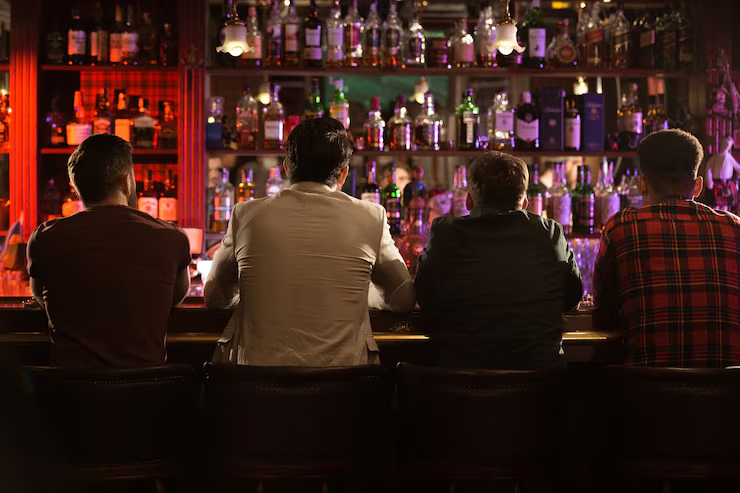
O’Malley’s on a Friday night sounded like every military town’s heartbeat—pool balls cracking against each other, classic rock humming from the jukebox, neon signs casting halos on scarred wood. A small American flag sat in a brass stand by the register, catching the AC breeze every few beats. At the bar, a woman in a gray flannel shirt and worn black jeans nursed a Corona, her ponytail clean and simple, her posture quiet and unremarkable. She looked like grad school and night classes. Nothing about her said war.
Near the dartboard, four Navy SEALs occupied their usual territory. Lieutenant Derek “Hammer” Patterson—broad shoulders, louder voice—had a deployment story tuned to the edge of classified and applause. He spotted the woman at the bar not clapping, not even looking his direction. Civilians in places like this usually reached for proximity to guys like him. She didn’t. He took it personal.
“Hey there,” he said, sliding onto the stool next to her. “You military, or just here for the atmosphere?”
“Just having a beer,” she said, her voice carrying Midwestern vowels and steady eyes that barely acknowledged his presence. “Finished my master’s at Old Dominion last week.”
“International relations,” she added when he asked, though he hadn’t really been interested in the answer. “Conflict resolution.”
Patterson laughed for the benefit of the table behind him. “We do a lot of conflict resolution too. Hands-on version.” Chuckles from the dartboard. The bartender—Eddie, with sleeves of old Marine Corps ink—polished the same glass twice and drifted closer, his instincts picking up something.
The SEAL leaned in, bourbon confidence making him bolder. “Tell you what—since you read about our world in textbooks—bet you don’t even know what a call sign is, sweetheart.”
The word hung in the air like bad smoke. The woman’s jaw didn’t move, but something in her spine did—a shift so subtle that only someone trained to read body language would catch it.
“An earned identifier,” she said evenly. “The kind you don’t put on résumés. The kind that follows you home.”
Patterson smirked, thinking he’d found a military enthusiast, maybe someone who dated a few operators and picked up the lingo. “Cute. What’s yours—Professor?”
She set her bottle down with careful precision, turned so he could see both her calm and her decision, and let two syllables cut through the music like a blade through silk.
“Ghost Nine.”
The beer slipped from Patterson’s hand and shattered against the wooden planks. Every conversation in the room collapsed into silence. At a corner table, a gray-haired Master Chief went completely still, then reached for his phone without looking away from the woman. Eddie stopped breathing along with the rest of the bar.
Patterson’s face lost its swagger and found a color closer to ash. The woman in the flannel didn’t blink.
“Sir,” he started, but his voice cracked.
And that’s when the night changed completely.
The Legend
To understand what happened next, you need to understand what “Ghost Nine” meant in certain circles. Circles that don’t advertise. Circles that most SEALs only hear about in rumors passed during training or late-night conversations in safe houses overseas.
Ghost Nine wasn’t just a call sign. It was a ghost story. A legend. The kind of operator whose existence was debated in the community like people debate UFOs—plenty of secondhand accounts, zero confirmed sightings, and just enough evidence to make you wonder.
The stories varied, but the constants remained: A sniper. A woman. Deployments so black they didn’t have paperwork. Confirmed kills that would make most operators’ careers look modest. And a signature—targets that simply stopped existing, cleanly, quietly, with no trace of how or who.
“Ghost Nine” had supposedly operated in places the United States officially wasn’t—Syria, Yemen, the tribal regions of Pakistan. Some said she’d been Delta. Others claimed CIA Special Activities. A few whispered about a joint task force so classified it didn’t have a name, just a number.
But everyone agreed on one thing: Ghost Nine had disappeared three years ago. No funeral. No announcement. No transfer. Just gone, like smoke clearing at dawn.
Most assumed she was dead. Some hoped she’d just retired. Nobody expected to find her drinking a Corona in a Virginia Beach dive bar on a Friday night.
Patterson stood frozen, his training fighting against his disbelief. The three other SEALs at the dartboard had moved closer, their casual Friday night energy replaced by something sharper, more focused.
“You’re…” Patterson’s voice was different now, stripped of the bravado. “That’s not possible. Ghost Nine was—”
“Was what?” the woman asked, taking another sip of her beer. Her voice hadn’t changed. She could have been discussing the weather.
“KIA. Missing. Something. The stories stopped three years ago.”
“Stories tend to do that when you want them to,” she said simply.
The Master Chief in the corner was on his phone now, speaking quietly but urgently. Eddie had abandoned all pretense of working and was watching the exchange like it was a religious experience.
One of the other SEALs, a younger guy with the lean build of a distance runner, stepped forward. “Ma’am, I don’t mean any disrespect, but Ghost Nine—if that’s really you—you’d be the first female—”
“The first female what?” she interrupted, her tone still calm but carrying an edge now. “The first female sniper? Wrong. The first female in special operations? Wrong again. The first female to do it at this level without anyone making a documentary about it?” She smiled slightly. “Now that might be accurate.”
Patterson had recovered enough to speak. “You have to understand, we’ve been hearing about Ghost Nine since BUD/S. They use your—the—missions as case studies. Never with names or details, but the tactics, the precision… If you’re really her, then you know things about operations that only a handful of people in the world know.”
The woman considered this, then set down her beer and looked at Patterson directly for the first time. “Operation Copper Hawk. November 2019. Idlib Province. They teach that one?”
Patterson’s face went white. “That’s… how do you know that designation?”
“Because I was on a rooftop three clicks from the target building, watching an entire SEAL team almost walk into an ambush I’d been tracking for six hours. I radioed the warning, adjusted your entry point, and eliminated four hostiles before your breach team even knew they were there.”
The bar was so quiet now that the hum of the neon Budweiser sign sounded loud.
“The after-action report,” Patterson said slowly, his mind clearly racing through classified briefings, “said we had ‘unexpected intelligence support from an unidentified asset.’ They never told us it was…”
“They wouldn’t,” she said. “That’s the point.”
The Call
The Master Chief approached the bar, his phone still in his hand. He was older than the others, probably mid-fifties, with the kind of weathered face that spoke of multiple decades in the teams. His name tag said Brennan.
“Ma’am,” he said, and the respect in his voice was absolute. “I just spoke with someone at JSOC. They’re asking if you’d be willing to verify your identity.”
“By doing what?” she asked. “Reciting my service number? That defeats the purpose of being a ghost.”
“No, ma’am. They want to know about Cairo.”
Something flickered across her face—not fear, but recognition. Memory. She was quiet for a long moment.
“Cairo was a mistake,” she finally said. “July 2018. Asset extraction. The intelligence was bad, the timeline was worse, and I lost my spotter. First time I’d worked with a partner in three years, and I got him killed.”
Brennan listened, then spoke quietly into the phone. After a moment, he nodded and hung up.
“They’re satisfied,” he said. “And they’re asking if you’d consider coming in for a conversation. Not an interrogation. A conversation.”
“About what?”
“About why you left. And whether you’d consider coming back.”
The woman—Ghost Nine—let out a short laugh that held no humor. “I didn’t leave. I was asked to disappear. There’s a difference.”
“Things have changed,” Brennan said carefully. “The people who made those decisions aren’t in those positions anymore.”
“And the reasons I was told to disappear? Have those changed too?”
Brennan hesitated. “I don’t know what reasons you’re referring to, ma’am.”
“Then we don’t have anything to talk about,” she said, turning back to her beer.
Patterson, who had been watching this exchange with growing understanding, spoke up. “The stories about why you disappeared—there are a lot of them. Some say you refused an illegal order. Some say you knew too much about a operation that went sideways. Some say you were burned by your own people.”
Ghost Nine didn’t respond, which was answer enough.
“If it’s the last one,” Patterson continued, “then Master Chief Brennan is right. Command structure has completely turned over in the past three years. Different people, different priorities. Maybe different outcomes.”
“Or maybe,” she said quietly, “I’m happy teaching conflict resolution to grad students and not wondering if the people I’m working with are going to throw me under a bus when something goes wrong.”
The bar had remained silent through all of this, but now conversations were starting to resume in hushed tones. The show, if that’s what it had been, seemed to be over.
Eddie finally found his voice. “Ma’am, your drinks are on the house. Tonight and any night you come in here.”
She nodded her thanks but didn’t smile.
Patterson, to his credit, looked genuinely apologetic now. “I’m sorry. For earlier. The ‘sweetheart’ comment. All of it. I was being an asshole.”
“Yes, you were,” she agreed. “But you’re not the first SEAL to have an inflated sense of his own importance, and you won’t be the last. At least you had the grace to apologize.”
“For what it’s worth,” he said, “the stories about you—about Ghost Nine—they inspired a lot of people. Made some of us work harder, train longer. The idea that someone could operate at that level, that quietly, with that much success… it raised the bar.”
“The bar,” she said, “was built on bodies I put in the ground. Some of them deserved it. Some of them probably didn’t, but I was following orders and trusting intelligence that may or may not have been accurate. You want to be inspired? Fine. But don’t romanticize what we do—what I did. There’s nothing romantic about it.”
The Truth
One of the other SEALs, who had been quiet until now, spoke up. He was older than Patterson, probably early thirties, with a scar running down his left forearm. “Ma’am, if you don’t mind me asking—why’d you really leave? The real reason, not the rumors.”
Ghost Nine looked at him for a long moment, then seemed to make a decision.
“Cairo,” she said. “Like I mentioned. My spotter—his name was Danny Reeves. Good kid, twenty-six, engaged to a teacher back in North Carolina. We were supposed to be providing overwatch for an asset extraction. Simple in and out. But the intelligence was wrong. The asset was already compromised, and we walked into a setup.”
She paused, taking a drink.
“Danny took a round in the throat. Bled out in four minutes while I tried to stop it and return fire simultaneously. I got us out, eliminated six hostiles in the process, but Danny died in a safe house three blocks from the target building. I carried him the whole way.”
The bar was silent again.
“The after-action report blamed me. Said I’d positioned us poorly, ignored warning signs, moved too quickly. Never mind that the intelligence I was given said the area was clear. Never mind that the asset I was supposed to protect had been turned two days earlier and nobody bothered to update us. I was the one on the ground, so I was the one who failed.”
“That’s bullshit,” Patterson said flatly.
“That’s politics,” she corrected. “Someone high up didn’t want to admit that the intelligence failure got an operator killed. Easier to blame the sniper than question the chain of command. I was given a choice: disappear quietly with an honorable discharge and a good pension, or fight it and probably lose everything including my freedom. They had enough on me—black ops, gray area missions, things that wouldn’t look good in a court martial—that fighting was suicide.”
“So you walked away,” Brennan said softly.
“I disappeared,” she corrected. “There’s a difference. I went back to being Elizabeth Morgan, the girl from Indiana who wanted to teach conflict resolution. Ghost Nine died in Cairo with Danny Reeves.”
“Except she didn’t,” Patterson observed. “You just admitted who you are in a bar full of operators.”
Elizabeth—because that was her name now, not Ghost Nine—smiled slightly. “I admitted it to you. After you called me ‘sweetheart’ and questioned whether I knew what a call sign was. That’s different than advertising it.”
“Fair point,” Patterson conceded.
Brennan’s phone rang again. He stepped away to answer it, returning a moment later with a serious expression.
“Ma’am—Miss Morgan—that was Captain Richards from JSOC. He’s asking if you’d be willing to meet him tomorrow. Just coffee, no pressure. He said to tell you that he’s personally reviewed the Cairo file and the after-action report, and he agrees that you were fucked over.”
Elizabeth raised an eyebrow. “Those his exact words?”
“Yes, ma’am. He’s not known for diplomacy.”
“And what does he want from this coffee meeting?”
“He wants to make you an offer. He wouldn’t tell me details, but he said it’s not about bringing you back into the field. It’s about something else.”
Elizabeth considered this. “What time?”
“Whenever you’re available.”
“Ten a.m. The Starbucks on Shore Drive. Public place, daytime, plenty of witnesses if this turns into something I don’t like.”
Brennan nodded and relayed the information into the phone. After a moment, he hung up. “He’ll be there.”
The Aftermath
The tension in the bar began to ease as people processed what they’d witnessed. The four SEALs bought Elizabeth another Corona—which she accepted—and kept a respectful distance for the rest of the evening. Other patrons gave her space as well, though more than a few took surreptitious photos that would undoubtedly end up on social media with vague captions about “meeting a legend.”
Eddie, the bartender, approached during a quiet moment. “I was in Fallujah in ’04,” he said. “Second tour. Got out after I took shrapnel in my leg. I’ve met a lot of operators over the years, worked this bar for almost a decade. Never met anyone quite like you.”
“That’s because people like me aren’t supposed to exist,” Elizabeth said.
“But you do exist. And if even half the stories about Ghost Nine are true, you saved a lot of American lives.”
“I also took a lot of other lives. That’s the part the stories tend to gloss over.”
Eddie nodded slowly. “My platoon sergeant used to say that the hardest part about war isn’t the fighting. It’s living with what you did when the fighting’s over.”
“Your platoon sergeant was a smart man.”
As the evening wore on, Elizabeth finished her beer and prepared to leave. Patterson approached one more time, this time with genuine humility.
“Ma’am, I know I already apologized, but I want to say it again. What I did—coming over here, talking down to you, making assumptions—that was wrong. And hearing your story, understanding what you sacrificed and how you were treated… I’m genuinely sorry.”
“Apology accepted, Lieutenant. Just remember this feeling the next time you see someone who doesn’t fit your expectations. You never know who you’re talking to or what they’ve been through.”
“Yes, ma’am. That’s a lesson I won’t forget.”
Elizabeth pulled on her jacket and headed for the door. As she reached it, Brennan called out to her.
“Miss Morgan? For what it’s worth, I served with Danny Reeves’ uncle. Good family. Danny was proud to be working with you. His family never blamed you for what happened.”
Elizabeth stopped, her hand on the door. For the first time that evening, her composure cracked slightly. “Thank you for telling me that,” she said quietly. Then she was gone, disappearing into the Virginia Beach night.
The Meeting
The next morning, Elizabeth arrived at the Starbucks fifteen minutes early. She chose a table near the back with a clear view of the entrance and both exits—old habits dying hard—and ordered black coffee.
Captain Richards arrived exactly at ten. He was in his mid-forties, built like someone who still ran five miles before breakfast, with the kind of face that had seen too much to be surprised by anything. He wore civilian clothes—jeans and a polo shirt—but carried himself like military.
“Miss Morgan,” he said, extending his hand. “Thank you for meeting me.”
“Captain Richards,” she replied, shaking his hand firmly. “You have thirty minutes. Make it count.”
He smiled slightly at her directness. “Fair enough. I’ll get to the point. I’ve spent the last three months reviewing black operations from 2015 to 2020, trying to understand why we lost some of our best operators during that period. Your name came up repeatedly—not in official records, but in the gaps. Missions that succeeded inexplicably. Problems that disappeared without explanation. And then suddenly, three years ago, the pattern stopped.”
“Because I stopped,” Elizabeth said simply.
“Because you were forced to stop,” Richards corrected. “I’ve read the Cairo after-action report. I’ve also read the original intelligence briefing and the updates that never made it to your team. You were set up to fail, and when Reeves died, you were set up to take the fall.”
“That’s ancient history now.”
“Maybe. But the people who did that to you—most of them are gone now. Retired, transferred, a few even prosecuted for unrelated corruption. The landscape has changed.”
“And you want me to come back,” Elizabeth said. “That’s why we’re here.”
“No,” Richards said, surprising her. “I don’t want you to come back. What I want is to offer you something different.”
He pulled out a tablet and showed her a document. “We’re building a training program for special operations personnel—all branches, all specialties. Advanced tactics, ethical decision-making, scenario-based learning. We need instructors who have actually been there, who can teach not just from manuals but from experience.”
Elizabeth scanned the document. “You want me to teach?”
“I want you to shape the next generation of operators so they don’t end up like you—burned out, betrayed, and disappeared. You have a master’s in conflict resolution. You have more real-world experience than ninety-nine percent of the people in the special operations community. And you have the moral authority to talk about the costs of this work because you’ve paid them.”
“This sounds like a PR move,” Elizabeth said skeptically. “First female this, breaking barriers that. I’ve seen this before.”
“It’s not PR,” Richards said firmly. “Your identity would remain protected. You’d teach under a pseudonym if you wanted. The goal isn’t publicity—it’s making sure operators have the training and ethical framework to handle situations like Cairo without someone dying unnecessarily.”
Elizabeth was quiet for a long time, sipping her coffee and thinking.
“What about Danny Reeves?” she finally asked. “His death was officially my fault. That’s in the record. How do you propose I teach when that’s hanging over me?”
“That record is being amended,” Richards said. “I have the authority to order a re-investigation. The new after-action report will accurately reflect the intelligence failures and command decisions that led to his death. Your record will be cleared.”
“That doesn’t bring him back.”
“No,” Richards agreed. “But it might prevent the next Danny Reeves from dying in a situation that could have been avoided.”
The Decision
Elizabeth finished her coffee, then looked directly at Captain Richards. “I need forty-eight hours to think about this.”
“Take as long as you need.”
“And I have conditions. If I agree to this, I want full autonomy over curriculum. I’m not teaching propaganda or sanitized versions of operations. If I’m going to do this, I’m teaching truth—the messy, complicated, morally ambiguous truth.”
“I wouldn’t expect anything else,” Richards said.
“And I want a memorial for Danny Reeves at whatever facility this training program is based out of. Not a big thing, just something that acknowledges who he was and what he gave. If we’re going to train operators to make better decisions, they should know about the people who died because of bad decisions.”
Richards nodded. “I can make that happen.”
“Then I’ll give you my answer in two days.”
They shook hands again, and Richards left. Elizabeth sat alone for a while, watching people come and go from the coffee shop—college students, young parents, retirees. Normal people living normal lives.
She thought about Danny Reeves, bleeding out in that safe house while she tried desperately to save him. She thought about the years she’d spent as Ghost Nine, the lives she’d taken, the missions she’d completed, all in service of a country that had discarded her when she became inconvenient.
But she also thought about the young SEALs in the bar last night—Patterson with his swagger and ignorance, the others with their respect and curiosity. They were good operators, probably. But they could be better. They could be smarter, more ethical, more prepared for the impossible situations they’d inevitably face.
She could help with that. Not as Ghost Nine, but as Elizabeth Morgan, someone who had been through the fire and survived with her humanity mostly intact.
That evening, Elizabeth called Captain Richards.
“I’ll do it,” she said. “On my conditions.”
“Understood. When can you start?”
“Give me a month to wrap up my teaching commitments here. Then I’m yours.”
“Thank you, Miss Morgan. I think you’re going to change a lot of lives.”
“Let’s hope so,” she said. “I’ve ended enough of them.”
Six Months Later
The training facility was located in a nondescript building outside Fort Bragg. No signs, no fanfare, just a secure facility where America’s special operations forces came to learn from people who had actually done the work.
Elizabeth taught three times a week under the name “Professor Morgan.” Her students—SEALs, Delta operators, Rangers, Air Force Para-rescue—initially questioned what a woman with no apparent military background could teach them.
That lasted about fifteen minutes into her first class.
She didn’t teach from PowerPoint slides or field manuals. She taught from experience, walking them through actual operations—sometimes her own, sometimes others’—and forcing them to grapple with the decisions that had been made, the outcomes that resulted, and the alternatives that might have existed.
She taught them about intelligence failures and how to question bad information. She taught them about the fog of war and how to make decisions with incomplete data. She taught them about moral injury and how to process the weight of what they’d done.
And in the hallway outside her classroom, there was a small memorial plaque:
In Memory of Sergeant Daniel Reeves
Special Operations, United States Army
Killed in Action, Cairo, Egypt, July 2018
A Good Man Who Deserved Better Intelligence
On Friday afternoons, after her classes, Elizabeth would sometimes drive down to Virginia Beach and stop by O’Malley’s. Eddie would pour her a Corona without asking, and she’d sit at the same stool where this had all started.
Patterson came in one Friday, now a few months into a new deployment cycle. He spotted her and approached respectfully.
“Ma’am—Professor Morgan. Good to see you.”
“Lieutenant. How’s training going?”
“Harder than I expected,” he admitted. “Your class especially. You made us confront some things about ourselves that weren’t comfortable.”
“That’s the point.”
“I know. And I’m grateful for it. We all are.” He paused. “I heard about the memorial for Sergeant Reeves. That was a good thing you did.”
“It was the least I could do.”
Patterson ordered his own beer and stood there for a moment, then asked the question he’d clearly been working up courage to ask. “Do you miss it? The field work, I mean.”
Elizabeth considered this. “Sometimes I miss the simplicity of it. Point to a target, eliminate the target, mission accomplished. But mostly I don’t miss it. What I’m doing now—teaching you and people like you to be better than I was, to avoid the mistakes I made—that feels more important.”
“For what it’s worth,” Patterson said, “Ghost Nine is still a legend. But Elizabeth Morgan is becoming a better one. The good kind.”
After he left, Elizabeth sat alone with her beer and thought about call signs and legends and the difference between the stories people tell and the truth people live.
Ghost Nine had been a legend built on silence and shadows and missions no one could talk about. Elizabeth Morgan was becoming something different—a teacher, a mentor, someone who helped operators become better versions of themselves.
She liked the second version better.
As she finished her beer and prepared to leave, Eddie called over to her. “Same time next week, Professor?”
“Same time next week,” she confirmed.
Outside, the Virginia Beach night was warm and clear. Elizabeth walked to her car, no longer looking over her shoulder out of habit, no longer scanning rooftops for threats. She was just a woman who had done hard things, survived them, and was now trying to make sure the next generation could do better.
Ghost Nine might have been a legend. But Elizabeth Morgan was real. And in the end, she decided, that was more important.