The Salute
They liked their success loud—frames on walls, uniforms at brunch, speeches that sounded like commercials. Mine was the kind you sign NDAs for and never post about. So at family dinners I poured wine, laughed in the right places, and let them tell the story where I was the “deadbeat” with time on her hands. When my brother joked, “Some of us actually work for a living,” nobody corrected him. When my mother introduced her children, she listed two careers and one… silence. I told myself silence was grace. Then came Talia’s birthday dinner.
Private banquet room. Gold centerpieces. That polite heat of a room built to impress. I took a seat at the back, black dress, no jewelry, no explanations. Luke smirked on approach—”look who made it off the couch”—and walked away before an answer mattered. Toasts rolled. Laughter piled up. I ate quietly and watched the narrative write itself again in real time.
The door opened.
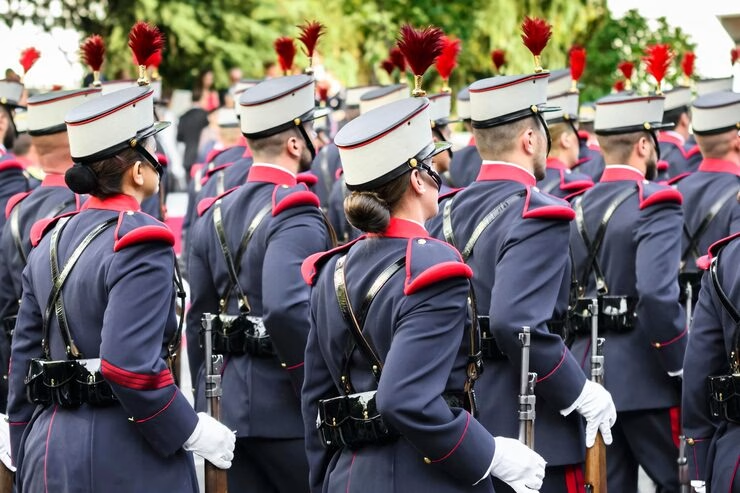
Dress whites. Gold trim. Ribbons set with surgeon’s hands. Commander Marcus Wyn—my sister’s husband—stepped in, scanned the room once, and began walking. Not to the head table. Not to my parents. To me. Conversations thinned, like the oxygen had been turned down. He stopped just short of my chair, shoulders squared in a way that changes a room’s math, and raised his hand in a clean, unmistakable salute.
“Ma’am,” he said, voice evenly cut to carry.
A fork clinked somewhere. My father’s expression stalled between offense and arithmetic. Talia’s practiced smile trembled at the edges. Luke’s grin broke like glass. I stood—slowly—feeling every edit they’d ever made to me slide off like a coat that was never mine.
“Commander,” I said quietly, returning the acknowledgment with a slight nod.
Marcus lowered his hand but didn’t step back. His posture remained parade-ground straight, his voice carrying across the suddenly silent room. “Lieutenant Commander Elena Chen, retired. Naval Intelligence. Sixteen years of service. Three tours in classified theaters. Two commendations I’m not cleared to name. And the officer who saved my entire unit in Kandahar when you decrypted enemy communications in real-time during an active siege.”
The silence that followed wasn’t empty. It was dense, packed tight with years of assumptions collapsing inward.
The Before
My name is Elena Chen, and for sixteen years I existed in spaces that don’t appear on maps, solving problems that never make the news. I analyzed signals intelligence, broke encryption protocols, and provided tactical support to operations that would be declassified long after I was dead. I worked in windowless rooms, lived in hotels under assumed names, and carried a phone that could only call three numbers.
When people asked what I did, I said “government contractor” and changed the subject. When my family asked, I said the same thing and endured the pity that followed—the assumption that “contractor” meant I filed paperwork or answered phones, that I was making do while my siblings made something of themselves.
Talia was a corporate attorney, the kind who wore power suits and negotiated mergers. She married Marcus Wyn when he was a Lieutenant, a rising star in naval operations. Their wedding photos looked like a military recruitment poster—flags and dress uniforms and a future that announced itself in capital letters.
Luke was a surgeon, cardiovascular, with a practice in a glass tower and a roster of wealthy patients who paid premium rates for premium care. He drove a car that cost more than most people’s houses and never missed an opportunity to mention it.
Our parents were professors—literature and economics respectively—who valued achievement you could hang on a wall or introduce at dinner parties. Awards. Titles. Tangible proof of worth.
I had none of those things. My commendations were classified. My achievements couldn’t be named. My job title was deliberately vague. So at family gatherings, I became the sister who “did something with computers,” the one with “time on her hands,” the one whose contributions to conversation were always prefaced with “Well, Elena wouldn’t know about this, but…”
I told myself it didn’t matter. That I knew the truth, and that was enough. That silence was its own kind of strength.
But silence, I learned, is also permission for others to write your story for you.
The Gathering
Talia’s fortieth birthday party was held at the Grandview Club, a venue that required membership and arrived with implied expectations. Gold tablecloths. Waiters in white gloves. A guest list that read like a networking event disguised as family celebration.
I arrived alone, as I always did. No date, no plus-one, no buffer between me and the gentle condescension that had become family tradition. I wore black because it was simple, because it didn’t demand attention, because I’d learned to dress like furniture—present but unremarkable.
“Elena!” My mother’s voice carried the particular brightness reserved for managing awkward situations. “You made it. We weren’t sure you’d come.”
“Wouldn’t miss it,” I said, kissing her cheek.
“Well, find a seat wherever. We’ve got quite the crowd tonight.” She gestured vaguely toward the back of the room, where a few empty chairs sat far from the head table where Talia held court.
I took my seat and watched the room fill. Talia’s law firm colleagues. Marcus’s military friends. Luke’s medical connections. Our parents’ academic circle. Everyone successful, everyone accomplished, everyone with a story worth telling.
Luke found me twenty minutes in, scotch in hand, smirk already in place. “Look who made it off the couch. Thought you might be too busy with your ‘consulting’ to join us.”
He used air quotes. He actually used air quotes.
“Wouldn’t miss Talia’s birthday,” I said evenly.
“Yeah, well, some of us actually work for a living.” He took a sip, letting the words land. “Must be nice to have all that free time.”
I could have responded. Could have said something sharp. But sixteen years of operational discipline had taught me that silence often communicated more than speech. I smiled blandly and reached for my water glass.
He walked away satisfied, believing he’d scored a point.
Around me, conversations swirled—deals closing, surgeries succeeding, cases winning. I ate my salad and listened to the symphony of achievement, the chorus of people whose worth could be measured in billable hours and social media posts.
Toasts began. Our father stood, raised his glass, spoke about his “extraordinary daughter” who’d built an impressive legal career. “Following in our footsteps,” he said proudly, as if success was hereditary and Talia’s was proof the bloodline was sound.
Luke offered the next toast, something about excellence and ambition, about people who “make things happen” versus those who “let life happen to them.” His eyes found mine across the room when he said it. The message was clear.
I sipped champagne and told myself it didn’t sting.
Then the door opened.
The Entrance
Marcus was supposed to be deployed. Talia had said as much three times during cocktail hour, her tone mixing disappointment with resigned acceptance. “Military life,” she’d sighed to her colleagues. “You learn to celebrate everything twice—once when it happens, once when he’s home.”
But there he stood, filling the doorway in dress whites that made him look carved from marble. Commander Marcus Wyn, decorated officer, hero of operations I couldn’t name, husband to my sister for twelve years.
His eyes swept the room with the methodical efficiency of someone trained to assess threats and assets in seconds. He found his wife. Acknowledged her with a nod. Then his gaze moved through the crowd and landed on me.
He began walking.
Conversations didn’t stop immediately. They tapered, the way sound fades when something more important arrives. People turned, following his trajectory, expecting him to move toward Talia, toward the head table, toward the center of celebration.
He walked past all of it.
Straight to the back corner. Straight to me.
I stood automatically, muscle memory from years of military protocol taking over before my brain could process what was happening. Marcus stopped precisely three feet away, his posture shifting into something formal, something official.
Then he raised his hand in a salute so crisp it could have been used in training manuals.
“Ma’am,” he said, his voice carrying across the suddenly silent room.
Time did something strange. It stretched and compressed simultaneously. I was aware of every face turning toward us, every fork suspended mid-air, every conversation dying mid-word. I was aware of my father’s confusion, my mother’s shock, Luke’s face draining of smug certainty, Talia’s expression cycling through bewilderment to something like horror.
But mostly I was aware of Marcus, standing at attention, giving me the acknowledgment I’d been trained never to expect outside classified circles.
I returned a slight nod—not quite a salute, because I was retired and in civilian clothes, but an acknowledgment that accepted his respect.
“Commander,” I said quietly.
He lowered his hand but maintained his formal bearing. “Lieutenant Commander Elena Chen, retired. Naval Intelligence. Sixteen years of service. Three tours in classified theaters. Two commendations I’m not cleared to name. And the officer who saved my entire unit in Kandahar when you decrypted enemy communications in real-time during an active siege.”
The silence that followed wasn’t the comfortable kind. It was the silence of narrative collapse, of certainty crumbling, of carefully constructed stories meeting facts that refused to cooperate.
Marcus continued, his voice never wavering. “Ma’am, I owe you my life. So do seventeen other men who made it home because you saw a pattern in signals traffic that everyone else missed. You gave us twelve minutes of warning. Twelve minutes was the difference between an ambush and an evacuation.”
My throat felt tight. I’d never talked about Kandahar. Couldn’t talk about it, technically, though Marcus was clearly operating under a different classification level than I was bound by.
“You were doing your job, Commander,” I said softly. “As was I.”
“Yes, ma’am. And your job saved lives. Continues to save lives, based on the methods you developed.” He shifted slightly, addressing the room now rather than just me. “Lieutenant Commander Chen’s work in signals intelligence led to the capture or neutralization of fourteen high-value targets. Her encryption protocols are still used by Naval Intelligence. And her tactical assessments informed operations across three theaters.”
He turned back to me. “With your permission, ma’am, I’d like to join you. It would be an honor to sit at your table.”
The question hung in the air, formal and utterly sincere.
“Please,” I managed, gesturing to the empty chair beside me.
Marcus moved with parade precision, pulling out the chair, sitting with perfect posture. Only then did the room slowly, uncertainly, resume breathing.
The Aftermath
Talia reached us first, her heels clicking like punctuation against the polished floor. Her face had arranged itself into something between greeting and interrogation.
“Marcus! You made it. I thought you were—” She stopped, eyes moving between her husband and me. “What’s going on?”
Marcus stood immediately, took her hand, kissed her cheek. “Happy birthday, love. I pulled every favor I had to make it back in time.”
“That’s wonderful, but why were you…” She gestured vaguely at me.
“Paying respect to a superior officer,” Marcus said simply.
“Superior—Elena?” Talia’s laugh was reflexive, disbelieving. “Elena works with computers. She does consulting or something.”
“Elena,” Marcus said, his tone gentle but immovable, “ran one of the most effective signals intelligence units in Naval Intelligence. Her team’s work directly contributed to operations that saved hundreds of lives, including mine.”
Talia looked at me, really looked, perhaps for the first time in years. “You never said…”
“I couldn’t,” I replied quietly. “Classification. Non-disclosure agreements. The nature of the work.”
“But you let us think—” She stopped, the sentence trailing off as she realized what she was about to say. You let us think you were nothing. You let us think you were the failure.
“I let you think what you wanted to think,” I said, not unkindly. “I couldn’t correct you without violating security protocols. And after a while, it seemed easier to just… let it be.”
Luke arrived next, our father trailing behind him. Luke’s face had gone through several color changes, settling on an unhealthy pink. “This is some kind of joke, right? Elena, you’re not seriously claiming—”
“She’s not claiming anything,” Marcus interrupted, his voice taking on an edge I recognized from the few times I’d heard him brief his unit. “I’m stating facts. Verifiable facts, though you’ll find most of her service record is redacted for security reasons.”
“That’s convenient,” Luke muttered.
Marcus’s expression didn’t change, but something in his stillness made Luke take a step back. “Lieutenant Commander Chen holds a Top Secret/Sensitive Compartmented Information clearance. Her work required her to sign approximately forty-seven separate non-disclosure agreements. She cannot discuss the specifics of her service without violating federal law. The fact that I can discuss some of it is due to recent declassification of certain operations and my own clearance level. But her inability to defend herself against your assumptions is not evidence of failure. It’s evidence of her commitment to national security.”
My father, who had been silent, finally spoke. “Elena, why didn’t you tell us?”
“I did tell you, Dad. I told you I worked for the government in intelligence. You asked if that meant I filed reports. I said it was complicated. You stopped asking.”
The truth of it settled over him like ash.
My mother appeared, her academic composure barely containing her shock. “All these years…”
“All these years I came to family dinners, listened to everyone’s achievements, and stayed quiet because I wasn’t allowed to compete in the story-telling. My work was classified. My accomplishments were redacted. My life existed in spaces I couldn’t describe at dinner parties.” I looked around at my family, at the guests now watching us with undisguised fascination. “I let you think I was the disappointing one because the alternative was violating federal law.”
Talia’s face had gone pale. “We treated you like…”
“Like the deadbeat,” I finished for her. “Like the sister with time on her hands. Like the one who didn’t quite measure up.” I kept my voice level, not cruel, just honest. “And I let you, because pride seemed less important than security clearance.”
The Unraveling
The party didn’t recover. How could it? The narrative that had held us together for sixteen years had been exposed as fiction, and no one knew which story to tell anymore.
Guests began leaving early, murmuring polite excuses. Talia’s law colleagues departed with curious backward glances. Luke’s medical friends found sudden pressing obligations. The room, which had been full of confident celebration, slowly emptied into awkward uncertainty.
My parents sat down at my table—the table at the back, the table I’d been relegated to—and for the first time in years, they looked at me with something other than benign disappointment.
“Why didn’t you fight harder to make us understand?” my mother asked, her professor’s mind trying to solve the equation.
“Because fighting would have required revealing classified information,” I said simply. “And because, honestly, after a while it hurt less to be underestimated than to be disbelieved.”
My father flinched. “We would have believed you.”
“Would you? When I said I worked in intelligence, you assumed I meant data entry. When I said it was complicated, you assumed I was being evasive because the truth was embarrassing. You’d already written the story, Dad. You just needed me to play my part.”
Marcus, who had remained quietly present, added, “For what it’s worth, sir, your daughter’s work required her to be underestimated. In intelligence, the most effective operators are the ones people overlook. Elena was exceptional at being underestimated.”
“That’s not a compliment in civilian life,” I said dryly.
“No, ma’am. But it kept you alive in the field.”
Luke had been listening from a few feet away, his drink forgotten in his hand. “So what, you’re some kind of spy? Like James Bond?”
“Nothing like James Bond,” I replied. “Intelligence work is mostly analysis. Patterns. Signals. Data. It’s not glamorous. It’s tedious, meticulous, and occasionally critical. I sat at computers for sixteen years, breaking codes and tracking communications. The most exciting part of most days was when the coffee arrived.”
“But Kandahar,” Marcus interjected quietly. “That wasn’t just coffee and computers.”
I met his eyes. “Kandahar was… an exception. I was attached to a forward operating base providing real-time intelligence support. When the signals chatter indicated an imminent attack on Commander Wyn’s unit, I had minutes to analyze and confirm the threat. I didn’t save anyone. I just did my job faster than the enemy could execute theirs.”
“You gave us twelve minutes,” Marcus said, his voice carrying the weight of someone who’d lived and relived those twelve minutes many times. “We were sitting ducks in that valley. Twelve minutes let us reposition before they hit where we’d been. Without your warning, I wouldn’t be here. Neither would seventeen other men.”
The number hung in the air. Seventeen lives. Seventeen families who didn’t have to plan funerals. Seventeen futures that continued because someone in a computer room halfway around the world had seen a pattern and acted fast.
Talia, who had been standing frozen near the head table, finally moved. She walked over slowly, like approaching something fragile. “Elena, I don’t… I don’t know what to say.”
“You don’t have to say anything,” I replied gently.
“But we’ve been terrible to you. For years. All those comments about you not working, about you having time on your hands, about you not contributing…” Her voice cracked. “God, I introduced you to my colleagues as my ‘freelancing sister’ with air quotes. I was embarrassed of you.”
“I know.”
“And you just took it. You never defended yourself, never corrected us, never—”
“Never violated my clearance,” I finished. “Talia, I made a choice. I chose service over ego. I chose security over validation. I don’t regret that choice, but I’m also tired of being the family’s cautionary tale about lack of ambition.”
Marcus stood, addressing my parents directly. “Sir, ma’am, your daughter is the definition of ambition. She pursued excellence in a field that would never give her public recognition. She sacrificed normal relationships because her work required mobility and secrecy. She lived under constant security restrictions that would make most people quit within months. And she did it for sixteen years, becoming one of the most respected intelligence officers in the Navy. That’s not lack of ambition. That’s ambition strong enough to operate without applause.”
My mother was crying quietly. My father looked like someone had rearranged his understanding of physics. Luke stared at his shoes. Talia stood with her hands pressed to her mouth.
“I think,” I said into the heavy silence, “I should probably go.”
“No.” My father’s voice was sharp. “Please. Stay. We need to… I need to understand what we missed.”
The Conversation
We moved to a smaller table after most guests had left. Just family now—Talia, Marcus, Luke, our parents, and me. The gold centerpieces seemed ridiculous in the sudden intimacy.
“Start from the beginning,” my mother said, her professor’s instinct taking over. “Help us understand.”
So I told them. Not the classified parts, but the shape of my life. How I’d been recruited during my senior year of college by a Naval Intelligence officer who’d noticed my aptitude for pattern recognition and mathematics. How I’d gone through months of background checks and security screening before being offered a position that I couldn’t describe to anyone, including my family.
“They told me the work would require sacrifice,” I explained. “Personal sacrifice. I’d miss family events because I was deployed to locations I couldn’t name. I’d have to lie about where I lived and what I did. I’d never be able to share my achievements because my achievements would be classified. They asked if I could handle being invisible. I said yes.”
“Why?” Luke asked, genuine confusion in his voice. “Why would anyone choose that?”
“Because the work mattered. Because saving lives matters more than getting credit for it. Because someone has to operate in the shadows, and I was qualified to do it.”
I described the rhythm of intelligence work—the long hours analyzing signals traffic, the tedious process of breaking encryption, the rare moments of breakthrough when patterns suddenly revealed themselves. I explained how most of my work was preventive, how success in intelligence often meant nothing happened because you’d identified and neutralized a threat before it materialized.
“So we’d never hear about your victories,” my father said slowly, “because your victories look like nothing changing.”
“Exactly. The best intelligence work is invisible. You prevent the attack, disrupt the plot, redirect the threat before it becomes news. My job was to make sure certain stories never got written.”
Talia was crying now, tears running freely down her face. “And we complained that you never had any stories to tell.”
“You had no way of knowing,” I said, and meant it.
“But we should have trusted you,” she insisted. “We should have believed you when you said your work was complicated. We should have—” She stopped, shoulders shaking. “I’ve been so cruel.”
Marcus put his arm around his wife, but his eyes were on me. “The Lieutenant Commander could have corrected us at any point after retirement. Classification restrictions change after you leave service. But she didn’t. She kept protecting your ignorance.”
“Because what was the point?” I asked quietly. “By then, the narrative was set. You’d all decided who I was—the disappointing sister, the one who didn’t quite make it. Correcting you would have felt like bragging. And honestly, I was tired of fighting to be seen.”
The words landed like stones.
My mother reached across the table, taking my hand. “We failed you. As parents, as family, we failed you.”
“You didn’t fail me,” I replied. “You just didn’t understand me. There’s a difference.”
“Is there?” Luke’s voice was rough. “Because I’ve spent years mocking you at family dinners. Making jokes about your ‘consulting work.’ Implying you were lazy. And you just… took it.”
“What was I supposed to do? Argue? Tell you that I’d spent my day analyzing terrorist communications while you were in surgery? Make it a competition?” I shook my head. “I chose not to compete because the games we were playing weren’t the same. You were playing for recognition. I was playing for national security. Different rules.”
Marcus leaned forward. “For what it’s worth, ma’am, every intelligence officer I’ve ever worked with carries this same burden. The people who do the most critical work are often the least recognized. It’s the nature of the field.”
“But she’s not in the field anymore,” Talia said, wiping her eyes. “She retired two years ago. She could have told us then.”
“I could have,” I agreed. “But by then, did it matter? You’d all built successful careers. You had stories to tell at parties. I was finally out of the classified world, finally able to live normally, and I didn’t want to spend what should have been my freedom explaining my past. I wanted to figure out who I was when I wasn’t Lieutenant Commander Chen. Turns out, I’m just Elena. And that’s been enough.”
“It’s not enough,” my father said firmly. “You’re extraordinary. Your service, your sacrifice—that deserves recognition. It deserves—”
“It deserves to be private,” I interrupted gently. “Dad, I didn’t serve for recognition. I served because the work needed doing and I was capable of doing it. Now I’m done. I’m retired. I’m trying to figure out what comes next. And what I don’t need is my family suddenly treating me like a hero because you learned facts you should have trusted me about years ago.”
The table went quiet.
“So what do you need?” my mother asked finally.
“I need you to stop writing me as the punchline. I need Luke to stop making jokes about my couch. I need Mom to stop introducing me with that apologetic tone like I’m the child she has to explain. I need to just… be part of the family without being the disappointing one.”
“You were never disappointing,” my father said, his voice thick. “We were just too blind to see what was right in front of us.”
“Then start seeing now,” I said simply.
The Shift
The weeks that followed felt like learning a new language. My family tried—sometimes awkwardly, sometimes too enthusiastically—to rewrite years of habit.
My mother called to ask about my day without the concerned tone that used to imply she was checking if I’d finally found “real work.” Luke texted an apology that was three paragraphs long and surprisingly heartfelt. My father sent me articles about intelligence work with subject lines like “Thought you’d find this interesting” instead of “Maybe relevant to your field?”
Talia was the most persistent. She called almost daily, trying to fill in the gaps of years we’d existed side by side but never really together. She asked about my work, my experiences, the friends I’d made in service who she’d never met because I’d kept those worlds separate.
“I want to understand,” she said during one call. “I want to know the sister I missed while I was busy being embarrassed of you.”
“You weren’t embarrassed of me,” I corrected. “You were embarrassed by what you thought I was. There’s a difference.”
“Is there? Because the result was the same. I treated you like you were less. Like your life was smaller than mine. Like you didn’t matter as much.”
“But you didn’t know—”
“I should have known something was different,” she insisted. “The way you traveled but could never say where. The way you had money but no obvious income. The way you’d disappear for months and come back different somehow—quieter, more careful. I should have asked better questions instead of assuming worse answers.”
“You assumed what made sense from your perspective,” I said. “I don’t blame you for that.”
“Well I blame me for it,” she replied sharply. “And I’m going to spend the rest of our relationship making it up to you.”
Marcus, for his part, treated me with a respect that was almost uncomfortable. He stood when I entered a room. He deferred to my opinions on security matters. He told stories about my work—the parts he could discuss—with a reverence that made me squirm.
“You don’t have to do that,” I told him after a particularly effusive introduction at a military event he’d invited me to.
“Do what, ma’am?”
“Treat me like I’m special. I was just doing my job.”
“With respect, ma’am, you were exceptional at your job. And I’m going to keep saying so until you accept that both things can be true. You were doing your job. And you were remarkable at it.”
I didn’t know how to argue with that kind of earnest insistence, so I stopped trying.
The hardest adjustment was learning to exist in my family without the armor of their low expectations. For years, I’d known exactly who I was supposed to be at family gatherings—quiet Elena, unremarkable Elena, Elena who listened to other people’s success stories and smiled supportively. Now I was expected to have stories of my own, to contribute, to be seen.
It was exhausting.
At Sunday dinner, my mother asked what I was working on. I mentioned I was consulting for a cybersecurity firm, helping them improve their threat detection protocols.
“That sounds interesting,” she said encouragingly. “Tell us more.”
I could feel everyone waiting, genuinely interested, genuinely wanting to understand. The attention felt like spotlights after years of shadows.
“It’s fairly technical,” I began, then stopped. The old habit of deflecting, of minimizing, was harder to break than I’d expected.
“Try us,” Luke said, and he sounded sincere.
So I did. I explained the work in terms they could understand, drawing parallels to their own fields. My father, the economist, grasped the pattern recognition aspects immediately. My mother, the literature professor, understood the work as translation—taking signals and converting them into meaning.
They listened. Really listened. Asked questions. Engaged with my work the way they’d always engaged with Talia’s cases or Luke’s surgeries.
It felt strange. Good strange, but strange.
The Healing
Six months after Talia’s birthday party, my family threw a dinner in my honor. No special occasion. Just, as my mother put it, “making up for sixteen years of dinners where you couldn’t be properly celebrated.”
I tried to talk them out of it. Failed.
The venue was smaller than Talia’s party had been—a private room at a restaurant, intimate and warm. The guest list was limited to family and a few of my former colleagues who Marcus had secretly tracked down and invited.
When I walked in and saw commanders and analysts I’d worked with, people I hadn’t seen since retirement, I actually stopped in the doorway.
“Surprise,” Talia said, coming up beside me. “We thought you should be properly honored. By people who actually understand what you did.”
The evening was surreal. My former commanding officer gave a speech about my contributions to naval intelligence. Colleagues told stories—some still classified, so heavily redacted they were more silence than speech, but meaningful nonetheless.
Marcus presented me with a shadow box containing my service medals and ribbons—decorations I’d received but never displayed because doing so invited questions I couldn’t answer. The box was elegant, professional, and completely unnecessary.
“You earned these,” he said simply. “They should be seen.”
My family watched all of it with expressions ranging from pride to guilt to wonder. They were finally seeing me—not the version they’d constructed from assumptions, but the actual person I’d been while they weren’t looking.
During dinner, Luke stood to give a toast. He looked uncomfortable, which was unusual for my typically confident brother.
“I need to apologize,” he started. “Publicly. To my sister.” He looked at me directly. “Elena, I spent years treating you like a punchline. Like you were the cautionary tale in our family—the one who didn’t reach her potential. I was cruel. I was dismissive. And I was completely, stupidly wrong.”
His voice cracked slightly.
“You’ve been a hero this entire time. While I was saving lives one surgery at a time, you were saving hundreds of lives I’ll never know about. While I was building a career I could brag about, you were building a career you couldn’t discuss. While I was collecting accolades, you were collecting clearances that prevented you from defending yourself against my mockery.”
He raised his glass. “To my sister Elena. Who taught me that the most important work often happens in silence, and that real strength doesn’t need applause. I’m sorry I didn’t see you sooner. I’m grateful I can see you now.”
The table—filled with family and former colleagues—raised their glasses. “To Elena.”
I had to excuse myself to the bathroom to cry privately.
When I returned, my mother caught my arm. “Are you okay?”
“I’m fine. Just… overwhelmed.”
“Good overwhelmed or bad overwhelmed?”
“Good,” I admitted. “Weird, but good.”
She hugged me tightly. “I’m so sorry we didn’t see you. Really see you. You deserved better from us.”
“You’re seeing me now,” I said. “That’s what matters.”
The New Normal
A year later, my life had settled into something I’d never quite expected—normalcy with validation.
I’d taken a position teaching cybersecurity at a university, working with the next generation of intelligence analysts. The work was satisfying in a different way than operational intelligence had been. Less urgent, perhaps, but more openly rewarding.
My family had learned to treat me like an equal rather than a project. Sunday dinners no longer felt like performances where I played supporting character to everyone else’s leads. We talked about work—all of our work—with genuine interest and respect.
Luke and I had developed an unexpected friendship. He’d started asking me technical questions about security protocols for his medical practice, and I’d started asking him about the science behind his surgeries. We’d discovered we both enjoyed hiking, so we’d begun taking monthly trips into the mountains, where the only competition was against terrain.
Talia had become something closer to a real sister. We had coffee every week, conversations that went deeper than surface pleasantries. She told me about the pressures of her law career, the constant performance required by corporate law. I told her about the difficulty of transitioning from classified work to civilian life, of learning to exist without the structure that had defined me for sixteen years.
“Do you ever regret it?” she asked during one coffee date. “The secrecy? The sacrifice?”
“No,” I answered honestly. “I regret that it cost me honest relationships with family. But I don’t regret the work itself. It mattered. It still matters.”
“Even though no one knew?”
“Especially because no one knew. The whole point was protecting people who never knew they needed protecting. Including my own family.”
She thought about that for a long moment. “I’m trying to imagine doing important work and never being able to tell anyone. I don’t think I could handle it.”
“You could if you had to,” I said. “People are capable of more than they think when the alternative is unacceptable.”
Marcus and I had developed an easy friendship, built on mutual respect and shared understanding of service. He consulted me on intelligence matters where my experience was relevant. I attended military events with him and Talia, finally comfortable in spaces where my background was known and valued.
At one such event, a young officer approached me nervously. “Ma’am, Commander Wyn said you were Naval Intelligence. I’m considering applying to the field, but I don’t know if I can handle the secrecy. Did you ever struggle with not being able to tell your family about your work?”
I considered the question carefully. “Yes. Constantly. The secrecy was the hardest part. But I learned something important: your value isn’t determined by who knows about it. If you need recognition to feel worthwhile, intelligence work will eat you alive. But if you can find satisfaction in the work itself, in knowing you’re making a difference even if that difference is invisible, then you’ll be fine.”
The young officer nodded thoughtfully. “Thank you, ma’am.”
After he left, Marcus smiled. “You’re good at that. Mentoring.”
“I spent sixteen years being underestimated,” I replied. “I’d like to help the next generation avoid that particular burden if possible.”
The Reflection
On the anniversary of Talia’s birthday party—the night Marcus had saluted me and everything changed—my family gathered again. This time it was casual, just Sunday dinner at my parents’ house.
We sat around the same table where years of assumptions had been built and reinforced. But the conversations were different now. Luke asked my opinion on a security breach at his hospital. Talia consulted me about a client dealing with classified information. My parents genuinely wanted to know about my teaching work.
After dinner, my father pulled me aside. “Can we talk?”
We went out to the back porch, the space where I’d spent countless hours as a child pretending to be invisible.
“I’ve been thinking,” he began, “about all those years. All those dinners where we diminished you. I need you to understand something: it wasn’t about you. It was about us.”
I waited.
“Your mother and I, we built our lives on achievement you could quantify. Publications. Awards. Rankings. We taught our children that success meant visible recognition. When you chose a path that didn’t offer that visibility, we didn’t know how to value it. So we didn’t. We devalued what we couldn’t measure.”
He looked out at the yard, at the fading light.
“That was our failure, not yours. Our narrow definition of success, not your inability to meet it. And I’m sorry. I’m sorry we made you feel invisible when you were doing the most visible good imaginable—keeping people safe.”
“Dad, you couldn’t have known—”
“I should have trusted you,” he interrupted. “When you said your work was important but classified, I should have believed you. When you said you couldn’t discuss details, I should have respected that rather than assuming it meant the details were embarrassing. I should have known my daughter well enough to trust her judgment.”
I felt tears building. “Thank you for saying that.”
“I’m not saying it to be forgiven,” he replied. “I’m saying it because it’s true. And because you deserve to hear it.”
We stood in comfortable silence for a moment.
“For what it’s worth,” I finally said, “I understand why you thought what you thought. I gave you very little to work with. I was deliberately vague. I maintained distance. I let you fill in the blanks rather than fighting to correct your assumptions. I prioritized security over family relationships. That was my choice, and it had consequences.”
“Noble consequences,” he said quietly.
“Maybe. But still consequences.”
He put his arm around my shoulders, something he hadn’t done since I was a child. “I’m proud of you, Elena. I know I failed to say that for sixteen years. But I’m saying it now. I’m proud of the work you did. I’m proud of the person you are. I’m proud that you chose service over ego, security over validation. You’re remarkable.”
“I’m really not,” I protested. “I just did a job that needed doing.”
“That’s what remarkable people always say.”
The Future
Two years after the birthday party that changed everything, I received a call from Marcus. He was being promoted to Captain and wanted me at the ceremony.
“You don’t have to do that,” I said. “I’m retired. I’m not—”
“You saved my life,” he interrupted. “You’re absolutely coming to my promotion ceremony. And you’re sitting in the front row. And I’m introducing you properly. Non-negotiable, ma’am.”
The ceremony was held at the naval base, full of dress uniforms and formal protocol. I sat in the front row, as promised, next to Talia and my parents. Luke had flown in specifically for the event.
When Marcus took the podium after being promoted, he did something unexpected. He asked me to stand.
“There’s someone here today who represents everything this uniform stands for. Service. Sacrifice. Commitment to something larger than personal recognition. Lieutenant Commander Elena Chen served sixteen years in Naval Intelligence. Most of her work remains classified. Most of her achievements cannot be named. But I can tell you this: she saved my life and the lives of seventeen other men in Kandahar. She developed intelligence protocols that are still protecting our forces today. And she did it all in silence, because that’s what the work required.”
He looked directly at me.
“Ma’am, you taught me that true service doesn’t seek applause. You showed me that the most important work often happens in shadows. And you demonstrated that strength isn’t about recognition—it’s about doing what’s necessary even when no one will ever know you did it.”
The room applauded. I stood there, uncomfortable with the attention but grateful for the acknowledgment.
After the ceremony, as we gathered for the reception, Talia leaned close. “How does it feel? Being properly recognized?”
“Weird,” I admitted. “But good weird.”
“You deserve it. You always deserved it.”
“Maybe. But I’m learning that deserving recognition and needing recognition are different things. I never needed it. But I’m discovering it’s nice to have anyway.”
Luke appeared with champagne. “To my sister. The actual hero in the family.”
“I’m not a hero,” I protested automatically.
“Yes, you are,” he insisted. “You just define hero differently than the movies do. But saving lives in silence is still saving lives. Protecting people who don’t know they need protecting is still heroism. You’re just a quieter kind of hero.”
I didn’t have a response to that. So I accepted the champagne and let him believe it.
Because maybe, after all these years of insisting I was just doing a job, I could finally accept that sometimes jobs become callings, and callings create heroes even when heroes never ask for the title.
My family had learned to see me. And I had learned to let them.
That felt like enough.
That felt like everything.