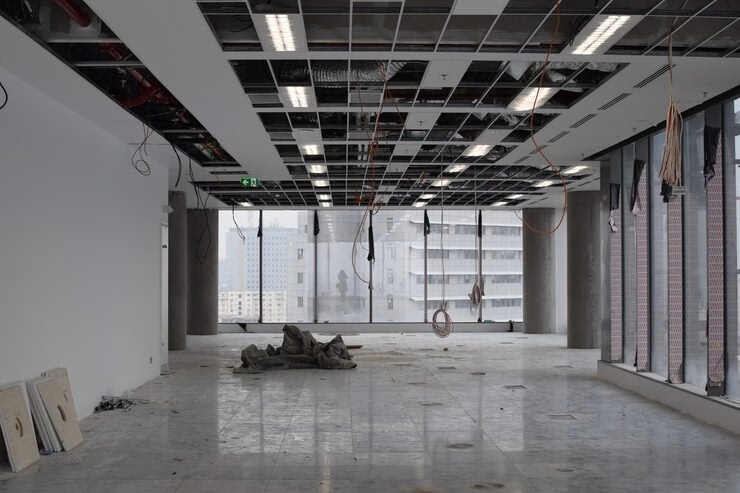
The Wall Behind the Office
One year after my husband passed away, I hired someone to renovate his old office. Just as I had arrived at the church, the contractor called, his voice urgent: “Ma’am, you need to come and see what we just found. But please don’t come alone—bring your two sons.”
I froze: “Why would you say that?”
He only replied briefly: “You’ll understand when you see it with your own eyes.”
Late September in the foothills of Virginia feels almost staged: crisp air, quiet streets, white houses lined up like they’ve agreed to behave. I was in the back row of Saint Andrew’s on Main Street when my phone vibrated—once, then again—too insistent for a place that’s meant to be calm.
MORGAN HULLBROOK — RENOVATION.
Morgan didn’t call during church unless something had shifted.
I slipped out between pews and stepped into the bright, still afternoon. Across the street, porch flags hung nearly motionless, and the town looked peaceful in that small-town American way that usually comforts you.
“Mrs. Golding,” Morgan said the moment I answered, “I’m sorry to interrupt, but I need you to come to the house.”
“What is it?”
“We opened the wall behind your husband’s office,” he said carefully. “And we found something I think you should see in person.”
Then he lowered his voice.
“Please don’t come alone. Bring your two sons. Both of them.”
The Room That Stayed Closed
My name is Eleanor Golding.
I’m sixty-three years old, and for forty-two of those years, I was married to Thomas Golding—a man everyone in Milbrook Falls respected. He was a lawyer. A deacon. A pillar of the community who donated to Little League and read to first-graders at the public library every other Thursday.
A year ago, Thomas was here. Then he wasn’t.
Heart attack. Sudden. He went to bed complaining of indigestion and never woke up.
Since then, his office had stayed shut—desk, shelves, everything untouched—because walking into it felt like stepping into a pause button I couldn’t unpress.
The room still smelled like him. Old Spice and leather and paper. His reading glasses sat on the desk exactly where he’d left them. His coffee mug—stained brown at the bottom—sat on the coaster like he’d be back any minute to finish it.
I couldn’t go in there.
Not to clean.
Not to sort.
Not even to open the curtains.
For a year, I let that room exist in a kind of stasis, as if keeping it frozen might keep some part of him alive.
But three weeks ago, on what would’ve been our anniversary, I made a decision.
I called Morgan Hullbrook, a local contractor I’d known for years, and asked him to turn Thomas’s office into a small library for the grandkids.
New wiring. Built-ins. Warm wood. Something that pointed forward instead of backward.
Morgan didn’t ask questions. He just said, “I’ll take care of it, Eleanor. Don’t you worry.”
The crew started the following Monday.
They stripped the carpet.
Pulled down the wallpaper.
Removed the old baseboards.
And then, apparently, they found something behind the drywall.
Now it felt like the past had been waiting all along.
I stood in the parking lot of Saint Andrew’s, gripping my phone, replaying Morgan’s words.
Don’t come alone. Bring your two sons. Both of them.
Why both sons?
What could possibly require both Michael and Dale to be there at the same time?
My boys hadn’t spoken in three months—not since Dale’s wedding, when Michael made a toast that landed somewhere between passive-aggressive and openly cruel. Since then, family dinners had become exercises in strategic seating and careful topics.
But Morgan’s voice hadn’t been a suggestion.
It had been a warning.
I called Michael first.
He answered with breakfast noise in the background and a voice that tried to sound patient but mostly sounded annoyed.
“Mom, what’s going on?”
“I need you at the house,” I said. “Right now. Bring Dale.”
There was a pause. I could hear him chewing.
“Why? What happened?”
“Morgan found something during the renovation,” I said. “He told me not to come alone. He specifically said to bring both of you.”
Michael went quiet.
I could almost hear him processing—the lawyer instincts kicking in, sorting the information, looking for the angle.
“What did he find?” Michael asked carefully.
“He didn’t say. Just that I needed to see it in person.”
Another pause.
“We’ll be there in twenty,” he said, and hung up.
I called Dale next.
He answered on the first ring, his voice softer, more concerned.
“Mom? You okay?”
“I need you at the house,” I said. “Morgan called from the renovation. He found something.”
Dale didn’t ask questions.
“I’m on my way,” he said, as if he already understood that whatever this was, it wasn’t something to face by yourself.
The Driveway
The drive through Milbrook Falls took ten minutes. It felt longer.
Neat lawns and wide porches slid past while my thoughts kept circling one line: Why both sons?
Thomas had been gone a year.
The funeral was done.
The estate was settled.
The will had been read, divided, executed without drama.
Michael got the investment portfolio and the lake cabin.
Dale got the tools, the truck, and the modest IRA Thomas had set up years ago.
I got the house and the life insurance.
Everything was clean. Legal. Fair.
So what could Morgan have found that required both of them?
When I turned onto Hawthorne Drive, both cars were already there—Michael’s sleek BMW parked beside Dale’s older Honda, the contrast between them as sharp as the contrast between the brothers themselves.
They stood near the porch without looking at each other, tension sitting between them like an extra person.
Michael wore a charcoal suit even though it was Sunday. His arms were crossed, his jaw tight.
Dale wore jeans and a flannel shirt, hands shoved in his pockets, shoulders hunched like he was bracing for impact.
When I pulled into the driveway, they both turned.
Michael’s face was unreadable.
Dale’s was worried.
“Mom,” Dale said, stepping forward. “What’s going on?”
“I don’t know yet,” I said, climbing out of the car.
Michael didn’t move. “Morgan’s inside?”
“He should be,” I said.
We walked up the porch steps together—three people who used to be a family, now moving in careful orbits around each other.
The front door opened before I could reach for my key.
Morgan stood there, sawdust clinging to his flannel, face pale in the afternoon light.
“Eleanor,” he said quietly. “Thank you for coming.”
He looked past me to Michael and Dale.
“Both of you,” he added, and something in his voice made my stomach tighten.
“What did you find, Morgan?” I asked.
He didn’t answer.
He just stepped aside and gestured toward the hallway.
“It’s back here,” he said.
The Hidden Space
Thomas’s study was stripped to its bones.
The carpet was gone, revealing scarred hardwood underneath.
The wallpaper had been peeled away, leaving patches of old adhesive and yellowed drywall.
The curtains were down.
The desk was gone.
The bookshelves were gone.
It looked like a crime scene.
Morgan led us to the wall behind where Thomas’s desk had sat for decades—the wall that had always seemed solid, permanent, unremarkable.
A clean rectangle of drywall was missing.
Beneath it was a second layer.
A seam.
A hollow.
A hidden space.
Work lights revealed a narrow room—maybe three feet deep, five feet wide—lined with shelves.
On those shelves were folders.
Dozens of them.
Stacked with a neatness I recognized instantly.
The labels were in Thomas’s handwriting, but they weren’t case files.
They were names.
Dates.
Short codes I didn’t understand.
My fingers hovered over the nearest tab.
Michael reached for one too fast, pulling it down before I could stop him.
Dale went still, staring at a label like it meant something he hadn’t expected to see again.
“What is this?” I whispered.
Morgan stepped back, giving us space.
“I don’t know, ma’am,” he said. “But when we found it, I knew you needed to see it first. Before anyone else.”
Michael opened the folder in his hands.
His face went white.
“Jesus Christ,” he breathed.
“What?” I demanded. “What is it?”
He turned the folder toward me.
Inside were photographs.
Black and white.
Grainy, like they were taken from a distance.
A young woman entering a motel.
A man following her.
A car with a visible license plate.
Beneath the photos were handwritten notes in Thomas’s careful script.
Subject: Rebecca Walton
Date: March 14, 1998
Location: Route 29 Motor Lodge
Vehicle: 1995 Honda Accord, Virginia plates
Companion: Unidentified male, approx. 30-35 years old
I stared at the page, my brain refusing to process what I was seeing.
“What is this?” I asked again.
Dale pulled another folder.
His hands were shaking.
“Mom,” he said quietly. “These are surveillance files.”
Michael grabbed another folder. Then another.
Each one was the same.
Names.
Dates.
Locations.
Photographs of people—some I recognized from town, some I didn’t—caught in moments they clearly didn’t know were being documented.
Entering hotels.
Meeting in parking lots.
Sitting in cars.
Embracing in doorways.
All photographed from a distance.
All catalogued with obsessive precision.
“How many are there?” I whispered.
Morgan stepped forward. “We counted at least sixty folders. Maybe more deeper in.”
Sixty.
Sixty people.
Sixty secrets.
All hidden behind the wall in my husband’s office.
“Why?” Dale’s voice cracked. “Why would Dad do this?”
Before anyone could answer, a firm knock landed at the front door—perfectly timed, as if someone had been watching the driveway.
Morgan swallowed and glanced toward the window.
“Ma’am,” he said quietly. “There’s a vehicle with county markings out front.”
My blood went cold.
“What kind of vehicle?” Michael demanded.
“Sheriff’s department,” Morgan said.
I looked at my sons.
Michael’s face had gone from white to gray.
Dale looked like he was about to be sick.
“Why would the sheriff be here?” I asked.
No one answered.
The knock came again.
Louder this time.
More insistent.
I walked to the front door on legs that felt like they belonged to someone else.
Through the decorative glass, I could see a figure in uniform.
I opened the door.
Sheriff Bill Oakes stood on my porch, hat in hand, expression carefully neutral.
“Eleanor,” he said. “I’m sorry to bother you.”
“Bill,” I said, trying to keep my voice steady. “What brings you out here?”
His eyes flicked past me into the house.
“I received a call about some unusual activity at this address,” he said. “Contractor reported finding something concerning during renovation work.”
My stomach dropped.
“Morgan called you?” I said, turning to look back at the contractor.
Morgan had gone pale.
“I’m sorry, Mrs. Golding,” he said. “But when I saw what was in there… I thought… I thought someone official should know.”
Sheriff Oakes stepped forward.
“Eleanor, I’m going to need to see what was found,” he said. “And I’m going to need to ask you and your sons some questions.”
The Investigation
The next three hours unfolded like a nightmare I couldn’t wake up from.
Sheriff Oakes called in two deputies.
They photographed everything.
Catalogued every folder.
Took statements from Morgan and his crew.
Then they turned to us.
Michael went first.
They sat him in the dining room—his childhood home now transformed into an interrogation site—and asked him what he knew about his father’s activities.
“Nothing,” Michael said. “I didn’t know about any of this.”
“Your father never mentioned surveillance work? Investigations? Anything that might explain this?”
“No.”
“Did your father have enemies? People who might have wanted information on others?”
“My father was a lawyer,” Michael said, voice tight. “He had professional boundaries. He didn’t spy on people.”
But even as he said it, the certainty in his voice wavered.
Dale went next.
They asked him the same questions.
Got the same answers.
“I don’t understand,” Dale kept saying. “This doesn’t make sense. Dad wasn’t like this.”
Finally, they came to me.
Sheriff Oakes sat across from me at my own kitchen table, notepad open, expression sympathetic but professional.
“Eleanor,” he said gently. “I need to ask you some difficult questions.”
“Go ahead,” I said.
“Did Thomas ever mention conducting private investigations?”
“No.”
“Did he ever talk about people in town? Their personal lives? Things they might want kept private?”
I thought about it carefully.
Thomas had been a gossip in the harmless way small-town people are—he knew who was dating whom, who got fired, who was having money trouble.
But this was different.
This was systematic.
“He mentioned things,” I said slowly. “But not like this. Not like he was… watching them.”
“Did you notice any unusual expenses? Cameras? Surveillance equipment?”
“No.”
“Did he ever go out at odd hours? Take unexplained trips?”
I opened my mouth to say no.
Then stopped.
Thomas had always worked late.
He’d always had evening meetings.
Client consultations.
Bar association dinners.
Community board sessions.
He’d been busy.
He’d been involved.
And I’d never questioned it.
“He worked a lot,” I said quietly. “But I thought it was just his practice.”
Sheriff Oakes nodded slowly.
“Eleanor, I’m going to be straight with you,” he said. “What we found in that wall raises serious questions. Some of those people in those files… they’re prominent. Married. Public figures.”
“You think he was blackmailing them?” I asked, the word tasting like poison.
“I don’t know yet,” Oakes said. “But we need to investigate that possibility.”
The Folders
Over the next week, the investigation expanded.
Sheriff Oakes brought in the state police.
They went through every folder.
Cross-referenced names with bank records.
Looked for patterns of payments, withdrawals, unexplained deposits.
And slowly, a picture began to emerge.
Thomas hadn’t been blackmailing anyone.
At least, there was no evidence of money changing hands.
But he had been collecting leverage.
Forty of the sixty folders contained documentation of affairs—photographs of married people with partners who weren’t their spouses, usually taken at motels or in cars parked in secluded locations.
Ten folders contained evidence of financial impropriety—business owners skimming from their own companies, tax evasion, undisclosed partnerships.
Five folders documented substance abuse—town councilman buying pills in a pharmacy parking lot, a high school teacher meeting a known dealer behind the grocery store.
The remaining five were the most disturbing.
They contained evidence of crimes.
A hit-and-run from 2003 that was never solved—Thomas had photos of the vehicle, the driver, and notes about the timeline.
An embezzlement case from a local nonprofit—Thomas had documentation showing exactly who took the money and where it went.
A domestic violence situation—photos of bruises, hospital records, 911 calls that were never followed up on.
All of it hidden.
All of it documented.
None of it reported.
“Why?” I asked Sheriff Oakes when he came to update me. “Why would he do this?”
Oakes sat heavily in Thomas’s favorite chair—the one in the living room where he used to read the paper every morning.
“Best we can figure,” Oakes said, “your husband was building an insurance policy.”
“Against what?”
“Against anyone who might come after him. Against anyone who might threaten his reputation, his practice, his standing in the community. He had dirt on half the town, Eleanor. And as long as he had it, nobody could touch him.”
I felt sick.
“But he never used it?” I asked.
“Not that we can prove,” Oakes said. “But the threat was always there. Just knowing he had it… that would’ve been enough.”
The Reckoning
Michael took it the hardest.
He’d idolized Thomas.
His entire identity was built on being Thomas Golding’s son—the successful lawyer from the good family with the spotless reputation.
When the investigation became public—and in a town like Milbrook Falls, there was no keeping something like this quiet—Michael’s world imploded.
Clients began asking questions.
Partners at his firm started distancing themselves.
His wife, Catherine, stopped coming to family dinners.
“I can’t believe he did this,” Michael said one night, sitting in my living room with a glass of whiskey he wasn’t really drinking. “I defended him my whole life. I told people he was the most ethical man I knew.”
“He was your father,” I said quietly. “You loved him.”
“I loved a lie,” Michael said bitterly.
Dale handled it differently.
He’d always been the black sheep—the son who didn’t follow Thomas into law, who worked construction instead of wearing a suit, who disappointed our father just by being himself.
“I’m not surprised,” Dale said when we finally talked about it. “I always knew there was something… off. I just couldn’t name it.”
“You never said anything,” I said.
“Would you have believed me?” Dale asked.
I didn’t have an answer.
The truth was, I wouldn’t have.
I would’ve defended Thomas.
I would’ve called Dale bitter, resentful, jealous of his successful brother.
I would’ve chosen my husband over my son.
And Dale had known that.
The Hidden Room, Revisited
Three months after the discovery, after the investigation concluded, after the scandal died down to whispers instead of headlines, I went back into that room.
The folders were gone—seized as evidence, then sealed by court order.
But the space remained.
The hidden shelves.
The secret Thomas had built into the architecture of our home.
I stood there in the empty cavity behind the drywall and tried to understand.
Had he been protecting us?
Or protecting himself?
Had he seen this as insurance?
Or as power?
I would never know.
Morgan came by that afternoon to finish the renovation.
“You still want the library?” he asked gently.
I looked at the room—Thomas’s office, the place where he’d spent so many hours, the place I’d thought I knew.
“No,” I said. “Seal it up. I don’t want to see it anymore.”
“You sure?” Morgan asked.
I nodded.
“I’m sure.”
He rebuilt the wall that same week.
Hung new drywall.
Painted it white.
By the time he finished, you’d never know there had been anything hidden there at all.
But I knew.
And I would always know.
The Inheritance
Six months after the discovery, I received a letter.
It came from a law firm in Richmond—not Thomas’s firm, but a different one.
Inside was a document I’d never seen before.
A second will.
Dated one month before Thomas died.
In it, Thomas laid out instructions for what should happen if the hidden room was ever discovered.
Eleanor,
If you’re reading this, then you’ve found what I kept from you. I’m sorry for that. I’m sorry for a lot of things.
The files were never meant to hurt anyone. They were meant to protect our family. In a small town, reputation is everything. One accusation, one scandal, and everything I built could disappear.
So I built my own protection. I made sure that if anyone ever tried to destroy what we had, I could destroy them first.
It was insurance, Eleanor. Nothing more.
But I know how it looks.
I know you’ll hate me for it.
Maybe you should.
But understand this: everything I did, I did for us. For you. For the boys. For the life we built.
I’m not asking for forgiveness. I just need you to know I never thought of myself as a bad man.
Just a careful one.
Thomas
I read the letter three times.
Then I burned it.
I didn’t show it to Michael.
I didn’t show it to Dale.
I didn’t want Thomas to have the last word.
One Year Later
It’s been two years since Thomas died.
One year since we found the room.
The house is quiet now.
Michael visits once a month, usually alone. He’s rebuilt his practice, but the shadow of what his father did still follows him. He doesn’t talk about Thomas anymore.
Dale comes by every week. He brings groceries, fixes things around the house, sits with me on the porch while we watch the evening settle over Milbrook Falls.
We don’t talk about Thomas much either.
But sometimes, when the light hits a certain way, I catch Dale staring at the wall where the hidden room used to be.
“You ever wonder what else he hid?” Dale asked once.
“Every day,” I said.
The truth is, I’ll never know who Thomas really was.
The man who read to first-graders and donated to Little League.
The man who held my hand through forty-two years of marriage.
Or the man who built a wall of secrets and called it protection.
Maybe he was both.
Maybe that’s the hardest thing to accept.
I still live in the house.
I still sleep in our bed.
I still make coffee in the same pot we used every morning.
But I don’t go into the room where his office used to be.
Morgan turned it into a guest room—neutral walls, simple furniture, nothing that carries memory.
Sometimes people ask me if I’m angry.
If I feel betrayed.
If I wish I’d known.
The truth?
I don’t know.
I loved Thomas.
I still love him, in that complicated way you love someone who’s gone and can’t defend themselves.
But I don’t trust him anymore.
And maybe that’s the real inheritance he left behind.
Not the house.
Not the life insurance.
Not even the scandal.
Just the knowledge that the person you thought you knew best was a stranger all along.
And you have to decide whether to mourn the man you loved or hate the man he actually was.
I’m still deciding.
Maybe I always will be.
But on quiet nights, when the house is dark and the only sound is the wind in the trees outside, I sometimes stand in that sealed-up room and whisper a question into the white wall.
“Who were you, Thomas?”
The wall never answers.
But I keep asking anyway.
Because even now, even after everything, part of me still hopes there’s a version of the story where he was the man I thought he was.
Where the secrets were smaller.
Where the lies were kinder.
Where love was enough to explain it all.
But I know better now.
Love doesn’t explain anything.
It just makes it hurt more when the truth finally comes out.
And in Milbrook Falls, Virginia, in the house on Hawthorne Drive, behind a wall that was sealed and painted white, the truth waited for a year before it was finally found.
I just wish I’d never gone looking.