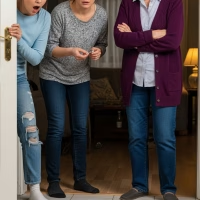
She Called Me a Leech and Stole My Lake House—So I Destroyed Her Life
I wanted to relax in my lake house, but my brother’s wife was already inside with her whole family and shouted, “Why is this stupid leech here? Get out.” I smiled and said, “Okay, I’ll leave.” But what I did next made her life a living hell.
The gravel crunched under my tires as I pulled up to the lake house on that Friday afternoon in June. Three months of overtime at the hospital had finally caught up with me, and all I wanted was a quiet weekend by the water. The key was cold in my palm when I noticed the extra cars in the driveway. My brother Marcus’s silver SUV sat next to two vehicles I didn’t recognize. Something felt wrong immediately.
I pushed open the front door to find complete chaos. Children were screaming and running through the living room. A woman I’d never seen before sprawled across my grandmother’s antique sofa with her muddy shoes still on. The smell of burnt popcorn hung thick in the air.
Then I saw her. Vanessa, my brother’s wife of two years, standing in the kitchen doorway with a glass of wine in her hand. Her face twisted into something ugly when our eyes met.
“Why is this stupid leech here? Get out.”
She shrieked loud enough that everyone in the house stopped what they were doing. The silence that followed felt suffocating. A little boy, maybe seven years old, stared at me with wide eyes. An older man—Vanessa’s father—had the decency to look embarrassed. Vanessa’s sister smirked from the corner, clearly enjoying the show.
My heart hammered against my ribs, but years of dealing with difficult patients had taught me how to keep my face neutral. I smiled slowly and deliberately.
“Okay,” I said. “I’ll leave.”
Vanessa looked surprised that I didn’t fight back. Good. Let her think she’d won.
The Inheritance
I walked back to my car with my head high, even though my hands were shaking. That lake house had been my sanctuary since childhood. My grandmother left it to me in her will specifically because I was the only one who truly loved it. Marcus had gotten the house in Boston—which was worth three times as much. He’d agreed to the arrangement without complaint, or so I thought.
The lake house wasn’t just property to me. It was where Grandma Martha taught me to fish from the dock. Where we’d spent summer evenings on the porch, her telling stories about growing up during the Depression while fireflies danced in the darkness. Where I’d hidden during my divorce three years ago, letting the quiet water heal wounds I thought would never close.
I’d poured money into maintaining it—new roof last year, dock repairs the year before, fresh paint every spring. I paid the property taxes, the utilities, the lawn service. Marcus contributed nothing and had never asked to use it. Until Vanessa came along.
I drove to a hotel twenty minutes away and checked into a room. Then I started making calls.
First, I called Marcus. He answered on the fourth ring, sounding distracted. “Hey, what’s up?”
“Your wife just kicked me out of my own lake house,” I said, keeping my voice steady. “She’s there with what looks like her entire extended family.”
The line went quiet for several seconds. “What are you talking about? Vanessa said you gave her permission to use the place this weekend.”
My grip tightened on the phone. “I absolutely did not. When would I have done that? We haven’t spoken in three weeks.”
“She showed me text messages from you,” Marcus insisted. “You said you weren’t going to use it and she could take her family there for a reunion.”
“Marcus, I never sent those texts. Check the phone number. I guarantee it’s not mine.”
I heard him moving around, probably pulling up his phone. More silence—then: “Oh God.”
“Yeah.” I let that sink in. “Your wife faked text messages to steal my property for the weekend. After calling me a leech in front of her entire family.”
Marcus started apologizing profusely, saying he had no idea and that he’d make it right. I let him talk himself out before responding.
“Here’s what’s going to happen. You’re going to call Vanessa right now and tell her she has exactly two hours to get everyone out of my house. If there’s a single thing damaged or out of place, I’m pressing charges for trespassing and fraud. And Marcus—this isn’t over between you and me. We’re going to have a serious conversation about why you believed your wife over your sister without even calling to confirm.”
I hung up before he could respond.
Next, I called my friend Derek, who worked in real estate law. I explained the situation in detail, including the forged messages. He listened carefully before speaking.
“You’ve got a strong case here, especially if she used those fake texts to gain access to property that isn’t hers. That’s fraud—possibly identity theft depending on how she created them. Document everything. Take photos when you go back. If anything’s damaged, get it assessed immediately.”
“I intend to,” I assured him. “But Derek, I want to know my options beyond just this weekend. Legal options.”
We talked for another thirty minutes. By the end of the call, I had a clear picture of exactly how much trouble Vanessa could be in if I decided to pursue it.
The Confrontation
I waited exactly two hours before driving back to the lake house. The extra cars were gone, but Marcus’s SUV remained. I found him on the porch looking miserable. He stood up when he saw me, his face pale.
“I’m so sorry. I should have verified with you directly. Vanessa kept saying you told her it was fine, and I just believed her.”
I walked past him into the house. The living room looked like a tornado had hit it. Red wine stained the carpet. The antique coffee table had a fresh scratch across the surface. In the kitchen, someone had left the stove on—the burner still glowing orange. The refrigerator door hung open, and half the food I’d brought for the weekend was gone.
I pulled out my phone and started documenting everything with photos and video. Marcus followed me silently, his expression growing more horrified with each room we entered.
The master bedroom—my bedroom—was the worst. Someone had been sleeping in my bed, and from the state of the sheets, they hadn’t bothered to shower first. My bathroom was a disaster of wet towels and empty shampoo bottles. A lipstick I didn’t recognize had been left open on the counter, and it had melted into the marble.
“Where’s Vanessa?” I asked, my voice dangerously calm.
“She left. She took her family and—” Marcus ran his hand through his hair. “God, I didn’t realize they’d done this much damage. Let me help clean up. I’ll pay for repairs.”
“No.” I turned to face him. “You’re going to leave. I’m going to finish documenting this disaster, and then I’m going to decide what to do next. But Marcus—you need to understand something. Vanessa didn’t just disrespect me today. She committed fraud. She created fake messages using my identity. She trespassed. She destroyed my property. And she did it all while you blindly believed her over your own sister.”
Marcus’s face crumpled. “I know. I’m so sorry. What can I do?”
“Go home. Talk to your wife. And prepare yourself for what comes next.”
After he left, I spent three hours cleaning and photographing. The wine stain in the carpet was permanent—it would need to be replaced. The scratch on the table went deep into the wood. The kitchen stove had a burnt pot welded to the burner. I catalogued every single thing.
Then I called Derek back.
“I want to press charges,” I said. “All of them.”
The Legal Battle
Monday morning, I walked into the police station with a folder full of evidence. The officer at the desk listened to my story, looked through my photos, and called over a detective.
Detective Sarah Chen was a woman in her forties with sharp eyes and a no-nonsense demeanor. She reviewed everything carefully—the timeline, the fake messages (which Marcus had forwarded to me), the property damage, the witness statements I’d collected from my hotel receipt and Marcus’s admission.
“This is definitely criminal trespassing,” Detective Chen said. “The forged messages constitute fraud and possibly identity theft. The property damage could be prosecuted as vandalism. You’ve got a solid case.”
“What happens next?”
“We’ll need to bring her in for questioning. If she admits to the fraud, or if we can prove she created those messages, she’ll be charged. From there, it goes to the prosecutor.”
“How long does this usually take?”
Detective Chen gave me a measured look. “Could be weeks, could be months. Depends on how cooperative she is and how backed up the courts are. But Ms. Harper—I’ll be honest. Cases like this, where it’s family involved, they can get ugly. Are you prepared for that?”
I thought about Vanessa’s sneer as she called me a leech. I thought about the muddy shoes on Grandma’s sofa and the ruined carpet. I thought about Marcus choosing to believe his wife’s lies without even a phone call to verify.
“I’m prepared,” I said.
The charges were filed by Wednesday. Marcus called me seventeen times that day. I didn’t answer. He left voicemails ranging from angry to pleading, but the general theme was the same: I was tearing the family apart over a misunderstanding. Vanessa hadn’t meant any harm. Couldn’t we work this out privately?
On Thursday, Vanessa called me herself. I almost didn’t answer, but curiosity got the better of me.
“What the hell is wrong with you?” she screamed the moment I picked up. “You’re pressing charges against me? Over a house? You really are a vindictive bitch.”
“You forged messages in my name to illegally access my property,” I said calmly. “You caused thousands of dollars in damage. And you called me a leech in front of your entire family. What exactly did you think was going to happen?”
“I thought you’d be a human being about it! I thought you’d understand that families share things!”
“We’re not family, Vanessa. You married my brother. That doesn’t give you the right to steal from me.”
“This is insane. Marcus is furious with you. Your whole family is going to hate you.”
“Then I guess I’ll know who my real family is,” I said and hung up.
The next call came from my mother. I’d been expecting this one.
“Honey, what’s going on? Marcus called me in tears saying you’re trying to send Vanessa to jail over the lake house.”
I explained the entire situation to her—the surprise arrival, the fake texts, the damage, Vanessa’s insults. My mother listened quietly.
“That’s terrible,” she said when I finished. “But sweetie, is pressing charges really necessary? Can’t you just make her pay for the repairs?”
“Mom, she committed fraud. She stole from me. And she did it deliberately.”
“I know, but she’s family now. And Marcus is your brother. This is going to cause a permanent rift.”
“The rift already exists,” I said. “Vanessa created it when she decided I was someone she could steal from and insult. I’m just making sure there are consequences.”
My mother sighed. “I love you, honey. But I think you’re making a mistake.”
We ended the call on uncomfortable terms. Over the next few days, I received similar calls from my father, my aunt, and two cousins. The message was always the same: I was being vindictive, unreasonable, cruel. I was hurting Marcus, who was innocent in all this. I was destroying the family over a house.
Only my grandmother’s sister, Aunt Claire, took my side.
“Your grandmother would be proud of you,” she said during our call. “She didn’t leave you that house so Vanessa could treat it like a cheap motel. You stand your ground, dear. Some people only learn through consequences.”
The Deposition
The prosecutor assigned to the case was a tired-looking man named Robert Mills who’d been handling property crimes for fifteen years. We met in his office three weeks after I’d filed the charges.
“I’ve reviewed the evidence,” he said, tapping the folder on his desk. “You’ve got a strong case. The forged messages are particularly damning—we pulled the metadata and they were sent from a texting app using a spoofed number. That’s premeditated fraud.”
“What kind of sentence are we looking at?”
“If convicted on all charges? Criminal trespassing is a misdemeanor in this state, but the fraud and property damage could be prosecuted as felonies depending on the dollar amount. She could be looking at probation, fines, possibly jail time if the judge wants to make an example.”
“And if she takes a plea?”
Mills leaned back in his chair. “Most likely she’ll plead to lesser charges, pay restitution, and get probation. First offense, no prior record—judges usually go easy on family cases. But it’ll still be a conviction on her record.”
I thought about that. A conviction would follow Vanessa forever—affecting job prospects, housing applications, background checks. It was harsh. But then I remembered the sneer on her face. Why is this stupid leech here?
“I want to proceed,” I said.
Vanessa’s deposition was scheduled for late July. I wasn’t present for it, but Derek obtained the transcript for me afterward. Reading it was surreal.
Vanessa had apparently decided her best defense was to play the victim. According to her testimony, I had always been jealous of her relationship with Marcus. I’d resented her from the moment they started dating. The lake house incident was just the latest example of me trying to cause problems in their marriage.
As for the fake messages? She claimed she’d genuinely believed I wouldn’t mind her using the house. The texts were just a misunderstanding—maybe she’d confused our phone numbers.
“Mrs. Harper,” the prosecutor had said, “phone numbers don’t get confused when you use a spoofing app to send them. We have the technical evidence.”
Vanessa’s response, according to the transcript: “I don’t know anything about apps. Maybe Marcus did it? He really wanted to do something nice for my family.”
I almost laughed when I read that part. She was actually trying to throw Marcus under the bus.
The prosecutor hadn’t been impressed. “Mr. Harper’s testimony directly contradicts yours. He states you showed him the messages and told him they came from his sister.”
The transcript showed a long pause before Vanessa answered: “I don’t remember.”
By August, it was clear Vanessa’s legal strategy was failing. Her lawyer—a public defender who looked exhausted in the courtroom—approached Derek about a plea deal.
“What are they offering?” I asked when Derek called me with the news.
“Vanessa pleads guilty to criminal trespassing and fraud. She pays full restitution for all damages—estimated at $8,200. She gets two years probation, 100 hours community service, and a permanent record. In exchange, the prosecutor drops the identity theft charge and doesn’t push for jail time.”
“What do you think?”
Derek paused. “Honestly? It’s a fair deal. She gets punished, you get compensated, and she doesn’t end up in jail—which would probably cause more family drama than it’s worth. But it’s your call.”
I thought about it for a long time. Part of me wanted to push for maximum punishment. But another part—the part that was exhausted from months of family conflict—just wanted it to be over.
“I’ll accept the deal,” I said finally. “But I want one more thing added.”
“What’s that?”
“A restraining order. Vanessa is not allowed within 500 feet of the lake house or me. Ever.”
Derek chuckled. “I think we can make that happen.”
The Aftermath
The plea deal was finalized in September. Vanessa appeared in court looking nothing like the smug woman who’d kicked me out of my house. She was pale, thin, and refused to make eye contact with me when I sat in the gallery watching the proceedings.
The judge was a stern woman in her sixties who clearly didn’t have patience for property crimes. She accepted the plea deal but added her own commentary.
“Mrs. Harper, you committed fraud to access property that didn’t belong to you. You damaged that property. And you did it all while convincing your husband to believe your lies over his own sister. This behavior is not only criminal, it’s deeply immoral. I’m accepting this plea deal because it’s your first offense, but understand—if you appear in my courtroom again, I won’t be nearly as lenient. Do you understand?”
“Yes, Your Honor,” Vanessa whispered.
“The restraining order will remain in effect for five years. If you violate it, you will go to jail. No exceptions.”
After the hearing, I waited in the hallway as Vanessa left with her lawyer and Marcus. My brother looked like he’d aged ten years in the past few months. He saw me standing there and stopped.
“Are you happy now?” he asked, his voice flat.
“No, Marcus. I’m not happy. I didn’t want any of this.”
“You could have dropped the charges. You could have worked it out privately.”
“She forged messages in my name and trashed my house. What was I supposed to do—just let it go?”
Marcus shook his head. “You destroyed my marriage. Vanessa’s parents won’t speak to me. Her sister calls me every day to scream about what a terrible family I come from. I’m sleeping in the guest room because she can’t stand to look at me.”
“Then maybe you should have believed your sister instead of your wife’s lies.”
“Maybe I should have,” he said quietly. “But it’s too late now.”
He walked away without another word. I stood there in the empty courthouse hallway feeling hollow. I’d won. Vanessa had been punished. My property was protected. But the victory felt pyrrhic.
The family fallout was exactly as predicted. Marcus and I didn’t speak for six months. My mother called occasionally, her conversations strained and formal. My father sent terse emails about family obligations and forgiveness. Most of my extended family seemed to view me as the villain who’d sent poor Vanessa to criminal court over a misunderstanding.
Only Aunt Claire remained firmly in my corner. She’d visit the lake house with me sometimes, sitting on the porch while we watched the sunset.
“Your grandmother always said family wasn’t about blood,” she told me one evening. “It was about who showed up when things got hard. Who kept their word. Who treated you with respect.”
“I miss her,” I said.
“She’d be proud of you. Standing up for yourself isn’t easy, especially when everyone’s telling you to back down.”
“Sometimes I wonder if it was worth it.”
Aunt Claire looked at me over her wine glass. “Did Vanessa ever apologize?”
“No.”
“Did Marcus ever admit he was wrong to believe her over you?”
“Not really.”
“Then it was worth it. Because you taught them both that you won’t be disrespected or stolen from. That’s a lesson that needed teaching.”
The Reconciliation
Winter came and went. I spent Christmas alone at the lake house, which was both peaceful and melancholy. I’d replaced the stained carpet, repaired the coffee table, and fixed the kitchen stove. The house looked beautiful again, but it felt empty without family.
In March, nearly a year after the incident, Marcus called me.
“Can we talk?” he asked. “In person?”
We met at a neutral location—a coffee shop halfway between his house and mine. He looked better than the last time I’d seen him. Less haggard. More like himself.
“I owe you an apology,” he said once we’d sat down. “A real one. I should have believed you from the start. I should have verified Vanessa’s story instead of just taking her word. I should have protected you instead of enabling her.”
I wrapped my hands around my coffee cup. “Why didn’t you?”
Marcus was quiet for a long moment. “Because I wanted to believe her. Because admitting she was lying meant admitting I’d married someone who would do that. It was easier to think you were overreacting than to face who she really was.”
“And now?”
“Now I’m divorced.” He said it matter-of-factly, but I could see the pain underneath. “The criminal charges destroyed us. But honestly? The marriage was already dying. I just didn’t want to see it.”
“I’m sorry.”
“Don’t be. You were right about everything. Vanessa was using me to get access to family resources. The lake house was just the most obvious example. After the trial, I started noticing other things—money missing from our joint account, lies about where she’d been, manipulation I’d been blind to.”
“That’s rough.”
“Yeah.” Marcus managed a small smile. “But I’m doing better. Therapy helps. And I wanted to see you because I need to make things right. I know saying sorry isn’t enough, but it’s where I need to start.”
We talked for two hours. It wasn’t easy—there was a lot of hurt to work through, a lot of trust to rebuild. But by the end, I felt like I had my brother back. Not the Marcus who’d blindly defended his wife, but the Marcus I’d grown up with. The one who used to build blanket forts with me and taught me to drive stick shift in the lake house driveway.
“Can I see the house sometime?” he asked as we were leaving. “I miss it. I know I don’t have any right to ask, but—”
“You can visit,” I said. “Not this weekend, but soon. Let’s take it slow.”
Marcus nodded, his eyes bright with what might have been tears. “Thank you.”
Two Years Later
The lake house is mine again in every sense that matters. I spent last weekend there with Aunt Claire and Marcus, who’s been dating a kind woman named Jennifer who works as an elementary school teacher. Jennifer loves the lake and has never once acted entitled to my property. We get along well.
My relationship with my parents is still strained but improving. They eventually admitted I’d been in the right, though it took them over a year to say it. My extended family either came around or stopped contacting me—I’m honestly fine with either outcome.
Vanessa completed her probation and community service. I heard through the grapevine that she moved to another state and remarried. The restraining order expires in three more years. I doubt I’ll ever see her again.
The criminal conviction follows her everywhere. Marcus told me she had to explain it on job applications and that it cost her at least two positions. Her family still blames me for “ruining her life.”
Sometimes I wonder if I did the right thing. If pressing charges was excessive. If I should have just accepted Marcus’s apology and let it go.
Then I remember the look on Vanessa’s face when she called me a leech. I remember the muddy shoes on Grandma’s sofa. I remember Marcus choosing to believe lies over his own sister without even a phone call to verify.
And I remember Aunt Claire’s words: Standing up for yourself isn’t easy, especially when everyone’s telling you to back down.
Last month, I was cleaning out the lake house attic and found a box of Grandma’s old letters. One of them was addressed to me, dated just before she died. I sat on the dusty floor and read it with tears streaming down my face.
Dear Sarah,
I’m leaving you the lake house because I know you’ll protect it. Not just the building, but what it represents—peace, family, belonging. Your brother will get the Boston property because that’s what suits him. But you, my dear, understand the difference between a house and a home.
People will try to take advantage of your kindness. They’ll mistake it for weakness. When that happens, remember: being kind doesn’t mean letting people walk all over you. Sometimes the kindest thing you can do—for yourself and for them—is to set boundaries and enforce consequences.
Be strong, my darling girl. And know that I’m proud of the woman you’ve become.
All my love,
Grandma Martha
I folded the letter carefully and put it in my wallet where I keep my most important things. Then I walked out onto the porch and looked at the lake stretching out before me, peaceful and eternal.
The house was safe. My boundaries were clear. I’d lost some family members and gained clarity about others. The price had been high, but the alternative—letting Vanessa’s theft and disrespect go unpunished—would have cost me something more valuable: my self-respect.
Next weekend, Marcus and Jennifer are coming up. We’re going to fish off the dock, like Grandma used to do with me. We’re going to cook dinner together and sit on the porch watching fireflies. We’re going to rebuild what was broken, one weekend at a time.
But the lake house remains mine. And anyone who tries to take it—family or not—will learn the same lesson Vanessa did.
Some things are worth fighting for. And some battles, no matter how ugly, need to be fought.
I smile as I lock up the house, the key cold and solid in my palm. The gravel crunches under my tires as I drive away, already looking forward to next weekend.
The lake house is safe. My boundaries are solid. And I am no one’s leech.