The Federal Judge They Never Knew: How I Exposed My Family’s True Nature
The dining room of Vance Manor was a monument to old money and older secrets. Crystal chandelier light cast harsh shadows over mahogany that had witnessed generations of family dysfunction. Our mandatory Sunday dinners felt less like family gatherings and more like performance reviews I was destined to fail.
“Pass the salt, Elena,” my mother Beatrice said without lifting her eyes from her coq au vin. Her voice carried that practiced condescension she’d perfected over decades. “Try to be careful. We know how uncoordinated you get when flustered. God knows you couldn’t handle the pressure of a simple semester of law school without crumbling.”
I reached for the crystal shaker, my hand steady as granite. Under my modest gray cashmere sweater, a heavy gold chain rested against my collarbone. Hanging from it, hidden from their sight, was a ring bearing the raised seal of the Third District Federal Court. The symbol of the life I actually lived—a life of immense power they knew absolutely nothing about.
“I’m doing fine, Mom,” I said quietly, sliding the salt across the tablecloth.
“Fine?” Chloe scoffed, swirling vintage Pinot Noir with practiced arrogance. My younger sister glowed with the insufferable radiance of the golden child, fresh from her promotion to Junior VP of Marketing at a luxury firm—a job secured because Beatrice played bridge with the CEO’s wife.
The Family Failure
“You work at a ‘legal clinic’ for the indigent, Elena,” Chloe sneered, eyes raking over my unstudied appearance. “You’re practically a glorified secretary filing pro-bono paperwork for people who can’t afford real representation. It’s embarrassing for the family. You’re lucky Mom and Dad still let you park that rust-bucket in the driveway. It lowers property values.”
I sipped water to hide the knowing smile playing on my lips. They believed I was a law school dropout spending my days in a dusty basement filling forms. They didn’t know the “clinic” was actually the Federal Courthouse. They didn’t know my “paperwork” involved sentencing cartel members, presiding over multi-million dollar litigations, and interpreting constitutional law.
I’d kept my appointment as Federal Judge secret for three years. Why? Because in this house, any achievement of mine was either minimized or co-opted for their social climbing. If they knew I was a judge, they wouldn’t be proud of my intellect—they’d spend every dinner asking me to fix their friends’ legal troubles.
“We just want you to have a future, Elena,” my father Arthur grunted between bites of steak. “Like Chloe. She’s on a trajectory. You’re just… drifting.”
“I have a future,” I said, my voice carrying hidden authority they were too blind to hear.
“We’ll see,” Beatrice sighed, dabbing silk napkin to her lips. “Just try not to be a burden on your sister when she’s running this town.”
Dinner ended with usual dismissals. I stood to clear the table, but Beatrice waved dismissively. “Leave it. Go home, Elena. Your depressing, working-class energy is ruining the wine’s bouquet.”
I walked toward the front door, reaching for the brass hook where I’d hung my car keys. The hook was empty. Cold intuition raced down my spine. I looked through the sidelight into the driveway.
My car—the black, government-issued sedan housing more surveillance technology than a police precinct—was gone. In the distance, I heard the frantic, metallic scream of an engine pushed beyond its limits.
The Crash
I ran down stone steps as headlights swung wildly into the driveway, illuminating ancient oaks like a chaotic strobe. The car lurched up the incline, engine coughing rhythmically, before coming to a violent halt inches from the closed garage door.
The driver’s door flew open and Chloe stumbled out, nearly tripping over herself. Her sequined cocktail dress was torn at the shoulder, blonde hair matted with panic. Expensive gin and raw terror wafted off her in waves.
But I wasn’t looking at her. I was looking at my car.
The front grill was shattered, hanging by plastic clips. The hood was crumpled like discarded tin foil, bent upward in a jagged V. Spread across the front bumper, dripping onto pristine asphalt, was thick, dark, viscous crimson.
Blood. Still steaming in the cool night air.
“I didn’t mean to!” Chloe wailed, words slurred into syllable soup. She leaned against the driver’s door to keep from collapsing. “He came out of nowhere, Elena! He was on a bike! I didn’t see him until the crunch! I heard the crunch!”
Beatrice and Arthur charged from the house, silk robes fluttering. Beatrice stopped dead seeing the car’s state. The blood. Her golden child swaying, visibly intoxicated, next to a felony hit-and-run scene.
“Is he dead?” Beatrice whispered, face turning ashen.
“I don’t know!” Chloe screamed, hysterics taking hold. “I didn’t stop! I couldn’t stop! I have the VP promotion! The press release is tomorrow! If I get a DUI, get a record, it’s over! My life is over! Mom, help me!”
Beatrice didn’t move toward the car. Didn’t ask where the victim was. Didn’t call an ambulance. Instead, her head turned slowly, mechanically, until cold, calculating eyes locked onto mine. She marched over and gripped my shoulders, manicured nails digging into skin with desperate strength.
The Unthinkable Request
“Elena,” she hissed, breath hot against my ear. “You have to do this. Save her.”
“Do what, Mom?” I asked, though familiar dread pooled in my stomach.
“Chloe has a life,” Beatrice said, voice shaking with manic intensity. “She has a trajectory. She’s going places people like us are meant to go. But you…” She gestured with a sneer at my simple clothes, the “failure” she’d spent twenty years manufacturing.
“You’re just a dropout,” Beatrice spat, venom finally surfacing. “You work at a basement clinic. No husband, no career, no prospects. You have no future anyway! Tell police you were driving. You took the car to the store for snacks. They expect someone like you to make a clumsy mistake. You’ll get a slap on the wrist. For Chloe, this is the end. For you, it’s just another Tuesday in a life of nothing.”
The naked calculation was breathtaking. It wasn’t just that they didn’t love me—they’d decided I was sub-human, a spare part to be cannibalized to keep the golden child running.
“You want me to go to prison,” I said hollowly. “For a felony hit-and-run that she committed while drunk?”
“It won’t be prison!” Beatrice pleaded, shaking me. “We’ll hire the best lawyers! You’re a nobody, Elena! Nobody cares what happens to a legal secretary! But Chloe… her face is going on the Business Journal cover!”
I looked at Chloe. She’d stopped crying, wiping a stray tear with the back of her hand. As she watched our mother berate me, her expression shifted. Panic receded, replaced by familiar, lifelong arrogance. She let out a short, sharp, jagged laugh.
“Mom’s right,” Chloe said, leaning against the blood-stained hood with sickening lack of remorse. “Look at you, Elena. Drab clothes. Tired eyes. You look like a criminal anyway. Who would ever believe a loser like you over a woman like me? Just take the fall. It’s the only useful thing you’ve ever done.”
I looked into my sister’s eyes—the eyes of a predator who thought she’d found a way to kill and survive—and felt the daughter in me finally die, replaced by cold, judicial stone.
The Judge Emerges
I stepped back deliberately, dislodging Beatrice’s hands like brushing off dirt. I took a slow, deep breath, and when I exhaled, the wounded daughter was gone. The approval-seeking sister vanished. In their place stood The Honorable Elena Vance.
My posture straightened, adding height they’d never noticed. My face went slack, settling into the stoic, unreadable mask I wore on the bench while sentencing drug lords and corrupt politicians.
“Okay,” I said. My voice dropped into a register they’d never heard—low, resonant, clinical. Designed to fill a courtroom. “If we’re doing this, we need the story straight. Police will be thorough. Any inconsistency leads to perjury charges for all of us. Do you understand?”
Beatrice exhaled a sob of relief, clutching her chest. “Thank god. Thank god you’re finally being a team player, Elena.”
“Chloe,” I said, turning to my sister. “Look at me. Eyes on mine.”
Chloe blinked, startled by the sudden, freezing authority in my tone. “What?”
“I need facts for the statement,” I said coldly, beginning to walk a slow circle around her like a prosecutor circling a witness. I positioned myself near the driver’s side mirror, where a microscopic pinhole lens was hidden. “Tell me exactly what happened. Where were you? Don’t leave out a single detail.”
“I was at the gala at the Grand Hotel,” Chloe said, rolling her eyes like the memory was a chore. “I took your car because mine was blocked by valet. I had… I don’t know, four martinis? Maybe shots of tequila with the senator’s son?”
“So you were intoxicated beyond the legal limit,” I stated. Not a question.
“Duh,” she snapped. “Then I took the shortcut through Highland Park. Corner of 4th and Main. The guy on the bike… he was just there. I hit him. He went over the hood—I saw his face hit the glass. I heard a crunch, like a dry branch snapping.”
“And you didn’t stop,” I pressed, voice like a scalpel. “Why didn’t you stop, Chloe?”
“Because I have a career to think about!” she shouted, voice echoing in the quiet suburban night. “Why are you acting weird? Just memorize the lines! You were driving, distracted by your phone, you hit him. You panicked. End of story.”
“Did you check if he was breathing?” I asked, eyes boring into hers.
“No,” Chloe said dismissively, flicking lint off her dress. “I didn’t want blood on my shoes. I just wanted to get home. Mom, make her stop looking at me like that. It’s creepy.”
The Confession
Beatrice stepped in, voice hushed. “Elena, stop the interrogation. Get in the driver’s seat, move the car down the street. We’ll call 911 and say you just arrived, hysterical.”
“So,” I summarized, voice cutting through night air like a guillotine blade. “To be clear for the record: You, Chloe Vance, admit to driving a government-registered vehicle under the influence of alcohol, striking a pedestrian at 4th and Main, fleeing the scene of a felony, and now conspiring with Beatrice Vance to obstruct justice by framing a third party for the crime.”
“Yes, yes, whatever! God, you’re so dramatic!” Chloe shouted. “Just take the blame! You’re a failure! It’s the only thing you’re good for! You have no future anyway!”
I looked at them. The mother who’d birthed me and the sister I’d protected as a child. I searched for a single shred of humanity, a flicker of hesitation or guilt. There was none. Only the cold, hard diamond of their narcissism.
“I have everything I need,” I said.
I reached into my bag. Beatrice watched greedily, expecting me to pull out tissues or car keys to begin the charade. Instead, I pulled out my secondary phone—the one with encrypted, direct line to Federal District Court Clerk.
I didn’t dial 911. I dialed a number triggering immediate, high-priority federal response. As the line picked up, I saw the first flicker of genuine, soul-deep confusion cross my mother’s face.
The Call That Changed Everything
“District Clerk’s office. This is Clerk Simmons.”
“This is Judge Vance,” I said into the phone. The tone was no longer that of a daughter, but of a superior officer. “Open a new case file immediately. Priority One. High-profile felony.”
Beatrice frowned, deep confusion clouding her brow. “Who are you talking to, Elena? Hang up that phone and call the local precinct like we agreed!”
I ignored her entirely, gaze fixed on the shattered windshield of my car. “I have a verbal confession of vehicular assault, a felony hit-and-run, and conspiracy to obstruct a federal investigation. The confession is corroborated by real-time digital surveillance from G-Vehicle 402.”
“Copy that, Judge Vance,” the clerk replied, voice humming with efficiency. “Are you in a secure location? Do you require tactical extraction?”
“I am on-site at the Vance Residence,” I said. “Notify the District Attorney and Office of Inspector General. Get an ambulance and forensic team to 4th and Main immediately. There’s a cyclist down.”
Beatrice lunged at me, face contorted with rage. “Judge? What are you talking about? You’ve lost your mind! Give me that phone!”
I stepped back with practiced fluidity, dodging her grasping hands. I raised my head, and for the first time in twenty-three years, let the full weight of my presence crush the air from the room.
“Sit down, Beatrice,” I ordered. The command was so forceful, so saturated with absolute authority of the federal bench, that my mother froze mid-stride, mouth hanging open.
The Truth Revealed
“I am Judge Elena Vance of the Third District Federal Court,” I announced. The words hung in cold night air, heavier than the silence that followed.
Chloe let out a high-pitched, nervous laugh. “You? A judge? You’re a dropout! You work at a free clinic for bums! You’re the family failure, Elena! Stop playing dress-up!”
“I graduated Summa Cum Laude from Yale Law while you were failing remedial marketing, Chloe,” I said, voice icy. “I was appointed to the Federal Bench by the President three years ago. I didn’t tell you because I knew you’d only see my position as a tool to fix parking tickets or influence your social standing. But this…” I pointed to the blood-stained car. “This isn’t a social faux pas.”
Chloe’s face went from white to translucent, ghostly gray. She looked at the sedan she’d mocked for being “boring” and “sensible.” She noticed, for the first time, small, black, high-definition sensors embedded in side mirrors and dashboard.
“That is a government-issued vehicle registered to the Federal Judiciary,” I said, taking a step toward them. “It’s equipped with 360-degree, high-definition surveillance and internal audio recording that uploads to a secure federal cloud in real-time. Every word you just said—the martinis, the ‘crunch’ of the bike, the plan to frame me because I’m a ‘loser’—it’s all been recorded, time-stamped, and saved to a server you can’t touch.”
I leaned in, face inches from my sister’s. “You didn’t just hit a cyclist, Chloe. You committed a felony in a federal vehicle. And you just gave a full, voluntary confession to a Federal Judge.”
Beatrice looked at me with horror that was finally genuine. But it wasn’t horror at what her daughter had done—it was horror at realizing she no longer held the leash. “Elena… you wouldn’t. We’re family. We can fix this. Pay the boy’s family whatever they want!”
“You told me I had no future,” I said softly, the words tasting like justice. “You were wrong. I am the future. And tonight, I am the law.”
In the distance, the low, rhythmic wail of sirens began to rise. Not the single siren of a local patrol car, but the cacophony of a Federal Marshal response unit.
“Run,” Chloe whispered, panic finally turning her blood to ice. She turned to bolt toward the dark expanse of the backyard.
My secondary phone buzzed. I looked at the screen and back at my sister. “Don’t bother running, Chloe. The arrest warrants have just been signed. I authorized them myself.”
Federal Justice
The driveway of Vance Manor became a sea of flashing red and blue lights. Federal Marshals, not local police, swarmed the property with military efficiency. They didn’t treat Beatrice and Arthur like wealthy socialites or community pillars—they treated them like suspects in a high-level obstruction case.
I stood by the garage edge, arms crossed, watching as a Marshal who’d stood guard in my courtroom dozens of times read Chloe her rights. She was sobbing, sequins catching police lights, screaming about her promotion, her reputation, her “life.”
Beatrice was being handcuffed against the hood of the very car she’d tried to use as a sacrificial altar for me. She saw me standing there, face impassive, eyes devoid of the hurt she’d spent a lifetime inflicting.
“Elena!” she screamed, voice cracking as steel ratcheted on her wrists. “How could you do this? I gave you everything! You ungrateful, cold-blooded monster! Tell them to stop! Tell them it was a mistake!”
“I can’t, Beatrice,” I said calmly. “The law doesn’t make mistakes for people like you. It only reveals who you’ve always been.”
“I’ll disown you!” she shrieked as they led her toward a black SUV. “You’re dead to me! You hear me? Dead!”
“I’ve been dead to you for twenty years,” I replied, voice barely a whisper over sirens. “I just finally stopped attending the funeral.”
They were placed in separate vehicles. As sirens faded into distance, profound, heavy silence returned to the driveway. I didn’t go inside the empty mansion. I didn’t want to breathe that air for another second. I got into the passenger seat of the lead Marshal’s car.
“Take me to the hospital,” I said. “I need to see the boy.”
The Victim
The victim was a nineteen-year-old engineering student named Marcus. He was in critical condition—battered, broken, clinging to life by a thread of modern medicine. I stood outside the heavy glass of the ICU window, watching the rhythmic rise and fall of the ventilator.
I thought about Chloe’s words: He came out of nowhere. I have a career to think about.
I thought about Beatrice’s words: You have no future anyway.
I looked at Marcus. He had a future. He’d been on his way home from a late-shift lab, dreaming of building things, not realizing a “golden child” was about to treat him like roadkill. I’d saved my own future by refusing to sacrifice it, but more importantly, I’d ensured Marcus wouldn’t be forgotten in the paperwork of a cover-up.
A nurse walked by, eyes red with exhaustion. “Are you family, ma’am?”
“No,” I said, hand touching cold glass. “I’m the reason he’s going to get justice. And I’m the reason the people who did this will never be able to hide again.”
I turned to leave, but as I walked toward the hospital exit, my phone buzzed with an alert. Arthur had just posted bail using a hidden account and was calling the top defense firm in the country. The war wasn’t over—it was just moving into my territory. The courtroom.
The Trial
Six months later, the Third District courtroom was packed to capacity. The fall of the Vance family had been high-society gossip fuel for months, a slow-motion wreck the city couldn’t stop watching.
I wasn’t presiding—total conflict of interest—but I sat in the back row, dressed in civilian clothes, a silent observer in the temple where I usually ruled.
Chloe’s defense attorney, charging a thousand dollars an hour to make monsters look like victims, argued she was a “promising young woman” who’d made a “single, tragic lapse in judgment” under high-powered career stress. He spoke of her “bright future” and “community contributions.”
The prosecutor didn’t say much. He didn’t have to. He simply played the high-definition audio and video recording from arrest night.
The courtroom heard Chloe’s slurred laughter. They heard the bicycle crunch. Then, the voice that silenced the room:
“She looks like a criminal anyway… Who would ever believe a ‘loser’ like you over a woman like me?”
The jury didn’t need two hours. The deliberation was the shortest in district history.
Chloe Vance was sentenced to eight years in federal penitentiary for vehicular assault, leaving the scene of a crime, and perjury. Beatrice Vance received four years for conspiracy to obstruct justice and witness tampering.
They lost everything. Legal fees bankrupted the estate. The mansion was sold at public auction. The “good name” of the Vance family became a punchline, synonymous with arrogance, cruelty, and spectacular lack of foresight.
A New Beginning
I sat in my private chambers a week after sentencing, afternoon sun filtering through heavy blinds, illuminating dust motes dancing in the air. On my desk sat a framed photo of me at law school graduation—the one Beatrice had refused to attend because she “had a headache.”
I picked up a fountain pen and signed a personal check. It was significant—nearly half my annual salary—made out to a trust fund for Marcus. He was walking again, albeit with a limp, and heading back to school in the fall. I’d made sure his tuition and medical bills were covered for life.
My bailiff knocked on the heavy oak door. “Your Honor? We’re ready for the afternoon docket. State vs. Miller.”
“Thank you, John,” I said, standing up.
I reached for my black robe. The fabric was heavy, comforting, carrying the weight of a thousand truths. It wasn’t a mask. It was the only skin I’d ever felt comfortable in.
Beatrice had been right about one thing that night in the driveway. The Elena she knew—the scapegoat, the victim, the failure—had no future. That version of me ceased to exist the moment I stopped seeking their love and started demanding their accountability.
The woman who walked into the courtroom wasn’t a daughter or sister. She was Judge Vance. And her future was just beginning.
As I took my place behind the bench, looking out at the attorneys who would argue before me, I felt the weight of real power. Not the power to hurt or diminish, like my family had wielded, but the power to protect the innocent and ensure justice prevailed.
Marcus would walk across a graduation stage someday. The next victim of a hit-and-run wouldn’t be forgotten because their attacker had money and connections. And somewhere in a federal prison, two women who thought family meant exploitation were learning that consequences don’t care about your last name.
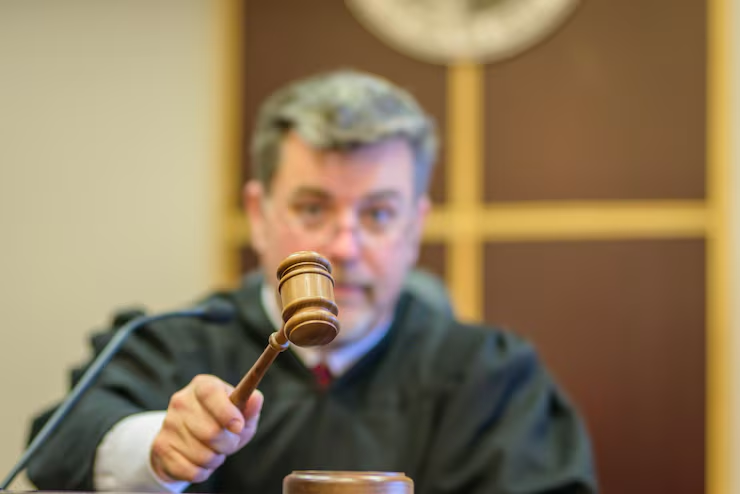
I raised my gavel, the sound echoing through the chamber like thunder.
“Court is now in session.”