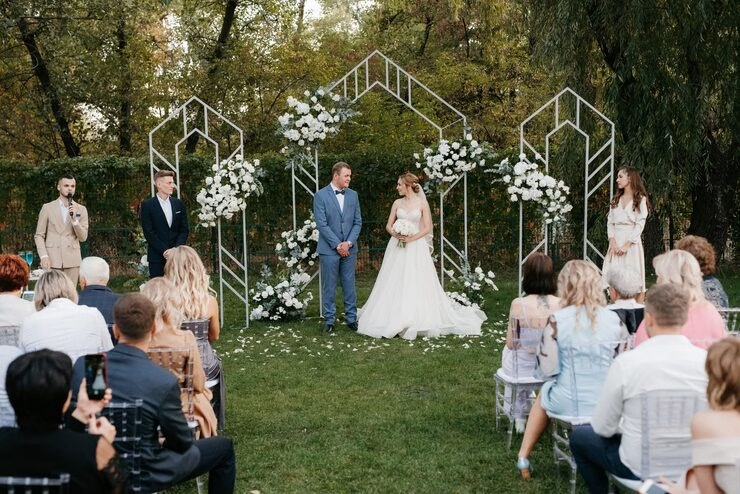
At My Wedding, My Mom Smiled And Said, “We’re Passing The Car His Parents Gave You…”
At my own wedding, my mom smiled and said, “We’re passing the car his parents gave you over to your sister.” That one sentence turned a perfect day into a public betrayal—and I finally decided to stop being the “good daughter.”
My name is Eva Harper, and this is the story of how I learned that sometimes the people who raised you are the same people you need to raise boundaries against.
The Perfect Day That Wasn’t
At my wedding, the air smelled like frosting and perfume sweet enough to choke on. The band had just switched to something soft when my mother leaned in, smiling for the cameras, and said, “We’re passing the car his parents gave you over to your sister.” Her tone was light, rehearsed, like she was rearranging napkins. Danielle laughed beside her, sequins flashing.
“Relax,” she said. “It’s just a car.”
The guests didn’t catch it, but my stomach did—a drop, cold and final. My groom didn’t move. He just looked at them, calm, unreadable. And that look changed everything.
People say weddings reveal who really loves you. Mine revealed who never did.
I grew up in a house where fairness was a story told at dinner, never lived in the kitchen. My mother, Grace, loved order—the kind that kept her looking perfect, and kept me quiet. My father, Richard, was the man who believed silence fixed things. And Danielle, my little sister, was the delicate one. The world bent for her. I was the hinge that made it move.
When we were kids, she got the bigger room because she was afraid of the dark. When she crashed her first car, Mom blamed the rain. I worked double shifts to buy mine, and Mom called it good character building. Danielle was the reason; I was the resource. That pattern raised me—someone always taking, someone always explaining.
By twenty-nine, I had built a life outside their script. I was an interior designer, careful and precise, the kind of woman who paid her own bills and didn’t borrow dresses. Meeting Evan felt like stepping into sunlight that didn’t burn. He came from a family that believed in boundaries, in respect. His parents weren’t rich, but they were generous in the way that costs nothing—listening, trusting, handing you space.
At our rehearsal dinner, they handed me a small silver key in an envelope. “You built this together,” his father said. “Here’s something to help you move forward.” A used car—clean, reliable—titled in my name. It wasn’t about the metal. It was about what it meant. Trust. Partnership. The kind of gift you protect.
That night, I’d caught Mom’s expression: tight, polite, already calculating. She’d smiled at Evan’s parents and said, “How thoughtful,” but her eyes flicked to Danielle like a reflex. I should have recognized it for what it was—an early warning.
The morning of the wedding, she fussed over my hair, told me how proud she was. “You’ve always been so giving, Eva,” she said, smoothing my veil. “Don’t lose that.” Her perfume filled the air—sweet, heavy, impossible to breathe through. I smiled back, pretending not to understand the message behind the compliment, but part of me already knew. Some gifts aren’t meant to be shared.
The Announcement
The reception felt like a movie playing too loud. Laughter, clinking glasses, a thousand polite smiles, all performing the same scene. Evan’s hand rested on my back as we swayed through our first dance. For a moment, it almost felt safe, like the world had agreed to behave.
Then I saw my mother cutting through the crowd, her pageant smile already set in place. She stopped beside us, perfume trailing behind her, and spoke just loud enough for the nearest tables to hear.
“We’re passing the car his parents gave you over to your sister.”
Every sound in the room blurred. Someone laughed at another table. The band singer drew out a note that suddenly felt like sirens. Danielle appeared, glowing under the fairy lights—sequins throwing shards of light across her grin.
“Relax,” she said, a playful shrug in her voice. “It’s just a car.”
It wasn’t about the car. It was about everything that had ever been taken and repackaged as kindness. I looked at my mother’s face—composed, benevolent, so sure she was right. She tilted her head, waiting for me to perform gratitude.
“You and Evan can manage with one,” she added. “You’ve always been so practical.”
A guest snapped a photo, catching her hand on my arm, her smile wide. In the picture, no one would see the way her fingers tightened.
I didn’t respond. Evan’s thumb brushed the inside of my wrist. A small question: Are you okay? I breathed in glass and frosting and the old taste of obedience.
Dad drifted over, drawn by the tone in her voice. “What’s going on?” he asked, eyes flicking between us.
“Nothing serious,” Mom answered quickly. “Just helping Danielle out. She’s had awful luck with cars.”
Danielle laughed again, soft and rehearsed. “It’s fine, Mom. She doesn’t mind sharing.”
Sharing. The word landed like a bruise. I thought about the night I’d stayed up fixing Danielle’s résumé, the dress she’d borrowed and lost, the endless apologies I made on her behalf. All those small surrenders dressed as love.
I smiled then—small, calm, dangerous. “You’re right,” I said. “I don’t mind sharing.”
My mother relaxed, mistaking surrender for peace. Evan didn’t. His hand found mine again—steady, certain. Across the room, the fairy lights flickered. A camera flashed. The air felt tight, like the moment before a storm breaks.
I leaned closer to Evan and whispered, “It’s starting again.”
He looked at me, not surprised, just ready. And in that silence, I realized something simple. They didn’t come to celebrate me. They came to test how much of me was still theirs.
The Envelope
After the cake was cut and the music softened, the room began to empty into laughter and wine. I smiled through photos, accepted congratulations that tasted like dust, and counted the minutes until I could breathe again. When the last guest disappeared toward the parking lot, Evan and I slipped out a side door into the quiet hallway.
He leaned against the wall, unbuttoning his collar. “Do you want me to say something to them?”
“No,” I said. My voice didn’t shake. “We already did.”
He frowned, then understood. We’d talked about this months ago, half-joking over takeout. My mother’s habit of turning my things into family property wasn’t new. It was inherited behavior. So I decided to stop being inheritable.
Two weeks before the wedding, my co-worker—who also happened to be a paralegal—helped me draft a notarized declaration. Every gift received in my name was legally protected, not to be transferred or sold without my written consent. I’d signed it in blue ink. So had Evan. I remembered her exact words when she stamped it: You’re not being paranoid. You’re being prepared.
Back in the hall, Evan reached for my hand. “You knew this might happen.”
“I hoped it wouldn’t,” I said. “But I didn’t want to bleed again without a bandage.”
We stood there for a while, listening to muffled laughter from the banquet room. It sounded distant, hollow, like something already ending. I thought about the look on my mother’s face, the delight of control disguised as generosity. She’d spent years training me to play the role of the gracious daughter. I had learned it so well that no one saw the quiet calculations behind my smile.
Evan’s phone buzzed. A text from one of the guests: “Your sister’s already posting about the car.” He turned the screen toward me. There it was, a photo from our garage—Danielle posing beside the car with the caption, “Finally got a ride that fits me.”
I laughed once, dry and low. She couldn’t even wait till morning.
He met my eyes. “So, what do we do now?”
I reached for my clutch, fingers brushing the thick envelope inside. “Now,” I said, “we let them open their own trap.”
Evan exhaled slowly, a quiet sort of pride in his voice. “Then let’s go finish the party.”
We straightened our clothes, fixed our smiles, and walked back toward the music. My heart was steady now. The storm had already changed direction.
The Confrontation
We walked back into the ballroom as the band shifted into another safe, romantic tune. The room glowed gold again, but the air had changed. Conversations felt thinner. Eyes darted away and back. My mother was near the cake table, laughing too loudly, a queen restored to her stage. Danielle hovered beside her, phone in hand, pretending to scroll.
When she saw us, Mom brightened. “There they are,” she called, like we’d been gone on a honeymoon already. “Everyone’s asking where the bride went.”
I smiled. “Handling a few final details.”
She didn’t hear the weight in that sentence. Or maybe she did and thought she could still outplay me.
“Good,” she said. “We’re wrapping up soon. Danielle needs a ride home anyway.”
Evan stepped forward just a little. “She has one now, doesn’t she?” His voice was light, polite, surgical.
Mom blinked. “What?”
“The car,” I said. “You said she’s taking it.”
Danielle tensed, eyes flicking between us. “Oh, come on, Eva. Don’t make this weird. It’s just a car—”
“—for her,” I finished.
Dad wandered closer, trying for peacekeeping. “Can we not do this here?”
I turned to him, calm. “Here’s the thing, Dad. This is where she did it. Publicly.”
The band faltered, then kept playing. A few guests turned their heads.
Mom’s smile stiffened. “Eva, sweetheart, you’re overreacting. It was a misunderstanding—”
Evan held out an envelope. “You might want to read this before you finish that sentence.”
Her hand hesitated before taking it. She glanced at Danielle, then at me, then unfolded the paper. The rustle was loud enough to cut the music. Danielle leaned in to read over her shoulder. At first, confusion. Then recognition. Then color draining inch by inch.
Mom tried to laugh. “What is this?”
“A notarized declaration,” I said. “Executed two weeks ago. It states that all wedding gifts titled in my name can’t be sold, gifted, or transferred without my written consent. Any attempt triggers a legal review and forfeits future inheritance from Evan’s side.”
The last words landed like a stone dropped into a still pond. Conversation stopped. Someone whispered, “Oh wow.”
Danielle let out a short, panicked laugh. “You can’t be serious.”
I met her eyes. “Completely.”
Dad exhaled through his nose. “This is petty, Eva.”
“No,” I said softly. “Petty is pretending theft is family tradition.”
Mom’s voice hardened. “We’re family. You don’t treat us like criminals.”
“You went into our garage last night,” I replied. “You took photos of the car and posted them.”
Danielle’s face froze. “That was a joke.”
“Symbolic?” Evan asked quietly. “Symbolic of what, exactly?”
Her lips parted. No answer.
I turned to Mom. “This isn’t about the car. It’s about the pattern. You call it love when you take what’s mine and tell me I’m good for giving it.”
“You’re being dramatic,” she snapped.
“Maybe,” I said. “But this time the drama has witnesses.”
A ripple went through the guests. Phones half raised, half hidden. Someone’s aunt mouthed drama behind her champagne flute.
Danielle’s voice cracked. “You’d really embarrass the family like this?”
“I’m not embarrassing anyone,” I said. “I’m just ending the script.”
Evan took my hand, grounding me. His tone was even, calm. “Mrs. Harper, you should keep that paper. It’s legal documentation.”
Mom stared at him like he’d betrayed her personally. “You encouraged this.”
“No,” he said. “She didn’t need encouragement, just respect.”
Danielle’s face turned red. “You married up, didn’t you? Think you’re better than us now?”
Evan didn’t answer. I did.
“Better? No. Boundaried? Absolutely.”
The word hung there—Boundaried—like a foreign language in that house.
Mom tried again, desperate. “We raised you to be kind.”
“You raised me to give,” I said. “You taught her to take.”
That was the fracture. The one sentence that split the air in half. The band stopped playing altogether. Even the fairy lights seemed to flicker.
Danielle stepped closer, trembling. “You’ll regret this.”
I smiled faintly. “I already did. For twenty-nine years.”
For the first time, Mom’s perfect composure cracked. Her voice wavered. “Eva, please don’t do this in front of everyone.”
“Then you shouldn’t have done it to me in front of everyone.”
She opened her mouth again, but no words came out. The silence that followed was thick enough to touch.
Evan leaned into the band. “Play something,” he said quietly. The drummer lifted his sticks, uncertain. The singer looked at me for permission. I nodded. Music rose again—soft, defiant, a heartbeat.
Evan pulled me back to the dance floor. The guests parted like we were royalty or a bomb. As we moved, I caught reflections in the mirrors: Mom’s face, pale and still. Danielle’s mascara smudged. Dad staring at the floor. The envelope sat on the table between empty glasses.
Evan whispered, “Breathe.”
“I am,” I said. And for once it was true.
When the song ended, I turned to my parents, still frozen near the cake. “Help isn’t theft,” I said evenly. “And love isn’t access.”
I placed the empty champagne flute beside the envelope and walked away with Evan through a sea of quiet stares. Behind us, the applause didn’t come, just whispers—like wind through a cracked door.
Outside, under the string lights, I exhaled everything I’d been holding for years. Evan slipped his arm around me.
“You okay?”
I nodded. “I think I just stopped apologizing.”
He smiled. “About time.”
We stepped into the night, the music still humming behind the doors. Somewhere inside, the smile my mother wore all my life finally fell.
The Drive Home
The drive home was quiet—the kind of quiet that felt earned. The city lights blurred past, soft and far away. I rolled the window down, letting the wind pull at my veil until it came loose and drifted into the night.
Evan laughed under his breath. “You just threw away your movie moment.”
“Good,” I said. “I don’t want one.”
We drove in silence after that, hand in hand, the same car they tried to steal humming beneath us. Every mile felt like distance from an old wound.
When we reached our house, Evan turned off the engine but didn’t move.
“You did it,” he said quietly.
“I did,” I said. “I broke the pattern.”
Inside, the kitchen still smelled like the morning coffee we never finished. I slipped out of my shoes, feeling the tile cool under my feet. On the counter sat my phone, buzzing with missed calls: Mom, Danielle, unknown numbers. I turned it face down.
Outside, crickets filled the air. For the first time, the silence didn’t ache. It settled.
Evan wrapped his arms around me from behind. “Still want that honeymoon drive?”
I smiled. “Let’s take the car.”
One Week Later
A week later, I stood in our kitchen with sunlight spilling across the floor. The same house, the same car in the driveway, but everything inside me felt rewired. On the fridge, one photo remained—the moment at the wedding when Mom’s smile cracked and I held the envelope. I used to think it looked harsh. Now it looked honest.
I realized freedom didn’t roar. It whispered. It was the sound of a phone that didn’t ring anymore, of doors I could lock without guilt. People say families fall apart because of pride or money. Maybe. But sometimes they fall apart because one person finally stops pretending.
I looked at that photo and whispered, “Boundaries don’t destroy families. They define them.”
The morning after the reception, the house smelled like new linens and lemon oil. Evan brewed coffee and set two mugs on the counter as if ordinary could muscle its way back into our lives just by being consistent.
My phone was a jar of bees: texts from Mom (We need to talk.), from Dad (Call me.), from Danielle (You humiliated me.), and from numbers with no names. I scrolled without absorbing and set the phone facedown.
“First drive?” Evan asked.
“Not yet,” I said. “Paper first.”
We sat at the table and opened the folder our paralegal friend had assembled. The notarized declaration we’d handed Mom was a cover sheet to a packet that also included a documented gift receipt from Evan’s parents and the title application with my name as primary owner.
“I’ll call her,” I said, referring to Ms. Appleby, the lawyer.
Evan nodded. “We’ll call her.”
Appleby answered on the second ring. “Congratulations and condolences,” she said dryly. “I saw a few photos. Looked like a lovely event until it wasn’t.”
“We want to make the boundaries official,” I said.
“Good,” she said. “Send me the copy of what you handed your mother. I’ll file a simple notice of gift with your county recorder. You’ll also add Evan as secondary driver on the policy.”
We drove to the BMV before noon. The clerk wore a cardigan printed with little daisies and took pity on brides and grooms with shaky hands. She slid the new registration across to me—EVA JEAN HARPER in block letters.
“Keep this in the glove compartment,” she said. “Keep a copy at home.”
“We have a safe,” Evan said.
She winked. “Then you’ll keep two.”
The First Statement
That afternoon, I posted the only public note I would make: one photo of the key in my palm, captioned: “Thanks to my in-laws for the gift we’ll use to build our life. The title says what the truth already did.”
Comments bloomed: hearts, congratulations, the polite sort of outrage people perform when they don’t intend to attend the hard part.
Danielle DM’d me a single line: You’ve changed.
Yes, I typed, and pressed send.
By Tuesday, my mother had staged a small coup. She invited three of her favorite friends for coffee and “clarification.” Grace could make anything sound like good manners. Eva is overwhelmed, dear. She doesn’t mean to sound ungrateful.
She texted me: I’ve explained to everyone. You overreacted. Bring the keys by Wednesday.
I screenshot it to Appleby. Appleby wrote back: Document retained. Silence recommended.
Silence can be a kindness; it can also be a scalpel.
Danielle’s Visit
Evan caught her on the camera at 10:18 p.m. Wednesday night: Danielle in a hoodie, walking down our driveway. She didn’t touch the car—the new lock on the garage door held—but she stood for a long moment staring through the glass.
I walked out with the porch light still off. “It’s late,” I said.
She jumped. “Jesus, Eva.”
“You texted?” I asked.
She looked down at her hands. “I came to apologize. And to say I understand it’s yours. Mostly.”
“Mostly?”
She pushed hair behind her ear. “Look—maybe we can share? You have another car—”
“No,” I said. “If yours is broken, I’ll help you schedule a fix. I’ll even pay for the appointment.”
She lifted her chin. “I don’t want your charity.”
“I didn’t offer charity,” I said. “I offered help.”
“There’s no difference.”
“There is,” I said. “Charity makes the giver feel big. Help makes the receiver feel able.”
She stared at the concrete. I could see how tired she was—a real, human tired.
“I got a job,” she said finally. “Real one. Front desk at a dental office. They expect me to show up.”
I exhaled. “I will drive you to the dealership myself. We’ll find something you can afford. I’ll match what you put down.”
She blinked fast. “Why?”
“Because I’m not you,” I said, and then softened it. “Because I’m me.”
She nodded once, slow. “Okay.”
When she left, I slid the bolt and leaned my forehead against the door. Evan wrapped his arms around me without speaking.
Making It Legal
Appleby filed the notice. The county recorder stamped it with a date I will always like to look at. We put the certified copy in the safe with two passports and one photograph of me at five with my hair a mess and my knees banged up and the wide, shameless grin of someone who hasn’t yet learned to apologize for taking up space.
We paid for Danielle’s down payment. She chose a sensible hatchback and signed the loan papers with a hand that shook less than I expected.
“You’re different,” she said in the parking lot.
“I’m consistent,” I said. “You’re just seeing it because I stopped making it convenient to miss.”
Dad called that night. “You hurt your mother,” he said, skipping hello.
“She embarrassed herself,” I said quietly. “I just returned the spotlight.”
“Eva, you know she means well.”
“I know she means hers,” I said. “That’s different.”
He exhaled. “You always were the rigid one.”
“Dad, rigid is what people call you when they have benefited from your flexibility.”
Silence. Then: “Take your mother to lunch. Fix it.”
“Dad, I love you,” I said. “I will meet her when she says sorry without a witness and without an audience.”
He hung up. I stared at the phone and felt the old ache try to rise. It didn’t win.
Three Months Later
Three months later, an invitation arrived: Harper Family Brunch with embossed initials. Beneath the date: Let’s show the world we’re fine.
“Propaganda,” Evan said.
“Perhaps,” I said. “But weather can be useful.”
We went. Grace greeted us like a woman shaking hands with a camera. “My beautiful daughter! My handsome son-in-law!”
Midway through the meal, she lifted a glass. “To family sharing,” she said, watching me. “We’ve learned a lot lately about generosity.”
I stood. The room quieted. “To family boundaries,” I said, my voice easy. “We have learned that generosity without consent is theft with nice napkins.”
A nervous laugh moved through the chairs.
Grace placed her glass down with a clink. “Eva dear, surely you don’t want to relive a misunderstanding.”
“Of course not,” I said, and slid an envelope across the tablecloth. “This is a copy of a legal document you already touched. Keep it for your records.”
Someone whispered, “Oh my.”
Dad tried the old peace voice. “Eva, what is the point?”
“The point,” I said, “is that we don’t negotiate the truth after the toast.”
We didn’t stay for dessert. Outside, I opened my bag and removed a bright red lipstick. I traced my mouth with the color of defiance that doesn’t require shouting. In the car, Evan kissed me anyway and came away with a faint smudge.
The Turn
It was not my speech that did it. It was a smaller thing: an invitation she didn’t curate. Mom’s best friend, Jeanette, was diagnosed with cancer.
I went to the hospital with flowers and a book of essays. Grace was in the waiting room, hair perfect, eyes not.
“Eva,” she said.
“Mom.”
We sat with our knees not quite touching.
“Jeanette asked for you,” Mom said, voice small. “She says you pick the right words.”
I went in and found the right ones. When I came back out, Mom was twisting her wedding ring.
“I was wrong,” she said without looking at me. “About… a lot. I wanted a story I could control.” She laughed once, thin. “You did not cooperate.”
“No,” I said. “I wrote my own.”
She nodded. “I’d like to read it. If you’ll let me.”
“There are chapters,” I said, “where you are not the hero.”
“I assumed,” she said, and for the first time I believed she had.
We didn’t fix it. We did something perhaps more valuable: we agreed to edit without pretending we had written the book together.
Two Years Later
The car has new tires and a scratched door from a parking lot that didn’t know how to be polite. It has crumbs from road-trip crackers and a map with a red pen tracing the route we took to see a lake that made us feel like the world is supposed to be enjoyed.
Danielle brings her girlfriend to dinner every other Friday. She laughs at herself first now. She pays her own loan. She asked me to help choose curtains and did not ask me to pay for them.
Mom texts me photos of recipes with the caption Tried it without calling first. Nailed it. She asks before she puts things away. She leaves with empty hands.
Dad took a class called How to Help Without Hovering. He mailed me the certificate. I framed it because I love effort more than I love being right.
Evan and I took the car to the courthouse to witness a stranger’s adoption. We clapped loudly. The child waved at us with the solemnity of small kings. We went home and planted another hydrangea like a promise.
On the fridge, the photo remains—the envelope in my hand, my mother’s smile finally cracking. I don’t love that she hurt in that moment, but I love that the moment is honest.
If you are reading this because you need permission: let the document be the spine. Let the spine hold the heart. Draw the line with a pen that works. Give the key back. Keep the car. Dance anyway.
And when someone says, “It’s just a car,” you can say, “No. It’s a boundary with wheels.” Then take the long way home.