The Invitation That Changed Everything
My name is Commander Elena Morrison, and I’ve spent twenty-three years in the United States Navy. I’ve commanded ships through storms that could swallow cities. I’ve made decisions that meant life or death for hundreds of sailors. I’ve stared down threats most people only see in movies.
But nothing—absolutely nothing—prepared me for the moment I opened a gold-edged envelope and discovered my parents had erased my daughter from our family.
The invitation arrived on a Tuesday afternoon in March. I was in my office at Naval Station Norfolk, reviewing deployment schedules, when my assistant knocked and handed me the personal mail. The envelope was thick, expensive cardstock with my parents’ monogram embossed in gold foil. My mother only used that stationery for events she wanted people to remember.
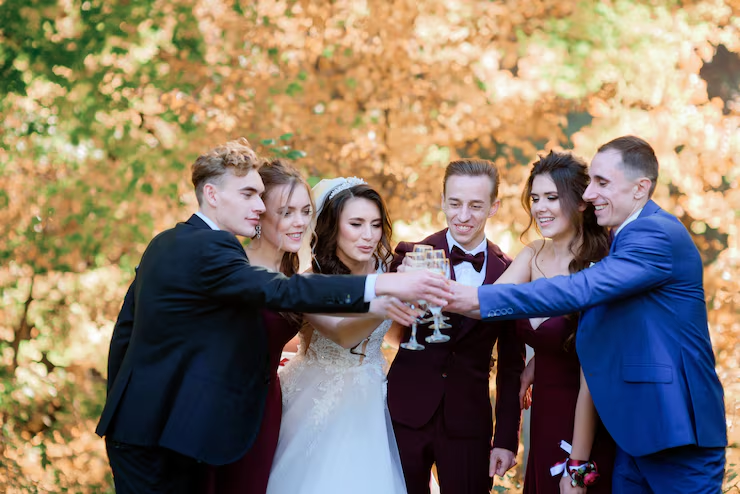
Inside was an invitation to my cousin Bradley’s wedding. The Ashford-Morrison Union, it proclaimed in elegant script. A celebration of bloodlines joining, of legacy continuing, of family honoring family.
I almost smiled. Almost. Then I saw the RSVP card.
My name was printed neatly: Commander Elena Morrison. Below it should have been a plus-one line, or my daughter’s name. Instead, there was a red slash mark—the kind editors use to delete unwanted text—drawn cleanly through where Isabella’s name had been.
And in my mother’s precise handwriting, a note in the margin: “Bloodline family only. You understand.”
I sat there in my dress whites, staring at that red line, feeling something crack inside my chest that had nothing to do with enemy fire.
Isabella wasn’t my biological daughter. She came to me when she was seven, through the foster system, a quiet girl with dark eyes that had seen too much and a habit of standing at attention without realizing it. She was the daughter of a sailor who’d served under my command—a single mother who died in a training accident, leaving behind a child with no other family and a file full of temporary placements.
I was thirty-four, unmarried, career-focused, and absolutely unprepared for parenthood. But when the social worker asked if I’d consider temporary guardianship until they found a permanent placement, I looked at this little girl standing in my office doorway, shoulders back like a recruit, and I said yes.
Temporary became six months. Six months became a year. A year became adoption papers and a bedroom painted her favorite shade of blue and a realization that I’d been waiting my whole life to be her mother, I just hadn’t known it yet.
That was twelve years ago.
Now Isabella was nineteen, a sophomore at the Naval Academy—following in my footsteps because she chose to, not because I pushed her. She was brilliant, disciplined, and kind in ways that made me wonder how I’d gotten lucky enough to be her mother.
And my parents had just drawn a red line through her existence.
I picked up my phone and called Isabella. She answered on the second ring, slightly breathless.
“Hey Mom, can I call you back? I’m about to head into navigation lab.”
“This won’t take long,” I said, keeping my voice steady. “Are you free this weekend? I need you to come home.”
There was a pause. Isabella had excellent instincts. “What’s wrong?”
“Nothing’s wrong. I just need to talk to you about something. In person.”
“Okay,” she said slowly. “I can catch the train Friday after classes.”
“Good. I’ll pick you up at the station.”
When I hung up, I looked at the invitation again. Then I folded it carefully, placed it in my desk drawer, and went back to work. I had three days to figure out how to tell my daughter that her grandparents considered her disposable.
Friday evening, I waited on the platform as the train from Annapolis pulled in. Isabella emerged in jeans and her Naval Academy hoodie, a backpack slung over one shoulder. At nineteen, she’d grown into herself—tall and lean, with her mother’s dark hair and a confidence that came from knowing exactly who she was.
She hugged me hard. “Okay, spill. What’s going on?”
“Let’s get home first,” I said.
In the car, she studied my face. “Is this about Grandma and Grandpa? Did something happen?”
I kept my eyes on the road. “Why would you think that?”
“Because you have your ‘navigating diplomatic waters’ expression. You only use that face for politics or family drama. And since we’re not currently at sea…”
Smart kid. I’d taught her too well.
At home, I made tea—her favorite, the chamomile blend she drank during exam weeks. We sat at the kitchen table, and I slid the invitation across to her.
Isabella read it carefully. Then she saw the RSVP card. I watched her face as she registered her absent name, the red slash mark, the notation about bloodline.
Her expression didn’t change. She just set the card down very carefully and wrapped both hands around her tea mug.
“Oh,” she said quietly.
“Isa—”
“It’s fine,” she said, too quickly. “I mean, it’s their wedding. They can invite whoever they want.”
“It’s not fine,” I said. “And it’s not okay.”
She shrugged, but I saw her shoulders tense. “I’m used to it, Mom. They’ve never really… I mean, Grandma always introduces me as ‘Elena’s foster daughter’ even though you adopted me twelve years ago. And Grandpa always asks about my ‘real’ family at holidays.”
My hands tightened around my own mug. “Why didn’t you tell me?”
“Because you would have done something,” Isabella said, meeting my eyes. “And I didn’t want to be the reason you fought with your parents. They’re your family.”
“You’re my family,” I said firmly. “You’re my daughter. Nothing about that is temporary or conditional or up for debate.”
Isabella’s eyes shimmened, but she blinked it back. She’d inherited my tendency to swallow emotions in favor of discipline. “So what do we do?”
I pulled out my phone and opened a new text to my mother. Isabella watched as I typed:
Received the invitation. If Isabella isn’t welcome, then neither am I. We won’t be attending. Best wishes to Bradley and his bride.
“Mom, you don’t have to—”
“Yes, I do,” I said, and hit send.
The response came within minutes. My phone rang. My mother’s photo filled the screen—her official portrait from her tenure on the hospital board, all pearls and perfect hair.
I answered on speaker so Isabella could hear. “Hello, Mother.”
“Elena, don’t be dramatic,” my mother said, her voice carrying that specific tone she used when she wanted to sound reasonable while being anything but. “This is a very intimate ceremony. Limited space. Family only.”
“Isabella is family.”
“You know what I mean. Blood family. It’s nothing personal against the girl—”
“Her name is Isabella.”
“—but Bradley and Catherine want traditional family photos. And it would just be… awkward. Having to explain who she is. Where she came from.”
I looked at Isabella. She was staring at her tea, jaw tight.
“You don’t have to explain anything,” I said. “She’s my daughter. That’s the entire explanation.”
“Elena.” My mother’s voice sharpened. “You’re being difficult. This is one day. One ceremony. Surely you can compromise on this.”
“I’m not compromising my daughter’s dignity.”
“She’ll understand when she’s older. She’s not really—”
“Don’t,” I said, cutting her off. “Don’t finish that sentence.”
My father’s voice rumbled in the background. My mother pulled the phone away briefly, then returned. “Your father wants to talk to you.”
A pause, then my father’s voice, heavy with disappointment. “Elena, your mother and I have tried to be supportive of your… unconventional family situation. But there are limits to what we can accommodate in our social circles. The girl is not a Morrison by blood. That matters.”
“Her name is Isabella, and she’s been a Morrison for twelve years.”
“On paper, perhaps. But you can’t expect the extended family to treat her as one of us when everyone knows—”
“Knows what?” I asked, my voice dangerous now.
“That she came from troubled circumstances. That she’s not our lineage. Elena, we have a reputation to maintain. The Morrisons have a legacy—”
I hung up.
Isabella was staring at me, eyes wide. “Mom…”
“Pack a bag,” I said, standing up. “We’re going to the beach house.”
“What? Now?”
“Right now. I need to think, and I do my best thinking with my feet in the sand.”
We drove two hours to the small cottage I’d bought on the Outer Banks years ago—my sanctuary from the noise of command. We arrived after midnight, and I made us hot chocolate while the ocean roared in the darkness beyond the windows.
“I’m sorry,” Isabella said finally, curled up on the couch. “I didn’t mean to cause problems with your family.”
“You didn’t cause anything,” I said, sitting beside her. “They did. And I’m sorry you’ve been dealing with their subtle cruelty for years while I was too blind to see it.”
“You’re not blind. You just… see the best in people.”
“Not anymore,” I said.
We sat in silence for a while, listening to the waves. Then Isabella spoke again, her voice small. “Do you ever regret it? Adopting me? How it complicated things with them?”
I turned to face her fully. “Listen to me very carefully. You are the best decision I ever made. The best thing that ever happened to me. And if choosing you means losing them, then I lose them. Every time. Without hesitation.”
She leaned against my shoulder, and I wrapped my arm around her. My daughter. Not by blood, but by choice—which, in my opinion, made it even stronger.
The next morning, my phone exploded.
Text messages from my mother, my father, my aunt, my uncle, two cousins, and Bradley himself. All variations on the same theme: I was being unreasonable. I was being selfish. I was making Isabella’s situation harder by forcing the issue. If I just let this one thing go, everything could go back to normal.
But “normal” meant my daughter being erased. And I was done with normal.
Then a different kind of message came in. From an unfamiliar number, but a familiar name: Captain Regina Hartwell, Navy Public Affairs.
Commander Morrison, we need to discuss a situation that’s come to our attention. Please call at your earliest convenience.
My stomach dropped. I stepped out onto the deck and dialed.
“Commander Morrison,” Captain Hartwell answered. “Thank you for calling back so quickly.”
“What’s this about, Captain?”
“We received a… concern… filed through unofficial channels. Regarding your fitness for command and your personal life choices affecting your judgment.”
I closed my eyes. “Let me guess. It came from someone with the last name Morrison.”
“I can’t disclose the source, but the timing is… interesting. The concern specifically mentions your insistence on bringing an ‘unauthorized family member’ to official Navy events and how it reflects poor judgment.”
“My daughter isn’t ‘unauthorized.’ She’s a cadet at the Naval Academy.”
“I’m aware. I’ve read her file. Exemplary record.” Captain Hartwell paused. “Commander, I’m telling you this off the record: this reeks of family politics, not legitimate professional concerns. But once something like this is filed, we have to investigate. It’s protocol.”
“Understood. What do you need from me?”
“Nothing right now. Just… be aware that someone is trying to weaponize Navy regulations against you. And be careful.”
After we hung up, I sat on the deck for a long time, watching the ocean. My parents weren’t just excluding Isabella from a wedding. They were actively trying to damage my career because I’d chosen my daughter over their prejudices.
Isabella found me there an hour later. “Mom? You okay?”
I told her about the call. I watched her face carefully, expecting hurt or anger. Instead, I saw something that looked like guilt.
“They’re going after your career because of me,” she said. “Maybe I should just… I don’t know. Stay away for a while. Let things cool down.”
“Absolutely not.”
“But—”
“Isa, listen to me. The Navy taught me a lot of things, but the most important lesson was this: you don’t abandon your crew. Ever. You’re my crew. You’re my family. And I don’t surrender to bullies, even when they’re wearing expensive suits and writing checks to the Heritage Gala.”
“The Heritage Gala?” Isabella asked. “Isn’t that next month? The big Navy fundraiser?”
I’d forgotten about that. The annual Naval Heritage Gala was one of the Navy’s premier events—a fundraiser attended by admirals, politicians, and major donors. It was also the event where they typically announced commendations and special recognitions.
And I’d been nominated for the Distinguished Service Medal this year.
My phone buzzed. Another message from Captain Hartwell:
Just got word. They’re pulling you from the Gala speaker lineup. “Scheduling conflict.” I’m sorry.
I showed the message to Isabella. She looked stricken. “They’re punishing you for defending me.”
“They’re exposing themselves,” I corrected. “And giving me time to think strategically.”
Because here’s what my parents didn’t understand: the Navy didn’t just teach me how to command ships. It taught me how to plan operations, how to gather intelligence, and how to strike precisely when and where it mattered most.
The wedding was in four weeks. The Heritage Gala was two weeks after that.
I had time. And I had a plan starting to form.
Over the next few weeks, I did something I’d never done before: I started documenting everything.
Every text message from my parents referring to Isabella as “the girl” or “your foster.” Every holiday photo where Isabella had been cropped out before being shared with extended family. Every time my mother had introduced Isabella as “Elena’s temporary situation” even years after the adoption was finalized.
I reached out to other family members—the cousins who’d been kind, the aunt who’d always sent Isabella birthday cards. I asked them, casually, about their experiences. Several admitted they’d noticed the pattern but hadn’t wanted to cause drama.
Then I did something that felt petty but necessary: I requested my own Navy file, specifically the sections related to my family status and dependent documentation. Isabella had been listed as my legal dependent for twelve years. Every official Navy document, every emergency contact form, every dependent ID card—all of it had her name, clear and official.
And finally, I made a phone call to Bradley, my cousin, the groom.
“Elena,” he answered, sounding wary. “I heard you’re not coming to the wedding.”
“That’s correct,” I said. “But I wanted to hear it from you directly. Do you also believe Isabella doesn’t belong?”
There was a long pause. “It’s… complicated.”
“It’s actually very simple. Is my daughter welcome at your wedding, yes or no?”
“Elena, you know how Aunt Diane and Uncle Richard are. They’re paying for everything. They’re very traditional about—”
“Yes or no, Bradley.”
Another pause. “Catherine and I would love to have you both there. But we can’t override the people paying for the wedding. I’m sorry.”
“I appreciate your honesty,” I said. “And I’m sorry you’re marrying into a family that values bank accounts more than integrity.”
I hung up before he could respond.
The wedding day arrived. I knew because my phone filled with messages from my mother throughout the morning. Last chance to make this right, followed by You’re breaking your father’s heart, and finally, You’ll regret choosing her over your real family.
I deleted them all without responding.
Instead, Isabella and I spent the day doing what we always did: we went to the National Museum of American History, got coffee at our favorite café, and walked along the National Mall. It was a perfect spring day, cherry blossoms drifting like pink snow.
“Are you sure you don’t regret this?” Isabella asked as we sat on a bench near the Lincoln Memorial.
“Not for a second,” I said. “Are you?”
She smiled—a real smile this time. “No. This is better than any wedding. Just us.”
My phone buzzed. A photo from a family group chat I hadn’t left yet: my parents at the wedding, standing beneath crystal chandeliers, all smiles and formal wear. A small American flag tucked into the floral arrangement on their table, as if patriotism were a decoration they could borrow for the evening.
I looked at that flag—the same one I’d served under for two decades—being used as a prop by people who’d tried to weaponize Navy regulations against their own daughter.
That’s when the final piece of my plan clicked into place.
The Naval Heritage Gala was two weeks away. I’d been pulled from the speaker lineup, but I was still nominated for the Distinguished Service Medal. Which meant I’d still be attending.
And so would Isabella—as my official guest, my daughter, and a cadet in good standing at the Naval Academy.
I made a phone call to Captain Hartwell. “Regina, I need a favor.”
The night of the Naval Heritage Gala, Isabella and I dressed in our formal uniforms. Hers was still new, the shoulder boards shiny, the fit perfect. Mine showed two decades of wear and polish, the ribbons on my chest telling stories I didn’t have to explain.
We arrived at the Marriott Wardman Park Hotel in Washington, D.C., where the ballroom glowed with Navy blue and gold. Admirals mingled with senators. Ship captains compared deployment stories. Donors wrote checks while waiters circulated with champagne.
And in the corner, looking distinctly uncomfortable, were my parents.
I hadn’t known they’d be there until I saw them. Apparently, their generous donations to the Naval Heritage Foundation had earned them an invitation. They stood near the bar, my mother in a silver gown, my father in a tuxedo that probably cost more than most sailors made in a month.
They spotted me immediately. And then they saw Isabella beside me, standing tall in her uniform, looking every inch the Naval officer she was training to become.
My mother’s smile froze. My father’s expression darkened.
They started making their way through the crowd toward us, but the lights dimmed before they could reach us. The ceremony was beginning.
The Master of Ceremonies, a rear admiral I’d served with in the Mediterranean, took the podium. He welcomed everyone, thanked the donors, and began the evening’s program.
Awards were presented. Stories were told. The Navy’s mission was celebrated with the kind of polished patriotism these events required.
Then came the moment I’d been waiting for.
“And now,” the Rear Admiral said, “we have a special presentation. In recognition of her twenty-three years of distinguished service, her leadership during multiple deployments, and her commitment to mentoring the next generation of Naval officers, we are honored to present the Distinguished Service Medal to Commander Elena Morrison.”
The room erupted in applause. I stood, Isabella beaming beside me, and made my way to the stage.
But when I reached the podium, I didn’t just accept the medal. I did something I’d planned very carefully with Captain Hartwell’s blessing.
“Thank you,” I said, as the applause died down. “I’m honored to receive this recognition. But I want to take a moment to talk about what service really means.”
I saw my parents in the crowd, both of them looking confused.
“I’ve commanded ships. I’ve led crews through storms and conflicts. I’ve made decisions that kept people safe. But the most important mission of my life didn’t happen at sea. It happened twelve years ago, when I became a mother.”
I gestured to Isabella, who was sitting in the front row now, looking slightly terrified.
“This is my daughter, Cadet Isabella Morrison, currently a sophomore at the Naval Academy. She’s brilliant, dedicated, and represents everything great about the next generation of Naval leadership.”
More applause. Isabella’s face turned red.
“But I want to share something that happened recently. Something that reminded me why we serve.”
The room went quiet.
“A few weeks ago, my daughter was excluded from a family wedding. Not because of anything she did. Not because of her character or her achievements. But because she wasn’t ‘blood family.’ Because she came to me through foster care rather than biology.”
I saw my mother stand up abruptly. My father was pulling at her arm, trying to get her to sit down.
“And when I declined to attend a wedding that excluded my daughter, the same family members who’d excluded her filed a complaint against me with Navy Public Affairs. They questioned my judgment. My fitness for command. All because I chose my daughter over their prejudice.”
The room was absolutely silent now. I saw admirals frowning, donors whispering to each other.
“I tell you this not to air family grievances,” I continued, “but to make a point about what we value. The Navy taught me that family isn’t just blood. It’s the people who stand beside you in the storm. The ones who have your back when things get hard. The ones you’d give your life for without hesitation.”
I held up the medal I’d just been awarded.
“This medal honors service and sacrifice. And I’d like to dedicate it to every service member who’s chosen love over biology. Every sailor who’s fostered or adopted. Every military family that’s been built through choice rather than chance. Because that kind of family—the kind you choose—that’s the strongest family there is.”
The applause started slowly, then built to something thunderous. Isabella was crying now, not bothering to hide it. Sailors and officers around the room were standing.
My parents were gone. Their table was empty, champagne glasses abandoned.
After the ceremony, I was surrounded by well-wishers. Admirals who thanked me for speaking out. Fellow officers who shared their own adoption stories. Donors who asked how they could support military foster programs.
And Isabella, who hugged me so hard I almost couldn’t breathe.
“Mom,” she whispered. “That was…”
“What you deserved to hear,” I said. “In front of everyone who matters.”
We stayed until the end of the gala, dancing and celebrating with people who understood what family really meant. When we finally left, after midnight, my phone had dozens of messages.
Some were from my parents. I deleted those without reading them.
Others were from family members—cousins, aunts, even Bradley. Apologies. Statements of support. Admissions that they’d been wrong.
And one message from Captain Hartwell: That was the bravest thing I’ve ever seen. The CNO wants to meet with you next week. I think you just changed some policies.
In the car, driving back through the quiet streets of Washington, Isabella turned to me.
“Did you plan all of that?” she asked.
“Some of it,” I admitted. “The speech was planned. The timing was opportune. Your grandmother trying to damage my career was… unanticipated but useful.”
“You used their cruelty against them.”
“I exposed their cruelty,” I corrected. “There’s a difference. I didn’t lie about anything. I just refused to keep their secrets anymore.”
Isabella nodded, processing. “What happens now?”
“Now? Now we go home. You finish your semester. I go back to work. And we stop letting other people define what our family means.”
“And your parents?”
I thought about that. “They made their choice. I made mine. Whether they can live with that is up to them.”
Six months later, my mother called.
I almost didn’t answer. But something made me pick up.
“Elena.” Her voice was different. Smaller. “I’d like to talk. If you’re willing.”
I thought about hanging up. Thought about all the reasons she didn’t deserve my time. But I also thought about the kind of person I wanted to be. The kind of parent I wanted to model for Isabella.
“I’m listening,” I said.
“I was wrong,” my mother said, and I heard something crack in her voice. “About everything. About Isabella. About the wedding. About trying to manipulate your career. I was… I was so focused on what the family should look like that I forgot what family should be.”
I didn’t respond immediately. Let her sit in that silence.
“Your father and I have been in therapy,” she continued. “After the gala, after everyone saw… we realized what we’d become. What we’d done. And we’re trying to change. I know that doesn’t fix anything. But I wanted you to know.”
“Why are you telling me this?” I asked.
“Because I’d like to meet my granddaughter,” she said quietly. “Really meet her. Not as an obligation or a complication. As family.”
I looked out the window of my office at the Norfolk harbor, ships coming and going, missions beginning and ending.
“I need to talk to Isabella,” I said finally. “This is her choice too.”
“Of course,” my mother said quickly. “Of course. And Elena? I’m proud of you. I should have said that years ago. I should have said a lot of things.”
We talked for another few minutes, carefully, like diplomats navigating a fragile peace. When we hung up, I sat for a long time, trying to untangle how I felt.
That evening, I told Isabella about the call. She listened carefully, her face thoughtful.
“What do you think?” I asked. “Do you want to meet them? Really meet them?”
Isabella was quiet for a moment. “Do you think they’ve actually changed?”
“I don’t know,” I admitted. “People can change. The question is whether they’ve changed enough, and whether you want to give them the chance to prove it.”
She nodded slowly. “I think… I think I’d like to try. But carefully. And only if you’re there.”
“I’ll always be there,” I promised.
We started slowly. Coffee first, in a neutral location. Then dinner. Then a weekend visit. My parents were different—not perfect, but genuinely trying. My mother used Isabella’s name without prompting. My father asked about the Academy and actually listened to the answers.
There were still awkward moments. Still things that needed to be worked through. But there was effort, real effort, to build something better than what had been broken.
Bradley and Catherine invited us to dinner a year after their wedding. They’d seen what happened at the gala—everyone in our extended family had—and they wanted to apologize in person.
“We should have stood up for you,” Catherine said to Isabella. “Both of you. We were cowards, and we’re sorry.”
Isabella handled it with more grace than I would have. “You were in a difficult position. I understand.”
“We’d like to make it up to you,” Bradley said. “If you’ll let us.”
And slowly, carefully, our family began to rebuild itself. Not the same as before—better. Because this time it was built on truth instead of tradition, on choice instead of obligation.
Two years after the gala, I received a call from the Chief of Naval Operations.
“Commander Morrison,” he said, “we’d like to promote you to captain. And we’d like you to consider a new assignment: leading our diversity and inclusion initiatives across the Fleet.”
I accepted. Because the Navy had given me more than a career. It had given me a framework for family, a language for loyalty, and the courage to choose love over legacy.
At my promotion ceremony, Isabella stood beside me in her own uniform—now a senior at the Academy, top of her class, on track for her own commission. When they pinned the captain’s eagles on my collar, she was the one who did it, her hands steady, her smile proud.
My parents were there too, watching from the audience. My mother was crying. My father was standing straight, his expression complex but genuine.
After the ceremony, as we took photos and accepted congratulations, Isabella leaned close and whispered, “Thank you for choosing me.”
“Thank you for being worth choosing,” I whispered back.
Because here’s what I learned from all of this: Family isn’t about blood or tradition or who’s in the wedding photos. Family is about who stands beside you when the world gets cruel. Who fights for you when you’re erased. Who chooses you every single day, even when it costs them something.
I spent twenty-three years serving the Navy, protecting people who never knew my name. But the most important person I ever protected was standing right beside me, wearing the same uniform, carrying the same name, and building her own legacy of courage.
She came to me as a foster child. She became my daughter. And in the process, she taught me that the strongest families aren’t built on bloodlines—they’re built on battle lines. The lines you draw when you say “this far and no further.” The lines you defend when people try to cross them.
My parents tried to erase my daughter with a red slash mark on an RSVP card.
Instead, they taught me exactly where my lines were. And they learned that when you force a Naval officer to choose between approval and honor, we’ll choose honor every single time.
Even when it costs us everything.
Even when it saves us instead.