The Bus Driver
They called me a “bus driver with a fancy uniform.” At my own family’s lawn party—white linens snapping in a gentle breeze, champagne flutes chiming, my brother Kevin basking in applause for a marketing promotion—my father, Richard, made sure the new guest heard it too.
He clapped my shoulder like he was pinning me to the ground. “She flies helicopters for the Army,” he said, smile curdled at the edges. “Basically a bus driver. Can’t be that demanding.”
The guest didn’t laugh. He was a senior agent—someone I’d be keeping alive in a joint operation two weeks from now—and in the space of one sentence I watched his eyes recalibrate, doubt slipping in like a draft beneath a door.
I’ve swallowed jokes like that my whole life. Not today. Not in front of the man who needed to know whether I could hold a bird steady on a mountain ridge with wind trying to tear it out of the sky.
So I walked away from the tent, away from the small talk and the practiced pride. The lawn opened in front of me like a landing zone. I checked the clock. The sky was clean blue. Somewhere beyond the treeline, doctrine was on its way.
The first hint wasn’t sound but feeling—a pulse under the soles of my feet, a low wump-wump-wump that gathered weight until the air itself began to vibrate. Conversations snapped in half. Heads tilted, glasses paused midair. My father squinted up, ready with another line.
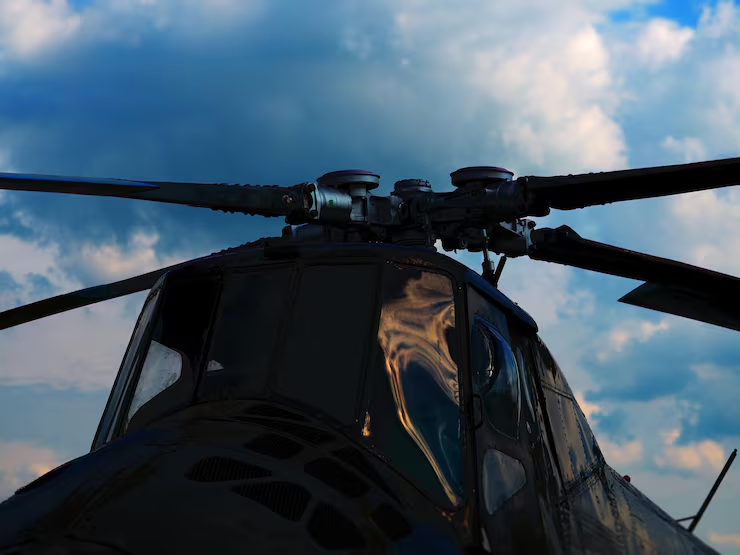
Then the shadow arrived—matte, disciplined, a blade of midnight carving the afternoon in two.
The wind hit first, lifting tablecloths, scattering Kevin’s note cards like startled birds. Guests stumbled, hands over faces. My mother clutched his arm. The machine didn’t land. It hovered—rock-steady, three feet off the grass—close enough for everyone to feel what respect sounds like when it comes with rotors.
I turned to my father, met the fear blooming where the smirk had been, and let my voice cut clean through the roar:
“Still think it’s just a bus?”
Chapter 1: The Golden Child
My name is Captain Sarah Hayes, callsign “Viper,” and I’ve spent the last twelve years of my life learning to fly machines that most people only see in movies. Black Hawks, Apaches, Chinooks—aircraft that require the kind of precision, nerve, and split-second decision-making that would make most people’s hands shake so badly they couldn’t hold a coffee cup, let alone a cyclic control.
But in my family, none of that has ever mattered.
In the Hayes household, there’s always been one star, one success story worth celebrating: Kevin Michael Hayes, my older brother by three years. Kevin of the corner office. Kevin of the business school connections. Kevin who works in marketing for a Fortune 500 pharmaceutical company and whose greatest professional achievement this year was securing a promotion that came with a title so long I can never remember all of it—Senior Vice President of Strategic Brand Integration or something equally meaningless.
Don’t get me wrong. I don’t hate my brother. Kevin is fine. He’s pleasant, well-groomed, says the right things at dinner parties, and has mastered the art of looking important while doing very little. He’s exactly what my parents always wanted: successful in a way they can explain to their country club friends, wealthy in a way that shows, safe in a way that doesn’t require them to worry.
Me? I’m the complicated one. The one who joined the Army at eighteen instead of going to Dartmouth like Kevin. The one who chose flight school over law school. The one whose career involves things my parents can’t brag about at cocktail parties because half of what I do is classified and the other half sounds too dangerous to be respectable.
“Sarah’s in the military,” my mother tells people, her voice carefully neutral, as if she’s announcing I have a moderately embarrassing medical condition. “Helicopters, you know. It’s very… brave.”
Brave. That’s her code for reckless. For irresponsible. For throwing away my potential on something she’ll never understand.
My father is worse. Richard Hayes—Dick to his golf buddies, Richard to everyone else—is a retired corporate attorney who spent forty years winning cases for pharmaceutical companies and investment firms. He measures worth in billable hours, annual salaries, and square footage of office space. To him, military service isn’t honorable. It’s a failure to launch. A detour taken by people who couldn’t cut it in the real world.
He’s been telling me this, in one way or another, since I was seventeen.
Chapter 2: The Party
The lawn party was Kevin’s idea, though my mother executed it with the precision of a military operation—ironic, considering how little respect she has for actual military operations.
It was late May, the kind of perfect spring afternoon that Virginia does better than anywhere else. The Hayes family estate—and yes, my parents call it an estate, though it’s really just a large house on five acres in Loudoun County—was decorated like something out of a magazine spread. White tents. String lights that wouldn’t turn on for hours but looked elegant anyway. Caterers in black and white. A jazz trio playing standards so inoffensive they barely registered as music.
The occasion: Kevin’s promotion. Six months in his new role, and apparently that was worth gathering fifty people to celebrate his ascent to a slightly more important desk.
I’d flown in from Fort Campbell that morning, still tired from a training exercise that had ended at 0200 hours. I’d managed four hours of sleep, a shower, and a drive that took twice as long as it should have because of traffic on I-95. I arrived in my Class A uniform because I didn’t have time to change and because, frankly, I knew it would irritate my father.
It did.
“You couldn’t have worn a dress?” he asked when I walked up the driveway. He was standing near the bar, scotch in hand, surrounded by three other men in expensive casual wear—the kind of outfit that costs eight hundred dollars but is designed to look effortless.
“I came straight from base,” I said. “Didn’t have time.”
“You couldn’t have planned better?”
“I’ve been awake for twenty-two hours, Dad. Planning wasn’t really—”
“Sarah!” My mother appeared like a guided missile, smile locked, eyes broadcasting don’t make a scene. She air-kissed both my cheeks, her hands briefly touching my shoulders as if confirming I was real. “You made it! Kevin will be so happy. Go say hello—he’s by the tent with some colleagues.”
Translation: go make yourself useful by congratulating your brother, and please don’t mention anything that will make people uncomfortable, like war or danger or the fact that your job involves getting shot at.
I found Kevin holding court near a table laden with shrimp and bruschetta. He was mid-story, gesturing with a champagne flute, his audience of four laughing on cue. When he saw me, his face lit up with what I’ve learned to recognize as performative affection.
“Sarah! You made it!” He pulled me into a hug that was just tight enough to seem genuine. “Everyone, this is my little sister. She’s a helicopter pilot. Army. Total badass.”
The group made appreciative noises. One woman asked, “What’s that like?”
I opened my mouth to answer, but Kevin was already talking again. “I mean, I could never do it. Too much responsibility. Too stressful. But Sarah’s always been the adrenaline junkie in the family.”
Adrenaline junkie. As if what I do is some kind of extreme sport. As if I’m base-jumping for Instagram likes instead of evacuating wounded soldiers under fire.
I smiled tightly. “It’s a job.”
“An important one!” Kevin raised his glass. “Here’s to public service. God knows someone has to do it.”
The condescension was so casual, so reflexive, that I don’t think he even noticed it. But I did. I always do.
I excused myself and drifted toward the edge of the party, near the tree line where the manicured lawn met the woods. I was checking my phone—messages from my unit, logistics for an upcoming joint operation—when I felt someone approach.
“Captain Hayes?”
I looked up. The man standing beside me was in his mid-forties, fit, with the kind of posture that suggested military or federal service. He wore khakis and a polo shirt, but they fit like a uniform. His eyes were sharp, assessing.
“I’m sorry, do I know you?”
“Marcus Webb. DEA. I’m here with your father—our agencies have worked together on some cases.” He extended his hand, and I shook it. His grip was firm, professional. “I’ve been looking forward to meeting you.”
“Oh?” I raised an eyebrow. “My father doesn’t usually advertise that I exist.”
Webb’s mouth twitched—not quite a smile. “He mentioned you were coming today. Said you’re part of the 160th SOAR.”
The 160th Special Operations Aviation Regiment. The Night Stalkers. The most elite helicopter unit in the world. We’re the ones who got Bin Laden to Abbottabad and back. We’re the ones who pull off the missions nobody else can.
“That’s right,” I said cautiously.
“I’m lead on an operation in two weeks,” Webb said, his voice dropping. “Joint task force. We’ll have air support from your unit. I was told the pilot would be—” He paused, checking something on his phone. “Callsign Viper. Captain Sarah Hayes.”
“That’s me.”
His expression shifted—relief mixed with something that looked like respect. “Good. I’ve heard excellent things. Your CO said you’re the best pilot he’s got.”
For the first time that day, I felt something loosen in my chest. “I appreciate that.”
“The op is going to be tricky,” Webb continued. “Mountain terrain. Narrow LZ. Potential hostiles. I need to know the pilot I’m trusting my team’s life to can handle it.”
“I can handle it,” I said, and I meant it.
“Good. Because if things go sideways—”
“Captain Hayes!”
My father’s voice cut through the conversation like a cleaver. He was walking toward us, scotch still in hand, that familiar smile on his face—the one that looks friendly until you realize it’s actually a warning.
“I see you’ve met Marcus,” Dad said, clapping Webb on the shoulder with the same gesture he’d used on me earlier. “Marcus and I go way back. Did some consulting work for the DEA a few years ago.”
“Sir,” Webb said politely.
Dad turned his attention to me, and I saw the setup coming before he even opened his mouth. “Marcus was just telling me about some operation he’s running. Helicopters involved. I told him you’d be perfect for it—you fly helicopters for the Army, don’t you, sweetheart?”
The way he said it. Helicopters. Like I flew tourists around the Grand Canyon.
“I do,” I said carefully.
“She’s very good,” Dad continued, talking to Webb but performing for the small crowd that had started to gather—Kevin, my mother, a few of the other guests. “Flies those big transport helicopters. What do you call them? Chinooks?”
“I fly multiple airframes, Dad.”
“Right, right. Very impressive.” He took a sip of his scotch. “It’s basically like being a bus driver, though, isn’t it? Just with a fancier uniform.”
The words landed like a punch.
I felt my jaw tighten, my hands curl into fists at my sides. I saw Webb’s expression shift—the respect in his eyes flickering, doubt creeping in at the edges. I saw Kevin smirking, clearly enjoying this. I saw my mother looking away, pretending she hadn’t heard.
And I saw my father, still smiling, still holding court, still convinced that he was hilarious.
“Bus driver with a fancy uniform,” someone repeated, and a few people laughed—nervous, uncomfortable laughter, but laughter nonetheless.
“Dad—” I started.
“Oh, don’t be so sensitive, Sarah,” he said, waving his hand dismissively. “You know I’m proud of you. I just think people get a little too worked up about military service. It’s a job, like any other job. Kevin works just as hard in his field.”
Kevin nodded, as if this comparison made perfect sense.
I looked at Webb. The doubt in his eyes had solidified. He was recalculating, wondering if the pilot he’d been assigned was really the best they had, or if I’d gotten my position through some kind of diversity quota or family connection. Wondering if, when things went bad on that mountain in two weeks, I’d freeze.
In that moment, I made a decision.
I pulled out my phone, opened my contacts, and sent a single text message to a number I wasn’t supposed to use except for emergencies.
Need a flyby. Hayes estate, Loudoun County. 20 minutes. Can you make it happen?
The response came in seconds.
For you, Viper? Always. Coordinates?
I sent the GPS location and put my phone away.
Then I looked at my father, at Kevin, at the guests still chuckling over the bus driver joke, and I smiled.
“Excuse me,” I said. “I need some air.”
Chapter 3: The Approach
I walked away from the tent, away from the clinking glasses and self-satisfied laughter. The lawn stretched out in front of me, perfectly manicured, obscenely green. Beyond it, the tree line marked the edge of my parents’ property—five acres of Virginia countryside that my father loved to call “the estate” as if he were landed gentry instead of a retired lawyer with a good investment portfolio.
I checked my watch. Eighteen minutes.
Behind me, the party continued. I could hear Kevin’s voice rising above the jazz trio, telling some story that ended with appreciative laughter. I could hear my mother directing the caterers. I could hear my father holding forth on something—probably the economy, or taxes, or some case from twenty years ago that he still considered his finest hour.
None of them were watching me. None of them cared that I’d walked away. I was the difficult daughter, the one who’d chosen wrong, the one who’d never quite fit into the perfect picture they wanted to paint.
Fine.
I stood in the center of the lawn, hands in my pockets, face tilted toward the sky. The weather was perfect—clear, unlimited visibility, wind at maybe five knots. Perfect flying weather.
Sixteen minutes.
My phone buzzed. A text from Chief Warrant Officer Jake “Reaper” Morrison, one of the best pilots in the 160th and my wingman on more missions than I could count.
Bird’s in the air. ETA 12 minutes. What’s the play?
I typed back: Low approach. Hover over the back lawn. Hold for 30 seconds. Make it loud.
Copy that. This is gonna be good.
I smiled. Reaper understood. He’d met my family once, at a military event, and had spent the entire evening looking like he wanted to punch my father in the face. “Your old man really doesn’t get it, does he?” he’d said afterward. “What we do. What it takes.”
“No,” I’d said. “He doesn’t.”
“Want me to explain it to him?”
“Not yet.”
Well. Now was “yet.”
Fourteen minutes.
I became aware that someone was walking toward me. I turned to see Webb approaching, his expression concerned.
“Everything okay, Captain?”
“Fine,” I said. “Just needed a moment.”
He nodded, understanding. “Your father’s… quite a character.”
“That’s one way to put it.”
“For what it’s worth,” Webb said carefully, “I don’t put much stock in what civilians think about military aviation. I’ve worked with enough pilots to know the difference between a bus driver and a warrior.”
“But you had doubts,” I said. “After what he said.”
Webb hesitated, then nodded. “For a second. Yeah.”
“That’s why I’m standing here.”
“What do you mean?”
I checked my watch. Twelve minutes.
“You’ll see.”
Webb frowned, but before he could ask more questions, we were interrupted by Kevin, who’d apparently noticed I was talking to someone important and decided to insert himself into the conversation.
“Marcus! There you are. Dad wanted to introduce you to—” He stopped, noticing me. “Oh. Sarah. You’re still here.”
“Where else would I be?”
“I don’t know. You looked pretty upset earlier. After Dad’s joke.” Kevin’s smile was infuriating—simultaneously sympathetic and superior. “You know he doesn’t mean anything by it. He just doesn’t understand military stuff.”
“Right,” I said flatly.
“I mean, it’s not his fault,” Kevin continued. “It’s hard for civilians to appreciate what you do. It’s so specialized, so niche. Not like the business world where success is more… measurable.”
Webb’s expression had gone carefully neutral—the look of a man watching a train wreck and trying not to get involved.
“Measurable,” I repeated.
“You know what I mean. Revenue, market share, quarterly growth. Concrete numbers. Whereas what you do is more… abstract. Harder to quantify.”
Ten minutes.
“Kevin,” I said, my voice very calm, “in my job, success is measured by whether people live or die. Whether a mission succeeds or fails. Whether a team makes it home or gets left behind. I’d say that’s pretty concrete.”
“Oh, absolutely! I didn’t mean—look, I’m not trying to diminish what you do. I’m just saying Dad comes from a world where achievement looks different. Where—”
The first sound was distant, almost subaudible—a rhythmic thumping that could have been mistaken for a truck on a far-off highway. But I knew better. I’d heard that sound in a hundred different contexts: over deserts and mountains, in storms and clear skies, in training and in combat.
It was the sound of a Black Hawk at full speed.
Eight minutes. They were early. Reaper must have pushed it.
“What’s that noise?” Kevin asked, frowning.
The sound was growing, no longer distant but approaching, the distinctive wump-wump-wump of rotor blades cutting through air.
“Sarah?” Webb was staring at me. “Is that—”
“Yep.”
More people were noticing now. Conversations were stopping. Heads were turning. My mother appeared at the edge of the tent, hand shading her eyes as she scanned the sky. My father emerged behind her, still holding his scotch, looking annoyed at the interruption.
Six minutes.
The sound was impossible to ignore now—a deep, rhythmic thunder that seemed to come from everywhere at once. The jazz trio had stopped playing. Guests were standing, looking around in confusion and growing alarm.
“Is that a helicopter?” someone asked.
“Sounds close,” another voice said.
“Too close,” a woman said nervously. “Are we under attack?”
I almost laughed. Under attack. In Loudoun County, Virginia, at a garden party.
My father strode across the lawn toward me, his face reddening with each step. “Sarah, what is going on? Do you know anything about this?”
“About what, Dad?”
“That noise! That helicopter! Is it one of yours?”
“One of mine?” I raised my eyebrows. “You mean from the Army? The organization where I’m basically a bus driver?”
His eyes narrowed. “This isn’t funny.”
“I agree. It’s not.”
The sound was massive now, overwhelming, vibrating in our chests and throats. People were looking genuinely frightened. My mother was clutching Kevin’s arm. Guests were backing toward the house, unsure whether to run or stay.
And then it appeared.
Chapter 4: The Display
It came over the tree line like a predator—low, fast, nose down in the aggressive posture of a combat approach. A UH-60M Black Hawk, matte black with minimal markings, the kind of bird we use for operations where visibility is a disadvantage and stealth is everything.
It was beautiful. It was terrifying. And it was coming straight for us.
The downwash hit first—a wall of rotor wash that flattened the grass, lifted tablecloths, sent champagne flutes tumbling. The catering tent shuddered. Kevin’s carefully prepared note cards for his speech scattered like startled birds. Women shrieked and grabbed at their dresses. Men stumbled backward, hands over their faces to protect against the debris.
The Black Hawk didn’t land. It hovered—rock-steady, rotors screaming, just three feet off the lawn, close enough that I could see Reaper in the pilot’s seat, his face partially obscured by his helmet but his hand clearly visible on the cyclic, holding the bird perfectly stable despite the chaos it was creating.
The noise was apocalyptic. Conversation was impossible. All anyone could do was stare up at this machine, this instrument of war that had appeared in the middle of their genteel garden party like a visitation from another world entirely.
I walked forward, directly toward the helicopter, and the crowd parted like I was Moses at the Red Sea. The wind tore at my uniform, but I kept my posture straight, my steps measured. I stopped ten feet from the bird and looked up at Reaper.
He gave me a thumbs up.
I turned to face my family.
My father was frozen, his face a mask of shock and something else—fear. Real fear. My mother had both hands pressed to her mouth. Kevin looked like he might faint. The guests were scattered across the lawn in various states of panic and awe, some filming on their phones, others just staring with their mouths open.
And Webb—Webb was watching me with an expression I recognized. Respect. Understanding. The doubt was gone, burned away by thirty seconds of pure, controlled power.
I walked back toward my father, and as I got close enough to be heard over the rotors, I leaned in and said, loud enough for everyone nearby to catch it:
“Still think it’s just a bus?”
He opened his mouth. Closed it. Opened it again. No words came out.
I gestured to Reaper, a simple hand signal: up and away. The Black Hawk rose smoothly, the noise shifting from overwhelming to merely deafening, and then it tilted forward and accelerated, disappearing over the tree line as quickly as it had appeared.
The silence it left behind was stunning.
For a long moment, nobody moved. Nobody spoke. They just stood there, scattered across the lawn like survivors of a natural disaster, staring at the space where the helicopter had been.
Then my father found his voice.
“What the hell was that?” His face was purple now, oscillating between fury and residual fear. “Sarah, did you—did you call in a military helicopter? To a private residence? Do you have any idea how dangerous that was? How reckless?”
“Dangerous?” I kept my voice level. “That was a textbook hover. CW2 Morrison is one of the best pilots in the regiment. The bird never got within six feet of anyone. Total control, start to finish.”
“You brought a weapon of war to a family gathering!”
“I brought a demonstration,” I corrected. “You called me a bus driver. I thought you might benefit from seeing what the bus actually looks like.”
“This is unacceptable! You could have hurt someone! You could have—”
“Dad.” I cut him off, and something in my voice made him stop. “In two weeks, I’m flying into hostile territory to extract a team of federal agents from a compound in the middle of a mountain range. The LZ is smaller than this lawn. The altitude is ten thousand feet. There will be people shooting at us. And if I don’t hold that bird steady—if I’m off by even two feet—people die.”
I let that sink in.
“That’s not bus driving. That’s not transportation. That’s not some easy job you can dismiss with a joke at a party. That’s years of training, thousands of hours of flight time, and a level of precision and skill that most people can’t even comprehend.”
My father’s mouth was a thin line.
“You want to compare Kevin’s marketing promotion to what I do? Fine. Let’s compare. Kevin sits in meetings. I fly into combat zones. Kevin gives PowerPoint presentations. I make split-second decisions that determine whether people live or die. Kevin’s biggest crisis this year was a failed product launch. Mine was pulling six wounded Marines out of a hot LZ while taking small arms fire.”
“Now, Sarah—” Kevin started.
“Shut up, Kevin.” I didn’t even look at him. “I’m talking to Dad.”
I took a step closer to my father. “You’ve spent my entire adult life acting like my career is a failure because it doesn’t fit into your idea of success. You’ve minimized what I do. You’ve made jokes. You’ve compared me unfavorably to Kevin at every opportunity. And I’ve let you do it because I kept hoping that eventually, you’d understand. That eventually, you’d be proud.”
“I am proud—”
“No, you’re not. You’re embarrassed. You don’t know how to brag about me to your golf buddies because what I do doesn’t translate into their language of money and prestige. You can’t put my job on a bumper sticker that makes you look good.”
The lawn was silent. Every guest, every caterer, every member of my family was watching this confrontation unfold.
“But here’s the thing, Dad. I don’t need your approval anymore. I don’t need you to understand what I do. Because the people who matter—the people whose lives depend on my skill—they get it. They know exactly what I’m capable of.”
I turned to Webb. “Agent Webb, do you still have doubts about whether I can handle your operation?”
He shook his head slowly. “No, Captain. No doubts at all.”
“Good. Because in two weeks, I’m going to fly into a situation that will scare the hell out of everyone involved, and I’m going to get your team in and out safely. Not because I’m a bus driver with a fancy uniform. But because I’m one of the best helicopter pilots in the world.”
I looked back at my father. “And if you can’t respect that, if you can’t see value in what I do, then that’s your limitation, not mine.”
He stood there, scotch glass still in his hand, looking older than I’d ever seen him. “Sarah—”
“I need to go,” I said. “I have an early flight tomorrow. Training exercise.”
“But the party—”
“Is for Kevin. Let him have his moment. He earned it.” I said it without sarcasm. “I’m happy for him. Really. But I’m done pretending that his success somehow diminishes mine. I’m done shrinking myself to make you comfortable.”
I turned to walk away, then paused and looked back. “And Dad? Next time you want to make a joke about my job, remember what you saw today. Remember what it felt like to have a Black Hawk hovering over your lawn. And ask yourself if you really want to underestimate the person flying it.”
Chapter 5: Aftermath
I made it halfway to my car before my mother caught up with me.
“Sarah, wait. Please.”
I stopped but didn’t turn around immediately. When I did, I saw that she was crying—not the performative tears she sometimes deployed to manipulate a situation, but real tears, messy and uncontrolled.
“Mom—”
“I’m so sorry.” Her voice broke. “I’m so sorry we’ve made you feel that way.”
“Mom, it’s okay—”
“It’s not okay!” She grabbed my hands, holding them tightly. “You’re right. About all of it. Your father and I—we’ve been so focused on what success looks like to us, to our friends, that we forgot to see what you’ve actually accomplished.”
“You don’t have to—”
“Yes, I do.” She wiped her eyes with the back of her hand. “When you joined the Army, I was terrified. Terrified you’d be hurt, or killed, or changed into someone I didn’t recognize. And instead of being honest about that fear, instead of supporting you, I… I diminished what you were doing. Made it smaller so it would scare me less.”
I felt my own eyes starting to burn. “Mom…”
“And your father—he doesn’t know how to be proud of something he doesn’t understand. He’s spent his whole life in a world where worth is measured in dollars and status. He doesn’t have the framework to appreciate what you do. But that’s his failure, Sarah. Not yours.”
She pulled me into a hug, and I let her. For a long moment, we just stood there in the driveway while the party continued on the lawn behind us.
“I don’t need him to understand,” I said quietly. “I just need him to stop making jokes.”
“He will. I’ll make sure of it.” She pulled back, holding me at arm’s length. “And I want to understand. Really understand. Will you tell me about it? About your work?”
“Most of it’s classified.”
“Then tell me what you can. I want to know my daughter. The real one, not the version I’ve been trying to reshape into something more comfortable.”
We talked for twenty minutes there in the driveway. I told her about flight school, about the physical and mental demands of flying helicopters, about the responsibility of carrying other people’s lives in my hands. I told her about missions I could discuss—humanitarian aid, disaster relief, training exercises. I didn’t tell her about the classified operations, the combat zones, the times I’d been shot at. But I gave her enough to understand that what I did was real, was difficult, was worthy of respect.
By the time we finished, the party had resumed on the lawn, though I could see people glancing our way, whispering. Kevin appeared, walking toward us with his hands in his pockets.
“That was quite an entrance,” he said.
“Yeah, well.” I shrugged. “I’ve had enough of the bus driver jokes.”
“I don’t think anyone’s going to make that joke again.” He was trying for his usual smooth tone, but there was something else underneath it. “Can I talk to you? Just for a minute?”
Mom squeezed my hand and headed back toward the party.
Kevin and I stood there in the driveway, the sun starting to sink toward the horizon, turning everything golden.
“I owe you an apology,” he said finally. “A real one. Not the kind where I apologize and then immediately make an excuse.”
“Okay.”
“I’ve been a dick. For years. And I’ve been a dick because…” He ran his hand through his hair, the perfect styling coming apart. “Because you scare me.”
“I scare you?”
“Yeah. You do what you do, and I sit in an office and argue about marketing strategies. You risk your life, and I risk… what? A bad quarterly report? You’ve actually done something meaningful, and I’ve spent my entire career optimizing profit margins for drugs that people can’t afford.”
“Kevin—”
“Let me finish.” He looked at me, and I saw something I’d never seen in his face before: genuine vulnerability. “Dad built me up my whole life. Told me I was special, I was smart, I was destined for great things. And I believed him. I built my whole identity around being the successful son. And then you joined the Army and became actually extraordinary, and it made me feel small.”
“That wasn’t my intention.”
“I know. But it’s true anyway. So I dealt with it by diminishing what you do. By joining Dad in his jokes. By acting like your career was just… less important than mine. Because if it wasn’t less important, then I had to face the fact that I’m not as special as I thought I was.”
He looked down at his expensive shoes. “I’m proud of you, Sarah. I’ve always been proud of you. I was just too insecure to say it.”
I didn’t know what to say. In twelve years, Kevin had never been this honest with me.
“Thank you,” I said finally. “That means something.”
“Are we okay?”
“We’re getting there.”
He nodded, accepting that. “For what it’s worth, watching that helicopter appear—watching you stand there like it was nothing—that was one of the most badass things I’ve ever seen.”
I smiled. “It was pretty cool.”
“Your friend who flew it—is he single? Asking for a friend.”
I laughed, and the tension broke. We walked back toward the party together, and for the first time in years, it felt like we were actually siblings instead of competitors.
Chapter 6: The Reckoning
My father found me near the bar, where I was getting a glass of water. The party was winding down, guests beginning to filter toward their cars, the caterers starting to pack up.
“Sarah.”
I turned. He looked tired, older, the confidence that usually armored him worn thin by the events of the day.
“Dad.”
“Can we talk?”
“If you want to lecture me about that flyby, save it. It was safe, it was legal, and it was necessary.”
“That’s not what I want to talk about.” He gestured toward the edge of the lawn, away from the remaining guests. We walked in silence until we were standing near the tree line, the same spot where I’d waited for the helicopter.
“I was wrong,” he said, and the words sounded like they were being dragged out of him with pliers. “About what I said today. About… all of it.”
“Okay.”
“That helicopter—watching it come in, seeing what it took to control something like that—I realized I’ve been an ass.”
“You have been,” I agreed.
He flinched but nodded. “Your mother explained some things to me. About your training, about what you actually do. About the 160th and what it takes to get accepted into that unit.”
“And?”
“And I didn’t know. I didn’t understand. I made assumptions based on my own ignorance, and I belittled something I should have respected.”
“Why?” I asked. “Why couldn’t you just be proud of me? Why did you have to compare me to Kevin, diminish my work, make me feel like I’d failed by choosing this path?”
He was quiet for a long time. When he spoke, his voice was raw. “Because I was afraid.”
“Afraid of what?”
“Of losing you.” He looked at me, and his eyes were wet. “When you joined the Army, when you went to flight school, when you told us you were going to be flying helicopters in combat zones—I was terrified. Terrified that you’d be killed. That I’d get a visit from an officer in dress uniform telling me you’d died in some war I didn’t understand in some country I couldn’t find on a map.”
“So you dealt with that fear by pretending what I do isn’t dangerous?”
“By pretending it isn’t important,” he corrected. “If it’s not important, if it’s just driving a bus, then maybe it’s not as dangerous as I think. Maybe you’re not really risking your life. Maybe I don’t have to lie awake at night wondering if you’re alive.”
I felt something shift in my chest—not forgiveness, not yet, but understanding.
“Dad, I am risking my life. Every time I fly a mission. That’s the reality.”
“I know. I know that now.” He wiped his eyes roughly. “But I’m your father. My job is to protect you. And I can’t protect you from what you do. So I tried to make it smaller, make it less real, so I wouldn’t have to face the fact that my little girl flies into danger and I can’t do a damn thing about it.”
“I’m not a little girl anymore.”
“I know. I know you’re not. You’re a captain in the Army. You’re a pilot. You’re…” He gestured helplessly. “You’re someone I don’t have the language to describe. Someone extraordinary.”
“I’m your daughter,” I said. “That should be language enough.”
He nodded. “You’re right. It should be.”
We stood there in the fading light, the party continuing behind us, the sounds of jazz and conversation drifting across the lawn.
“I can’t promise I’ll never worry,” he said. “I can’t promise I’ll ever understand what you do. But I can promise I’ll stop minimizing it. I’ll stop making jokes. And I’ll try to see you for who you actually are, not who I wanted you to be.”
“That’s all I’ve ever wanted.”
“I’m proud of you, Sarah. I should have said it years ago. I’m proud of you, and I’m sorry I made you feel like you had to prove it with a helicopter demonstration.”
I smiled despite myself. “To be fair, the helicopter demonstration was pretty effective.”
He laughed, a real laugh, not the performative one he used at parties. “It scared the hell out of me.”
“Good. That was the point.”
We walked back toward the house together. The party was almost over now, just a handful of guests remaining, Kevin and my mother standing together near the tent.
Webb approached as we got closer. “Captain Hayes. I wanted to thank you before I leave.”
“For what?”
“For the demonstration. For putting my doubts to rest.” He extended his hand. “I’ll see you in two weeks for the op brief. And I’m honored to be flying with you.”
“We’ll get your team in and out safely. I promise.”
“I believe you.” He nodded to my father. “Richard, thank you for the invitation. It’s been… enlightening.”
After Webb left, my father turned to me. “That operation he mentioned. Is it dangerous?”
“They all are.”
“Will you—” He stopped, started again. “Will you tell us when it’s over? That you’re safe?”
“If I can. Some missions I can’t talk about.”
“Then just tell us you’re safe. That’s enough.”
Kevin joined us, wrapping an arm around my shoulders. “So, little sister. Think you can teach me to fly one of those things?”
“Absolutely not. You’d crash it in five minutes.”
“Probably true.” He grinned. “But admit it—that was the coolest thing that’s ever happened at a Hayes family party.”
“By far,” I agreed.
My mother appeared with champagne glasses. “A toast,” she announced. “To Kevin, for his promotion.” We raised our glasses. “And to Sarah, for reminding us what real achievement looks like.”
We drank, and for the first time in my adult life, I felt like I was actually part of this family. Not the disappointing daughter, not the one who’d chosen wrong, not the bus driver with a fancy uniform.
Just me. Captain Sarah Hayes. Pilot. Warrior. Daughter.
The sun had set by the time I finally got in my car to drive back to base. As I pulled out of the driveway, I looked in the rearview mirror and saw my family standing together on the front steps, waving goodbye.
My phone buzzed. A text from Reaper.
How’d it go?
I smiled and typed back: Perfect. Thanks for the assist.
Anytime, Viper. That’s what wingmen are for.
I drove through the Virginia night, windows down, the warm air rushing through the car. In two weeks, I’d be in a very different cockpit, flying a very different mission, in a very different context. But for now, for this moment, I felt something I hadn’t felt in years.
Peace.
My family finally understood who I was. They finally respected what I did. And if they ever forgot, well—I knew a guy with a Black Hawk who could remind them.
After all, sometimes the best way to prove you’re not a bus driver is to show them exactly what kind of vehicle you’re driving.
And there’s nothing quite like sixty-four feet of rotary-wing aircraft hovering over your garden party to make that point crystal clear.






A fantastic story, from start to finish.