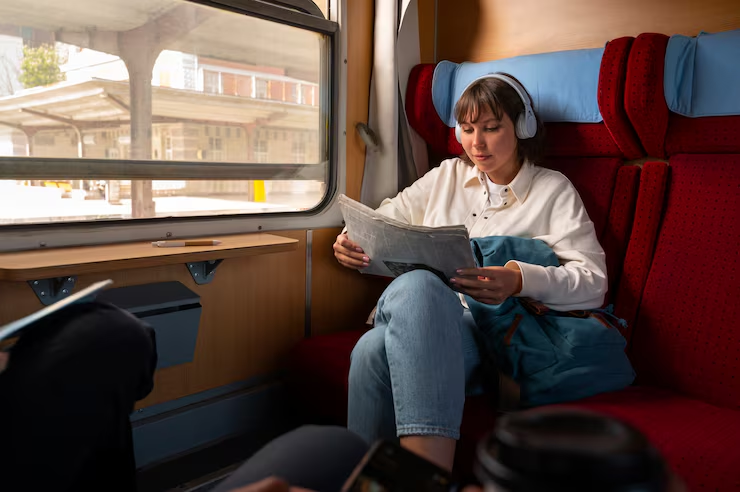
No Room for Me
My brother said, “No room for you on the dream Christmas trip.”
So I just texted back two words: “All good.”
One week later, when I vanished from their calls and the internet found my story, my family panicked. They weren’t scared for me. They were scared of the world seeing the truth.
My name is Harper Moore, and for the last seven years I’ve made a living by predicting how human beings interact with digital interfaces at Aurora Mosaic Creative Lab. My official title is senior UX designer. But my actual job is to smooth out the friction in other people’s lives. I anticipate where a user might get frustrated and I build a bridge over that frustration before they even know it’s there.
I’m good at it. I’m efficient, invisible, and accommodating.
It’s a skill set I didn’t learn in design school. I learned it at the dinner table of my childhood home.
The Text
I was standing at my standing desk, the ergonomic mat cushioning my feet, staring at the high-fidelity prototype for a new mental wellness app we were pitching to a major healthcare provider. The office was quiet, filled only with the hum of expensive servers and the soft clatter of mechanical keyboards. Outside the floor-to-ceiling windows, the Seattle sky was a flat, oppressive gray, threatening snow that likely wouldn’t stick.
I was adjusting the hex code on a calming blue button when my phone vibrated against the birch veneer of the desk. It was a single short buzz, the kind that usually signals a delivery update or a spam notification.
I glanced down.
The name on the screen was Dylan.
My younger brother usually only texted me when he needed advice on a gift for our mother or when he wanted me to look over his résumé. We’d been planning the family Christmas trip to Silver Ridge for four months. I’d already requested the time off. I’d already bought a new set of thermal layers.
I picked up the phone, expecting a logistical update about departure times or a request to bring that specific brand of artisanal coffee bean Dad liked.
The message was two sentences long.
No room for you on the cabin trip. Maybe next year.
I read it once. Then I read it again.
The words were so simple, so devoid of emotion, that they felt like a syntax error in a line of code.
No room.
This was a cabin my parents had rented in Colorado. A massive A-frame that slept fourteen people, according to the listing Mom had sent around in the group chat back in August. There were four of us in the immediate family, plus Dylan’s wife, Megan. Even with the two dogs, the math didn’t add up.
I stared at the screen until the backlight dimmed and timed out, leaving me looking at the reflection of my own shocked face in the black glass.
My heart didn’t race. Instead, it seemed to stop entirely, a cold vacuum opening up in the center of my chest.
I waited for the follow-up text. I waited for the just kidding or the we had to change cabins to a smaller one.
Nothing came.
The three dots that indicate someone is typing never appeared.
My fingers hovered over the keyboard. I wanted to scream. I wanted to type a paragraph outlining the logistics of sleeping bags, of sofas, of the fact that I’d spent three grand on plane tickets to Denver that were non-refundable. I wanted to ask why I was the one being cut from the roster less than a week before Christmas.
But I knew the script. I knew exactly what would happen if I pushed back.
I would be the difficult one. I would be the one ruining the holiday spirit. I would be the drama queen.
So I swallowed the scream.
I typed two words.
All good.
I hit send.
My hand was trembling so violently that when I reached for my mouse to go back to work, the cursor skittered across the dual monitors, deleting a navigation bar I’d spent forty minutes perfecting.
I sat there staring at the broken design, breathing in shallow, jagged gasps.
Three minutes later, a notification popped up on my secondary monitor. It was a Facebook alert. Patricia, my mother, had just uploaded a new album.
I clicked it.
I shouldn’t have clicked it, but the masochistic impulse was too strong to resist.
The album was titled “Silver Ridge-bound,” and the cover photo was a masterpiece of curated family joy. They were standing in the driveway of my parents’ house in the suburbs. My father, Ron, was wearing his Santa hat, the one with the bells that he only wore when he was in a truly good mood. My mother was holding the leash of Buster, their golden retriever, who looked manic with excitement.
And there, in the center, was Dylan. He had his arm draped possessively around Megan’s shoulders. They were all beaming, their teeth white and straight, their cheeks flushed with the anticipation of a winter wonderland.
The caption read: “Our perfect Christmas crew. The car is packed and we’re ready for the mountains. Blessed to have the family together.”
“Family together.”
The words tasted like ash in my mouth.
I zoomed in on the photo, my eyes trained to catch pixel misalignments and spacing errors. I began to scan the image for data. I looked at the trunk of the SUV, which was popped open behind them. I saw the skis. I saw the cooler.
And then I saw the detail that made my blood run cold.
Tucked behind Megan’s legs, partially obscured by the bumper but unmistakably visible, was the large hard-shell Samsonite suitcase. The blue one. We used to call it the Beast because it was massive. It was the spare suitcase my parents kept in the attic.
It was packed. It was bulging at the seams.
That suitcase was large enough to hold a week of clothes for a grown adult. It was large enough to hold my clothes.
If there was no room, why were they bringing the spare luggage? If the car was too full for me, how did they fit a thirty-inch hard-shell case that was clearly not empty?
It sat there in the corner of the frame like a silent, mocking punchline.
There was room for an extra fifty pounds of gear. There was room for the dog’s oversized bed, which I could see wedged on top. There was room for everything and everyone except me.
The comments were already rolling in. I watched them appear in real time.
“Beautiful family. Have a safe drive,” wrote Aunt Linda.
“So jealous. Silver Ridge is a dream. Wish I was there,” commented cousin Sarah.
These were the same people who had forgotten to text me on my birthday for the last four years. To them, the picture was complete. There was no missing piece.
Then I saw Dylan’s reply to Sarah.
“Wish some people could make time to join us. But you know how it is—priorities.”
The air left my lungs.
He wasn’t just excluding me. He was rewriting the narrative in real time. He was spinning it. He was making it look like I was the one who had bailed. Like I was the busy, city-dwelling career woman who considered herself too important to descend from her high-rise apartment for a family gathering.
He had told me there was no room.
And ten minutes later he was telling the world I had simply chosen not to come.
I felt a physical nausea rise in my throat.
The Pattern
I looked around the office. My colleague Jason was wearing headphones, bobbing his head to music, completely oblivious that my entire world was collapsing in a Facebook comment section.
I scrolled past the comments, and suddenly the office faded away.
I was ten years old again.
It was Christmas Eve. My parents had been invited to a couples-only gala at the country club. It was a prestigious event, very important for my father’s networking. They took Dylan because he was the baby, only six years old, crying that he couldn’t sleep without Mom. They put him in a tuxedo that matched Dad’s. They left me with Mrs. Gable next door.
“The hotel suite only has one pullout couch, Harper,” my mother had said, adjusting her pearl earrings. “And you’re big enough to be independent. Mrs. Gable has cable TV.”
I spent that Christmas Eve watching Mrs. Gable knit beige socks while my family slept in a four-star hotel and ordered room service.
The memory shifted.
I was fourteen. My family went to Hawaii for the holidays. They told me the plane tickets were just too expensive that year, that the economy was tight, so they sent me to stay with my best friend’s family for a week. I tried to be grateful. I tried to have fun.
But when they came back, tan and smiling, I found the ticket stubs in the trash.
Dylan had flown first class.
The memories came in waves, overlapping with the cold silence of my apartment later that night.
I was sixteen. The Grand Christmas Cruise. My parents had talked about it for months. Two weeks before departure, my mother sat me down with that specific look on her face, a tight, apologetic grimace that didn’t reach her eyes.
She told me there had been a mix-up with the booking agent. The family suite only had accommodations for three people. Because I was older, sixteen and responsible, surely I would understand that Dylan, who was barely twelve, couldn’t be left behind.
I spent that Christmas heating up frozen lasagna and watching reruns of sitcoms. Ten days later, a postcard arrived in the mail. It was a generic photo of the ship docked in Jamaica. On the back, in my mother’s looping, decorative handwriting, it said:
Having a wonderful time. The buffet is endless. Wish you were here.
I remember holding that card, feeling the glossy paper against my thumb.
Wish you were here.
It felt like a joke. It felt like they were laughing at me from 3,000 miles away.
Two years later, the pattern solidified into concrete.
I was eighteen. Dylan was turning sixteen, and his birthday fell right near the holidays. My parents rented a penthouse suite in Las Vegas. I was excited. I had never been to Vegas. I bought a sparkly dress from the clearance rack at the mall three days before the trip.
My father cleared his throat at the dinner table. He told me that upon reflection, Las Vegas was not an appropriate environment for a young woman who was almost legal but not quite. He said it would be frustrating for me to not be able to enter the casinos or the clubs. He said they were doing me a favor by not dragging me along to a place where I would be bored.
I stayed home.
I saw the photos later. They went to the M&M store. They went to the massive arcade. They went to family-friendly shows. There was nothing in that trip I couldn’t have done.
The only thing that was inappropriate for the trip was me.
The sharpest blade, the one that still woke me up at night sometimes, was my college graduation.
I graduated summa cum laude with a degree in interaction design. It was a big ceremony in the university stadium. I had sent my parents the date six months in advance. I had reminded them weekly. When I walked across the stage to accept my diploma, I scanned the crowd. I knew exactly where their seats were supposed to be. I had bought the tickets myself. I looked for my father’s bald spot, for my mother’s expertly highlighted blonde hair.
I saw three empty gray folding chairs.
I accepted my diploma, shook the dean’s hand, and walked off stage with a smile plastered on my face that felt like it was made of cracking plaster.
Later, in the parking lot, while other families were hugging and popping confetti cannons, I checked Facebook. There was a check-in from my mother:
Napa Valley Vineyards.
Caption: “Celebrating our boy. Dylan just landed a summer internship at a tech startup. So proud of his hustle. Wine tasting to celebrate the future.”
They had skipped my actual college graduation to celebrate my brother getting a temporary unpaid summer job.
I stood there in my heavy black gown, the tassel of my cap blowing in the wind, and I felt like I was dissolving. I was transparent. I didn’t matter.
And then I heard the rumble of an engine.
A beat-up, rusted red pickup truck pulled up to the curb, coughing smoke. The window rolled down and there was Aunt Jo.
Josephine is my father’s older sister. She’s everything he’s not. Where he’s polished, she’s rough around the edges. Where he cares about appearances, she cares about substance. She was wearing a flannel shirt covered in sawdust and a Mariners baseball cap. She hopped out of the truck, marched over to me, and wrapped me in a hug that smelled like engine grease and vanilla.
“I told Ron he was an idiot,” she said into my hair. “But I’m glad he’s an idiot because it means I get you all to myself.”
She had driven five hours from Spokane. In the passenger seat was Uncle Mark, looking sleepy but smiling. In the back was little Maya, who was only four years old at the time. They had brought a homemade apple pie that was still warm, wrapped in tin foil, and a bouquet of sunflowers they’d bought from a roadside stand.
That night, we didn’t go to a fancy dinner. We went to their motel room, ordered three large pizzas, and sat on the beds eating straight from the box.
That was the beginning of my other life, my real life.
Over the years, Jo, Mark, and Maya became my shelter. When I got my first big promotion and my parents ignored the text, Mark called me to ask specifically about the coding languages I was using, even though he didn’t understand a word of it. When I had my heart broken by a guy I thought was the one, Jo drove over and let me cry on her shoulder for four hours while she brushed my hair.
Sundays became our ritual. I would drive over to their small, cluttered house. We would eat cold pizza or whatever experimental casserole Jo had burned that week. We would watch black-and-white movies because Mark loved them. Maya, who was growing up too fast, would make me play shop. I had to be the difficult customer who returned everything, and she would practice her customer service voice.
The Call
Sitting in my apartment that night after the “no room” text, I called Jo on FaceTime.
The connection sputtered for a second and then the screen filled with chaos.
“Harper!” Maya screamed.
She was ten now, missing a front tooth and wearing a sweater that looked like it was made of tinsel.
“Hi, Bug,” I said, forcing a smile.
Jo’s face appeared in the frame. She looked tired. Her hair was graying, pulled back in a messy bun.
“You look terrible,” she said bluntly. “What’s wrong?”
I took a deep breath and told her everything.
When I finished, the silence on the other end of the line was heavy.
“Harper,” she said, her voice low and steady, “they’ve been telling you there’s no room for twenty years. They’re never going to make room. You keep waiting for them to pull up a chair, but they’re never going to do it.”
I felt a tear slide down my cheek.
“I know.”
“So,” Jo continued, leaning in, “if they don’t have a seat for you, why don’t you book your own seat—a better one?”
I stared at her.
“What do you mean?”
“I mean, you have the money now. You have the time. Why are you sitting in that apartment waiting for them to give you scraps? Go somewhere. Go somewhere they can’t afford. Go somewhere they would hate because they aren’t invited.”
“Book my own seat,” I whispered.
“Exactly,” Jo said. “Stop being the person who was left behind. Be the person who went ahead.”
The Train
The email arrived at ten in the morning on a Tuesday, exactly one week before Christmas.
Subject: Year-end Performance Bonus – Stock Grant Allocation.
I clicked it, expecting the usual corporate token of appreciation. Maybe a few thousand. Maybe a gift card to a steakhouse.
I had to blink twice to make sure I was reading the numbers correctly.
Dear Harper, in recognition of your outstanding leadership on the Helix Health Project and your consistent delivery of high-value UX solutions, we are pleased to award you a year-end performance bonus of $20,000.
Twenty thousand dollars.
I sat back in my ergonomic chair, the breath leaving my lungs in a slow hiss.
For my entire life, my worth had been calculated in nickels and dimes. I’d been told over and over that the family budget simply couldn’t stretch to accommodate me. I was the line item that always put them in the red. I was the luxury they couldn’t afford.
And now, sitting in my office with a cooling cup of coffee, I was staring at a sum of money that could have paid for every single one of those trips ten times over.
They had never been too poor to take me. They were just unwilling.
I opened a new browser tab and typed: luxury train travel winter.
I didn’t want to fly. I wanted to disappear into the landscape. I wanted to see the world move past me while I stayed still.
The search results gave me the Empire Builder, a train route that ran from Seattle all the way to Chicago. I scrolled through the stops until I saw a smaller station near the border of Montana and Idaho, a place called Frost Peak Station.
It sounded like a place where cell service went to die.
It was perfect.
Near the edge of a national forest reserve was a link for something called the Ice Lantern Inn.
The website was elegant, dark, and minimalist.
The Ice Lantern Inn. For those who seek silence.
There was one suite left for the Christmas week: the Solstice Loft.
The photos showed a room with high, vaulted timber ceilings, a private stone fireplace, a king-sized bed piled with faux-fur throws, and a copper soaking tub situated right in front of a floor-to-ceiling window overlooking a dense, snow-covered pine forest.
It cost $800 a night.
I looked at the bonus email again.
I clicked Book Now.
I added the starlight snowshoe tour. I added the private chef’s tasting menu. I added the in-room massage package.
I hit the final confirmation button.
Reservation confirmed. Welcome to the Ice Lantern, Harper.
My heart was hammering against my ribs. It felt like I was doing something illegal.
I wasn’t sitting by the phone waiting for an invite. I wasn’t begging for a foldout couch.
I was buying the castle.
I booked the train ticket on my phone. Departure: King Street Station, 9:45 p.m.
It was happening.
That evening, I packed for me. I pulled out my old battered leather suitcase. Into it went my thickest wool sweaters. I packed my heavy hiking boots. I went to the back of my closet and pulled out a dust-coated box. Inside was my expensive camera and my sketchbook. I hadn’t touched them in years.
I packed them both.
Then I reached for the scarf. It was a long, lumpy, multicolored thing made of cheap acrylic yarn. Maya had knitted it for me last year. It was neon green, bright purple, and orange. It was objectively the ugliest piece of clothing I owned.
I buried my face in the scratchy wool. It smelled like Jo’s house—wood smoke and vanilla.
I packed it on the very top.
The ride to King Street Station was a blur. The station itself was a cavern of white marble and echoing announcements.
I found the gate for the Empire Builder. The train was massive, a steel snake stretching out into the dark.
I stepped onto the train. The corridor was narrow, lined with doors. I found mine, Room Number Four. I slid the door open. It was compact, efficient, and incredibly cozy.
I sat down and slid the door shut, latching it. The silence was immediate.
The train gave a lurch, then a smooth, heavy pull. The station began to slide backward. We rolled out into the night.
I stood up and leaned my forehead against the cool glass.
I thought about the matching jackets. I thought about the “no room” text. I thought about the years I’d spent trying to squeeze myself into the frame of their picture.
I closed my eyes.
For the first time in my life, I wasn’t heading toward a place where I wasn’t wanted. I was heading toward a place that didn’t even know I existed yet.
“Goodbye,” I whispered to the reflection in the glass.
The city vanished behind us, swallowed by the rain and the night, and the train pushed forward into the dark, carrying me toward the snow.
The Stranger
Hours later, I gave up on sleep. I pulled on my boots, grabbed Maya’s lumpy scarf, and made my way to the dining car.
I ordered a grilled cheese sandwich and a cup of black coffee. It felt like the kind of meal a person on the run eats.
As I waited, I listened to the conversations around me. Behind me, college students complained about being forced into perfect family photos.
I wondered what they would think of my story.
My phone vibrated. A text from my mother.
Send a selfie at Grandma’s when you get there tomorrow. She wants to see you. Remember to tell her you love the new haircut.
I stared at the message.
My blood turned to ice.
Grandma’s.
My grandmother lived in a nursing home just outside Portland. I was supposed to be there. That was the cover story. They were making me the good, responsible one to cover their own tracks while Dylan posted about my “bad priorities.”
They were playing both sides.
A sound escaped my lips. It wasn’t a laugh. It was more like a cough that had given up.
“That bad of a grilled cheese, huh?”
I looked up.
One of the college students was standing by my table. He had a friendly, open face, a scruffy beard, and a beanie pulled down low. He was holding a small professional-looking camera.
“Sorry, I couldn’t help but see you staring at your phone like it just insulted your entire family. I’m Liam, by the way.”
I didn’t know why I said it. Maybe it was the anonymity of the train.
“My mom,” I said, my voice flat. “She just texted me to make sure I send a picture from my grandmother’s nursing home. The one I’m supposed to be visiting. The one I’m not visiting.”
Liam raised an eyebrow.
“Where are you visiting instead?”
“Montana,” I said.
Then the words just fell out.
“They said there was no room for me on the family Christmas trip, so I booked my own.”
Liam was silent for a second.
“Wait, for real?” he asked. “They just told you not to come?”
“Got a text,” I said. “Two sentences. ‘No room for you. Maybe next year.'”
“Whoa,” he said. “That is cold.”
He hesitated.
“Look, this is going to sound weird, but I’m a travel vlogger. Would you be willing to say that again? No face, no name, I swear. Just your hands and the snow outside.”
I looked at him.
“What is it for?”
“I post on TikTok mostly,” he said. “Just short clips. It probably won’t even get more than a hundred views.”
A hundred views. That felt safe.
“Fine,” I said. “Just the hands and the window.”
He turned on the camera. He crouched down, getting the angle right.
“Okay, whenever you’re ready.”
I took a breath. I looked at my hands. I looked at the black, snowy void outside.
“They said there was no room for me on the cabin trip,” I said. My voice was low, steady, and cold. “So I booked my own.”
Liam held the shot for a few more seconds. The train whistle blew.
“Perfect,” he whispered. “Thank you.”
The Storm
An announcement crackled over the intercom later that night.
“Ladies and gentlemen, we’re getting reports of a significant blizzard ahead. We may be forced to stop at the next service station if the route is deemed unsafe.”
I looked out the window. The snow was falling harder now, thick and relentless.
Twenty minutes later, the train began to decelerate. The brakes hissed.
We stopped.
Another announcement: “We’re evacuating the train and moving all passengers to the nearby emergency lodge at Pine Hollow.”
Ten minutes later, we were trudging through snow up to our knees. The emergency lodge was a long, low-slung building. Inside, it was chaos—confused passengers, crying children, overwhelmed staff.
I found myself assigned to a small room with two other women—Mrs. Gable, a widow in her seventies, and Sarah, a pediatric nurse.
We spent the next two days stranded. We played cards. We ate instant oatmeal. And slowly, I told them my story.
When I finished, Mrs. Gable reached out and placed her hand over mine.
“Honey,” she said, “you do realize that they weren’t running out of beds, right? They were actively looking for a bed to remove. Every single year. It wasn’t about space. It was about subtraction.”
The words hit me like a physical blow.
It was about subtraction.
Meanwhile, five hundred miles away, Liam had found a weak Wi-Fi signal. He uploaded the clip to TikTok with a simple caption:
They said there was no room for her at Christmas, so she took the train into a snowstorm alone. #noroomforme
He hit Post and went to find cocoa.
But the video didn’t vanish.
Somewhere, an algorithm snagged it.
A woman in Ohio who’d been told her new step-siblings needed the guest room saw it. She liked it. She shared it.
The hashtag #noroomforme started to trend.
The clip was multiplying. It was becoming a mirror.
And I, the source of it all, was completely oblivious.
I was in a drafty dormitory, sipping watery hot chocolate, trying to figure out which stranger I’d have to room with.
I was anonymous. I was stranded.
And, unknown to me, I was about to become the sympathetic, faceless symbol for everyone who’d ever been left out in the cold.
The Fallout
Back at Silver Ridge, the fire crackled. Dylan was arranging logs for the perfect Instagram shot.
“Okay, everyone, look at the fire. Then look back at me and laugh.”
They posed. They smiled. They posted.
Morgan Christmas tradition. Nothing beats the warmth of family. #blessed #SilverRidge #familyfirst
They didn’t mention me. My name wasn’t spoken.
I didn’t exist.
Then Megan’s phone lit up. A text from a coworker.
Isn’t this your sister-in-law’s sister? The one your mother-in-law said was “too dramatic”? You need to see this.
It was a link to TikTok.
The video was simple. My hands. The mug. My voice.
“They said there was no room for me on the cabin trip, so I booked my own.”
The view count: 540,000.
Megan felt the blood drain from her face.
“It’s Harper,” she whispered. “It’s a video of Harper. On a train.”
Dylan snatched the phone. He watched. He read the comments.
Imagine birthing a child and then telling them there’s no room. Trash family.
I did some digging. Found a Patricia Morgan on Facebook. Look at the trunk. There’s a giant blue suitcase. They had room.
Dylan felt cold sweat break out.
“They found Mom’s Facebook,” he said. “They’re linking this to us.”
My mother grabbed her phone. Her notifications were exploding.
Where is your daughter, Patricia?
Nice jackets. Shame about your soul.
“Oh my God,” Patricia gasped. “The church ladies are going to see this.”
Dylan’s phone buzzed. A message from his boss.
Dylan, seeing some disturbing content trending under #noroomforme. Hope this isn’t about your family. We have the merger press release in January. We cannot have this kind of noise.
“Call her,” Dylan ordered. “Tell her to take it down.”
Patricia dialed. Straight to voicemail.
“She turned her phone off. That spiteful girl.”
They called again. And again. And again.
My phone lay dead in my bag, buried under four feet of snow in Pine Hollow. I was eating lukewarm soup, completely unaware.
Back at the chalet, dinner was abandoned.
“We need to control the narrative,” Dylan said.
Megan stood up. She worked in HR. She knew how to frame a story so the victim looked like the aggressor.
“We don’t need her to answer,” she said quietly.
They all looked at her.
“If Harper is the victim, we’re villains,” she said. “But if Harper is unstable—if she’s having a mental health episode—then we aren’t villains. We’re the concerned family.”
Dylan leaned in. “How?”
“We create a paper trail,” Megan said. “I’ll draft an email to HR at her company. We’ll say we’re worried. That this video is part of a pattern of erratic behavior.”
It was nuclear. It was cruel.
“Do it,” Dylan said.
Later that night, they sat in the hot tub, steaming jets bubbling around them, as Megan typed on her waterproof phone.
Subject: Urgent Concern Regarding Employee Harper Moore – Confidential Family Matter.
To the Human Resources Director at Aurora Mosaic,
I’m writing with a heavy heart as the sister-in-law of your employee, Harper Moore. Our family is in deep distress regarding Harper’s recent behavior, which has culminated in a disturbing social media presence that we believe indicates a significant mental health crisis…
Harper has a history of perceiving rejection where none exists…
The narrative she’s currently spinning online is a complete fabrication…
We’re terrified for her safety. We believe she may be a danger to herself or the reputation of those around her…
Sincerely, Megan Morgan, Senior HR Business Partner.
“Send it,” Dylan said.
Megan hit Send.
The email flew through the digital ether, landing in the inbox of Aurora Mosaic’s HR director.
They sat back in the hot tub, deleting comments, blocking strangers, fighting a war against a ghost they’d created.
And in the silence of Pine Hollow lodge, I pulled Maya’s scratchy scarf up to my chin, closed my eyes, and slept the deepest, most peaceful sleep of my life, completely unaware that my family had just tried to burn my life to the ground to save their own skins.
The Return
Three days later, the train was cleared. I made it back to Seattle just after Christmas.
I walked into Aurora Mosaic on Monday morning. My stomach was a knot of cold wires. I knew what was waiting.
My phone pinged. Sarah Jenkins, HR Director.
Hey Harper. Welcome back. Can you pop into my office? Just want to touch base.
I knocked on Sarah’s door.
She didn’t smile, but she didn’t look angry. She looked analytical.
“We received a very detailed email from your sister-in-law while you were on leave,” she said.
She looked at her monitor.
“It’s quite a document. She suggests you’re having a mental health crisis.”
I said nothing.
Sarah leaned forward.
“So… do you want to tell me what’s actually going on?”
This was the moment Megan had counted on—where I would be flustered, emotional, defensive.
I wasn’t.
I placed my laptop on Sarah’s desk and opened it.
“I’m a UX designer,” I said. “My job is to analyze user journeys. Megan’s email is one version of the story. I’d like to present the data.”
I turned the laptop around.
“Exhibit A. The text from Dylan: ‘No room for you.'”
Click.
“Exhibit B. The Facebook photo posted three minutes later with the spare suitcase visible.”
Click.
“Exhibit C. Dylan’s comment implying I chose not to come.”
I played the audio of my mother’s voicemail about her reputation.
I played Dylan’s about his bonus.
“Their primary concern wasn’t my safety in the blizzard,” I said flatly. “It was damage to their reputations.”
Click.
“Exhibit D. Megan’s email to you. Not an act of concern. A calculated act of professional sabotage.”
I closed the laptop.
Sarah stared for a long time.
“My God,” she said quietly. “That’s DARVO. And your sister-in-law, an HR professional, put it in an email.”
She started typing.
“From a company perspective, you’ve violated zero policies. I’m placing a block on Megan’s email. This”—she tapped the file—”is being moved to ‘external harassment claim.’ Any further contact, call security immediately.”
I felt years of tension uncoil.
“Welcome back, Harper,” she said.
The Confrontation
A week later, my father showed up at my office.
The receptionist called. “Harper, you have a visitor. Mr. Ron Moore. He says he’s your father.”
My blood turned to slush.
“Tell him I’m in a meeting.”
“I did. He won’t leave. He’s very loud.”
I walked to the lobby.
My father was there in his silver ski jacket, clutching a red envelope.
“Harper,” he boomed. “You’ve been ignoring your mother. You’re destroying her. All because of a stupid video.”
He shoved the envelope at me.
“You’re going to fix this. It’s an apology. We wrote it for you. Sign it. Then this can be over.”
A pre-written apology. From me. To them.
“I’m not signing anything.”
“You’re tearing this family apart!” he hissed.
“Sir, lower your voice,” the security guard said.
“Actually,” a new voice said, “it is my business.”
The doors opened.
Aunt Jo stood there in her barn coat and baseball cap.
She walked past my father without looking at him and came to my side.
“You okay, kid?”
“I am now.”
She turned to the guard.
“That man is Ron Morgan. He’s been harassing my niece for two weeks. If he takes one more step, I want your cameras recording.”
My father looked stunned.
“Sir, you need to leave,” the guard said.
Ron threw the envelope on the floor.
“Don’t come crying when you have no family left.”
He stormed out.
I looked at the red envelope on the marble.
I picked it up.
I tore it in half. Then quarters.
I walked to the trash and dropped the pieces inside.
One Year Later
A year has a way of sanding down sharp edges.
The following December, the no room for me clip resurfaced like it did every holiday season. It had become a classic.
But I wasn’t watching snow from my Seattle apartment.
I was at Aunt Jo’s.
I’d been there for a week. I’d driven my own car. I had a spreadsheet of holiday activities. I was the operations manager.
I was sitting on Jo’s new porch—the one I’d paid for with my bonus—wrapped in a blanket, sipping coffee, when an email arrived.
From Dylan.
Subject: A much-needed conversation (from my perspective).
I clicked it.
It was a novel. Four paragraphs about being a victim of the internet. About how hard it was to see friends look differently at him. About his mental health after his bonus was suspended.
He never mentioned the cruise. Never mentioned Vegas. Never mentioned “no room for you.”
Then came the ask.
If you were to just post something explaining the misunderstanding… we could be a family again. I know you’re smart enough to see this is the only logical path forward.
I looked at the email.
From the living room, I heard Maya practicing ukulele badly. From the kitchen, I smelled cinnamon. Jo was baking.
I looked at Dylan’s words.
He’d written two thousand words about his own suffering.
Not once had he asked: Are you okay, Harper?
I hit Reply.
I typed a single sentence.
Dylan, the “normal” you want to go back to is you all pretending for fourteen years that my exclusion was okay. I’m not going back there, ever.
I hit Send.
I turned off my phone.
Christmas Eve dinner was loud, messy, and perfect. Mark had deep-fried a turkey without setting the porch on fire. Jo had made five pies. Maya performed a show with her ukulele.
We were arguing about Muppet Christmas Carol when my phone buzzed.
A FaceTime call.
Mom.
The table went silent.
“It’s okay,” I said. “Put it on speaker.”
I placed it in the middle of the table.
My mother’s face filled the screen. She was in a hotel room. Ron and Dylan were shadows behind her.
She didn’t say Merry Christmas.
“Do you have any idea how much I’ve suffered this year because of that video?”
I looked at the phone. I looked at Jo. I looked at Maya.
I took a bite of pie.
“Hello, Mom.”
“Don’t ‘Hello, Mom’ me. Dylan tried to build a bridge and you sent that horrible reply.”
“I didn’t think it was horrible,” I said. “I thought it was true.”
“True? You ran off and told a stranger you were abandoned!”
“Mom,” I said, my voice cutting through her panic, “we’re not talking about the video. The video was a symptom. We’re talking about the disease.”
I leaned forward.
“Let’s make a list. Age ten: Mrs. Gable’s house. Age fourteen: Hawaii. Age sixteen: the cruise. Age eighteen: Vegas. My graduation: you went to Napa.”
I saw her flinch.
“This wasn’t the first time you told me there was no room. It was just the first time I finally believed you.”
My father grabbed the phone.
“That’s enough! Family is family!”
“I didn’t break this,” I said softly. “I just stopped pretending it wasn’t already broken.”
“What about Maya?” Patricia screeched. “You’re poisoning her against us.”
Before I could answer, Maya stood on her chair.
“I don’t care about a stupid grandma!” she yelled. “I just need an aunt who keeps her promise, and Harper is taking me to see fireworks!”
She sat back down and ate her cookie.
I smiled.
“Merry Christmas, Mom. When you’re ready to talk about the cruise, or the graduation, or the fourteen years—and not just the video that made you look bad… call me.”
“Until then, you can consider me out of room.”
I hit End Call.
Jo raised her glass.
“To the family that always has room.”
“Hear, hear.”
Later that night, we bundled up and went outside. The town was putting on fireworks. We could see them perfectly from Jo’s yard.
I was wearing Maya’s lumpy scarf.
Maya held my hand, jumping as a rocket exploded.
“That one was a dragon!” she screamed.
“It absolutely was,” I agreed.
I looked up at the sky.
My phone was inside, face down on the counter.
I didn’t know if Dylan was frantically refreshing hashtags. I didn’t know if my parents were sitting in their hotel room blaming me.
And as a bright red firework burst overhead, I realized I didn’t care.
They’d lost their power. They’d lost their narrative. They’d lost their scapegoat.
I was outside in the cold, clear air with people I loved, building a new story.
My revenge was complete.
My revenge was that I was finally happy, and I’d done it without them.
My revenge was that they had lost.
And I was free.