The Christmas I Stopped Being the Punchline
I never planned to overhear my own family plotting to humiliate me on Christmas Eve, but that’s exactly what happened. Two nights before the holiday, I stood outside the dining room, hidden behind a half-closed door, listening to my mother laugh as she described the skit they would use to embarrass me in front of the entire extended family and the church cameras. They wanted me dressed like a mechanic, pushing a toy car while they listed all the ways I’d failed. My father called it a lesson. My siblings called it funny.
So that night, when my mother called me—furious, breathless, demanding to know where I was—I simply said, “Yeah, quick question, Mom. Did you enjoy my gift?”
Because I hadn’t shown up to be their punchline. I sent the truth instead.
If it were you, would you let your own family shame you publicly? Where are you listening from? At what time? Tell me. Because this Christmas, I’d like to know I’m not alone.
The Perfect Family
When I tell people my family lives in Plano, Texas, they picture warm suburban comfort—big houses, trimmed lawns, smiling parents, and kids who grow up to become doctors or marry them. And honestly, that’s exactly the fantasy my parents have curated for decades.
The Carters aren’t just any Plano family. We’re the kind others point to as an example of discipline, achievement, and “good upbringing.” At least that’s the image my parents fight desperately to maintain.
My dad, Thomas Carter, built a small chain of high-end furniture stores across North Texas. At every dinner party, he likes to remind everyone he’s self-made—even though his own father lent him the money to open his first store and my mom’s parents helped him buy the second. Still, he loves the story: the bootstrap myth, the long hours, the sacrifices. Whether or not the numbers add up isn’t the point. It’s the brand.
And in our house, everything is a brand: his business, our family image, even our emotions, which are usually polished into whatever photograph will play best on social media.
My mother, Linda, is the executive producer of that façade. She’s the kind of woman who buys seasonal décor in bulk, organizes church charity galas like military operations, and knows exactly which family should sit at which table during Christmas brunch to create the best optics. Growing up, I used to watch her adjusting centerpieces or fixing her lipstick before answering the door, even if she was just expecting neighbors dropping off cookies.
“Presentation matters,” she’d say. “People believe what they see.”
And in our family, people saw perfection.
My older brother, Ryan, embodied it. At thirty-two, he’s an orthopedic surgeon—the golden child, the miracle boy who played varsity sports, went to med school, married a pretty blonde from church, and followed every step of my father’s blueprint. Dad never says he has a favorite child, but he doesn’t have to. When Ryan walks into a room, Dad’s whole posture changes. His chest widens, his voice deepens, his pride radiates so intensely it’s almost embarrassing to witness.
And then there’s Chloe, my little sister. Twenty-six, petite, luminous, a dental hygienist who works part-time but brands herself full-time as a lifestyle content creator. She posts perfect brunch shots, outfit grids, makeup routines, and “day in my life” videos of errands that somehow look like luxury commercials. Mom is obsessed with her, constantly fixing her hair, buying her clothes, photographing her from every angle like she’s sculpting a porcelain doll.
“My baby girl,” she calls her, as if Chloe were a fragile ornament that must always shine.
Both Ryan and Chloe fit our family’s aesthetic: clean, polished, white-coat professions or careers adjacent to them.
Meanwhile, I—Maya, twenty-nine—have always been the glitch in the Carter algorithm.
The Black Sheep
When I was younger, I loved math, science, anything mechanical. I could take apart a lawn mower at fifteen and rebuild it in a weekend. Teachers pushed me toward Harvard, Yale, engineering programs, law school—anything prestigious. My parents saw me the same way. I was supposed to become the lawyer or the consultant, the one who completed their trio of shining children. They bragged about my test scores before I even took the tests.
So when I announced that I wanted to study automotive engineering at UT Austin and eventually become a mechanic, the silence at the dinner table was so violent it felt like a physical blow.
My dad dropped his fork. My mom blinked slowly, as if I’d told her I planned to join a circus. Ryan tried to hide a laugh behind his water glass. Chloe straight up snorted.
“Why would you waste your potential like that?” Dad finally said. “People like us don’t do that kind of work.”
Mom was blunter. “We didn’t sacrifice everything so you could smell like motor oil.”
That line stuck with me. She said it again years later after I opened my repair shop, as if the worst thing a daughter could do was be useful in a way that wasn’t photogenic.
Ryan and Chloe treated my career like a running joke. At family dinners, they’d make comments like, “So, how’s the grease pit?” or “Did you fix any fancy tractors this week?” Always with that half-pitying, half-amused tone. They weren’t even trying to be cruel. They genuinely believed they were teasing the quirky sibling who had chosen an inferior path.
But the truth was, I loved the work. I loved helping single moms who couldn’t afford dealership prices, delivery drivers who relied on their cars to pay rent, college kids scared they were being scammed by big auto shops. My customers weren’t glamorous, but they were real. They were grateful. They made me feel like I belonged somewhere.
Still, in the Carter household, none of that mattered. Success had a very specific definition: a degree you could frame, a title you could flaunt, a salary high enough to buy things my mother could brag about, and a lifestyle curated for Instagram. A daughter who owned a repair shop, who wore jeans stained with grease, who worked with her hands—that daughter didn’t fit the picture.
I wasn’t just the odd one out. I was the flaw in their portrait, the smudge they tried to crop out whenever possible. And when you grow up in a family obsessed with image, being the smudge doesn’t just make you invisible. It turns you into something they feel compelled to fix, reshape, or quietly erase.
That’s why, when I overheard their plan two weeks before Christmas—the jokes, the costumes, the “lesson” they wanted to teach me—it hurt in a way that wasn’t new, but deeper. It was the final confirmation that, in my parents’ eyes, my whole life had become an inconvenience to their brand.
And I had finally reached the point where I was done being their flaw.
Building My Own Life
If there’s one thing I learned early, it’s that passion doesn’t need permission. It doesn’t wait for approval, and it definitely doesn’t care if your parents think it fits their Instagram aesthetic.
I discovered mine the first semester I moved to Austin for college. While other students decorated dorm rooms with fairy lights and sorority paddles, I spent my afternoons in the engineering building, elbow-deep in combustion systems, and my weekends working part-time at a tiny auto shop off Burnet Road.
I loved everything about it: the hum of engines, the raw honesty of machines, the way a car could go from broken to alive again because I understood what it needed.
Austin was the first place I ever felt free. Free from Plano perfection, free from my mother’s constant need for polished appearances, free from the subtle but sharp reminders that I was the different one.
My parents, however, reacted as if I had personally offended the entire Carter bloodline. They gradually reduced financial support, framing it as “encouraging independence.” But we all knew it was punishment.
But for once in my life, their disapproval didn’t stop me.
After graduation, I moved back to Dallas and worked full-time at another garage, a bigger one this time, where I learned not only technical skills but how to talk to customers, how to diagnose issues quickly, how to run operations. I saved every spare dollar, slept in a tiny apartment above a laundromat, and slowly developed a vision for a place that felt nothing like the intimidating, upselling, male-dominated garages I had worked in.
Two years later, that vision became Carter Street Garage, named not after my family, but after the street where the building sat. A rundown, forgotten little block with more potholes than traffic. I rented a shabby unit, painted the walls myself, bought used equipment, and opened with a promise written in marker on the front door:
No hidden fees. No pressure. Just honest car care.
At first, it was slow. A few customers trickled in—college students, gig drivers, single moms who couldn’t afford dealership pricing. But word of mouth spreads fast when people feel respected. I talked them through every issue, showed them replaced parts, offered payment plans, and built trust one conversation at a time.
Reviews started piling up. Then came contracts with delivery companies. The shop got busier. I hired one mechanic, then another.
Meanwhile, not a single member of the Carter family ever visited. Not once.
My dad would call occasionally and ask in the same detached tone, “So, when are you done playing with cars?”
My mother was worse. She would text me job listings—service advisor roles at luxury dealerships, administrative positions in corporate offices—accompanied by passive-aggressive notes like, “This would be a nice way to use your people skills.”
What neither of them understood—what they never bothered to ask—was that my shop was doing better than fine. It wasn’t glamorous, but it was profitable. I had a steady income, savings, and a growing community of customers who trusted me.
Quietly, on the side, I started learning more. Instead of drinking wine at charity galas like my mother, I spent my nights studying finance, small-business law, and real estate trends. I took online courses on commercial leases, LLC structures, and market cycles. Eventually, I created a small LLC—just me, no partners—and began looking for distressed properties in Dallas.
That’s how, eighteen months ago, I bought an old commercial building south of Knox Street. It was ugly, drafty, and needed more repairs than I could count. But it had bones, potential, a future.
I had no idea that my parents would later rent that exact property. No idea that their entire Christmas would blow up because of it.
The Invitation
By the time November rolled around, Christmas had already begun growing like a storm cloud over the Carter household. And not just any Christmas—this Christmas. The one my mom had been planning since July.
This year, relatives were flying in from Houston, Oklahoma, California—people I hadn’t seen since childhood. Even my grandparents, now frail and slow-moving, were coming despite doctors’ orders to avoid long trips. My mother kept saying it might be their last Christmas with all of us together, as though guilt were a seasoning she sprinkled on every conversation.
On top of that, the pastor from our church had asked to film a segment called “A Carter Family Christmas,” which would be used for some inspirational holiday montage during the Christmas Eve service. The idea of a camera crew inside our home documenting our smiles, our scripted laughter, our coordinated outfits was exactly the kind of thing my parents lived for.
Then one evening in mid-November, my phone buzzed with a call from Mom. Her voice was softer than usual—controlled, careful—the tone she used when she needed something.
“Maya,” she began. “This year is important. Very important. We have family coming in from everywhere, and the church is filming. We need to show a united front.”
She paused before adding, “No drama. No grease under the fingernails. Okay?”
I stared at my workbench while she talked, my hands still covered in motor oil from replacing brake pads. Grease under the fingernails. She said it like it was profanity.
Still, some part of me—some naïve, hopeful fragment I hadn’t been able to kill—wanted to meet her halfway. Maybe because I had finally created stability for myself and wanted my family to see it. Or maybe because a small part of me still craved the approval I pretended not to care about.
So I told her, “Sure, Mom. I’ll be there.”
Over the next week, I rearranged my entire life to make it happen. I asked one of my mechanics to take my holiday shifts. I organized the shop’s workflow so customers wouldn’t need me on Christmas Eve. I even bought a dress—nothing expensive, just a simple dark green one that fit nicely.
I planned gifts, too. I created custom emergency car kits for everyone: tire pressure gauges, jumper cables, reflective triangles, small first aid pouches. Something practical, something that came from my world but could help them in theirs.
I told myself this year would be different. That maybe my parents would see I wasn’t some embarrassment they needed to tuck behind the Christmas tree. Maybe they’d finally understand that success didn’t always come wearing a blazer. Sometimes it came with dirty hands, a strong back, and a heart that wanted to help.
That tiny dream—simple, fragile, stupidly human—was enough to make me try again.
But I didn’t know what was waiting for me. I didn’t know what they were planning behind closed doors.
The Overheard Plot
By December 23rd, the house in Plano was already glowing like a Christmas showroom. Every window dripped with warm white lights. The front lawn had three identical reindeer, all perfectly symmetrical—because in the Carter family, even the deer had to look coordinated.
I arrived hours earlier than anyone expected, planning to help with decorations, maybe even bond a little before the chaos. I parked behind my dad’s Lexus, grabbed the box of emergency car kits from my back seat, and walked toward the front door with a strange flutter of optimism in my chest.
Inside, the house smelled like cinnamon candles and pine needles. My mom greeted me not with a hug, but with, “Oh, good. You’re early. Can you take those basement decorations downstairs?”
Her voice was brisk, already stressed. Still, I nodded and headed toward the kitchen, passing the dining room on the way.
That’s when I heard it.
Laughter. Loud, unfiltered. I froze when I heard my name in the middle of the noise.
“Maya.”
Instinctively, I stepped closer, stopping just outside the dining room door. It was cracked open, barely.
And what I heard next hollowed me out.
My mother’s voice, excited: “Pastor Jim wants a fun moment on camera for the church video. I thought we could do a little skit about Maya’s career choices.”
My father’s laugh followed. “We could have her wear that old mechanic jumpsuit. And maybe she could push in a toy car and pretend to change a tire. Meanwhile, the rest of us could read out loud all the opportunities she walked away from.”
More laughter.
My breath caught in my throat.
Then Chloe chimed in. “Ooh, and we could make a PowerPoint. First slide: Ryan, Dr. Carter. Second slide: Chloe, influencer and dental hygienist. Third slide: Maya, discount oil-change queen.”
She giggled. “I have a bunch of old photos of her covered in grease. We can add memes.”
Ryan’s voice came next, quieter, hesitant. “I don’t know… if maybe that’s a little—”
But my father cut him off. “Oh, relax. It’s harmless fun. And honestly, maybe she needs it. She’s almost thirty and still messing around with that garage. It’s time she grows up.”
My mother added in her sugary tone, “Exactly. It’ll be good for her. A gentle reminder that she has responsibilities. Plus, the church will love it.”
I pressed my hand to my mouth, trying to keep myself from making a sound.
But it wasn’t just a skit.
My mother lowered her voice and said, “After the skit, we’ll read the will update. It’s time she learns about consequences. If she refuses to contribute to the family in a meaningful way, then everything goes to Ryan. She’ll still get a small amount, something symbolic.”
Symbolic. Like I was a charity case.
I felt something inside me crack.
Ryan spoke again. “Are we really doing the will thing in front of everyone? That feels… public.”
My father sighed. “She needs this, Ryan. Otherwise she’ll keep believing that little garage of hers is enough.”
Enough. Enough for who?
My mother continued, “Besides, we have to protect the family assets. Your father and I are already drowning trying to keep up with expenses. We’ve had to refinance the store building again.”
My father grumbled, “Exactly. She can’t pull her weight. Better to cut her loose before she drags us down.”
Cut me loose. Like I was dead weight.
I don’t know how long I stood there. The words blurred together—the laughter, the planning, the ease with which they spoke about turning me into entertainment, humiliating me in front of everyone, then downgrading me financially as the grand finale.
Slowly, I backed away from the door. When I reached the kitchen, the box of emergency car kits was still sitting on the counter, wrapped in red ribbons. They looked pathetic now, like a child’s project.
All that time, they were planning to turn me into a joke.
I grabbed my bag and walked out the back door without saying a word.
No one noticed.
No one called.
The Phone Call That Changed Everything
I spent the rest of that night in my car outside a gas station, crying so hard my chest hurt. Eventually, when the sobs eased, I called the only person who had ever seen me without a mask.
Lena.
We’d been friends since college—met in a brutal thermodynamics class. She became a CPA and helped me manage the finances for both the garage and my LLC. She knew everything real about me.
She answered on the second ring. “Hey, you okay?”
“I’m not okay,” I choked out.
So I told her everything. The skit, the toy car, the PowerPoint, the will, the humiliation they were planning.
Lena was silent for a long moment. Then she exhaled. “Okay, first: I’m sorry. That’s cruel.”
Her voice shifted into something firmer. “Second: you need to remember who you are. Maya, your garage is profitable. You have no debt. None.”
She didn’t wait for me to answer. “And your LLC, your properties, are appreciating. Your cash flow is stable. You are not the weak one here.”
I sniffed. “It doesn’t feel like that.”
“I know. But feelings aren’t facts.” She took a breath. “Remember that building you bought eighteen months ago? The commercial one?”
I frowned. “Yeah.”
“Do you remember which street it’s on?”
“Knox Avenue.”
“Right. Knox Avenue, Maya. That’s the same building your dad’s flagship store moved into last year. The one he said had ‘shockingly reasonable rent.'”
I sat up straight. “No.”
“You own that building. You—through your LLC.”
The world froze.
“I… I had no idea,” I whispered.
“Of course you didn’t. Because you never bragged about it. You bought the property quietly, repaired it, leased it out responsibly.”
I pressed my hand over my mouth as the realization hit me.
My parents—the people berating me for not being successful—were renting their flagship location from me.
And they didn’t know.
Lena continued, “You’ve been charging them below market rate. They’re late on payments. You’ve been unknowingly subsidizing them while they’ve been plotting to humiliate you.”
I felt something shift inside my chest. Something fragile but strong.
All this time they had looked down on me—while my work was keeping them afloat.
Lena’s voice softened. “If they want to teach you about consequences, maybe it’s time they learn some too.”
I stared out at the empty highway. “If they want a lesson about consequences, I can give them one. Just not the way they planned.”
For the first time that night, I felt steady.
The Gift
I spent the rest of that night with Lena on the line, planning. We drafted what she jokingly called “the Christmas gift”—though the truth was, it wasn’t a gift. It was accountability wrapped in legal stationery.
The plan was simple, clean, and painfully fair.
One: A formal letter from a licensed attorney would be delivered to my parents during Christmas Eve dinner. The timing was symbolic. They had chosen that night to humiliate me. I chose it to tell the truth.
Two: The letter would state that the current lease would not be renewed after January 30th. If they wished to remain in the building, they would need to sign a new lease at market value.
Three: The overdue rent—two months’ worth—would need to be paid within fifteen days.
Four: Attached would be the official beneficial ownership documents confirming that I, Maya Carter, was the sole owner of the Knox Avenue property.
This wasn’t punishment. This was business.
When we finalized the draft, Lena paused. “Before we send this, I need to ask you something.”
“What?”
“Do you want to do this because you’re hurt, or because you’re ready to stop letting them hurt you?”
I swallowed. “I’m ready.”
“Then one more thing. I want you to schedule an appointment with a therapist.”
Surprisingly, I didn’t resist. I made the appointment before dawn.
The next morning, instead of packing for Plano, I packed for Colorado. I rented a small Airbnb cabin outside Breckenridge. Then I started making calls to the people who had become my real support system: customers whose cars I’d fixed for free, delivery drivers, gig workers, friends from Austin. And of course, Lena.
I told them I wasn’t spending Christmas alone.
They showed up without hesitation.
As I drove toward Colorado, I whispered to myself, “If they chose to make me the punchline, I choose to stop being part of the joke.”
This Christmas, I wasn’t running away. I was choosing where I belonged.
Christmas Eve
Christmas Eve arrived like two completely different worlds unfolding at the same time.
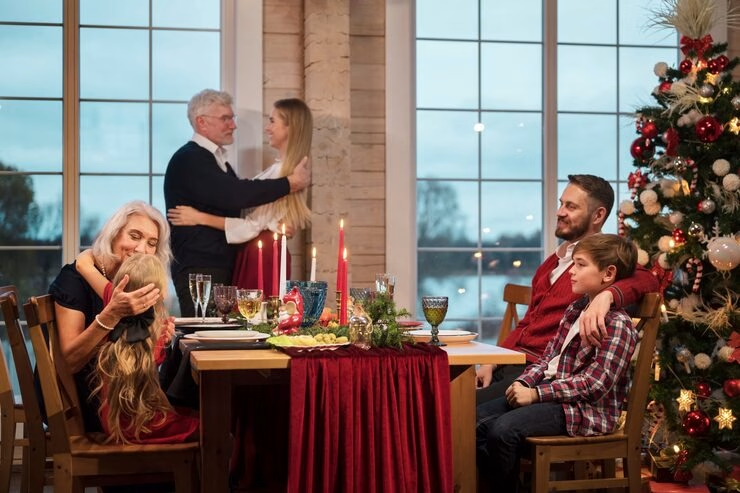
In Plano, the Carter house gleamed with curated perfection. Candles glowed. Wreaths hung with symmetry. The camera crew from the church was already setting up.
My mother floated through the house in a deep red dress. Whenever someone asked where I was, she tilted her head in that dramatic way.
“Oh, Maya. She’s just so busy with that garage. You know how mechanics are around the holidays.”
Chloe livestreamed snippets of the house, letting the camera linger on the empty chair meant for me. “Some people just don’t value nights like this, I guess.”
Back in Colorado, my cabin flickered with warm string lights and mismatched mugs of hot cocoa. Lena wore an ugly sweater with a reindeer. A delivery driver brought tamales. Two single moms brought their kids, who were building a lopsided gingerbread house.
This felt more like family than anything in Plano.
Until it happened.
At the Carter house, right as everyone finished dessert and the cameras were rolling, the doorbell rang.
My mother’s face lit up. She opened the door to find a courier holding large white envelopes stamped with a law firm logo.
She accepted them with a bright smile, expecting something flattering.
Instead, her face stiffened. Her eyes darted across the page. Confusion slid into dread.
“Thomas,” she whispered. “Read this.”
My father took the letter, scanning it with growing horror. A formal notice of default. Overdue rent. Lease termination.
My mother grabbed another envelope. Inside were documents—proof of beneficial ownership, contracts, LLC filings—showing that the Knox Avenue building was owned by one person:
Maya Carter.
They read the name aloud. Loud enough for the whole room to hear.
The silence was suffocating.
My father blinked at the page. “Maya? Maya?”
My mother dropped her wine glass. It shattered.
Grandma leaned forward. “Is that our Maya? Mechanic Maya?”
Chloe’s livestream cut off instantly.
Ryan whispered, “Oh, God.”
The perfect Carter Christmas had cracked open. Messy, raw, unfiltered.
Hundreds of miles away, my phone began vibrating. Call after call. “Mom,” then “Dad,” then “Chloe,” then “Ryan.”
Lena looked at me. “Showtime. Want to answer?”
I smiled, picked up the pie server. “Not yet. We haven’t cut the pie.”
And for the first time in years, I felt free.
The Call
By the time the dishes were washed and the kids had fallen asleep, the Colorado night had settled into deep quiet. I stepped onto the porch, letting the cold air steady my heartbeat.
My phone vibrated. Another incoming call. This time, I answered.
Her voice tore through instantly. “How dare you ambush us like this on Christmas? In front of the church? Do you have any idea what you’ve done?”
I leaned against the railing. “Where are you?”
The question threw her off. “Where are we? We’re at home, trying to salvage—”
“Did you enjoy my gift?” I asked gently.
Silence cracked like ice.
Then she roared, “Gift? That wasn’t a gift. That was betrayal. You humiliated us. You ruined—”
I cut her off. “Mom, let’s not pretend you just learned what betrayal feels like tonight.”
“You ungrateful child. We gave you everything—”
“Mom,” I said quietly. “You’re angry at the consequences, not the truth.”
“We were trying to help you! That skit was supposed to motivate you.”
“Funny?” My voice remained steady. “A PowerPoint calling me ‘discount oil-change queen’ is funny? Making me push a toy car in front of the church is funny? Cutting me out of the will on film is funny?”
She hesitated.
I continued, “Let’s talk about the will. And the skit. You wanted to humiliate me publicly as a moral lesson. But I’m the one who betrayed you?”
“You misunderstood—”
“No. I understood perfectly.”
I paused. “You know what’s funny, Mom? I bought that building eighteen months ago. The one your flagship store is in. I gave you below-market rent. I said nothing when you were late on payments. I stayed silent because I thought even if you didn’t respect my career, I could still help the family. Quietly.”
She sucked in a breath. “You’re lying.”
“I’m not. I gave you below-market rent while you planned to humiliate me.”
Her silence was louder than her shouting.
“This isn’t love,” I said. “And it wasn’t a joke.”
“You’re overreacting. And if you go through with this—raising the rent, canceling the lease—your father’s business will suffer.”
“Mom, you already ruined the family name. I just stopped covering for it. You have thirty days to vacate or renegotiate at actual market rate. I’m not punishing you. I’m done setting myself on fire to keep you warm.”
She screamed, “This conversation isn’t over!”
“For me,” I said softly, “it actually is. Merry Christmas, Mom.”
I hung up.
My hand trembled slightly, but not from fear. From release.
The snow kept falling, and I had never felt lighter.
One Year Later
A full year passed. Not quietly, but steadily—like a long exhale after decades of holding my breath.
My parents moved their flagship store to a smaller location. They didn’t talk to me much. The communication remained transactional—occasional emails about forwarded mail. Nothing cruel. Nothing warm. Just neutral.
Ryan broke away entirely. He opened his own clinic, no longer under my father’s shadow. He sent me a text: I’m doing this on my own. Just wanted you to know.
I wished him luck. It wasn’t forgiveness yet. But it was a start.
Chloe kept up her influencer life, but occasionally posted something introspective. “Family is complicated and growth is messy.”
It wasn’t an apology, but it was something.
My world bloomed. By late summer, I opened a second garage location. I moved into a little house with its own garage. I renovated it piece by piece.
I kept going to therapy, learning that worth didn’t come from being the daughter my parents wanted.
Christmas returned. This time, I drove back to the same Colorado cabin. But the gathering was bigger, louder, warmer.
Lena came. So did my regular customers who’d become friends. My apprentice Mina. A delivery driver. A nurse. A teacher. People who showed up because they wanted to.
When it was nearly over, I checked my phone and saw an email from Dad.
Business is stable. We signed a fair lease. Ryan says your shop is doing well. I heard about your free winter checks. That’s good work.
Good work.
Not a compliment entirely. But not a criticism either. A small crack in the armor.
I typed back: I’m glad you’re stable. I hope one day we can talk without turning each other into lessons.
Later that night, I stepped onto the same porch where I’d stood a year ago.
Inside were people laughing. People who chose to be here. Not because of blood, but because we’d become a family—a chosen one.
As I leaned against the railing, watching snow settle over the pines, I realized something profound.
Losing my family hadn’t ended my story. It had given me back the pen.
I inhaled, exhaled, and said—not to anyone in particular, but to myself, to the cold night, and to whoever needed to hear it:
“Last Christmas, I thought losing my family would be the end of everything. Turns out it was the beginning of my own story. Sometimes the kindest gift you can give yourself is to stop sitting at tables where you’re the punchline.”
Then, as the cabin door opened behind me and warm light spilled across the snow, I smiled.
“If you’ve ever been made into a joke by your own family, remember this: you were never born to be a prop in their performance. You deserve your own story.
“And where are you listening from? And what time is it right now? Tell me. Because maybe, just maybe, this Christmas, we’ve become part of each other’s chosen family.”