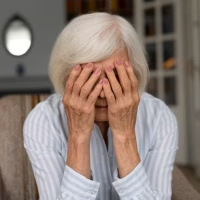
The Inheritance
The lawyer’s office smelled like old leather and expensive cologne—the kind of place where fortunes changed hands behind mahogany doors and crystal decanters. I sat in one of four chairs arranged in a semicircle facing the massive desk, my hands folded in my lap, watching dust particles drift through the afternoon sunlight streaming through floor-to-ceiling windows.
My grandmother had died three weeks ago. Victoria Ashford Chen, ninety-two years old, sharp as a blade until the very end. I had visited her every Sunday for the past five years, bringing her favorite pastries from the bakery on Elm Street and listening to her stories about building her import business from nothing in the 1960s when women weren’t supposed to own anything more significant than good china.
“Maya,” she would say, her accent still thick despite six decades in America, “never let anyone convince you that being kind means being weak. The strongest steel bends but doesn’t break.”
I thought of those words now as the office door opened and the rest of my family filed in. My mother, Patricia, entered first, her designer handbag matching her shoes in that calculated way that signaled old money and new anxiety. My father, Richard, followed close behind, already checking his phone. My older brother, Brandon, came last, his suit perfectly tailored, his expression one of polite boredom masking barely contained anticipation.
They took their seats without acknowledging me. We hadn’t spoken much since I’d moved out six years ago to take a teaching job across the state. The distance had been intentional on my part—a necessary buffer between who I was expected to be and who I actually wanted to become.
“Thank you all for coming,” said Mr. Harrison, the attorney who had managed my grandmother’s affairs for over thirty years. He was a slight man with wire-rimmed glasses and the careful manner of someone who had witnessed countless family implosions over inherited wealth. “I’ll get straight to the reading of Victoria Chen’s last will and testament.”
He opened a thick folder and began reading the formal language that opened all such documents. I only half-listened, my mind drifting to my grandmother’s small apartment filled with antiques and photographs, the scent of jasmine tea always hanging in the air.
“To my daughter Patricia,” Mr. Harrison read, “I leave my collection of jade jewelry and the sum of fifty thousand dollars.”
My mother’s face tightened. Fifty thousand was not nothing, but it was far less than the fortune everyone knew my grandmother had accumulated over her lifetime. The jewelry was valuable—I had seen appraisers examine it—but Patricia had clearly expected more.
“To my son-in-law Richard, I leave my gratitude for tolerating my daughter’s ambitions, and the hope that he finds his own purpose someday. No monetary bequest is made to you personally.”
My father’s face went red. The insult was deliberate and precise. He had spent his adult life managing my mother’s family money while contributing little of his own, a fact my grandmother had never let him forget.
“To my grandson Brandon, I leave the sum of twenty-five thousand dollars and my collection of first-edition business books.”
Brandon’s jaw clenched. Twenty-five thousand was less than half what my mother received, and Brandon had always been the golden child—Harvard educated, working in finance, everything the family had hoped for in an heir. The books felt like an afterthought, almost an insult.
Mr. Harrison paused and looked directly at me. Something in his expression made my heart start to race.
“To my granddaughter Maya Chen, who has been my truest companion in my final years and who alone among my family asked about my life rather than my assets, I leave the entirety of my remaining estate.”
The words seemed to echo in the suddenly silent room. My mother gasped. Brandon shot to his feet.
“That’s impossible,” he said, his voice sharp. “She’s lying. Maya manipulated her—”
“Mr. Chen,” Mr. Harrison interrupted, his tone brooking no argument, “I can assure you that your grandmother was of completely sound mind when she executed this will two years ago. She updated it six months ago to ensure her intentions were crystal clear.”
“How much?” my father demanded. “What’s the value of this ‘remaining estate’?”
Mr. Harrison consulted his documents. “Approximately three point seven million dollars in liquid assets, plus the commercial property in Chinatown that houses six businesses, valued at roughly two million more. Additionally, there are investment accounts, a small home in Taiwan, and various personal effects. The total estate value is approximately six million dollars.”
The room exploded.
My mother turned to me, her face twisted with rage and disbelief. “You scheming little bitch. You pretended to care about her just to steal our inheritance.”
“Patricia,” Mr. Harrison said sharply, “I must remind you that we’re in a professional setting and accusations of undue influence are serious legal matters that require evidence, not emotional outbursts.”
But my mother wasn’t finished. “She poisoned Mother against us! She filled her head with lies about our family! This is fraud!”
Brandon paced the room like a caged animal. “There’s no way Maya deserves six million dollars. She’s a public school teacher making forty thousand a year. She doesn’t even know how to manage that kind of wealth.”
I finally found my voice, though it came out quieter than I intended. “I visited her every week. I listened to her. I never asked her for anything.”
“That was the manipulation!” my father shouted. “Playing the devoted granddaughter while plotting to steal everything from your own family.”
The words hit like physical blows, but underneath the shock, something else stirred. Anger. Not the hot, explosive kind, but something colder and more sustainable. These people—my family—had barely spoken to my grandmother in the last five years except when they needed something. They had rolled their eyes at her stories, dismissed her business advice as outdated, and visited only on major holidays, staying for exactly as long as politeness required before making excuses to leave.
“I loved her,” I said, my voice stronger now. “I spent time with her because I wanted to, not because I expected anything in return.”
“Bullshit,” Brandon spat. “Nobody does anything without expecting something back. You knew exactly what you were doing.”
Mr. Harrison cleared his throat. “If I may, Victoria anticipated this reaction. She left letters for each of you explaining her decision. I have them here.”
He produced four sealed envelopes from his folder. One for my mother, one for my father, one for Brandon, and one for me. Nobody moved to take them at first, so Mr. Harrison stood and personally handed them out.
I stared at my name written in my grandmother’s distinctive handwriting—strong strokes with the occasional flourish. My hands shook slightly as I opened the envelope and pulled out two pages of her neat script.
My dearest Maya,
If you are reading this, I am gone, and I imagine your mother and brother are making quite a scene. They always did have a flair for drama, though never for self-reflection.
Despite everything, I almost smiled.
I want you to understand why I made this decision. It was not impulsive, and it was not the result of any manipulation on your part—though I’m certain they will accuse you of exactly that. I made this choice because you were the only one who ever saw me as a person rather than a source of money.
When your brother visited, he would spend exactly fifteen minutes asking about my health before steering every conversation toward his career, his achievements, his need for investment capital. When your mother came, she brought expensive gifts I neither wanted nor needed, then spent the entire visit complaining about the burden of maintaining her lifestyle. Your father never came at all unless dragged, and he spent those visits checking his phone as if my apartment were a waiting room he couldn’t wait to escape.
But you, my darling girl, you asked about my childhood in Taipei. You wanted to know about the boat journey to America, about starting my business with three hundred dollars and a suitcase full of silk scarves. You listened when I talked about your grandfather, about the discrimination I faced, about the small victories that meant everything to someone building a life from nothing.
You never asked for money. Not once. Even when I knew you were struggling to pay your student loans, even when your car broke down and you started taking the bus to see me, even when your apartment had that terrible leak and you couldn’t afford to move. You never asked. That meant more to me than you will ever know.
I am leaving you my estate because you are the only one who honored my life while I was living it, not just my death now that I’m gone. My wealth was built through hard work, through sacrifice, through refusing to accept limitations others tried to impose. I want it to go to someone who understands that—someone who has lived by those same principles.
Your mother will tell you that you don’t deserve this money. Your brother will claim you manipulated me. They will threaten legal action and try to make you feel guilty for accepting what I freely chose to give you. Don’t listen to them. This is my decision, my gift, and my final act of love for the granddaughter who gave me the greatest gift of all—your genuine presence in my final years.
Use this money wisely. Build something meaningful. Help others. Don’t let it change who you are. And Maya? Don’t give them a single penny out of guilt. They had every opportunity to build a relationship with me and chose not to. The consequences of that choice are not your responsibility.
With all my love, Grandma
P.S. The commercial property in Chinatown is special. The tenants there are good people—immigrants like I once was, building their dreams. Be fair with them. That building is not just an investment; it’s a community. Honor that.
I read the letter twice, tears streaming down my face. Around me, my family was reading their own letters, and the reactions were instructive. My mother crumpled hers and threw it on the floor. Brandon read his once then stuffed it in his pocket, his face dark with barely suppressed rage. My father read my mother’s over her shoulder, his expression growing more thunderous with each line.
“This is ridiculous,” Patricia finally said, her voice shaking. “Mother was clearly suffering from dementia. This will should be contested.”
“Your mother underwent a full cognitive evaluation at my request when she updated her will,” Mr. Harrison said calmly. “The neurologist’s report is part of the estate documents. Victoria Chen was found to be of sound mind and completely capable of making her own decisions. Any challenge based on mental incapacity will fail.”
Brandon turned to me, his eyes cold. “You realize this makes you a target, right? Three million in liquid assets? Six million total? You’re a schoolteacher. You have no idea how to manage that kind of money. You’ll blow through it in five years and end up with nothing.”
“Or,” I said quietly, “I’ll do exactly what Grandma did and build something meaningful with it.”
“You?” My mother’s laugh was brittle and cruel. “You can barely manage your own student loans. You live in a one-bedroom apartment with furniture from IKEA. You drive a car that’s held together with duct tape and prayer. And now you think you’re going to successfully manage a six-million-dollar estate?”
“I think I’m going to try,” I said. “With help from professionals, the same way Grandma did.”
My father spoke for the first time since the will had been read. “You’re going to regret this, Maya. Family is everything. By accepting this money, by allowing this ridiculous will to stand, you’re destroying this family.”
“No,” I replied, surprised by how steady my voice sounded. “Grandma destroyed nothing. She simply stopped pretending that performative family obligations were the same as genuine relationships. If you want to be angry at someone, be angry at yourselves for never bothering to know her.”
The meeting ended badly. My mother threatened to contest the will. Brandon swore he would never speak to me again. My father predicted I would come crawling back within a year, broke and begging for their help. Mr. Harrison maintained his professional composure throughout, making notes and promising to send me copies of all relevant documents within the week.
As my family stormed out, still shouting accusations and threats, Mr. Harrison gestured for me to stay behind.
“That went about as well as Victoria predicted it would,” he said with a tired smile once we were alone. “She warned me they would react badly.”
“She knew,” I said, more statement than question.
“She knew,” he confirmed. “Which is why she took extensive precautions. The will is ironclad. The cognitive evaluation eliminates any claim of mental incapacity. And she documented everything—every phone call they didn’t make, every visit they skipped, every time they asked for money. She kept a journal for the last five years specifically for this purpose.”
I looked up sharply. “A journal?”
“Detailed entries about her interactions with each family member. Dates, times, topics of conversation. It’s in the safe deposit box along with other important documents. She wanted you to have it, partly as a record, partly as protection if they try to claim you manipulated her.”
The thoroughness of it took my breath away. My grandmother had known exactly how this would unfold and had planned accordingly.
“There’s something else you should know,” Mr. Harrison continued. “The commercial property in Chinatown—the building she specifically mentioned in your letter? She purchased that thirty years ago for sixty thousand dollars. It’s now worth two million. She could have sold it a dozen times for substantial profit, but she never did.”
“Why not?”
“Because the tenants reminded her of herself when she first came to this country. Small business owners, most of them immigrants, all of them struggling to build something from nothing. She kept their rents reasonable even when the market would have allowed her to charge three times as much. Several of those businesses have been there for over twenty years because of her.”
I thought of my grandmother’s postscript about honoring the building as a community, not just an investment. Even in death, she was teaching me.
“What happens now?” I asked.
“Now we begin the process of transferring the estate to you. It will take several months—these things always do. In the meantime, I’ll provide you with temporary access to accounts so you can manage immediate expenses. And Maya?” He looked at me seriously. “Your family is going to make this difficult. They’ll likely file a challenge to the will. It won’t succeed, but it will be unpleasant and potentially expensive for them. Be prepared for that.”
I nodded, still processing everything. Six million dollars. An apartment building. A business legacy built by a woman who had started with nothing and refused to accept limitations.
I left Mr. Harrison’s office and walked to my car—the decade-old Honda that my brother had mocked, held together with duct tape and prayer. I sat behind the wheel for a long time, my grandmother’s letter resting on the passenger seat, and tried to understand how my life had just fundamentally changed.
My phone buzzed. A text from Brandon: You’re dead to me. Enjoy spending our money.
Then one from my mother: I will never forgive you for this. You’ve destroyed our family.
I turned my phone face down and started the engine. They were wrong about so many things, but especially about this: I hadn’t destroyed anything. I had simply inherited the consequences of their choices—and my grandmother’s love.
The apartment building in Chinatown was located on a corner lot, three stories of red brick with businesses on the ground floor and residential units above. I drove there the next morning, wanting to see it with my own eyes rather than just as a line item in an estate document.
The ground floor housed six businesses: a traditional Chinese restaurant that had been there for twenty-five years, a small grocery store specializing in Asian ingredients, a tailor shop, a bookstore selling both English and Chinese titles, a tea shop, and a family-owned bakery that opened at five a.m. every day.
I parked across the street and just watched for a while. Saturday morning foot traffic was steady. The bakery had a line out the door. The grocery store’s produce displays spilled onto the sidewalk in colorful abundance. Through the restaurant window, I could see families gathered around tables, multiple generations sharing dim sum and conversation.
This was what my grandmother had meant. This wasn’t just real estate—it was lives, dreams, communities. The weight of that responsibility settled over me like a physical thing.
My phone rang. Mr. Harrison.
“Maya, I wanted to give you a heads up. Your mother filed a petition to contest the will this morning. As I expected, it claims undue influence and questions your grandmother’s mental capacity despite the evaluation. It’s frivolous and will be dismissed, but it means there will be a hearing.”
“When?”
“Three weeks. I’ll need you to come to my office beforehand to prepare. And Maya? They’re going to try to paint you as a manipulative opportunist who preyed on an elderly woman. The journal I mentioned will be crucial in refuting that narrative.”
After we hung up, I crossed the street and entered the bakery. The smell of fresh bread and sweet pastries was overwhelming. Behind the counter, a woman in her sixties smiled warmly.
“Good morning! What can I get for you?”
I ordered one of everything, suddenly starving. As she boxed up the pastries, I said, “This building—do you know who owns it?”
Her smile dimmed slightly. “Victoria Chen owned it. She passed away recently. We’re all worried about what happens next.”
“Worried how?”
“New owners usually mean higher rent. We’ve been lucky for so long, but…” She shrugged. “Nothing lasts forever.”
I paid for the pastries and added a generous tip. “I don’t think you need to worry. The new owner seems to care about keeping this community intact.”
“You know them?”
“I’m getting to know them,” I said.
That evening, I read through my grandmother’s journal in my small apartment. Five years of entries, just as Mr. Harrison had described. She had documented everything with the precision of someone building a legal case.
March 3rd – Brandon called. Asked for $50,000 investment in his friend’s tech startup. Did not ask about my health. Call lasted 12 minutes. Declined investment.
June 15th – Patricia visited. Brought expensive orchids I’m allergic to (I’ve told her this before). Spent visit complaining about country club drama. Left after 45 minutes. Did not ask about my week.
November 8th – Maya came for our weekly visit. Brought pork buns from my favorite bakery. Asked to see photos from my childhood. We talked for three hours. She helped me organize old documents and didn’t complain once about the dust.
Page after page of this. A record not just of who visited, but of what those visits revealed about their priorities and their relationships with her.
There were also entries about money—every time she had lent money to my mother or Brandon, every repayment deadline that passed unmet, every new request that came before the old debt was addressed. The pattern was damning.
The most heartbreaking entries were the ones about holidays.
Christmas – Family dinner at Patricia’s house. I was seated at the children’s table despite being the eldest. Maya noticed and switched seats with me without making a scene. Nobody else seemed to register the insult.
My grandmother had seen everything. Had felt everything. And had said nothing at the time, storing it all up for this final accounting.
I called Mr. Harrison. “I’ve read the journal.”
“And?”
“And I understand now why she did this. Not just the money—the whole thing. She’s leaving them a mirror, isn’t she? Forcing them to see what they chose not to see while she was alive.”
“Your grandmother was many things, but subtle was not one of them. Yes, this will is partly about providing for you. But it’s also her final statement about character, about what matters, about the price of taking people for granted.”
“They’re going to hate me forever.”
“Probably,” he agreed. “Is that worse than letting them get away with it?”
I thought about that for a long time after we hung up. Was family harmony worth more than truth? Was peace more valuable than justice?
My grandmother had decided it wasn’t. And in leaving me everything, she had forced me to make the same choice.
The hearing took place in a sterile courtroom that smelled of floor polish and old wood. My mother, father, and Brandon sat on one side with their attorney—a sharp-eyed woman named Ms. Brennan who specialized in estate litigation. I sat on the other side with Mr. Harrison and a growing sense of surreal detachment.
The judge, a woman in her sixties named Judge Martinez, reviewed the initial filings with an expression that suggested she had presided over countless family disputes and found them all equally tedious.
“Ms. Brennan,” she said, “you’re alleging undue influence and questioning the testator’s mental capacity despite a clinical evaluation confirming soundness of mind. That’s a high bar to clear. What evidence are you presenting?”
Ms. Brennan stood. “Your Honor, we intend to demonstrate a pattern of isolation and manipulation by the beneficiary, Maya Chen, who systematically worked to alienate Victoria Chen from her family while positioning herself as the sole caregiver and confidante.”
“Evidence?” Judge Martinez repeated.
“Testimony from family members about the sudden change in Victoria Chen’s behavior toward them. Documentation of Maya Chen’s increased contact with the deceased in the final years of her life. The dramatic disparity in the distribution of assets that suggests improper influence.”
Mr. Harrison stood. “Your Honor, we have Victoria Chen’s personal journal documenting five years of family interactions, including dozens of entries about visits from all family members—or more accurately, the lack thereof. We have phone records. We have testimony from the testator’s physician, her accountant, and her neighbors. The evidence will show that Maya Chen did not isolate her grandmother; rather, the family isolated themselves through their own choices and actions.”
Judge Martinez looked between the two attorneys. “This appears to be a case of a family unhappy with an estate distribution, not a case of actual undue influence. However, I’ll hear testimony. Let’s keep this efficient.”
Brandon was called first. He described his grandmother as having been close to the family until I began “monopolizing her time” in her final years. He claimed I had prevented them from visiting, that I had told his grandmother lies about how busy they were.
“And when was the last time you visited your grandmother before her death?” Mr. Harrison asked on cross-examination.
Brandon hesitated. “I’m not sure exactly. Time gets away from you.”
“Let me help you. According to phone records and visitor logs from her apartment building, your last in-person visit was fourteen months before her death. Does that sound correct?”
“I called her,” Brandon protested.
“Yes, you did. Three times in the last year of her life. Two of those calls lasted less than five minutes. The third lasted eight minutes and included a request for a fifty-thousand-dollar loan. Does that sound accurate?”
Brandon’s face flushed. “We were busy. We had lives.”
“And Maya Chen, during that same period, visited how many times?”
“I don’t know. Too many.”
“Fifty-two times. Once a week, every week, for the entire year. Did she prevent you from doing the same?”
“I… we couldn’t visit that often. We had responsibilities.”
My mother’s testimony was even worse. She broke down crying multiple times, describing herself as a devoted daughter who had been cruelly cut out of her mother’s life by a manipulative granddaughter.
Mr. Harrison let her finish, then produced the journal.
“Mrs. Chen-Richards, I’m going to read from your mother’s personal journal. These are her own words, written in her own hand.” He adjusted his glasses. “March 20th: Patricia visited today. She spent the entire time on her phone planning a vacation to Europe. When I asked if she would like to see the photos from my trip to Taiwan last year, she said she didn’t have time. The visit lasted thirty-seven minutes.”
My mother’s lawyer objected. “Hearsay, Your Honor.”
“It’s a contemporaneous personal record,” Mr. Harrison countered. “And we have the original journal, authenticated by a handwriting expert.”
Judge Martinez nodded. “I’ll allow it. Continue.”
Mr. Harrison read entry after entry. Each one a small wound, a moment of thoughtlessness, a choice to prioritize everything else over a relationship with my grandmother. My mother stopped crying and started looking furious instead.
When it was my turn to testify, I was surprisingly calm. I described my weekly visits, what we talked about, how much I had learned from her. I explained that I had never asked her for money, that I had been shocked by the will, that I understood my family’s anger even as I disagreed with their claims.
“Did you ever prevent family members from seeing your grandmother?” Ms. Brennan asked on cross-examination.
“No.”
“Did you ever speak negatively about your family to her?”
“No. She formed her own opinions based on her own experiences.”
“You expect this court to believe you visited a wealthy elderly woman every week for five years with no expectation of financial reward?”
“I visited my grandmother because I loved her and enjoyed her company. If you find that impossible to believe, that says more about you than it does about me.”
The courtroom was silent. Even Ms. Brennan seemed momentarily at a loss.
Judge Martinez called a recess. When we returned two hours later, her decision was ready.
“I’ve reviewed all the evidence, all the testimony, and Victoria Chen’s journal extensively during the break. What I see is a woman who was isolated by her family’s choices, not by her granddaughter’s manipulation. I see a family that took her for granted and is now experiencing the consequences of that choice.”
She looked at my mother and Brandon. “Your mother left you a detailed record of why she made the decision she did. You may not like it, but that doesn’t make it invalid. The petition to contest the will is denied. This estate will be distributed according to Victoria Chen’s wishes.”
The gavel came down with finality.
My mother screamed that I had ruined everything. Brandon grabbed my father’s arm to prevent him from approaching me. Ms. Brennan quietly gathered her papers, clearly unsurprised by the outcome.
Mr. Harrison placed a gentle hand on my shoulder. “It’s over. The estate is yours.”
But it wasn’t over, not really. That night, sitting alone in my apartment with six million dollars’ worth of responsibilities weighing on my shoulders, I understood that my grandmother had given me more than money.
She had given me a choice: to accept the truth of what family can become when love is conditional and presence is optional, or to pretend that everything was fine for the sake of peace.
She had chosen truth. And in doing so, she had freed me to do the same.
Six months later, I stood in the bakery in Chinatown, watching the morning rush with a cup of tea in my hands. I had kept all six businesses at their current rents. I had renovated the residential units upstairs. I had started a scholarship program for immigrant students trying to navigate college applications.
I had invested most of the liquid assets with the help of financial advisors my grandmother had recommended years ago. I still taught school because I loved it, but now without the constant stress of student loan debt and car repairs.
My family didn’t speak to me. My mother sent one email after the court decision: I hope you’re happy. You’ve destroyed the one thing that mattered most—our family.
I didn’t respond, but I thought about my grandmother’s words. The strongest steel bends but doesn’t break.
I hadn’t broken. I had bent toward the truth, toward authenticity, toward relationships built on genuine care rather than obligation and expectation.
My grandmother had known that would be hard. She had known I would lose my family in the process of gaining myself. And she had decided I was worth the price.
Standing in that bakery, surrounded by the community she had helped build and protect, I finally understood the full weight of her gift. It wasn’t just money. It was permission—to value myself, to honor truth, to build a life on my own terms rather than theirs.
The inheritance wasn’t six million dollars. It was freedom. And that was worth everything.