The Helicopter Wedding
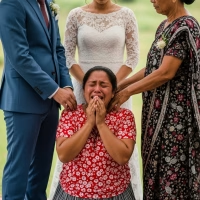
The floral arrangements, white hydrangeas and blush roses meticulously curated months in advance, lay scattered across the manicured lawn like fallen soldiers. They were no longer symbols of a joyous union; they were casualties of a war waged by a woman who despised the very air I breathed.
“Get out!”
The voice was brittle, sharp as a glass shard. It belonged to Patricia Van Derlyn, my future mother-in-law, a woman who wore her cruelty as comfortably as she wore her Chanel suits.
I stood frozen on the limestone steps of the Van Derlyn estate, the ancestral home where I was supposed to be married in less than two hours. My custom ivory gown, hand-beaded and heavy, suddenly felt like a lead weight dragging me into the earth.
“This is my son’s house,” Patricia spat, her perfectly coiffed blonde hair immobile in the morning breeze. She tilted her head, her eyes scanning me with the clinical detachment of a butcher examining a cut of meat. “And I will not allow a piece of trash like you to marry into this family.”
Trash.
The word didn’t just hang in the air; it stung like acid splashed on open skin. I had heard the whispers at the country club, the hushed giggles when I walked into a room, but hearing it spoken so boldly, so contemptuously, shattered something vital inside me.
I looked for Richard. He had promised to handle her. He had sworn, holding my face in his hands just last night, that he would protect me.
But Richard stood by the oak doors, pale and silent, studying the tips of his Italian leather shoes. He was a statue carved from cowardice.
“Patricia, please,” I managed, my voice trembling despite my best efforts to steel myself. “The guests are arriving. The caterers are setting up.”
She laughed—a cold, mirthless sound that sent a shiver down my spine. “Oh, darling, you really are naive. There won’t be a wedding. I fired the caterers an hour ago. I sent the band away. Your little charade ends here.”
My heart plummeted into my stomach. The months of planning. The late nights. The dreams of a family I never had. All of it, erased by a single, spiteful checkbook.
I remembered the lunch we’d had just weeks ago. An interrogation masquerading as a meal. She had asked about my family, her nose wrinkling when I mentioned my mother had passed and my father was estranged.
“Is he respectable?” she had asked. “Does he have money?”
I had lied. I told her he was a Senator—which was true—but I implied we were close. It was a desperate attempt to buy dignity in a marketplace where I had no currency.
“Richard loves me,” I said now, my voice gaining a desperate edge. “That’s all that matters.”
“Love?” Patricia scoffed, checking her watch as if I were a boring appointment she needed to end. “Richard is infatuated. He is weak. But he will come to his senses. And when he does, he will thank me for scraping you off his shoe.”
I looked at Richard again. “Say something,” I pleaded.
He looked up, his eyes wet, pleading for me to understand him. “Amelia… maybe… maybe it’s best if we just postpone. Until things calm down.”
The betrayal hit harder than the insult.
The Arrival
I was about to turn, to run, to flee this nightmare with whatever shred of dignity I had left, when a low thrumming sound began to vibrate in my chest.
It grew louder. A rhythmic chopping noise that deepened into a roar.
“What in God’s name…” Patricia muttered, shielding her eyes against the sun.
A maid, Emily, rushed out onto the lawn, pointing upward. “Mrs. Van Derlyn! A helicopter!”
A sleek, obsidian-black helicopter banked sharply over the estate, the downdraft whipping the scattered flowers into a frenzy. Dust swirled. The noise was deafening, drowning out Patricia’s outraged shouts.
The machine descended, landing right in the center of the great lawn, crushing the pristine grass Patricia prized above all else.
The rotors slowed. The side door slid open.
A figure emerged.
He was tall, imposing, wearing a dark suit that cost more than my entire education. He stepped onto the grass with the kind of authority that cannot be bought, only wielded. He scanned the scene—the crying bride, the cowering groom, the furious matriarch—with piercing blue eyes that mirrored my own.
It was him.
My father. Senator David Thornton.
I hadn’t seen him in ten years. Not since he chose his ambition over his wife and child. But there was no mistaking the jawline, the aura of power. Behind him, a phalanx of grim-faced men in suits carrying briefcases poured out of the helicopter like a special ops team.
Patricia’s mouth fell open.
My father strode past her, ignoring her completely, and stopped in front of me. He looked at my tear-streaked face, then at the ruined flowers. His expression softened for a fraction of a second before hardening into granite.
“Amelia,” he said, his voice deep and resonant, carrying easily over the dying whine of the engine. “I heard there was a disturbance.”
He turned to Patricia.
“I am Senator Thornton,” he announced. “And I am here to ensure my daughter gets the wedding she deserves. Anyone who objects can speak to my legal team.”
The silence that followed was heavy, pressurized. Patricia looked as though she had swallowed a lemon whole.
“Senator… Thornton?” she stammered, her socialite armor cracking. “I… I had no idea.”
“Clearly,” my father said. He didn’t raise his voice. He didn’t have to. “You called my daughter trash. I believe an apology is in order. Immediately.”
Patricia looked at the legal team, then at the helicopter, and finally at the Senator. Her survival instinct kicked in.
“I… I was emotional,” she said, her voice tight. “Amelia, I apologize. It seems there was a… misunderstanding.”
It was a lie, but it was a surrender.
Richard finally stepped forward, looking like a man waking from a coma. “You’re… you’re really him?”
My father glanced at Richard with a look of mild distaste. “And you must be the man who let his mother eviscerate his bride. Impressive.”
Richard flinched.
“We have caterers on standby,” my father told me, taking my hand. His grip was firm, calloused, familiar. “The wedding proceeds. Go fix your makeup, sweetheart.”
I let myself be led inside, my head spinning. I was grateful, yes. But I was also furious. Where had he been for a decade? Why show up now, in a helicopter, like a deus ex machina in a bad movie?
The Wedding
An hour later, the ceremony took place. It was a blur. I said “I do” to a man I was no longer sure I respected, in front of a father I didn’t know, under the gaze of a mother-in-law who hated me.
But the facade held. Until the reception.
My father was holding court near the champagne tower, charming the very people who had shunned me an hour earlier. I walked over to him, needing answers.
“Why?” I asked quietly. “Why now?”
He looked at me, swirling his drink. The power in his eyes seemed to dim slightly. “I have regrets, Amelia. A career is a cold thing to come home to.”
“You left us,” I whispered.
“I know.” He sighed, and for a moment, he looked old. Tired. “I wanted to make it right. I wanted to give you this.”
Suddenly, he swayed.
It was subtle at first—a stumble, a hand reaching out to the table for support. Then, his glass shattered on the floor.
“Dad?”
His face went ashen. He clutched his chest, his eyes going wide and unfocused.
“Amelia…” he gasped.
Then he collapsed.
The thud of his body hitting the marble floor silenced the room instantly.
“Help!” I screamed, dropping to my knees. “Call 911!”
Chaos erupted. Richard froze again. Patricia stood back, watching with an unreadable expression.
I loosened his tie, shouting for him to stay with me. For a moment, amidst the panic, I saw Patricia pull her phone out. She wasn’t calling for help. She was texting someone, a small, cruel smile playing on her lips.
The ambulance arrived within minutes. They loaded him onto a stretcher, his face gray, his breathing shallow. I climbed in beside him, still wearing my wedding dress.
“I’m coming with you,” I said to the paramedic.
He nodded, not questioning it.
As the doors closed, I caught a glimpse of Richard standing on the steps, Patricia’s hand on his shoulder, pulling him back inside.
The Hospital
The hospital waiting room smelled of antiseptic and stale coffee. The wedding dress felt ridiculous now, a costume from a play that had ended in tragedy.
Richard arrived twenty minutes later, his tie loosened, his hair disheveled. He sat beside me, reaching for my hand.
“He’s going to be okay, Amy. He’s a fighter.”
I pulled my hand away. “Don’t,” I said. “Don’t pretend everything is fine. You stood there, Richard. You stood there and let her call me trash.”
“I was in shock!” he protested weakly. “She’s my mother.”
“And I was supposed to be your wife.”
Before he could answer, the double doors swung open. Patricia walked in. She wasn’t alone. She was carrying a thick, manila envelope.
“You shouldn’t be here,” Richard said, standing up.
“Sit down, Richard,” she commanded. She looked at me, her eyes gleaming with a terrifying triumph. “I told you, Amelia. I told you that you didn’t belong.”
“My father is fighting for his life,” I hissed. “Have you no decency?”
“Decency?” She laughed. “Your father is a fraud. A criminal.”
She tossed the envelope onto the plastic chair between us.
“While you were playing nursemaid, I made some calls. My friends in D.C. have been sitting on this for months, waiting for the right time. Seems your father isn’t just a negligent parent. He’s a thief.”
I stared at the envelope. “What is this?”
“The truth,” Patricia said. “Land deals. Bribes. Embezzlement. He built his career on the backs of the poor. He destroyed families to build his empire. And the Feds are closing in. That’s why he came today, darling. Not for you. He needed a photo op. A humanizing moment to soften the jury.”
My stomach turned. “You’re lying.”
“Read it,” she challenged. “It’s all there. And tomorrow morning? I’m leaking it to the press. The Van Derlyn name will not be associated with a felon.”
I grabbed the envelope. My hands shook as I pulled out the documents.
Bank transfers. Emails. Photos of meetings with developers who looked like they belonged on wanted posters. Contracts signed in my father’s distinctive scrawl.
I read a name on a foreclosure document. The Henderson Family.
I remembered that name. My mother had mentioned them years ago—friends who lost their farm. My father had represented the bank that took it.
He hadn’t just left us. He had used us. Used his position. Used his power to crush people who trusted him.
Patricia leaned in close, her perfume cloying. “You have a choice, Amelia. Annul the marriage tonight, walk away, and disappear. Or stay, and I drag you down with him. I will make sure the world knows you were living off stolen money. That you knew. That you benefited.”
She straightened up, smoothing her skirt.
“You have until midnight to decide. After that, I go to the press with everything. Including your name.”
She turned on her heel and walked out, her heels clicking on the linoleum like a countdown clock.
I looked at Richard. He was reading the documents over my shoulder, his face pale.
“Amelia,” he whispered. “Is this true?”
I looked at the ICU doors. The man lying in that bed was the only one who could answer. And he might never wake up.
The Truth
I walked into the ICU. The machines beeped in a rhythmic, indifferent cadence. My father looked small beneath the sheets, the tubes and wires stripping away his aura of invincibility.
I sat down. “Is it true?” I asked the unconscious man.
His eyelids fluttered. For a moment, I thought I’d imagined it. Then his eyes opened, glassy and unfocused.
“Amelia,” he rasped, his voice barely audible over the machines.
“Dad,” I said, holding up the papers Patricia had given me. “Did you do this?”
He looked at the documents. He didn’t deny it. He didn’t fight. A tear leaked from the corner of his eye.
“I… I wanted power,” he rasped. “I thought… if I had enough power… I could fix everything later. Fix what I broke with you and your mother.”
“You hurt people,” I said, my voice breaking. “You destroyed families.”
“I know.” He squeezed my hand, his grip weak. “I am sorry, Amelia. The story… the story is going to break. They will destroy my legacy.”
“Patricia is going to leak it tomorrow,” I told him.
He closed his eyes. “Then let her. I deserve it.”
“No,” I said. A sudden, fierce clarity washed over me. “She doesn’t get to tell your story. She doesn’t get to use your sins to destroy me.”
My father’s eyes opened slightly. “What will you do?”
“I don’t know yet,” I admitted. “But I won’t let her win.”
He smiled faintly. “That’s my girl.”
His heart monitor began to beep erratically. Nurses rushed in. I was ushered out, back into the waiting room where Richard sat with his head in his hands.
My father died just before dawn.
The doctor came out, her face professionally sympathetic. “I’m sorry. We did everything we could. His heart just… gave out.”
I nodded, numb. Richard tried to hug me, but I stepped back.
“I need to be alone,” I said.
The Disappearance
I didn’t have time to grieve. I had a war to fight.
I walked out of the hospital and found Richard sleeping in the chair.
“I’m leaving,” I said.
He woke up, groggy. “What? The annulment?”
“No annulment,” I said. “But I’m not coming back to that house. And I’m not letting your mother win.”
I took the documents. I took my father’s journals, which his lawyer delivered to me that morning—a final request he had made before the wedding, sealed and addressed to me.
I disappeared for six months.
I went to a cabin in Maine that belonged to a college friend. I turned off my phone. I didn’t speak to Richard. I didn’t speak to the press.
I wrote.
I took the ugly, jagged shards of the truth—the corruption, the ambition, the abandonment—and I laid them out next to the human parts. The regret. The fear. The love he was too broken to show.
I interviewed the families he’d hurt. I tracked down the Hendersons, living in a cramped apartment in Ohio. They told me about the farm, about their children, about the promises my father had made and broken.
I didn’t make excuses for him. I didn’t sugarcoat the damage. But I told the story from all sides—the victims, the perpetrator, the daughter caught in between.
I titled the book A Necessary Lie: The Senator and His Daughter.
It wasn’t a defense. It was a confession. I exposed him completely, but I did it with my voice, not Patricia’s. I robbed her of her scoop. I robbed her of her power to blackmail me.
The manuscript was raw, brutal, unflinching. My editor warned me it would be controversial.
“Good,” I said. “Let it be.”
The day the book was published, I sent the first copy to the Van Derlyn estate with a note:
You wanted to tell his story. I beat you to it. — Amelia
The Aftermath
The book tour was a whirlwind. People didn’t hate me for being the daughter of a corrupt man; they respected me for having the courage to burn the pedestal he stood on.
I appeared on morning shows, sat across from journalists who tried to catch me in contradictions. I didn’t flinch. I didn’t cry. I answered every question with the same unflinching honesty I’d put on every page.
“Did you know about his crimes?” they asked.
“No. But ignorance doesn’t erase the damage.”
“Do you think he loved you?”
“I think he loved the idea of me. The photo op daughter who could humanize him. But he didn’t know how to love a real person.”
“What about the families he hurt?”
“Fifty percent of my royalties go to them. It won’t undo what he did, but it’s a start.”
The book climbed the bestseller list. Patricia’s attempted leak fizzled—everyone had already read my version, complete with context and accountability. Her vindictive little document dump looked petty in comparison.
I was standing in a bookstore in Boston, signing copies, when I saw him.
Richard.
He stood at the back of the line. He looked different. He wasn’t wearing a suit. He was wearing jeans and a sweater. His hair was longer, less carefully styled. He looked… solid. Real.
When he reached the table, he didn’t ask for a signature. He placed a small box on the table.
“I left the estate,” he said quietly. “I moved out the day you left. I told my mother I was done.”
I looked at him, wary. “Why?”
“Because I read the manuscript,” he said. “Your editor sent me an advance copy. I don’t know if you knew that. But I read it. Every word. And I realized… I didn’t want to be the man who stood by and watched. I wanted to be the man who helped you write the ending.”
He opened the box. It wasn’t a ring. It was a key.
“I bought a small place near the coast in Maine,” he said. “It has a garden. No hydrangeas. Just wildflowers. The kind that grow without permission.”
I stared at the key.
“I’m not asking you to come back to me,” Richard continued. “I’m asking for a chance to prove I’m not the man I was on those steps. That I can be the man I should have been.”
I picked up the key. It was warm from his pocket.
“This doesn’t fix it,” I said.
“I know.”
“Your mother—”
“Is alone,” he said. “Her friends stopped calling when the book came out. Turns out people don’t like being associated with someone who tried to blackmail a grieving daughter. She’s bitter. Isolated. And I’m okay with that.”
I looked at him for a long moment. “I need time.”
“I’ll wait,” he said.
One Year Later
It took time. Trust is a slow-growing thing. But Richard showed up. He went to therapy. He confronted Patricia in ways I never asked him to but needed him to.
He sent me letters—actual handwritten letters—apologizing not in grand gestures but in small, specific admissions.
I’m sorry I didn’t defend you on the steps.
I’m sorry I let her fire the caterers.
I’m sorry I chose comfort over courage.
Six months after Boston, I drove to Maine.
The house was exactly as he’d described. Small. Weathered. Surrounded by wildflowers that grew in glorious, chaotic abundance.
Richard was on the porch when I pulled up. He stood, his hands in his pockets, waiting.
“You came,” he said.
“I did.”
We sat on the porch for hours, talking. Not about the wedding or my father or Patricia. About smaller things. Books. The ocean. What it feels like to start over.
“I’m not the same person,” I said.
“Good,” Richard replied. “Neither am I.”
A year after that, we were sitting on that same porch. The air smelled of salt and freedom. The wildflowers had spread, overtaking the small lawn, and we’d let them.
My father’s legacy was complicated. The money from the book sales went to a fund for the families he had defrauded. It didn’t fix everything, but it was a start. The Hendersons used their portion to buy a small farm in Vermont. They sent me pictures of their grandchildren running through apple orchards.
I watched the ocean, the waves crashing against the rocks, constant and cleansing.
“You okay?” Richard asked, handing me a mug of tea.
I leaned back against him. “Yeah.”
I thought about the girl in the ivory dress, standing on the lawn, waiting for someone to save her. I thought about the helicopter. I thought about the documents. I thought about the six months alone in a cabin, writing through pain until I found something solid underneath.
My father had saved me that day, but not in the way he intended. He didn’t save me with his power. He saved me by forcing me to find my own.
Patricia’s attempts to destroy me had backfired spectacularly. The book’s success, combined with her public vindictiveness, had made her a pariah in her own social circle. She’d tried to sue me for defamation, but the case was dismissed when I produced the very documents she’d given me.
Last I heard, she’d moved to Florida, far from the estate and the memories and the people who’d once feared her.
Richard reached for my hand. “What are you thinking about?”
“Home,” I said.
“Want to go back inside?”
I shook my head. “I mean this. Right here. I’m thinking about how I finally found home.”
He squeezed my hand. We sat in comfortable silence, watching the sun set over the water.
The helicopter wedding felt like a lifetime ago. The girl who’d stood on those steps, begging for someone to see her, to validate her, to save her—she was gone.
In her place was a woman who’d learned that salvation doesn’t come from helicopters or senators or validation from people who never deserved the power you gave them.
It comes from the choice to tell your own story. To refuse to be erased. To build something new from the ashes of what burned down.
“I’m finally home,” I whispered.
And for the first time in my life, I knew it was the truth.