The Inheritance
I signed the leave form with hands that still smelled like lemon cleaner and hospital tape. A month off duty for one mission only: stay with Grandma until the road turned where roads finally turn.
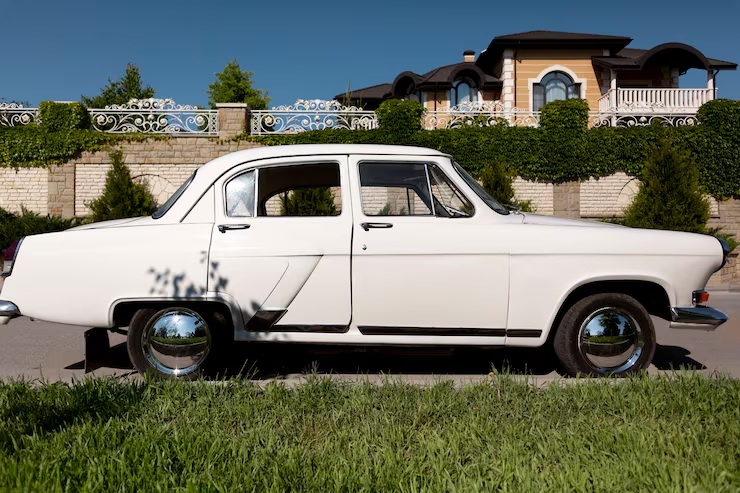
She didn’t have much left—an old farmhouse that groaned in the wind, a recipe box that remembered better than we did, and a 1968 Pontiac under a torn tarp, asleep like a secret in the detached garage.
My name is Clare Hart. I’m 29 years old, a nurse at County General, and for the last month of my grandmother’s life, I was her world. Or maybe she was mine. It’s hard to tell when you’re holding someone’s hand while they let go.
The Month
The call came on a Tuesday during my shift. Dad’s voice was clipped, efficient, the way it always was when emotions threatened to leak through.
“Your grandmother’s had a stroke. Hospice says weeks, maybe days. Someone needs to be there.”
“I’ll go,” I said immediately.
“Clare, you don’t have to—”
“I’ll go.”
There was a pause. “I’m too busy with the merger. Your aunt’s in Seattle. I suppose… yes, that makes sense. You’re good at that sort of thing.”
That sort of thing. Dying. Caregiving. The unsexy, unglamorous work of loving someone when they can’t love you back the same way anymore.
I put in for emergency family leave. My supervisor approved it without hesitation. “Take care of her, Clare. And yourself.”
I drove to Grandma’s farmhouse that same night. It sat on twelve acres outside the city, a white clapboard structure with peeling paint and a porch that sagged like a tired smile. The driveway was gravel. The mailbox leaned. Inside, it smelled like lavender sachets and old wood and something else I couldn’t name—maybe just time.
Grandma was in the hospital bed they’d set up in the living room, surrounded by machines that beeped and hissed. Her eyes were closed. Her breathing was shallow. The hospice nurse, a kind woman named Maria, was adjusting an IV line.
“You’re Clare?” Maria asked.
“Yes.”
“She’s been asking for you.”
I sat beside the bed and took Grandma’s hand. It was light, almost hollow, like a bird’s wing. Her eyes fluttered open. They were still sharp, still her.
“There’s my girl,” she whispered, her voice thin as tissue paper.
“I’m here, Grandma. I’m not going anywhere.”
She squeezed my hand. “Good. We’ve got work to do.”
For the next thirty days, I became a different version of myself. I wasn’t Nurse Hart from County General. I was just Clare, granddaughter, learning how to measure love in increments smaller than I’d ever imagined.
I learned the rhythm of her breathing—when it was easy, when it labored. I learned to angle the spoon so soup wouldn’t spill. I learned which music she wanted in the morning (Ella Fitzgerald) and which she wanted at night (silence, just the creak of the house settling).
I changed sheets. I administered morphine. I read to her from the books on her nightstand—old paperbacks with cracked spines and margin notes in her handwriting.
Some days she was lucid. We talked about recipes, about the garden she used to keep, about my mother, who’d died when I was six.
“You look like her,” Grandma said one afternoon, her eyes wet. “Same stubborn chin.”
“Is that a compliment?”
“The highest one I know.”
Other days she drifted. She called me by my mother’s name. She talked to people who weren’t there. Once, she sat up suddenly and said, “The car. Don’t forget the car.”
“What car, Grandma?”
“The Pontiac. In the garage. It’s important.”
“Okay,” I said, smoothing her hair. “I won’t forget.”
She relaxed back into the pillows, satisfied.
Dad called twice in those thirty days. Once to ask if I needed anything. Once to say the lawyer would be in touch about the estate.
“She’s still alive, Dad,” I said.
“I know. I just want to be prepared.”
My aunt sent a fruit basket. It arrived with a card that said, Thinking of you both.
No one else came.
It was just me and Grandma and the machines and the hospice nurses who rotated through like kind ghosts.
On the twenty-eighth day, Grandma opened her eyes at dawn. The light was soft, golden, the kind that makes you believe in something.
“Clare,” she said.
“I’m here.”
“You stayed.”
“Of course I stayed.”
She smiled. It was small and tired and perfect. “Steady on, soldier. We finish what we start.”
Those were the last words she said to me.
She died two days later, at 3:47 a.m., while I was dozing in the chair beside her bed. I woke to silence—no beeping, no hiss of oxygen, just the absence of sound that means everything has changed.
I held her hand until it went cold.
The Will
The funeral was small. Dad wore a black suit and shook hands with people whose names he didn’t remember. My aunt flew in from Seattle, cried quietly, and flew back out the same day.
I stood by the graveside in my nurse’s shoes because I didn’t own funeral shoes. I didn’t cry. I’d already cried every tear I had in those thirty days.
A week later, Mr. Keller, Grandma’s lawyer, called and asked us to come to his office for the reading of the will.
“Is that still a thing people do?” I asked.
“In this case, yes,” he said. “Your grandmother was very specific.”
The office was in an old building downtown, the kind with brass nameplates and wooden floors that creaked. It smelled faintly of church lilies and lemon oil. Mr. Keller was in his sixties, silver-haired, calm.
Dad sat in the leather chair across from the desk like he owned it. I sat beside him in the chair that wobbled.
Mr. Keller opened a folder. “This is the Last Will and Testament of Eleanor Mae Hart. It’s quite straightforward.”
He adjusted his glasses and began to read.
“To my son, Thomas Hart, I leave the Lake View residence, all investment accounts, and remaining savings.”
Dad smiled. Not at me. Not at Mr. Keller. Just at the air, the way a man does when he’s expecting applause.
I knew what was coming. Grandma didn’t have much else. The farmhouse was mortgaged. The land was worth something, but not much. There was probably some jewelry, maybe the china.
“To my granddaughter, Clare Hart,” Mr. Keller continued, “I leave the 1968 Pontiac Catalina currently stored in the detached garage.”
The sentence landed like a coin on tile—small sound, big room.
I pictured the car. I’d seen it a few times over the years when I helped Grandma with yard work. It sat under a torn tarp, dusty and forgotten. Gray hood. Cracked vinyl seats. A glove box that stuck on the third try.
Heat rose in my chest anyway. Not anger. Something else. Something that felt like being seen and dismissed in the same breath.
Dad chuckled. It was a sound with edges. “Guess she wanted you to drive away for good.”
I looked at him. His cuff links gleamed. His smile was thin and sharp.
I opened my mouth to say something—anything—but Mr. Keller spoke first.
“Actually…”
The word hung in the air like a door on a hinge.
Dad’s smile thinned. My breath did, too.
Mr. Keller slid a smaller envelope across the desk. His thumb tapped once on the seal. “Your grandmother left specific instructions regarding the vehicle. This envelope contains a letter for Clare, to be opened in my presence.”
He handed it to me.
The envelope was cream-colored, thick paper, sealed with wax—Grandma’s initials pressed into red. My hands shook as I opened it.
Inside was a single page, handwritten in Grandma’s careful script.
Dearest Clare,
If you’re reading this, I’m gone, and you’ve just heard your father laugh. Don’t let him. He doesn’t know what he’s talking about.
The Pontiac isn’t junk. It’s a 1968 Catalina, one of 3,000 ever made in that color (Starlight Blue, if you’re curious). Your grandfather bought it for me the year we were married. We drove it across the country twice. You were conceived in the back seat on a July night in Nevada, though your mother made me promise never to tell you that. Oops.
I kept it because it mattered. I’m giving it to you because you stayed.
The car is registered in your name as of today. The title is in the glove box. So is something else.
Don’t open it until you’re alone.
I love you, soldier. Finish what we started.
—Grandma
I read it twice. My throat was tight. My vision blurred.
Mr. Keller cleared his throat. “There’s one more thing. The vehicle was recently appraised for insurance purposes.”
He slid a piece of paper across the desk.
I looked at it.
Vehicle: 1968 Pontiac Catalina, Starlight Blue
Condition: Excellent (restored)
Appraised Value: $85,000
The number didn’t make sense. I read it again.
Dad leaned over. His face went white. “That’s a mistake.”
“It’s not,” Mr. Keller said calmly. “Mrs. Hart had the vehicle professionally restored three years ago. It’s fully documented. She kept it under a tarp to protect it from the elements.”
“Why would she—” Dad started, then stopped. His jaw worked. He looked at me like I’d stolen something.
I looked back at him, holding the letter, holding the appraisal, holding the weight of thirty days I’d spent by her bedside while he counted her money from a distance.
“Guess she wanted me to drive away in style,” I said quietly.
Dad stood up so fast his chair scraped. “This is ridiculous. She was senile. She didn’t know what she was doing.”
“She was fully competent,” Mr. Keller said, his voice still calm, still steady. “I can assure you, Mr. Hart, this will is ironclad.”
Dad looked at me. “You manipulated her. You spent that month worming your way—”
“I spent that month keeping her comfortable,” I said, my voice rising now. “I spent that month making sure she wasn’t alone. Where were you, Dad?”
He didn’t answer.
“That’s what I thought,” I said.
I stood up, folded the letter carefully, and put it in my purse. “Thank you, Mr. Keller.”
“There’s one more thing,” he said.
I paused.
He reached into his desk and pulled out a set of keys on a worn leather strap. “She wanted you to have these today.”
I took them. They were heavy, real, warm from his hand.
“The car is still in the garage,” he said. “The address is on file. The property transfers to your father, but you have thirty days to remove the vehicle.”
“I’ll get it today,” I said.
I walked out of the office. I didn’t look back.
The Garage
I drove to the farmhouse that afternoon. The driveway looked different now—empty, haunted. The house was locked. I didn’t have a key. I didn’t need one.
I walked around to the detached garage. The door was old, wooden, with a padlock that opened with one of the keys on the ring.
Inside, it was dark and cool and smelled like oil and dust and time.
The Pontiac sat in the center, still under the tarp.
I pulled the tarp off slowly.
The car underneath was beautiful.
Starlight Blue, just like Grandma said. The paint was flawless. The chrome gleamed. The interior had been redone—new leather, new dash, everything perfect.
I opened the driver’s door. It didn’t creak. I slid into the seat. It fit me like it was made for me.
I opened the glove box.
Inside was the title, signed over to me, notarized, legal.
And underneath it, wrapped in a silk scarf, was a small leather journal.
I took it out carefully. The cover was worn, soft. I opened it.
The first page was in Grandma’s handwriting.
Clare,
This is the logbook your grandfather and I kept on our road trips. Every stop. Every memory. Every place that mattered.
The last entry is for you.
I flipped to the last page.
August 2023
Clare is with me. She thinks I’m dying. She’s right. But she doesn’t know that these thirty days—these ordinary, exhausting, unglamorous days—are the most extraordinary gift anyone has ever given me.
She stayed.
No one else did.
She changed my sheets and read me stories and held my hand in the dark when I was afraid.
She didn’t do it for money. She didn’t do it for the will. She did it because that’s who she is.
So I’m giving her this car. Not because it’s worth money (though it is). But because it’s worth something more. It’s proof that the things we love are worth keeping. That the people who stay are worth everything.
Drive it, Clare. Drive it far. Drive it fast. Drive it anywhere you want.
And know that wherever you go, I’m riding shotgun.
—Grandma
I sat in the car and cried. Not the polite, quiet crying from the funeral. The ugly, gasping, chest-heaving kind that comes from the bottom of everything.
I cried for her. I cried for me. I cried for the thirty days that had felt like a burden and turned out to be a gift.
When I was done, I wiped my face, started the engine, and smiled.
The Pontiac purred like it had been waiting.
Six Months Later
I didn’t sell the car. I didn’t even think about it.
I kept it in a climate-controlled garage I rented across town. I drove it on Sundays. I took it to car shows. People stopped to stare, to ask questions, to take pictures.
“1968 Catalina,” I’d say. “Starlight Blue. One of 3,000.”
“Where’d you get it?”
“My grandma.”
Every time I said it, I felt her next to me.
Dad didn’t speak to me for four months. When he finally called, his voice was stiff.
“I’ve been thinking,” he said. “About the car.”
“What about it?”
“It’s worth a lot of money. If you wanted to sell it, we could split—”
“No,” I said.
“Clare, be reasonable—”
“I’m keeping it, Dad. It’s not for sale. It’s never going to be for sale.”
He was quiet for a long time. “She always liked you more.”
“No,” I said. “She loved us the same. I just showed up.”
I hung up.
A year after Grandma died, I got a letter in the mail. It was from Mr. Keller.
Inside was a check for $8,500 and a note.
Clare,
Your grandmother set aside a small trust to cover the maintenance and insurance on the Pontiac for the next ten years. This is the first annual disbursement.
She thought of everything.
Best regards,
Harold Keller
I sat on my couch and laughed until I cried.
She had.
She really had.
The Road Trip
Two years after Grandma died, I took a month off work. Not for a funeral this time. For something else.
I loaded the Pontiac with a suitcase, a cooler, and the leather journal.
I drove across the country, following the route she and Grandpa had taken. I stopped at the same diners, the same overlooks, the same strange little towns.
I added my own entries to the journal.
Nevada, July. The sky here is so big it makes you feel small and infinite at the same time. I think I understand now why they loved this place.
Wyoming, August. I met a woman at a truck stop who said the Pontiac was the most beautiful thing she’d ever seen. I told her it belonged to my grandma. She said, “Then your grandma had good taste.” I said, “She really did.”
On the last night of the trip, I parked on a bluff overlooking the Pacific. The sun was setting. The sky was orange and pink and gold.
I sat on the hood of the Pontiac, the journal open in my lap.
I thought about the month I’d spent with her. The soup, the pills, the charts on the fridge. The soft beep of monitors. The way her hand felt in mine.
I thought about Dad, sitting in Mr. Keller’s office, expecting applause.
I thought about the letter. You stayed.
And I realized something.
Grandma didn’t give me the car because it was worth money.
She gave it to me because it was worth something more.
It was proof.
Proof that the people who stay are worth everything.
Proof that love isn’t always loud or shiny or easy.
Sometimes it’s just showing up. It’s thirty days of lemon cleaner and hospital tape. It’s soup and silence and steady hands.
And sometimes, if you’re lucky, it’s a 1968 Pontiac Catalina in Starlight Blue, waiting for you in a garage, ready to take you anywhere you want to go.
I closed the journal.
I looked at the sunset.
And I whispered, “Thanks, Grandma. I’m still driving.”
Somewhere, I swear, I heard her laugh.
Steady on, soldier. We finish what we start.