When We Came Back From Vacation, Our Ancient Tree Was Gone — The Footage Revealed a Betrayal We Never Saw Coming
It was broad daylight when we saw it.
The sun was high, the sky painfully blue, birds still chirping like nothing was wrong. But in the middle of our backyard, where shade had ruled the land for generations, there was only a massive stump. Flat. Fresh. Silent.
My mother placed her palm on the cut surface, as if touching it might undo what had happened. My father stood a few steps back, staring at the rings—decades stacked inside each other like a timeline someone had just erased.
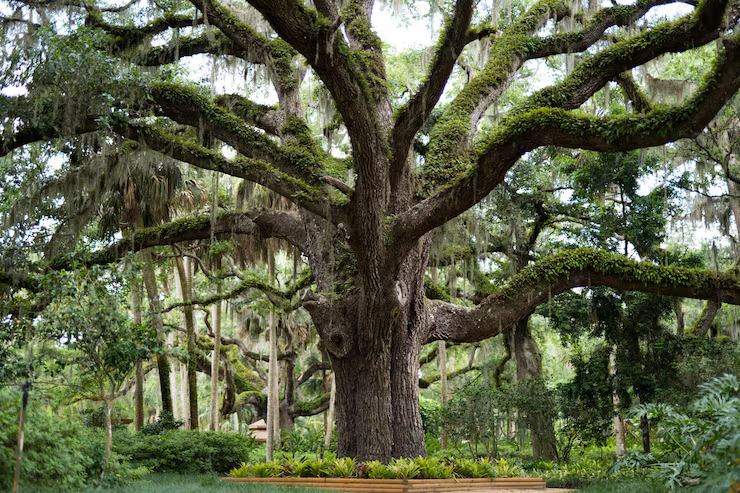
That tree had been older than the house. Older than the fence. It had survived storms, heatwaves, and three generations of our family. And somehow, it had vanished while we were gone for just four days.
No fallen branches. No sawdust trail. No note.
“Where is it?” my mother whispered, her voice breaking. “Where did it go?”
I stood next to her, feeling the roughness of the fresh-cut wood under my fingers. The tree had been a presence in my life since birth—a constant, like the sky or the foundation of the house. My grandmother used to sit beneath it with me when I was small, reading stories while the leaves whispered overhead. My father had proposed to my mother under those branches. We’d hung swings from its limbs, carved initials into its bark, and photographed every major life event with it standing sentinel in the background.
And now it was just… gone.
“Someone had to have done this,” my father said, his jaw tight. “Trees don’t disappear. This was deliberate.”
We walked the perimeter of the yard, searching for clues. There was no debris, no scattered sawdust, no tire tracks in the grass. Whoever had done this had been professional, efficient, and thorough. They’d cleaned up after themselves like they were erasing evidence of a crime.
The only thing left behind was the stump—a gravestone marking where something beautiful had once lived.
The Confrontation
The first thing we did was walk next door.
Our neighbor, Mr. Collins, answered the door slowly. He was in his late sixties, a retired accountant who spent his days tending to his immaculate lawn and complaining about the HOA newsletter. We’d known him for fifteen years. He’d brought us casseroles when my grandmother died. We’d watered his plants when he went to visit his daughter in Oregon.
He looked surprised to see us, then uncomfortable when my father asked the question none of us wanted to ask.
“Did you… cut our tree?”
Mr. Collins stiffened. His hand tightened on the doorframe, and something flickered across his face—was it guilt? Annoyance? Fear?
“What? No,” he said, shaking his head vigorously. “Why would I do that?”
“Because it’s gone,” my mother said, her voice trembling with barely contained emotion. “It’s completely gone, Roger. Someone cut it down while we were on vacation.”
“Well, it wasn’t me,” he insisted, but his eyes wouldn’t meet ours. “I’ve been home all week, yes, but I haven’t touched your tree. I loved that tree. It blocked the afternoon sun just right.”
My father studied him carefully. “You didn’t see or hear anything? Chainsaws? Trucks? Nothing?”
“I…” Mr. Collins hesitated. “I might have heard some noise on Tuesday. Around midday. But I was watching television. I assumed it was landscaping work down the street.”
The explanation was plausible. But something about his body language—the way he shifted his weight, the way his fingers drummed against the doorframe—felt wrong.
“If you hear anything or remember anything else,” my father said slowly, “please let us know. That tree was irreplaceable.”
“Of course,” Mr. Collins said quickly. Too quickly. “I’m sorry for your loss. It was a beautiful tree.”
He closed the door before we could say anything else.
We stood on his porch for a moment, the three of us processing what had just happened.
“He’s lying,” I said quietly.
My mother nodded. “I’ve known Roger for fifteen years. I’ve never seen him look like that.”
“Then we need proof,” my father said, pulling out his phone. “Thank God for security cameras.”
The Footage
Back inside, my father pulled up the security camera footage on his laptop. We’d installed the system two years ago after a string of package thefts in the neighborhood. The camera faced the backyard and part of the side fence, recording continuously during daylight hours.
We scrolled backward through the days we’d been gone, watching the backyard in reverse—birds flying backward, shadows shrinking instead of growing, the grass swaying in reverse wind.
Then we found it.
Tuesday, 11:03 a.m.
The tree stood tall, its shadow stretching across the grass like it had for the past century. Leaves rustled gently in the breeze. Everything was as it should be.
Tuesday, 11:41 a.m.
A white pickup truck appeared at the edge of the frame, pulling into our driveway with the casual confidence of people who belonged there. The vehicle had no company logo, no signage, nothing that would identify who they were or why they were there.
Tuesday, 11:42 a.m.
Two men stepped out, wearing plain clothes—jeans, t-shirts, work boots. No safety vests. No helmets. No official-looking equipment beyond the chainsaws they pulled from the truck bed.
They didn’t rush. They didn’t look around nervously. One of them pointed toward the tree, gesturing as he spoke to his companion. The other nodded and walked to the base of the trunk, examining it like a surgeon planning an incision.
“Who are these people?” my mother whispered.
We watched in horrified silence as they began their work.
Tuesday, 11:58 a.m.
The tree started to fall.
Even in the silent footage, you could see the violence of it—the way the massive trunk tilted, then accelerated, crashing down in a cloud of leaves and splintered branches. The camera shook slightly from the impact, and I realized I was holding my breath.
The men worked efficiently, like they’d done this a thousand times before. They sectioned the trunk with chainsaws, loaded the pieces into the truck, and raked up the smaller debris. By 12:36 p.m., our backyard was clear. Empty. Violated.
But then something happened that changed everything.
Before leaving, one of the men walked straight up to the fence separating our yard from Mr. Collins’ property… and knocked.
The three of us leaned closer to the screen.
A moment later, Mr. Collins appeared on the other side of the fence. He didn’t look surprised. He didn’t look concerned. He spoke to the men calmly, nodding as one of them gestured back toward our yard. Then—and this was the detail that made my stomach drop—he smiled.
He smiled and reached over the fence to shake their hands.
The timestamp froze on his face: 12:38 p.m.
“Son of a bitch,” my father breathed.
My mother stood up abruptly, her chair scraping against the floor. “He hired them. Roger hired those men to cut down our tree.”
“But why?” I asked, though even as I said it, I was starting to understand.
My father rewound the footage and zoomed in on the conversation at the fence. Though we couldn’t hear the audio, the body language was clear—this wasn’t a confrontation. This was a business transaction being concluded. Mr. Collins was thanking them for a job well done.
“The sun,” my mother said suddenly. “He mentioned the sun when we talked to him. He said the tree blocked the afternoon sun ‘just right.’ What if he didn’t mean that as a good thing?”
I remembered something then—a conversation I’d overheard months ago during a neighborhood barbecue. Mr. Collins complaining about his lawn, about how the shade from our tree was creating a patchy, unhealthy strip of grass along his property line. My father had offered to trim the branches, but Collins had waved it off, saying it wasn’t a big deal.
Apparently, it was a bigger deal than he’d let on.
“We need to report this,” my father said, reaching for his phone.
That evening, my father received a message from the city: “No permit found for tree removal at your address.”
Which meant what had happened wasn’t just a neighbor dispute—it was illegal destruction of property.
And at that exact moment, as if the universe had a sense of dramatic timing, Mr. Collins’ backyard lights turned on.
The Investigation
We stood at the window, watching the lights illuminate his yard—a newly empty space where once our tree’s branches had reached over the fence. The grass beneath was already recovering, turning from shade-starved yellow to a healthier green.
He’d wanted the sun. And he’d stolen it.
“I’m calling the police,” my father said.
The officer who arrived an hour later was a middle-aged woman named Detective Sarah Montez. She listened to our story with increasing concern, took notes, and reviewed the security footage three times.
“This is pretty clear-cut,” she said, the unintentional pun making my mother wince. “Your neighbor hired contractors to remove a tree from your property without permission. That’s criminal trespass, destruction of property, and potentially fraud if he misrepresented ownership to the contractors.”
“What happens now?” my mother asked.
“We’ll interview Mr. Collins and the contractors, if we can identify them. You’ll need to get the tree appraised to establish the value of the damage. Trees this old can be worth tens of thousands of dollars.”
That number shocked us. We’d never thought of the tree in monetary terms—it had been priceless to us in the way that family heirlooms are priceless, valuable not because of dollars but because of memory.
But if the law needed a number, we’d give them one.
Detective Montez walked next door, and we watched from our window as Mr. Collins answered. His casual demeanor evaporated the moment he saw her badge. We couldn’t hear the conversation, but we could see his body language change—defensive posture, crossed arms, shaking head.
Twenty minutes later, she returned.
“He’s denying everything,” she said. “Claims he never spoke to any contractors, never hired anyone, and that the footage must be doctored or mistaken. He says it’s dark and far away, and we can’t definitively prove that’s him in the video.”
“But it is him!” I protested.
“I know,” Detective Montez said gently. “And a jury will probably know too. But he’s within his rights to deny it. We’ll need to build a case.”
Over the next few days, several things happened in rapid succession.
First, we hired an arborist to examine the stump and provide an appraisal. He was a soft-spoken man named Dr. Chen who specialized in heritage trees. He took samples, counted rings, and measured the diameter with the solemnity of someone performing an autopsy.
His report was devastating.
“This tree was approximately 140 years old,” he told us, standing over the stump like a detective over a body. “It was a black oak, perfectly healthy, with no signs of disease or structural weakness. Based on its size, location, and historical value, I’d estimate its replacement value at $87,000.”
My mother gasped. “Eighty-seven thousand dollars?”
“Replacement value isn’t just about buying a new tree,” Dr. Chen explained. “It’s about compensating for the loss of something that took 140 years to grow. It’s about shade, air quality, wildlife habitat, property value, and yes, sentimental value. Trees like this are environmental infrastructure. They don’t just exist—they serve.”
The number gave us leverage. But it also made the situation feel even more real, more criminal. This wasn’t just a neighborly disagreement. This was grand theft of living history.
Second, Detective Montez tracked down the contractors through the license plate visible in our security footage. They were a father-son team who ran a small tree removal business an hour outside the city.
When confronted, they cracked immediately.
“We got a call from a guy named Roger,” the father admitted in his interview, which Detective Montez later shared with us. “He said it was his tree, on his property, and he wanted it gone before the weekend. He paid cash—three thousand dollars. We had no reason to doubt him.”
“Did you ask to see a permit?” Detective Montez asked.
“He said he’d handle the paperwork afterward. Honestly, we’ve done dozens of jobs like this. People call, we cut, we leave. We’re not cops. We don’t interrogate clients.”
“Did you see the property line? The fence?”
The son shifted uncomfortably. “We saw the fence. But we assumed the tree was on his side. It was close.”
“It was six feet inside the neighbor’s property,” Detective Montez said coldly. “You cut down a tree that wasn’t his to remove.”
The contractors looked at each other, realizing they’d been used as tools in someone else’s crime.
Third, the story leaked to the local news.
I don’t know who tipped them off—maybe Detective Montez, maybe someone at the city office—but suddenly our driveway was filled with news vans and our phones were ringing with interview requests.
“Beloved 140-Year-Old Oak Illegally Destroyed in Neighborly Dispute,” read the headline in the local paper. The article featured the security footage stills—the tree standing, the tree falling, Mr. Collins shaking hands with the contractors.
The community response was immediate and visceral.
Our mailbox filled with sympathy cards and letters from neighbors we barely knew, expressing outrage on our behalf. Someone started a GoFundMe to help with legal costs, though we hadn’t asked for it. The neighborhood Facebook group exploded with arguments about property rights, tree law, and whether Mr. Collins should be forced to move.
The most surprising support came from an environmental nonprofit called Urban Canopy Coalition. Their director, a fierce woman named Margaret Reeves, called us personally.
“I’ve been fighting for tree protection ordinances for fifteen years,” she said. “Your case is exactly why we need stronger laws. Can I ask—would you be willing to pursue this publicly? Not just for compensation, but to set a precedent?”
My parents looked at each other across the kitchen table.
“We just want justice,” my father said.
“Then let’s get it,” Margaret replied.
The Deposition
Mr. Collins hired a lawyer—a slick, expensive-looking man who specialized in property disputes. His strategy was simple: deny, minimize, and deflect.
In his deposition, which we were allowed to observe, Mr. Collins stuck to his story.
“I never hired anyone to cut down any tree,” he said, his voice steady. “I don’t know those men. I may have spoken to some landscapers working in the area, but I didn’t hire them, and I certainly didn’t direct them to cut down my neighbors’ tree.”
“Then why,” our attorney asked, sliding a still image from the security footage across the table, “are you shaking their hands and smiling after the tree is gone?”
Mr. Collins barely glanced at it. “I don’t recall that specific interaction. If I spoke to them, it was probably just being neighborly. Maybe they asked for directions or wanted to use my garden hose.”
“After cutting down a 140-year-old tree?”
“I didn’t know about the tree until the Harrisons came to my door.”
“But you mentioned the tree specifically,” our attorney pressed. “You said it ‘blocked the afternoon sun just right.’ How did you know it provided that specific benefit if you didn’t notice it was gone?”
Mr. Collins hesitated for the first time. “I… misspoke. I meant that I had noticed it before.”
“And you expect us to believe you didn’t notice an entire tree disappearing from your neighbor’s yard while you were home all week?”
“I was watching television,” he said stiffly. “I don’t spend all day staring out my window.”
It was a weak defense, and everyone in the room knew it.
The contractors’ testimony was more damaging. Under oath, they confirmed that “Roger from next door” had called them, provided the address, met them at the property, pointed out the tree, and paid them in cash. They identified him from the security footage without hesitation.
“He told us it was his tree,” the father testified. “He said it was dropping branches on his garage and he was worried about liability. We had no reason to doubt him.”
“Did he seem nervous or hesitant?” our attorney asked.
“No. He seemed… relieved, actually. Like he’d been wanting to do this for a while.”
That detail stuck with me. Mr. Collins hadn’t acted impulsively or made a mistake in the heat of the moment. He’d planned this. He’d waited until we were gone, hired contractors, and executed his plan with calculated precision.
He’d stolen our tree the way someone steals jewelry—deliberately, knowing exactly what they were taking and what it meant.
The Offer
Two weeks before the case was scheduled to go to trial, Mr. Collins’ lawyer reached out with a settlement offer.
He would pay $20,000 in damages, cover all legal fees, and issue a formal apology. In exchange, we would drop all criminal charges and sign a non-disclosure agreement preventing us from discussing the case publicly.
We sat in our attorney’s office, the offer letter spread out on the desk between us.
“It’s not enough,” my mother said immediately.
“It’s not about the money,” my father added. “It’s about what he did. He lied to us, destroyed something irreplaceable, and then lied some more when he got caught. Twenty thousand dollars doesn’t fix that.”
Our attorney, a sharp woman named Linda Keating, nodded. “I agree. The tree was appraised at $87,000. Even if we only get half that in court, it’s more than twenty. And frankly, I think we can get more.”
“What about the criminal charges?” I asked. “Can we really drop those?”
“The prosecutor handles the criminal side,” Linda explained. “But victims often have significant influence. If you tell the DA you want to pursue charges, they’re more likely to proceed. If you settle and signal you’re satisfied, they might reduce charges or drop them entirely.”
My mother’s hands were shaking. “I want him to face consequences. Real consequences. Not just write a check and pretend this never happened.”
“Then we go to trial,” Linda said. “It’ll be harder, longer, and more expensive. But if you want justice instead of settlement, that’s the path.”
We chose justice.
The Trial
The trial took place on a gray morning in October, almost four months after the tree fell.
The courtroom was smaller than I expected, cramped and windowless, with fluorescent lights that made everything look slightly sickly. But it was packed—reporters, neighbors, representatives from Urban Canopy Coalition, and people I didn’t recognize who apparently cared deeply about tree law.
Mr. Collins sat at the defense table, wearing a suit that looked borrowed and uncomfortable. He wouldn’t meet our eyes.
The prosecution presented their case methodically. They showed the security footage on a large screen, walking the jury through every damning moment—the truck arriving, the tree falling, the handshake at the fence.
They called Dr. Chen, who explained the tree’s age, value, and ecological importance with the gravitas of someone testifying about a murder victim.
They called the contractors, who repeated their story about being hired by “Roger from next door” and paid in cash.
They called Detective Montez, who walked through the investigation and Mr. Collins’ inconsistent statements.
And they called us.
My mother testified about the tree’s history—how it had been planted by the original homeowner in 1883, how three generations of our family had grown up in its shade, how it had been the backdrop for every important moment in our lives.
She cried on the stand, not from sadness but from anger—fury at having something so precious stolen and then being told to accept an insult of a settlement.
My father testified about the confrontation, about Mr. Collins’ body language and evasive answers, about the gut feeling that something was wrong.
I testified about what the tree meant to me. About reading under it with my grandmother. About climbing its branches as a child. About taking prom photos beneath its canopy.
“It wasn’t just a tree,” I said, looking directly at the jury. “It was a member of our family. And he killed it because it cast a shadow on his lawn.”
The defense’s strategy was to paint us as overly emotional and Mr. Collins as a confused old man who made an innocent mistake.
His lawyer argued that the contractors had misidentified the property line, that Mr. Collins had believed in good faith that the tree was partially on his land, and that the whole thing was a tragic miscommunication rather than a crime.
But the evidence was overwhelming. The security footage didn’t lie. The property survey didn’t lie. The contractors’ testimony didn’t lie.
After three days of testimony, the jury deliberated for less than two hours.
Guilty on all counts.
The judge sentenced Mr. Collins to pay the full appraised value of the tree—$87,000—plus legal fees, plus a fine for the criminal trespass and destruction of property. Additionally, he was placed on probation and ordered to perform 200 hours of community service with a local conservation organization.
“Mr. Collins,” the judge said, looking down at him over her glasses, “you didn’t just cut down a tree. You violated your neighbors’ trust, destroyed something that took 140 years to grow, and then lied about it repeatedly. The court finds your actions to be willful, malicious, and deserving of the maximum penalty under the law.”
Mr. Collins stood there, gray-faced and trembling, as the sentence was read.
He’d gotten the sun he wanted.
And it had cost him everything.
The Aftermath
The aftermath was strange and bittersweet.
Mr. Collins paid the judgment in full—we learned later that he had to take out a second mortgage on his house to cover it. He completed his community service in silence, planting saplings in city parks and caring for street trees, never speaking to the other volunteers about why he was there.
He stopped making eye contact when we passed on the street. He let his own lawn go, the grass growing shaggy and unkempt, as if tending it had lost all meaning now that he had his precious sunlight.
We used part of the money to hire a landscape architect who specialized in heritage restoration. She designed a memorial space around the stump—a circular garden with native plants, a stone bench, and a bronze plaque that read: “In Memory of the Harrison Oak, 1883-2023. Some things once cut down can never be replaced.”
We planted a new tree—a young black oak, the same species as the original—six feet away from the stump. It would take a century to reach the height of its predecessor, and we would never see it in its full glory. But our grandchildren might. Their grandchildren might.
The Urban Canopy Coalition used our case as the cornerstone of a successful campaign to strengthen the city’s tree protection ordinance. Now, any tree over 100 years old is automatically protected, and property owners face severe penalties for unauthorized removal.
Margaret Reeves sent us a framed copy of the new ordinance with a note: “You lost a tree, but you saved a forest.”
As for Mr. Collins, he moved away six months later. The house sold quickly—apparently to a young couple who loved the idea of all that afternoon sun in the backyard.
I saw him one last time before he left. He was loading boxes into a moving truck, and I was getting the mail. Our eyes met across the property line, and for a moment, I thought he might say something—apologize, explain, justify.
Instead, he just looked away and carried another box to the truck.
The Legacy
People ask me sometimes if it was worth it. Worth the legal fees, the stress, the time, the energy spent on what some people dismissed as “just a tree.”
And I tell them what my grandmother used to say: trees are never just trees.
They’re living records of time. They’re habitats and ecosystems. They’re shade on hot days and beauty on gray ones. They’re witnesses to history, standing silent sentinel over generations of human drama.
Our tree had watched my great-great-grandparents build the house. It had sheltered my great-grandparents during the Depression. It had shaded my grandparents during the war. It had watched my parents fall in love and me learn to walk.
And then one day, a man who wanted more sunlight decided all of that was worth less than the health of his lawn.
So yes, it was worth it.
Not because we got money—though the compensation helped us cope with the loss.
Not because Mr. Collins was punished—though the accountability mattered.
But because we refused to let the theft stand unchallenged. We refused to let someone rewrite our family history without consequences. We refused to treat 140 years of life as disposable.
The new tree is ten feet tall now, slender and hopeful. I visit it every time I go home, touching its trunk the way I used to touch the old tree—reverently, gratefully, as if reminding both of us that we’re still here.
The stump is still there too, slowly decomposing, becoming part of the soil that will feed the new tree’s roots. In a way, the old tree is still nourishing its successor, still providing, still giving even in death.
That’s what trees do. They stand. They shelter. They persist.
And they teach us that some losses are too important to accept without a fight.
The snow fell last winter, covering the memorial garden in white, transforming the stump into a pedestal and the young tree into something almost ethereal. I took a photo and sent it to my mother with the caption: “Still here.”
She replied immediately: “Forever.”
Because that’s the thing about trees—even when they fall, even when they’re stolen, they leave roots behind. They change the soil. They alter the landscape. They remain.
And so do we.
The story of the Harrison Oak serves as a reminder that not everything can be measured in dollars, and not every theft is about material possessions. Mr. Collins didn’t just take a tree—he took shade and memory, history and peace, beauty and belonging.
He took something that couldn’t be replaced and convinced himself it was his right to do so.
But the law, and ultimately justice, disagreed.
The oak may be gone, but its legacy remains—in the ordinance that now protects other ancient trees, in the young oak that grows in its place, in the community that rallied to defend what couldn’t defend itself.
And in the lesson that some things, once taken, can never truly be stolen. They live on in memory, in consequence, in the roots that run deeper than property lines or petty grievances.
The shade is gone.
But the shadow it cast will remain forever.