My Parents Humiliated My Grandfather at Our Luxury Resort — That Night, He Revealed Something That Destroyed Their World Forever
In the middle of Le Perle, where massive crystal chandeliers dripped like diamond waterfalls, Grandpa Arthur looked like a relic in his faded flannel shirt. He stood up to use the restroom, navigating shakily around a magnificent six-foot tower of champagne glasses.
Suddenly, his bad knee buckled.
CRASH!
The sound was deafening, like a bomb going off in a library. Hundreds of crystal glasses shattered at once. Champagne exploded outward in a frothy wave. The entire restaurant went terrifyingly silent. Arthur lay sprawled amidst the shards, blood from his arm mixing with the gold liquid on the white marble.
“Oh my God!” my mother shrieked. But she didn’t rush to help. She grabbed a menu to hide her face in shame.
My father, Robert, marched over. He didn’t offer a hand. Instead, he pulled a hundred-dollar bill from his wallet, crumpled it into a ball, and threw it at his own father. The paper hit Arthur in the chest.
“Take that for the damage and get back to your room!” Robert screamed, his face a violent shade of red. “Why do you have to be such a burden? Why don’t you just die and save us the trouble?”
The cruelty hung in the silence like toxic smoke. The safety on my internal weapon clicked off.
I kicked my chair back, marching through the puddle of wine and glass to stand between my father and my grandfather.
“You just violated the most basic rule of humanity,” I said, my voice icy. “You are not worthy of the name Mosley.”
Blind rage took over my father. He swung. Smack.
The slap caught me square on the cheekbone. The metallic taste of blood flooded my mouth. I took the hit like a soldier, standing perfectly still. I helped the Commander to his feet, guiding him to the lobby while my family chased us, screaming about ruined reputations.
Suddenly, the Resort General Manager came sprinting across the floor. My father pointed an accusatory finger. “Hey! Throw this old beggar out! He’s bleeding all over your floor!”
The Manager ignored Robert completely. He skidded to a halt in front of Arthur and bowed—a deep, ninety-degree bow of absolute subservience.
“Chairman Hannot,” the manager gasped, trembling visibly. “Sir, we did not know you were dining downstairs… I am so terribly sorry.”
The world froze.
“Chair… Chairman?” my mother stammered.
Arthur removed my hand from his waist. He stepped forward. The frail old man vanished. In his place stood a lion.
“Manager Henderson,” Arthur said, his voice a deep baritone that commanded the room. “Show them.”
Henderson pulled a cord on a massive velvet curtain nearby. Revealed underneath was a ten-foot oil painting of Arthur Hannot, founder of the Hannot Luxury Group.
My family stared. The man they had humiliated owned the floor they were standing on.
“Manager Henderson,” Arthur declared, his voice cold. “These people are trespassing. Effective immediately, their reservation is terminated. Remove them from my barracks.”
Security moved in. My father was hoisted by his armpits, screaming, while my mother was dragged toward the revolving doors.
Arthur watched them go. He didn’t smile. He just let out a long sigh.
“General Manager,” Arthur said softly. “Bring the Sergeant a medical kit for her face. And bring me a bottle of the Chateau Margaux. The real one.”
Three Days Earlier
My name is Elena Mosley, and three days before my grandfather revealed who he really was, I thought I knew my family.
I was wrong.
The invitation arrived on embossed cream cardstock, delivered by a courier in white gloves. My mother, Victoria, held it like it was the Holy Grail, her perfectly manicured fingers trembling with excitement.
“Le Perle Resort,” she breathed, reading the elegant script. “Robert, do you know what this means? This is the most exclusive resort in the entire Mediterranean. People wait years for a reservation.”
My father adjusted his Rolex—the real one, not the knockoff he used to wear before his tech startup sold for eight figures three years ago.
“Of course I know what it means,” Robert said, though his eyes betrayed his uncertainty. “It means we’ve finally arrived. The Mosleys are no longer middle class. We’re elite.”
I watched this performance from the corner of our newly renovated living room, expensive Italian furniture surrounding us like a stage set. My parents had spent the last three years desperately trying to sand off every rough edge of their former lives, as if poverty was a stain that could be scrubbed away with money.
“Who sent the invitation?” I asked.
My mother waved a dismissive hand. “Some family member, apparently. Does it matter? This is our chance to network with real wealth, Elena. You need to dress appropriately. No more of those military surplus jackets you insist on wearing.”
I was twenty-six, a recent graduate of West Point, and currently on leave before my first deployment. The military had given me something my parents’ new money never could—a sense of purpose that didn’t require a price tag.
“I’ll wear what I want,” I said quietly.
Robert’s jaw tightened. “You’ll wear what represents this family properly. We didn’t claw our way up just to have you embarrass us with your GI Jane routine.”
That was the thing about new money. It made you forget where you came from and terrified you’d be sent back.
The next morning, as we packed for the trip, my mother made the call that would change everything.
“Arthur?” she said into her phone, her voice dripping with forced sweetness. “It’s Victoria. Yes, your daughter-in-law. Listen, Robert and I are taking a luxury vacation to Le Perle Resort in Monaco. We thought… well, it might be nice for you to join us. Get you out of that depressing little apartment.”
I could hear Grandpa Arthur’s gravelly voice through the speaker, though I couldn’t make out the words.
My mother’s smile went brittle. “Oh, don’t worry about the cost. We’ll cover your room. Just… please try to pack something nice? We’ll be around important people.”
She hung up, looking satisfied with herself, like she’d just performed an act of charity.
“Why did you invite him?” Robert asked, frowning. “He’s going to stick out like a sore thumb. The man shops at thrift stores.”
“Exactly,” Victoria said. “It’ll make us look generous. Plus, someone needs to watch him. He’s getting older. What if he falls and we’re not there? We’d look negligent.”
They weren’t inviting him out of love. They were inviting him as a prop—and as insurance against judgment.
I thought about calling Arthur to warn him, to tell him not to come. But I didn’t. Because part of me—the part that remembered him teaching me to tie my boots, to stand up straight, to look people in the eye—wanted him there. Even if my parents had forgotten what he meant to our family, I hadn’t.
Grandpa Arthur had raised me while my parents worked three jobs between them, back when we lived in a two-bedroom apartment that smelled like mildew and broken dreams. He taught me chess on a board missing half its pieces. He told me stories about his time in the service—vague stories that never quite added up, that made him seem like a foot soldier who’d seen too much.
He was the one who encouraged me to apply to West Point when my parents said it was a waste, that I should study business or marry well instead.
“You’ve got steel in you, Sergeant,” he’d said, using the nickname he’d given me when I was eight. “Don’t let anyone tell you to soften it.”
So when we arrived at Monaco, when the private car pulled up to Le Perle—a sprawling white palace perched on cliffs overlooking the impossibly blue Mediterranean—and I saw Arthur standing at the entrance in his faded flannel shirt and worn khakis, I smiled.
He looked exactly like himself.
My mother did not smile. She looked horrified.
“Oh God,” she whispered. “He looks like a homeless person.”
“Dad,” Robert hissed as we approached. “I told you to dress up.”
Arthur looked down at his clothes, then back at his son. “This is my good shirt.”
“Jesus Christ,” my father muttered.
I stepped forward and hugged my grandfather. He smelled like Old Spice and peppermint, exactly as he always had.
“Good to see you, Commander,” I whispered, using my nickname for him.
“Good to see you too, Sergeant,” he replied, his eyes crinkling at the corners.
The resort staff descended on us immediately—porters in crisp white uniforms, a concierge with a tablet, a manager with a practiced smile that didn’t quite reach his eyes.
“Welcome to Le Perle,” the manager said. “Mr. and Mrs. Mosley, correct? And guests?”
“Yes,” Robert said, puffing his chest. “Robert Mosley. We have the executive suite.”
The manager’s eyes flicked to Arthur, lingered for a fraction too long on the flannel shirt, then returned to his tablet.
“Of course. We’ll have your luggage brought up immediately. Please, follow me to reception.”
As we walked through the lobby—past marble columns, past a fountain that probably cost more than our old apartment building, past guests dripping in jewelry and designer labels—I watched my parents transform. Their spines straightened. Their voices got louder. They laughed at nothing, performing wealth like actors who’d barely memorized their lines.
And Arthur? He just shuffled along behind us, looking at everything with a quiet, unreadable expression.
At dinner that first night, we ate at the resort’s second-tier restaurant, Le Jardin. My parents had made a reservation at Le Perle—the resort’s crown jewel dining room—for the final night, wanting to “build up to it.”
Arthur ordered the cheapest thing on the menu: soup.
“Dad,” Robert said through gritted teeth. “You can order whatever you want. We’re paying.”
“I like soup,” Arthur replied simply.
My mother stabbed at her sixty-dollar salad with barely contained frustration. Around us, other diners glittered—women in evening gowns, men in jackets that probably cost five figures. And there sat Arthur in his flannel shirt, slurping his soup with the contentment of a man who had nothing to prove.
“You’re embarrassing us,” Victoria finally whispered, leaning across the table.
Arthur looked up, his spoon halfway to his mouth. “How?”
“You know how,” she hissed. “Look around. Look at how people are dressed. You look like… like…”
“Like what?” I cut in, my voice sharp. “Like a human being who doesn’t need to perform for strangers?”
“Elena, stay out of this,” my father warned.
But Arthur put his hand on mine, a silent message to stand down.
“It’s all right, Sergeant,” he said. Then he turned to his son. “I’m sorry if my presence makes you uncomfortable, Robert. I can eat in my room for the rest of the trip if you’d prefer.”
“That might be best,” Victoria said quickly.
I watched my grandfather’s face. There was no hurt in it. No anger. Just a patient, knowing look—the expression of someone watching a play they’d seen before and knew the ending to.
“I’ll eat with you, Grandpa,” I said.
“No, you won’t,” my mother snapped. “We didn’t bring you here to babysit. We brought you to make connections. The Hendersons are dining here tomorrow night—he’s on the board of three major corporations. You need to impress him, not hide away with…”
She didn’t finish the sentence. She didn’t have to.
The next two days followed a similar pattern. My parents networked aggressively, inserting themselves into conversations at the pool, at the spa, in the resort’s exclusive cigar lounge. They name-dropped their way through every interaction, desperate to be remembered, to be validated, to be seen as equals by people who had been born into the world my parents were trying to purchase entry to.
Arthur mostly stayed in his room. When he did emerge—for breakfast, for a walk in the gardens—my parents treated him like a liability, steering him away from other guests, making excuses for his appearance.
“He’s a veteran,” Robert would say, as if that explained the flannel shirt. “A bit eccentric, you know how it is.”
On the afternoon before the Le Perle dinner, I found Arthur sitting alone on a bench overlooking the sea.
“You don’t have to stay,” I said, sitting beside him. “I can get you a car back to the airport. You don’t deserve to be treated like this.”
Arthur was quiet for a long moment, watching the waves crash against the rocks below.
“Do you know what the hardest part of war is, Sergeant?” he finally asked.
I shook my head.
“It’s not the combat. It’s not the fear. It’s coming home and watching people who’ve never been in the mud act like they’re generals. It’s watching people confuse the uniform with the person wearing it.”
“I don’t understand,” I admitted.
He smiled. “You will. Soon.”
That night, we dressed for Le Perle. My mother forced me into a black cocktail dress that cost more than my monthly stipend. My father wore a tuxedo. Victoria dripped in diamonds—real ones now, not the cubic zirconia she’d worn when I was young.
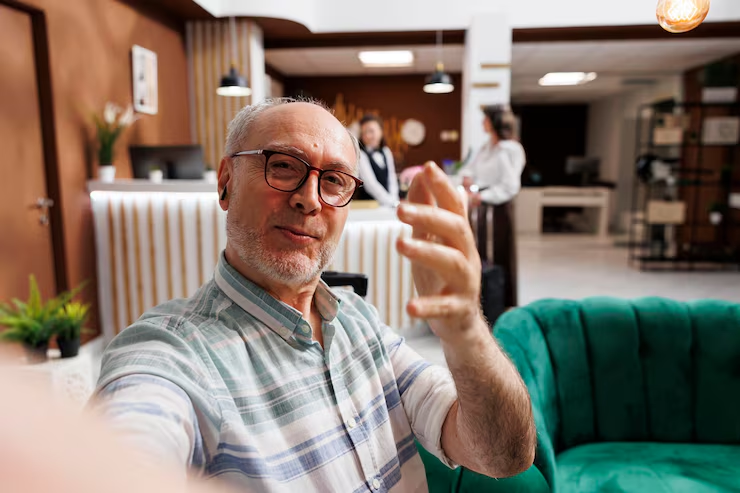
And Arthur? He emerged from his room in the same flannel shirt, the same worn khakis.
“Dad,” Robert said, his voice dangerously quiet. “I laid a suit on your bed. Why aren’t you wearing it?”
“Didn’t fit,” Arthur said simply.
“Didn’t fit?” Victoria’s voice climbed an octave. “It was tailored!”
“Wasn’t my style,” Arthur clarified.
My father’s face went red, but we were already running late. The reservation was for eight, and it was 7:55.
“Fine,” Robert spat. “But you sit at the far end of the table. And you don’t order. We’ll order for you.”
That’s how we ended up at Le Perle.
The restaurant existed on a different plane of reality. The ceiling was a vault of hand-painted frescoes. The chandeliers were genuine crystal, each one probably worth more than my college education. The tables were spread far apart, offering privacy and exclusivity. Piano music drifted through the air like smoke.
We were seated at a table near the center—my parents’ request, ensuring maximum visibility.
The maître d’ eyed Arthur’s flannel shirt with barely concealed disdain but said nothing. Money bought permission for many sins in places like this.
The first course arrived on plates that looked like abstract art. My parents ooh-ed and ahh-ed appropriately, desperate to signal that they belonged. Arthur ate in silence, methodical and unbothered.
Then came the tower of champagne glasses—a centerpiece near our table, six feet tall, hundreds of delicate crystal flutes stacked in a perfect pyramid. It was a monument to excess, to waste, to beauty that existed only to be admired and destroyed.
Arthur stood up, excusing himself to use the restroom.
His bad knee—the one he’d told me he injured “doing yard work”—gave out as he passed the tower.
CRASH.
The explosion of glass was apocalyptic. Champagne erupted like a geyser. Arthur went down hard, his arm slicing open on the shards. Blood pooled immediately, mixing with the golden liquid in a grotesque cocktail on the white marble floor.
The entire restaurant froze.
Two hundred eyes turned to watch an old man bleeding on the ground.
And my mother? She grabbed a menu to hide her face.
My father stood up, his face contorting with rage and shame. He marched over—not to help, but to punish.
He pulled out a hundred-dollar bill, crumpled it like it was garbage, and threw it at his father’s chest.
“Take that for the damage and get back to your room!” Robert screamed, his voice echoing off the painted ceiling. “Why do you have to be such a burden? Why don’t you just die and save us the trouble?”
The words hung in the air, poison in a place that pretended poison didn’t exist.
I moved without thinking.
I kicked my chair back, the screech of wood on marble cutting through the silence. I walked through the champagne and shattered glass, my expensive heels crunching crystal, and planted myself between my father and my grandfather.
“You just violated the most basic rule of humanity,” I said, my voice cold and precise—the voice I’d learned to use giving orders. “You are not worthy of the name Mosley.”
My father’s hand came up fast.
SMACK.
The slap caught me across the cheekbone, hard enough to snap my head to the side. The metallic taste of blood filled my mouth where my teeth cut the inside of my cheek.
I didn’t move. Didn’t flinch. Didn’t give him the satisfaction of a reaction.
Instead, I bent down, offering my hand to Arthur.
“Come on, Commander,” I said quietly. “Let’s get you cleaned up.”
He took my hand, and I helped him to his feet. Blood dripped down his arm, staining his beloved flannel shirt.
As we walked toward the lobby, my parents followed, their voices overlapping in a chorus of panic and fury.
“Do you know what you just did?” my mother shrieked. “Do you know who saw that?”
“You just ruined us!” my father added. “The Hendersons were three tables away! Everyone saw! Everyone!”
I ignored them, focused on getting Arthur to safety.
That’s when the General Manager appeared.
Henderson—that was his name—came sprinting across the marble, his polished shoes squeaking with urgency.
My father saw an opportunity. He pointed at Arthur with all the authority of a man who thought money made him important.
“You! Manager! Throw this old beggar out! He’s bleeding all over your floor!”
Henderson skidded to a halt.
But he didn’t look at my father.
He looked at Arthur.
And then he bowed—a deep, ninety-degree bow of absolute subservience, the kind of bow reserved for royalty or gods.
“Chairman Hannot,” Henderson gasped, his voice trembling. “Sir, we did not know you were dining downstairs… I am so terribly sorry for this incident. Please, allow me to—”
“Chairman?” my mother’s voice was barely a whisper.
“Hannot?” my father echoed, confusion and dread creeping into his tone.
Arthur gently removed my hand from his waist. He straightened up, and something extraordinary happened.
The frail old man in the flannel shirt vanished.
In his place stood someone else entirely. His spine straightened. His shoulders squared. His entire bearing changed, like a switch had been flipped.
When he spoke, his voice wasn’t the raspy whisper of an elderly man. It was a deep, commanding baritone that filled the room.
“Manager Henderson,” Arthur said calmly. “Show them.”
Henderson moved immediately, pulling a cord on a massive velvet curtain I’d never even noticed along the restaurant’s wall.
The curtain fell away.
Revealed underneath was a ten-foot oil painting—the kind reserved for founders, for legends, for people who built empires.
The portrait showed a man in his prime, standing in a military dress uniform covered in medals and honors. His face was stern, his eyes sharp, his presence undeniable.
It was Arthur.
Below the painting, a bronze plaque read: Arthur Hannot, Founder and Chairman, Hannot Luxury Group. Est. 1962.
The restaurant, which had been silent before, became a vacuum. Not just quiet—empty of sound, of breath, of thought.
My mother’s champagne glass slipped from her fingers, shattering on the marble with a pathetic tinkle that seemed impossibly small compared to the earlier explosion.
My father’s mouth opened and closed like a fish drowning in air.
Arthur—no, Chairman Hannot—looked at his son with an expression I’d never seen before. Not anger. Not disappointment. Something colder. Something final.
“You want to know why I wore this flannel shirt?” Arthur asked, his voice carrying to every corner of the restaurant. “Because sixty years ago, I wore one just like it when I was sleeping in a foxhole in Korea. I wore it when I came home with nothing but a duffel bag and a dream. I wore it when I started my first hotel with a loan I paid back by cleaning the rooms myself.”
He paused, letting the words land.
“I built this company with these hands,” he continued, holding up his palms—calloused, scarred, working hands. “I scrubbed floors. I hauled luggage. I learned every job in this industry from the ground up because I refused to ask my employees to do anything I wouldn’t do myself.”
His eyes never left my father’s face.
“I became successful, Robert. Wealthy beyond imagination. But I never forgot where I came from. I never pretended those years didn’t exist. And I certainly never treated people as disposable because they looked poor.”
“Dad, I—” Robert started, but Arthur held up a hand.
“You threw money at me like I was a beggar. You told me to die. In front of your daughter. In front of hundreds of strangers. You did this because you were embarrassed by my flannel shirt.”
Arthur took a step forward, and my father actually backed up.
“This resort—this entire property—I built it with my own hands. This company owns seventeen properties across three continents. We employee over forty thousand people. And you… you told me to get out of my own hotel.”
The weight of realization was crushing my parents. I could see it in their faces—the horror, the shame, the desperate scramble to understand how badly they’d miscalculated.
“The invitation,” my mother whispered. “You sent us the invitation.”
“I did,” Arthur confirmed. “I wanted to see my family. I wanted to see if success had taught you gratitude or arrogance. I wanted to know if you’d treat a stranger in a flannel shirt with dignity.”
He smiled, but it was the saddest smile I’d ever seen.
“You failed.”
My father dropped to his knees, literally collapsing onto the champagne-soaked marble.
“Dad, please, I didn’t know—we didn’t know—”
“That’s exactly the problem,” Arthur cut him off. “You didn’t know, so you treated me like trash. What does that say about how you treat everyone else you think is beneath you?”
Henderson stood rigidly at attention, waiting for orders.
Arthur’s voice went quiet, which somehow made it even more powerful.
“Manager Henderson, these people are trespassing. Effective immediately, their reservation is terminated. Remove them from my property.”
“No!” Victoria screamed. “Arthur, please, we’re family!”
“Family?” Arthur repeated the word like he was tasting something bitter. “Family doesn’t throw money in your face. Family doesn’t tell you to die. Family doesn’t hide you in a room like a shameful secret.”
Security materialized from the shadows—large men in dark suits who moved with the efficiency of people who’d done this before.
They hoisted my father up by his armpits. He was screaming, begging, promising to change, to do better, to make it right.
My mother was dragged toward the revolving doors, her diamonds glittering in the chandelier light as she sobbed, her carefully constructed image crumbling with every inch of marble she was pulled across.
“Please!” she wailed. “We’ll lose everything! Everyone saw! Our reputation!”
“Your reputation?” Arthur called after her. “You just destroyed that yourself.”
I stood frozen, watching my parents disappear through the doors like criminals being hauled away from a crime scene.
Which, in a way, they were.
The other diners were silent, but I could feel their eyes, their judgment, their satisfaction at witnessing the fall of people who’d tried too hard to be something they weren’t.
Arthur turned to me. His eyes softened.
“General Manager Henderson,” he said, his voice gentle now. “Bring the Sergeant a medical kit for her face. And bring me a bottle of the Chateau Margaux. The real one. From the vault.”
Henderson bowed again and hurried away.
Arthur gestured to a private table in the corner—one that was set apart from all the others, elevated slightly, overlooking the sea through massive windows.
“Come, Elena,” he said. “We have a lot to talk about.”
I followed him to the table, my legs shaking, my mind trying to process what had just happened.
We sat down. A server appeared immediately with a first-aid kit, cleaning and bandaging my split cheek with professional efficiency. Another server brought towels and attended to Arthur’s bleeding arm.
Henderson returned with a bottle covered in dust, cradling it like a newborn.
“The 1961 Chateau Margaux,” he announced reverently. “Sir, this is the last bottle in our collection.”
“Then it’s time to open it,” Arthur said.
The wine was poured—deep red, almost black in the crystal glasses.
Arthur raised his glass, and I raised mine.
“To family,” he said. “The real kind.”
We drank.
The wine tasted like history, like time itself in liquid form.
“You could have told us,” I finally said, my voice cracking. “You could have told me.”
“Would it have mattered?” Arthur asked. “Would you have loved me more if you knew I was rich? Would you have spent those afternoons playing chess with me, listening to my stories, if you’d known I owned the company? Or would you have treated me differently—like a wallet with legs, like an investment instead of a person?”
I wanted to say yes, it wouldn’t have mattered. But I couldn’t. Because the truth was, I didn’t know.
“I wanted to know who you really were,” Arthur continued. “All of you. So I hid the money. I played the part of the poor old veteran living on a pension. And I watched.”
“What did you see?” I asked.
“In you?” He smiled. “I saw someone who treated me with respect regardless of my bank account. Someone who called me ‘Commander’ not because of my wealth but because of who I was. Someone who stood between me and violence, even when it cost you.”
He reached across the table and took my hand.
“You passed the test, Sergeant. You always have.”
“And my parents?”
His expression went dark. “They revealed exactly who they’ve become. Money didn’t corrupt them—it just gave them permission to show their true nature. They were always like this. They just didn’t have the resources to act on it before.”
We sat in silence for a moment, the weight of everything settling over us.
“What happens now?” I asked.
Arthur took another sip of wine. “Now? Now I make some decisions about my estate, my company, my legacy. I’m eighty-three years old, Elena. I won’t live forever. I need to know that what I’ve built will go to someone who understands that wealth is a responsibility, not a trophy.”
He looked at me with an intensity that made me sit up straighter.
“You’re going back to your deployment in two weeks. You’ll serve your country with honor, just like I knew you would. But when you’re done—when you’ve completed your service—I want you to come work for me. Learn the business. Learn how to lead not just soldiers, but people. Learn how to build something that lasts.”
“Me?” I stammered. “I don’t know anything about hotels or luxury or—”
“You know about honor,” he interrupted. “You know about dignity. You know about treating people with respect regardless of their station. That’s more valuable than any MBA.”
He pulled an envelope from his pocket—somehow dry despite the champagne disaster—and slid it across the table.
“Your parents are no longer in my will,” he said simply. “I’ve had it changed. The company, the properties, the fortune—it’s all going to you. Not today. Not tomorrow. But when the time comes, you’ll be ready.”
I stared at the envelope like it might bite me.
“I don’t want it,” I whispered.
“I know,” Arthur said, smiling. “That’s exactly why you should have it.”
Over the next hour, we talked. Really talked, for the first time in years without the weight of my parents’ expectations and shame pressing down on us.
He told me about his life—the real story, not the sanitized version. How he’d come back from Korea with PTSD and nothing to his name. How he’d started working at a small motel, cleaning rooms for minimum wage. How he’d noticed inefficiencies, ways to improve, ways to make guests feel valued. How he’d saved every penny, taken out a risky loan, and bought his first property at thirty.
“I failed twice,” he admitted. “Went completely bankrupt. Slept in my car. Ate from soup kitchens. But I never quit. And I never forgot what it felt like to be invisible, to be treated like garbage because of my clothes or my account balance.”
He built the company on a simple philosophy: luxury wasn’t about price tags. It was about dignity. Every employee, from the cleaning staff to the executive board, was treated with respect. Every guest, regardless of their wealth, received the same level of service.
“That’s why this place works,” he said, gesturing at the opulent restaurant around us. “Not because of the chandeliers or the wine. Because people feel valued here. They feel seen.”
“My parents didn’t see you,” I said quietly.
“No,” he agreed. “They only saw the flannel shirt. They never looked underneath.”
As the night wore on, other guests began to approach our table. Not to gawk, but to pay their respects. I realized that many of them knew who Arthur was—had always known. The staff certainly did. Henderson had been standing at a respectful distance all night, ready to fulfill any request.
An elderly couple stopped by, the woman’s eyes wet with tears.
“Mr. Hannot,” she said. “Forty years ago, you gave my husband a job when no one else would. He’d just been released from prison—nobody would hire him. But you did. You gave him a chance to rebuild his life.”
Arthur stood and embraced her. “How is Thomas?”
“He passed last year,” she said. “But he died with dignity, with a career he was proud of, with a pension that’s taking care of me. Because you saw him as a person, not a criminal.”
“He earned it,” Arthur said simply. “I just opened the door.”
This happened again and again. A waiter who Arthur had put through college. A manager whose medical bills Arthur had quietly paid. A chef who Arthur had believed in when she was just a line cook with a dream.
I watched my grandfather—this man I’d thought I knew—reveal himself to be something far greater than I’d ever imagined.
Not because he was rich.
Because he was good.
When the last guest had left and the restaurant was being cleaned, Henderson approached our table.
“Sir, the media has gotten wind of tonight’s incident,” he said carefully. “They’re requesting a statement. The story is spreading rapidly on social media—several guests posted videos of the… confrontation.”
Arthur sighed. “Let them post. The truth is the truth.”
“Your son and daughter-in-law have checked into a competing hotel,” Henderson continued. “They’ve been calling, requesting to speak with you.”
“Block them,” Arthur said without hesitation. “For now, at least. They need time to understand what they’ve lost. And I need time to decide if I want to give them a chance to earn it back.”
He looked at me. “What do you think, Sergeant? Do people deserve second chances?”
I thought about my father’s hand hitting my face. My mother hiding behind a menu. The hundred-dollar bill crumpled and thrown.
“I think second chances have to be earned,” I said. “Not demanded.”
Arthur nodded. “Wise answer.”
We left Le Perle around midnight, walking through the lobby as staff bowed and nodded respectfully. No one stared at Arthur’s flannel shirt anymore. They saw past it now, to the man underneath.
Or maybe they’d always seen it, and I was the one who’d been blind.
At the elevator, Arthur pressed the button for the top floor—the penthouse level I’d never been to.
“Where are we going?” I asked.
“Somewhere I should have taken you a long time ago,” he said.
The elevator rose smoothly, opening directly into a private foyer. Arthur used a key card to unlock a set of double doors.
Inside was an apartment that defied description. Floor-to-ceiling windows overlooking the Mediterranean. Art on the walls that belonged in museums. But also—surprisingly—photos. Hundreds of them. Family photos spanning decades.
“This is my real home,” Arthur said. “Not the apartment you thought I lived in. That place in the suburbs? I keep it for anonymity. When I want to be just Arthur, not Chairman Hannot. But this… this is where I come to remember.”
He led me to a wall covered in pictures. I recognized younger versions of my parents, smiling and happy. Photos of holidays, birthdays, graduations. All the moments that made up a life.
“I kept every memory,” Arthur said softly. “Even when they started pulling away. Even when success made them ashamed of where they came from. I kept loving them. Kept hoping they’d remember.”
“But they didn’t,” I said.
“No. They forgot. Or maybe they chose to forget. There’s a difference.”
He pointed to a photo of me as a child, maybe seven years old, sitting on his lap with a chess piece in my hand.
“You never forgot,” he said. “Even when you went to West Point, even when you could have pulled away like they did, you stayed. You called. You visited. You treated me the same.”
“Because you’re my grandfather,” I said simply. “Why would I treat you differently?”
“Exactly,” he said, his voice thick with emotion. “That’s exactly why everything I’ve built is going to you. Because you understand what they don’t—that people are more than their balance sheets.”
I stayed in that penthouse with Arthur for hours, looking at photos, listening to stories, learning about the man behind the flannel shirt.
As dawn broke over the Mediterranean, painting the sky in shades of gold and rose, Arthur made me a promise.
“When you come back from your deployment,” he said, “we’ll start your training. Not just in business—in life. I’ll teach you everything I know. And when I’m gone, you’ll carry it forward.”
“I’m not ready,” I protested.
“No one ever is,” he replied. “But you will be. I have faith in you, Sergeant.”
We stood at the window, watching the sun rise over the empire my grandfather had built with his own hands—hands that were calloused and scarred, that had scrubbed floors and hauled luggage, that had given second chances and demanded dignity.
“What about Mom and Dad?” I asked.
Arthur was quiet for a long moment.
“Time will tell,” he finally said. “If they can learn—truly learn—what they did wrong, then maybe. But forgiveness has to be earned. And right now, they haven’t even begun to understand what they’ve lost.”
Three months later, I was deployed to Eastern Europe. I served my country, led my soldiers, and carried with me the lessons my grandfather had taught me—about honor, about dignity, about seeing people for who they are rather than what they appear to be.
And every week, I received a letter from Arthur. Not emails. Not texts. Handwritten letters on expensive paper, sealed with wax, telling me about the business, about life, about philosophy and humanity.
My parents tried to contact me once. A long email, full of apologies and justifications, explaining that they’d been under stress, that they didn’t mean it, that surely I understood.
I didn’t respond.
Because understanding wasn’t the same as forgiveness.
And forgiveness wasn’t the same as restoration.
Two years later, when my service was complete, I returned to Monaco. Arthur was waiting for me at Le Perle, sitting at the same table where everything had changed.
He was still wearing a flannel shirt.
“Welcome home, Sergeant,” he said, standing to embrace me.
“Ready to get to work, Commander,” I replied.
And I was. Not because I wanted his money or his company. But because I wanted to continue what he’d started—building a legacy that measured success not in dollars, but in dignity.
My parents did eventually reach out. They wrote letters, made calls, begged for reconciliation. Arthur gave them one condition: they had to work for it. Not with money. Not with promises. But with actions.
They had to volunteer. Serve food at shelters. Work at veteran’s centers. Spend a year treating people with the respect they’d denied their own father.
My mother refused. She couldn’t imagine lowering herself to that level.
My father took the challenge. I watched him struggle, watched him face his own prejudices and shame, watched him slowly—painfully slowly—begin to understand what he’d lost and why.
It took three years.
But eventually, Arthur invited him back to Le Perle. Not as a guest. As an employee.
“If you want back into this family,” Arthur told him, “you’ll start the same way I did. At the bottom. Cleaning rooms. Learning respect.”
My father, to his credit, accepted.
I don’t know if he’ll ever fully understand what he did. I don’t know if forgiveness will ever be complete.
But I do know this: the man in the flannel shirt taught me more about wealth than any bank account ever could.
True wealth isn’t measured in dollars.
It’s measured in dignity—how you treat people when you have nothing to gain from them, how you act when no one is watching, how you remember where you came from even when you’ve traveled far beyond it.
My grandfather built an empire from a flannel shirt and a dream.
And when the world tried to judge him by his clothes, he reminded them that the most valuable things in life can’t be bought, worn, or displayed.
They can only be earned.
And that is the story of how my grandfather destroyed my parents’ world—not with cruelty or revenge, but with the simple act of revealing that the beggar they’d scorned was the king who owned the castle.