My Brother Begged Me Not to Attend His Wedding — On the Big Day, My Phone Wouldn’t Stop Ringing
My name is Rachel Carter, and the night my brother begged me not to come to his wedding, I learned exactly where I stood in my own family.
I was in my cramped office at a small auto-detailing shop on the edge of Austin, Texas, still smelling like tire cleaner and engine degreaser, when my phone lit up with his name. I almost let it go to voicemail. Instead, I swiped to answer, and my life split into a before and an after.
“Ra, please don’t come to my wedding,” my brother said. No hello. No warm-up.
His voice was tight, like he’d rehearsed this a hundred times and still hated saying it. I stared at the invoices on my desk, a smear of polish on my thumb.
“What are you talking about?” I asked. “You’re my brother. It’s your wedding.”
There was a long, shaky pause. I could hear people talking faintly in the background—cutlery, music—like he’d stepped out of some fancy dinner just to make this call.
“I don’t want people to know you’re just a cleaner,” he finally blurted out.
For a second, I thought I misheard him. I don’t scrub toilets. I restore cars, make engines shine, turn dented metal into something people show off on weekends. But to him, all of that collapsed into one small word: cleaner.
The insult burned deeper than any chemical I’d ever worked with. I hit the record button on my phone without even thinking.
“So my job embarrasses you now?” I asked quietly.
“It’s not like that,” he rushed. “Liam’s family. They’re important. They’re all in tech and finance. They have expectations. If they find out my sister works in a garage detailing trucks and beat-up sedans off the highway—”
“They’ll what?” I cut in. “Assume you’re human?”
Before he could answer, I heard another voice. Older. Harder.
“Give me the phone.”
My father.
“Rachel,” he said—no warmth left in the way he used my name—”we’ll tell them you moved away, that you’re gone. Don’t contact us again until you learn your place.”
My hand went cold around the phone.
“So I’m dead now to both of you.”
No one answered. Just breathing. Just shame.
I didn’t scream. I didn’t cry. I simply ended the call. I sat there in the flickering fluorescent light of my shop and let the silence tell me everything.
A few days later, on the morning of the wedding, my phone would light up again and again—calls from my brother, my mother, relatives whose numbers I hadn’t saved in years. I would watch it buzz across my workbench over and over without touching it. Something had gone very, very wrong. But that night, all I knew was the sound of the line going dead and the feeling of being erased by the people who were supposed to love me first.
The Days Between
The days after that call felt like driving with a cracked windshield. Everything looked normal from a distance, but the fracture was always there, spiderwebbing through my thoughts. I threw myself into work at Highway Halo Detailing, the little shop I’d built with my business partner, Marco. While my family polished their image for the big wedding, I polished trucks, SUVs, and dusty work vans under the Texas sun. Every morning, I rolled up the shop door and let the light spill over the concrete floor. By seven, I was already hunched over some contractor’s pickup, scraping red clay out of the wheel wells.
On the surface, it was just another Tuesday. Underneath, my brother’s words replayed on a loop: I don’t want people to know you’re just a cleaner.
At lunch, I sat at the tiny metal desk in the back, scrolling through social media with grease on my hands. There they were—my parents, my brother, his fiancé’s family—standing under strings of fairy lights at the rehearsal dinner. Champagne flutes raised high. Captions like, “So proud of our boys.” “Two families becoming one.” I zoomed in on each photo, hunting for any sign I existed, a tag, a mention, anything.
Nothing.
I was already edited out of their story.
“You’re grinding your teeth again,” Marco said from the doorway, holding two Styrofoam cups of coffee. His dark hair was tied back, his coveralls dusted with wax powder. “What’s going on?”
I didn’t answer right away. It wasn’t that I didn’t trust him. He’d been the only one who didn’t laugh when I said I wanted my own place one day. I’d just never put my family’s ugly side into words.
“My brother called,” I said finally. “He doesn’t want me at his wedding because I embarrass him.”
Marco raised an eyebrow. “The same brother you helped with that down payment for his first apartment? That brother?”
I nodded. “He doesn’t want his precious in-laws to know his sister makes a living scrubbing brake dust off rims.”
I pulled up the recorded call and let a few seconds play—just enough for Marco to hear.
“We’ll tell them you’re gone. Don’t contact us again.”
Marco swore under his breath. “You know that’s not about you, right? That’s their shame talking, not yours.”
I wanted to believe him. But the barrage of messages that followed told a different story.
A new family group chat popped up on my phone. The same relatives who hadn’t texted me in years suddenly had plenty to say.
“Rachel, don’t make this harder than it has to be. Your brother worked so hard for this moment. If you show up with your job, people will talk. Be smart. Stay away.”
It wasn’t just about the wedding anymore. It was about control. About who got to be seen.
That afternoon, while detailing a sleek black Tesla, my phone buzzed with a text from my mother.
“We know business is slow. If you behave and don’t come, we’ll help with your rent for a few months.”
I stared at the message, then at the car parked in front of me. Business wasn’t slow. For the first time in years, I had a waiting list. They weren’t offering help. They were offering a bribe.
The old version of me—the one who still believed my parents’ approval was something worth chasing—might have said yes and stayed quiet. But my hands were stronger now. My life was heavier in all the right ways.
I typed back, “I’ll handle my own rent. You handle your own shame.”
Then I put my phone on Do Not Disturb, grabbed my pressure washer, and went back to work. As I blasted months of road grime off that Tesla, another thought crept in. If they’re willing to erase me this easily, why am I still so afraid to walk away?
The Break
The week before the wedding, my life split into two parallel timelines. In one, I was the woman under the hood of a truck, tightening bolts, wiping down dashboards, turning chaos into shine. In the other, I was a ghost hovering over floral arrangements and seating charts I’d never see—invited only as a problem to be managed.
Work got busier. Marco and I landed a huge opportunity. A boutique tech firm in downtown Austin needed all their company cars detailed before a major investor summit. If we nailed it, they’d put us on a yearly contract—the kind of contract that could finally move us out of our cramped shop and into something bigger.
“This is the break we’ve been waiting for,” Marco said, slapping the clipboard with the order on it. “Fleet of twelve, all before Saturday.”
Saturday. The wedding day.
I had a choice: obsess over people who didn’t want me, or pour everything I had into building something that did.
“I’m in,” I said. “Let’s make these cars glow.”
We turned the shop into a choreography of motion. In the mornings, I pressure washed and foamed down SUVs until the asphalt ran white. By noon, I was crouched inside, steam cleaning carpets and buffing out scuffs. Every smear I wiped away felt like scrubbing years of my family’s comments off my skin.
You smell like work.
You should have gone to law school like your brother.
You’re wasting your brain on cars.
One night after locking up, I checked my phone and saw a DM from my cousin Laura, one of the few relatives who hadn’t chimed in on the group chat.
“I thought you should see this,” she wrote, followed by a screenshot.
It was another thread, this one between some of my aunts and my mother. Their words sat there in gray bubbles.
“She always chose the shop over school. She could have been something if she didn’t like getting dirty so much.”
“We’ll tell Liam’s family she moved overseas. It’s simpler.”
They weren’t just ashamed of my job. They were rewriting my entire story.
I had dropped out of college to help when Dad lost his job. I took on night shifts at a gas station, changed oil for minimum wage, learned from YouTube and old mechanics with ruined knuckles. I built something from nothing.
And they reduced it to: she chose the shop.
Rage settled over me like a second skin.
That’s when my phone rang again. This time it was my brother.
I hesitated, then answered.
“What?” I said flatly.
“Ra,” he began, his voice softer. “Look, maybe I was harsh. Maybe you could come. Just—if you do, tell people you’re managing the front office. Or say you’re between careers for now.”
There it was. The fake apology with a leash attached.
He wasn’t sorry for what he’d said. He was sorry I hadn’t disappeared quietly.
I hit record again.
“So I can show up as long as I lie about who I am?” I asked.
“I’m trying to protect you,” he insisted. “Liam’s parents can be judgmental. They don’t get blue-collar work.”
“Then maybe they deserve the truth,” I replied. “And maybe you deserve to marry into a family that knows who you actually are, including the sister who bailed you out when you maxed your first credit card.”
Silence—the kind that says you’ve hit a bruise someone’s been hiding.
“If you come,” he said finally, “please don’t make a scene.”
“You’re asking me to hide myself at your wedding after you told everyone I don’t exist.” My voice went calm in a way that scared even me. “I won’t fight for a seat at your table, Noah. If I go, it’ll be on my terms. Not as your dirty little secret.”
We hung up with nothing resolved, but something had shifted inside me.
That night, I stayed late at the shop alone. I lined up microfiber cloths in a row, turned on the radio low, and started cleaning a black SUV for the tech firm. As the vacuum hummed, I pictured myself walking into that wedding exactly as I was—work-strong hands, calloused palms, the smell of polish still clinging to my hair—not begging, not apologizing, just present.
The more I worked, the clearer it became. Their shame was not my inheritance. I could choose a different legacy.
When I finally shut off the shop lights, I caught my reflection in the glass. Tired, sure, but there was a steel in my eyes I hadn’t seen in years. I picked up my phone and whispered the decision out loud just to make it real.
“I’ll go,” I said. “Not for them. For me.”
The Morning Of
The morning of the wedding broke hot and bright over Austin, the kind of August heat that made metal tools burn your hands if you left them in the sun. I unlocked the shop at dawn, already drenched in sweat, and fired up the pressure washer. If I was going to face my family later, I wanted every car in that tech firm fleet to leave my shop looking like a mirror.
As I worked, my phone buzzed on the workbench over and over. At first, I ignored it. Foam sprayed. Suds slid down the sides of a silver SUV. The whine of the machine drowned out everything else.
When I finally shut off the water to refill the soap tank, the silence was broken only by the insistent vibration of my phone. I wiped my hands on my coveralls and glanced at the screen.
Twenty-two missed calls.
Ten from my mother. Six from my brother. The rest from numbers I didn’t recognize—relatives, I guessed.
A fresh call came in, my brother’s name flashing across the display. I let it ring. Then another, then another.
A text popped up.
“Pick up, please. It’s urgent.”
I felt a bitter laugh rise in my throat. Urgent now, was it? After they’d pronounced me gone.
I set the phone face down and went back to work, channeling my anger into every sweep of the wash mitt. By late morning, I’d finished the fifth car and was moving on to the sixth. My arms ached. My shirt clung to my back.
The phone vibrated again and again, skittering across the metal surface every time.
Finally, curiosity outweighed stubbornness. I paused and opened my messages.
There were photos from Laura, my cousin, sent without comment. A shot of the wedding venue, a sprawling hill-country resort with stone arches and a view over rolling fields. Another of the ceremony setup: white chairs, flower petals lining the aisle, an arch overflowing with greenery. Then a close-up of my parents talking to a group of well-dressed strangers—my mother’s face tight, my father’s jaw clenched.
Underneath, Laura had typed: “They told everyone you died in a car accident years ago. I couldn’t listen to it. I had to tell you.”
The room narrowed around me.
Even after everything, I hadn’t expected that. Not a lie that big. Not a lie that permanent.
My phone rang again, this time from an unknown number. I answered on impulse.
A woman’s voice, low and steady. “Is this Rachel?”
“Yes.”
“This is Liam’s mother,” she said. “We need to talk.”
The name hit me like a jolt.
“How did you get my number?”
“From your cousin,” she replied. “She told me your parents weren’t telling the whole truth. I stepped outside and now I’m calling you while everyone else is pretending.” There was a muffled sound like she was moving farther from the crowd. “Is it true?” she asked. “You’re alive and they told people you died?”
I leaned back against the wall of the shop, the concrete cool against my shoulder blades.
“Apparently,” I said. “They decided their embarrassment was worth more than their daughter.”
She let out a harsh breath. “I don’t care what you do for a living,” she said. “I care that the man my son is marrying thinks it’s acceptable to lie about his own sister to impress us.”
There it was. The crack in their perfect story. The reason my phone wouldn’t stop ringing.
“They want you here,” she continued. “Your brother looks sick. The officiant is stalling. People are asking questions. You don’t owe them anything, Rachel, but I thought you should know the truth from someone who isn’t trying to manage you.”
I didn’t answer right away. My hands shook, not from fear this time, but from something hotter, sharper. They had erased me so thoroughly they’d killed me off—and now, in front of all those polished guests, the lie was unraveling.
“I’ll think about it,” I said, and hung up before she could say more.
Marco appeared from the garage, wiping his hands.
“You look like you just got sideswiped,” he said.
I told him, as simply as I could, what had happened—how my parents told an entire room full of people that I was dead, and how that lie was now bleeding through their perfect white tablecloth.
Marco didn’t hesitate. He grabbed the keys to his old but reliable truck and tossed them to me.
“Go,” he said. “I’ll finish the cars. You need to see this through.”
“What if I blow up his wedding?” I asked, the words coming out half gasp, half laugh.
“Sounds like it’s already on fire,” he replied. “The only question is whether you walk into the smoke or let them rewrite your story forever.”
I stared at the fleet of half-finished cars, then at the truck keys in my hand. My phone buzzed one more time. A simple text from my brother.
“Please. I’m sorry. Just come.”
No conditions. No instructions to hide. Just desperation.
I locked up the shop, still in my work boots, and changed into a clean but oil-splattered black dress I kept in my locker just in case we landed a fancy client. I didn’t fix my hair. I didn’t scrub away the faint scent of polish.
I got in Marco’s truck and drove toward the Hill Country resort, my heart pounding louder than the engine.
When I pulled into the gravel lot, I could see wedding guests milling around awkwardly. The ceremony clearly delayed. People glanced at their watches, whispered in clusters under the shade trees.
I parked, killed the engine, and sat there for a moment, gripping the steering wheel.
Then I stepped out into the thick, humming heat and walked toward the chaos my family had created without me.
The Arrival
The resort’s courtyard smelled like roses and nerves. I could hear the wedding coordinator’s strained voice as I came up the stone steps, trying to keep people calm.
“We just have a slight delay,” she chirped into the mic. “Thank you for your patience.”
Conversations buzzed, a low hive of speculation.
I slipped through the open doors at the back of the ceremony space, standing behind the last row of chairs.
No one noticed me at first.
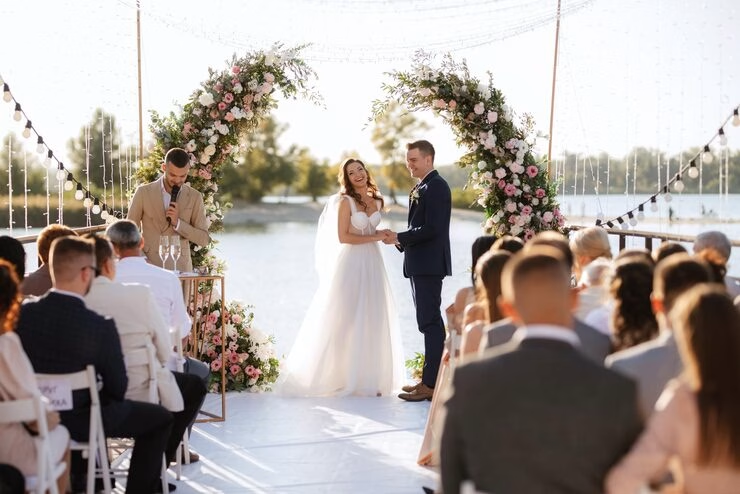
Up front, under the flower-covered arch, my brother Noah stood in a navy suit that probably cost more than all my tools combined. Beside him was Liam, looking confused and rigid, his eyes flicking from Noah to the murmuring crowd. The officiant shuffled his notes, clearly stalling.
My parents were off to the side, whispering urgently to a cluster of well-dressed guests. My mother’s smile was stretched so tight it looked painful. My father’s hand rested on her elbow, anchoring her in place like if he let go, she might bolt.
Then Laura saw me. Her mouth dropped open, and she grabbed the arm of the woman beside her—Liam’s mother. They both turned, their eyes locking on me.
In that instant, the sound in the courtyard seemed to dim, like someone turned down the volume.
“She’s here,” Liam’s mother whispered, loud enough that the few rows around her heard.
The whispers spread through the crowd like a gust of wind. Heads turned. People shifted, craning to see.
Noah followed their gaze and froze when he saw me—standing there in my black dress, work boots dusty from the gravel lot, hair pulled back in a no-nonsense knot.
For a second, we just stared at each other across the aisle that was supposed to carry him into a new life, one that did not include me.
His face went pale.
“Rachel,” he breathed.
The mic on his lapel caught it and sent my name rippling through the speakers.
I could have stayed in the back. Let them pretend I was some distant cousin who arrived late. I could have turned around, walked away, let them keep their fragile illusion intact.
But that was the old version of me—the one who apologized for existing.
I stepped forward into the aisle.
The coordinator reached out like she might stop me, then dropped her hand. No one moved. No one spoke. The only sound was the soft rustle of my dress and the crunch of petals under my boots.
“You told them I was dead,” I said, stopping halfway up.
I didn’t shout. I didn’t need to.
The mic on Noah’s chest picked up my words, feeding them through the speakers. Everyone heard.
Gasps rippled through the crowd.
Liam turned sharply to Noah. “What is she talking about?” he demanded.
My brother’s mouth opened and closed, but no sound came out.
My mother stood up abruptly.
“This isn’t the time,” she hissed. “Rachel, sit down. We can talk about this later.”
“You’ve had years to talk about it,” I replied, eyes never leaving Noah. “You chose to talk about me in past tense instead.”
Liam’s mother stood too now, her expression fierce. “They told us you were killed in a car crash,” she said, voice trembling with controlled anger. “They played a slideshow with a photo of Noah and his late sister last night at the rehearsal dinner.”
All eyes swung back to my parents, then to Noah.
The lie was no longer controllable. It was bleeding out in front of everyone.
“I was trying to protect you,” Noah said finally, his voice cracking.
“From what?” I shot back. “From the horror of having a sister who works with her hands, who built something without a degree you can brag about?”
He flinched.
“It’s not like that.”
“I have the recordings,” I said calmly. “The night you told me not to come. The night Dad said you’d tell them I was gone. Do you want me to play them, or will you tell them yourself?”
Murmurs swelled into a low roar. Some guests looked horrified. Others looked like they’d seen this kind of family performance before and were just waiting to see how bad it would get.
Liam took a step away from my brother, like the distance might help him see more clearly.
“You lied about your own sister being dead,” he said slowly, disbelief twisting his features. “To impress my parents?”
Noah’s eyes were shining now, panic and shame warring on his face.
“I panicked,” he said. “It got out of hand. They kept asking about my family, what everyone did, where you lived. I didn’t want them to judge you or me.”
“It started as a little lie and then—”
“And then you buried me,” I finished. “You buried me because my life didn’t fit your Instagram aesthetic.”
For a heartbeat, no one moved.
Then Marco’s voice cut through the murmurs.
I turned to see him standing at the back, having slipped in while I’d been focused on the front. He was still in his navy coveralls, arms crossed, watching the scene unfold.
“Funny thing about lies,” he said, loud enough for people around him to hear. “They always leave a stain. Doesn’t matter how much you dress them up.”
A few people chuckled, but it was strained. The officiant shifted uncomfortably.
“Perhaps we should take a short break,” he suggested. “Give the family a moment to—”
“No,” Liam said sharply, surprising everyone.
He turned fully to my brother, eyes bright. “I don’t want a break. I want to know if I’m about to marry someone who thinks people like your sister are disposable. Because my mother called her, not you. She’s the one who told us the truth, not you.”
Every word was another spotlight on the rot they had tried to hide.
My heart pounded, but I stayed where I was, rooted to the spot. I hadn’t come to destroy his wedding. I’d come to stop them from finishing the job of erasing me. What was burning down now was the carefully staged fiction they’d built on my grave.
The Reckoning
The courtyard had become a courtroom, and my family was on the stand.
I could see it in Noah’s eyes—the desperate calculations, the urge to salvage what he could. He looked at Liam, then at the guests, then back at me, trapped between the life he wanted and the lie he’d built to get it.
“I messed up,” he said finally, voice raw. “I thought if I made things look cleaner, it would all be easier. I didn’t want to explain why my sister didn’t go to college, why she works at a shop off the highway, why my parents still feel like they’re climbing out of the hole they grew up in. I was ashamed of our past, and I took it out on you.”
That word again. Cleaner.
This time, it tasted different in his mouth.
My mother stepped into the aisle now, heels clicking against the stone. Her face was flushed, eyes bright with something between fury and fear.
“Enough,” she snapped. “We have guests. This is your wedding day, Noah. Rachel, if you have any love for your brother left, you will stop this right now and sit down.”
I turned to face her fully.
“If I had sat down years ago, you’d have been a widow trying to pay the mortgage when Dad lost his job,” I said quietly. “Who picked up extra shifts at the gas station? Who learned how to change oil so we didn’t have to pay for it? Who missed exams so she could watch the kids you babysat for, so you could keep your precious side income?”
A flicker of guilt flashed across her face.
“That was your choice,” she said weakly. “We never asked you to.”
“You didn’t have to,” I cut in. “You just let me carry it and then pretended the weight never existed.”
The guests were silent again, pulled into the emotional gravity of a family history they’d never expected to witness.
My father finally spoke, his voice low.
“We grew up with nothing,” he said. “Your mother’s father was a janitor. Mine cleaned motel rooms. We were mocked for the smell of bleach on our clothes. We wanted more for you, for both of you.”
“More doesn’t mean pretending I’m dead,” I said. “You didn’t want more for us. You wanted distance from who you used to be. You wanted to pretend you never scrubbed floors.”
“So when I chose a path that looked like yours—just with engines instead of bathrooms—you decided I was a step backward.”
My mother’s shoulders sagged. For the first time, she looked less like a villain and more like a frightened woman clutching a flimsy shield made of other people’s opinions.
“I was terrified,” she whispered. “Terrified they’d look at us the way people used to. I thought if we acted like we’d always been like them, it would finally stop. The whispers. The humiliation.”
“So you humiliated me instead,” I replied. “You passed the shame down like a family heirloom. You didn’t break the cycle. You just handed it to the next generation, wrapped in nicer clothes.”
Liam’s mother nodded slowly, something like understanding crossing her face.
“We started with nothing too,” she said. “My father fixed fences for ranchers. My mother sewed clothes in the living room. If my son ever lied about them the way you lied about your daughter, I’d walk him down from that arch myself.”
A faint ripple of agreement moved through the crowd.
There it was. Immediate consequences.
My parents’ social armor was cracking in real time. Their fear of judgment had brought them exactly what they dreaded—a public reckoning.
Noah looked like he might be sick. He glanced at the guests, at Liam, at the arch heavy with flowers, like he was trying to decide whether to run or stand his ground.
“What do I do?” he whispered, more to himself than anyone else.
I took a breath. This was the moment I’d imagined in a hundred angrier versions of this story—me screaming, them weeping, everyone picking a side. But standing there, I realized revenge wasn’t just about making them hurt. It was about forcing them to see what they’d done and what it cost.
“You start by telling the truth,” I said. “Not just about me, but about us. All of it, right here, right now.”
The officiant, to his credit, stepped back and motioned for Noah to take the mic. The entire courtyard seemed to lean forward.
Noah swallowed hard, then turned to face the guests.
“My name is Noah Carter,” he began, voice shaking, “and I have lied to you.”
He told them about the call, about the fake story of my death, about the way he’d trimmed his past to make it fit the expectations he thought Liam’s family had. He admitted he’d asked me to stay away because he was embarrassed by what I did for a living. Each confession cost him. His face flushed, his hands trembled, but he kept going.
“My sister isn’t dead,” he finished. “She runs an auto-detailing shop off the highway. She works harder than anyone I know. She paid bills when my parents couldn’t, and I paid her back by acting like she was a stain on our family photo.”
He turned to look at me, eyes wet.
“I am ashamed. Not of her. Of myself.”
The silence that followed was different this time. Not shocked. Not scandalized. Heavy. Honest.
Then somewhere in the crowd, someone started clapping. A single pair of hands, then another, then another, until the courtyard filled with the rough, uneven sound of people acknowledging the truth. It wasn’t applause for a performance. It was for a crack in the polished surface, for the first real thing that had happened all day.
My mother sank back into her chair, tears streaking her mascara. My father stared at the ground, jaw tight, legacy crumbling at his feet. And me? For the first time, I felt like I was standing in my family story instead of watching it happen from outside the window.
The Choice
Once the clapping died down, all eyes shifted to Liam. This was his moment too—the day he’d planned to start a new chapter. Instead, he’d gotten an unedited view of the family he was marrying into.
He stepped forward, away from the arch, away from my brother, and turned to face me.
“Rachel,” he said, his voice steadier than I expected, “I don’t know you well, but I know this. You deserved better than a fake eulogy and a ghost seat at this wedding.”
A strained laugh rippled through the guests.
He continued, “I also know I can’t marry someone today if I’m not sure he knows how to stand up to his own fear. I love your brother, but I need to know.”
He turned to Noah now, eyes searching.
“Are you ready to build a life on truth, even if it’s messy? Even if your parents have to sit in their discomfort for a while?”
Noah swallowed, wiped his eyes with the back of his hand, and nodded.
“Yes,” he said hoarsely. “If you’ll still have me.”
Liam looked at his parents. His mother gave a small nod. His father, who’d been silent this whole time, finally spoke.
“We care more about how you treat people than we do about what they do for a living,” he said. “If you’re willing to own this mistake and treat your sister like she’s alive from now on, then you still have our blessing.”
There was a ripple of relieved laughter.
The officiant, sensing the tide turning, cleared his throat.
“We can still continue with the ceremony,” he said gently, “if everyone is ready.”
All eyes came back to me.
For years, I’d blurred myself at the edges of family photos, staying out of the way, minimizing my presence so they could have their curated narrative.
Now, they were waiting to see what I would do—give my blessing, or walk out and let the fracture become permanent.
I thought about the recordings on my phone, about posting them online, letting the internet judge my family, about burning every bridge I’d ever built with them. It would have been satisfying in a quick, sharp way—the kind of revenge that leaves everything scorched.
But I also thought about the mechanic who trained me for free because he saw a girl who wouldn’t quit. About Marco handing me his truck keys without hesitation. About the tech firm that trusted my shop with their entire fleet.
I already had a life built on sweat and honesty. I didn’t need to destroy everything behind me to prove my worth. I just needed to stop letting their shame dictate my direction.
“I’m not here to decide if your wedding happens,” I said finally. “That’s between you two. But I am done trying to earn a place in a family that only loves the polished version of me.”
I turned to my parents.
“Here’s what I learned today. Love that depends on my job title, my clothes, or how easily you can brag about me is not love. It’s PR. I’m not your PR project.”
My mother sobbed quietly into a crumpled tissue. My father looked away, throat working.
“From now on,” I continued, “I set my own terms. If you want me in your life, you use my name in the present tense. You don’t lie about me. You don’t shrink me to make anyone else comfortable. You don’t have to approve of every choice I make, but you will respect the fact that I’m making them.”
I looked back at Noah.
“As for you, I don’t know when or if I’ll fully forgive you. You buried me to please people you didn’t even know. That hurt in a way I can’t wrap words around yet. But you told the truth today when you could have kept hiding. That doesn’t erase what you did. But it’s a start.”
He nodded miserably.
“I’ll spend the rest of my life earning that forgiveness,” he said. “Not just from you, but from myself.”
I took a step back out of the aisle, returning the space to the couple it was meant for.
“If you two decide to get married today,” I added, “do it with your eyes open. Build something real. Not for me. For yourselves.”
Liam looked at Noah, then at the arch, then back at the guests, who now watched with a kind of raw, cautious hope.
“Well,” he said, exhaling sharply, “if we can survive this before the vows, maybe we’ve got a fighting chance.”
Laughter—this time genuine—broke out across the courtyard.
The officiant smiled, repositioned his notes, and gently guided everyone back into place.
The ceremony, shorter and simpler now, went on. When they finally kissed and the guests cheered, it felt less like a fairy tale and more like a hard-won truce with reality.
The Aftermath
Afterward, during the reception, people approached me one by one. A woman in a sleek navy dress told me her brother hadn’t invited her to his wedding because she was still working retail. A man in a tie loosened at the neck admitted he hadn’t talked to his son since he came out as gay.
“I’m going to call him tonight,” he said, eyes shining. “I don’t want him standing in some crowd one day telling a story like yours about me.”
The revenge I’d thought I wanted—the kind that leaves your enemies on their knees—was replaced by something heavier but cleaner: accountability, consequences, conversations that might actually change how people treated each other when the microphones were turned off.
As the evening wound down, I slipped out before the last dance, the Texas sky turning indigo over the hills.
My phone buzzed with a final text from my father.
“We’re sorry. We want to talk. When you’re ready.”
I didn’t respond. Not yet.
Healing, I realized, isn’t a favor you do for someone else. It’s a boundary you build for yourself, brick by honest brick.
I drove back to my shop in Marco’s truck, windows down, letting the warm air whip through my hair. The neon OPEN sign flickered faintly in the distance, waiting. That small, grease-stained building wasn’t a shameful footnote in my family tree. It was my proof that you can start with nothing and still build something worth being proud of.
And if you’re watching this wondering where your own worth fits in a world obsessed with titles and appearances, here’s what I hope you take away from my story. Your value isn’t measured by the softness of your hands or the shine of your résumé. It’s in the courage it takes to keep showing up as yourself, even when the people closest to you ask you to disappear.
The story of Rachel and Noah serves as a powerful reminder that shame passed down through generations doesn’t heal—it multiplies. My parents had spent their lives running from the smell of bleach and the memory of minimum wage, only to discover that the further they ran, the more they lost. They didn’t just erase me from the wedding. They erased the very strength that had kept our family afloat when everything else was sinking.
In the end, the biggest lie wasn’t the one they told Liam’s family. It was the one they told themselves: that respectability could be bought with silence, that love could survive on conditions, that you could build a future by burying your past.
I learned that day that you don’t owe anyone a smaller version of yourself just to make them comfortable. You don’t have to sand down your edges to fit into someone else’s frame. And you certainly don’t have to apologize for the hands that built you, even if they’re stained with the work others are too ashamed to claim.
My brother called three days later. Not to argue. Not to justify. Just to say he was sorry, and he meant it this time. My parents sent flowers with a card that said, “We’re learning.” It’s not enough yet. But it’s something.
As for me? I’m still at Highway Halo Detailing, still turning rust into shine, still building something real with my own two hands. The difference is, I’m no longer waiting for permission to be proud of it.
And that is the story of how a phone that wouldn’t stop ringing taught me that the people who try hardest to erase you are usually the ones who need you most—and how sometimes, the greatest act of love is refusing to disappear.