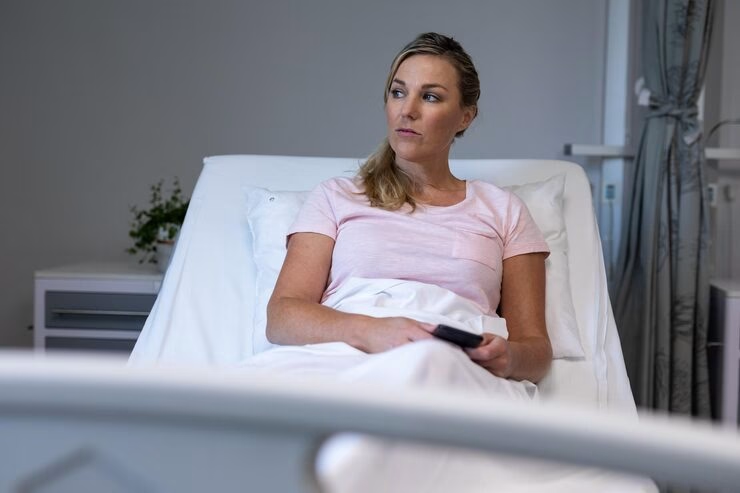
The Invisible Daughter
The pain hit me so hard I dropped the tray. Coffee splashed across the counter in a dark wave, ceramic mugs shattered against tile, and I had to grip the edge of the bakery display case just to keep myself from collapsing right there on the floor. For a second, everything around me—the rhythmic hum of the espresso machine, the cheerful chatter of the morning rush, the warm scent of cinnamon rolls and sourdough—blurred into a wall of meaningless noise. But the pain, that was sharp and immediate and real, like someone had reached inside my abdomen and twisted my organs into a knot.
“Naen, you okay back there?” My manager Julia called out from the register, concern threading through her voice.
I forced a smile, wiping sweat from my upper lip with the back of my hand. “Just a cramp,” I lied, my voice steadier than I felt. “Didn’t eat much breakfast this morning.”
It wasn’t the first time I’d said that. And it wasn’t remotely true. This wasn’t a cramp from skipping breakfast or drinking too much coffee or standing on my feet for six hours straight. For weeks—maybe months if I was being honest—the ache in my stomach had been growing progressively worse, starting as a dull throb after meals that I could ignore, then evolving into sharp, stabbing sensations that left me breathless and dizzy.
But I kept going. I couldn’t afford not to.
At twenty-seven years old, working part-time at Sweet Haven Bakery didn’t come with health insurance. Between rent for my studio apartment, groceries, student loan payments, and the money I contributed to utilities at my parents’ house because they’d asked and I’d never learned to say no, doctor visits were a luxury I couldn’t justify. I tried everything I could afford: generic pain relievers from the drugstore, heating pads pressed against my side until the fabric scorched, peppermint tea like my grandmother used to make me when I was little. Nothing touched the pain. So I worked through it, smiled through it, hid it behind a cheerful customer service voice until I physically couldn’t anymore.
The Diagnosis
That night after closing, I took the bus to the urgent care clinic near the shopping plaza on Riverside. The fluorescent lights buzzed overhead, harsh and unforgiving, while I sat clutching my stomach and filling out intake forms with hands that shook so badly my handwriting looked like a child’s. The doctor who eventually saw me was kind, middle-aged with tired eyes that suggested she’d seen everything twice. She pressed gently on my abdomen, asked careful questions about my symptoms, my diet, my family history, then straightened up with an expression I couldn’t quite read.
“I’m referring you to a gastroenterologist,” she said, writing something on her prescription pad. “I don’t want to speculate without proper diagnostics, but this could be something that requires surgical intervention.”
Surgical. The word made my blood run cold. Surgery meant time off work I couldn’t afford to take, hospital bills that would bury me, recovery time measured in weeks not days, money I didn’t have and couldn’t even imagine finding. Still, the fear in her eyes was enough to make me go to the specialist she recommended.
Dr. Patel was a soft-spoken man in his fifties who reviewed my scans with the careful attention of someone reading a difficult text. He asked me to point to where it hurt most, pressed methodically along my side, then pulled up images on his computer screen that looked like abstract art rendered in grays and whites.
“This is concerning,” he said, tapping the screen with one finger. “You have what appears to be a partial intestinal obstruction, possibly adhesions from an old infection or injury. If we don’t address this soon—and I mean within weeks, not months—this won’t just be painful. It’ll become dangerous. Life-threatening, potentially.”
I sat in his office nodding like I understood, even though all I could hear was the word dangerous echoing in my skull like a bell.
He handed me a folder thick with paperwork: procedure codes, cost estimates, pre-surgical instructions, recovery timelines. “Talk to your family,” he said gently. “See what your options are. But don’t wait too long.”
I walked home that evening in a daze, the folder pressed tight against my chest like it could somehow protect me from the dread settling into my bones. The numbers swam in my vision: $18,000 for the surgery itself, another $4,000 for anesthesia, $2,500 for the overnight hospital stay, additional costs for follow-up appointments and medications. Even with payment plans, it was impossible.
The Ask
That night, I waited until after dinner to approach my parents. Timing, I’d learned, was everything when asking for anything in our house. You had to catch them in the right mood, after they’d eaten but before they got too comfortable on the couch, when the television was on but not showing anything they actually cared about.
The dishwasher hummed its familiar rhythm in the kitchen. The television murmured something forgettable about weather patterns. Mom was picking at her teeth with a fingernail, and Dad was finishing the last of his sweet tea. I took a deep breath, squared my shoulders, and stepped into the living room.
“Can I talk to you both for a minute?” I asked, my voice smaller than I’d intended.
They looked at me like I’d just interrupted the State of the Union address. Dad muted the TV with an exaggerated sigh. Mom didn’t bother to hide her eye roll.
“Is this about the car again?” she asked, her tone already annoyed. “Because we already told you, Naen. We can’t afford to help you with a down payment right now.”
“No, it’s not about a car,” I said quickly. “It’s about me. I went to the doctor. Actually, I went to two doctors. They think I need surgery.”
Silence. Not the shocked, concerned silence of people who’d just learned their daughter was seriously ill. Just that hollow, uncomfortable silence that fills a room when nobody really wants to deal with what’s being said.
“Is this still that stomach thing?” Mom asked without looking up from her phone. “You’ve always had a sensitive stomach, Naen. Maybe just cut back on the fried food and dairy.”
“No,” I said, my voice cracking despite my efforts to stay calm. “They ran scans. They found something. It’s not going away on its own, and if I don’t get it fixed, it could get dangerous. I might need to have surgery within the next few weeks.”
Dad exhaled loudly, like I’d just asked him to co-sign a mortgage on a house he’d never live in. “Sweetheart, we’re in a really tough spot right now financially. Inflation’s killing us, and we’re still paying off that roof repair from last year. This really isn’t the best time for medical surprises.”
“I’m not asking you to pay for all of it,” I whispered, clutching the folder so hard the edges crumpled. “Just maybe help with part of it? I can put something down, I can set up a payment plan, I just can’t cover the whole thing by myself.”
Mom crossed her arms, her expression shifting to something that looked almost annoyed. “Have you looked into those medical loan companies? Or what about crowdfunding? Those websites where people raise money for their pets and mission trips and things. That’s what people your age do now, right?”
The way she said people your age—like I was some alien species she didn’t quite understand—made it perfectly clear: I was no longer their responsibility. Just an adult inconvenience who happened to still live under their roof and contribute to their bills.
I nodded slowly, my throat so tight I could barely swallow. “Okay. I understand.”
But I didn’t understand. Not really. I didn’t understand how the people who’d brought me into this world could look at me standing there in pain, holding documentation of a potentially life-threatening condition, and see nothing but an inconvenience. I didn’t understand how love could be so conditional, so carefully rationed, reserved exclusively for my younger sister Chelsea.
I walked back to my room without another word. Nobody followed me. Nobody called after me. The TV volume rose behind me, punctuating my invisibility. I sat on the edge of my bed, folders still clutched in my trembling hands, and stared at the worn carpet.
The same carpet I used to vacuum every Saturday as my assigned chore. The same floor where I’d spilled grape juice when I was nine and gotten grounded for a week. The same tiles in the kitchen that Chelsea had once cracked with her stiletto heels and gotten forgiven for because she was “just expressing herself.” I was never expressive. I was careful, responsible, quiet, convenient. And now I was hurting. And still nobody saw me.
The Mercedes
A week passed in a fog of pain and avoidance. The ache in my abdomen dulled but never left, a constant companion that I folded myself around like a terrible secret. I started moving slower at work, taking longer to bend down and retrieve fallen pastries, pausing mid-shift to press my hand against my side and breathe through the spasms. Julia noticed, offered to cut my hours, said I looked pale and exhausted and needed rest.
I begged her not to. I needed every dollar, every shift, every tip. I skipped breakfast to stretch my grocery money further. I took over-the-counter painkillers I couldn’t pronounce and drank herbal teas a coworker swore by. Nothing helped for long, but I stayed quiet. I didn’t bring up the surgery again at home. What was the point? They’d made it perfectly clear: I wasn’t worth the cost.
That Saturday morning, I was upstairs in my room folding laundry, staring blankly at the same faded college T-shirt I’d owned for nearly a decade, when I heard it: laughter. Loud, joyful, unmistakably celebratory. I moved to my bedroom window and looked down at the driveway.
A black Uber had pulled up. The door opened and Chelsea stepped out, looking like she’d walked directly off an Instagram influencer’s feed. Her honey-blonde hair fell in perfect waves around her shoulders. Her nails were freshly manicured in that trendy almond shape. She wore designer sunglasses that probably cost more than my monthly rent.
“Chelsea’s home!” Dad shouted from the driveway like she was a returning war hero. I watched him wave her over enthusiastically, beaming with unmistakable pride. Mom appeared from the garage, and that’s when I saw it.
A silver key with a ribbon tied around it. And behind them, sparkling in the late morning sun like it had descended from heaven itself, sat a brand-new white Mercedes-Benz.
Chelsea blinked once, twice, then let out a shriek so loud and piercing I flinched. She dropped her designer bags and ran into Mom’s arms, screaming, “No way! You got me a Mercedes?! Are you serious right now?!”
“You deserve it, baby,” Mom cooed, brushing hair away from Chelsea’s face with such tenderness it made my chest ache. “Straight A’s, Dean’s List three semesters in a row, that amazing internship. You’ve worked so incredibly hard.”
“Only the best for our girl,” Dad added, patting the hood of the car like it was a beloved pet. They were laughing, hugging, taking selfies. Chelsea did a little spin next to her new car, posing like she’d just won a pageant. Dad climbed into the passenger seat to demonstrate the touchscreen interface, the premium leather interior, the panoramic sunroof. Mom took video after video, already planning which ones to post on Facebook.
I stood behind my window blinds with socks still clutched in my hands, completely frozen.
They’d told me money was tight. They’d said they were still paying off the roof. They’d implied that helping with my surgery was financially impossible, that inflation had hit everyone hard, that this just wasn’t the right time for unexpected medical expenses.
But now they were dancing in the driveway, handing my twenty-three-year-old sister a car that could have paid for my surgery three times over with money left for recovery expenses.
It wasn’t the car that hurt. Cars can be sold, returned, regifted. It was the message underneath the bow: Too expensive for me, but not for her. Your life isn’t worth what her happiness is worth.
I stood at that window for a long time after they went inside. Watched Chelsea take dozens of photos with her new Mercedes from every conceivable angle. Watched Mom and Dad look at her like she was the sun itself, the source of all light and warmth in their world. Nobody glanced up at the second-story window where I stood. Nobody thought to check on me, to see if I was okay, to wonder if maybe I might want to be part of this family celebration.
That night, I stayed in my room. Skipped dinner entirely—not because I wasn’t hungry, but because I couldn’t sit across the table from them. Not after that. Not after understanding with brutal clarity exactly where I ranked in this family’s priorities.
I scrolled through Chelsea’s Instagram instead, watching her posts multiply. Her leaning against the hood of the car with one foot popped, designer sunglasses tilted perfectly, smile radiant and practiced. The caption read: “Manifestation works ✨ Dream big babes”
The comments flooded in immediately: “OMG you deserve this queen!” “So proud of you!” “Literally goddess energy!” She hadn’t mentioned it was a gift. Hadn’t said our parents paid for it. Why would she? Let the world think she’d earned it through her own hard work and success. Let them worship the carefully curated version of her life.
Meanwhile, I lay in bed clutching a heating pad against my side, wondering if the growing pain in my abdomen was slowly becoming something that would kill me. And even then, even in that moment of clarity, I felt guilty for being bitter. Guilty for comparing. Guilty for wanting what she had.
Grandpa Harold
Thursday afternoon arrived heavy and gray. I’d just finished a brutal double shift, my body feeling like it weighed twice its normal weight, every step a negotiation with pain. I dragged myself through the front door of my parents’ house, heading straight for the kitchen and the promised relief of ginger tea.
Then I heard it. Three deliberate knocks on the front door.
I froze. We weren’t expecting anyone. Mom and Dad had left for their weekly grocery run an hour ago. Chelsea had already returned to campus, promising to “take such good care of her baby” like the Mercedes was a living creature that required emotional nurturing.
I shuffled to the door, unsure whether to even answer, when I heard the voice.
“Hello? Anybody home?”
My breath caught. Grandpa. I hadn’t seen Harold Given in weeks, maybe months. He wasn’t the drop-in type—he was the holiday-and-birthday kind of grandfather, old-fashioned and proper, always calling ahead to announce his visits. I opened the door and there he stood, tall despite the cane, wearing his brown wool coat buttoned neatly against the autumn chill, sharp gray eyes scanning me with an intensity that made me feel suddenly transparent.
“Hi, Grandpa,” I said, stepping aside to let him in. “Mom and Dad aren’t here right now.”
“I didn’t come to see them,” he said plainly, his voice carrying that quiet authority he’d cultivated over forty years as a lawyer.
I blinked. He stepped inside, leaning his cane carefully against the wall. Then he looked at me again—really looked, the way people do when they’re actually seeing you rather than just registering your presence.
“You look terrible,” he said, voice calm but cutting. “Are you sick?”
I shook my head too quickly. “Just tired. Work’s been crazy busy.”
He didn’t move, didn’t look away. “You’re sweating. And pale. And you’re holding your side.”
“I just got home from a long shift. It’s warm outside.”
He clearly didn’t buy it. Without asking permission, he pulled out a kitchen chair and lowered himself into it slowly. “Sit,” he said, tapping the chair across from him with one finger.
I hesitated, then obeyed. The pressure in my gut was still there, sharp and insistent, but now my chest felt heavy too. I avoided his eyes, busying myself with straightening a napkin that didn’t need straightening.
“What’s going on, Naen?” he asked. His tone wasn’t soft exactly, but it wasn’t harsh either. Just firm and expectant, wrapped in something that felt like genuine concern.
I opened my mouth, then closed it. Shook my head. “Nothing, Grandpa. Really. I’m just dealing with some things. Work stuff.”
“Has a doctor seen you?”
Silence stretched between us.
“Naen,” he said again, more insistent.
I swallowed hard. “They think I might need surgery. For my stomach. Something about an obstruction.”
His eyebrows raised slightly. He leaned forward, elbows on the table. “What kind of surgery? How serious?”
“They’re not entirely sure yet, but it could be dangerous if I don’t get it taken care of soon. It’s just… it’s expensive. Really expensive.”
His weathered hands folded together slowly. “Did you ask your parents for help?”
I nodded, unable to meet his eyes. “They said they’re tight on money right now. They suggested I try crowdfunding or medical loans or something.”
I expected some visible reaction—disappointment, confusion, maybe sympathy or anger. Instead, there was just stillness. A deep, terrifying stillness. He sat completely motionless, staring at the kitchen table like it had personally offended him. The temperature in the room seemed to drop ten degrees.
Then he spoke, his voice cold and clinical. “I saw Chelsea’s new car on Facebook this morning. Brand new Mercedes-Benz, white with chrome trim. Looked extremely expensive.”
I didn’t respond. There was nothing to say. We both knew exactly what that meant.
Grandpa stood up slowly, deliberately, like a judge rising to deliver a verdict. Then he did something I hadn’t felt in years—something I’d almost forgotten was possible. He walked around the table and hugged me. Not a casual side-hug or a polite pat on the shoulder. A full, firm embrace, one hand pressed gently against the back of my head.
My throat closed up immediately. That was all it took. One genuine gesture of care and I nearly crumbled completely.
He pulled back, looked me directly in the eyes with an intensity that made me feel simultaneously seen and protected, and said just six words: “I’ll take care of it, Naen.”
Then he picked up his cane, nodded once with absolute finality, and walked out the door. He didn’t ask for additional details about the surgery. He didn’t wait for thanks. He didn’t need explanations or justifications. He had seen me—really, truly seen me—and decided I was worth helping.
And in that moment, I wasn’t invisible anymore.
The Dinner
Sunday dinners at Grandpa’s house were a sacred tradition in our family. Rain or shine, holiday or ordinary weekend, we gathered at his table. Always at five o’clock, always with the same menu: roast chicken, creamy mashed potatoes, green beans with almonds, and his famous blueberry pie that had won ribbons at the county fair decades ago.
But this Sunday felt different from the moment Grandpa called earlier in the week. He hadn’t called Mom or Dad—he’d called me directly.
“I’d like you to come to dinner this Sunday, Naen,” he’d said, his voice clipped and businesslike. “All of you. Your parents, Chelsea if she’s available. There’s something important I need to discuss with the family.” His tone left absolutely no room for excuses or postponements.
When we arrived, the house looked exactly as it always did—quiet, immaculately neat, with the comforting smell of herbs and roasting meat wafting from the kitchen. The dining table was already set with military precision: napkins folded into perfect triangles, silverware aligned with ruler accuracy, water glasses positioned at precise angles.
But the air itself carried something different. A current of tension, something unspoken and heavy that made the usual comfort feel strained.
Chelsea walked in first, her heels clicking against the hardwood floor like punctuation marks. She didn’t even remove her designer sunglasses before announcing breathlessly, “You guys, I have gotten at least twenty compliments on my car this week! It’s absolutely insane! I’m like low-key famous on campus now.” She laughed, tossing her perfect curls over one shoulder.
Dad chuckled warmly. “You deserve every bit of it, sweetheart. That car is a well-earned reward for all your dedication and hard work.”
Mom nodded eagerly, beaming at her favorite daughter. “You’ve made us so incredibly proud, Chelsea. You always do.”
I didn’t say anything. I just pulled out my chair slowly, carefully, keeping my eyes focused on my empty plate. It wasn’t jealousy anymore. It was something deeper—a kind of ache that comes from realizing your own family is proud of someone else’s reflection in the mirror but has never actually bothered to look at you.
We ate mostly in tense silence, aside from Chelsea enthusiastically recounting her classes, her brilliant professors, and how literally everyone in her sorority was obsessed with her new car. I picked at my food, the pain in my stomach still simmering beneath the surface like coals that wouldn’t quite go out.
Then, without any warning, Grandpa stood up. The clinking of forks against plates stopped immediately. Even Chelsea went quiet, looking up from her phone. Grandpa’s eyes swept across the table, pausing just long enough on each person to make everyone shift uncomfortably in their seats.
“I’ve been thinking a great deal about family lately,” he began, his voice low but carrying absolute authority. “About what it truly means to show up for the people who need us most. And I’ve come to a decision that’s been a very long time coming.” He paused, letting the silence thicken and expand. “I’ve rewritten my will.”
My heart thudded once, hard enough that I felt it in my throat.
Chelsea looked up sharply from her phone. Mom’s mouth fell open slightly. Dad set down his fork with a soft clink.
“All of my assets—my house, my savings, my investments, every dollar I’ve worked for and set aside over seventy-six years—will go to the person in this family who has been consistently left behind when she needed support the most. The one who has carried herself with quiet dignity even in suffering. The one who has been overlooked while others were celebrated for far less.” He looked directly at me, only at me. “That person is Naen.”
The room went utterly silent. Mom blinked rapidly. Dad looked like he’d just swallowed broken glass. Chelsea’s mouth opened, but no sound came out.
Grandpa pulled a small stack of papers from the inside pocket of his blazer and laid them on the table like evidence being presented in a courtroom. “These are Naen’s medical records,” he said, tapping the top sheet with one finger. “Scans, specialist recommendations, cost estimates for a surgery she desperately needs. The same records she brought home last week, hoping desperately for family support.”
He laid down a second sheet of paper with deliberate precision. “And this,” he said, his voice sharpening, “is the invoice for the Mercedes-Benz.”
He didn’t raise his voice. He didn’t need to.
“I find it absolutely remarkable,” he said quietly, each word chosen with surgical precision, “that there was money available for luxury vehicles but somehow not for life-saving medical care.”
Chelsea’s face flushed deep red. “I—I didn’t ask for the car,” she stammered. “It was a surprise. I didn’t know—”
Grandpa nodded once. “That’s absolutely true. You didn’t ask for it. But you also didn’t ask if your sister was okay. You didn’t notice she was in pain. You didn’t wonder why she’d stopped coming to family dinners.”
The room felt like it was cracking open, emotion flooding in through the fractures.
He turned back to Mom and Dad, his expression hardening further. “And neither did you. You didn’t ask. You didn’t notice. You saw one daughter’s academic achievements and social media presence, and you completely forgot that the other one was quietly breaking apart in your own house.”
Mom’s lips trembled. Dad rubbed his forehead like he could physically wipe away the shame. Grandpa shook his head slowly.
“Life isn’t about playing favorites. It’s not about who shines brighter in public or who’s easier to brag about at church. It’s about who needs you, when they need you, and whether you choose to show up. When Naen needed you most, you vanished completely.”
Chelsea stared down at her lap. The air was so thick with tension I could barely breathe.
Then, softer but somehow more devastating, Grandpa said, “That ends today. She’s no longer invisible. Not here. Not to me. Not anymore.”
I couldn’t speak. I didn’t trust my voice. I looked up at him through eyes burning with unshed tears and saw something I hadn’t seen in anyone’s eyes in longer than I could remember: respect. Not pity, not obligation, not the conditional affection that evaporates when you stop being useful. Just pure, unshakable belief that I was inherently worth seeing and protecting.
The Surgery
The next morning, Grandpa was waiting in his car outside my apartment when I stepped onto the porch. He didn’t say much—just a small nod, a gentle pat on my shoulder, and a firm, “Let’s go, kiddo.”
I didn’t ask where. I didn’t need to.
Three hours later, we pulled into the driveway of a private hospital in Charlotte. It looked like something from a luxury magazine—pristine white stone walls, manicured landscaping with blooming azaleas, tall glass windows that sparkled in the autumn sunshine. Too clean, too perfect, too expensive for someone like me.
My hands clenched in my lap. I couldn’t breathe properly. The only hospitals I’d ever been in were overcrowded public facilities with fluorescent lighting and waiting rooms that smelled like industrial cleaner and desperation.
“Grandpa, I can’t afford to even walk through those doors,” I whispered.
He turned off the ignition and looked at me. “You’re not paying for anything. I am. End of discussion.”
And that was that. No argument, no negotiation, just love wrapped in absolute certainty.
He walked me inside, filled out every single form, signed every document, answered every question the receptionist asked like he’d done this a thousand times before. It was like watching a general methodically execute a campaign, with my pain and fear as the enemy to be defeated.
I was admitted that same day. A team of specialists ran new scans, confirmed the diagnosis—severe adhesions causing partial obstruction, high risk of complete blockage—and scheduled surgery for the following morning. The lead surgeon explained risks and recovery timelines. I nodded numbly, only half-hearing him.
I’d been dealing with things alone for so long that the concept of someone else taking charge felt surreal, almost dreamlike.
That night, Grandpa sat beside my bed in the quiet pre-surgical suite. He brought me ginger ale and saltines I couldn’t eat. He told me stories about his younger days—about the time he’d chased down a shoplifter while still wearing his courtroom suit, about the summer he’d taught himself to sail and nearly capsized in a thunderstorm.
He didn’t mention my parents. Didn’t bring up Chelsea or the Mercedes or the devastating dinner conversation. Didn’t comment on the shame that had been written across their faces. He just sat there and stayed, his presence alone saying everything that mattered: You are not alone. You matter. I’m here.
When nurses came to prep me for surgery the next morning, I was shaking—not primarily from fear of the procedure, though there was plenty of that, but from everything that had built up inside me over the years. All the silence, all the second-place finishes, all the times I’d been the extra, the afterthought, the daughter nobody bragged about.
Grandpa held my hand all the way to the operating room doors. “You’re going to be just fine,” he said softly. “And when you come out of this, you’re going to start over. This time with people who actually see you for who you are.” Then he smiled—small but absolutely certain. “And that starts with me.”
The surgery lasted nearly five hours. Complicated, delicate work to remove adhesions and repair damage. The first few days of recovery were brutal—deep, stubborn pain that medication could only dull, not eliminate. But this time, I didn’t suffer alone.
Grandpa came every single day without fail. Sat by my hospital bed, held my hand when I winced, read me the newspaper when I was too tired to talk. There was no pressure to heal faster, no rush to get back to normal, no guilt for being slow or difficult or needy. Just steady, unwavering presence.
For the first time in years—maybe ever—I didn’t feel like a burden. I didn’t feel like someone constantly trying to justify their existence. I felt like someone being cared for simply because they mattered, not for what they could provide or achieve but just for being themselves.
Beginning Again
By the time I was discharged three weeks later, spring had begun its gentle arrival. Trees outside Grandpa’s house bloomed with dogwoods and tulips, soft pinks and whites reaching toward a sky so blue it looked painted.
He brought me home to his house, not to my parents’. He didn’t ask permission. I didn’t resist.
We settled into a rhythm that felt like healing made tangible. Mornings were quiet—tea on the back porch, birdsong providing a gentle soundtrack, the rustle of newspaper pages. Afternoons were slow walks through his garden, my steps tentative at first but growing more confident each day. Evenings were filled with old movies and stories I’d never heard before.
It wasn’t dramatic. It wasn’t loud. It was simply, profoundly healing.
My parents called once. Just once. Mom’s voice was tight, artificially cheerful. “Hey honey, just wanted to check in. Heard everything went well with the surgery.”
I confirmed it had. She paused, clearly waiting for something. I didn’t fill the silence.
Then she cleared her throat. “Chelsea feels terrible about everything, you know. She says she had no idea you were that sick. And your father, well, you know how he is. Not great with emotional stuff.” Another pause, longer this time. “We’d really love to have you back for dinner soon. As a family.”
I stared at the phone, watching Grandpa tend his tomato plants through the kitchen window. For a moment, the old version of me stirred—the girl who would have said yes immediately just to keep peace, just to feel wanted for a few hours.
But that girl didn’t live here anymore.
“I appreciate that,” I said carefully, “but I’m not ready yet. Maybe someday.”
Mom didn’t know what to do with that answer. She hung up shortly after, her voice faltering into a mumbled goodbye.
Chelsea texted once too: hey sorry if i made things worse i didnt mean to
No punctuation, no capitals, just enough words to ease her conscience without requiring actual effort or reflection. I didn’t respond. I wasn’t angry anymore—I was just finished. Done waiting to be seen. Done trying to earn love that should have been given freely. Done shrinking myself to fit into corners of a family that had never made room for me.
Instead, I started over. Applied for online nursing classes—something I’d always wanted to pursue but never had because someone else’s needs or dreams always came first. Grandpa cheered when I got accepted, even brought out a bottle of cider he’d been saving since the nineties.
“Better to celebrate this than any holiday,” he said, raising his glass with genuine pride.
One afternoon several months later, we sat on the back porch in comfortable silence. The wind carried the scent of cut grass and new leaves. Grandpa leaned back in his chair, eyes closed, face peaceful.
I looked at him for a long time—at the lines etched in his face, the steady rise and fall of his chest, the quiet strength that had carried me when I couldn’t carry myself.
“Do you ever regret it?” I asked suddenly.
He opened one eye. “Regret what?”
“Calling them out. The will. Everything.”
He was quiet for a moment. Then he said, “I regret not doing it sooner. I regret the years I watched them treat you like an afterthought and didn’t say anything.”
I smiled—the kind that starts deep in your chest and spreads outward like warmth.
He reached over and patted my hand once. “Don’t ever wait for permission to take up space in your own life, Naen. You don’t need anyone’s approval to matter.”
I nodded, and for the first time, I actually believed it.
Now when I think about family, I don’t think about shared last names or blood relations. I think about who shows up when everything falls apart. Who sees you not just when you’re shining but when you’re breaking. Who chooses you not because they have to, but because you’re worth choosing.
I am not invisible. I never was.
They just didn’t bother to look.
But I do now. And so does he.
And that, I’ve learned, is more than enough.





Wonderful Heartfelt story. I enjoyed reading it and it also confirmed a lot of my thoughts about family. I was lucky enough to live in a family that saw each one of us separately and with love.