The Ledger of Silence
For seven years, I purchased my sister’s future in monthly installments. I bought her stethoscope, her textbooks, her rent, and the pristine white coat she wore like a coronation robe. When she finally graduated, she didn’t hand me a diploma or a thank-you card. She took me to court.
Her argument? That I had manipulated our grandfather into leaving me his modest inheritance. Her justification?
“Your only job is to sacrifice,” she had told me, her voice as cool and sterile as the hospital corridors she now walked. “That is your place in this family.”
During the inheritance hearing, I didn’t scream. I didn’t cry. I simply handed the judge an envelope. And then, the Honorable Justice Harrison—a man who had likely seen every variation of human greed pass before his bench—looked at my sister, looked at the evidence, and did something I had never seen a judge do.
He burst out laughing.
My name is Ashley Cole. I am thirty-three years old, the eldest child, and the designated “fixer” of messes my family refuses to acknowledge. I work as a private investigator. It sounds glamorous on TV, but in reality, it’s a life of skip traces, background checks, insurance fraud, and photographing the occasional spouse who isn’t actually “working late.”
I notice small things. I listen for the pauses in conversation that people hope I’ll miss. I track the flow of assets and the leakage of truth. In my family, however, these skills didn’t make me respected—they made me the mop. If something broke, I glued it. If someone cried, I paid.
Seven years of that. Seven years of financing Nora’s tuition, her exam fees, her scrubs, and the textbooks she sold back for cash she kept. Seven years of telling myself, When Nora becomes a doctor, it will all have been worth it. We are a team.
I learned to live lean. I ate instant noodles until the sodium made my fingers swell. I wore cheap boots that leaked when it rained. I drove a sedan that sounded like a drum line whenever I idled at a red light. I took surveillance gigs in the dead of winter that froze my bones, just to cover her spring semester lab fees.
My mother called me “resourceful” when she needed something. She called me “obsessive” when I tried to set a boundary. My father called it “being strong,” which, in the lexicon of the Cole household, always meant “being a wallet.”
I thought I knew the rules of the game. I thought I was buying love, or at least loyalty. But the night everything shifted, I realized I hadn’t been buying anything. I was just paying rent for the privilege of being used.
The Kitchen
It started in my mother’s kitchen on a Tuesday evening. The room was dominated by fake marble counters and a refrigerator that hummed aggressively, like a nervous throat clearing itself. I had come by with a bag of groceries because my mother had texted, We’re a little short for dinner, sweetheart.
I was at the island, chopping onions, when my sister swept in.
Nora didn’t walk; she arrived. She had her fresh white coat folded over her arm, handling it with the reverence one might reserve for a religious artifact.
“Take tomorrow off,” Mom said from the stove, not looking at me. “Nora needs you to drive her downtown. It’s the White Coat Ceremony.”
“I already plan to go,” I said, the knife rhythmically hitting the cutting board. Chop. Chop. Chop. “I cleared my afternoon schedule.”
Nora opened the mail on the counter, spreading envelopes out as if she owned the surface of the earth. “You’ll be on time, right? Don’t pull your P.I. thing where you go ghost because you’re following some cheating husband.”
“I have never missed an event,” I said.
She didn’t look up. “You miss a lot, Ashley. You just hide it by paying for things.”
The comment stung, sharp and sudden, like a paper cut with lemon juice in it. But I kept chopping. Onion tears are useful camouflage.
Then my mother added, almost gently, like she was sliding a knife under a tight knot to loosen it: “Your only job is to sacrifice, honey. That’s your place in this family.”
I set the knife down. The silence in the kitchen suddenly felt heavier than the humidity outside.
“My job?” I asked.
“You know what I mean,” Mom said, her eyes soft but her voice hard, like granite wrapped in velvet. “You’re good at support. You aren’t… you aren’t made for center stage. Let Nora shine. She’s the one who is going to save lives.”
Nora finally looked at me, offering a small, clinical smile—the kind you give a patient before you tell them the prognosis is poor. “It’s not that complicated, Ash. You were made for the background. Some people are the painting, some people are the frame.”
Something tilted inside me. My hands were steady, but the floor felt slightly wrong, as if a photo on the wall had been hung crooked. I wanted to say a hundred things. I wanted to scream about the credit card debt, the skipped meals, the years of my life I had poured into her “shine.”
I said nothing.
I wiped the cutting board, bagged the onion halves, and told myself, Smile tomorrow. Clap for her. Swallow it. She has earned this.
I didn’t know then that the “background” was about to become the battleground. Because later that same week, Grandpa Henry died, and the family group chat lit up like a police siren.
The Inheritance
Nora: We’ll do the inheritance hearing after my residency match. Timing matters. Mom: Ashley can file the papers. She knows how to deal with the courts. Me: Okay.
That was the first mistake: saying “Okay.” The second was believing I still understood the rules of engagement.
Grandpa Henry wasn’t rich, but he was meticulous. He had a paid-off house in the suburbs with peeling paint but good bones, a little lake cabin three hours north, a modest investment account, and a 1958 Omega watch he would wind whenever he told a long story. He also had a soft spot for me and a harsh intolerance for lies.
He once told me, while we were fishing off the dock of that cabin, “Nobody can fake the sound of an honest ‘no,’ Ashley. But a fake ‘yes’ sounds like plastic.”
I didn’t get it then. I do now.
When I turned twenty-six, I started paying Nora’s tuition because our parents couldn’t. My dad’s back had given out, forcing an early retirement, but his golf swing miraculously remained intact. My mom had stretched her savings thin, though somehow the living room acquired a new leather couch set and a crystal chandelier that made the dining table look strangely short.
Nora got into a prestigious medical school. Everyone cried tears of joy. I looked at the numbers and cried internal tears of panic.
It started with a semester. Then a year. Then seven.
“The loans are in your name for now because your credit score is better,” Mom had said, patting my hand. “We’ll refinance when Nora is licensed. We’re a team.”
I paid what financial aid didn’t cover. I caught overdraft charges, exorbitant cell phone bills, and an apartment deposit that bounced because Nora’s landlord was shady. I told myself I was investing in a person, not a mutual fund. I told myself that family was the one investment that never depreciated.
The family chat read like a corporate memo written by people who were allergic to accountability.
Mom: Nora is our priority right now. Dad: We’re all making sacrifices. Me: I’ve got this semester covered. Transfer sent. Nora: Thanks.
Sometimes “thanks” came with a heart emoji. Sometimes it came with a list of demands. Books. Lab fees. The Step 2 exam prep course. “The good course,” she’d add. “Mine expires on Tuesday.”
My work scaled to meet her needs. I took cases I hated. I sat through eight-hour stakeouts in a freezing car, drinking stale coffee, peeing in a cup because I couldn’t risk leaving the post. I learned which pawn shops would give me decent cash for my camera gear when a client paid late.
At family dinners, I ate quietly and listened to plans I was not included in. Mom talked about Nora’s future private practice, the decor of her waiting room. Dad made jokes about me catching cheaters, reducing my career to a punchline.
Nora would tap away on her phone and say things like, “I don’t have time to sleep, much less budget. You guys don’t understand the pressure.”
I would nod, finish my water, and then slide my debit card across the table when the check came. The waitress always handed it to Dad. Dad always handed it to me without making eye contact.
Then came Residency Match Day. Balloons, confetti, photos with captions like, Proud of our future doctor! I was behind the camera, adjusting the focus.
Mom took my elbow and whispered, “By the way, about Grandpa’s will. Be reasonable.”
My stomach tightened. “Reasonable how?”
“You know, Nora made real sacrifices to get here,” she whispered, swirling her wine. “She deserves the house. She’ll need the equity to start her life. The will hasn’t been read yet, but… please don’t be difficult.”
The will was read on a rainy Tuesday in a conference room that smelled faintly of toner and old dust.
Grandpa Henry left the lake cabin to Nora and me jointly, “for peace and shared summers.”
He left the investments divided sixty-forty in my favor, “in recognition of services rendered.”
He left the 1958 Omega watch to me.
And he left the house—the house my mother so desperately wanted for Nora—entirely to me.
There was a letter attached with my name on it, and a single line in the preamble that made my throat burn: To the one who paid the bills she didn’t owe.
Mom’s smile stayed glued on, but her eyes underwent a terrifying transformation. Dad asked the lawyer how “flexible” the language was. Nora made a joke about buying a decent coffee machine for the cabin, then looked at the numbers for the house and went silent.
The next day, there was a new group chat without me. I saw the screenshots later.
Mom: Ashley will give up the house. She doesn’t need the space. Nora: She loves control. She’ll make it about the watch. It’s petty. Dad: We’ll handle it. Our girl is sentimental. She’ll fold.
What I did get was a call.
“Hey,” Nora said, her tone casual, as if asking to borrow a sweater. “You should sign a quitclaim deed on the house. It’s cleaner. I’ll pay you out when I’m settled in a few years.”
“How much?” I asked.
“We’ll figure it out. Do the right thing, Ash. You don’t even want a house. You live like a nomad.”
“I do,” I said, my voice surprising me with its steadiness. “I want the house.”
Her voice went flat. “Don’t be selfish. Grandpa wanted what was best for me. He was old, Ashley. He probably got confused. He wrote it down wrong.”
“He was sharper than any of us,” I said.
“You’re obsessed with rules because you don’t understand love,” she snapped. “That’s why you’re alone.”
That one cut deep, slicing through the armor I wore. But I still didn’t say no. I said, “Let’s talk after your graduation.”
Two weeks later, I got served.
Nora had filed a petition to contest the will and a separate civil claim for “Restitution of Family Support Funds,” alleging I had unduly influenced Grandpa Henry during a period of cognitive decline.
The language sounded like a bad TV drama. Undue influence. Coercion. Fiduciary breach.
The attached evidence looked familiar. Photos of me leaving Grandpa’s house with a folder. Screenshots of me texting Grandpa: Can I swing by later with forms? Copies of checks I’d written with “Tuition” in the memo line, re-captioned as proof of my “controlling financial grip” on the family.
I called Nora. She picked up on the second ring.
“Court,” she said simply.
“You’ll be fine,” I said, mocking her usual reassurance to me.
She sighed, a sound of immense condescension. “Don’t be dramatic, Ashley. It’s just the cleanest way. The judge will understand that the house was meant for the successful sibling. You can afford a lawyer. This isn’t personal.”
“It is entirely personal,” I said.
She raised her voice for the first time. “You don’t get to make this harder! Your only job is to sacrifice! That’s your place in this family!”
Click.
I stared at my phone, then at the manila envelope sitting on my desk. The one containing seven years of receipts, bank transfers, loan statements, and one thing she hadn’t thought I’d ever keep.
I slid the envelope into my fireproof safe. I sat down in my office chair, and for the first time in a long time, I let myself be angry all the way through. I didn’t cry. I didn’t bargain. I planned.
The Courtroom
The inheritance hearing was set for a Thursday morning. The sky was a bruised purple, threatening a storm that wouldn’t break. I wore the only suit I own—a charcoal gray number I reserve for funerals and the rare client who insists on paying in person.
In the hallway outside the courtroom, my mother was smoothing Nora’s hair like she was still eight years old. Dad approached me, hands in his pockets, jingling his keys.
“We can still settle this like adults, Ash,” he said, avoiding my eyes. “Just sign the paper.”
Nora stayed on her phone, scrolling rapidly. She glanced up, saw me, and said, “Try not to be theatrical, Ashley. The judge is going to see right through you.”
“I’ll do my best,” I said.
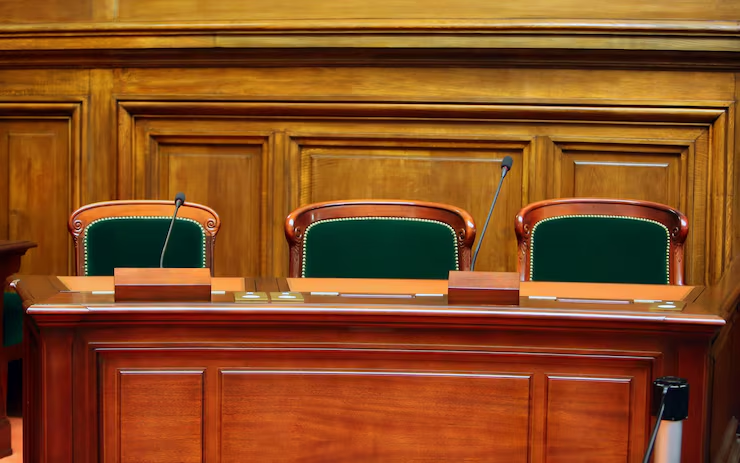
Inside, the courtroom was a study in beige: beige benches, beige walls, a sleepy clock ticking away the seconds of people’s lives. The judge, the Honorable Justice Harrison, wore half-moon glasses and possessed the demeanor of someone who has seen every possible way a family can rip itself apart over a house with peeling paint.
Nora’s attorney sounded expensive. His suit was tailored, his voice a rich baritone. My attorney was Eva, a friend from law school who knew me back when I was just the girl who could find anyone’s locker combination in under a minute.
Nora went first. Her voice was calm, clinical, practiced. She framed the lawsuit as an act of protection.
“My sister isolated our grandfather in his final year,” she testified, looking earnestly at the judge. “She inserted herself into his financial decisions. She conditioned her support of the family to gain leverage. She used his dementia against him.”
I watched the judge’s eyebrows. They didn’t move.
Her attorney held up printouts—grainy photos of me at Grandpa’s, text logs that made me look like I controlled his schedule. “She was the gatekeeper, Your Honor. She manipulated a confused old man to steal the inheritance that was promised to the family’s future doctor.”
None of it was fake. It just wasn’t the whole truth. It was a lie built from true bricks.
Then, it was my turn.
Eva stood up. “Ms. Cole, where did your disposable income go for the last seven years?”
“To Nora,” I said clearly.
“Why?”
“Because she wanted to be a doctor. And I believed in her.”
Nora snorted softly from the plaintiff’s table. Mom glared at me like I had insulted God himself.
Eva nodded to me. I reached into my briefcase and pulled out an envelope. It was thick, ugly, and rubber-banded like a brick.
I walked it to the clerk. “Financial records,” I said. “Every transfer with memos. Every rent payment. Every exam fee. Every scrub top. Every textbook.”
The judge accepted the exhibit, flipping through the pages. The sheer volume of it made a thwack as he set it down.
“And one more thing,” I said.
I pulled a second envelope from my jacket pocket. Smaller. Cream paper. Yellowed at the edges. I had found it in Grandpa’s desk the week after he died, tucked under his chessboard. It was addressed to Nora. I had never opened it. I had considered burning it.
I handed it to the bailiff.
“Your Honor,” I said, “this is a letter my grandfather left for my sister. I didn’t read it. She should.”
Nora looked confused for the first time all morning. She took the letter with careful fingers, broke the seal, scanned the page, and froze. Color rose to her cheeks, violent and red.
Eva continued like we had choreographed it. “We also submit Exhibit C,” she said, sliding a stack of screenshots across the table. “These are messages from Nora Cole to her friends and to our client’s mother, in which she wrote: ‘Keeping the tuition loans in Ashley’s name is safer for me because I can always guilt her if something happens.'”
There was a gasp from the gallery. Mom put a hand over her mouth.
“There is more,” Eva said. “She also wrote, immediately after the will was read: ‘I intend to scare her with a lawsuit so she’ll give up the house. She’s weak. She’ll fold.'”
Nora’s attorney jumped up. “Objection! Foundation!”
Eva laid the foundation seamlessly. Metadata. Timestamps. The digital fingerprint of betrayal.
The judge flipped through the screenshots, then turned to Nora. “Counsel, do you contest the authentication of these messages?”
He whispered with Nora. She was shaking her head, pale now. “We… reserve, Your Honor.”
“Noted,” the judge said, his voice dry as sand.
I wasn’t finished.
“Your Honor,” I said, standing up. “May I read the last line of my grandfather’s letter to me? Just briefly?”
I held up my own copy of the letter I had received with the will.
“Proceed.”
“It says: ‘Ashley, if anyone ever tells you your job is to sacrifice, tell them no. You are the foundation, but foundations are not meant to be buried.'”
Nora rolled her eyes, finding her voice again. “He wrote things like that all the time. He liked his little aphorisms. It doesn’t prove mental competence.”
The judge looked at her. “Ms. Cole, would you like to summarize the letter you just opened? The one from your grandfather to you?”
She folded it once, twice, three times. “It’s private.”
“Understood,” he said. “But you filed the suit. This is discovery by any other name.”
She swallowed hard. “He wrote… he wrote that the house should be Ashley’s because Ashley doesn’t ask for things. And that I have been given enough.”
The room went so quiet I could hear the fluorescent light buzz overhead. Mom whispered, “That’s not what he meant.”
The judge turned to me. “Ms. Cole?”
I pulled out my phone. “One more piece of context, Your Honor. A video.”
It was a thirty-second clip I had taken in my grandfather’s kitchen. He is sitting at the table, the Omega watch on his wrist. He looks at the lens, then at Nora, who is off-screen but clearly present. His voice is clear, strong, and devoid of dementia.
“Sweetheart, I’m proud of you. But remember this. When you’re a doctor, you will pay Ashley back every single dollar. We’ll write it down if it helps you remember. Debt isn’t just money, Nora. It’s honor.”
I paused it. “Timestamped,” I said. “Two years before he died.”
Nora stood up, knocking her chair back. “That was a joke! He joked like that! We joked as a family!”
The judge leaned back in his leather chair. He looked at the screen. He looked at the letter. He looked at the brick of financial records that represented seven years of my life. And then he looked at Nora.
He exhaled through his nose very slowly. And then, the laugh came.
It wasn’t a cruel laugh. It was the laugh of a man who just heard the world’s most brazen lie delivered with a straight face. It was a chuckle of pure disbelief.
“Counsel,” he said, composing himself but still smiling faintly. “Your client’s position is… untenable. Unless she wishes to proceed to trial and pay everyone’s legal fees for the privilege of losing spectacularly, I suggest you take the next five minutes to talk about dismissal with prejudice.”
He paused, looking directly at my sister.
“Also,” he added, his voice dropping to a softer, deadlier register. “Ms. Cole… your sister is not a bank. Dismissed.”
Nora stared at the table. Mom reached for her hand and missed. Dad looked suddenly very old.
The Settlement
We settled in the hallway. “Settled” is a generous word. Eva drafted a one-page agreement on a wooden bench while a bailiff ate a blueberry muffin three feet away.
Nora withdrew everything. She agreed not to contest the will. She agreed to stop contacting my clients—yes, she had tried that too, sending “concerned sister” emails about my mental stability to ruin my business. In exchange, I agreed not to pursue sanctions for a frivolous lawsuit.
Mom tried to spin it immediately. “Family fight. This was all a big misunderstanding. Emotions were high.”
I looked at her. “You told me my place is to sacrifice.”
She flinched. “I was upset. You know how I get.”
“No,” I said. “You were honest. For the first time.”
Nora wouldn’t meet my eyes. She folded Grandpa’s letter so small it looked like a secret pill she wanted to swallow.
“You humiliated me,” she whispered.
“You sued me,” I said. “That video was the only reason you couldn’t lie your way through me like you’ve done since you were twelve.”
She stiffened, her white coat mentality returning. “You think I’m a villain. I’m tired, Ashley. I work so hard. Residency is brutal.”
“So did I,” I said. “But only one of us sent the other a bill for it.”
We stood there with our baggage claim tickets for a relationship that never arrived. Dad suggested brunch, desperate for normalcy. Eva made a face like she’d smelled something dead in a wall.
I said I had to get back to work.
I drove to the house—my house. It isn’t big. The front steps sag. The porch light switch crackles when you flip it. But I sat on the floor of the living room with the Omega watch in my palm and the keys biting into my thigh through my pocket.
The silence felt different. Not empty. Just unoccupied. Waiting.
That night, I put the seven-year spreadsheet into a digital folder called CLOSED. Then I did something reckless. I ordered a pizza with extra everything, no coupon. I turned my phone face down.
I thought the story ended there. But Nora wasn’t done, and neither was the universe.
The Currency of No
The next weeks were quiet, like the city had put a heavy wool blanket over me and told me to breathe. I swapped the safe under my bed for a bolted one in the hall closet and moved the case files there. I replaced my car’s serpentine belt, which had been complaining for months.
I took exactly one new client: a woman whose ex had taken their Golden Retriever and vanished. We found the ex two states away. We got the dog back. The woman cried into the dog’s fur, and I didn’t bill the last hour.
People who knew my sister sent messages. Some were angry—How could you sue your own family? Some were soothing—She’s just stressed, give her time.
My favorite came from an attending physician who had supervised Nora on overnight call. He found me on LinkedIn. She’s brilliant, he wrote. But she’s never had to apologize for a mistake. That’s a dangerous trait in a doctor.
Nora tried a different tactic. She showed up on my porch with two coffees and eyes that said, I’m ready to be the good sister if we pretend none of this happened.
“I’m not doing amnesia,” I said through the screen door. The mesh made her look pixelated, like a glitch.
“I paid you back!” she said, her voice small.
“No,” I said. “You dropped your lawsuit. That isn’t payment. That’s stopping a robbery in progress. You can come in when you understand the difference.”
She left the coffee on the step. An hour later, it was cold. I poured it into the sink.
Mom texted holiday plans like a project manager sending a calendar invite. I didn’t respond. Dad called and left voicemails about “starting fresh.” I saved one of them so I could hear his voice when I missed the version of him that existed in my head, but I didn’t call back.
The house started feeling like mine. I found Grandpa’s screwdriver set in a drawer next to pennies and rubber bands. I fixed the sag in the front step. I replaced the porch light with one of those motion-sensor kinds. Not because I needed it, but because security comforts me. Occupational hazard.
On a Tuesday, I opened a savings account labeled CABIN FUND. I texted Nora one line: Let me know when you want your half of the cabin expenses.
She replied with a heart emoji and nothing else. Fine.
I also called the loan servicer. With the inheritance portion I’d received, I paid off the loans that had lived under my name like barnacles for nearly a decade. Watching the balance hit $0.00 felt like cutting off a weight I’d carried for so long I forgot it wasn’t part of my anatomy.
Work changed in small ways. I stopped saying “yes” to cases that paid cash but felt like poison—the ones where a landlord wanted dirt to evict a single mom. I took more custody runs and a few elder abuse cases. Turns out, I’m good at listening to people who were trained to think they don’t deserve to be believed.
A month after the hearing, I got an email from Nora.
Residency is brutal. I’m on nights. Can we talk when it calms down?
I typed: No.
Then I erased it and wrote: I’m not available to be your reset button. We can talk after you send me a plan to repay what you promised Grandpa.
I attached a spreadsheet. Columns. Amounts. Dates. Interest set at 0% because I wanted to be able to sleep at night without feeling like a loan shark.
She didn’t reply.
Two weeks later, a notification popped up on my phone. A bank transfer. $500.
Memo: First.
Then $300 the next paycheck. Then nothing for a while. Then $1,000 after she picked up an extra shift.
No apology. No explanation. Just money with lowercase memos like: sorry late got hit with car repair.
It wasn’t enough to fix everything. But it was enough to prove one thing: She knew.
Mom sent a group text on my birthday with balloons. I didn’t answer. Instead, I drove to the lake cabin alone. I read Grandpa’s letter again. I wound the Omega watch and let it tick in the quiet until the room felt full of it.
I said out loud to no one: “No.”
It felt like a clean word. Not cruel, not petty, just honest.
And here is the part I didn’t expect. Life after “No” is louder. Food tastes better. A stupid joke from a mechanic in a grease-stained cap can make you grin all the way to the parking lot. Friends—the ones you kept making excuses not to see because you were too broke or too tired—become anchors, not distractions.
I stopped being the woman who lives on hold. I started answering my own calls.
I thought closure would be a big speech. Instead, it was an ordinary afternoon with a small sound. The mail slot clacking.
An envelope slid onto my rug. No return address. Inside was a cashier’s check for $8,000 and a note in Nora’s handwriting.
For the spring semester. I’ll keep going.
Nothing else. No hearts. No “love.” Not an apology. Just a ledger entry that admitted what she’d denied.
I stood there for a long time. Then I put the check in the Cabin Fund and made myself a grilled cheese sandwich that would make a nutritionist cry. I ate it on the porch while the new motion light clicked on and off every time a moth tried to own the night.
People still tell me I’m so strong. They mean, You kept paying even when it hurt.
But strength isn’t carrying a house full of other people’s furniture on your back until your knees lock. Strength is putting the furniture down and locking your door. Strength is saying “No” and not explaining it until your throat bleeds.
My mother still sends group texts. Sometimes I read them. Sometimes I don’t. My father called last week to tell me the lawn at their place needs work. I told him there’s a number you can call for that. He laughed like he thought I was joking. I wasn’t. We ended the call politely, like neighbors.
I see Nora sometimes on post-shift mornings when she stumbles out of the hospital with eyes like paper. Once, she saw me across the street. She lifted a hand. I lifted mine.
Not a truce. Not a war. Something else. A boundary that holds.
If you were hoping for revenge, I don’t have it. The judge’s laugh was enough. The rest of it—the quiet house, the watch ticking, the dog case that ends with a wagging tail, the spreadsheet named CLOSED—does the work better than any speech ever could.
Here is the truth: I am not a wallet. I am not a background character. I am not a job description written in someone else’s handwriting. I am a person, and my answer is “No” when “No” is correct.
And here is the promise I made to myself on the cabin dock at sunset, with the watch steady on my wrist and the water moving like breath: I will never again let anyone tell me my only job is to sacrifice.
That isn’t love. That’s theft with manners.
I’m done paying to be allowed inside my own family. I have my own keys now. The door opens from my side.