The Lavender Fields of vindication
Growing up as the second daughter in the Martinez family meant existing in permanent shadow. My older sister, Veronica, got the sunshine while I learned to navigate by whatever dim light filtered through. Mom and Dad never bothered hiding their preferences. Veronica walked at nine months. I stumbled around until fourteen months, which apparently sealed my fate as the disappointing child before I could even form sentences.
Every family has dynamics, but ours felt carved in stone. Veronica made honor roll throughout elementary school. I brought home mostly Bs with the occasional A-minus, which prompted Dad to ask what was wrong with me at every parent-teacher conference. She played varsity volleyball and Dad never missed a game, filming every serve and spike. I joined the art club and Mom forgot to pick me up so many times that Mrs. Chen, our adviser, started driving me home herself.
The pattern repeated through every milestone. Veronica got a car for her sixteenth birthday—a used Honda Civic that Dad spent three weekends detailing until it gleamed. When my sixteenth rolled around, they took me to dinner at Applebee’s and gave me a gift card for fifty dollars. Mom said I should be grateful they remembered at all given how busy they were with Veronica’s college applications.
College became another chasm between us. Veronica got into UCLA with a partial academic scholarship. My parents covered the rest, roughly thirty thousand a year, without blinking. They threw her a graduation party before she even left, inviting everyone from our church and Dad’s office. I watched from the kitchen, refilling chip bowls, while relatives I barely knew congratulated my parents on raising such an accomplished daughter.
When my turn came two years later, I’d gotten accepted to a state school three hours away. The tuition was half what Veronica’s cost. I sat my parents down during dinner, acceptance letter in hand, excited despite years of training myself not to expect much. Dad barely looked up from his pot roast.
“We’re not paying for that,” he said, cutting into his meat with surgical precision.
The room tilted slightly. “What do you mean? You paid for Veronica.”
Mom jumped in, her voice taking on that syrupy, reasonable tone she used when delivering bad news. “Veronica earned her spot at a prestigious university. You’re going to a state school. That’s something people do when they’re not serious about education.”
“It’s still college,” I managed, hearing my voice crack like I was thirteen again.
Dad finally looked at me, and I wished he hadn’t. His expression held nothing but disappointment, as familiar as my own reflection. “Veronica is going places. She’s got potential. You’ve never applied yourself to anything. We’re not throwing money away on someone who’s just going to waste it.”
The words landed like physical blows. “You think I’m going to waste it?”
“We think you need to figure out your life on your own,” Mom said, already clearing plates like the conversation was over. “Veronica worked hard. You coast. There’s a difference.”
The Weight of Debt
I took out student loans. All of them. Every single dollar of that education got financed at 6.8% interest, which I’m still paying off today. I worked two jobs through college—one at the campus library and another waiting tables at a diner that smelled permanently of burnt coffee and broken dreams. My grades suffered because exhaustion makes a terrible study partner, but I graduated.
Barely anyone from my family came to the ceremony. Veronica was too busy with her new marketing job in San Francisco, and my parents said the drive was too long for “just a state school graduation.” What they didn’t know was that I’d stopped expecting them to show up long before graduation day.
The real breaking point had come during my sophomore year when I’d gotten pneumonia from working double shifts in winter without a proper coat. I couldn’t afford to miss work, so I kept going until I collapsed during my library shift. My roommate Jennifer found me on the floor between the stacks, fever so high I was hallucinating about the Dewey Decimal System coming to life. She drove me to urgent care, paid the copay I didn’t have, and let me stay with her family over Thanksgiving break so I could recover.
I called my parents from her mother’s guest room, voice barely above a whisper, thinking maybe serious illness would trigger some parental instinct. Dad answered on the fourth ring.
“What is it? We’re about to sit down for dinner.”
“I’ve been in urgent care. I have pneumonia. The doctor says I need to rest for at least a week, but I’ll lose both jobs if I don’t work.”
Silence stretched across the line. Then: “Well, that’s what happens when you overextend yourself. You need to learn better time management.”
No offer to help with medical bills. No suggestion that they could send money so I could take a week off work. Just criticism delivered in that flat tone that suggested my crisis was boring him.
Mom got on the phone, her voice syrupy with false concern. “Are you taking your vitamins? I told you to take vitamins. This wouldn’t have happened if you’d listened to me.”
I hung up while she was still talking.
Jennifer’s mom, Mrs. Patricia Chen—yes, the same woman who later became my financial adviser; funny how life works—knocked on my door ten minutes later with hot soup and a check for five hundred dollars.
“My daughter tells me you’re working yourself sick,” she said, settling into the chair beside my bed. “This isn’t a loan. Consider it an investment in your future. Take the week off. Heal. Your jobs will still be there, and if they’re not, better jobs will come.”
I cried so hard I almost threw up the soup. That was the moment I understood that family wasn’t about blood. It was about who showed up when you needed them.
Building Without a Net
After college, I bounced between jobs. Graphic design at a small firm that folded after eight months. Administrative work at a dentist’s office where the dentist’s wife decided she wanted my position. Freelance work that paid sporadically and kept me refreshing my bank account with increasing anxiety.
I lived in a studio apartment that had mysterious stains on the ceiling and neighbors who screamed at each other in three different languages. The freelance years taught me more than any formal education ever could, though not the lessons anyone plans for. I learned to negotiate rates without flinching when clients lowballed me. I learned to spot red flags in project descriptions—words like “exposure” and “portfolio piece” that really meant “we won’t pay you.” I learned to invoice immediately and follow up relentlessly because creative work was the first thing clients decided they could skip paying for when budgets tightened.
But mostly I learned that I was capable of surviving things that should have broken me.
Through all of it, my family’s commentary provided a bitter soundtrack. At the rare family gatherings I still attended, Dad would ask about my “little hobby projects” while Veronica talked about her corporate advancement. Mom would suggest I look into getting “a real job with benefits,” as if I hadn’t applied to hundreds of positions, only to lose them to candidates with family connections or the financial cushion to take unpaid internships.
The comparison felt calculated, surgical in its precision. Veronica would mention her Christmas bonus, and Dad would beam with pride. I’d mention landing a three-month contract, and Mom would ask when I planned to get serious about my career. The goalposts shifted constantly, always staying just beyond my reach.
What they never acknowledged was that Veronica’s success had been bankrolled from the start. Her UCLA degree opened doors that my state school credentials couldn’t. Her debt-free graduation meant she could take an unpaid internship at a prestigious firm while I was scrambling to make loan payments. Her resume showed stability because she could afford to be choosy about positions, while mine showed job-hopping because I took whatever paid the bills.
We weren’t running the same race. She’d started at the fifty-yard line while I was still trying to find the track.
The Final Dinner
Then came the family dinner that detonated whatever remained of our relationship.
I’d driven four hours to have dinner with them, something I did monthly despite every instinct screaming to stop. Veronica video-called halfway through the meal, face glowing with news.
“We found the perfect place in Marin County,” she gushed through the phone screen. “Three bedrooms, gorgeous kitchen, near the good schools for when we have kids. But we’re just slightly short on the down payment.”
I watched my father’s face transform into something tender, an expression I’d spent twenty-six years trying to earn. “How much do you need, sweetheart?”
“A hundred thousand would make it comfortable. We could swing it without, but it would stretch us thin.”
Mom and Dad exchanged one of their silent conversations, the kind where entire decisions happen in the space between eye contact. Dad nodded. “Consider it done,” he said. “We’ll wire it tomorrow.”
My fork clattered against my plate. “You’re giving her a hundred thousand dollars?”
“We’re investing in her future,” Mom corrected, like word choice changed the mathematics of favoritism.
Something in me snapped. Or maybe finally broke free. “I couldn’t get thirty thousand for education, but she gets a hundred thousand for a house?”
Dad’s expression hardened. “Veronica has proven herself. She’s responsible. She’s made something of her life.”
“And I haven’t?” The question came out smaller than I intended.
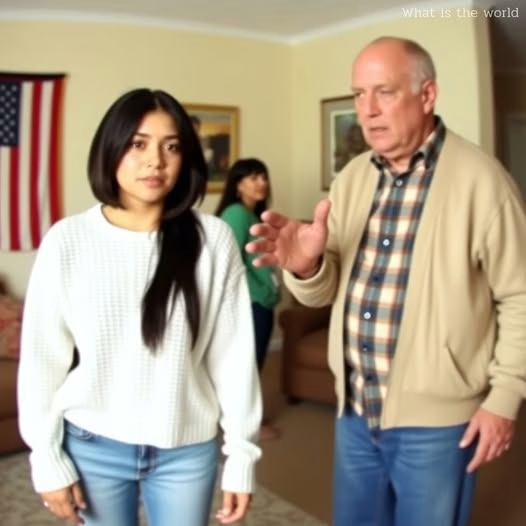
“Look at yourself,” Dad said, and his tone carried such contempt that I physically recoiled. “You’re twenty-six years old, working freelance jobs, living in that terrible apartment. You’ve accomplished nothing. Veronica is settling down, building equity, making smart choices. You’re the failure of this family, and we’re not going to fund failure anymore.”
The silence that followed could have swallowed planets. Mom didn’t contradict him. Veronica’s face on the phone screen showed discomfort, but no disagreement. Nobody rushed to my defense or softened the blow.
I stood up, legs somehow steady despite feeling like my entire foundation had crumbled.
“Sit down. We’re not done with dinner,” Mom said.
“Yeah, we are.”
I walked out of that house and didn’t look back, even when Mom called after me that I was being dramatic.
The Silent Years
I stopped calling, stopped texting, stopped showing up to family dinners and holiday gatherings. My phone would light up occasionally with messages from Mom asking if I was still sulking or Dad demanding I grow up and stop punishing everyone with my attitude. Veronica sent a few half-hearted texts about family being important and forgiveness being strength. I deleted them all.
The first few months of no contact felt like withdrawal from a drug I’d never wanted to be addicted to. My finger would hover over Mom’s contact every Sunday evening—muscle memory from years of obligatory check-in calls. Holidays loomed like emotional landmines.
But cutting contact didn’t mean I stopped working. The spite became fuel, better than coffee, more sustaining than sleep. I picked up every freelance gig I could find, building a portfolio while my eyes burned from screen time and my back ached from hunching over my laptop. I took online courses in UX design, motion graphics, brand development. Every skill I could monetize, I learned.
Six months after I walked out of their house, a mid-size tech company hired me full-time as a senior designer. The salary made me blink three times at the offer letter. I took it immediately, then found a financial adviser through my new company’s benefits program.
“I need to invest aggressively,” I told her, a woman named Patricia who wore efficient pantsuits and had kind eyes. “I have no safety net, no family money. Everything I build has to come from me.”
Patricia didn’t ask questions about family. Instead, she asked about goals, risk tolerance, timeline. We built a plan. I maxed out my 401(k) contributions. Opened a Roth IRA. Started a brokerage account and learned the difference between index funds and individual stocks. Every paycheck got divided with military precision: living expenses, loan payments, investments.
The Land
My career accelerated. The tech company promoted me to lead designer after a year. I switched companies eighteen months after that for a senior position at a startup that offered equity. The startup got acquired fourteen months later, and suddenly my stock options transformed into actual money—the kind with multiple zeros that made my hands shake when I checked my bank account.
But I didn’t blow it. Patricia and I had planned for windfalls. The money got invested, diversified, protected. I kept living in my decent apartment and driving my seven-year-old Toyota.
The only indulgence I allowed myself was starting to look at land. I’d always loved the idea of space, of owning enough earth that nobody could crowd you or look over your fence and judge your worth. I spent weekends driving through areas north of the city, watching for sale signs.
Most properties were too expensive or too small. Then I found it: forty acres in Sonoma County, rolling hills with valley oak trees and a seasonal creek running through the eastern portion. The land had sat on the market for eight months because it needed well and septic work, which scared off most buyers. The property had an old farmhouse that needed complete renovation and several outbuildings in various states of decay.
I didn’t see problems. I saw potential.
The sellers were an elderly couple moving to Arizona to be near their grandchildren. They’d loved the land but couldn’t maintain it anymore. We sat at their kitchen table drinking instant coffee while I made my offer. They accepted, tears in the wife’s eyes as she talked about how glad she was the property would go to someone who appreciated it.
I closed on the land with cash from my investments, then took out a construction loan for renovations.
But I didn’t hire everything out. Years of watching DIY videos and spite-driven determination meant I could do more than most people assumed. I hired contractors for the structural work, the well drilling, the septic system. Everything else I researched and learned. I spent every weekend out there tearing out rotted wood and learning to tile. I refinished the original hardwood floors myself, on hands and knees with a rented sander. Painted every wall. Replaced light fixtures and cabinet hardware. The farmhouse transformed slowly, room by room, into something beautiful.
But the house was just the beginning. I wanted the land to work for me. I researched agricultural options and discovered that Sonoma County had perfect conditions for lavender farming. The market for lavender products—essential oils, dried flowers, culinary lavender—kept growing. Better yet, lavender required relatively low maintenance once established and could generate solid income.
I planted my first five acres of lavender, spending weeks creating irrigation lines and learning about soil pH. Bought bees to help with pollination and discovered I loved keeping them. Added a small herd of goats because they were excellent for land management and I’d always wanted animals. Built a processing barn where I could dry lavender and extract oils. Started an online store and got licensed to sell at farmers markets.
The learning curve for farming was steep enough to qualify as a cliff, but I threw myself into it with the same determination that had gotten me through everything else. I joined online forums where experienced farmers answered my endless questions. Took a beekeeping course at the local extension office. Named my hives ridiculous names—Beyoncé, Dolly, and Cher—because if I was going to do this, I was going to enjoy it. The goats got similarly absurd names: Robert Downey Jr., Goatse, and Billy Joel.
My property started feeling less like an investment and more like a home.
The Call
Then came last Tuesday. I was in the processing barn bundling dried lavender for an online order when my phone rang from an unknown number. I almost didn’t answer, but something made me pick up.
“Hello?”
Heavy breathing came through the line, then Dad’s voice, shaking with something I’d never heard before: uncertainty. “We need to talk.”
“No, we really don’t.” My voice came out flat, years of therapy helping me maintain boundaries without emotion.
“Your sister drove past your property.”
That stopped me. “What?”
“She was in Sonoma for a wine tasting with Marcus, took a wrong turn, and ended up on some rural road. She says she saw your truck in a driveway—a big property with lavender fields and a renovated farmhouse.”
My stomach tightened, but I kept my voice steady. “And?”
“Is it true? Do you own that land?”
“Why would that matter to you?”
Dad’s breathing got heavier. “Veronica looked up the property records. Forty acres. House, barn. She says it must be worth close to two million.”
“Two-point-three,” I corrected before I could stop myself. “I had it appraised last month.”
The silence on the other end stretched so long I thought he’d hung up. Then: “How?”
“Hard work. Smart investing. Everything you said I wasn’t capable of.”
“We had no idea you were doing so well. You could have told us.”
The laugh that came out of me held no humor. “Why would I tell you anything? You called me a failure and funded my sister’s life while leaving me to drown in student loans.”
“We thought you needed tough love. We thought if we didn’t enable you, you’d find motivation.”
“Tough love,” I repeated, tasting the words like poison. “You gave Veronica a hundred thousand dollars while telling me I’d accomplished nothing. That’s not tough love. That’s just cruelty.”
Mom’s voice came through in the background, apparently on speakerphone. “We want to see the property. We want to be involved in your life again.”
“No.”
“You can’t shut us out forever,” Dad said, and now I heard the edge in his voice, the familiar demand for compliance. “We’re your parents.”
“You stopped being my parents when you told me I was the family failure. You made your choice. I’m just living with it.”
“Your sister is very upset,” Mom chimed in. “She’s been crying all evening. She feels terrible about the house money now that she knows your situation.”
“My situation?” The bundle of lavender in my hand crushed under my grip, releasing its scent in a purple cloud. “My situation is that I built a life without you. Without your money, without your approval, without your presence. I don’t need you now.”
“We could help you expand the farm,” Dad tried, and I could hear him scrambling, recalculating. “We have connections. We could invest.”
“I don’t want your investment. I don’t want anything from you.”
Veronica’s voice came through—she must have been there too. “I never meant to hurt you. I didn’t know they were treating you so differently.”
That almost broke me because it was such an obvious lie. She’d been there. She’d watched them dismiss me at every turn. Had accepted their money while knowing I got nothing.
“You knew exactly what you were doing. You all did. You bet on the wrong daughter. And now you’re trying to hedge.”
“That’s not fair,” Mom said, voice rising to that pitch she used when losing control of a narrative.
“Neither is giving one daughter everything while telling the other she’s worthless. But here we are.”
“So what? You’re just never going to speak to us again?” Dad demanded. “After everything we did for you growing up?”
“You mean feeding and housing me? That’s called basic parenting, not a debt I owe.”
I could hear arguing on their end, muffled voices talking over each other. Finally, Dad came back on, his voice trying for warmth and landing somewhere near desperation. “Let’s have dinner. Just one dinner. Come to the house. We’ll talk this through like adults.”
“I am being an adult. Adults have boundaries. Adults walk away from people who damage them. Adults build lives that don’t include their abusers.”
“Abusers?” Mom’s shriek could probably be heard without the phone. “We never abused you!”
“You’re right. You just systematically destroyed my self-worth while financing my sister’s dreams. Totally different.”
I hung up before they could respond, then immediately blocked the unknown number.
The Returned Check
They tried other ways to reach me. An email from Dad’s work account that went straight to spam. A letter mailed to my property that I returned unopened. Veronica showed up at my gate one Saturday morning, but I’d installed a camera system and simply didn’t open it. She stood there for twenty minutes, occasionally calling out my name, before finally leaving.
Six months after that phone call, a package arrived at my property. No return address, but I recognized Mom’s handwriting on the label. Inside was a check for one hundred thousand dollars and a note in her careful cursive: We should have given you this for college. We’re sorry.
I looked at that check for a long time, sitting at my kitchen table with morning light streaming through windows I’d installed myself. One hundred thousand dollars. The exact amount they’d given Veronica without hesitation. The amount they’d decided I wasn’t worth.
The money could do a lot. Pay off my remaining student loans. Build a proper store on the property. Buy equipment I’d been saving for.
But taking it would mean accepting their terms, their timeline for reconciliation. It would mean agreeing that money could fix what they’d broken.
I tore the check into pieces small enough that they couldn’t be taped back together. Put them in an envelope with a single sentence written on a piece of paper: You can’t buy forgiveness. Mailed it back to their address.
Dad tried one more time about a month after the returned check. He showed up at my gate without warning, apparently having decided Veronica’s ambush approach might work better for him. I watched him on the security camera, standing there in his weekend khakis and polo shirt, looking older than I remembered.
I picked up the intercom. “Leave.”
“I just want five minutes. Please.”
“You had twenty-six years. You used them to tell me I wasn’t good enough. We’re done.”
“I was wrong.” His voice cracked slightly, and part of me—the part that was still his little girl desperate for approval—wanted to open the gate. But I’d worked too hard to let that part drive anymore.
“You were. And now you get to live with that, just like I had to live with it.”
“Can’t we move past this? Can’t you forgive us?”
“I can forgive you,” I said slowly, realizing as I spoke that it was true. “I can forgive you for being flawed parents who played favorites and damaged their daughter. But forgiveness doesn’t mean reconciliation. It doesn’t mean letting you back into my life to do more damage. It just means I’m not carrying your mistakes anymore.”
He stood there for a long moment, shoulders sagging. Then he walked back to his car and drove away. I watched until his taillights disappeared down the road.
The Life I Built
That was three months ago. They haven’t tried since.
My lavender farm just finished its best season yet. Revenue hit six figures for the first time, and projections for next year look even better. I’m launching a line of lavender skincare products in partnership with a small cosmetics company. I’m teaching a workshop next month on sustainable farming practices.
Life looks nothing like what my parents imagined for either of their daughters, and everything like what I needed it to be. Some days I still feel that old ache, wishing I had a family who celebrated my successes and showed up for my life. But mostly I feel grateful for the family I’d chosen—friends who actually care, a therapist who helps me heal, a community that values what I build.
The Martinez family lost a daughter the day they called her a failure. They just didn’t realize it until she stopped needing their validation enough to prove them wrong. By then, I’d already built something they could never touch: a life that belonged entirely to me.
Sometimes at sunset, I walk through my lavender fields with the bees humming and the goats trailing behind me. And I feel something I never felt growing up: peace. The bone-deep certainty that I’m exactly where I’m supposed to be, doing exactly what I’m meant to do.
My parents gave Veronica one hundred thousand dollars and called it an investment. They gave me nothing but doubt and criticism and called it motivation. Turns out they were both wrong about what I needed.
I needed exactly what they refused to give me: the chance to fail on my own terms, to struggle without them watching with disappointment, to build something without their fingers on the scale. They meant to abandon me. Instead, they freed me.
So when people ask if I’ll ever reconcile with my family, I smile and say, “Probably not.” Because the family that matters isn’t the one you’re born into. It’s the one you build around yourself—person by person, choice by choice, boundary by boundary.
And mine doesn’t have room for people who only valued me once I didn’t need them anymore.