The Harvest of the Unwanted Son
Chapter 1: The Erased Boy
At fifteen, my parents dumped me at the end of a dirt driveway with a single duffel bag and a warning not to embarrass them. They drove away in a cloud of dust, leaving me at a farm I barely remembered, believing they were disposing of a problem.
Years later, after I had built a life from the ashes they left behind, they returned. They came demanding access, demanding credit, and demanding seats at a wedding that had no room for ghosts.
My name is Ryan Harper. I am thirty years old. To the outside world, I am a landowner, a husband, and a man who built his own home with calloused hands. But back then, inside the sterile, suffocating walls of my parents’ house, I was simply the “screw-up.”
The hierarchy in the Harper household was clear. My parents, Deb and Gary, were the architects of a perfect suburban image. My younger sister, Madison—or “Maddie,” the Golden Child—was the shining monument to their ego. And I? I was the cracks in the foundation.
Before the silence took over, I wasn’t entirely alone. I had Tyler Brooks. Tyler wasn’t blood, but he was my brother in every way that mattered. We spent years joined at the hip, gaming until two in the morning, biking through the neighborhood until our legs burned, and dreaming up stupid, impossible plans about renting a tiny apartment and fixing it up ourselves. He was the anchor that kept me from drifting away.
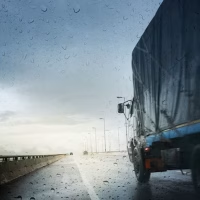
And then, on a Tuesday that started like any other, the cable snapped.
The accident took Tyler and his parents on the same afternoon. There was no slow fade, no long goodbye. Just phone calls, hushed voices in the hallway, and the sudden, violent absence of the person who understood me best. I stood in my living room, fifteen years old, waiting for someone to tell me it was a mistake. No one did.
The grief was a physical weight, pressing against my lungs. But in my house, grief was inconvenient. It was messy. It disrupted the brand.
Three days later, my parents insisted on a “family dinner.”
“We need to get back to normal,” Gary announced, carving a roast chicken with clinical precision.
I sat there, staring at my plate. The food looked like gray paste. I could still see Tyler’s bike leaning against my garage door, rusting in the rain.
While I fought the urge to scream, Deb launched into the nightly liturgy of Maddie.
“Her teachers just can’t stop raving,” Deb gushed, pressing a hand to her chest as if she were witnessing a miracle. “She has such… potential. It’s breathtaking.”
Gary nodded, chewing thoughtfully. “She’s setting an example. That is what discipline looks like.” He paused, then leveled his gaze at me across the table. “Ryan, fix your face. Don’t drag the mood down.”
Maddie leaned back, twirling a fork, basking in the spotlight. “Maybe you could try harder, too,” she said. Her voice was sweet, laced with that specific toxicity only siblings can detect. “It’s not that hard to smile.”
“Tyler is dead,” I whispered. It was the first thing I’d said in an hour.
The silence that followed wasn’t sympathetic; it was annoyed.
“Ryan, please,” Deb sighed, dropping her utensils. “We are trying to have a positive dinner.”
“There is a time and place for emotions,” Gary added, wiping his mouth. “This isn’t it.”
I realized then that the “time and place” didn’t exist. I was invisible. My grief was a stain on their tablecloth.
I stopped trying. I stopped caring about homework. I stopped caring about the teachers who offered pitying looks. I fell in with a crowd of kids who didn’t ask questions—burnouts and drifters who hung out in parking lots because they, too, didn’t want to go home. We didn’t do anything criminal, mostly just loitered and smoked cheap cigarettes, but to Deb and Gary, I had become a monster.
“You’re destroying this family,” Deb would wail, perfecting her martyr pose.
“You’re choosing the wrong path,” Gary would lecture, timing his speeches for when I was already broken.
The end came on a Friday night. We were in a parking lot after curfew, being loud, being stupid. A patrol car rolled up. They didn’t arrest us, but they detained us until parents arrived.
When Deb walked into the station, she was already weeping. “How could you do this to us?” she sobbed, loud enough for the desk sergeant to hear.
Gary stood with his arms crossed, looking at me like I was a bad investment he needed to liquidate.
The ride home was a silent tribunal. The next morning, before the sun had fully risen, they were standing at the foot of my bed.
“Pack a bag,” Gary said. “You’re going to your grandparents. We can’t have you here anymore.”
Maddie stood in the hallway, arms crossed, a small, satisfied smile playing on her lips. She had won. The competition was over.
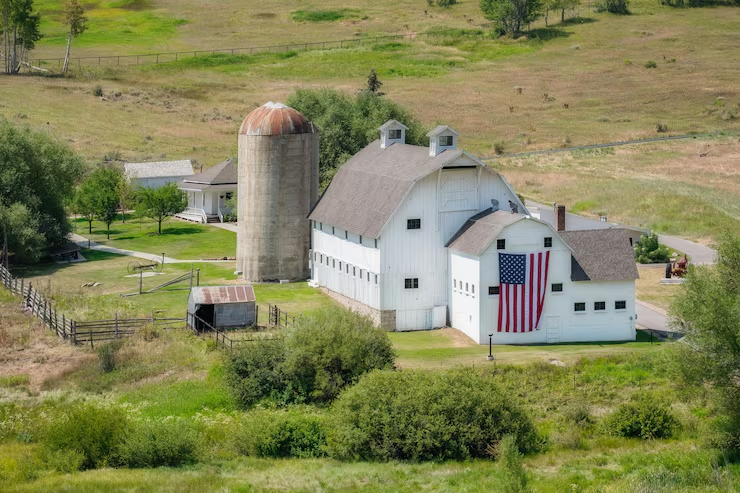
I got into the car without a fight. I felt erased, hollowed out. As we drove down the highway, leaving the city behind, I didn’t know I was heading toward salvation. I thought I was being sent to prison. We turned down a long gravel road, the tires crunching over stones, and I saw an old farmhouse standing against the gray sky. I didn’t know it then, but that house was about to teach me everything my parents never could.
Chapter 2: The Soil and the Soul
The drop-off was surgical.
My parents’ luxury SUV looked alien next to the rusted tractor in the driveway. Grandpa walked out of the barn, wiping grease from his hands with a red rag. He moved with a slow, deliberate strength. Grandma came out onto the porch, wiping her hands on her apron.
Gary stepped out of the car, looking at his watch. “Don’t make us regret this,” he said to me. It was his final piece of fatherly advice.
Grandpa ignored him completely. He walked past Gary, walked past Deb who was clutching her purse like a shield, and put a heavy hand on my shoulder.
“You’re home now,” he said. His voice was gravel and oak.
Grandma hugged me, smelling of yeast and rain. “Come inside, Ryan. You look worn thin.”
Deb and Gary got back in their car and drove away. They didn’t look back. I watched the dust settle, feeling a strange lightness in my chest. The anchor was gone.
That evening, I met Uncle Scott. He was Gary’s brother, but they were different species. Where Gary was soft hands and sharp words, Scott was all callus and quiet. He walked in from the fields, nodded at me, and sat down.
“You’re safe here,” Scott said, cutting straight to the bone. “You’ve got a chance to rebuild yourself. I’m not gonna give up on you, but you can’t wreck this house. We work here. You understand?”
I nodded. It was the first time an adult had given me clear terms without a layer of guilt.
The transformation wasn’t instant. The first few weeks were a detox from the toxicity of my childhood. I flinched when doors slammed. I waited for the yelling that never came.
Instead, I got work. Real, bone-aching work.
Grandpa woke me at five in the morning. We fed the livestock. We mended fences. We cleared brush. My hands blistered, peeled, and blistered again. My back screamed. But there was a purity to it. When I fixed a fence, it stayed fixed. When I fed an animal, it was fed. There was no manipulation, no passive-aggression. Just cause and effect.
Scott taught me without lecturing. “Lift with your legs,” he’d say. Or, “Knot it like this, or the wind will take it.” When I messed up—and I messed up often—he didn’t sigh or roll his eyes. He just showed me again.
“You’re learning,” Grandma would say, sliding a plate of hot food in front of me. “Takes time to get the city out of your blood.”
By seventeen, I was physically different. My shoulders had broadened. My hands were rough. And my mind had quieted. The static of my parents’ expectations had faded into the background noise of the farm.
Scott was the one who pushed for college. “Community college is twenty minutes down the road,” he said one evening. “You’re smart. Go learn something. Don’t waste your brain just because you’re good with a shovel.”
So I went. It wasn’t the Ivy League dreams Deb used to harp on about, but it was mine.
That’s where I met Hope.
She was in my Intro to Business class, sitting in the front row, taking notes with a ferocity that terrified me. We ended up in a group project. I expected her to take over, to be another Maddie.
Instead, she looked at my notes and smiled. “You have good handwriting for a guy who looks like he wrestles bears.”
“I wrestle tractors,” I said.
She laughed. It was a genuine sound. “I’m Hope.”
We started studying together. Then we started walking to our cars together. Then we started sitting on the hood of my rusted truck, talking until the security guard kicked us out. She didn’t treat me like a project. She treated me like a person.
Back at the farm, the peace was shattered by a ghost.
Gary showed up unannounced on a Tuesday. He stood in the kitchen, wearing a suit that cost more than the tractor, looking out of place among the cast-iron skillets.
“Good to see you’re… functioning,” he said to me, offering a limp handshake. He turned to Grandpa. “I think it’s important he understands that this little improvement doesn’t erase the past. He needs to earn forgiveness.”
I felt the old anger flare, hot and sharp.
Grandpa set his coffee mug down. The sound was like a gavel.
“You don’t get to come into my house and tell me how to raise the boy you threw away,” Grandpa said.
Gary bristled. “I’m just saying, he needs structure. Discipline.”
Scott walked in then, tracking mud on the floor. He looked at Gary with pure disdain. “Well, look who it is. The absentee landlord.”
“Fine,” Gary snapped, adjusting his tie. “Do it your way. But when he fails, don’t call us.”
He stormed out. I didn’t follow him. I looked at Grandpa.
“Thank you,” I said.
“Don’t thank me,” Grandpa grunted. “Just keep working.”
But the poison had been reintroduced. A few weeks later, a cousin texted me.
Maddie is talking trash. Says you’re freeloading off Grandma and Grandpa. Says you’re draining their retirement.
I showed the text to Scott. He spat on the ground. “She doesn’t know how this house works. We’ve never had more money since you started running the market stand.”
It was true. I had taken over the vegetable sales, modernized the tracking, and increased our profits by thirty percent. I wasn’t freeloading; I was investing. But Maddie needed a villain so she could remain the hero.
I thought I could ignore them. I thought distance was enough. But then spring came, and with it, a disaster that would test the very foundation of the life I was building. I woke up to the sound of something heavy falling in the barn, followed by a shout of pain that made my blood run cold. It was Uncle Scott.
Chapter 3: The Weight of the World
I found Scott on the floor of the barn, clutching his lower back, his face gray with pain. He had tried to lift a grain sack the wrong way—a moment of distraction, a lifetime of consequence.
“I’m fine,” he gritted out, trying to stand and failing.
“Stay down,” I said, my voice commanding in a way it had never been before.
We got him to the house. The doctor called it a severe lumbar strain. Bed rest. Weeks of it.
The timing couldn’t have been worse. It was planting season. The busiest, most brutal time of the year. Grandpa was seventy-two. He couldn’t do the heavy lifting anymore.
“We’ll have to hire help,” Grandma said, looking at the checkbook with worry.
“No,” I said. “I’ve got it.”
I was working a full-time job at a telemarketing firm by then—a soul-sucking gig I took to save money for my own land. I didn’t quit. I just stopped sleeping.
My day started at four in the morning. Farm chores until seven-thirty. Shower. Drive to the call center. Manage a team of twenty sales reps until five. Drive home. Farm chores until dark. Fix fences by flashlight until midnight. Repeat.
I was running on caffeine and stubbornness. Hope saw it. She didn’t tell me to stop; she just started showing up. She’d bring dinner to the barn. She’d hold the flashlight. She’d help Grandma with the canning.
One night, exhausted and covered in mud, I checked my phone. A voicemail from Deb.
I heard about Scott. It’s a shame. Gary says sending you there was the best thing we ever did. We really saved you, didn’t we?
They were taking credit for my survival while I was killing myself to keep their parents’ farm afloat.
I didn’t reply. I channeled the rage into the post-hole digger. Slam. Twist. Lift.
We survived the spring. Scott healed. The crops went in. My bank account grew.
At twenty-four, Grandpa slid a flyer across the kitchen table.
“Land auction,” he said. “Five acres. Just down the road. It’s rough ground, but it’s got good bones.”
I looked at Scott. He nodded. “You’ve earned it, Ryan.”
I went to the auction with every cent I had saved. I stood in the back of the humid community center, heart hammering. When the bidding started, I didn’t hesitate. I fought for that land like I fought for my life.
“Sold!” the auctioneer yelled.
I signed the papers with a shaking hand. I owned dirt. It was mine. No one could kick me off it.
I spent the next year building a small house. I did most of the work myself, with Scott advising and Hope painting and sanding. We were building a future.
Then, the vultures circled.
I was framing the porch one Saturday when a shiny convertible bounced down my dirt driveway. Maddie hopped out, sunglasses perched on her nose, followed by two friends holding cameras.
“Oh my god, this light is perfect!” she squealed, ignoring me. “Okay, pose over by the lumber.”
I climbed down from the ladder. “Leave.”
Maddie blinked, lowering her sunglasses. “Excuse me?”
“This isn’t a photo op,” I said. “This is my home. Get off my property.”
“You’re so dramatic,” she scoffed. “It’s just dirt, Ryan. Mom said you bought some swamp land. We’re actually doing you a favor by making it look cool.”
“Get out,” I stepped closer. “Now.”
She huffed, rolled her eyes at her friends, and stomped back to the car. “You’re literally the most toxic person I know,” she yelled before speeding off, kicking gravel onto my fresh foundation.
The fallout was predictable. Deb called Grandma, sobbing about how I had “attacked” Maddie. Gary called Scott, lecturing him about my anger issues.
But then, the world stopped turning.
Grandpa collapsed at the breakfast table.
It wasn’t a heart attack, but it was heart failure. The doctor was grave. “His heart is operating at thirty percent. No stress. No work. Absolute rest.”
Grandpa, the strongest man I knew, looked small in the hospital bed.
The news traveled to the suburbs. Suddenly, the phone lines were burning.
Deb called, hysterical. “This is happening to us! I can’t handle this stress!” She made her father’s heart failure about her anxiety.
Gary showed up at the hospital the next day, strutting in like the CEO of the family. He looked at me, sitting by Grandpa’s bedside.
“We need to discuss the estate,” Gary said, his voice low. “If Dad goes… we need to make sure the farm is handled correctly. I don’t want it falling into the wrong hands.”
He meant me. He was looking at the farm I had saved, the farm I had worked for a decade, and he saw a paycheck.
“Get out,” Scott said from the corner of the room.
“Excuse me?” Gary turned.
“You heard him,” I stood up. I was taller than Gary now. Broader. “You aren’t here to help Grandpa. You’re here to scavenge. Leave.”
“I am his son!” Gary shouted.
Grandpa opened his eyes. His voice was a whisper, but it cut through the room. “Ryan is my son. You… you are just a visitor.”
Gary turned purple. He stormed out.
Grandpa recovered, slowly. But the line had been drawn. The war was open.
A year later, the house was finished. The farm was stable. And I asked Hope to marry me on the front porch of the home we built together.
We planned the wedding. It was going to be on the farm. Small. Intimate.
“What about your parents?” Hope asked one night, looking at the guest list.
I looked at the names. Deb. Gary. Maddie. I thought about the car ride when I was fifteen. I thought about the rumors. I thought about Gary trying to liquidate the farm while Grandpa was in a hospital bed.
“No,” I said.
I didn’t send invites. I simply didn’t include them. I thought that would be the end of it. I thought they would take the hint. But I forgot that narcissists don’t believe in closed doors. On the morning of my wedding, as I was adjusting my tie in the mirror, Scott walked in. His face was pale. “Ryan,” he said. “There’s a problem at the gate.”
Chapter 4: The Empty Seats
I walked out to the front gate of the farm. My tuxedo felt like armor.
There they were. The Escalade. The convertible. Deb, Gary, and Maddie, dressed in wedding attire that was far too flashy for a farm ceremony. They were arguing with the security guard I had hired specifically for this moment.
“This is ridiculous!” Deb was screaming. “I am the Mother of the Groom!”
“And I’m the sister!” Maddie added, holding up her phone, likely live-streaming the injustice.
I walked up to the gate. The silence that fell over them was immediate.
“Ryan!” Deb cried, her face shifting instantly from rage to tragic victimhood. “Thank God. Tell this ape to let us in. We’re late!”
“You aren’t late,” I said calmly. “You aren’t invited.”
Gary stepped forward, adjusting his expensive suit. “Now, son. Let’s not make a scene. We’re family. We forgave you for the past. We’re here to celebrate.”
“Forgave me?” I laughed. It was a dry, sharp sound. “You threw me away. You tried to steal this farm. You mocked my life. You don’t get a seat at my table just because you share my DNA.”
“Think about the optics, Ryan,” Maddie hissed. “People will talk.”
“Let them talk,” I said. “Let them know that while you were taking selfies, I was fixing fences. Let them know that while you were playing the victim, I was building a life.”
“I carried you for nine months!” Deb wailed.
“And Grandpa and Grandma carried me for fifteen years,” I countered. “They are my parents. Scott is my father. You are strangers.”
I turned to the guard. “Do not let them in.”
I walked away. Behind me, the screaming started again, but it sounded distant, like a radio playing in another room. I didn’t look back.
The ceremony was under the old oak tree. The sun was setting, casting a golden light over the fields I owned, the house I built, and the people who actually loved me.
When I stood at the altar, I looked out at the chairs. There were no empty seats reserved for ghosts. Every chair was filled with someone who had earned their place. Grandpa was sitting in the front row, frail but smiling. Grandma was wiping her eyes. Scott stood beside me as my best man.
Hope walked down the aisle, and the rest of the world fell away.
We said our vows. We danced on the grass. We drank cheap beer and ate barbecue. It was perfect.
Late that night, Hope and I sat on the porch of our new house, watching the fireflies dancing over the fields. My phone buzzed. A text from a blocked number. I knew who it was. I didn’t read it. I deleted it without looking.
I looked at Hope. I looked at the dark outline of the barn where I had healed, the fields where I had sweated, and the land that was mine.
“You okay?” Hope asked, resting her head on my shoulder.
“Yeah,” I said, and for the first time in my life, I meant it completely. “I’m home.”
Epilogue: The Harvest
Five years have passed since that wedding day. The farm continues to thrive. Grandpa is still with us, moving slower but still offering advice from his chair on the porch. Grandma still makes the best biscuits in the county. Scott expanded his side of the operation, and together we’ve turned the farm into something neither of us imagined possible.
Hope and I have two children now. A daughter named Grace, who has her mother’s determination, and a son named Tyler, who has his namesake’s gentle spirit. They run through the fields I once walked alone, laughing and covered in dirt, learning the same lessons the farm taught me.
I still get messages sometimes. Deb sends holiday cards that I throw away unopened. Maddie occasionally posts passive-aggressive things on social media about “family betrayal,” which I never see but people tell me about. Gary tried to show up at the farm once more, two years ago, with a lawyer and some paperwork about inheritance rights. Scott ran him off before he made it past the mailbox.
The truth is, I don’t hate them anymore. Hate requires energy I’d rather spend on my children, my wife, and this land. They’re simply people I used to know, ghosts from a life that doesn’t belong to me anymore.
Sometimes I think about that fifteen-year-old boy, sitting in the back of that SUV with a duffel bag, thinking his life was over. I wish I could tell him that the worst thing that ever happened to him was actually the beginning of the best thing.
My parents tried to bury me. They didn’t know I was a seed.
And the harvest? It’s more abundant than I ever imagined.