The Airport Lounge
They said, “Stay in the lounge, Grandma. We’ll come back for you after check-in.”
I nodded. Of course I did. That’s what you do when your son gives you an instruction in that clipped, overpatient voice—the one reserved for the elderly, the confused, and the inconvenient.
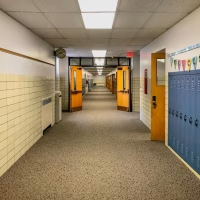
I sat where they told me, next to a dusty potted plant, between a crying toddler and a flickering television tuned to a weather channel. It was 9:15 a.m.
I waited eight hours.
I’d packed three days before, laid out every outfit on the bed like I used to do for Adam’s school trips. The tickets were to Honolulu—our big family vacation, as Lisa, my daughter-in-law, called it. She’d insisted on matching T-shirts for the kids and me. Mine said “Vacation Nana” in bright pink letters. I didn’t like it, but I wore it anyway.
She’d rolled her eyes at the airport when I brought my own snacks.
At the security line, things started to feel off. Lisa kept glancing at her watch. Adam was unusually quiet. The kids were on their phones. When the TSA agent asked about seating, Lisa laughed and said, “Oh, we’ll sort that later.”
And that was the last time anyone looked me in the eye.
Once we passed security, Lisa turned to me with that same brittle smile. “Mom, why don’t you stay in the lounge? We’ll go ahead to check in the bags, sort the kids’ boarding passes, and then come get you. Just relax. You’ve done enough.”
She patted my arm. It wasn’t affection. It was dismissal.
I sat. I waited. I watched them disappear into the crowd.
The Wait
After an hour, I stood up and paced near the window. After two, I asked the front desk to page Adam. No response. By the fourth hour, I stopped looking at the entrance. People around me came and went. Flights were announced and departed. The woman across from me had lunch, made two phone calls, and left.
I stayed.
It wasn’t until five o’clock that I asked the clerk at the front for help. I gave Adam’s full name. She typed, hesitated, and glanced at me carefully.
“They checked into the 1:45 p.m. flight to Honolulu. Ma’am… it’s already departed.”
I nodded. Then I asked her to repeat it. She did, slowly. Her voice was kind. I remember that.
So that was it. They’d boarded without me. Not by accident. Not a mistake. I knew my son. He was a lot of things, but careless wasn’t one of them.
I stepped into the restroom, locked the stall, and sat down—not to cry. I didn’t have it in me. I just needed to sit where no one would ask if I was all right.
When I emerged, the airport was shifting into evening mode. The buzz had dimmed. I walked to the departure screen and stared at it. My hands didn’t shake. My heart didn’t race. I simply looked at the list like a woman looking at options in a diner.
And then I saw it. Portland, 7:35 p.m.
I don’t know why I chose Portland. Maybe because I hadn’t seen it in decades. Maybe because it was where I once learned to ride a bike. Maybe because it was the furthest thing from Hawaii.
I walked to the counter. “One ticket to Portland. Tonight.”
The young woman hesitated. “Round trip?”
“No,” I said. “Just one way.”
I used my own card from my own account—the one Adam didn’t know about, the one I’d kept open since before his wedding. I had just enough for the fare, a motel, and maybe a start.
I didn’t need more.
I turned off my phone. No messages. No missed calls. Of course not.
The boarding process was quiet. No one asked why I was traveling alone. No one looked at my shirt. I’d taken it off and stuffed it in the trash before heading to the gate.
On the plane, I watched the lights of the city fall away beneath me. Eight hours ago, I thought I was going to paradise. Turns out I was just being left behind. But now—now I was going somewhere real. Somewhere they couldn’t follow.
Portland
I landed in Portland just after ten. The airport was quieter than I remembered, smaller somehow. Or maybe it was me who had shrunk, folded inward from the weight of a day like no other.
I walked slowly through the terminal, not because of my age, but because I didn’t feel the need to rush anymore. No one was waiting for me. And for the first time, that felt like freedom.
Outside, the air was damp and sharp. Rain had fallen recently. It smelled like concrete and pine. I stood under the awning for a minute, just breathing.
Then I found a bench and sat down with my carry-on, the same one Adam had mocked for being too old school. It was brown leather, worn at the corners—the kind Derek gave me for our twenty-fifth anniversary.
He would have laughed at what happened today. A deep, knowing laugh. The kind that said, “Well, sweetheart, what did you expect?”
I didn’t expect this. Not really. But I also wasn’t surprised.
I opened my wallet. Two cards, one ID, seventy-six dollars in cash, and a folded piece of paper with an address I hadn’t used in fifty years. 1849 Quinn Street, my first apartment after marrying Derek. I didn’t know if it still existed. I didn’t even know why I’d brought the address with me. But there it was.
I called a cab. The driver was quiet, a blessing. I gave him the address of a cheap motel I’d looked up before leaving Wilmington, just in case.
When we pulled up, I paid without blinking, took my key, and climbed the narrow stairs to the second floor. Room 207. The hallway smelled like cleaning fluid and tired stories.
Inside, the room was small but clean. One bed, one chair, a TV bolted to the wall. I washed my face in the sink and lay down on the bed in my clothes, the blanket scratchy against my arms.
I slept without dreams.
Joyce’s House
The next morning, I stood at the window watching a woman in a pink robe walk her dog. She looked about my age, though maybe a little stronger in the back.
I made coffee in the little machine on the nightstand and sat in the stiff chair by the window, sipping slowly. No one called. No one texted. I didn’t check. I had nowhere to be.
That was a strange thing to realize. For decades, my time belonged to others—to Adam, to Derek, to the grandchildren, even to the PTA meetings I stopped going to twenty years ago. But now my time was mine again.
At nine, I left the motel and walked into the neighborhood. My legs ached. My hip was murmuring. But I kept going.
I stopped at a corner bakery and bought a scone. The woman behind the counter smiled when I handed over exact change.
“You’re not from around here, are you?” she asked.
“I used to be,” I said. “A long time ago.”
“Well,” she said, “welcome back.”
I didn’t know if I was back. I wasn’t even sure I belonged anywhere, but the words felt warm. I asked her where to find housing listings. She pointed to a corkboard by the door. I scanned the notes—dog walking, used bike for sale, music lessons, room for rent.
That one caught my eye.
For quiet lady. Private room, shared kitchen, house safe, near bus. No nonsense, no drama. $400/month. Call Joyce.
It was written in blocky, no-nonsense handwriting, like someone who meant what she said. I took a photo of the number.
By noon, I’d walked two more blocks and found a park bench in the sun. I called. The voice that answered was raspy, skeptical.
“Yes.”
“I’m calling about the room for rent,” I said.
Long pause. “How old are you?”
“Seventy-seven.”
“Are you clean?”
“Yes.”
“No boyfriends, right?”
I chuckled. “Not in a long time.”
“Well,” she said, “come by at four. 2185 East Stafford. Bring cash for the first week.”
Then she hung up. I wrote the address on a napkin.
By four, I stood in front of a faded blue house with a peeling porch and a windchime that sounded like someone tapping spoons together. Joyce opened the door with a cigarette in one hand and a cat curled around her ankles.
“You’re the old lady?” she asked.
“I suppose I am.”
She stepped aside. “Come in then. Let’s see if we can tolerate each other.”
Joyce’s house smelled like lavender and fried onions—not unpleasant, just lived in. She led me through a narrow hallway stacked with books into a small sitting room where the television was on mute.
“The room’s upstairs,” she said, gesturing with her cigarette.
I followed her up the creaky stairs, one hand on the banister. The hallway at the top was darker, the paint slightly chipped. She opened the door to a room at the end.
“This is it.”
It was small. A twin bed, a nightstand, a dresser that had seen better decades. But the window was wide, and the afternoon sun poured in like it knew something good had finally found me. There was even a little desk with a worn chair.
“It’s fine,” I said. “How much again?”
“Four hundred a month, but I take weekly. One hundred a week. Cash. No checks, no credit, no sob stories.”
She looked me over. “You don’t seem like the sob story type.”
“No,” I said. “Not anymore.”
She nodded like that was the right answer. “Kitchen’s shared. Bathroom’s down the hall. No guests without warning. I like quiet. You cause trouble, you’re out. We clear?”
“Crystal.”
She handed me a key. “You can stay tonight if you’ve got the first week’s rent.”
I handed her five twenties from the envelope I’d tucked into my inner coat pocket. She folded the bills without counting.
“You hungry?”
“I could eat.”
The Cafe
Joyce made grilled cheese sandwiches and poured tomato soup from a saucepan. We ate at the small kitchen table under a yellowed ceiling fan. She didn’t ask questions, which was a relief. People always ask too soon, before you’re ready to say it out loud.
She only said, “I hate eating alone.”
And I understood that well enough.
After dinner, I unpacked in the small room. I’d only brought three changes of clothes, a toothbrush, my medications, and an old paperback novel I never finished. I laid everything out carefully in the dresser, folding each item like it mattered. Maybe it did.
That night, I lay in the narrow bed, listening to the sounds of a house not mine—the ticking of a wall clock, the groan of floorboards, the distant sound of Joyce talking softly to the cat.
No one called. No one texted. I didn’t turn the phone on.
In the morning, I made coffee before Joyce was up. The kitchen felt more familiar than my own back home, maybe because it didn’t belong to people who only remembered me when they needed something.
By the third day, I started walking the neighborhood. Two blocks down, there was a small corner cafe with a chalkboard sign out front.
Help wanted. Morning shift. Apply inside.
I stood there for a moment. I hadn’t worked in fifteen years, but I was no stranger to early hours and coffee pots.
Inside, the place was simple. Three booths, a counter, a few bar stools with cracked red cushions. A young woman in an apron was wiping the counter.
“You hiring?” I asked.
She looked up, surprised. “You want to apply?”
“Yes.”
She called to the back. A stocky woman with her hair in a messy bun emerged. Her name tag read HEATHER.
“You have experience?” she asked.
“I’ve raised three kids and run a household for fifty years. I can make coffee, carry plates, and I don’t call in sick.”
She stared at me for a beat, then shrugged. “Trial shift tomorrow. Six to eleven. You make it through that, we’ll talk.”
That night, I ironed the only blouse I had that still held a crease. I went to bed early and stared at the ceiling for a long time.
It had been less than a week since the airport—less than a week since I’d been left behind like forgotten luggage. But something had shifted. I wasn’t waiting anymore. Now I was walking, working, beginning.
No one needed to know. Not yet. This life—this quiet, new, unexpected life—was mine.
Finding My Rhythm
The cafe smelled like burnt toast and old hope. I arrived at 5:45, fifteen minutes early. The front door was still locked. A man with thick glasses and a flour-stained apron opened it for me without a word. He grunted something that might have been good morning and returned to the kitchen.
Heather arrived ten minutes later, holding a travel mug and a set of keys on a rainbow lanyard. She unlocked the register and handed me an apron without ceremony.
“Keep your hair tied back. No perfume. Refill cups without waiting to be asked. And if someone leaves less than a dollar tip, that’s on you, not them.”
I nodded. She looked at me for a moment, then softened just a little.
“You nervous?”
“No,” I said. “I’m seventy-seven. I’ve buried a husband, raised a son who forgot my birthday three years in a row, and survived five colonoscopies. This is just coffee.”
Heather snorted. “Fair enough.”
By seven, the first wave of regulars came in. Contractors, early risers, nurses fresh off the night shift. I moved slow but steady. I remembered orders, poured coffee with a steady hand, smiled without overdoing it. By nine, I found a rhythm.
“Where’d they dig you up?” one of the men asked, smiling kindly.
“Same place they find everything worth keeping,” I said. “The back shelf under a blanket.”
He laughed and left a five-dollar tip.
Heather watched. She didn’t say much, just nodded once after the breakfast rush died down and handed me a clean towel.
We finished at eleven. She poured herself another cup of coffee, then pointed to the stool next to her at the counter.
“Sit,” she said.
I did.
“You did fine. Just fine. You’ll get better. You’re hired. Minimum wage plus tips—no health insurance—but you work steady. I’ll give you all the weekday mornings. That enough for you?”
“It’s more than enough.”
We sat in silence a moment. “You got kids?” she asked.
“I did.”
She glanced sideways at me, waiting.
“They’re traveling,” I said simply.
She nodded. “They always are.”
Arthur
The first paycheck was small—$74.26 after taxes. Heather handed it to me in a thin envelope at the end of my Friday shift.
“Cash it or frame it,” she said.
I smiled and slipped it into my coat pocket. I wasn’t used to carrying money that was purely mine. For years, everything I had went to someone else—groceries for Adam’s family, birthday gifts that never got a thank you, co-pays for appointments no one bothered to drive me to.
But this was different. I’d earned this standing on my own two feet, apron tight, hands steady.
I walked to the bank on Third and cashed the check. The young teller looked at me like she wasn’t sure I understood what I was doing.
“I’d like tens and fives, please,” I said. “Ones for the rest.”
When she handed me the bills, I folded them neatly and tucked them into my wallet. I walked out of the bank with my chin a little higher.
Across the street was a secondhand clothing shop. Nothing fancy, just a narrow storefront with a cluttered display and a small handwritten sign. Fall specials, 20% off coats.
I stepped inside. The bell on the door tinkled softly. A girl barely out of high school looked up from behind the counter and gave me a genuine smile.
“Looking for something in particular?” she asked.
“Yes,” I said. “Something that makes me feel like myself again.”
She didn’t laugh, just nodded and started showing me the racks. I chose a navy wool coat with a subtle herringbone pattern and deep pockets. It wasn’t new, but it was warm and solid and well made. I tried it on. It fit like it had been waiting for me.
When I paid in cash, the girl wrapped it in tissue as if it were a gift.
“You look sharp,” she said.
“Thank you,” I replied. “I feel sharp.”
By the second week, the ache in my feet began to fade. My hands remembered how to carry plates without spilling. I could clear a four-top in under two minutes.
Heather still didn’t say much, but one morning she brought me a cinnamon roll wrapped in foil. “Too many,” she muttered, sliding it across the counter. “Take one.”
That was her way of saying I belonged.
I settled into a rhythm. Monday to Friday, I worked mornings. Saturday, I took long walks through unfamiliar neighborhoods. On Sunday, I let myself rest.
One morning, a man in a gray windbreaker stood just inside the door, peering at the menu like it was written in another language. He looked to be in his early eighties—neatly dressed, clean-shaven, a little unsteady on his feet.
When he spotted me, he smiled. “You the one who knows how to make real coffee?” he asked.
I poured him a cup and set it down. “Cream and sugar?” I asked.
“Just cream,” he said. “Two splashes.”
We didn’t talk much at first. He drank slowly, folded the newspaper someone had left behind, and left a tip that was more generous than necessary. He came back the next day, and the day after that.
By Thursday, I learned his name was Arthur. Widowed. Two sons—one in Boston, one in Arizona. We didn’t talk about them much. Mostly we discussed birds. He liked cardinals. I liked finches. We both agreed crows were smarter than people gave them credit for.
On Friday, he brought in a picture of his wife. “Married forty-six years,” he said. “She made better coffee than this, but you come close.”
I smiled and refilled his cup.
The Letter from Kieran
One evening, Joyce came home with a stack of mail. “Something for you,” she said, tossing an envelope onto the table.
It had no return address—just my name in a familiar looping script. I stared at it for a moment before opening it. Inside was a single sheet of lined paper.
Grandma, where are you?
I didn’t need to see the name. I knew the handwriting. Kieran—my oldest grandchild, the only one who used to visit without being asked. The only one who once spent an afternoon building a birdhouse with me, then painted it bright red and said, “This will be the coolest place in the whole yard.”
The letter was short, just a few lines. “Dad and Lisa are freaking out. They said you disappeared. No one’s heard from you. I’ve been checking every day. I miss you. Please let me know you’re okay.”
There was a phone number scribbled at the bottom. His new one.
I sat with the letter in my lap, reading it twice. Then I folded it carefully and tucked it into the drawer of my nightstand. I didn’t call. Not yet. But something inside me softened.
It had been three weeks—three weeks since the airport, since the lounge chair with the broken armrest, since the cheap plastic water bottle Adam pressed into my hand before disappearing.
Not a single call had come through. Not one attempt that I’d seen to find me. Except Kieran.
The phone stayed off. I kept it in the bottom drawer of my nightstand, wrapped in a clean handkerchief—like something sacred or dangerous. And I wasn’t yet sure which.
Joyce didn’t ask. She wasn’t the type. But one evening, while we shelled peas in the kitchen, she said, “You hiding or healing?”
I looked up from the colander. “Both,” I said.
She nodded once and went back to the peas.
The Confrontation
By the fourth week, I’d memorized the walk from the cafe to the corner pharmacy, the smell of the lilac bush outside Joyce’s neighbor’s yard, and the sound of Arthur’s knock on the cafe window when I forgot his cream.
Life was not exciting. But it was whole. It had shape. It had peace.
And then, on a rainy Tuesday afternoon, a letter came in the mail. Joyce slid it across the kitchen table without comment. The return address was Wilmington. My old home. The handwriting was familiar in the way a bruise is familiar—something you recognize by the ache it leaves behind.
Adam.
The envelope was thick. Inside, six pages of neat, angry script. No greeting. Just: I can’t believe you did this.
He accused me of disappearing, of making a scene by absence, of putting the family through stress during their vacation. Lisa cried every night, he wrote. The kids were confused.
“Do you think that was fair to them?”
Not a word about the airport lounge. Not a word about asking me to wait. No mention of the eight hours—just the performance of pain, the rewriting of facts.
He ended the letter with: “We’re willing to talk, but only if you’re ready to be reasonable.”
Reasonable. As if decades of babysitting, cooking, paying their bills, and being told where to sit and when to be quiet had been unreasonable. As if disappearing was a tantrum, not a choice.
I folded the letter and slid it back into the envelope. Joyce didn’t ask what it said. She only passed me a plate of toast and nodded toward the window.
“Storm’s coming,” she said.
It was.
The next morning, Kieran called. I’d finally turned the phone on. “I heard Dad wrote to you.”
“He did.”
“You going to respond?”
I was quiet for a moment. “No. Not yet. Maybe not at all.”
Kieran didn’t argue. “I get it.”
He told me he’d started a job at a bookstore—part-time, low pay. “But I like it. Books don’t yell at you.”
We laughed, easy and warm. “You sound different,” he said at the end of the call.
“Different how?”
“Lighter.”
That night, I took the letter from Adam, lit a match, and fed it to the kitchen sink—flame by flame. Joyce didn’t flinch.
“I would’ve used the fire pit,” she said. “More satisfying.”
Lisa’s Visit
Saturday brunch at the cafe was chaos. By eight, the line was out the door. Heather moved like a woman in a war zone—snapping orders, flipping tickets, slapping spoons into syrup containers.
“Eggs over hard. Booth three,” she barked.
I didn’t flinch. “Refill on six.”
“Already done.”
By ten, my feet felt like stone, but my head was clear. There’s a strange comfort in service. You stop thinking about yourself because you’re thinking about everyone else. And in that, sometimes you find peace.
As I wiped down the corner booth, I caught sight of something that made my breath pause. A face at the window—younger than Arthur, sharper around the jaw. But the eyes. Those eyes, I knew.
Lisa.
She stood outside for only a second. Her coat was too nice for the drizzle, her expression unreadable. She didn’t come in. Just turned and walked away.
I said nothing to Heather. I finished my shift, counted my tips, and walked home slowly in the fading afternoon.
On Monday, Arthur returned. He settled onto his stool, cane hooked on the backrest. “Busy weekend?” he asked.
“Eventful,” I said.
He stirred his coffee. “Something bothering you?”
“Yes,” I said, “but not enough to ruin this moment.”
He smiled, and we sat in silence for a while—the way only two people who’ve seen enough can do.
I expected silence. What I didn’t expect was Lisa in person. She showed up on a gray Thursday afternoon. Heather spotted her first—a woman in a tailored coat, standing stiffly by the pastry display.
She looked out of place. Polished. Waiting.
I didn’t go to her. I finished refilling the sugar caddies, wiped the counter, and let her sweat.
When she finally stepped forward, her voice was low. “Martha.”
I turned slowly. “Lisa.”
The cafe was nearly empty. “Can we talk?” she asked.
“You’re talking now.”
She winced. “Privately.”
I nodded toward the back. “Booth’s free.”
She slid into the seat like a woman bracing for bad weather. “I didn’t know Adam was sending someone. The lawyer. That wasn’t my idea.”
“No,” I said. “But leaving me in an airport lounge was.”
Her eyes filled. “We panicked. The flight was boarding. The kids were cranky. We thought you were behind us.”
“And then?” I raised an eyebrow. “Eight hours, Lisa. You didn’t call, didn’t check in.”
She looked down at her hands. “I didn’t think you’d leave.”
“I didn’t,” I said. “You did.”
Silence stretched between us. Then she reached into her purse and pulled out an envelope.
“I don’t want anything from you,” she said. “But Kieran… he’s struggling. He misses you. Adam’s furious. But Kieran—he’s different.”
I took the envelope. “He doesn’t need a go-between. He knows how to call.”
Lisa nodded. “He might.”
She looked up then. “I wasn’t trying to replace you. I just didn’t want your shadow in every room.”
That was the closest thing to honesty I’d ever heard from her.
I stood. “I’m not your shadow, Lisa. I’m my own person. And I finally remembered how to be one.”
She left without finishing her coffee.
Kieran’s Visit
Friday morning came faster than expected. I dressed carefully. Navy coat. Clean shirt. Lipstick the color of dried cherries.
I didn’t tell Joyce where I was going. She didn’t ask.
The Red Fern Motel was modest—clean, but tired. I knocked once. He opened the door like he’d been waiting.
He was taller than I remembered. Scruff on his jaw, shadows under his eyes, but the same gentleness.
“Hi, Grandma.”
“Hi, sweetheart.”
He didn’t hug me right away. He stepped back and let me in. The room smelled like takeout and hotel soap. The bed was made, but the desk was cluttered with books.
He’d brought books. That said everything.
We sat not too close. “I didn’t know if you’d come,” he said.
“I didn’t know either.”
He nodded. “I read your letter. The one you didn’t send. You left it in the drawer. Mom found it.”
I smiled faintly. “I’m glad you didn’t send it. But I’m more glad you wrote it.”
We talked about small things and big things—his job, how I liked Portland, how freedom tasted.
“I think about you a lot,” he said. “You were the only person who ever made me feel enough just by sitting beside me.”
I reached over and took his hand. “You always were enough. You still are.”
We didn’t cry—neither of us—but we breathed deeper.
He didn’t ask if I was coming back. I didn’t ask if he was staying. We knew better than that.
Before I left, he handed me a small wrapped bundle. Inside was a book of poems.
“I underlined the ones that made me think of you,” he said.
That night, I read them one by one by lamplight, slowly. One line stayed with me:
There are women who rise not from fire, but from forgetting who told them they couldn’t.
And I slept with the window cracked, the sound of wind soft like a second chance.
Moving Forward
The next morning, I walked to the cafe like usual—same coat, same steps. But something was different. Not around me. In me.
Kieran had gone back after breakfast. His train was at noon. We didn’t say goodbye, just hugged long and quiet in the lobby.
He held on the way boys do when they’re not sure they’re still allowed. “Be good to yourself,” I whispered.
“You too,” he said. “Finally.”
At the cafe, Heather handed me a new apron. “Found this in a clearance bin. Thought of you.”
It was deep green with stitched lettering. Not your grandma’s kitchen.
I laughed—loud and full. Arthur looked up from his booth and raised his mug like a salute.
After my shift, I walked home slowly. The sky was overcast, the air soft. Franklin greeted me at the door. Joyce was in the kitchen with a pot of something fragrant on the stove.
“You look smug again,” she said.
“New apron.”
“I approve.”
We ate in the quiet way people do when they’ve said everything already. No need to fill the space. Just presence. Just ease.
That night, I sat on the porch with a pen and a blank card. I wrote:
Dear me, you waited so long for someone to save you. You forgot you were always the one holding the key. You didn’t lose them. They let go. And you—you finally let go back. And look. Look at the life that opened. Well done. Love, me.
I taped it to the inside of my dresser drawer behind the old recipe cards, just in case I ever forget again.
So, that’s my story. I wasn’t abandoned. I was released. And I didn’t rebuild my life. I built something new.