The Wedding I Crashed With Evidence
My name is Laura Bennett, and six weeks after my husband abandoned me and our newborn son in the middle of a Vermont snowstorm, I walked into his wedding carrying the one thing he never thought I’d find: proof that he’d stolen everything from me, including my future.
The invitation arrived on a Tuesday afternoon in late February, delivered to my sister’s apartment where I’d been staying since the hospital released me. Cream-colored cardstock, elegant calligraphy, the kind of wedding invitation that costs more than most people spend on groceries in a month. My hands shook as I read the names embossed in gold foil: Michael Thompson and Olivia Grant request the honor of your presence…
I didn’t cry. I’d used up all my tears in the weeks since that terrible January night when Michael walked out our front door and never came back, leaving me alone with our ten-day-old son in a house where the heating had failed, where the car was gone from the driveway, where my phone had no signal because he’d cancelled our service plan that very afternoon.
Instead, something inside me turned cold and crystalline and absolutely clear. I set the invitation on my sister Rachel’s kitchen table, looked down at Ethan sleeping in the bassinet beside me, and made a decision that would change everything.
The Beginning
I met Michael Thompson seven years ago at a fundraising gala for the local children’s hospital in Burlington, Vermont. I was twenty-four, working as a pediatric nurse, wearing a dress I’d borrowed from Rachel because I couldn’t afford anything fancy on my salary. He was thirty-two, a financial consultant who’d recently relocated from Boston, wearing confidence like an expensive suit.
The courtship was a whirlwind—flowers delivered to the hospital, weekend trips to Montreal, dinners at restaurants where I couldn’t pronounce half the items on the menu. He made me feel special, chosen, like I was the center of a universe I’d never imagined I could inhabit. Six months later, he proposed at the top of Mount Mansfield, and I said yes with tears streaming down my face, convinced I was the luckiest woman alive.
We married that autumn in a small ceremony at the inn where we’d had our first real date. My parents had passed away years earlier in a car accident, so it was just Rachel standing beside me, smiling but with something cautious in her eyes that I pretended not to see. Michael’s family came from Connecticut—his parents polite but distant, his younger brother giving a toast that felt rehearsed rather than heartfelt.
Still, I was too happy to notice the warning signs, too eager to believe in the fairy tale.
The first few years were good, or at least they seemed that way. Michael’s consulting business was growing, taking him on trips to New York and Chicago and occasionally overseas. I continued working at the hospital, loving my job despite the long hours and emotional weight of caring for sick children. We bought a house—a beautiful old Victorian on the outskirts of Burlington with hardwood floors and a wraparound porch and enough bedrooms to fill with the family I desperately wanted.
The cracks started showing about three years in. Michael became secretive about his work, dismissive when I asked questions, irritable when I suggested we do things together. His trips grew longer and more frequent. When I’d call him in the evenings, he’d answer with that distracted tone that meant he was barely listening, already thinking about whatever came next.
But I told myself this was normal, that all marriages went through phases, that his work stress would eventually ease.
The Pregnancy
Then I got pregnant. It was unplanned but desperately wanted—at least by me. When I told Michael, showing him the positive test with trembling hands, his first response wasn’t joy but a question: “Are you sure this is the right time?”
I’d laughed it off, attributed it to shock, convinced myself his enthusiasm would grow. And maybe it did, in those early weeks when he’d put his hand on my still-flat stomach and smile. But as my pregnancy progressed, he grew more distant. He missed the twenty-week ultrasound because of a “critical meeting.” He skipped the childbirth class because he was “traveling for work.” By the time I was eight months pregnant and enormous and terrified, he was gone more than he was home.
Three weeks before my due date, Michael came home with documents he needed me to sign. “Just routine estate planning stuff,” he’d said, setting the papers on the kitchen table while I was eating dinner, exhausted and swollen and desperate for him to stay home for once. “My lawyer wants everything updated before the baby comes. You know, just in case.”
I should have read them more carefully. I should have asked questions. But I was so tired, so focused on the imminent arrival of our son, so grateful that Michael seemed to be thinking about our family’s future, that I signed where he pointed without really understanding what I was agreeing to.
Ethan was born on January 3rd in the middle of a blizzard that shut down most of Vermont. Michael made it to the hospital just in time, held my hand through the labor, cut the umbilical cord with shaking hands, and for a few precious hours, I believed we’d made it through to something better. That the baby would fix us, bring us back together, restore whatever had broken.
We came home three days later to a house that felt too big and too quiet. Ethan cried constantly, struggling with nursing, and I was sleep-deprived and hormonal and developing what I’d later learn was the beginning of mastitis. Michael tried to help at first, but he was awkward with the baby, uncertain, and within days he’d retreated to his home office, claiming he had to catch up on work he’d missed.
The Night He Left
On January 13th, when Ethan was exactly ten days old, everything fell apart.
I remember the date because I’d been tracking every day in the app on my phone, counting feedings and diaper changes and the hours of sleep I wasn’t getting. It was bitter cold outside—the kind of Vermont winter night where the temperature drops to minus fifteen and the wind makes it feel even colder. Snow had been falling for hours, piling up against the windows, muffling all sound from the outside world.
I was on the couch trying to nurse Ethan, my whole body aching, when Michael came down the stairs carrying his phone and wearing the distracted expression I’d come to dread. He paced the living room, tapping at his screen, his jaw tight with tension.
“Everything okay?” I asked, though I already knew the answer.
“I need to go out for a bit,” he said without looking at me. “Something urgent came up.”
“Out? Michael, it’s eight o’clock and there’s a snowstorm. Can’t it wait until morning?”
“It’s important. I’ll be back soon.”
He grabbed his coat from the hook by the door, picked up his car keys from the table. I watched him through the haze of exhaustion, too tired to argue properly, too focused on the baby in my arms to fully process what was happening.
“Michael, I—”
“I’ll call you later,” he said, and then he was gone, the door closing behind him with a finality I wouldn’t understand until morning.
I waited up for hours, Ethan fussing in my arms, my fever climbing though I didn’t realize it yet. I tried calling Michael’s phone, but it went straight to voicemail. I told myself he’d just lost signal in the storm. That he’d be home any minute, apologetic, with some reasonable explanation.
Around midnight, I noticed the house was getting colder. The heating system, which had been temperamental lately, had stopped working entirely. I went to check the thermostat and found it blank, dead. I tried the circuit breakers, but nothing helped. The temperature was dropping, and I had a newborn to keep warm.
I bundled Ethan in every blanket I could find, layered him in the snowsuit he wouldn’t need until he was bigger, pressed him against my chest for warmth. I heated water on the gas stove and filled water bottles to tuck around him in his bassinet. I wore my winter coat indoors, my breath visible in the air, and tried to keep panic from overwhelming me.
By dawn, I was shaking uncontrollably, my fever now undeniable, my body weak from infection I didn’t understand. Ethan was crying that thin, desperate cry of a newborn who senses his mother’s distress. I tried to reach for my phone to call for help, but when I picked it up, I discovered there was no service. Michael must have cancelled our plan—that was the first thought that broke through the haze of illness and cold.
I stumbled to the front door, thinking maybe I could get to a neighbor’s house, but when I looked outside, Michael’s car—our only car—was gone. The driveway was empty except for snow, and the storm had intensified, making it impossible to see more than a few feet.
I don’t remember much after that.
The Hospital
Later, Rachel would tell me that our neighbor Mrs. Chen had gotten worried when she didn’t see any lights or movement from our house for a full day. She’d called 911, and they’d found me barely conscious on the living room floor with Ethan still somehow safe in my arms, both of us dangerously cold but alive.
I woke up in the hospital two days later, the infection being treated with IV antibiotics, my body temperature slowly returning to normal. Ethan was in the NICU being monitored, but the doctors assured me he’d be fine. Rachel was sitting beside my bed, her face drawn with worry and something else—anger, maybe, or a terrible knowledge she didn’t want to share.
“Where’s Michael?” Those were my first words, my voice hoarse from dehydration and disuse.
Rachel took my hand, her grip gentle but firm. “Laura, there’s something you need to know.”
That’s when she told me. Michael hadn’t just left for an urgent errand—he’d left, period. He’d withdrawn $15,000 from our joint account the morning of January 13th. He’d packed several suitcases that I’d been too distracted to notice going missing from our bedroom. He’d rented an apartment in downtown Burlington two weeks earlier. And according to the credit card statement Rachel had found when she’d gone to our house to get my things, he’d purchased an engagement ring on December 28th—six days before Ethan was born.
The abandonment was premeditated. Calculated. While I was preparing to give birth to our son, Michael was already building an exit strategy.
The Discovery
The doctors wouldn’t let me leave until I’d completed the full course of antibiotics and they were satisfied Ethan was thriving. It took four more days. Rachel brought my clothes and toiletries, held my hand while I cried, and helped me figure out what came next. I couldn’t go back to that house—not to the cold, empty place where I’d almost died, where Michael had left us. So Rachel drove us to her apartment across town, set up the guest room for me and Ethan, and started making calls to lawyers on my behalf.
The legal consultation happened in Rachel’s living room, because I was still too weak to go anywhere. The attorney, a woman named Patricia Winters who specialized in family law, listened to my story with increasingly dark expressions, taking notes on a yellow legal pad.
“He abandoned you and your newborn in a house with no heat, no car, and no way to call for help,” she said when I’d finished. “That’s not just abandonment—that’s reckless endangerment. We need to file an emergency custody order and start divorce proceedings immediately.”
I nodded, numb to it all. “There’s something else,” I said, remembering the documents I’d signed before Ethan was born. “He had me sign papers. I didn’t really read them carefully, but—”
Patricia’s expression sharpened. “Do you have copies?”
“They’re at the house. I can ask Rachel to get them.”
Two days later, when Rachel brought the documents back, Patricia spent an hour reviewing them, her frown deepening with each page. Finally, she looked up at me with something like awe mixed with outrage.
“Laura, do you own property? Besides the house you’re living in?”
I blinked, confused. “My grandfather left me his house in Stowe when he died five years ago. It’s been rented out—the property management company handles everything. Why?”
“Because according to these documents, you signed over power of attorney to Michael, giving him authority to sell any property in your name.” She tapped the papers. “And according to county records I just checked, your grandfather’s house was sold three weeks ago for $1.2 million. The money went into an account in Michael’s name only.”
The room tilted. “That’s not possible. I would have known—”
“The signature on the sale documents is yours,” Patricia said gently. “Or rather, it’s a very good forgery. The notary signature is also fraudulent. This is criminal fraud, Laura. He didn’t just leave you—he stole over a million dollars from you.”
That’s when the shock wore off and the rage set in. Not the hot, explosive kind that makes you scream and throw things. The cold, determined kind that makes you methodical. Precise. Unstoppable.
“What do we do?” I asked.
Patricia smiled grimly. “We build a case. And then we take everything from him that he tried to take from you.”
Building the Case
Over the next three weeks, we worked together like generals planning a campaign. Patricia filed paperwork with the county to challenge the sale of my grandfather’s house. She contacted the FBI fraud division about the forged signatures. She submitted emergency motions for sole custody of Ethan and temporary spousal support. She requested all financial records from our joint accounts and from Michael’s business.
Meanwhile, I did my own investigating. I went through old credit card statements and found charges to hotels in Burlington on nights when Michael claimed to be traveling for work. I discovered that “Olivia Grant” had worked at his consulting firm until six months ago, when she’d suddenly resigned. I found text messages on an old phone Michael had left in his desk drawer, saved in a cloud backup he’d apparently forgotten about—messages planning our future, coordinating the timing of his departure, discussing how they’d finally be together once “all this was handled.”
She’d known. She’d known he had a pregnant wife, and she’d helped him plan how to abandon us.
The wedding invitation arrived exactly four weeks after he’d left. At first, I couldn’t believe it—how could someone be so shameless, so confident in their escape that they’d send invitations to mutual friends and colleagues who knew Michael had just become a father?
But then I understood. Michael was controlling the narrative. He was probably telling everyone that our marriage had been over for years, that the separation was mutual, that he’d found love with Olivia and deserved to be happy. He was counting on me being too traumatized, too weak, too overwhelmed with a newborn to challenge his story.
He’d miscalculated.
The Plan
“I want to go to the wedding,” I told Patricia during our meeting the day the invitation arrived.
She raised her eyebrows. “Are you sure that’s a good idea?”
“I’m sure. And I want to bring evidence. I want everyone there to know exactly what he did.”
Patricia was quiet for a long moment. Then she smiled—that same grim smile I was learning to love. “Let’s make sure we do this right.”
Over the next two weeks, we prepared. Patricia coordinated with the fraud investigators, who agreed to have officers present at the wedding venue as backup. We organized all the evidence into a blue folder—copies of the forged sale documents, bank statements showing the theft, text messages proving the affair had started before Ethan was born, medical records from my hospitalization showing the endangerment.
I also did something else. I went to see my grandfather’s house in Stowe—the beautiful ski chalet he’d built with his own hands, the place where I’d spent childhood summers, the inheritance that was supposed to secure my future. It had been sold to an investor who planned to turn it into a vacation rental. I explained the situation, showed him the legal documents Patricia had filed. Three days later, after consultation with his own lawyers, he agreed to void the sale pending the investigation’s outcome. The money was frozen in escrow, untouchable by anyone until the courts decided its rightful owner.
Michael, it turned out, hadn’t actually gotten away with anything yet. He’d just believed he had.
The Wedding Day
The morning of the wedding arrived cold but clear, the brutal Vermont winter finally releasing its grip. I dressed carefully—not fancy, but presentable. A navy dress Rachel had lent me, simple jewelry, my hair pulled back in a neat bun. I looked like someone who’d been through hell and survived it, which was exactly what I was.
Ethan was six weeks old by then, still tiny but thriving, his dark eyes alert and curious. I secured him in his carrier against my chest, his warmth a comfort, and Rachel drove us to the church—a historic stone building in downtown Burlington that probably cost more to rent for an afternoon than I earned in a month.
“Are you absolutely sure about this?” Rachel asked for the tenth time, her hands tight on the steering wheel.
“I’ve never been more sure of anything.”
We arrived fifteen minutes after the ceremony was scheduled to begin. I wanted Michael standing at the altar, Olivia beside him, everyone gathered and settled. I wanted the maximum impact, the complete exposure.
Rachel stayed in the car with my purse and phone. I carried only Ethan and the blue folder. My hands were steady as I pulled open the heavy church doors. The music—something classical and romantic—was playing. Through the inner doors, I could hear the officiant speaking, could glimpse the backs of heads turned toward the altar.
I took a breath, kissed Ethan’s head, and walked into the sanctuary.
The Confrontation
The music cut off abruptly, as though someone had yanked the needle off a record. Every head turned. I walked slowly down the center aisle, my footsteps echoing on the old stone floor, the blue folder held against my chest beside my sleeping son.
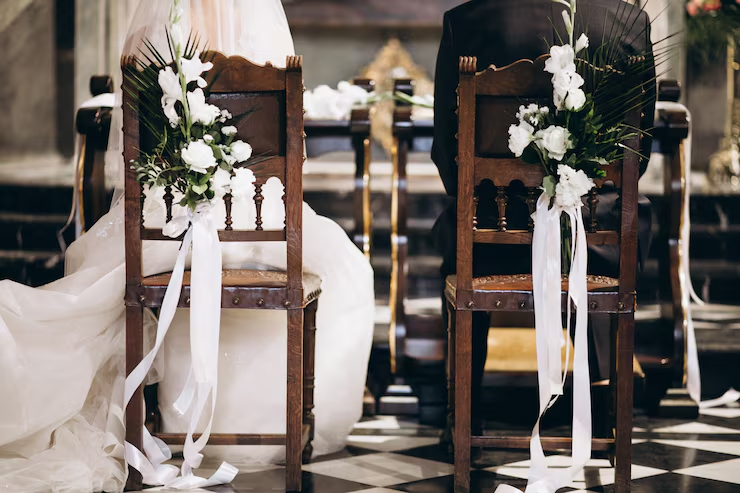
At the altar, Michael’s face drained of all color. Olivia, resplendent in a white gown that probably cost more than my car, looked confused. The officiant—an older man with kind eyes—took an uncertain step backward.
“Laura?” Michael’s voice cracked on my name. “What are you doing here?”
I stopped about ten feet from the altar, in full view of everyone. The guests numbered maybe seventy people—his family, her family, colleagues from his firm, friends who probably had no idea about the real story.
“I came to return something you left behind,” I said. My voice was calm, clear, carrying through the stone church. I’d practiced this moment in my head a hundred times.
“This isn’t the time—” Michael started, but I opened the folder.
“Six weeks ago, my husband left me and our ten-day-old son in a house with no heat, no car, and no way to call for help. We nearly died.” I held up the first document—the hospital record. “This is the medical report from when they found us. I had a fever of 104. Ethan’s body temperature was dangerously low.”
Murmurs rippled through the crowd. Olivia’s hand flew to her mouth. Michael took a step toward me, reaching out as if to stop me.
“But that’s not even the worst part,” I continued. “While I was pregnant with his son, Michael forged my signature on documents to sell my grandfather’s house. A property worth $1.2 million. He stole over a million dollars from me to finance his new life with her.”
I held up the sale documents, the pages marked with sticky notes where Patricia had highlighted the obvious forgeries. “I have the county records. I have the bank statements showing where the money went. I have the FBI fraud investigation file number.”
“Laura, you don’t understand—” Michael’s voice was desperate now.
“I understand perfectly.” I looked directly at Olivia. “Did he tell you he had a wife who’d just given birth? Did he tell you he was abandoning his newborn son? Or did he lie to you too?”
Olivia’s face crumpled. She looked at Michael with dawning horror. “You said you were separated. You said—”
“I have text messages,” I interrupted, pulling out another set of papers. “Messages between the two of you planning this. Planning how he’d leave me. When would be the ‘right time.’ How much money he’d need to start over. You knew, Olivia. You helped him.”
Justice
That’s when the church doors opened again, and two police officers walked in. They’d been waiting outside for my signal—the moment I’d shown the evidence, establishing probable cause in front of witnesses.
“Michael Thompson?” one of them said.
Michael looked between me, the officers, Olivia, and the crowd of shocked guests. His face cycled through expressions—panic, rage, fear, and finally something like resignation.
“This isn’t happening,” he whispered.
“Actually, it is,” Patricia Winters said, stepping out from where she’d been standing at the back of the church. “Mr. Thompson, you’re being served with emergency custody papers granting sole custody of Ethan Bennett to his mother. You’re also being formally notified of the fraud investigation. The district attorney’s office will be in touch.”
The officers approached Michael, who stood frozen at the altar. Olivia backed away from him like he was suddenly contagious, her white dress rustling. Guests were standing now, some pulling out phones, others whispering urgently. The officiant had disappeared entirely.
Michael looked at me one last time. “I never thought you’d go this far,” he said quietly.
“Neither did I,” I replied. “But I did it for him.” I glanced down at Ethan, still sleeping peacefully against my chest, oblivious to the drama surrounding him. “He deserves better than a father who’d abandon him in a snowstorm. He deserves the truth.”
I turned and walked back down the aisle, leaving behind the chaos, the gasps, the shouts. Patricia walked beside me, her hand lightly on my back. Outside, Rachel was waiting with the car running, and I slid into the passenger seat, suddenly exhausted.
“You did it,” Rachel said, tears streaming down her face. “You actually did it.”
“Yeah,” I said. “I did.”
The Aftermath
The aftermath was messy but satisfying. The fraud investigation took three months, but between the forged signatures, the witness testimony, and Michael’s own financial records, the case was straightforward. He accepted a plea deal—paying full restitution of the stolen money plus penalties, five years probation, and permanent loss of custody rights. Olivia broke off the engagement within days of the wedding fiasco, and I heard through mutual acquaintances that she moved back to Massachusetts, refusing to speak about what had happened.
The sale of my grandfather’s house was voided, and I made the difficult decision to sell it properly this time, using the money to buy a smaller, more practical house in a good school district near Rachel. The divorce was finalized four months after the wedding that never was, and Michael didn’t contest a single term.
Today, sitting in my bright kitchen while Ethan—now fourteen months old—plays with blocks on the floor, I can finally breathe. Being a single mother is exhausting in ways I never imagined. The sleepless nights, the constant worry, the financial juggling even with Michael’s court-ordered support payments. But it’s also clarity, in its own way.
I know who I am now. I’m not the woman who signed papers without reading them. I’m not the woman who ignored warning signs. I’m the woman who walked into a church and demanded justice, who fought back when someone tried to erase me, who protected her child when no one else would.
What I Learned
People often ask if I was scared that day. Of course I was. Fear doesn’t disappear when you do the right thing—it simply stops controlling you. I learned that silence only protects those who do harm, and that sometimes the bravest thing you can do is tell the truth publicly, witnesses and all.
I wasn’t trying to humiliate Michael, though I understand why it looked that way. I was trying to close a cycle of lies with facts, with documentation, with the truth laid bare for everyone to see. That was the only way to stop him from controlling the narrative, from painting himself as the victim.
What I learned through all of this is that resilience isn’t something you’re born with—it’s something you build when you have no other choice. When you’re holding your child and deciding that his story won’t begin with abandonment but with courage. With a mother who fought for him when he couldn’t fight for himself.
Ethan is pulling himself up on the coffee table now, babbling his nonsense syllables, grinning at me with that smile that makes everything worth it. He won’t remember any of this—the snowstorm, the cold house, the wedding confrontation. He’ll just know that his mother loved him enough to fight for him.
And maybe, when he’s older, I’ll tell him this story. Not as a tale of revenge or bitterness, but as a lesson about courage. About how sometimes the most loving thing you can do is refuse to be silent. About how truth, even when it’s painful and public and scary, is still better than living a lie.
I look at my son, at this small person who depends on me entirely, and I make him a promise: I will always protect you. I will always fight for you. And I will always, always teach you that your mother is someone who stands up for what’s right, no matter how frightening it is.
Because six weeks after my husband abandoned us in a snowstorm, I walked into his wedding and changed everything. Not because I wanted revenge, but because I wanted justice. And sometimes—sometimes—they’re the same thing.
Michael lost more than a wedding that day. He lost the chance to be a father, to be honest, to be better. I gained something different—my voice, my strength, my future. And in the end, that’s the only thing that matters.
The snow has melted now, and spring is coming to Vermont. Ethan and I are building a life—modest but secure, simple but ours. And every day, I’m grateful not for what I escaped, but for what I became in the escaping.
Strong enough to stand alone. Brave enough to demand justice. Clear enough to know that sometimes, the hardest thing and the right thing are exactly the same.