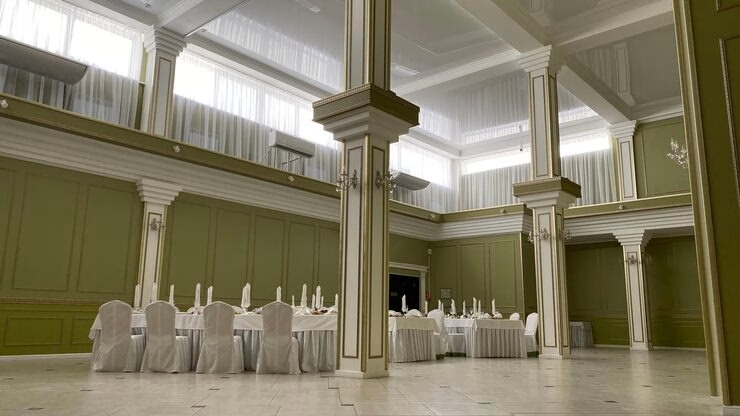
Behind the Pillar
I was seated behind a load-bearing pillar at my own sister’s wedding, a structural necessity that seemed to double as a metaphor for my existence in this family: present, supporting the weight of their expectations, yet entirely obstructing their aesthetic.
Everyone pretended I wasn’t family. It was a practiced ignorance, an art form perfected over decades of Thanksgiving dinners and passive-aggressive birthday cards. Then, a stranger sat beside me. He didn’t look like the other guests—he looked sharp, dangerous, and bored. He leaned in, the scent of expensive sandalwood and rebellion clinging to him, and whispered, “Just follow my lead and pretend you’re my date.”
When he eventually stood to speak later that night, the room turned on its axis. My sister stopped smiling. My mother dropped her champagne flute. But I am getting ahead of myself. To understand the sweetness of the coup, you must first taste the bitterness of the ingredients.
Let me start from the beginning. From the moment that cream-colored envelope arrived like a summons in the mail three months earlier.
The Invitation
It was a Tuesday morning in April. I was living in Denver, carving out a life in the flour-dusted kitchen of The Gilded Crumb, a boutique bakery downtown. My apartment was small, a third-floor walk-up that perpetually smelled of vanilla bean and caramelized sugar—the scent of my experimental baking sessions. I had been up since 4:00 a.m., wrestling with humidity and temperamental dough for honey-lavender croissants. When I finally stumbled home around 2:00 in the afternoon, exhaustion pulling at my eyelids, I almost missed the heavy, linen-stock envelope wedged between utility bills and grocery store circulars.
Victoria was getting married.
My older sister. The golden child. The daughter who could do no wrong in our mother’s discerning, critical eyes. The invitation was formal, traditional, and cold—exactly what I expected. Embossed lettering announced her union to Gregory Bennett, a name I had never heard her mention during our increasingly rare, stilted phone calls.
I should have been happy for her. Sisters are supposed to weep with joy during milestone moments. But as I held that invitation, feeling the raised ink under my thumb, all I could think about was the last family dinner we’d endured together six months prior.
Our mother, Eleanor, had hosted Thanksgiving at her sprawling suburban fortress. I had brought a pumpkin cheesecake I’d spent two days perfecting—layers of spiced cream cheese, a ginger snap crust that shattered perfectly upon impact, and a bourbon-infused caramel drizzle. Victoria had brought a store-bought pie in a foil tin.
“Elizabeth, you really shouldn’t have gone to so much trouble,” Mother had sighed, barely glancing at my masterpiece before shoving it to the far, dark corner of the buffet table. Then she turned to the foil tin. “Victoria’s pie looks lovely, darling. So classic. So traditional.”
That was the dynamic. Victoria could show up empty-handed and receive a ticker-tape parade for her presence. I could bring the moon on a silver platter, and Mother would complain about the tarnish on the silver.
The wedding invitation included a small note card, handwritten in Victoria’s perfect, private-school cursive: Elizabeth, I know we haven’t been as close lately, but it would mean everything to have you there. You’re my only sister.
I called her that evening. She answered on the fourth ring, her voice tight and distracted.
“Victoria, I got your invitation. Congratulations.”
“Oh, good,” she exhaled, the sound of papers shuffling in the background. “I was worried it might get lost. Can you make it?”
“Of course. I wouldn’t miss it. Tell me about Gregory. How did you two meet?”
There was a pause, a beat of silence just long enough to make me wonder if she was fabricating the details. “At a pharmaceutical conference. He’s a Regional Director at Bennett Health Solutions. Very successful, very established. Mother absolutely adores him.”
Of course she did. I wondered if Victoria loved him, or if she loved how he looked on a résumé.
“I’m really happy for you,” I said, trying to force the lie into a shape that resembled truth.
“Thank you. Listen, I have to run. We’re meeting with the wedding planner in twenty minutes. I’ll send you more details later.”
She hung up before I could say goodbye. I stared at my phone, the abrupt silence filling my small kitchen, and felt a familiar, dull ache settle in my chest. It wasn’t quite sadness, and it wasn’t quite anger. It was the heavy, suffocating realization of being perpetually secondary.
The Exclusion
The weeks leading up to the wedding passed in a blur of buttercream and sleepless nights. I bought a new dress, a soft slate blue that complimented my complexion without being too attention-grabbing—camouflage for the unwanted. I arranged time off from the bakery, much to my boss’s dismay since June was wedding season for us, too.
I should have known something was wrong when Victoria didn’t ask me to be a bridesmaid. She had five bridesmaids, a fact I learned from her curated Instagram feed. College friends, work acquaintances, even our cousin Jessica, who she’d barely spoken to in a decade. But not me.
“The wedding party is already set,” she explained when I finally worked up the courage to ask, her voice airy and dismissive. “You understand, right? These are people I see regularly. It’s just logistics, Liz.”
I understood perfectly. I understood that I would never be part of her inner circle. That our shared childhood, the secrets whispered under blanket forts, meant nothing compared to her current social standing.
The wedding was scheduled for a Saturday in late June at an upscale resort outside Denver. I drove there alone, my dress hanging carefully in the back seat, a small gift wrapped in silver paper on the passenger seat. I had spent weeks deciding what to give them, finally settling on a set of handcrafted ceramic bowls from a local artist I admired. Something thoughtful. Something real.
The resort was stunning—a manicured playground for the elite. Lawns stretched toward mountain views like green velvet, and the ceremony site overlooked a pristine, glass-like lake. White chairs were arranged in military-precision rows, and flowers seemed to bloom from every available surface, defying nature with their abundance. Victoria had spared no expense, which meant our mother had spared no expense. This was the wedding Eleanor had always dreamed of, the perfect culmination of her perfect daughter’s perfect life.
I arrived two hours early, a foolish hope fluttering in my chest that perhaps I could find Victoria, offer my help, fix a hem, hold a hand—be a sister.
Instead, I found a fortress. The bridal suite was a cacophony of laughing women in matching silk robes, champagne flutes catching the light, while a photographer snapped away, capturing the “candid” joy.
I knocked softly on the open door. Victoria glanced up from her makeup chair, her eyes meeting mine for a fraction of a second before sliding away like oil on water.
“Elizabeth, you’re here early.” It wasn’t a greeting; it was an accusation.
“I thought maybe I could help with something. Steaming dresses? Last-minute errands?”
“Everything’s under control,” she said, turning her face back to the makeup artist. “The wedding planner has it all handled. Why don’t you go find your seat? The ceremony starts soon.”
One of the bridesmaids, a blonde woman I didn’t recognize, giggled and whispered something to the woman next to her. They both looked at me—me in my street clothes, smelling faintly of the long drive—and smiled that tight, pitying smile people reserve for the help.
I backed out of the room, my face burning with a heat that had nothing to do with the summer sun. I shouldn’t have come early. I shouldn’t have assumed I’d be welcome in that inner sanctum.
The Pillar
The ceremony site was still being prepared when I made my way outside. I wandered to the area where guest seating had been arranged, looking for my name card. Row after row of Chiavari chairs stretched before me. The front rows were clearly reserved for immediate family and VIPs—gold name cards, velvet ribbons. I expected to find my name somewhere in the second or third row. Close enough to show blood relation, far enough to acknowledge our distance.
I walked past row two. Past row five. Past row ten.
I found my name card in the back row. The very last row. And not just the last row—my chair was positioned partially behind a decorative, ivy-covered pillar that supported the ceremony arbor. From that seat, I would have a blocked view of the altar. I wouldn’t see my sister’s face as she said her vows. I would see masonry.
I stood there, holding that little card with Elizabeth printed in elegant calligraphy, and something inside me cracked. A hairline fracture in the foundation of my patience.
This wasn’t an oversight. The wedding planner didn’t make mistakes like this. This was deliberate. This was Victoria’s way of putting me exactly where she thought I belonged: out of sight, out of mind, a footnote in the margin of her triumphant day.
I could have left. I could have driven back to Denver, called in sick to life, and spent the day nursing my wounded pride with cheap wine. But a cold, stubborn resolve rooted my feet to the grass. I was her sister. I had been invited. And I would be damned if I gave her the satisfaction of my absence.
I sat down. And I waited for the show to begin.
Guests began arriving around 4:00 p.m., a parade of linen suits and designer dresses. I watched from my vantage point behind the pillar as people found their seats, greeted each other with performative warmth, and took selfies against the mountain backdrop. I recognized faces from family gatherings of the past—aunts, uncles, cousins I hadn’t seen in years. None of them noticed me tucked away in my architectural exile.
Our mother arrived twenty minutes before the ceremony, resplendent in a champagne-colored gown that probably cost more than my car. She was escorted to the front row by a groomsman, beaming, radiating the triumph of a general who has won the war. She didn’t look back. She didn’t scan the crowd for her younger daughter. Why would she? She knew exactly where I was.
The ceremony began at five o’clock sharp. Music swelled from hidden speakers—a string quartet playing a modernized version of a pop song. The wedding party processed down the aisle. Sage green dresses, white roses, sharp navy suits.
Then, Victoria.
Even from my obstructed view, catching only glimpses between the pillar and the shoulder of the man in front of me, I could see she was stunning. Her dress was a masterpiece of lace and structure, her veil trailing behind her like morning mist. Our father, who I’d barely spoken to since the divorce five years ago, walked her down the aisle, looking proud and distinguished.
I craned my neck, trying to see past the ivy. It was useless. I was watching a radio play.
That’s when I noticed I wasn’t the only exile in the back row.
The Stranger
Two chairs away, also partially obscured by the pillar, sat a man. He was younger than most of the senior guests, maybe in his early thirties, wearing a charcoal suit that was tailored within an inch of its life. His dark hair was styled with casual precision, and he possessed the kind of sharp, angular features that belonged in a cologne advertisement.
But it was his expression that caught me. He looked bored. Not just impatient, but existentially weary of the pageantry. He caught me staring, and instead of looking away, he offered a small, crooked smile. It was a conspiratorial expression, like we were the only two sober people at a frat party.
I smiled back weakly and returned my attention to the pillar.
The officiant droned on about love, commitment, and the sanctity of pharmaceutical mergers—or perhaps that was just my interpretation. Victoria and Gregory exchanged vows I couldn’t hear. They kissed to enthusiastic applause. And just like that, my sister was married.
As the guests began to stand, shuffling toward the cocktail hour, the stranger approached me. Up close, his eyes were a startling, intelligent grey.
“That was quite a view, wasn’t it?” His voice was a rich baritone, laced with dry amusement.
“Spectacular,” I replied, smoothing my dress. “I especially enjoyed the texture of the stucco on this pillar. Very engaging.”
He laughed—a genuine, barking sound that made a few heads turn. “I’m Julian. And I’m guessing from your prime seating assignment that you’re either someone’s least favorite ex-girlfriend or you committed a felony against the wedding planner.”
“I’m Elizabeth. And I’m the bride’s sister, actually.”
His eyebrows shot up. The amusement vanished, replaced by a flash of genuine shock. “Her sister? And they put you back here? Behind the masonry?”
“Apparently, I disrupt the aesthetic.”
Julian studied me for a long moment, his gaze dissecting me. It wasn’t predatory; it was analytical. “Well,” he said finally, “that is a profound error in judgment on their part. The cocktail hour is about to start, and I have a feeling it’s going to be a minefield of small talk and judgment. What do you say we face it together?”
“You don’t have to pity me. I’m used to this dynamic.”
“It’s not pity,” he countered, stepping closer. “It’s a strategic alliance. I’m here as a proxy for my business partner who came down with pneumonia. I know exactly three people here: the groom, who is too busy being adored, and two board members I’m trying to avoid. So, really, you’d be saving me.”
There was a glint in his eye—a challenge. He extended his arm, an old-fashioned gesture that felt oddly grounding in the chaos.
“Shall we?”
I hesitated for a heartbeat. Then, I linked my arm through his. “Lead the way.”
We walked toward the pavilion, and for the first time all day, I didn’t feel invisible. I felt armored.
The Reception
The reception was a masterclass in excess. The ballroom was dripping in crystals and orchids. Long tables were arranged in a U-shape, with a head table elevated like a throne. I found my name card at a table in the far, dark corner, near the kitchen doors—the overflow seating for the irrelevant.
Julian appeared at my elbow, holding his own place card. “Interesting. I’m at the opposite end of the room. It’s almost like they want to dilute the cool people so we don’t form a union.”
“This is ridiculous,” I hissed, the humiliation finally clawing its way up my throat. “I’m her sister. She put me by the kitchen.”
“You know what?” Julian plucked my place card from the table. “Screw the seating chart.”
He pocketed my card, then his own. “Come on.”
“What are you doing?”
“Improvising. Just follow my lead and pretend you’re my date.”
Before I could protest, he guided me toward Table 4—a prime table near the front, clearly designated for VIPs and business associates. He pulled out a chair for me with practiced ease, then sat beside me, radiating the confidence of a man who owned the building.
“Julian, we can’t just—”
“We can. And we did. If anyone asks, there was a mix-up with the placards and we fixed it. Trust me.”
The table filled quickly. These were Gregory’s people—pharmaceutical executives, board members, people who spoke in acronyms and checked their Rolexes. They greeted Julian with familiarity.
“Julian! Didn’t expect to see you here without Dominic,” a woman named Patricia said. She was formidable, wearing a structured blazer over her gown.
“Dominic sends his regrets,” Julian said smoothly. “But I couldn’t miss it. And I brought Elizabeth.”
Patricia turned to me, her smile warm but appraising. “And you must be Julian’s…?”
“Girlfriend,” Julian interjected, his hand finding the small of my back. “She’s been keeping me sane.”
“Lovely to meet you. How do you know the happy couple?”
“Elizabeth is Victoria’s sister,” Julian dropped the bomb casually, reaching for a bread roll.
Patricia’s fork paused halfway to her mouth. “Sister? I… I had no idea Victoria had a sister. She never mentioned you during the planning meetings.”
“I’m sure it just slipped her mind,” I said, my voice steady, though my heart was hammering against my ribs.
“I’m sure,” Patricia murmured, looking between me and the head table with new interest.
Dinner was a blur of courses I barely tasted, my senses tuned entirely to the man beside me. Julian played the role of the attentive partner perfectly. He filled my wine glass, laughed at my dry observations, and steered conversations toward me in a way that made me shine.
Then came the speeches.
My mother stood up. She spoke of Victoria’s grace, her beauty, her perfection. She spoke of their bond, their shopping trips, their shared dreams. She didn’t mention me. Not once. I was edited out of the family narrative in real-time.
I felt Julian’s hand find mine under the tablecloth. He squeezed it—hard. A silent anchor in the storm of erasure.
“She missed a spot,” he whispered when my mother sat down to applause. “She forgot the part about the sister who has more integrity in her little finger than that entire head table combined.”
I looked at him, startled. “You don’t even know me.”
“I know enough. I watched you during the ceremony. You stood there, behind a pillar, holding your head high when most people would have stormed out. That takes steel, Elizabeth.”
The music swelled. The dancing began. Victoria and Gregory swirled around the floor, the perfect couple in their perfect world.
Julian stood and offered his hand. “Dance with me.”
We moved to the floor. He was a good dancer—confident, leading without dominating. As we swayed, I felt the tension of the day begin to bleed out of me.
“Thank you,” I whispered against the lapel of his suit. “For saving me tonight.”
“I didn’t save you, Elizabeth. I just gave you a better vantage point. You were already surviving just fine.”
As the song ended, my mother approached our table, her eyes narrowing as she spotted me in a seat I wasn’t assigned.
“Elizabeth,” she said, her voice dripping with ice. “I didn’t expect to see you here. This table is for Gregory’s business associates.”
“There was a mix-up,” Julian said, his voice dropping an octave, becoming dangerous. “I’m Julian. I work with Bennett Health. Elizabeth is with me.”
My mother froze. She looked at Julian’s expensive suit, then at the executives at the table watching the interaction. She recalculated instantly.
“Oh. I see.” Her smile became brittle. “Well, isn’t that nice. I didn’t know you were seeing anyone, Elizabeth.”
“We’re keeping it private,” Julian said. “Elizabeth values discretion.”
My mother sniffed. “Well. Enjoy the evening.” She swept away, but I saw the confusion in her eyes. I had broken the script.
Later, as the night wound down and guests began to leave, Julian walked me to the lobby.
“I’m staying here tonight,” I said. “Room 314.”
“I’m in 209,” he smiled. “Breakfast tomorrow? 9:00 a.m.? No pillars, I promise.”
“I’d like that.”
He leaned in, brushing a stray hair from my face. For a second, I thought he would kiss me. Instead, he just looked at me with an intensity that made my knees weak.
“Goodnight, Elizabeth.”
I went to my room, threw myself on the bed, and stared at the ceiling. I had survived the wedding. But as I closed my eyes, I had a feeling the real drama was just beginning.
The Morning After
The next morning, the sunlight over the lake was blindingly bright, washing away the sins of the previous night. I met Julian in the restaurant. He looked less formidable in a navy sweater, but no less striking.
Over waffles and coffee, the dynamic shifted. The playfulness remained, but something sharper entered his tone.
“You light up when you talk about baking,” he observed after I spent ten minutes describing the chemistry of ganache. “Why do you let them treat you like a failure?”
“Because in their world, I am. I’m not a doctor. I’m not a VP. I make cookies.”
“You’re an artist,” he corrected. Then he leaned forward, pushing his plate aside. “Can I ask you something? Do you want to change the narrative?”
“What do you mean?”
“I mean, last night made me angry. Seeing how they erased you. It’s not just mean; it’s bad business. But here’s the thing, Elizabeth: I have leverage.”
I put my coffee cup down slowly. “What kind of leverage?”
“Gregory’s company, Bennett Health Solutions, is in deep trouble with their sustainability compliance. They’re desperate to rebrand as ‘green’ and ‘eco-conscious.’ My firm is the one consulting on their overhaul. It’s a multi-million dollar contract. If I say jump, Gregory asks ‘how high’ on the way up.”
A chill ran through me. “And?”
“And,” Julian’s eyes glittered, “I think it’s time you became visible. Not as the poor sister, but as the partner of the man who holds their future in his hands. And not just that—I think we can use this to showcase what you do.”
“This sounds manipulative.”
“Is it more manipulative than hiding your own sister behind a column?”
He had a point.
“What do you propose?”
“We date. For real. I want to see you again anyway—that part isn’t a strategy, that’s just me being captivated by you. But we make sure they see us. And we make sure they see your talent.”
The Strategy
We started dating. It was a whirlwind. Dinners at places where we’d inevitably run into people from Gregory’s world. Gallery openings. Charity events. And amidst the strategy, something real blossomed. We talked about books, about fears, about the lonely architecture of our childhoods.
Two weeks later, Julian invited me to a business dinner with Patricia, the executive from the wedding. We went to a high-end bistro in Denver.
When dessert arrived—a deconstructed lemon tart—I couldn’t help myself.
“Technically, the curd is split,” I murmured, poking it with my fork. “And the lavender is overwhelming the citrus. It’s soapy.”
Patricia leaned in. “You know, I thought the same thing. How would you fix it?”
I launched into an explanation of tempering eggs and infusing cream. I spoke with authority, forgetting to be shy. Patricia watched me, mesmerized.
“You know,” Patricia said, tapping her chin. “Bennett Health is hosting a massive gala in August to celebrate the completion of our green initiative. We’re expecting 200 guests, press, the mayor. We haven’t picked a caterer for the desserts yet.”
She looked at Julian, then back at me. “Would you be interested? It’s a huge job. But if you’re as good as you sound…”
“She’s better,” Julian said, squeezing my knee under the table.
“I’d love to,” I said, my voice trembling only slightly.
The contract was signed three days later.
Then, the call came.
“Elizabeth?” It was Victoria. Her voice was syrupy sweet, a tone I hadn’t heard in years. “Hi! We haven’t talked since the wedding. I wanted to see if you wanted to grab lunch?”
I met her at a cafe. She spent twenty minutes making small talk before getting to the point.
“So,” she swirled her iced tea. “I hear you’re dating Julian. And that you’re doing the desserts for the Bennett Gala.”
“News travels fast.”
“Gregory is… concerned. He wants to make sure everything goes smoothly with Julian’s firm. He was hoping you could put in a good word? Remind Julian how committed Gregory is to this project?”
I stared at her. She didn’t want to see me. She wanted to use me.
“Victoria,” I said, setting my glass down hard enough to rattle the silverware. “I’m not here to be a conduit for your husband’s business. And I’m not here to be your doormat anymore.”
“Excuse me?”
“I know you put me behind the pillar. I know you’re embarrassed by me. But here’s the reality: I am the lead pastry chef for the biggest event in your husband’s career. And the man holding his contract happens to think I’m extraordinary. So, you don’t get to treat me like the help anymore. If you want a relationship, it starts with respect. If not, enjoy your salad.”
I stood up and walked out. My hands were shaking, but my spine felt like steel.
I called Julian from the car. “I did it. I stood up to her.”
“I’m proud of you,” he said. “Now, get back to the kitchen. You have a gala to win.”
The Gala
The night of the Bennett Health Gala, the event space was transformed into a modern garden of glass and light.
I had spent three weeks in the kitchen. I wasn’t just baking; I was crafting ammunition. Every tart, every macaron, every petit four was a declaration of war against mediocrity. I made chocolate-raspberry tarts with 24-karat gold leaf. I made honey-lavender macarons that dissolved on the tongue like a memory. I made miniature lemon cakes topped with edible flowers that looked almost too beautiful to eat.
I wore an emerald green gown that Julian had bought me. “Green for money,” he had winked. “Green for envy.”
We walked in together. The room stopped.
Gregory and Victoria were near the entrance, holding court. When they saw us—saw Julian’s hand on my waist, saw the way the photographers turned toward us—their smiles faltered.
Patricia rushed over to us. “Elizabeth! The dessert display is the talk of the room. People are ignoring the open bar to eat the cake. That never happens!”
She dragged me toward the stage. “Come, come.”
Before I knew what was happening, Patricia was at the microphone.
“Ladies and gentlemen, if I could have your attention. Tonight is about sustainability, about building a better future. And part of that future is recognizing incredible local talent. I want to introduce the artist behind tonight’s extraordinary dessert experience—Elizabeth Caldwell from The Gilded Crumb.”
The spotlight hit me. The applause was thunderous.
I looked out into the crowd. I saw Julian, beaming with pride, clapping the loudest.
And then I saw them.
Victoria and Gregory stood near the back. My mother was with them. They looked stunned. For the first time in my life, I wasn’t the blurry figure in the background of their photo. I was the focal point.
They weren’t clapping out of polite obligation. They were clapping because the room demanded it. They were clapping because they realized, with dawning horror, that I had outgrown the small box they had built for me.
After the speeches, Gregory approached us. He looked sweaty.
“Elizabeth, fantastic work,” he said, his voice too loud. “Julian, good to see you. We should talk about the Phase 2 rollout next week.”
“We’ll see,” Julian said coolly, sipping his drink. “Elizabeth and I are taking a vacation next week. We’ll discuss business when I get back. If the schedule permits.”
Gregory swallowed hard. “Right. Of course.”
Victoria wouldn’t meet my eyes. She looked at the dessert table, stripped bare by ravenous guests, and then at me.
“You look… happy, Elizabeth,” she said, and for the first time, it sounded like she meant it. Or maybe she just realized she couldn’t afford for me to be unhappy.
“I am,” I said. “I really am.”
The View from the Top
Later that night, Julian and I stood on the balcony overlooking the city lights.
“So,” he asked, loosening his tie. “How does it feel? To be the most important person in the room?”
“It feels… quiet,” I said.
“Quiet?”
“The voice in my head. The one that told me I wasn’t enough because I didn’t have the title or the house or the approval. It’s gone.”
Julian pulled me close, kissing my temple. “They didn’t just lose power over you, Elizabeth. They realized they need you. Gregory needs my firm. Victoria needs Gregory to succeed. And my firm loves you. You hold all the cards now.”
“I don’t want to hold cards,” I said, looking at the stars. “I just want to bake.”
“And you shall.”
In the months that followed, the dynamic shifted permanently. Victoria called—actually called—to ask for recipes. My mother stopped critiquing my career and started bragging to her friends about my “exclusive corporate contracts.”
It was a forced respect, born of necessity and fear, but it was respect nonetheless. They walked on eggshells, terrified that one wrong move would offend the sister who held the keys to the kingdom.
I had spent my life behind a pillar, watching the world happen to other people. But as I stood there that night, leaning against the man who had handed me the sledgehammer to break down my own walls, I realized something.
The best revenge wasn’t destroying them. It was forcing them to watch me rise, slice by slice, until they were the ones begging for a seat at my table.
I looked at Julian. “Hungry?”
“Starving.”
“Good,” I smiled. “I saved the best tart for us.”
We went back inside, past the crowd still milling around the dessert display, past my family who were now trying to insert themselves into conversations about my work, past all the noise and performance.
And for the first time in my life, I walked right through the center of the room.
No pillars. No shadows. No apologies.
Just me, finally visible, finally free.