The Ticket That Changed Everything
They say the loudest sound in the world isn’t an explosion or a scream. It’s the sound of a door closing when you’re standing on the wrong side of it.
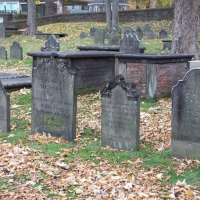
I never expected to bury my child. It’s the most unnatural thing on earth—to stand upright while they lower your boy beneath it. Richard was thirty-eight. I was sixty-two. April rain threaded through the oaks at Green-Wood Cemetery and slicked the marble angels until they looked like they were weeping with us. Sound came thin and far away: the scrape of shovel on wet soil, a zipper of thunder somewhere over the harbor, the soft human noises people make when they don’t know what to do with their hands.
I remember thinking the world should stop. Just for a minute. Traffic on Fourth Avenue, the F train rumbling under our feet, planes on their way to somewhere sunnier—all of it should have gone still in recognition that my boy, the boy who once tried to glue macaroni to a shoebox to make me a “jewelry safe,” was now inside a polished mahogany box disappearing into the ground.
Grief walled me off from everything. Faces blurred at the edges until only the casket remained in focus, the raw mouth of earth, my own name spoken in softened tones by people I barely recognized. A cousin pressed a tissue into my fist. Someone from Richard’s company squeezed my elbow and murmured, “He was a visionary, Eleanor.” The words slid off like rain off the funeral tent.
Across the grave stood my daughter-in-law Amanda—precision hair, liner that wouldn’t dare smudge, posture like a trademark. Married to Richard for three years and somehow already the gravitational center of his world. Her black Chanel looked like a dress made for sponsorship dinners, not for the edge of a grave. She accepted condolences with a professional tilt of her head, like grief was a networking opportunity she was managing with appropriate solemnity.
When our eyes met, she arranged a sympathetic smile that never touched anything living. There had been a time I tried to love her simply because my son did, because after cancer took his father Thomas five years earlier, I had promised myself I would not be the stereotype of the jealous mother-in-law. But with Amanda, there was always the sense of something calculated humming behind her eyes, like a spreadsheet running in the background of every conversation.
“Mrs. Thompson?” A man in a gray suit waited until the last handful of soil hit wood. His umbrella dripped neatly at his side. “Jeffrey Palmer. Palmer, Woodson & Hayes. Richard’s attorney. The reading of the will is at the penthouse in an hour. Your presence is requested.”
“At the house?” The words sounded like they belonged to someone else. “That’s very soon.”
“Amanda—Mrs. Conrad-Thompson—was insistent.” He corrected himself with the reflex of a man who knew where power lived and where his invoices got paid.
Of course she was. Amanda loved theater almost as much as she loved the audience for it.
The Reading
The Fifth Avenue penthouse sailed over Central Park like a glass ship. Richard had bought it before her; she’d remade it after—books banished, angles everywhere, seating that punished the idea of comfort. The kind of place you hire people to live in for you.
I rode the private elevator with Palmer and a pair of board members wearing identical navy suits and identical expressions of solemn networking. My sensible black dress and thrift-store coat looked like they’d cleared security by mistake.
The doors opened to the soft clink of glassware and murmured conversations. Fashion friends, board members, glossy strangers drifted through as if this were a launch party instead of a wake. Caterers moved like choreography. The skyline wrapped the room in windows, Manhattan glittering behind the gathered mourners like a jealous understudy.
“Eleanor, darling.” Amanda offered an air-kiss that landed safely a breath from my cheek. Her perfume smelled like something you had to sign for. “So glad you could make it. You look strong.”
“I’m here,” I said. That was all I could promise.
“No wine?” A crystal stem appeared in her hand.
“No, thank you.” I didn’t trust myself not to throw it.
She pivoted to a tall man in an Italian suit stationed near the windows. “Julian, you came.” Her hand fell to his knee as she sat beside him on the brutalist sofa and stayed there—an intimate, casual touch, the kind couples forget other people can see.
I found a corner near a piece of white canvas someone had angrily overpaid for and held to the last thin rope of composure. This used to be my son’s home. Somewhere under the lacquer and glass there had been a shelf of battered sci-fi paperbacks, a photograph of him and Thomas on a fishing boat, a chipped mug from a diner in Queens where we used to split pancakes.
Palmer positioned himself by the marble fireplace. A real fire burned behind glass, as if even flames required barriers here. “Ladies and gentlemen,” he said, and expensive silence fell. “This is the last will and testament of Richard Thomas Thompson, executed and notarized four months ago.”
Four months. Richard updated his will every August on his birthday. Something had changed in January that I didn’t yet understand. A prickle ran along the back of my neck.
Palmer began reading. “To my wife, Amanda Conrad-Thompson, I leave our primary residence at 721 Fifth Avenue, including all furnishings and art. I also leave to Amanda my controlling shares in Thompson Technologies, my yacht Eleanor’s Dream, and our vacation properties in the Hamptons and Aspen.”
A soft intake of breath moved through the room. It was almost everything. Thompson Technologies wasn’t just a company—it was my son’s name in code, then in contracts, then on financial news crawls. Those shares were a kingdom.
Amanda did a convincing impression of modest shock, her hand slipping from Julian’s knee just long enough to dab her eye with a linen handkerchief before returning to its place.
“To my mother, Eleanor Thompson…” Palmer continued.
I straightened, bracing for something that felt like us—the Cape house where we traced constellations, the first editions we hunted at auctions, the vintage MG his father kept alive with tenderness and wire. Something that said, I remember who held the flashlight while I installed my first motherboard.
“…I leave the enclosed item to be delivered immediately following the reading.”
Palmer produced a crumpled envelope from his leather briefcase. It sat on his palm like it weighed more than paper.
“That’s it?” Amanda let the syllables ring. “An envelope? Richard, you sly dog.”
Laughter chimed—hers first, then the satellites that orbited her, then a couple of Richard’s newer associates who laughed on instinct. Julian’s hand hadn’t moved from her knee.
I could feel eyes flicking toward me, gauging my reaction. Old woman, small envelope, public humiliation.
Palmer approached. “Mrs. Thompson, I—”
“It’s fine,” I said in the careful politeness women learn to use when cruelty wears etiquette. I would not give Amanda the satisfaction of a scene.
I took the envelope. The paper was creased like it had been handled often. My name was written in Richard’s slanted, impatient hand. I opened it because refusal would have been a second spectacle.
A single airline ticket slid into my hand. First class to Lyon, France. Connecting train to a village I’d never heard of—Saint-Michel-de-Maurienne. Departure: tomorrow morning.
“A vacation?” Amanda sang. “How thoughtful. Time alone. Far away. Maybe someplace without cell service.” The laughter sounded like glass breaking somewhere you couldn’t reach.
Palmer cleared his throat. “There is a stipulation I’m required to read. Should Mrs. Thompson decline to use this ticket, any potential future considerations will be nullified.”
“Future considerations?” Amanda’s brows knit. “What does that mean, Jeff?”
“I’m not at liberty to explain,” he said, looking like a man who disliked the room he was in.
“It hardly matters.” Amanda’s smile sharpened. “There’s clearly nothing else. Please, everyone, stay and celebrate Richard’s life. He would hate a dull party.”
The party resumed with hungry relief. I rode the elevator down inside a soundproof box of grief. At my Upper West Side apartment—where Richard’s height was still penciled on the kitchen doorjamb and the curtains held the smell of old paper and tomato sauce—I set the ticket on the table and watched afternoon shadows climb the brick building across the way.
I could have called a lawyer. Could have contested the insult. But under the humiliation there was a stubborn frequency only one voice in the world carried. Trust me, Mom. One last time.
Ghosts from Paris
The ticket glowed with its own light. Lyon. Saint-Michel-de-Maurienne. The names pulled at something buried—a twenty-year-old girl who had once sat on the banks of the Seine and believed her life could split in two.
Paris rose up in my memory. Not tourist postcards, but the smell of diesel and coffee on Boulevard Saint-Germain, the wobble of a café table under my notebook, the way a boy named Pierre had said my name like it was a word the language had been waiting for.
I saw the cramped student apartment with blue shutters, the map of the Métro we’d memorized, the list of places we would go someday. I saw myself packing to fly home after my semester abroad, braiding promises into my hair. I saw Jean-Luc, Pierre’s roommate, standing in the doorway with tragic news.
“There was an accident,” he’d said. “A motorcycle. Pierre didn’t survive.”
I’d heard the rest through water. Hospital. Too late. Two weeks later I was back in New York with a secret blooming under my ribs and grief so loud I married the first good man who offered me a steady hand.
Thomas had been that good man. Kind, stable, devoted. He never knew that the baby I carried wasn’t his by blood, though sometimes I wondered if he suspected. He loved Richard fiercely, completely, and that love was real regardless of genetics.
By dawn, I had packed a single suitcase, watered the philodendron, and written a note to my neighbor. I tucked the ticket into my coat pocket and ordered a car to JFK.
On the plane, wedged between a sleeping businessman and a young woman with loud earbuds, I wondered: What if this is nothing? What if it’s a cruel joke?
But what if it isn’t? another part answered. What if it’s the last thing your son arranged, and you stay home because you’re afraid of looking foolish?
Lyon greeted me with pale sun and ancient elegance. My college French woke like an old cat—stretching, stiff, game. At a café by the station, I drank coffee so strong it felt like faith and watched people hurry toward lives I’d never know.
The regional train climbed into the Alps. The world rose on both sides—stone and snow, fields stitched to mountains, church spires like sentries. My reflection in the window looked like my mother on her last good day—tired, but still here.
Saint-Michel-de-Maurienne was a sketch of a village—slate roofs, cream walls, café chalkboards promising tartes. The platform emptied to me, a family with ski bags, and an older man in a driver’s cap holding a sign: Madame Eleanor Thompson.
“I’m Eleanor,” I said, my voice smaller than I meant.
He studied my face with bright blue eyes. There was a flicker of recognition he smoothed away politely. Then he spoke five words that moved something ancient in my chest.
“Pierre has been waiting forever.”
The platform tilted. The mountains leaned in. My knees went soft.
He stepped forward quickly, steady as the mountain behind him. “Madame, pardonnez-moi. Perhaps I spoke too directly. I am Marcel. I drive for Monsieur Bowmont.”
“Pierre Bowmont?” The name snagged in my throat.
“Oui. Monsieur Bowmont sends his apologies. After your journey and your loss, he feared meeting you on the platform might be too much.”
Too much. My son was dead, my life had been turned into public humiliation, and now a ghost from my twenties was apparently alive. Too much had come and gone three disasters ago.
Château Bowmont
Marcel guided me to a black Mercedes that purred like confidence. As we climbed, the village fell away, replaced by slopes and stone walls that had seen more winters than my family line.
An iron gate appeared, its bars twined with sleeping vines. A brass plate bore a name in elegant script. Then the château rounded the curve like a wish granted—golden stone starred with windows, turrets remembering history, terraces tumbling to gardens and vineyards combed into the hill.
“Château Bowmont,” Marcel said with French pride. “Monsieur has modernized with respect. The wines, you will see.”
The front door opened before the car stopped. A man stood there—silver where he’d once been ink, lines where there’d been none, eyes the same startling dark.
“Eleanor,” he said, and my name arrived with the accent it had always preferred.
I got as far as “You’re alive” before the world went politely black.
I woke in a study—bookshelves, stone hearth, the grammar of old wood. A blanket was tucked over my legs.
“You’re awake.” Pierre sat in a leather chair, hands folded. “Marcel is preparing a room. I thought we should talk before you decide whether to stay.”
“Richard,” I said first. “Did he know? Is he—?”
“I am so sorry for your loss,” Pierre said, his English precise but dusted with age. “Your son came to me six months ago. A medical question sent him to a DNA service. A private investigator followed the thread. It led to me.”
He paused, searching my face. “Biologically, he is mine. In all the ways that matter, he was Thomas’s.”
“He was,” I whispered. “Thomas loved Richard like breath.”
“You knew,” Pierre said—not accusation, just fact.
“I knew. I found out I was pregnant after Jean-Luc told me you were dead. I flew home with a funeral in my chest. Thomas was steady, kind. I thought marrying him was choosing stability for a child. I thought there was nothing left to tell you.”
Pierre’s jaw altered. “There was no accident. I waited at our café for hours. You never came. At your pension they said you’d checked out. Jean-Luc told me you’d decided you preferred a safe life and wanted no contact.”
He swallowed. “He was in love with you. I didn’t see it. He told you I died, and told me you left. He wanted to punish us both.”
Forty years rearranged like furniture in darkness. “If I had known—”
“We are here now,” Pierre said quietly. “With more past than future, perhaps. But we have some future.” He poured cognac. “And we have something of your son’s you must see.”
“There’s more,” I said, because of course there was.
“Richard discovered something about Amanda. About his business partner Julian Marsh. Financial transfers. Shell companies. A plan to force him out. And when that proved difficult—talk of removing him another way.”
“The boat,” I whispered. “The accident off Maine. They said it was a storm.”
His silence was answer enough.
The Second Will
“He revised his will four months ago. Left the visible world to Amanda—performed it. But he’d hidden more. Investments, properties, accounts. He drew a second will, witnessed and notarized, leaving the bulk of his estate to a trust administered by you and me.”
“By us?” The room spun. “Why?”
“Because he wanted his life to stitch itself back together, even if he wouldn’t see it.” Pierre set a leather folder on the desk. “The plane ticket was his condition. If you used it, if you trusted him one more time, the second will would activate. If you didn’t, everything would revert to Amanda.”
“The ticket was a key.”
Pierre nodded. “He called it a test. He said you were the only person he trusted to hear a door slam and still check for one quietly opening.”
He produced another envelope. “He left you a letter.”
My hands shook as I broke the seal. Richard’s handwriting filled the page—apologizing for the theater, explaining the DNA kit, the notification that said New Close Relative: Parent?, how he’d clicked and stared at the name Pierre Bowmont until the text blurred.
He wrote about meeting Pierre in Paris, about Amanda’s affair with Julian, the embezzlement, the sabotaged yacht. If you’re reading this, assume the worst. Trust no one except Pierre and Marcel. The evidence is in the blue lacquer box you gave me at sixteen. Hidden where only you would think to look. Remember our treasure maps?
“The Cape house,” I said, memory arriving complete. “The iron bench beneath the X-trellis. We built a hidden drawer when he was twelve.”
“We need it before Amanda does,” Pierre said, his face sharpening.
“She owns the deed now.”
“Paper burns. Fact remains. And Richard’s second will makes clear that assets recovered through that evidence fall under the trust.” He was already on the phone. “Marcel can ready the jet.”
The Cape
We left at first light. The mountains wore deep blue, dawn pulling gold along their shoulders. Boston met us in pewter. A black SUV waited. The driver—Roberts—briefed us as the city fell away.
“Amanda and Julian arrived at the Cape house at dawn. They brought a locksmith. Our caretaker identified a plumbing issue requiring immediate attention. Should slow them while they argue.”
“We’ll need a distraction,” Pierre said.
“Already arranged,” Roberts said. “A furniture company insisting the neighbor signed for sofas at the wrong address. Loudly.”
The ocean matched the sky. The house wore its cedar silver. The trellis waited, its beams still forming a crooked X over the garden where Richard and I once buried time capsules.
Roberts checked a device. “Their vehicle’s present. We have a window.”
At noon, chaos bloomed next door—men heaving sofas, a foreman arguing, a neighbor conducting symphony in the driveway. Amanda and Julian stepped onto the deck to watch.
“Now,” Roberts said.
We took the back path, the one that skirted hydrangeas and slid behind the shed. The iron bench sat beneath the trellis. My heart pounded. I knelt, fingers finding the rose-shaped latch that looked decorative unless you knew.
“Come on,” I whispered. I pressed. For a second, nothing. Then a soft click. A drawer slid out, smelling of damp earth and metal.
The blue lacquer box lay inside, waiting.
“You found it,” Pierre breathed.
“We need to go,” Roberts said, watching the house.
I rose with the box clutched to my ribs and turned straight into Amanda’s voice.
“Well,” she said, stepping through the gate with Julian behind her, “look who’s trespassing.”
She’d traded funeral silk for casual luxury—cashmere, perfect denim, expensive boots. “Breaking and entering is a felony, Eleanor. Especially when the property belongs to me.”
“This house belonged to Richard,” I said, something inside me finally done bending. “A place he loved before he knew your name.”
“And now it’s mine.” Her gaze flicked to the box. “What’s in that?”
“Personal effects,” Pierre said, stepping between us. “Items excluded from the estate.”
Her eyes slid to him. “And you are?”
“Pierre Bowmont. Richard’s father.”
For the first time since I’d met her, Amanda’s composure cracked. Color drained, then returned in uneven patches.
“Impossible. His father is dead.”
“The man who raised me is dead,” said a voice behind her. “The man whose blood I carry is not.”
Resurrection
Time hiccupped. Richard stepped through the gate, alive and solid. He looked tired and thinner, but breathing. My knees nearly gave.
“Richard,” I said, because there’s no word for grief turning back into a person.
He crossed the stones and pulled me into his arms. He smelled like salt and starch and summer road trips. I hit his chest once with my fist—small, useless protest—then gripped his coat like I’d never let go.
“I’m sorry, Mom. It was the only way to catch them.”
Amanda went white. “We saw your body. The casket—”
“Did you?” Richard asked, his voice suddenly the one that negotiated billion-dollar deals. “Or did you see what a cooperating medical examiner needed you to see?”
Julian’s hand twitched toward his pocket. Roberts was on him before the thought formed, grip professional. A gun clattered to flagstones. Roberts kicked it aside.
“I wouldn’t. The property is surrounded by federal agents.”
An older man in a plain suit stepped through the gate. “Agent Donovan. Lead on the case.”
“You faked your death to frame us,” Amanda spat.
“We documented your crimes to convict you,” Donovan replied, his voice scraped clean of patience. “The speed with which you moved to liquidate assets, the offshore transfers—none of it reads like grief.”
Agents materialized from hedges and sea grass. A voice read rights. When they cuffed Amanda, she looked smaller, suddenly—a woman who’d dressed in other people’s power for so long she’d forgotten how little was actually hers.
As they led her away, she twisted to look back. “You think you’ve won, you bitter old woman? You’re nothing without his money.”
“No,” I said, surprised by how calm it sounded. “I was something before the money. I’ll be something after. You might want to start figuring out who you are without his.”
Aftermath
Inside the house, Agent Donovan came and went with updates. The recordings were devastating. The yacht mechanic cooperated. Shell companies unfolded. Board members began remembering their spines.
We stayed while the case grew teeth. Officially, Richard remained dead—a witness wrapped in paperwork. Unofficially, my son made coffee in the morning while I made blueberry pancakes, because ritual tells your heart it may continue.
One evening, as sun smeared orange across water, Richard said, “I found out about Pierre before Amanda. One secret made the other easier to see.”
“I should have told you earlier,” I said.
He shook his head. “Thomas was my father. Pierre is my father. I get two.” He bumped my shoulder like he was twelve. “You don’t have to choose for me anymore.”
Later, we stood at Thomas’s grave in Brooklyn. I spoke to the stone. “I lied and I didn’t. I loved you. I was scared. Our boy is alive. You’d hate what he had to do, and you’d be so proud.”
The wind moved through trees. Richard took my hand.
Three weeks later, plea agreements were signed. Amanda and Julian pled to charges that would keep them away for years. The press conference was scheduled. When Richard walked out beside Donovan, alive, the room gasped. Cameras clicked like mechanical birds.
“How does it feel to be back from the dead?” a reporter asked.
Richard considered. “Expensive. But worth it.”
Markets panicked and remembered themselves. The board called with apologies that melted when he asked for accountability. He began cleaning house.
The night before he returned to the office, he found me on the deck. “Pierre invited us to France. Not for a visit. For six months. I can run the company remotely. I need distance. I want to know where half my face comes from.” He took my hand. “Come with me.”
“We’ll call it an extended visit,” I said. “I’ll pack sensible shoes.”
France, Again
France the second time felt less like a dream and more like a calendar. Marcel met us with a bow and a joke. We walked the vineyard before our coats were off. Pierre showed Richard the winery—steel and stone, hoses and patience.
“So you don’t force the grapes to be what you want,” Richard said slowly. “You figure out what they are and build around that.”
“Exactement,” Pierre said. “Like people, non?”
We learned the schedule of a place that had been home without us for generations. We learned the village—Madame Arnaud who insisted I take extra apricots, the café owner who called Richard “le fils.”
Evenings, we ate in a small dining room. Pierre pulled dusty bottles and told harvest stories. Richard talked about firewalls catching threats. I told them about students learning to love Steinbeck.
Some nights, after Richard took calls to New York, Pierre and I stayed. “I’ve been thinking about the word again,” he said softly.
“What word?”
“Love. Dangerous word. It carries ghosts. Also possibility.”
“I’m not twenty,” I told him. “I snore. My knees complain.”
“Nor am I. My back is a weather report. Which is why the word feels less like fire and more like a hearth.”
We moved carefully, learning not to reach for a past we couldn’t have but a present that didn’t ask us to pretend. Some afternoons our hands found each other. Some nights we said goodnight like careful teenagers.
On the last night of harvest, the courtyard smelled like fruit and gratitude. Students and cousins ate at long tables. Someone sang something older than anyone there. When the bottle reached us, Pierre stood.
“To new beginnings,” he said.
“To truth,” Richard added.
“To family,” I said—a word that had taken me fifty-plus years and two countries to understand.
What Came After
Years later, people ask how it began. I could say it started with a DNA test or a suspicious transfer. I could point to Paris in 1983 or a Cape Cod garden.
But the true beginning is always the same: My son died and left me a plane ticket. Everyone laughed. I went anyway. At a train platform, a stranger held a sign with my name and said five words that made my heart race.
Pierre has been waiting forever.
He had been. And so had I.
What I don’t tell in the neat version is how ordinary the days became after the miracle, and how that ordinariness was its own thrill. My body learned new rhythms—tractors instead of sirens, bottles in crates instead of garbage trucks. I traded the corner bodega for Madame Arnaud, who pretended to scold me for taking extra pears.
Richard and Pierre threw themselves at projects—a scholarship fund named for Thomas and Pierre’s parents, a bridge between institutions. The first time we met applicants in Lyon, my chest felt tight with joy I hadn’t named before. There was something satisfying about telling a seventeen-year-old whose parents picked grapes that the world had just opened wider.
Three years after the case closed, Amanda petitioned for sentence reduction. Victims could submit statements. I wrote to the panel about standing at my son’s grave believing he was gone, about the envelope handed like an insult, about Amanda’s laugh. I wrote about the sleeping pills in Richard’s system, the faulty fuel line, the “accident” that almost was permanent.
I ended: I do not wish her suffering; I wish her understanding. And I do not believe she is there yet.
Petition denied. There was no victory dance, just a quiet nod across dinner between me and Richard.
Old students found me through social media. “Ms. Thompson, is it true you live in a castle?” one wrote.
Not a castle, I replied. A house full of stories. And stairs. If you’re in France, visit. I mean it.
One summer, Lydia came—front-row arguer about symbolism—with a backpack and nervous grin. She stayed in a guest room, helped in the vineyard, read under a fig tree. Watching her laugh with seasonal workers, I felt something unclench. My old life and new one could overlap.
Richard came to dinner one night with an idea sparking. “Thompson Tech has been talking about corporate responsibility. What if we partnered with the scholarship fund? Paid internships in New York for vineyard kids. Remote coding classes.”
Of course he would tie together the halves of his life, make sure no one else had to choose between small and big worlds.
We built new mythology. We celebrated Richard’s birthday twice—once on his birth certificate date, once on his “resurrection.” The second one was just us, small cake, terrible singing.
One year, Richard lifted his glass. “To Dad and to Papa.” He nodded at Thomas’s photo, then at Pierre. “It took two men to make me. I’m keeping both.”
We toasted with cheap prosecco pretending to be champagne, because sentiment matters more than labels.
When I flew back to New York occasionally, I’d swing past the old penthouse. Different name on the buzzer now. New doorman who didn’t know me.
I also visited the Cape house, which belonged to the trust and practically to all of us. We kept it not as status but as grounding. Summers, vineyard families saw the ocean for the first time.
Once, I took Pierre there. We sat on the iron bench, jackets zipped, watching waves.
“Do you ever think about going back further?” he asked. “To that apartment in Paris. The life we might have had.”
“Of course. But then I think about everything that came from the life I did have. Thomas. Richard. The students. I can’t wish away the pain without erasing the joy.”
He nodded. “You have always been better at the hard math.”
“I just had to teach it to teenagers.”
There are still nights I wake from dreams where the casket is real and the château is fantasy. On those nights, I pad to the big window at the hall’s end. The vineyard lies in darkness. I press my hand to cool glass and remind myself of facts.
My son is alive, breathing in the same building. Pierre is asleep nearby, his soft snore a reminder. My books still lean on Upper West Side shelves. All of it is real. All of it is mine.
If there’s a lesson, it’s not about fate or the universe having a plan. What I know is this: sometimes the most important thing is saying yes when everything wants you to curl inward and say no. Sometimes the insult handed in front of a room is actually a key. Sometimes the ticket everyone laughs at is the map you’ve been waiting for.
So when I pour wine for tourists at vineyard tastings who’ve heard the owner’s story is “wild,” I tell them the short version. The will, the laughter, the ticket, the platform, the driver, the five words. I watch their eyes widen with wonder.
Later, when they’ve gone, I walk the rows in evening cool. The vines look like handwriting against sky. I run my hand along leaves and think not about miracles, but choices. My son chose to trust the right people. Pierre chose to open an old wound to air. I chose to get on a plane.
Underneath is the quiet truth that held even when grief tried to drown it: love doesn’t always arrive on time, but when it does, it’s worth every mile you traveled to meet it.
My son died and left me a plane ticket. Everyone laughed. I went anyway. And because I did, I found a father for my son, a partner for my old age, and a life I’d buried under the words “too late.”
Pierre had been waiting forever. So had I.
What none of us understood was that the waiting itself had been shaping us into people capable of saying yes when the door finally opened.