The Empty Row
Chapter 1: The Sound of Silence
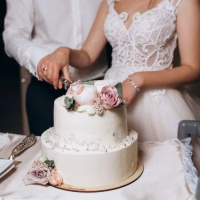
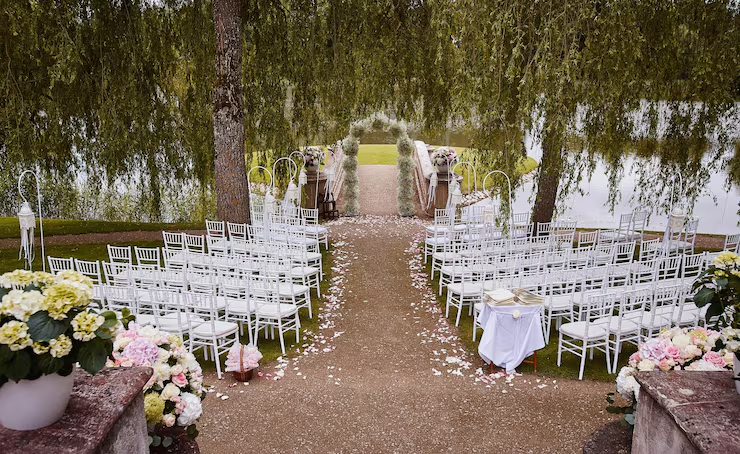
The row of chairs was white. Stark, blinding white against the lush, deep green of the vineyard.
I remember staring at them while the string quartet began playing Can’t Help Falling in Love. We had placed a small, tasteful sign on the end of the aisle reserved for the bride’s family. It was hand-painted on reclaimed wood, a detail I had spent three hours perfecting on a Sunday afternoon.
Family.
On my wedding day, that word felt less like a title and more like an accusation.
My name is Rachel. I am thirty-two years old, a marketing manager used to fixing disasters and spinning narratives. But standing there in my lace gown, clutching a bouquet of white peonies that were trembling because my hands wouldn’t stop shaking, I couldn’t spin this.
The chairs were empty. Completely, painfully empty.
No one from my side was there to walk me down the aisle. No one from my side was there to witness the vows.
Two hours earlier, while my makeup artist was applying the final touches of setting spray, my phone had lit up on the vanity. It was a text from my mother, Karen.
We will celebrate later, honey. Your brother’s Hawaii trip is already booked. Have a lovely day.
It was a neat little sentence. Grammatically correct. Punctuated with a heart emoji. It felt like a slap across the face that left my ears ringing.
It wasn’t a joke. It wasn’t a misunderstanding caused by a canceled flight or a medical emergency. My mother, my father Tom, and my younger brother Jake had simply made a choice. They had weighed my wedding against a discounted vacation package to Maui, and the scale had tipped in favor of sand and Mai Tais.
“Rachel?”
I snapped back to the present. Alex, my soon-to-be husband, was watching me from the altar. His eyes were wide, filled with a mixture of love and frantic worry. He saw me staring at the empty seats. He saw the way my chest was heaving, fighting back tears that would ruin the mascara I’d paid a fortune for.
I took a breath that shuddered through my ribcage. I looked at Aunt Linda—my mother’s estranged sister—who was sitting in the second row. She stood up, defying protocol, and gave me a fierce, watery nod. She was the only blood relative who had bothered to show up.
I started walking.
I walked past the empty chairs. I walked past the ghost of the family I thought I had. I walked toward Alex, whose family filled their side of the aisle to bursting—aunts, uncles, cousins, grandparents, all leaning in with smiles that said, We are here.
When the officiant asked, “Who gives this woman to be married?” the silence that followed was heavy enough to crush lungs.
It lasted for three agonizing seconds.
Then, Alex’s father, a man of few words but immense heart, stepped out from the groom’s side. He walked over, took my hand, and placed it in Alex’s. He didn’t say a word, but the squeeze of his rough palm said everything: You are not an orphan today.
I got through the vows. I got through the kiss. I even managed to smile for the photos, though I made sure the photographer angled the shots to hide the gaping hole in the audience.
But the real blow came during the reception.
I was sipping champagne, trying to let the adrenaline settle, when a venue staff member approached me with a thick ivory envelope.
“This arrived by courier this morning, ma’am,” he said.
It had my parents’ return address on it. My heart did a foolish, hopeful flip. Maybe it was a heartfelt letter. Maybe it was a profound apology.
I opened it. Inside was a check for five hundred dollars and a note on hotel stationery.
We hope you understand priorities when you are older. Enjoy the party. Love, Mom and Dad.
I stared at the paper. The ink was barely dry. They hadn’t even sent a card; they had scribbled on a notepad from the resort nightstand. Priorities.
“Rachel?” Alex whispered, touching my elbow. “Are you okay?”
I looked at him. I looked at the note. And then, I looked at my phone, where a notification had just popped up. It was an Instagram notification from Jake.
He had posted a video. He was shirtless on a beach, holding a tropical drink, with my parents waving in the background. The caption read: Vacation mode: ON. Sometimes you just gotta put yourself first. #FamilyTime #Reset.
I didn’t cry. The tears I had been holding back evaporated, replaced by a cold, hard clarity.
I handed the note to Alex.
“I’m fine,” I said, and for the first time that day, I meant it. “I’m finally done pretending.”
But as I stood there in my white dress, watching the sunset over the vineyard, I didn’t know that the universe has a funny way of balancing the scales. I didn’t know that in less than a year, the roles would be reversed, and the people sipping cocktails in Hawaii would be begging for the very thing they had just thrown away.
Chapter 2: The Golden Boy and the Scapegoat
To understand why my parents chose a beach over my wedding, you have to understand the dynamic of the house I grew up in.
I was the “easy” child. The one who did her homework, made her own dentist appointments, and never needed bailing out. I was the sturdy foundation the family walked on.
Jake was the golden boy. He was charismatic, chaotic, and perpetually in need of “support.”
When I got a promotion at my tech firm in Seattle, my mom said, “That’s nice, dear.” When Jake managed to hold down a sales job for three consecutive months, my parents threw a dinner party.
It started subtly with the wedding. Alex and I had booked the vineyard eighteen months in advance. We chose the date because it was the anniversary of the day we met—a rainy Saturday in a coffee shop where we talked until closing time.
At first, my mom, Karen, acted thrilled. She cried on FaceTime. She talked about flowers. She promised she wouldn’t miss her only daughter’s wedding for the world.
Then came the pivot.
Six months before the wedding, Mom called me. She used her “concerned mother” voice—soft, wheedling, dangerous.
“Rachel, honey,” she started. “I was looking at the calendar, and I realized your date conflicts with Jake’s annual trip.”
I frowned. “Jake’s trip? You mean his vacation?”
“It’s not just a vacation,” she said quickly, defensive. “It’s his reset. He’s been under so much pressure at work. He found this incredible non-refundable deal on flights to Maui. If he changes it, he loses everything.”
I waited for the punchline. “Okay… so he’ll have to pay a change fee. Or come a day late.”
“Well,” she sighed. “We were thinking… could you move the wedding?”
The air left the room. “Move the wedding? Mom, we have contracts. We have deposits. People have booked flights.”
“Just by a few weeks!” she pressed. “Jake really needs this, Rachel. You know how fragile he gets when he’s stressed. You’ve always been the flexible one. The strong one.”
The strong one. The code word for the one who sacrifices so Jake doesn’t have to.
“No,” I said. It was the first time I had ever drawn a hard line with her. “We are not moving our wedding for Jake’s discount plane ticket.”
The shift was immediate. She didn’t yell. She just got cold. She accused me of being rigid. She said I was being a “bridezilla” who cared more about a party than her brother’s mental health.
Jake texted me a few days later. Really, Rach? You’re gonna make Mom cry over a date? Just shift it. The world doesn’t revolve around you.
For months, the pressure campaign continued. Guilt trips. Vague Facebook posts about “ungrateful children.” My dad, Tom, stayed silent, cowardly nodding along with whatever Karen decided.
And then came the silence.
Three weeks before the wedding, the communication stopped. No RSVPs. No calls. Just the group text message sent on the morning of the ceremony.
We will celebrate later.
They thought I would fold. They thought I would beg. They thought I would do what Rachel always did: swallow the hurt, apologize for being difficult, and welcome them back with open arms whenever they decided to return from paradise.
They were wrong.
Chapter 3: The Honeymoon and the Blockade
For our honeymoon, Alex and I went to the Caribbean. I turned my phone off for three days. When I finally turned it back on, the family group chat—which I hadn’t left yet—was a dumpster fire.
My mom had posted a long, dramatic status update. She didn’t use my name, but she didn’t have to.
It breaks a mother’s heart when her children refuse to compromise. We are enjoying paradise, trying to heal from the negativity. Family is about sacrifice, and it’s a shame some people only care about themselves.
Below it, Jake had commented: Facts. Toxic expectations are real.
I felt a surge of nausea. They were rewriting reality in real-time. In their version of the story, I was the villain for having a wedding on a day that inconvenienced them. I was the one who had driven them away.
Alex took the phone from my hand. He read the messages, his jaw tightening.
“Do not reply,” he said firmly. “That is what they want. They want you to engage so they can call you crazy. Silence is the only thing they can’t spin.”
So, I didn’t reply.
I posted one photo from our honeymoon. Just me and Alex, laughing in the surf. No caption about family. No passive-aggressive hashtags. Just joy.
And then, I quietly blocked my mother, my father, and my brother on all social media. I archived the group chat.
I chose peace.
I thought that was the end of it. I thought we would just drift apart, two separate islands in a vast ocean of resentment.
But six months later, an envelope arrived in the mail. It was heavy, cream-colored, and embossed with gold leaf.
It was a wedding invitation.
Jake and Sophia. A destination wedding in Florida. A three-day extravaganza at a luxury resort.
At the bottom of the card, in my mother’s unmistakable handwriting, was a note:
It would mean the world to the family if you and Alex could be there. Let’s put the past behind us. Xoxo, Mom.
I stared at the invitation, and for the first time in months, I laughed. It was a dark, incredulous sound.
They didn’t want me there. They wanted the appearance of a united family. They wanted a gift. They wanted the validation that they were good people.
My phone rang. It was Mom.
I looked at Alex. He nodded. “Answer it. Let’s hear the pitch.”
I swiped green.
“Rachel!” Her voice was breathless, manic with forced cheer. “Did you get the invite? Isn’t it exciting? Sophia is just wonderful. We’re going all out. It’s going to be the event of the year.”
“Hi, Mom,” I said, my voice flat.
“Listen, I know things have been… tense. But this is Jake’s big day. I was hoping we could put all that negativity behind us. You know how important family is.”
“Family,” I repeated slowly. “The thing that was so important you skipped my wedding for a beach vacation.”
The line went quiet for a beat. Then she laughed, a tinkling, dismissive sound. “Oh, honey. You’re still upset about that? We sent you money. We explained our situation. Jake really needed that trip.”
“And I really needed my mother at my wedding.”
“Rachel, don’t be dramatic. You got married. It was lovely, I’m sure. But Jake’s wedding is different. It’s at a resort. There are expectations. His future in-laws will be there. We need to present a united front.”
I closed my eyes. The audacity was breathtaking.
“So you need me there to look good.”
“I need you there because you’re my daughter,” she said, her voice hardening. “And because families show up for each other. Unlike some people.”
The jab was intentional. She was trying to make me the villain again.
“I showed up for my wedding, Mom. You didn’t.”
“We’ve been over this,” she snapped. “Are you coming to Jake’s wedding or not? I need a headcount.”
I looked at Alex. He was watching me with those steady, patient eyes that said, Whatever you decide, I’m with you.
“No,” I said. “I’m not coming.”
The silence on the other end was volcanic.
“Excuse me?”
“I said no. I have plans that weekend.”
“Plans?” she sputtered. “What plans could possibly be more important than your brother’s wedding?”
“A vacation,” I said sweetly. “A non-refundable trip. You understand priorities, right?”
I could hear her breathing, ragged and furious.
“You are being incredibly selfish, Rachel. After everything we’ve done for you.”
“What have you done for me, Mom? Specifically.”
“We raised you! We gave you a home!”
“That’s called basic parenting. It’s not a favor.”
“How dare you—”
“I have to go,” I interrupted. “Give my best to Jake. I hope his wedding is everything mine wasn’t.”
I hung up.
Alex let out a low whistle. “That was brutal.”
“It felt good,” I admitted.
Within an hour, the text messages started.
From Jake: Wow. Really showing your true colors. Mom is in tears.
From Dad: This is beneath you, Rachel. Be the bigger person.
From Mom: I will never forgive you for this.
I blocked all three numbers. I didn’t need their forgiveness. I needed my dignity.
Chapter 4: The Fallout
The wedding happened without me. I saw the photos later—Aunt Linda sent them with a bitter commentary.
Your brother looked miserable. Your mother spent the whole reception complaining about your absence. Sophia’s family thought it was weird. Thought you should know.
I didn’t feel vindicated. I felt sad. Sad that this was what we had become.
But three months after Jake’s wedding, everything changed.
I got a call from Aunt Linda. Her voice was tight, urgent.
“Rachel, you need to sit down.”
“What’s wrong?”
“It’s your dad. He had a massive heart attack. He’s in the ICU.”
The world tilted. I gripped the edge of the kitchen counter.
“Is he… is he going to be okay?”
“They don’t know yet. It’s bad, Rachel. Your mom is asking for you.”
I drove to the hospital in a fog. Alex came with me, his hand steady on my knee as I navigated the highway.
When I walked into the ICU waiting room, my mother looked up. She was smaller than I remembered, her face gray and hollow. Jake sat beside her, staring at his phone.
“Rachel,” Mom whispered. She stood up, arms outstretched.
I didn’t move into the embrace. I stood there, frozen.
“How is he?”
“Critical. They’re running tests. He might need surgery.”
I nodded. “Can I see him?”
“Not yet. Only immediate family.”
I let that sit for a moment. Immediate family. The same phrase that had excluded me from my own wedding in their minds.
I sat down across from them. The silence was suffocating.
After an hour, a doctor emerged. Dad had stabilized, but he needed a triple bypass. The surgery was risky.
Mom broke down, sobbing into Jake’s shoulder. He looked uncomfortable, patting her back mechanically.
“Rachel,” Mom said, looking up at me with red-rimmed eyes. “I need you. I can’t do this alone.”
I wanted to feel compassion. I wanted to be the bigger person.
But all I felt was tired.
“You’re not alone, Mom. Jake is here.”
“Jake has to work. He has responsibilities.”
I laughed, a bitter sound. “And I don’t?”
“You know what I mean.”
“I really don’t.”
The doctor came back with consent forms. Mom’s hands were shaking too badly to sign. She looked at me.
“Rachel, please.”
I took the pen. I signed as the emergency contact because someone had to.
But I didn’t stay.
Chapter 5: The Reckoning
Dad survived the surgery. Over the next two weeks, he slowly recovered in the cardiac unit.
Mom called me every day. She needed rides. She needed someone to sit with Dad while she showered. She needed meals brought to the hospital.
Jake was conspicuously absent. He had “work commitments.” He sent a fruit basket.
I helped because I’m not cruel. But I didn’t pretend we were fixed.
On the day Dad was discharged, Mom cornered me in the hospital parking lot.
“Thank you,” she said. “For being here. For helping.”
I nodded.
“I know we’ve had our… differences. But family is family, right?”
I looked at her. Really looked at her. She was aging, graying at the temples, lines deepening around her mouth.
“Mom, do you remember my wedding?”
She blinked. “Of course.”
“Do you remember where you were?”
Her face hardened. “Rachel, don’t start.”
“You were in Hawaii. You chose a vacation over watching me get married.”
“We explained that—”
“You explained nothing,” I said. “You made a choice. You chose Jake’s discount flight over me. And then you tried to make me the villain for not moving my entire wedding to accommodate him.”
“That’s not fair.”
“It’s exactly fair. And now you want me to pretend it never happened because you need me.”
She looked away, jaw tight.
“I helped you, Mom. I signed the forms. I brought you food. I did it because Dad didn’t deserve to suffer. But don’t mistake my compassion for forgiveness.”
“What do you want from me, Rachel? An apology?”
“I want you to understand what you did. I want you to acknowledge that you hurt me.”
She crossed her arms. “You’re being childish.”
“I’m being honest.”
“Family forgives, Rachel.”
“Family shows up,” I countered. “And you didn’t.”
I turned and walked away. She called after me, but I didn’t stop.
Chapter 6: The Empty Chairs
A year later, I got pregnant.
When I told Alex, he cried. We had been trying for months, and the positive test felt like a small miracle.
I didn’t tell my parents right away. I told Aunt Linda. I told Alex’s family. I let the news settle into my bones before sharing it with people who had proven they couldn’t be trusted with my joy.
But eventually, I called my mom.
“That’s wonderful, honey,” she said, her voice cautious. “When are you due?”
“March.”
“We’ll throw you a shower. A big one. I’ll invite everyone.”
I closed my eyes. “I don’t want a shower.”
“Don’t be silly. Every new mother needs a shower.”
“I don’t want one from you.”
The silence was sharp.
“Rachel—”
“You weren’t there for my wedding, Mom. You don’t get to be there for this.”
“That’s cruel.”
“It’s honest.”
She hung up.
When my daughter was born, I sent a photo to the family group chat I had un-archived for the occasion.
Emma Grace. 7 lbs, 3 oz. Healthy and perfect.
The responses came quickly.
Mom: She’s beautiful. When can we visit?
Jake: Congrats sis.
I didn’t respond.
A week later, they showed up at my house unannounced. Mom was carrying a giant teddy bear. Dad looked uncomfortable. Jake was scrolling on his phone.
I answered the door but didn’t open it wide.
“We came to meet our granddaughter,” Mom said, smiling that forced, brittle smile.
“You should have called first.”
“We’re family, Rachel. We don’t need an appointment.”
I looked at them—these people who had taught me that love was conditional, that my worth was measured in convenience.
“You’re right,” I said. “You don’t need an appointment. You need an invitation. And you don’t have one.”
“Rachel, please,” Dad said. “Let us meet her.”
“You didn’t meet me at the altar on my wedding day. You don’t get to meet her now.”
Mom’s face crumpled. “You can’t keep our granddaughter from us.”
“I’m not keeping her from you. I’m protecting her from people who have shown me exactly who they are.”
I closed the door.
They stood on the porch for five minutes, knocking, pleading. Then they left.
Epilogue: The Full Row
Emma is three now. She’s bright, curious, and surrounded by people who would move mountains for her.
Alex’s parents are Grammy and Pop-Pop. Aunt Linda is Nana Linda. Our chosen family fills every holiday, every birthday, every milestone with presence and love.
My parents send cards on Emma’s birthday. I don’t open them.
Jake got divorced last year. I heard through Aunt Linda that he’s struggling. That he’s finally realizing that being the golden child doesn’t guarantee a golden life.
Sometimes I think about forgiveness. I think about what it would mean to let them back in.
But then I remember the empty row of white chairs.
I remember standing at the altar, surrounded by absence, learning the hardest lesson of my life: that I was enough, even when they made me feel like I wasn’t.
Forgiveness isn’t reconciliation. I can forgive them for being broken, flawed people. But I don’t have to give them access to my life.
Last month, we had Emma’s birthday party at the same vineyard where Alex and I got married. The chairs weren’t divided by bride and groom. They were just filled with people who loved us.
As I looked out at the crowd—laughing, eating cake, celebrating my daughter—I realized something.
The empty row wasn’t a loss. It was a boundary. It was the space I needed to build something better.
And on the other side of that boundary, I built a family that shows up.